
Japan Commercial HVAC Market Size and Share
| Study Period | 2020 - 2030 |
| Forecast Data Period | 2025 - 2030 |
| Historical Data Period | 2020 - 2023 |
| Market Size (2025) | USD 3.45 Billion |
| Market Size (2030) | USD 4.88 Billion |
| CAGR (2025 - 2030) | 7.16% |
| Market Concentration | Low |
Major Players *Disclaimer: Major Players sorted in no particular order |
Japan Commercial HVAC Market Analysis by Mordor Intelligence
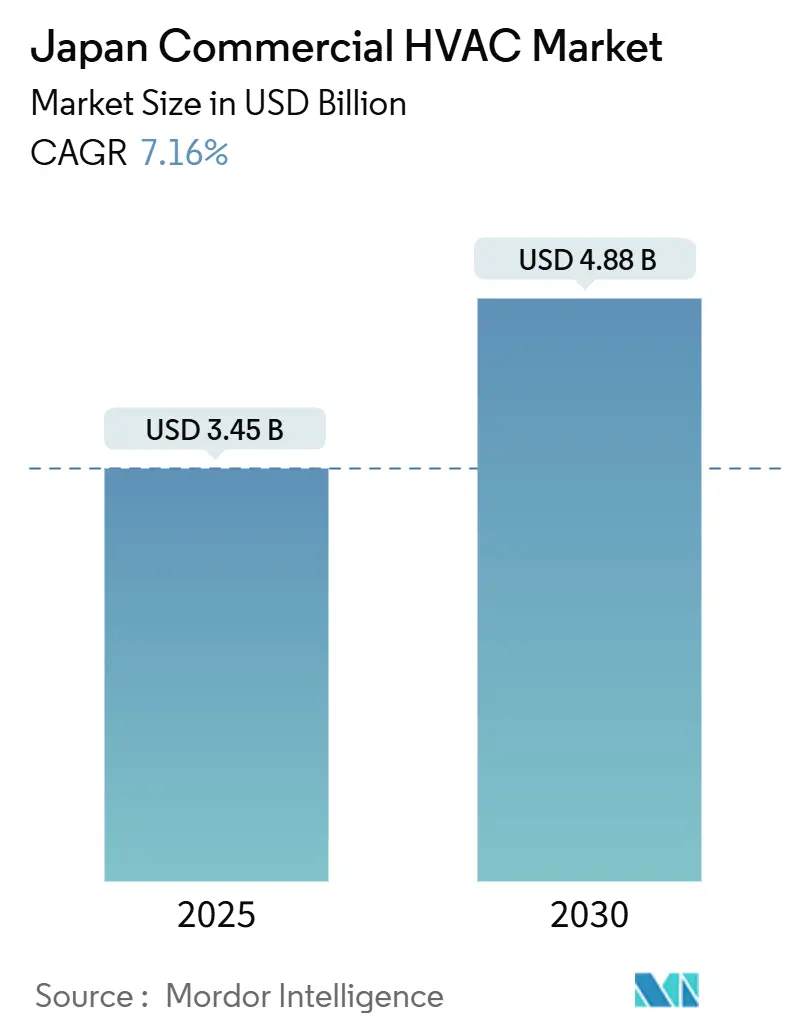
The Japan Commercial HVAC Market size is estimated at USD 3.45 billion in 2025, and is expected to reach USD 4.88 billion by 2030, at a CAGR of 7.16% during the forecast period (2025-2030).
- HVAC systems are necessary for creating comfortable indoor environments in commercial buildings. In office spaces, they regulate temperatures, provide ventilation, and boost employee productivity and well-being. Furthermore, they assist in reducing health risks related to poor humidity control.
- Increasing levels of pollution in Japan have led the country to focus on eco-friendly buildings, presenting various investment prospects for industry players aiming to grow their footprint in the Japanese market.
- According to the International Energy Agency (IEA), Japan has updated its building standards, mandating that all new buildings achieve zero-energy performance by 2030 and existing structures meet this criterion by 2050. These standards, aimed at enhancing energy efficiency in buildings, are projected to stimulate market demand.
- Moreover, the increasing number of data centers, warehouses, shopping centers, educational institutions, and other facilities in developing nations is fueling the demand for commercial HVAC systems. The country is experiencing a surge in investments in the construction of data centers. For instance, in April 2024, ST Telemedia Global Data Centres (STT GDC) revealed plans to begin construction on its second data center facility in Tokyo, STT Tokyo 2, in response to the growing need for critical digital infrastructure in the country. The data center campus is expected to offer a maximum of 70 MW of IT capacity, and the STT Tokyo 2 project is expected to generate up to 38 MW upon completion.
- Energy-efficient HVAC systems are increasingly attractive in the country because of the escalating energy costs, providing potential savings. Nevertheless, the substantial upfront expenses linked to installation could hinder widespread acceptance and market expansion.
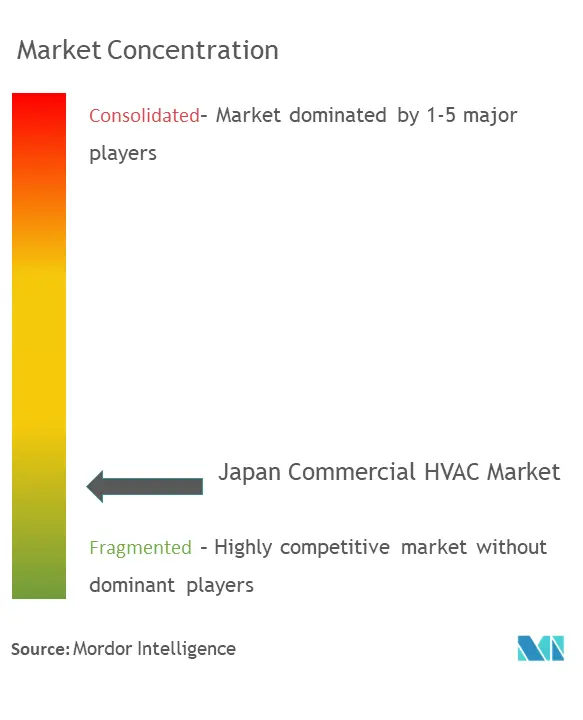
- The commercial HVAC market in Japan is fragmented, with a large number of players occupying a small market share. Key market players operating in the commercial HVAC market are focusing on new product development, strategic partnerships, acquisition, and expansion to meet the growing demand from customers, further supporting market growth.
- For instance, in August 2023, Daikin Industries, Ltd announced plans to acquire land in Tsukubamirai City, Ibaraki Prefecture, Japan, with the intention of establishing a new manufacturing plant dedicated to air conditioners. This calculated decision is set to bolster the company's domestic production capacity and further its objective of strengthening its position within the Japanese market.
- Furthermore, the rising expansion of public buildings in the country will support market growth. For instance, in June 2024, Citi revealed the introduction of Citi Commercial Bank (CCB) in Japan. This initiative is a crucial component of Citi's plan to establish CCB in strategic growth markets within targeted clusters to facilitate significant expansion.
- Additionally, the commercial HVAC industry in Japan is significantly influenced by macroeconomic elements like governmental regulations and fresh endeavors aimed at promoting the use of energy-efficient equipment. For instance, Japan has set a target to reduce its greenhouse gas (GHG) emissions by 46% by 2030, with a further ambition to achieve a 50% reduction.
Figures recorded within Japan feed into a worldwide estimate while studying the global industry. Mordor Intelligence's commercial hvac market size captures this aggregation.
Japan Commercial HVAC Market Trends and Insights
HVAC Equipment Holds the Significant Market Share
- The single split system is the preferred HVAC system for small commercial buildings. It is cost-effective and allows for precise control over the temperature in each room.
- VRF systems in commercial space efficiently circulate the precise amount of refrigerant required for heating or cooling purposes. These advanced air conditioning systems enable businesses to manage multiple air conditioning zones within their premises simultaneously.
- Moreover, Air Handling Units (AHUs) collect air from the external environment and indoor air, filter out contaminants, and regulate the temperature and humidity in the commercial building. The treated air is then circulated back into the atmosphere. Because of their design and operation, AHUs are more efficient than traditional retail air conditioning units. They can potentially lower costs and decrease energy usage within commercial establishments.
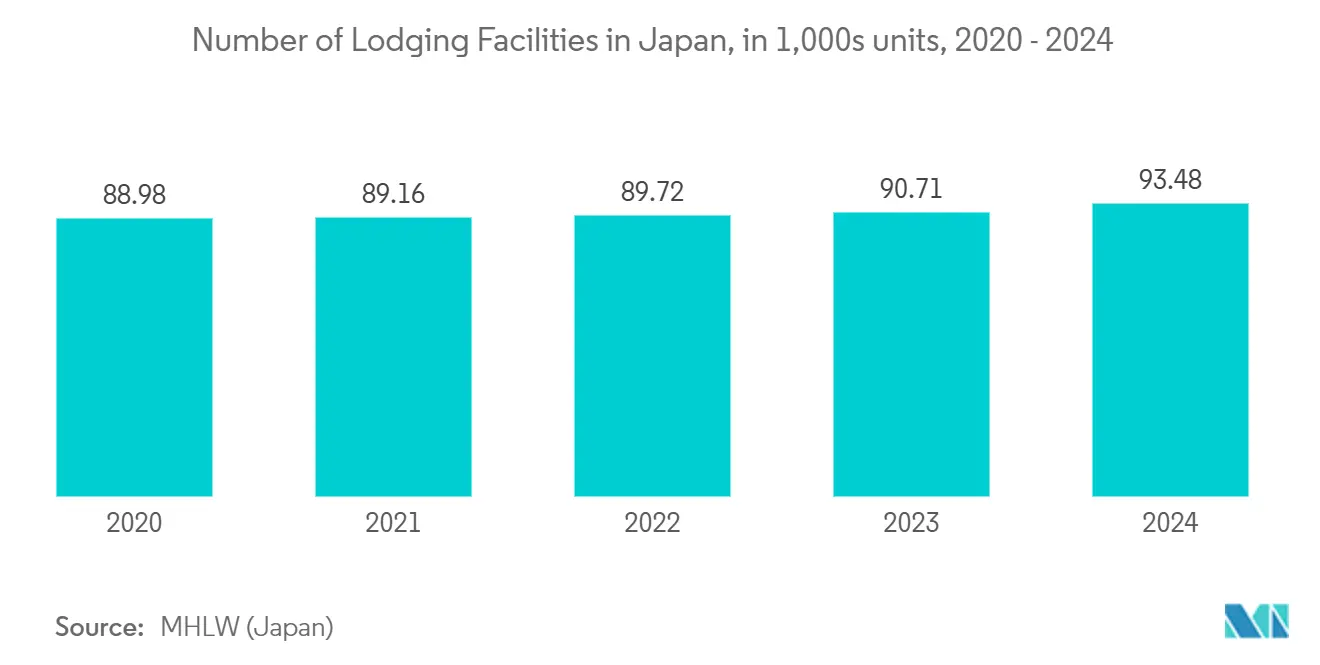
- The rising expansion of the hospitality sector in Japan due to growing tourism will propel the demand for commercial HVAC systems in the country. In Japan, travelers can choose from various holiday accommodations, including city hotels, business hotels, resorts, ryokan, and group lodgings. According to the Ministry of Health, Labour and Welfare of Japan, as of the end of March 2023, Japan had seen a surge in the number of registered hotels and inns, totaling around 90,700 establishments, which was a significant increase compared to the previous year.
- Despite Japan's rapid growth in inbound tourism, the market prioritizes domestic travel activities. Although the number of lodging guests has continuously increased in recent years, foreign nationals account for only one-fifth of overnight guests.


Commercial Building Segment Holds the Significant Market Share
- The commercial building segment compromises infrastructures, such as office buildings, retail, showrooms, and warehouses, among others. Heating and cooling systems are essential to any commercial building, as they provide occupants with a comfortable environment.
- Commercial HVAC systems are intricate, including elements for heating, ventilation, and air conditioning. They are tailored to meet large buildings' particular requirements to guarantee excellent indoor air quality, energy efficiency, and occupant satisfaction.
- Commercial HVAC systems effectively regulate indoor temperature, control humidity levels, and maintain air quality by coordinating the functions of three key systems. Air conditioning units cool indoor spaces by utilizing refrigerants, which also help in dehumidifying the air. Heating systems raise indoor temperatures using water, radiator coils, or gas. Ventilation systems clean the air with filtration systems and ensure proper air circulation with fans.
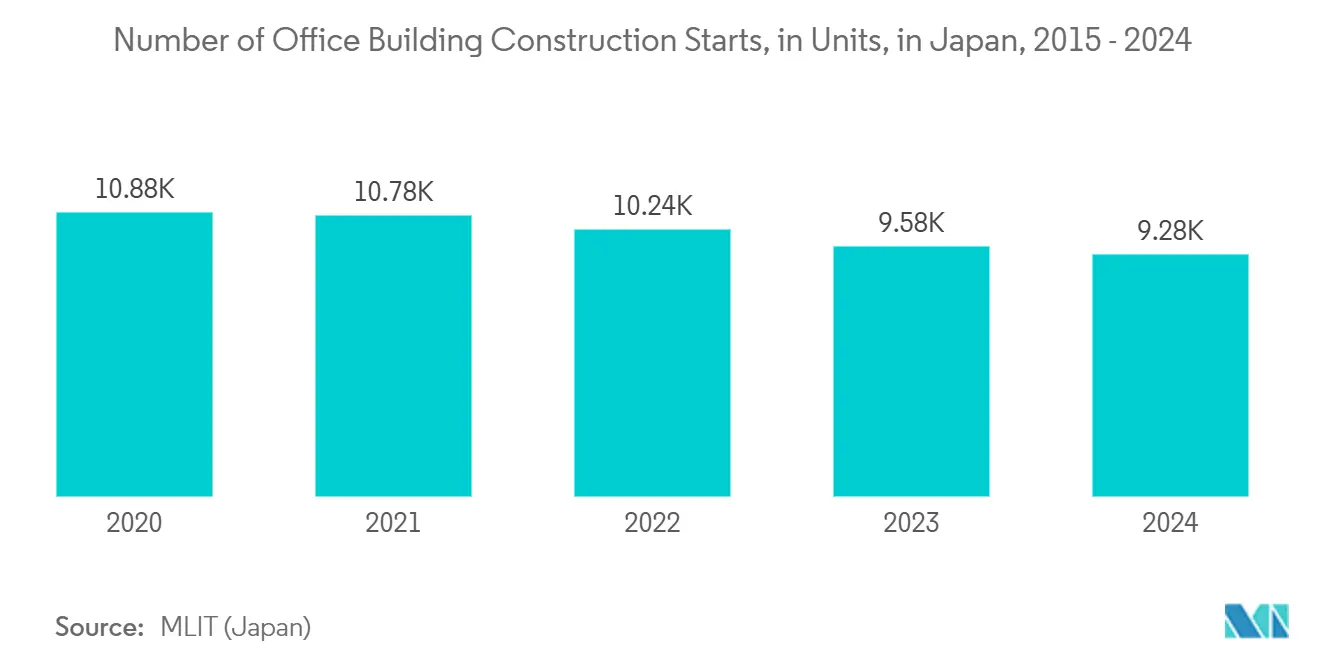
- The rising expansion of office space in the country will drive the demand for HVAC services and equipment during the projected timeline. According to the Ministry of Land, Infrastructure, Transport, and Tourism, approximately 9,580 office construction projects commenced in Japan in 2023. The floor area of these office constructions remained consistent with the previous year.
- Moreover, leading retail players are expanding their presence in the country, thus creating high demand for commercial HVAC systems and services. An efficient HVAC system offers a significant benefit by enhancing the air quality in the retail space. This involves removing pollutants, allergens, and unpleasant odors, ultimately improving the shopping experience and ensuring the well-being of both customers and employees.
- In January 2024, IKEA revealed plans to open a new store in the northern Kanto region of Japan. This store has been strategically located to serve the needs of the local communities, encompassing an area with a population of more than seven million individuals. Demonstrating IKEA's dedication to sustainability, IKEA Maebashi is set to become Japan's most environmentally friendly IKEA store, boasting the smallest operational climate impact.

Mordor Intelligence evaluates the commercial hvac market across all key regional markets, including Europe, North America, and Middle East and Africa, with deeper country-level insights covering China, South Korea, Italy, Canada, Germany, and United Kingdom.
Competitive Landscape
The Japanese commercial HVAC market is fragmented and consists of several players. Companies in the market continuously try to increase their market presence by introducing new products, expanding their operations, or entering into strategic mergers and acquisitions, partnerships, and collaborations. Some of the major players include Carrier Corporation, Daikin Industries Ltd, Mitsubishi Electric Corporation, Hitachi Ltd, Panasonic Corporation, and many more.
- In May 2024, Midea has introduced the EVOX G3 heat pump system. This new iteration of the EVOX series consists of the EVOX G3 Heat Pump and EVOX G3 Air Handling Unit (AHU). Available in sizes ranging from 1.5-ton to 5-ton units, the Midea EVOX G3 heat pumps are equipped with Enhanced Vapor Injection (EVI) technology and a multi-layer heat exchanger, guaranteeing reliable warmth without the need for auxiliary heat, even in extreme weather conditions.
- In March 2024, Panasonic Corporation unveiled three new commercial air-to-water (A2W) heat pump models that utilize eco-friendly natural refrigerants designed for use in multi-dwelling units, stores, offices, and other light commercial properties.
Japan Commercial HVAC Industry Leaders
Carrier Corporation
Daikin Industries, Ltd.
Mitsubishi Electric Corporation
Hitachi Ltd.
Panasonic Corporation
- *Disclaimer: Major Players sorted in no particular order

Recent Industry Developments
- February 2024: Voltas unveiled a new range of commercial air conditioning units designed for business environments. These new Scroll Inverter Chillers offer a cooling capacity ranging from 12 to 72 TR and utilize eco-friendly refrigerants. Equipped with Internet of Things technology, these chillers are BMS-compatible, operate silently, and can be conveniently controlled through a mobile application.
- January 2024: Daikin announced the launch of variable refrigerant volume (VRV) 7 series variable refrigerant flow (VRF) systems that realize the industry's top-level energy-saving performance by strengthening seven features required by air conditioning equipment. For example, adopting low-global warming potential (GWP) refrigerant R32 is excellent in environmental adaptability and energy savings and in improving the basic performance, and it also contributes to reducing the environmental burden and the workload.


Japan Commercial HVAC Market Report Scope
Heating, ventilation, and air conditioning (HVAC) is a technology that ensures indoor and vehicular comfort by regulating thermal conditions and maintaining acceptable indoor air quality.
The study tracks the revenue accrued through the sale of commercial HVAC equipment and services by various players in the Japanese market. The study also tracks the key market parameters, underlying growth influencers, and major vendors operating in the industry, which supports the market estimations and growth rates during the forecast period. The study further analyses the overall impact of COVID-19 and other macroeconomic factors on the market. The report’s scope encompasses market sizing and forecasts for the various market segments.
The Japanese commercial HVAC market is segmented by type of component (HVAC equipment [heating equipment, air conditioning/ventilation equipment, and HVAC services) and end-user industry (hospitality, commercial building, public building, and other end-user industries). The market sizes and forecasts are provided in terms of value (USD) for all the above segments.
| HVAC Equipment | Heating Equipment |
| Air Conditioning /Ventillation Equipment | |
| HVAC Services |
| Hospitality |
| Commercial Buildings |
| Public Buildings |
| Others |
| By Type of Component | HVAC Equipment | Heating Equipment |
| Air Conditioning /Ventillation Equipment | ||
| HVAC Services | ||
| By End-User Industry | Hospitality | |
| Commercial Buildings | ||
| Public Buildings | ||
| Others |


Key Questions Answered in the Report
How big is the Japan Commercial HVAC Market?
The Japan Commercial HVAC Market size is expected to reach USD 3.45 billion in 2025 and grow at a CAGR of 7.16% to reach USD 4.88 billion by 2030.
What is the current Japan Commercial HVAC Market size?
In 2025, the Japan Commercial HVAC Market size is expected to reach USD 3.45 billion.
Who are the key players in Japan Commercial HVAC Market?
Carrier Corporation, Daikin Industries, Ltd., Mitsubishi Electric Corporation, Hitachi Ltd. and Panasonic Corporation are the major companies operating in the Japan Commercial HVAC Market.
What years does this Japan Commercial HVAC Market cover, and what was the market size in 2024?
In 2024, the Japan Commercial HVAC Market size was estimated at USD 3.20 billion. The report covers the Japan Commercial HVAC Market historical market size for years: 2020, 2021, 2022, 2023 and 2024. The report also forecasts the Japan Commercial HVAC Market size for years: 2025, 2026, 2027, 2028, 2029 and 2030.
Page last updated on:
Japan Commercial HVAC Market Report
Statistics for the 2025 Japan Commercial HVAC market share, size and revenue growth rate, created by Mordor Intelligence™ Industry Reports. Japan Commercial HVAC analysis includes a market forecast outlook for 2025 to 2030 and historical overview. Get a sample of this industry analysis as a free report PDF download.





