
Ireland Data Center Construction Market Size and Share
Market Overview
| Study Period | 2020 - 2031 |
|---|---|
| Forecast Data Period | 2026 - 2031 |
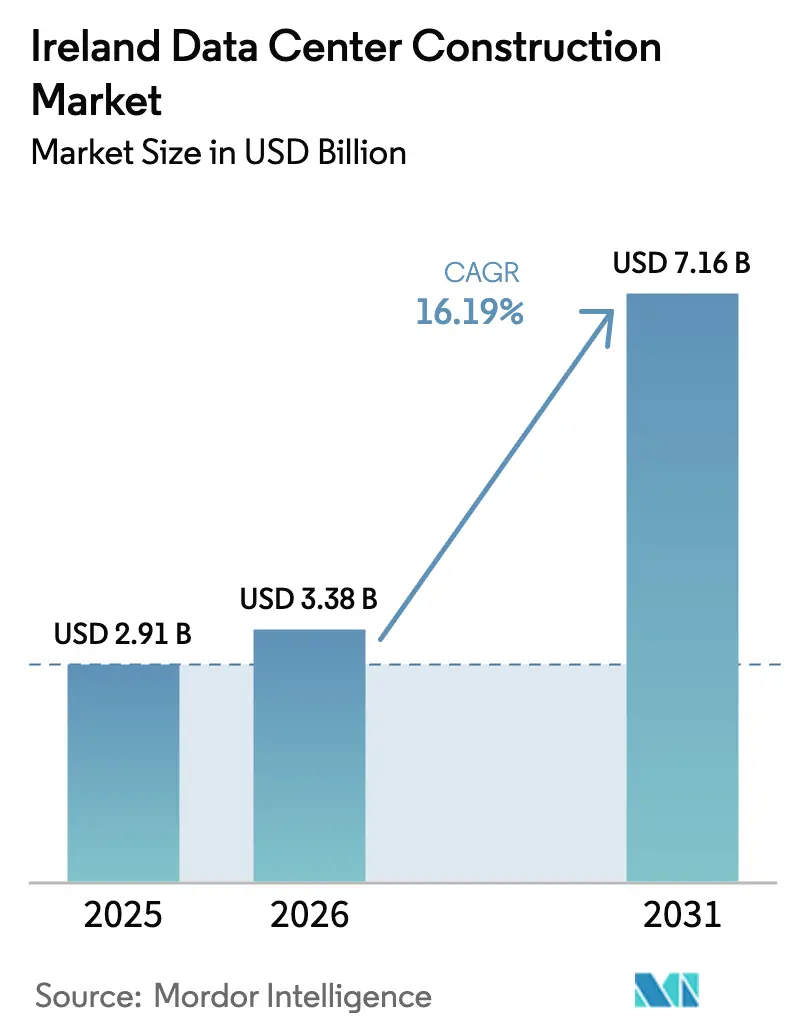
| Base Year Market Size (2025) | USD 2.91 Billion |
| Market Size (2026) | USD 3.38 Billion |
| Market Size (2031) | USD 7.16 Billion |
| Growth Rate (2026 - 2031) | 16.19 % |
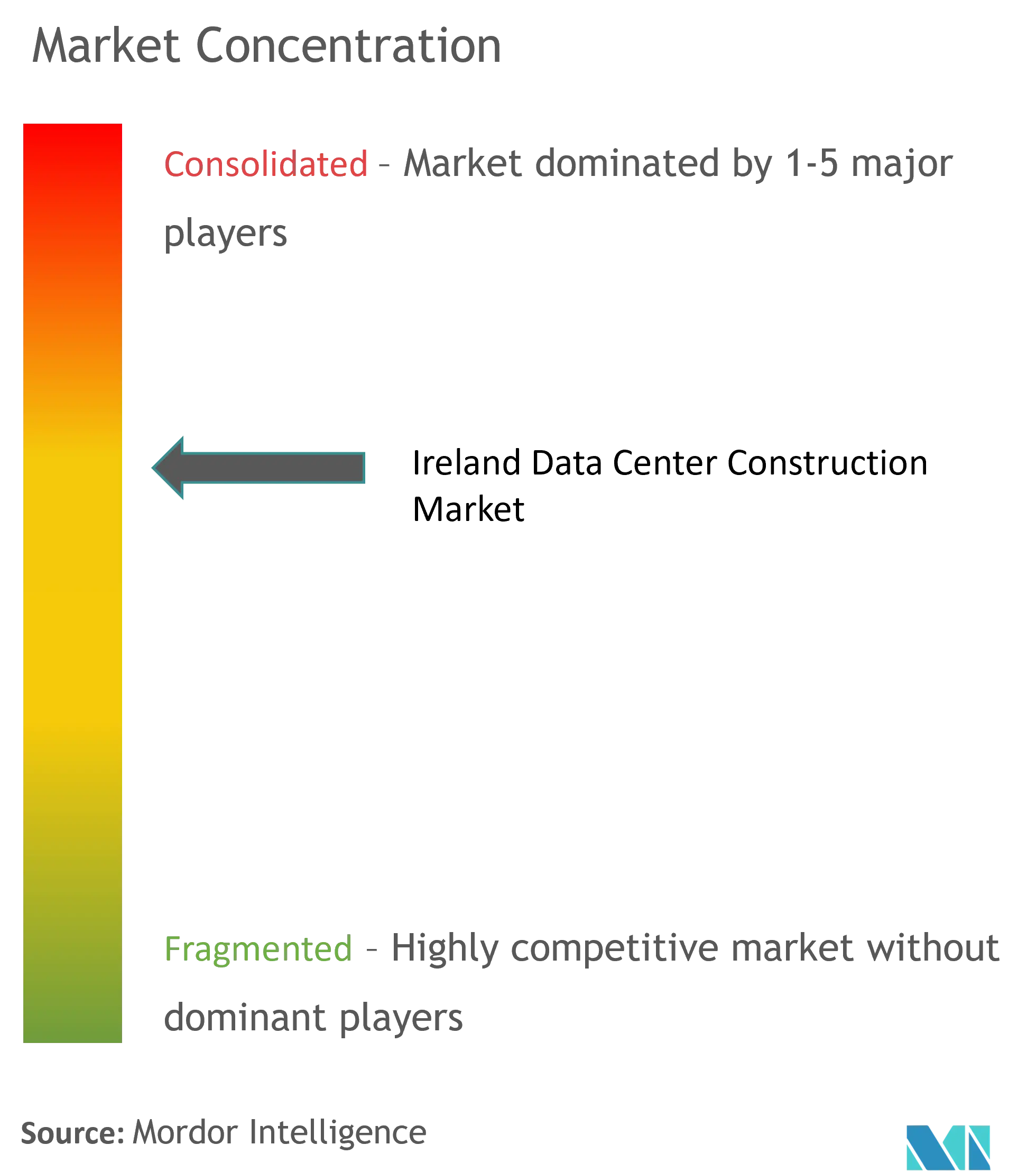
| Market Concentration | Medium |
Major Players *Disclaimer: Major Players sorted in no particular order Image © Mordor Intelligence. Reuse requires attribution under CC BY 4.0. | |
Ireland Data Center Construction Market Analysis by Mordor Intelligence
The Ireland data center construction market size in 2026 is estimated at USD 3.38 billion, growing from 2025 value of USD 2.91 billion with 2031 projections showing USD 7.16 billion, growing at 16.19% CAGR over 2026-2031. This growth reflects Ireland’s role as a digital infrastructure hub, where hyperscale cloud operators and artificial-intelligence workloads drive demand for power-dense facilities, liquid cooling systems, and integrated on-site generation. Regulatory tension remains pronounced because data centers consumed 22% of Ireland’s electricity in 2024, intensifying the debate over grid capacity, renewable integration, and carbon targets. Developers are responding with modular builds, prefabricated electrical skids, and district-heating interfaces to secure planning approval while meeting aggressive delivery schedules. Consolidation among specialty contractors accelerates technical know-how, as seen in Turner Construction’s EUR 700 million acquisition of Dornan Engineering Group, which created the country’s largest mission-critical builder. Together, these forces sustain a market where advanced engineering capabilities, resilient power design, and sustainability credentials underpin competitive advantage.
Key Report Takeaways
- By tier type, Tier 3 facilities held 54.70% of Ireland's data center construction market share in 2025, while Tier 4 is projected to expand at a 16.38% CAGR to 2031.
- By data center type, colocation led with 58.40% revenue share in 2025; self-build hyperscaler deployments are forecast to grow at an 17.85% CAGR through 2031.
- By electrical infrastructure, power-distribution systems accounted for 51.80% share of the Ireland data center construction market size in 2025 and are advancing at a 16.18% CAGR to 2031.
- By mechanical infrastructure, cooling systems commanded a 46.60% share of the Ireland data center construction market size in 2025, whereas servers and storage components record the highest CAGR at 16.88% through 2031.
Note: Market size and forecast figures in this report are generated using Mordor Intelligence’s proprietary estimation framework, updated with the latest available data and insights as of 2026.
Ireland Data Center Construction Market Trends and Insights
Drivers Impact Analysis*
| Driver | (~)% Impact on CAGR Forecast | Geographic Relevance | Impact Timeline |
|---|---|---|---|
| Hyperscale cloud and AI workload investment boom | +4.2% | National, concentrated in Dublin and Cork | Medium term (2-4 years) |
| Government digital-economy initiatives and tax incentives | +2.8% | National, with regional development focus | Long term (≥ 4 years) |
| 5G-enabled edge demand and new trans-Atlantic subsea cables | +3.1% | National, with Galway connectivity hub | Medium term (2-4 years) |
| Surplus-heat reuse mandates opening district-heating revenue | +1.9% | Dublin metropolitan area | Long term (≥ 4 years) |
| Green-bond financing momentum for sustainable facilities | +2.3% | National, emphasis on renewable energy regions | Medium term (2-4 years) |
| Modular prefab builds mitigating skilled-labour shortages | +1.5% | National, rural development priority | Short term (≤ 2 years) |
| Source: Mordor Intelligence | |||
Hyperscale Cloud and AI Workload Investment Boom
Hyperscale and AI projects reshape specifications as rack power rises to 90-130 kW for model training, compelling liquid-cooling adoption, and 300 MW campus designs. Microsoft’s USD 500 million Grange Castle build shows how on-site generation circumvents Dublin’s grid moratorium and secures predictable energy. Investor appetite remains strong; Vantage Data Centers raised EUR 720 million via Europe’s first data-center securitization to fund Dublin capacity that relies on hydrotreated-vegetable-oil generators. These investments cascade across the Ireland data center construction market as contractors compete for GPU-ready cooling packages, high-frequency switchgear and resilient distribution paths. Supply-chain strain intensifies demand for prefabricated modules that shorten on-site schedules and guarantee component availability.
Government Digital-Economy Initiatives and Tax Incentives
Ireland’s enterprise policy highlights a EUR 7 billion (USD 8.06 billion) economic contribution from data centers since 2010 and prioritizes them as strategic assets.[1]Department of Enterprise, “Ireland’s Digital-Economy Strategy 2025,” enterprise.gov.ieThe Planning & Development Bill 2023 accelerates approvals for large sites while enforcing sustainability screening, pushing builders to integrate renewable sourcing and heat-recovery loops from day one. IDA Ireland’s grants steer construction toward regional towns such as Galway, where fast-track permitting and land support reduce soft costs idaireland.com. Tax relief for green-capex plus accelerated depreciation trims project budgets by 8-12%, improving return profiles for Tier 4 builds. Collectively, fiscal incentives preserve Ireland data center construction market momentum despite power-capacity headwinds.
5G-Enabled Edge Demand and New Trans-Atlantic Subsea Cables
The EUR 1.1 billion (USD 1.27 billion) Far North Fiber, a 15,000 km cable landing in Galway, positions Ireland as a trans-Pacific gateway.[2]Marine Institute, “Far North Fiber to Land in Galway,” marine.ie Low-latency applications linked to 5G require edge nodes within 20 km of users, prompting 1-5 MW modular sites across Cork, Limerick, and Waterford. Prefabricated steel frames, containerized chillers, and standardized bus ducts support 12-18 month delivery cycles—half that of conventional hyperscale campuses. Sub-marine landing stations introduce strict environmental criteria, so contractors with coastal engineering expertise secure premium margins. Edge proliferation diversifies the Ireland data center construction market while easing pressure on Dublin’s grid.
Surplus-Heat Reuse Mandates and District-Heating Revenue
Dublin’s heat-reuse rules create secondary revenue as Amazon’s Tallaght facility delivers 3 MW of thermal output, lowering emissions by 1,500 t annually.[3]Werner Vogels, “AWS Heat Reuse in Tallaght,” allthingsdistributed.comConstruction now embeds plate-exchangers, insulated pipework and metering for third-party heat offtake, adding 3-5% to capex yet boosting lifecycle returns 12-15%. Equinix’s Blanchardstown site proves scalability, integrating recovery systems during fit-out to avoid costly retrofits. Contractors skilled in thermal hydraulics gain bid advantages as heat-reuse shifts from optional to required for permits, reinforcing sustainability credentials across the Ireland data center construction market.
Restraints Impact Analysis*
| Restraint | (~)% Impact on CAGR Forecast | Geographic Relevance | Impact Timeline |
|---|---|---|---|
| Grid-connection moratorium & Dublin power-capacity shortfall | -3.8% | Dublin metropolitan area | Short term (≤ 2 years) |
| Escalating electricity costs & carbon-pricing exposure | -2.1% | National, higher impact in urban areas | Medium term (2-4 years) |
| Long-lead HV switchgear & transformer supply bottlenecks | -2.9% | National, affecting all major projects | Short term (≤ 2 years) |
| Local opposition over groundwater & cooling-water abstraction | -1.4% | Regional, particularly rural developments | Long term (≥ 4 years) |
| Source: Mordor Intelligence | |||
Grid-Connection Moratorium and Dublin Capacity Shortfall
EirGrid’s suspension of new Dublin data-center connections until 2028 pushes developers toward on-site generation that lifts capex 15-20% while prolonging design cycles. The regulator now assesses applications case-by-case, prioritizing facilities able to shed load or island from the grid. Developers spend an extra 6-12 months securing gas turbines, battery farms and wastewater-sourced cooling to maintain schedules. The constraint bifurcates the Ireland data center construction market between grid-tied builds and hybrid projects with dedicated generation.
Long-Lead Transformer and HV Switchgear Bottlenecks
Global transformer scarcity stretches delivery beyond 100 weeks and raises prices, turning HV gear into the critical path of many Irish builds. AI-ready sites needing 300 kW-plus racks depend on specialized step-down units that few vendors supply at scale. Contractors such as Kirby Group Engineering invest in an EUR 8 million prefabrication plant to manufacture electrical skids and mitigate supply-chain risk. Those without secured gear face 6-18 month delays, eroding project IRR and straining customer commitments. Component stockpiling and early procurement now dominate bid strategies across the Ireland data center construction market.
*Our forecasts treat driver/restraint impacts as directional, not additive. The impact forecasts reflect baseline growth, mix effects, and variable interactions.
Segment Analysis
By Tier Type: Shift Toward Fault-Tolerant Infrastructure
Tier 3 designs held 54.70% of the Ireland data center construction market in 2025 as a cost-efficient baseline for cloud hosting, yet Tier 4 facilities are on track for a 16.38% CAGR through 2031. This premium reflects AI training workloads demanding 99.995% availability and 2N+1 redundancy in power, cooling and network paths, forcing contractors to master concurrent-maintenance layouts and fault-tolerant switchgear.
High-complexity builds raise margins but also carry schedule risks; builders like Mercury Engineering deliver Tier 4 projects using off-site-fabricated MEP modules to compress fit-out by 20%. Financial institutions and semiconductor fabs co-locate AI clusters inside Tier 4 shells, anchoring long-term leases that stabilize cash flows. Green-bond investors favor Tier 4 because integrated renewable inputs and heat-recovery loops align with ESG criteria, reinforcing their dominance in the Ireland data center construction market. Lenders now discount Tier 1 and Tier 2 projects, deeming them obsolete for edge or 5G use-cases that also require high uptime.




By Data Center Type: Hyperscaler Self-Build Gains Pace
Colocation operators maintained 58.40% revenue in 2025, but self-build hyperscaler campuses are expanding at an 17.85% CAGR, reshaping the Ireland data center construction market size for owner-developed assets. Hyperscalers retain full design authority, enabling 480 V distribution, liquid-immersion cooling and custom AI accelerators without shared governance.
Turner-Dornan’s integration targets this segment, offering combined civil, electrical and process-piping capability to meet single-contractor procurement models. Meanwhile, colocation firms respond by pivoting to “build-to-suit” shells that accommodate 140 kW racks on shared backbones. Edge and enterprise micro-facilities also grow as sovereign-data laws and telecom 5G rollouts require distributed 1-5 MW nodes. Each archetype fuels unique supply-chain flows, widening participation in the Ireland data center construction market.
By Electrical Infrastructure: Distribution Systems Dominate Capex
Power-distribution assemblies captured 51.80% of Ireland data center construction market share in 2025 and will grow 16.18% annually, reflecting moves to 600 V buses, back-fed breakers and bus-duct topology. High-density racks propel demand for fast-switching static transfer units that isolate faults in microseconds, protecting GPU clusters valued at millions per row.
Transformer shortages prompt builders to pre-purchase gear two years out, locking prices and warehousing units close to site. To shorten installation, Kirby Group now ships pre-terminated busways from its Portlaoise factory, reducing field labor 30%. Backup systems evolve too; lithium-ion UPS blocks and hydrogen fuel cells appear in Tier 4 designs, although uptake stays limited to flagship campuses. Electrical scope thus remains the largest risk and profit lever in the Ireland data center construction market

By Mechanical Infrastructure: Cooling Technology Transforms Design
Cooling systems held 46.60% of the Ireland data center construction market size in 2025, yet servers and storage posted a faster 16.88% CAGR as hardware shifts to GPU-dense blades. Liquid technologies dominate specification lists, with direct-to-chip loops, rear-door heat exchangers and immersion tanks replacing legacy CRAC rows.
R&D from Irish start-ups like Nexalus recovers up to 80% of waste heat, aligning with district-heating mandates while driving PUE below 1.1. Facebook’s StatePoint deployment in Clonee exemplifies evaporative systems that cut water use by 30-40%. The mechanical package now intersects strongly with architectural design because chilled-water plants, pumps and plate exchangers define building massing. Mastering these interfaces differentiates contractors in the Ireland data center construction market, which increasingly resembles advanced manufacturing rather than commercial real-estate work.

Geography Analysis
Development remains Dublin-centric, with roughly 60% of operational facilities, owing to dense fiber rings, submarine-cable proximity and a deep subcontractor base. However, the grid-connection embargo redirects fresh capital toward counties with renewable headroom and receptive councils, diversifying the Ireland data center construction market.
Cork rises as the principal alternative, supported by legacy tech employers and better wind-farm linkage, enabling lower energy tariffs and streamlined permits. EMC’s planned expansion validates the city’s potential to anchor hyperscale clusters that siphon overflow from Dublin.
Galway’s relevance accelerates with the Far North Fiber landing that positions the region for latency-sensitive Asia-Europe routes, attracting edge clusters aimed at trans-Pacific content delivery. County Offaly and County Mayo also court investment by bundling brownfield industrial sites with grid capacity from local wind assets, shortening lead times.
As a result, regional contractors partner with national specialists to deliver standardized 5 MW modules, ensuring the Ireland data center construction market maintains momentum irrespective of Dublin restrictions.
Regulatory Landscape
Ireland's regulatory stance on new data center connections shifted in late 2025 and 2026, with decisions focused on electricity system impacts after data centers reached 22% of national metered electricity consumption in 2024. On 12 December 2025, the Commission for Regulation of Utilities (CRU) issued the Large Energy Users Connection Policy (CRU/2025236), replacing the earlier de facto moratorium with a conditional pathway for new connections. The policy requires data centers (>=1 MVA) to meet at least 80% of annual electricity demand with additional renewable electricity generated in Ireland, using a 6-year glide path to full compliance.
Implementation is being carried through the transmission system operator's process. EirGrid published the Data Centre Connection Offer Process and Policy (DCCOPP3) in May 2026, outlining how connection applications are assessed and increasing transparency on locational capacity and system constraints, alongside mandated engagement and process proposals by 31 March 2026. Together, these steps raise the bar on project permitting and grid access, pushing developers and contractors to plan renewable sourcing and flexible-load or islanding capabilities early to progress through the connection and planning pipeline.
Competitive Landscape
Market consolidation advances as specialty players command high-value mechanical and electrical scopes that traditional builders cannot match. Turner Construction’s EUR 700 million Dornan buyout produced a 1,000-person entity holding EUR 1.6 billion backlog concentrated 85% in advanced-technology projects.
Mercury Engineering, Collen Construction and BAM Ireland retain strong positions by offering design-build approaches with single-line accountability, an advantage prized by hyperscalers seeking rapid, repeatable deployment. Kirby Group Engineering, meanwhile, leverages its Portlaoise prefab plant and BIM library to deliver 25% of projects with factory-assembled skids, mitigating labor scarcities.
Competitive dynamics shift as green-bond investors and district-heating mandates favor contractors with demonstrable sustainability records. Firms that bundle low-carbon concrete, HVO generators and heat-recovery subsystems increasingly win bids. Consequently, technical depth and ESG compliance—not low price—govern contract awards across the Ireland data center construction market.
Ireland Data Center Construction Industry Leaders
Mercury Engineering
Jacobs Engineering Group
Arup
AECOM Ireland Ltd
Turner & Townsend
- *Disclaimer: Major Players sorted in no particular order

Market Opportunities and Future Outlook
The reopening of the grid-connection pathway under the CRU Large Energy Users Connection Policy (12 December 2025) creates a clearer whitespace for developers and EPCs to package grid applications with verifiable renewable supply and operational flexibility. The policy's requirement for 80% additional Ireland-generated renewable electricity (with a 6-year glide path) increases demand for integrated delivery models that connect campus electrical design with on-site generation or demand-response capability, supported by commercial structures for renewable procurement. This broadens scope for design, project management, commissioning, and energy-integration specialists.
Opportunity also shows up in how Ireland is coordinating energy-intensive growth through the Department of Enterprise, Trade and Employment's Large Energy User Action Plan (LEAP), published in January 2026, which frames how sectors including data centers fit into national infrastructure planning. With 1,150 MW of data center capacity in operation as of mid-2025 and EirGrid highlighting the scale of electricity demand pressure, new construction activity increasingly depends on locations and designs that can demonstrate efficient use of grid infrastructure and renewable resources. That dynamic supports build-out beyond Dublin where feasible, and it lifts demand for prefabricated electrical skids, high-voltage equipment procurement programs, and heat-reuse-ready mechanical packages to help projects clear planning and connection screens.
Recent Industry Developments
- May 2026: Mercury Holdings reported 2025 revenues of €2 billion, with data center construction across Europe accounting for €1.7 billion of that total. The release points to sustained European demand for data center construction, reinforcing the backlog environment relevant to the Ireland market.
- March 2026: Equinix commenced construction on the DB7x data center facility in Blanchardstown, Dublin. The project expands Dublin data center capacity and reflects fast deployment by leveraging existing site power capacity to accelerate Irish buildouts.
- March 2026: Art Data Centres secured regulatory go-ahead for a €1.6 billion data center campus project in Ennis. The clearance supports a multi-hundred-megawatt footprint, shaping competition and supply chain dynamics across the Irish market.


Research Methodology Framework and Report Scope
Market Definition and Coverage
For this study, the Ireland data center construction market is the total spend tied to building and upgrading data center facilities in Ireland, covering on-site physical works and the core construction scope that enables IT load to be delivered safely and reliably.
Scope exclusions: This sizing excludes the value of IT hardware and software, and it also excludes ongoing facility operations after commissioning.
Segmentation Overview
- By Tier Type
- Tier 1 and 2
- Tier 3
- Tier 4
- By Data Center Type
- Colocation
- Self-build Hyperscalers (CSPs)
- Enterprise and Edge
- By Infrastructure
- By Electrical Infrastructure
- Power Distribution Solution
- Power Backup Solutions
- By Mechanical Infrastructure
- Cooling Systems
- Racks and Cabinets
- Servers and Storage
- Other Mechanical Infrastructure
- General Construction
- Service - Design and Consulting, Integration, Support and Maintenance
- By Electrical Infrastructure
- Tier 1 and 2
Data Sources, Market Sizing, and Validation
Desk Research
Desk research starts by mapping Ireland's build activity and constraints, then turning that context into usable inputs for the model. Public and official sources, such as the Central Statistics Office (Ireland) construction output series, EirGrid and ESB Networks grid-connection publications, Commission for Regulation of Utilities (CRU) policy notes, and local authority planning portal records, help anchor what can be built and when.
To keep the construction lens clear, we also review broader construction and energy context using sources such as SEAI energy statistics, Eurostat construction price indicators, and relevant European Commission reporting on energy and climate targets. Company filings, investor presentations, and reputable press coverage are used to cross-check project timelines and typical scope language, and a paid subscription for company financials and news supports consistency checks on CAPEX commentary. This desk source list is illustrative, and many other public documents and references were also used for data collection, validation, and clarification.
Primary Interviews and Surveys
We speak with data center developers, construction contractors, electrical and mechanical specialists, consultants, utilities, and planning or procurement professionals active in Ireland. Their views test project timing, build cost per MW, fit-out intensity, power and cooling choices, and the share of planned work that reaches construction.
Distribution of primary research fieldwork respondents
| Company type | Respondent position |
|---|---|
| Top tier: 28% | CXOs: 15% |
| Mid tier: 52% | Functional/Unit leaders: 30% |
| Smaller Players: 20% | Managers: 55% |
Market-Sizing & Forecasting
The sizing model starts with a top-down build-up from Ireland's active and planned data center development pipeline, then it reconstructs annual construction value using typical cost per MW and stage-wise spend curves that reflect how these projects are delivered. Once the annual totals are formed, they are corroborated with selective bottom-up checks, such as sampled project budget ranges, contractor throughput, and simple cost times MW approximations for major systems, which are then used to adjust any overstatement.
Inputs that matter most for Ireland include announced and permitted capacity additions (MW), grid connection and energization timing, construction cost inflation for MEP-heavy builds, typical redundancy choices tied to tier expectations, and cooling and power distribution design shifts that change cost density. To avoid forcing perfect data, gaps in project-level disclosures are handled through ranges and midpoint assumptions that are reviewed with interviews, followed by sensitivity checks on the most uncertain variables.
For forecasting, we rely on scenario analysis supported by short-cycle indicators, because grid constraints and planning outcomes can move the timing more than demand intent. The scenarios are shaped around expected connection availability, delivery lead times for electrical equipment, and the likely pacing of new starts outside the most constrained nodes, and then the final trajectory is selected after reconciliation with primary feedback.
Data Validation & Update Cycle
Validation is done in layers so that each step can be explained and repeated. We compare modeled spend against independent signals, such as construction output trends, known commissioning milestones, and the observed direction of cost indices, then we investigate any variance that looks too large for the year.
Before sign-off, the numbers go through multi-step analyst review where assumptions are checked for internal consistency and for alignment with what interviewees describe as current contracting reality. If a major event changes the market picture, such as a grid policy shift, a large project pause, or a sharp move in equipment lead times, we re-contact sources and re-run the sensitive parts of the model. Reports are refreshed annually, with interim updates for material events, and a final fresh pass is completed right before delivery so clients receive the latest updated view.
Mordor Intelligence's Ireland Data Center Construction Market Size Compared With Other Published Estimates
Published estimates for Ireland data center construction do not always line up, even when they talk about the same country and the same broad theme. The differences usually come from what each publisher counts as construction spend, which years are treated as the base, and how cost inflation and project timing are handled.
The main gap drivers here are scope and timing, since some estimates roll adjacent items into construction, such as IT fit-out, land, or financing, while others lean heavily on pipeline headlines that may not reflect grid-connection pacing. When the model is anchored to MW additions and stage-based spend timing, and cost uplift is aligned to Ireland-specific construction conditions, it avoids mixing physical build with non-construction items, which keeps the sizing tighter for Mordor Intelligence.
Benchmark comparison
| Source | Market Size | Gaps in Research Methodology |
|---|---|---|
| Mordor Intelligence | USD 2.91 B (2025) | |
| Industry Report A | USD 2.51 B (2025) | Uses a narrower construction scope that appears to exclude some major electrical and mechanical packages, and it applies a smoother cost path that can understate MEP-heavy inflation in active tender cycles. |
| Market Tracker B | USD 4.22 B (2023) | Blends broader data center investment with construction, which can include items outside physical build, and it anchors on an earlier base year that does not fully reflect later project slippage from power-connection constraints. |
The spread across sources is mostly explained by whether the number is strictly tied to construction delivery in a given year, or whether it bundles wider investment categories and timing assumptions. Our approach stays traceable to a small set of repeatable drivers, which helps buyers compare scenarios without losing sight of what is actually being built and when.


Key Questions Answered in the Report
What is the current value of the Ireland data center construction market?
The market stands at USD 3.38 billion in 2026 and is projected to reach USD 7.16 billion by 2031.
Why are Tier 4 facilities growing faster than other tiers?
AI training workloads require 99.995% uptime and 2N+1 redundancy, prompting hyperscalers to favor Tier 4 designs that can support 90-130 kW racks.
How is Dublin’s grid-connection moratorium affecting new projects?
Developers must add on-site generation or shift builds to Cork, Galway and rural counties, extending schedules by up to 12 months in some cases.
Which infrastructure segment captures the largest share of project budgets?
Power-distribution equipment leads with 51.80% share in 2025 because AI-ready facilities need 600 V bus ducts, redundant switchgear and fast-transfer units.
Page last updated on:
- Artificial Intelligence (AI) Data Center Market AI facilities across all regions, split by facility type, component and tier.
- Data Center Power Market Power systems worldwide, split by component, tier and facility size.
- Ireland Hyperscale Data Center Market Hyperscale sites demand across Ireland, covering facility type, component and tier.
- Africa Data Center Power Market Africa's power systems, split by component, facility type and facility size.


 Your data is secure and never sold or shared.


