
Infantry Fighting Vehicles (IFV) Market Size and Share
Market Overview
| Study Period | 2019 - 2030 |
|---|---|
| Market Size (2025) | USD 10.52 Billion |
| Market Size (2030) | USD 13.85 Billion |
| Growth Rate (2025 - 2030) | 5.65 % |
| Fastest Growing Market | Asia Pacific |
| Largest Market | Europe |
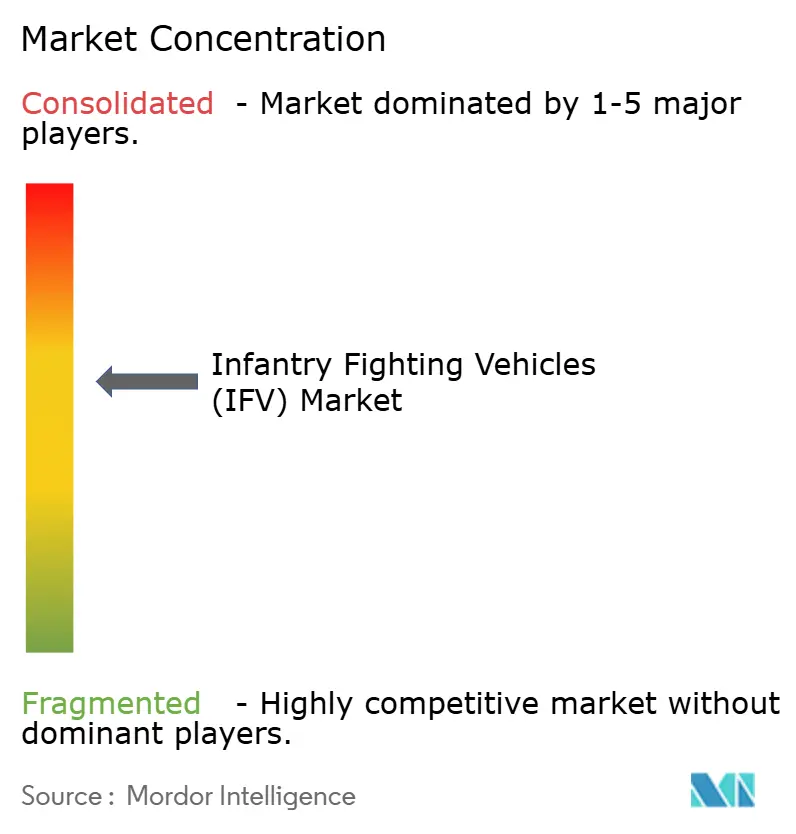
| Market Concentration | Medium |
Major Players *Disclaimer: Major Players sorted in no particular order Image © Mordor Intelligence. Reuse requires attribution under CC BY 4.0. | |

Infantry Fighting Vehicles (IFV) Market Analysis by Mordor Intelligence
The infantry fighting vehicles (IFV) market size is valued at USD 10.52 billion in 2025 and is projected to reach USD 13.85 billion by 2030, registering a 5.65% CAGR over the forecast period. Robust fleet-replacement programs, the shift toward network-centric operations, and escalating near-peer threats continue to accelerate procurement decisions. Europe’s large-scale initiatives, such as Italy’s EUR 16 billion (USD 18.70 billion) A2CS program and Poland’s framework deal for more than 1,400 Borsuk vehicles, illustrate the commitment to recapitalize aging inventories with modular, protection-focused designs. Simultaneously, Asia-Pacific modernization—anchored by China, India, and emerging Southeast Asian buyers—adds momentum through high-volume orders that demand scalable, upgradable architectures. The IFV market benefits from expanding use-cases from conventional maneuver warfare to expeditionary, littoral, and hybrid manned-unmanned operations, prompting sustained vendor investment in AI-enabled battle-management systems, active protection suites, and hybrid-electric powertrains. Supply-chain bottlenecks and export-control constraints temper the near-term outlook, yet persistent emphasis on survivability and mission modularity positions the IFV industry for long-run growth.
Key Report Takeaways
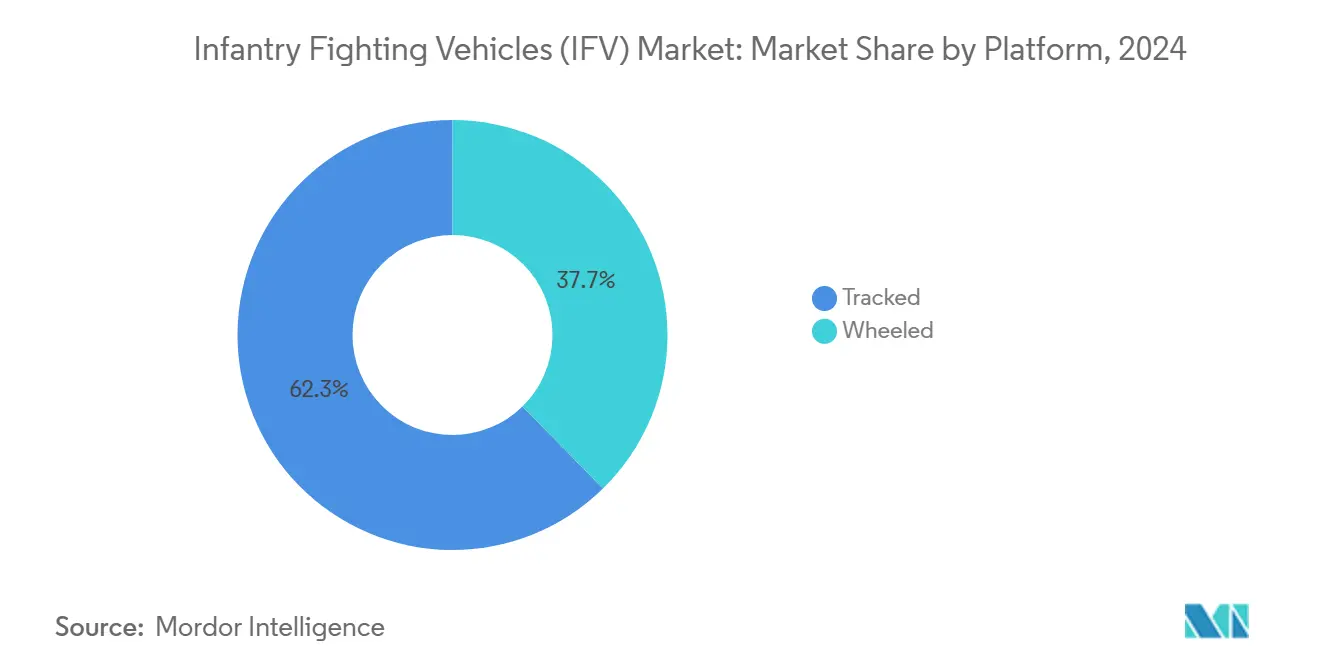
- By platform, tracked vehicles held 62.34% of the IFV market share in 2024, while wheeled variants are set for the fastest expansion at a 7.65% CAGR through 2030.
- By propulsion, conventional diesel commanded 81.27% of the IFV market size in 2024; hybrid-electric systems are forecasted to grow at a 9.22% CAGR to 2030.
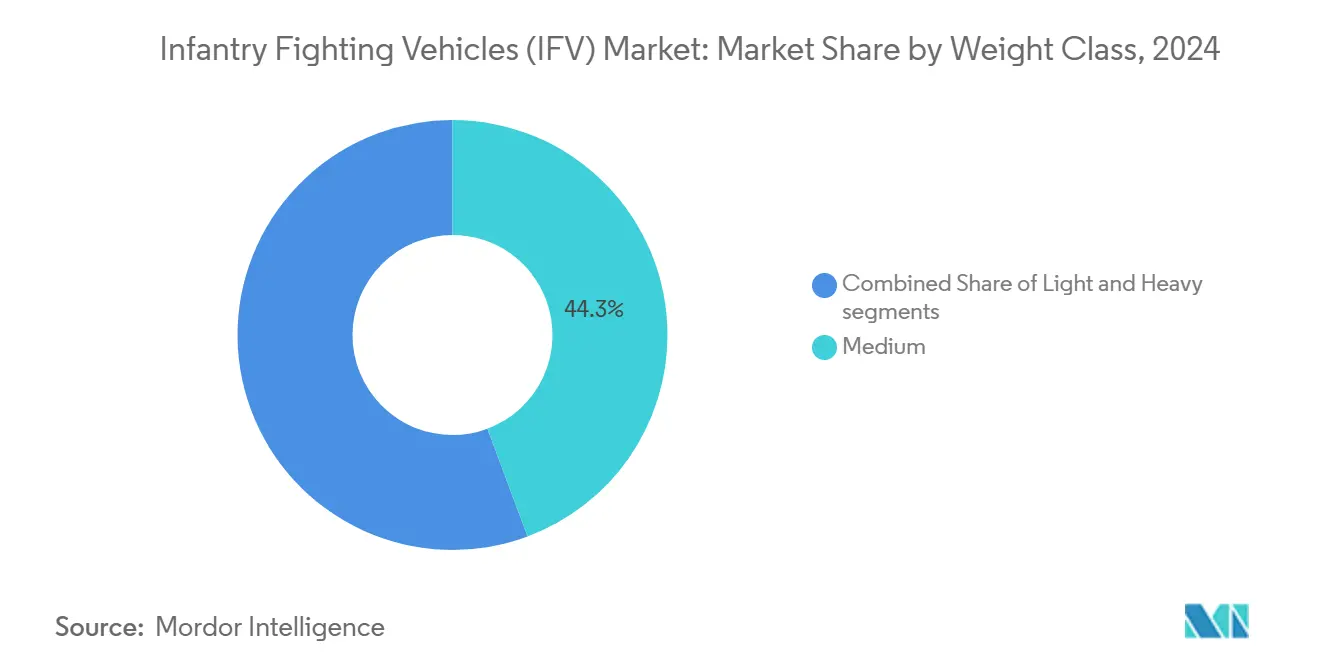
- By weight class, medium platforms accounted for 44.32% of the IFV market size in 2024 and are advancing at a 6.78% CAGR during the outlook period.
- By armament, the 30-50 mm caliber category captured 52.62% of the IFV market in 2024, and a 6.55% growth pace is anticipated through 2030.
- By end user, army formations dominated 87.75% revenue share in 2024; marine customers represent the fastest-growing niche at a 7.62% CAGR to 2030.
- By geography, Europe held 28.87% of the IFV market in 2024, while Asia-Pacific is expected to grow the quickest, at a 6.89% CAGR over the forecast span.
Note: Market size and forecast figures in this report are generated using Mordor Intelligence’s proprietary estimation framework, updated with the latest available data and insights as of January 2026.
Market Trends and Insights
Drivers Impact Analysis of Infantry Fighting Vehicles (IFV) Market*
| Driver | (~) % Impact on CAGR Forecast | Geographic Relevance | Impact Timeline |
|---|---|---|---|
| Growing emphasis on network-centric and digitally integrated land platforms | +1.2% | Global, with emphasis on NATO and Asia-Pacific | Medium term (2-4 years) |
| Increased investment in ground combat vehicle modernization programs worldwide | +1.4% | Global, led by Europe, Asia-Pacific, and North America | Long term (≥4 years) |
| Rising adoption of modular and scalable vehicle architectures for lifecycle flexibility | +0.9% | Global, early adoption in North America and Europe | Medium term (2-4 years) |
| Stricter battlefield signature management standards driving platform redesigns | +0.8% | North America, Europe, Asia-Pacific core markets | Long term (≥4 years) |
| Expanding role of manned-unmanned teaming in mechanized force structures | +0.7% | Global, early adoption in North America and Europe | Short term (≤2 years) |
| Advancements in survivability systems for dense and asymmetric combat environments | +1.1% | Global, driven by conflict zones and high-threat regions | Medium term (2-4 years) |
| Source: Mordor Intelligence | |||
Growing Emphasis on Network-Centric and Digitally Integrated Land Platforms
Military planners increasingly demand IFVs that share real-time sensor data, video, and targeting cues with allied assets, aligning platform design with multi-domain doctrine. The US Army’s XM30 program illustrates this shift by reducing crew size from four to two through AI-enabled decision aids while improving situational awareness via open-systems architecture. Israel’s Carmel initiative follows a similar path, leveraging artificial intelligence and sensor fusion to shrink crew footprints without sacrificing lethality. European manufacturers have taken note; the latest CV90 MkIIIC integrates NATO interoperability standards to plug effortlessly into allied C2 networks. As armed forces see information superiority as the decisive factor in peer combat, demand rises for platforms that embed computing power, cyber-resilience, and robust data links from the outset.
Increased Investment in Ground Combat Vehicle Modernization Programs Worldwide
Global commitments to replace aging Soviet-era fleets have pushed active IFV modernization budgets above USD 50 billion through 2030, ensuring a robust order pipeline. Poland’s framework for 1,400 Borsuk vehicles tops USD 1.7 billion, Italy’s 1,050-unit A2CS Lynx package approaches EUR 16 billion (USD 18.75 billion), and India’s twin programs for FICV and FRCV amount to more than USD 7 billion. South America is also engaged; Brazil’s Strategic Armored Forces Program exceeds BRL 20 billion (USD 3.71 billion) to indigenize production. Heightened border tensions, technology gaps, and the need for interoperable NATO-standard equipment keep modernization at the top of defense agendas. The long budget visibility allows suppliers to scale production lines, amortize R&D outlays, and lock in multi-year sustainment revenues.
Rising Adoption of Modular and Scalable Vehicle Architectures for Lifecycle Flexibility
Defense ministries favor chassis that accept mission kits, alternate turrets, or armor packages with limited re-engineering, cutting life-cycle costs by up to 20% compared with one-off builds. Through bolt-on modules, Rheinmetall’s KF41 Lynx can shift from IFV to command, engineer, or short-range air-defense roles, letting buyers tailor fleets without separate acquisition tracks. Poland’s Borsuk echoes this approach; its ZSSW-30 turret is carrier-agnostic, enabling cross-platform economies of scale. Turkey’s TULPAR family stretches from 28 t to 45 t on the same hull, providing weight latitude for additional protection or firepower. Modular architecture also eases technology insertion, as sensor suites, APS, and computing hardware evolve faster than hull life cycles, making future-proofing a procurement prerequisite.
Stricter Battlefield Signature Management Standards Driving Platform Redesigns
Low-observable requirements now span thermal, radar, acoustic, and visual spectra, with NATO STANAG updates codifying these metrics into procurement checklists. The Netherlands has retrofitted its CV90 fleet with adaptive camouflage and Iron Fist APS, lowering detectability while defeating tandem-warhead threats. Israeli operations in dense urban terrain highlight the combat advantage of thermal masking and sound suppression, prompting buyers to treat signature management on par with armor thickness. Suppliers respond by embedding metamaterials and hybrid-drive noise dampening at the concept stage instead of costly retrofits. The resulting high-value tech packages fetch premium margins yet meet customer appetite for survivability without weight penalties.
Restraints Impact Analysis of Infantry Fighting Vehicles (IFV) Market*
| Restraint | (~) % Impact on CAGR Forecast | Geographic Relevance | Impact Timeline |
|---|---|---|---|
| Frequent cost escalations in tracked combat vehicle development programs | -1.3% | Global, particularly affecting large procurement programs | Short term (≤2 years) |
| Limited global availability of high-performance armor and composite materials | -0.9% | Global, acute impact on North America and Europe | Medium term (2-4 years) |
| Regulatory and ethical constraints on international arms transfers and defense exports | -0.8% | Global, affecting US and European exporters primarily | Long term (≥4 years) |
| Operational and maintenance complexities of electrified propulsion and hybrid powertrains | -0.6% | Early adopter markets in North America and Europe | Medium term (2-4 years) |
| Source: Mordor Intelligence | |||
Frequent Cost Escalations in Tracked Combat Vehicle Development Programs
Program overruns of 20–40% above baseline estimates remain common, forcing buyers to trim unit counts or defer milestones. The US Army pushed its Future Fighting Vehicle start to FY 2029 under budgetary strain, signaling how funding volatility can stall capability refresh rates. Pandemic-era supply disruptions delayed Mobile Protected Firepower prototypes from BAE Systems and General Dynamics, illustrating the ripple effect of first-article integration and vendor shortfalls. European efforts suffer from fragmentation; multiple small national orders dilute economies of scale, inflating per-unit costs relative to consolidated US buys. Higher sustainment outlays for advanced electronics further squeeze defense budgets, lowering the annual production tempo that suppliers count on for steady cash flow.
Limited Global Availability of High-Performance Armor and Composite Materials
Ultra-high-hardness steel, ceramic strike faces, and advanced fibers come from a handful of qualified mills, many running near-capacity, extending lead times to 18–24 months. The US Marine Corps has flagged diminishing manufacturing sources for key armor alloys, mirroring wider industrial bottlenecks. Semiconductor shortages that battered civilian automotive sectors likewise slow deliveries of fire-control and network modules, as defense orders must queue behind commercial high-volume clients. Europe seeks strategic autonomy by subsidizing domestic materials plants, but near-term output lags demand, keeping prices high. Smaller defense budgets, therefore, struggle to absorb cost premiums, trimming growth in emerging markets.
*Our forecasts treat driver/restraint impacts as directional, not additive. The impact forecasts reflect baseline growth, mix effects, and variable interactions.
Infantry Fighting Vehicles (IFV) Market Segment Analysis
By Platform:
Tracked Dominance Faces Wheeled ChallengeTracked vehicles retained 62.34% of the IFV market in 2024, underscoring preference for superior off-road agility and battlefield survivability. The Borsuk, Lynx, and CV90 platforms illustrate how modern track-borne designs integrate digital backbones, modular armor, and APS to tackle peer-level threats. Wheeled alternatives grow at a 7.65% CAGR, propelled by easier road transit, lighter logistics footprints, and lower sustainment costs. Peru’s USD 60 million order for K808 8×8 IFVs exemplifies emerging-market appetite for strategic mobility and amphibious reach.[2]Editorial Staff, “Peru Modernizes Armored Fleet with K808 IFVs,” Army Recognition, armyrecognition.com
The near-term design race centers on hybrid architectures with common subsystems—powerpacks, vetronics, and sensors—across track and wheel baselines. Such convergence simplifies training and spares stocking, offering procurement agencies a hedge against shifting doctrinal priorities. As urbanization narrows maneuver corridors, wheeled IFVs promise rapid redeployment between dispersed operating hubs, while tracked fleets anchor high-intensity breakthrough operations in the IFV market.



By Propulsion:
Hybrid-Electric Gains MomentumDiesel propulsion still powers 81.27% of fielded IFVs, reflecting mature infrastructure and proven endurance. Yet hybrid-electric variants register a 9.22% growth path as armies seek silent-watch, low-thermal-signature, and efficiency benefits. US research programs test high-voltage architectures that merge electric drive with on-board power generation for directed-energy weapons (DEWs). European primes adopt modular engine bays that swap diesel-electric packs when battery density reaches operational thresholds.
Transition barriers include battery fire-safety certification, arctic-climate performance, and expeditionary recharging solutions. Early adopters focus on dual-mode configurations that revert to diesel for strategic mobility while exploiting electric propulsion during stealth operations. The cumulative technology maturity curve suggests that hybrid-electric penetration will steadily widen, reinforcing innovation cycles in the IFV market.
By Weight Class:
Medium Platforms Optimize BalanceVehicles in the 25 to 35 tons band captured 44.32% share in 2024, delivering the sweet spot of armor protection, firepower, and C-130 airlift compatibility. Poland’s 28-ton Borsuk leverages lightweight composites and Iron Fist APS to match STANAG 4569 Level IV ballistic protection without breaching bridge-class limits. Heavier concepts above 40 tons, like the Lynx with stratified modular armor, aim to survive tandem warhead threats but concede strategic deployability.
Light variants under 20 tons address airborne, marine, and rapid-intervention roles, though they rely heavily on APS and signature-control to compensate for thinner steel. Emerging materials science and additive-manufacturing techniques promise future weight rationalization, keeping medium designs central in defense planning and cementing their status within the IFV market.
By Armament Caliber:
Multi-Role 30-50 mm Systems PreferredCalibers between 30 mm and 50 mm generated a 52.62% share in 2024, enabling operators to employ programmable airburst, proximity-fused, and armor-piercing fin-stabilized discarding-sabot (APFSDS) rounds against mixed threats. Qatar’s interest in VBCI with 40 mm cased-telescoped munitions confirms user appetite for lethality upgrades without undue recoil penalties.[3] News Desk, “Is Qatar Set to Acquire VBCI IFVs?” Army Recognition, armyrecognition.com Concurrent missile-launcher integration provides long-range tank-kill capabilities, offering layered fires from a single turret envelope.
System houses now develop universal fire-control units that accept multiple gun-caliber inserts, streamlining export customization and life-cycle upgrades. Ammunition suppliers accelerate R&D in electronically time-fuzed rounds to defeat drones and defilade infantry, ensuring that cannon-based solutions remain relevant within the evolving IFV market.
By End User:
Army Applications DominateArmy formations consumed 87.75% of 2024 spending, driven by mechanized infantry doctrine and combined-arms maneuver requirements. The XM30 and FICV programs illustrate the Army's commitment to replacing Cold War-era fleets with digitally native designs. Marine Corps and Naval Infantry pursue amphibious IFVs that bridge sea-land gaps, growing at a 7.62% CAGR as littoral flashpoints intensify.
Other end users—border guards, gendarmerie, and peacekeeping contingents—seek lighter, cost-optimized variants with scalable protection. Suppliers respond with mission kits that tailor communications, less-than-lethal payloads, or additional seating. Such diversification broadens addressable demand pools, reinforcing revenue resilience across the IFV market.
Geography Analysis
Europe Infantry Fighting Vehicles (IFV) Market
Europe contributed 28.87% of global revenue in 2024, anchored by NATO readiness goals and regional conflict triggers. Italy’s A2CS order for 1,050 Lynx units and Poland’s USD 1.7 billion initial Borsuk contract underscore large-volume demand. Cross-border collaboration, such as Denmark and Sweden’s combined USD 2.5 billion CV90 MkIIIC purchase, strengthens supplier economies of scale and reinforces indigenous industrial capacity. Persistent fragmentation of specifications, however, limits serial-production efficiencies, compelling European states to explore joint logistical frameworks to safeguard the IFV market against budget erosion.
APAC Infantry Fighting Vehicles (IFV) Market
Asia-Pacific registers the fastest growth at 6.89% CAGR through 2030. China’s indigenous amphibious designs and India’s twin FICV/FRCV track inject sustained order volumes exceeding USD 7 billion. Australia’s LAND 400 Phase 3 and Japan’s Type 89 follow-on program enlarge the competitive field for global prime contractors. Southeast Asia, typified by Philippine and Indonesian purchases, increasingly sources from non-traditional suppliers to balance cost and geopolitical alignment. This diversified procurement tapestry amplifies opportunities for mid-tier manufacturers within the IFV market.
The Americas and Middle East Infantry Fighting Vehicles (IFV) Market
North America maintains a substantial installed base, yet modernization lags expectations because of evolving acquisition priorities. The US Army’s USD 1.6 billion XM30 design contracts and incremental Bradley M2A4 upgrades signal a phased refresh strategy. Canada eyes replacements for its LAV III fleet, potentially leaning on hybrid-electric proposals that align with national decarbonization objectives. Middle East buyers pursue limited but technologically ambitious fleets to match evolving threat profile. At the same time, South America sees sporadic acquisitions, such as Brazil’s multibillion-real program, that illustrate demand elasticity tied to fiscal health. These dynamics collectively reinforce a geographically balanced revenue pipeline for the IFV market.


Competitive Landscape
Global supply is moderately consolidated, with the top five vendors—BAE Systems plc, General Dynamics Corporation, Rheinmetall AG, Hanwha Corporation, and KNDS N.V.—controlling a weighty portion of orders yet facing agile competition from Turkish and South Korean contenders. Differentiation increasingly depends on integrating AI-enabled situational awareness, hard-kill APS, and plug-and-play mission modules rather than purely on steel thickness. Rheinmetall’s Hungarian plant, opened in 2024, typifies near-customer production models that blend political goodwill with export potential.
White-space opportunities surface in hybrid-electric drivetrains and manned-unmanned teaming ecosystems, where niche firms can supply power-management, autonomy, or sensor-fusion subsystems. Hanwha Defense’s K21 derivative, pitched to South America, illustrates how emerging players leverage cost-competitive production and offset packages to win share from entrenched Western suppliers. Consolidation pressure may intensify as legacy primes acquire software, cyber, and drone specialists to expand portfolio breadth, safeguarding contract margins in the IFV market.
Lifecycle service contracts form a decisive bid discriminator. When scoring proposals, customers evaluate through-life availability, digital-twin-based predictive maintenance, and training-as-a-service models. KNDS bundles data analytics platforms for remote diagnostics and AI-driven inventory management, aiming to cut the total cost of ownership by double-digit percentages. Such service-centric strategies will likely elevate switching barriers and deepen strategic ties, solidifying competitive positions across the IFV market.
Infantry Fighting Vehicles (IFV) Industry Leaders
General Dynamics Corporation
Rheinmetall AG
KNDS N.V.
Hanwha Corporation
BAE Systems plc
- *Disclaimer: Major Players sorted in no particular order
Infantry Fighting Vehicles (IFV) Market Companies Covered in this Report
- BAE Systems plc
- General Dynamics Corporation
- Rheinmetall AG
- KNDS N.V.
- Hanwha Corporation
- FNSS Savunma Sistemleri A.S.
- Otokar Otomotiv ve Savunma Sanayi A.S.
- Patria Oyj
- Iveco Defence Vehicles (Iveco Group)
- Singapore Technologies Engineering Ltd.
- China North Industries Corporation
- Denel Land Systems (Denel SOC Ltd.)
- Tata Advanced Systems Limited

Recent Industry Developments in Infantry Fighting Vehicles (IFV) Market
- March 2025: Poland signed a contract to acquire 111 Borsuk IFVs valued at USD 1.7 billion. The procurement agreement encompasses training programs, vehicle testing, logistics support, and technical documentation for serial production.
- January 2025: Latvia signed a EUR 373 million (USD 435.98 million) procurement contract for 42 ASCOD IFVs.
- December 2023: Hanwha Defence Australia (HDA) signed a USD 2.4 billion contract with the Australian government to deliver 129 Redback IFVs, training systems, and support components.


Global Infantry Fighting Vehicles (IFV) Market Report Scope
| Tracked |
| Wheeled |
| Conventional Diesel |
| Hybrid-Electric |
| Light |
| Medium |
| Heavy |
| 20 to 30 mm |
| 30 to 50 mm |
| More than 50 mm |
| Army |
| Marine |
| Others |
| North America | United States | |
| Canada | ||
| Mexico | ||
| Europe | United Kingdom | |
| France | ||
| Germany | ||
| Spain | ||
| Rest of Europe | ||
| Asia-Pacific | China | |
| India | ||
| Japan | ||
| Indonesia | ||
| Philippines | ||
| Rest of Asia-Pacific | ||
| South America | Brazil | |
| Rest of South America | ||
| Middle East and Africa | Middle East | United Arab Emirates |
| Saudi Arabia | ||
| Rest of Middle East | ||
| Africa | South Africa | |
| Rest of Africa | ||
| By Platform | Tracked | ||
| Wheeled | |||
| By Propulsion | Conventional Diesel | ||
| Hybrid-Electric | |||
| By Weight Class | Light | ||
| Medium | |||
| Heavy | |||
| By Armament Caliber | 20 to 30 mm | ||
| 30 to 50 mm | |||
| More than 50 mm | |||
| By End User | Army | ||
| Marine | |||
| Others | |||
| By Geography | North America | United States | |
| Canada | |||
| Mexico | |||
| Europe | United Kingdom | ||
| France | |||
| Germany | |||
| Spain | |||
| Rest of Europe | |||
| Asia-Pacific | China | ||
| India | |||
| Japan | |||
| Indonesia | |||
| Philippines | |||
| Rest of Asia-Pacific | |||
| South America | Brazil | ||
| Rest of South America | |||
| Middle East and Africa | Middle East | United Arab Emirates | |
| Saudi Arabia | |||
| Rest of Middle East | |||
| Africa | South Africa | ||
| Rest of Africa | |||


Key Questions Answered in the Report
What is the current value of the infantry fighting vehicles (IFV) market?
It stands at USD 10.52 billion in 2025 and is projected to climb to USD 13.85 billion by 2030.
Which segment of the infantry fighting vehicles (IFV) market is expanding the fastest?
Wheeled platforms post the highest growth, advancing at a 7.65% CAGR through 2030.
How large is Europe’s share in global infantry fighting vehicle (IFV) demand?
Europe accounted for 28.87% of global revenue in 2024, supported by NATO-driven modernization.
Why are hybrid-electric infantry fighting vehicles (IFV) gaining traction?
They provide silent-watch capability, lower acoustic signatures, and better fuel efficiency, encouraging a 9.22% CAGR adoption rate.
Which technological feature is becoming standard for new infantry fighting vehicles (IFV)?
Active protection systems that defeat anti-tank guided missiles are moving from optional to core requirements across new builds.
Page last updated on:


 Your data is secure and never sold or shared.


