
Military Amphibious Vehicle Market Size and Share
Market Overview
| Study Period | 2020 - 2031 |
|---|---|
| Market Size (2026) | USD 3.15 Billion |
| Market Size (2031) | USD 4.59 Billion |
| Growth Rate (2026 - 2031) | 7.82 % |
| Fastest Growing Market | Asia Pacific |
| Largest Market | North America |
| Market Concentration | Medium |
Major Players *Disclaimer: Major Players sorted in no particular order Image © Mordor Intelligence. Reuse requires attribution under CC BY 4.0. | |
Military Amphibious Vehicle Market Analysis by Mordor Intelligence
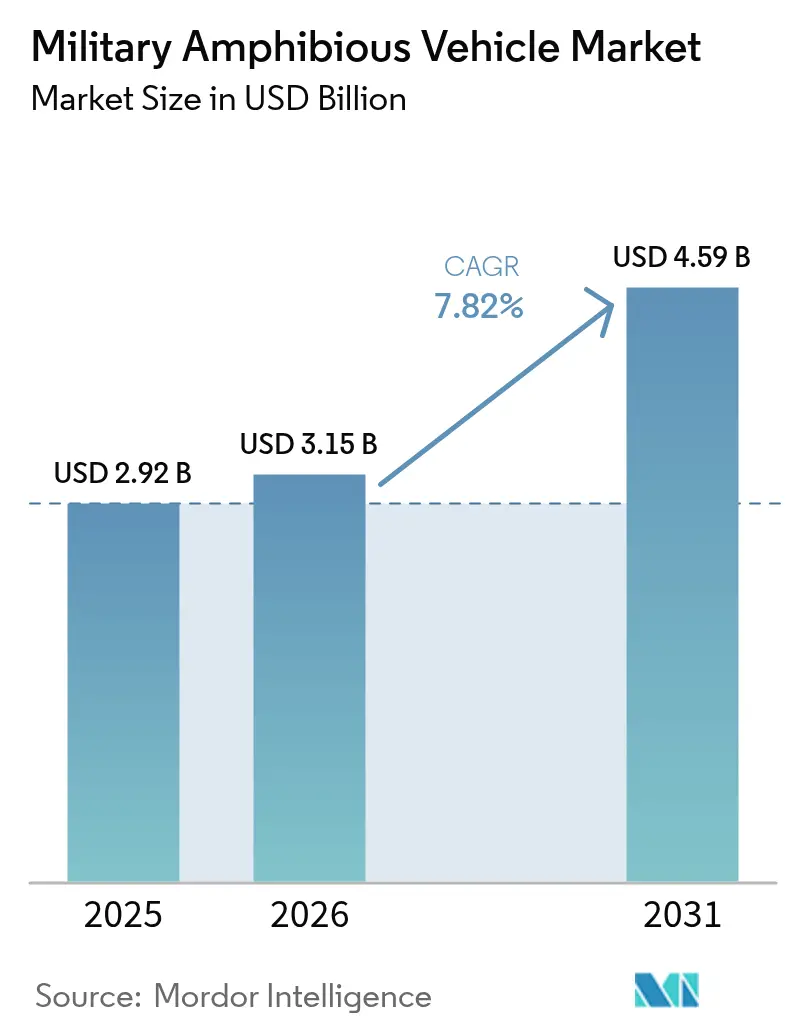
The military amphibious vehicles market size was valued at USD 2.92 billion in 2025 and estimated to grow from USD 3.15 billion in 2026 to reach USD 4.59 billion by 2031, at a CAGR of 7.82% during the forecast period (2026-2031). Demand growth reflects widening maritime flashpoints, especially in the Indo-Pacific, where expeditionary warfare, over-the-horizon logistics, and contested-littoral operations have become top procurement priorities. Programs such as the US Marine Corps Amphibious Combat Vehicle (ACV), Brazil’s VBTP-MR Guarani, and the US Navy Ship-to-Shore Connector (SSC) illustrate sustained investments in protected mobility, rapid ship-to-shore transfer, and network-enabled command. Hovercraft reliability upgrades, additive-manufactured spare parts, and saltwater-resistant materials reshape life-cycle economics while tracking global demand toward more agile, corrosion-resilient fleets. As nations recalibrate force structures to counter anti-access threats, the military amphibious vehicles market continues to attract moderate but stable competitive intensity led by BAE Systems, Textron, General Dynamics, and Lockheed Martin.
Key Report Takeaways
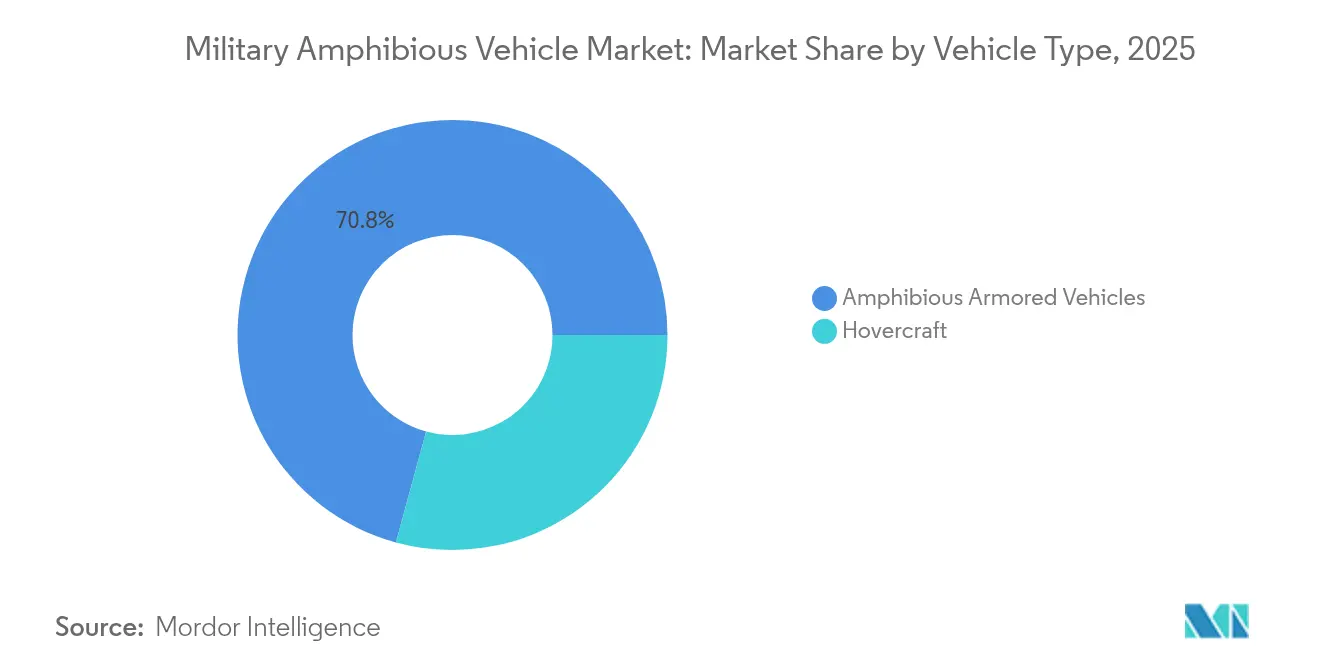
- By vehicle type, amphibious armored vehicles led with 70.76% revenue share in 2025, while hovercraft are forecasted to expand at an 8.11% CAGR through 2031.
- By mobility, tracked systems held 63.62% of the military amphibious vehicles market share in 2025, whereas wheeled variants are advancing at a 7.98% CAGR to 2031.
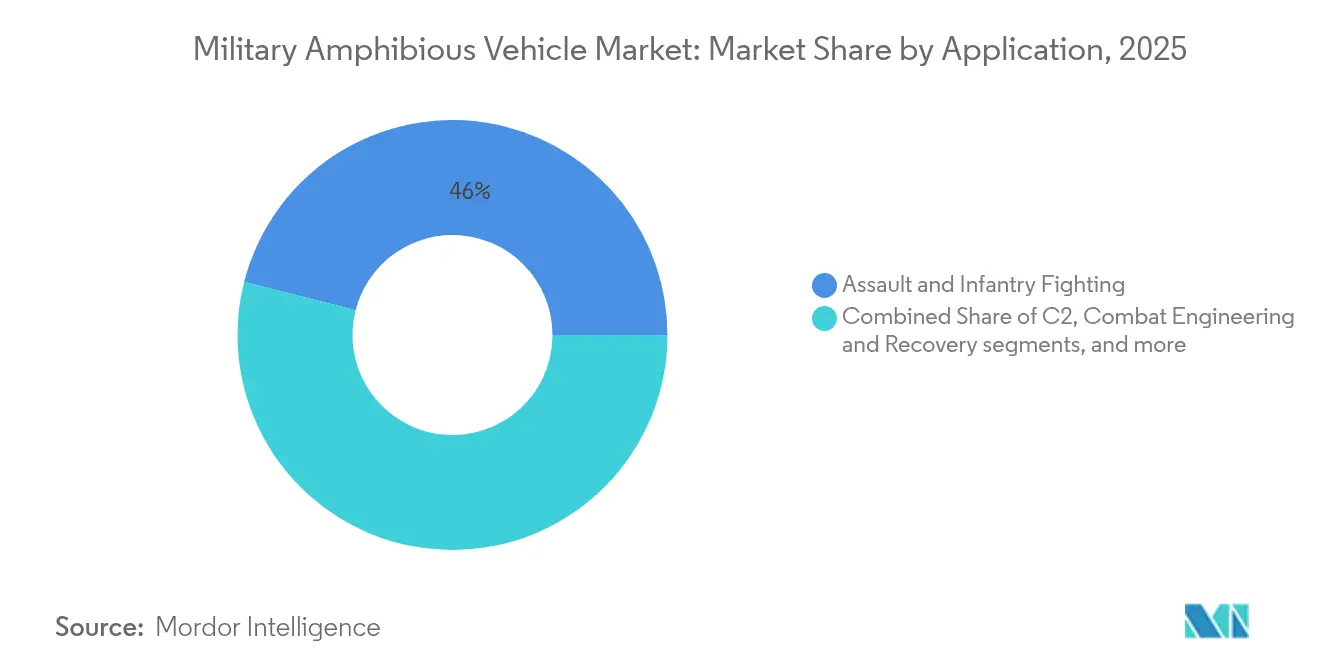
- By application, assault and infantry fighting captured 46.02% of the military amphibious vehicles market size in 2025 and will progress at a 7.28% CAGR through 2031.
- By end user, Marine Corps units accounted for a 46.68% share of the military amphibious vehicles market size in 2025 while growing at an 8.38% CAGR to 2031.
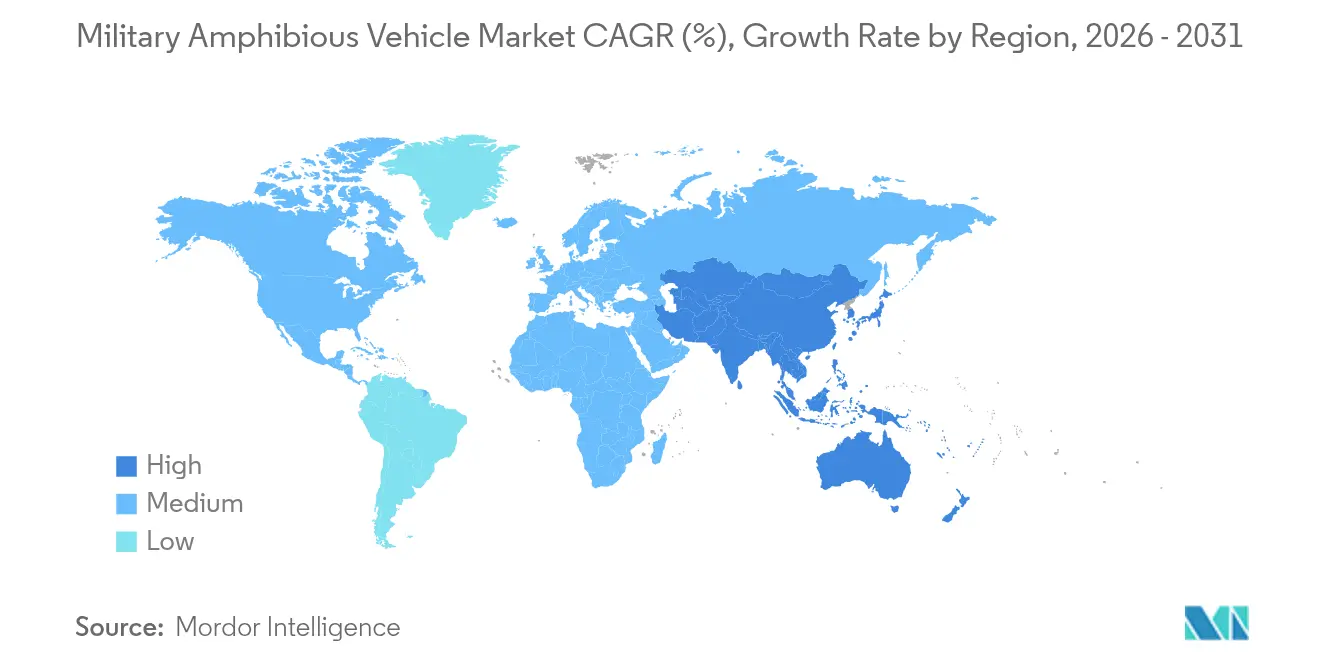
- By geography, North America held a 45.77% share in 2025, yet Asia-Pacific is set to post the fastest 8.78% CAGR between 2026 and 2031.
Note: Market size and forecast figures in this report are generated using Mordor Intelligence’s proprietary estimation framework, updated with the latest available data and insights as of 2026.
Market Trends and Insights
Drivers Impact Analysis of Military Amphibious Vehicle Market*
| Driver | (~) % Impact on CAGR Forecast | Geographic Relevance | Impact Timeline |
|---|---|---|---|
| Rising maritime tensions and grey-zone confrontations | +2.1% | Indo-Pacific, South China Sea, Eastern Europe | Short term (≤ 2 years) |
| Increasing focus on over-the-horizon expeditionary logistics capabilities | +1.8% | North America, Asia-Pacific, NATO Europe | Medium term (2-4 years) |
| Accelerated fielding of next-generation amphibious combat vehicles | +1.5% | North America, Europe, advanced Asia-Pacific | Medium term (2-4 years) |
| Naval adoption of additive manufacturing to reduce spare part lead times | +0.9% | North America, Europe, allied nations | Long term (≥ 4 years) |
| Development of amphibious ground vehicles for first-wave breaching operations | +1.2% | Global early adopters | Medium term (2-4 years) |
| Integration of multi-domain command and control (C2) systems in amphibious platforms | +0.8% | NATO, Five Eyes, advanced militaries | Long term (≥ 4 years) |
| Source: Mordor Intelligence | |||
Rising Maritime Tensions Drive Amphibious Capability Investments
Escalating South China Sea and Taiwan Strait disputes compel regional forces to acquire platforms to maneuver in contested littorals. Chinese Type 072A drills within 24 nautical miles of Taiwan demonstrate operational readiness, prompting allied programs such as Japan’s new assault vehicle prototype and South Korea’s KAAV II. The US Marine Corps’ Force Design 2030 accents distributed operations across the first island chain. Together, these developments reinforce procurement of highly protected, long-range systems that can survive anti-access threats and deliver combat power ashore.
Expeditionary Logistics Capabilities Transform Doctrine
Modern militaries emphasize rapid, self-sustained deployment beyond fixed port infrastructure. The ACV’s ship-launched, over-the-horizon reach enables Marines to bypass fortified beaches. Brazil’s 2,044-vehicle Guarani order shows emerging powers pursuing similar versatility for warfighting and disaster relief. Networked command suites extend mission duration, while modular mission bays allow quick role change from troop lift to cargo or casualty evacuation.
Next-Generation Combat Vehicles Accelerate Growth
Additive-manufactured hulls, autonomous navigation, and AI-enabled threat detection improve survivability without weight penalties. The US Army’s Jointless Hull research reduces weld points, lowering maintenance needs. Japan’s sensor-fused demonstrator achieves real-time situational awareness, and South Korea’s KAAV II targets higher water speed while protecting against kinetic threats. These advances raise replacement demand among fleets built in the 1990s and early 2000s.[1]
Additive Manufacturing Revolutionizes Spare Parts Supply
Shipboard 3D printers now produce propulsion seals, hatch latches, and structural brackets, cutting lead times from months to hours. The US Navy fabricates lightweight aluminum couplings aboard LHD-class assault ships, trimming inventory and shipping costs. European partners Denmark and the Netherlands embed similar depot-level printers, enhancing NATO interoperability and sparing logistics chains in highly dispersed operations.
Restraints Impact Analysis of Military Amphibious Vehicle Market*
| Restraint | (~) % Impact on CAGR Forecast | Geographic Relevance | Impact Timeline |
|---|---|---|---|
| High life-cycle costs due to saltwater corrosion exposure | –1.4% | Coastal and island operators | Long term (≥ 4 years) |
| Operational limitations linked to low gearbox reliability in hovercraft | –0.8% | North America, Europe LCAC users | Short term (≤ 2 years) |
| Supply chain risks from single-source skirt fabric procurement | –0.6% | Hovercraft operators worldwide | Medium term (2-4 years) |
| Complex maintenance requirements for hybrid propulsion and waterjet systems | –1.1% | Advanced market adopters | Medium term (2-4 years) |
| Source: Mordor Intelligence | |||
Saltwater Corrosion Inflates Ownership Costs
Studies show salt-spray exposure lifts maintenance spending 40–60% above land-only fleets. Hull pitting, galvanic corrosion, and electronic degradation shorten overhaul intervals, forcing navies to allocate growing sustainment budgets. Protective coatings and fiber-reinforced composites help, yet they require specialized repair skills that are not always available in forward areas.[2]
Hovercraft Gearbox Reliability Constrains Tempo
LCAC transmissions experience wear from abrasive sand ingestion and fluctuating lift loads. The US Navy incorporated hardened steel gears and improved lubrication circuits in new SSC blocks, but legacy craft still record lower availability. European fleets conduct pre-deployment gearbox borescope checks, raising operating costs and delaying sortie generation.
*Our forecasts treat driver/restraint impacts as directional, not additive. The impact forecasts reflect baseline growth, mix effects, and variable interactions.
Military Amphibious Vehicle Market Segment Analysis
By Vehicle Type:
Armored Platforms Dominate Despite Hovercraft MomentumAmphibious armored vehicles accounted for 70.76% of 2025 revenue, underpinned by continuous ACV deliveries to the US Marine Corps. The military amphibious vehicles market benefits from armor upgrades that defeat medium-caliber threats and improvised explosives. Demand for autonomous gunnery, active protection, and modular mission packages sustains replacement cycles.
Hovercraft posts the strongest outlook at an 8.11% CAGR through 2031 as navies seek over-the-horizon lift and lighter footprints in contested bays. The SSC introduces composite air-cushion systems and corrosion-resistant propulsion gear, lowering life-cycle costs. Expanded cargo decks enable the delivery of heavier main battle tanks, broadening mission sets beyond beach assault to humanitarian supply. Operational doctrines now treat hovercraft as integral to maritime pre-positioning rather than niche connectors, which enlarges their share of future fleet plans.

By Mobility:
Tracked Systems Lead While Wheeled Variants Gain GroundTracked platforms held 63.62% of 2025 sales, reflecting proven traction on littoral mud and obstacle-strewn beaches. The military amphibious vehicles market values their balanced buoyancy and armor baseline. Upgraded hydropneumatic suspensions extend service lives while preserving low-ground pressure for soft-sand mobility.
Wheeled variants, forecast at an 7.98% CAGR, gain favor for strategic mobility and lower road wear. Patria 6×6 trucks in Denmark’s EUR 247 million (USD 289.95 million) order achieve 100 km/h on highways, accelerating joint force response times. Reduced maintenance man-hours and simpler drivetrains appeal to midsized armies, while modular flotation kits permit quick amphibious configuration changes, enlarging mission scope.
By Application:
Assault Operations Dominate While Engineering Capabilities ExpandAssault and infantry missions captured 46.02% of 2025 revenue. Demand is driven by integrating remotely operated turrets, anti-tank guided missiles, and C4ISR nodes into core troop carriers, ensuring immediate fire support after beach landing. The military amphibious vehicles market size for assault roles will grow as forces replace aging AAV-7 and BTR-50 fleets.
Combat engineering and recovery platforms register the top 8.26% CAGR. Gap-crossing, mine-clearing, and obstacle-breaching kits enable first-wave survivability. NATO coastal exercises increasingly feature armored dozer blades, line-charge launchers, and self-deploying bridge layers, unlocking stable demand among amphibious engineer battalions. Urban littoral operations in congested megacities further underscore the importance of engineer variants.
By End User:
Marine Corps Leadership Reflects Doctrine EvolutionMarine Corps formations commanded 46.68% of 2025 revenue and will grow at an 8.38% CAGR. Force Design 2030 reorients US Marines toward dispersed stand-in forces, prompting sustained investment in amphibious mobility and long-range fires. Comparable reforms in Japan, South Korea, and the United Kingdom fuel parallel acquisition programs.
Army use cases expand as continental forces anticipate river-crossing and disaster-relief missions. Navy procurement focuses on connectors and logistics craft. Interservice joint experimentation now treats amphibious fleets as shared assets, driving interoperable specifications and joint sustainment frameworks. The military amphibious vehicles industry benefits from specialized and multi-domain procurement pathways.
Geography Analysis
North America Military Amphibious Vehicle Market
North America maintained a 45.77% revenue lead in 2025, anchored by the ACV’s USD 1.16 billion contract portfolio and the SSC’s USD 706 million modernization track. Mexico’s coastal security orders and Canada’s Arctic-amphibious exercises add incremental volume, though US budgets remain the region’s core driver. Robust depot infrastructure mitigates corrosion costs, extending platform service lives.
APAC Military Amphibious Vehicle Market
Asia-Pacific records the fastest 8.78% CAGR as China, Japan, South Korea, and India intensify amphibious modernization. PLA drills near Taiwan illustrate gray-zone escalation, while Japan’s autonomous assault prototype and South Korea’s KAAV II fielding expand local supply chains. India’s WhAP deployments in overseas peace missions prove the region’s desire for adaptable, export-compliant craft. Emerging Southeast Asian users monitor technology trends, potentially spurring second-wave demand later in the decade.
Europe Military Amphibious Vehicle Market
Europe advances steady replacement programs aligned with NATO interoperability mandates. Denmark’s 130-unit Patria buy, Portugal’s EUR 1.236 billion (USD 1.45 billion) army overhaul, and the Netherlands’ BvS10 transfer to Ukraine signal commitment despite fiscal constraints. Arctic climate change also raises northern amphibious requirements for search-and-rescue and infrastructure defense missions.
Regulatory Landscape
Military amphibious vehicle procurement is primarily governed by national defense acquisition rules, with the United States setting many baseline requirements through Department of Defense contracting and Congressional oversight. In the United States, the FY2026 National Defense Authorization Act (NDAA) process (S.2296) includes direction that affects tactical vehicle strategy and adjacent amphibious and unmanned concepts. Budget controls under the Fiscal Responsibility Act of 2023 have also been cited in program quantity adjustments, including reported impacts to ACV procurement quantities in FY2025 and FY2026.
Platform qualification and acceptance are shaped by defense technical standards and certification regimes that emphasize survivability and environmental hardening for saltwater and surf-zone conditions. Environmental and durability test expectations commonly reference MIL-STD-810G/H-type requirements for shock, vibration, temperature, and corrosion exposure, which affects material selection, sealing, electronics ruggedization, and life-cycle validation plans for amphibious armored vehicles and hovercraft/connectors.
Value Chain Analysis
The value chain begins with requirements definition and funding approval by defense ministries, then moves to prime contractors responsible for vehicle design, system integration, and qualification for amphibious operations. In the United States ACV ecosystem, BAE Systems serves as the prime across the ACV family (including personnel, command, recovery, and 30mm variants), while subsystem suppliers provide mission equipment and lethality packages. Kongsberg, for example, supports turret solutions used on ACV-30 configurations. This prime-led structure concentrates design authority and configuration control with the OEM, while pushing specialized content such as turrets, sensors, and C2 suites into tier suppliers.
Manufacturing and sustainment are closely linked for amphibious fleets because saltwater corrosion and surf-zone wear drive recurring demand for spares, refurbishments, and capability insertions. Evidence points to established US industrial nodes supporting production and integration, including BAE Systems sites in York and Johnstown, Pennsylvania, as well as government depot participation for specific variant features. For example, Anniston Army Depot supports crane-related integration on ACV-Recovery (ACV-R). Downstream, operators depend on depot-level repair, upgrade kits (corrosion protection, situational awareness, drivetrain improvements), and technical data access, which can be constrained by export controls and proprietary components for items such as hovercraft skirts, gear alloys, and marine propulsion subsystems.
Competitive Landscape
Leading suppliers leverage multi-year government contracts, proven combat pedigrees, and classified intellectual property to sustain mid-level market concentration. BAE Systems plc dominates armored categories through ACV and Guarani backlogs. Textron holds a near-duopoly in military hovercraft with the SSC, consolidating aftermarket revenues through proprietary skirt and gearbox upgrades. General Dynamics Corporation complements its portfolios with command-centric variants and hybrid propulsion research.
Sub-tier innovators target autonomy kits, additive-manufactured spares, and corrosion-resistant composites to gain footholds. However, International Traffic in Arms Regulations (ITAR) restrict technology export, raising entry barriers that favor incumbents licensed for cross-border transfers. Supply-chain shocks from single-source skirt materials, turbine blades, and high-strength gear alloys expose OEMs to schedule risk, prompting diversification of suppliers and localized “factory-in-a-box” concepts.
Merger and acquisition prospects remain selective, with primes focusing on software-defined radios, battery management systems, and composite hull producers rather than full-platform acquisitions. Joint ventures with regional shipyards help incumbents comply with local content mandates, reinforcing share stability. Consequently, the military amphibious vehicles market sustains moderate rivalry without price-war races as performance and survivability rank above unit cost in procurement evaluations.
Military Amphibious Vehicle Industry Leaders
-
BAE Systems plc
-
General Dynamics Corporation
-
Rheinmetall AG
-
Griffon Hoverwork Ltd.
-
Textron Systems Corporation (Textron Inc.)
- *Disclaimer: Major Players sorted in no particular order

Military Amphibious Vehicle Market Companies Covered in this Report
- BAE Systems plc
- General Dynamics Corporation
- Textron Systems Corporation (Textron Inc.)
- Rheinmetall AG
- Griffon Hoverwork Ltd.
- KNDS N.V.
- Hyundai Rotem Company (Hyundai Motor Group)
- China North Industries Group Corporation Limited
- Saab AB
- Patria Group
- Tata Advanced Systems Limited
- Arquus (John Cockerill S.A.)
- Marine Alutech Oy Ab
- Oshkosh Corporation
Market Opportunities and Future Outlook
White-space appears most evident where modernization programs widen the addressable platform set beyond troop carriers into reconnaissance, recovery, and connector-enabled logistics. That shift tightens requirements for digital integration and survivability in contested littorals. The US Marine Corps Advanced Reconnaissance Vehicle (ARV) effort progressed through 2026 with prototype evaluation activity, which creates supplier room for 360-degree situational awareness, counter-UAS-aware sensor fusion, and networked C2 integration that can carry across amphibious armored vehicles used for assault and command roles. Planned contracting milestones also matter, including an ACV-Recovery (ACV-R) production contract planned for award by the end of FY2026, which can expand demand for mission equipment, recovery systems, and depot support packages.
Ship-to-shore and distributed operations further raise the value of interoperability between amphibious vehicles and future naval platforms and connectors. In the current evidence base, the US Navy Medium Landing Ship (LSM) program timeline includes a construction start targeted for late 2026, which supports procurement pull for beachable logistics concepts and compatible vehicle handling, lashing, and embarkation interfaces. In regions prioritizing over-the-horizon logistics and dispersed basing, procurement and upgrade pathways increasingly attach value to corrosion-resilient materials, sustainment data packages, and additive-manufacturing-enabled spares, aligning with the readiness constraints tied to saltwater exposure and high-tempo littoral use.
Recent Industry Developments in Military Amphibious Vehicle Market
- April 2026: The US Marine Corps selects General Dynamics Land Systems and Textron Systems for ARV program phase two, delivering three pre-production variations by 2028. The arrangement advances reconnaissance and assault capabilities within the Marine fleet and shows progress along a domestic development path for amphibious vehicles.
- February 2026: BAE Systems secures a $195 million contract for 30 additional Amphibious Combat Vehicles, expanding ACV production for the USMC. The award reinforces the supplier’s role in sustaining backlog and continuing fielding of protected mobility for expeditionary operations.
- January 2026: BAE Systems receives a $184 million full-rate production contract expanding the Amphibious Combat Vehicle program. This adds scale to ACV deployment and strengthens aftermarket support for ongoing fleet modernization.
Military Amphibious Vehicle Market Report Scope and Research Methodology
Market Definition and Coverage
This market covers military platforms that can operate on land and water and are procured for defense missions, including vehicle procurement and related modernization value captured at the platform level.
Scope exclusions: We exclude civilian amphibious recreation vehicles and boats that do not have a military vehicle role.
Segments Covered in This Report
- By Vehicle Type
- Amphibious Armored Vehicles
- Hovercraft
- By Mobility
- Wheeled
- Tracked
- By Application
- Assault and Infantry Fighting
- Command and Control (C2)
- Combat Engineering and Recovery
- Logistics and Humanitarian
- By End User
- Army
- Marine Corps
- Navy
- By Geography
- North America
- United States
- Canada
- Mexico
- Europe
- United Kingdom
- France
- Germany
- Italy
- Rest of Europe
- Asia-Pacific
- China
- India
- Japan
- South Korea
- Rest of Asia-Pacific
- South America
- Brazil
- Rest of South America
- Middle East and Africa
- Middle East
- Saudi Arabia
- United Arab Emirates
- Rest of Middle East
- Africa
- South Africa
- Rest of Africa
- Middle East
- North America
Data Sources, Market Sizing, and Validation
Desk Research
Desk research was used to build the initial demand pool and to set realistic boundaries for what gets counted as an amphibious military vehicle program. We referenced public defense procurement releases and budget documents, plus contract award notices and tender portals that spell out quantities, delivery timelines, and upgrade scope.
We also used official defense statistics and reference libraries such as NATO publications, the Stockholm International Peace Research Institute (SIPRI) databases, UN Comtrade where relevant for trade-coded vehicle flows, and technical standards and test reports released by defense agencies. Company annual reports, investor materials, and credible defense press were reviewed to understand platform roadmaps, production cadence, and pricing direction. Where needed, we used paid subscriptions for company financials and defense news intelligence, a patents database to track technology focus areas, and a global contracts and tenders dataset to cross-check program visibility. These sources are illustrative, and many other public documents were also used to collect data, validate assumptions, and clarify points that were not explicit in primary releases.
Primary Interviews and Surveys
Primary discussions were conducted with defense procurement stakeholders, program integrators, subsystem suppliers, and independent domain experts, so our inputs on volumes, delivery schedules, and typical pricing ranges could be pressure-tested against how programs actually get sourced and accepted. For a global view, we ensured coverage included demand signals and operational needs across APAC, EMEA, and the Americas, since program timing and procurement conversion differ by region.
Distribution of primary research fieldwork respondents
| Company type | Respondent position | Region |
|---|---|---|
| Top tier: 34% | CXOs: 21% | APAC: 44% |
| Mid tier: 44% | Functional/Unit leaders: 19% | EMEA: 31% |
| Smaller Players: 22% | Managers: 60% | Americas: 25% |
Market-Sizing & Forecasting
Sizing was built using a top-down approach where defense procurement spend and visible amphibious vehicle programs by country were reconstructed into annual demand, then filtered into this market through platform eligibility rules. To keep totals realistic, we cross-checked results with selective bottom-up approximations, mainly by sampling announced unit quantities and applying price bands, followed by supplier and integrator channel checks.
Key model inputs included announced procurement quantities and replacement cycles, delivery and acceptance schedules, mission profile needs that influence platform mix (wheeled, tracked, hovercraft), typical unit pricing ranges by class, and modernization intensity that shifts value between new-build and upgrade years. When program details were not available, gaps were handled using proxy signals such as adjacent armored vehicle procurement tempo, known fleet counts, and conservative delivery phasing, then reviewed with primary inputs.
Forecasts were built using scenario analysis, since the market is driven more by procurement timing, budget cycles, and program slippages than by smooth consumer-style demand. Variables such as defense budget direction, regional security priorities, and platform refresh windows were projected, then translated into annual program-level rollups so the final time series stays explainable and repeatable.
Data Validation & Update Cycle
Validation was done through multiple checks that compare the modeled totals against independent signals such as awarded contract values, publicly disclosed program milestones, and regional procurement patterns that should move in the same direction. Outliers were investigated, and where the variance could not be justified by program timing or scope, assumptions were revisited and selectively rechecked with experts.
Before sign-off, the model and write-up go through stepwise analyst reviews so that definitions, unit logic, and currency conversions match across sections. Reports are refreshed annually, and interim updates are made when material events occur, including major contract awards, program cancellations, or large budget revisions. Right before delivery, we run a final pass so clients receive the most current view available at that time.
Mordor Intelligence's Military Amphibious Vehicle Market Size Compared With Other Published Estimates
Published market values for this space can differ a lot because the scope line is drawn differently, and then the pricing and timing assumptions follow that line. Differences also show up when studies use different base years, exchange-rate timing, and how they treat upgrade value versus full platform value.
Amphibious assault ships and landing craft are left outside Mordor Intelligence's scope, which keeps the total tied to vehicle platforms rather than broader naval lift spending, and that single exclusion can explain a large part of the spread versus higher figures. Some sources also assume faster procurement conversion from budget plans, or they apply an aggressive average selling price uplift without matching it to known contract milestones and delivery schedules.
Benchmark comparison
| Source | Market Size | Gaps in Research Methodology |
|---|---|---|
| Mordor Intelligence | USD 3.15 B (2026) | |
| Global Consultancy A | USD 3.42 B (2026) | Uses a broader demand roll-up that can count additional amphibious combat support platforms, and it typically assumes quicker budget-to-contract conversion, which lifts the near-term total. |
| Industry Publisher B | USD 4.05 B (2024) | Starts from a different base year and appears to blend a wider set of amphibious military equipment categories into one value, which raises the reported market size versus a vehicle-only count. |
The table shows that year choice and category inclusion are the biggest drivers behind the gaps. When platform eligibility is kept consistent and timing is anchored to visible program schedules, the outcome becomes easier to replicate and to track over time.
Key Questions Answered in the Report
What is the 2026 value and projected CAGR for the Military Amphibious Vehicles market?
The market stands at USD 3.15 billion in 2026 and is forecasted to grow at a 7.82% CAGR to reach USD 4.59 billion by 2031.
Which vehicle type currently leads global sales?
Amphibious armored vehicles hold 70.76% of 2025 revenue, driven by programs like the US ACV and Brazil’s Guarani.
Which region is expanding the fastest?
Asia-Pacific posts the highest 8.78% CAGR through 2031 due to heightened geopolitical tensions and modernization in China, Japan, South Korea, and India.
Why are hovercraft gaining momentum despite reliability concerns?
Upgraded gearboxes, composite skirts, and larger cargo decks in new Ship-to-Shore Connectors support over-the-horizon logistics, driving an 8.11% CAGR outlook for hovercraft.
How do corrosion costs affect platform selection?
Saltwater exposure can lift maintenance spending by up to 60%, prompting buyers to specify advanced coatings and composites that lower life-cycle costs despite higher upfront prices.