
Industrial Drums Market Size and Share
Market Overview
| Study Period | 2020 - 2031 |
|---|---|
| Market Size (2026) | USD 15.41 Billion |
| Market Size (2031) | USD 20.06 Billion |
| Growth Rate (2026 - 2031) | 5.42 % |
| Fastest Growing Market | Asia Pacific |
| Largest Market | Asia Pacific |
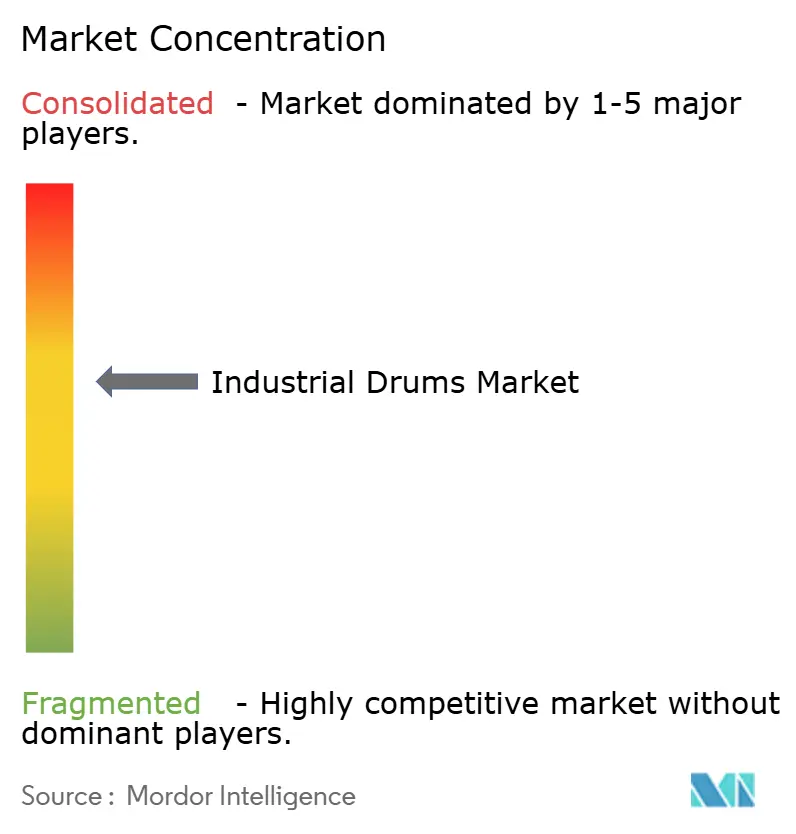
| Market Concentration | Medium |
Major Players *Disclaimer: Major Players sorted in no particular order Image © Mordor Intelligence. Reuse requires attribution under CC BY 4.0. | |
Industrial Drums Market Analysis by Mordor Intelligence
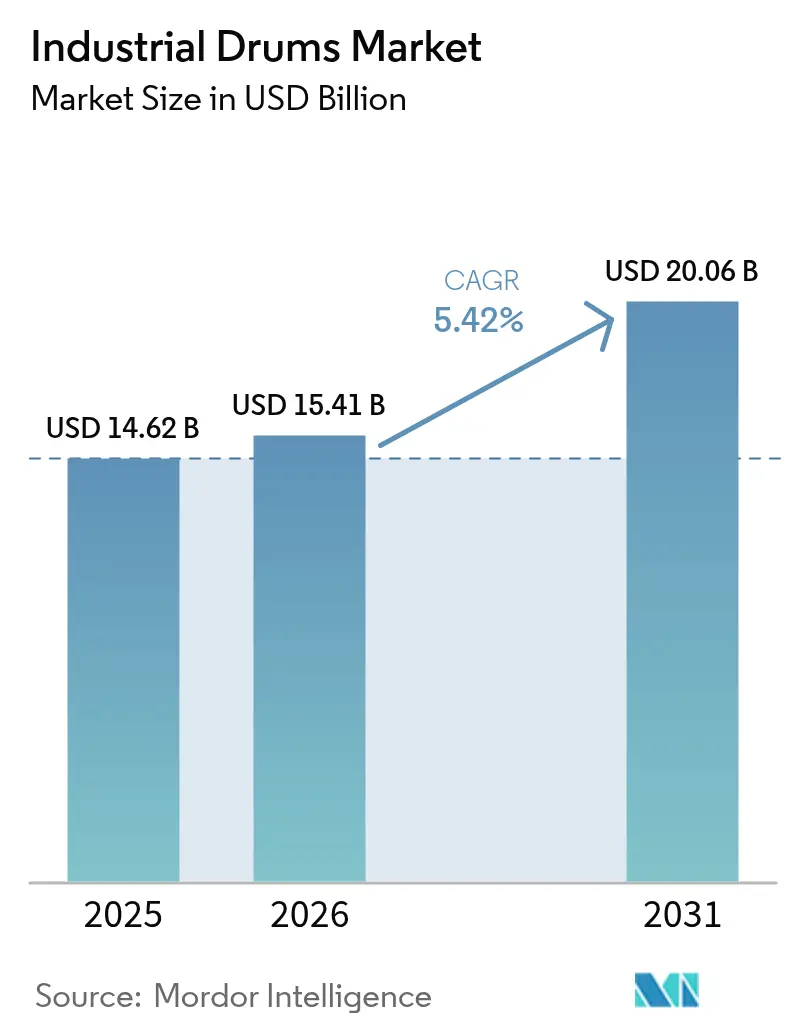
The industrial drums market size is expected to grow from USD 14.62 billion in 2025 to USD 15.41 billion in 2026 and is forecast to reach USD 20.06 billion by 2031 at 5.42% CAGR over 2026-2031. Steady chemical output, rising petrochemical investments, and widening food‐grade export flows anchor demand. Regulatory momentum toward reusable packaging, demonstrated by Cummins’ RFID‐enabled returnable program, reinforces the shift away from single-use bulk bags. Composite drums win share as weight-sensitive shippers pursue corrosion-resistant options, while RFID adoption spreads across hazardous-materials fleets to improve traceability. Asia-Pacific drives volume on the back of China’s cracker additions and India’s 12% annual chemical growth target through 2030, whereas North America and Europe prioritize premium, compliance-led formats. Consolidation such as Berry Global’s 2025 merger with Amcor adds scale advantages that squeeze smaller rivals. [1]
Key Report Takeaways
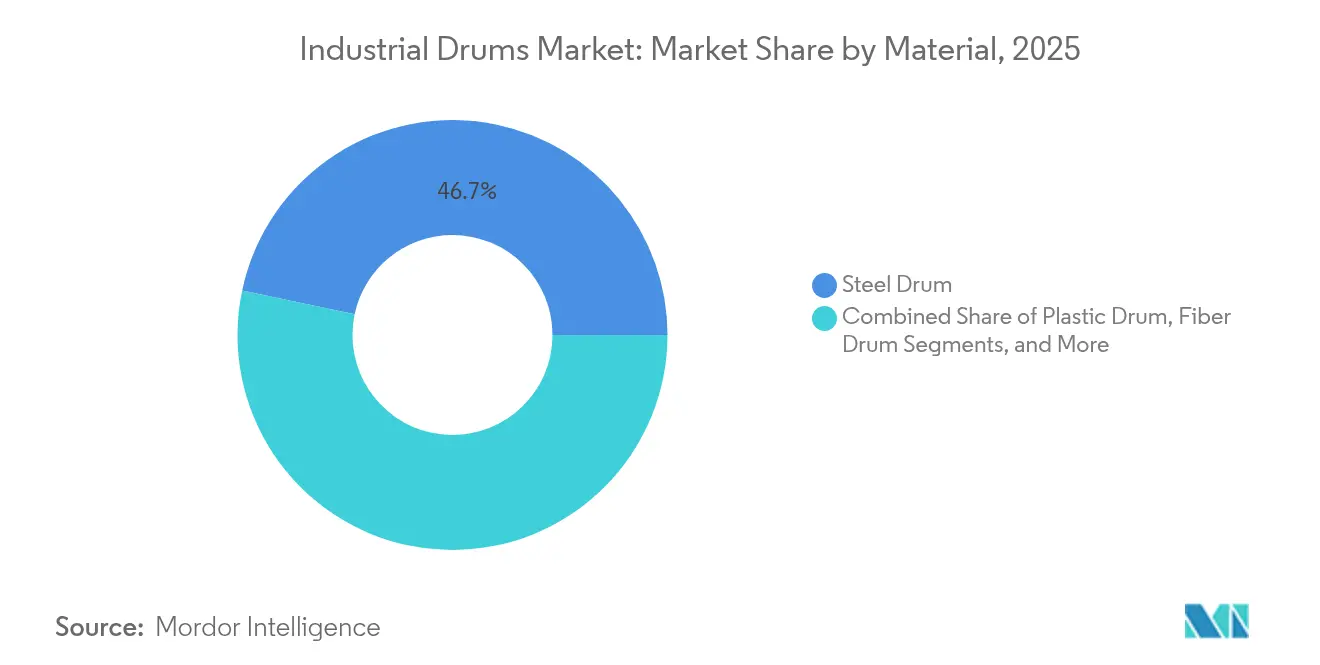
- By material, steel accounted for 46.68% of the industrial drums market share in 2025, while composite drums recorded the fastest 7.21% CAGR to 2031.
- By capacity, the 60 - 100 gallon range held 35.21% of the industrial drums market size in 2025, while above-100-gallon formats hold the fastest 6.08% CAGR to 2031.
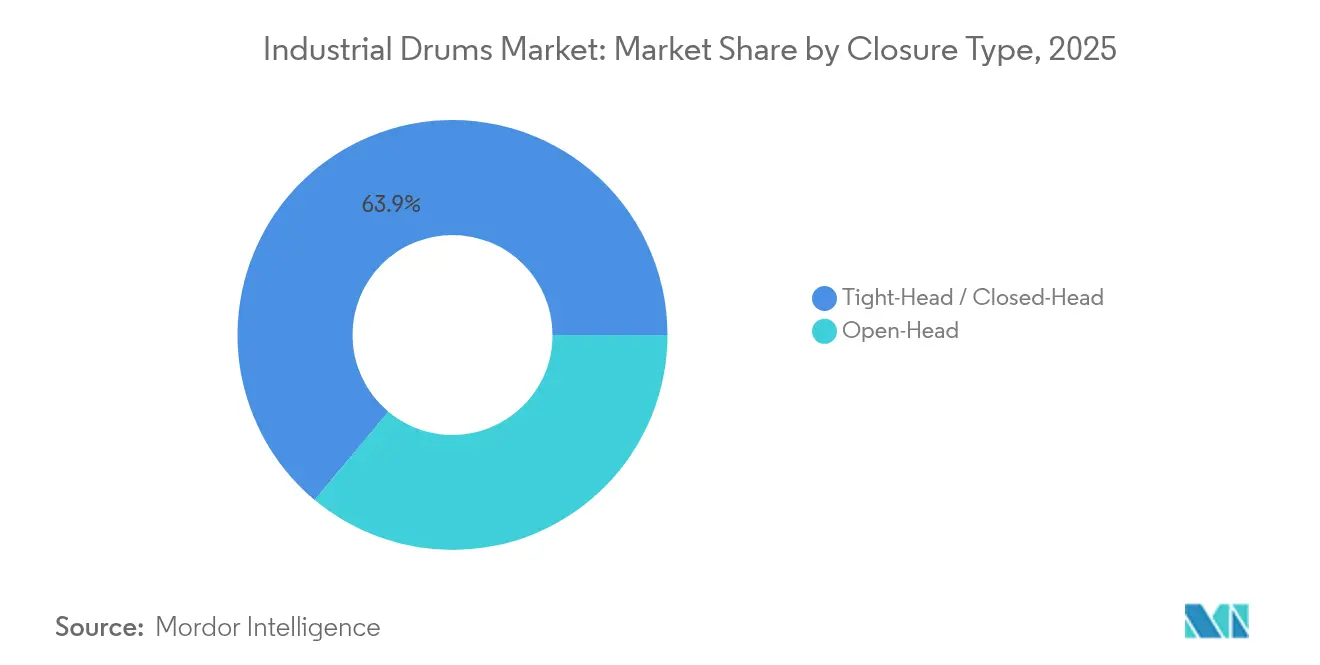
- By closure type, tight-head designs led with 63.92% revenue share in 2025, and Open-Head designs hold the fastest 6.47% CAGR to 2031.
- By end-user, chemicals and fertilizers retained 32.11% share of the industrial drums market size in 2025, while pharmaceuticals recorded the fastest 6.85% CAGR to 2031.
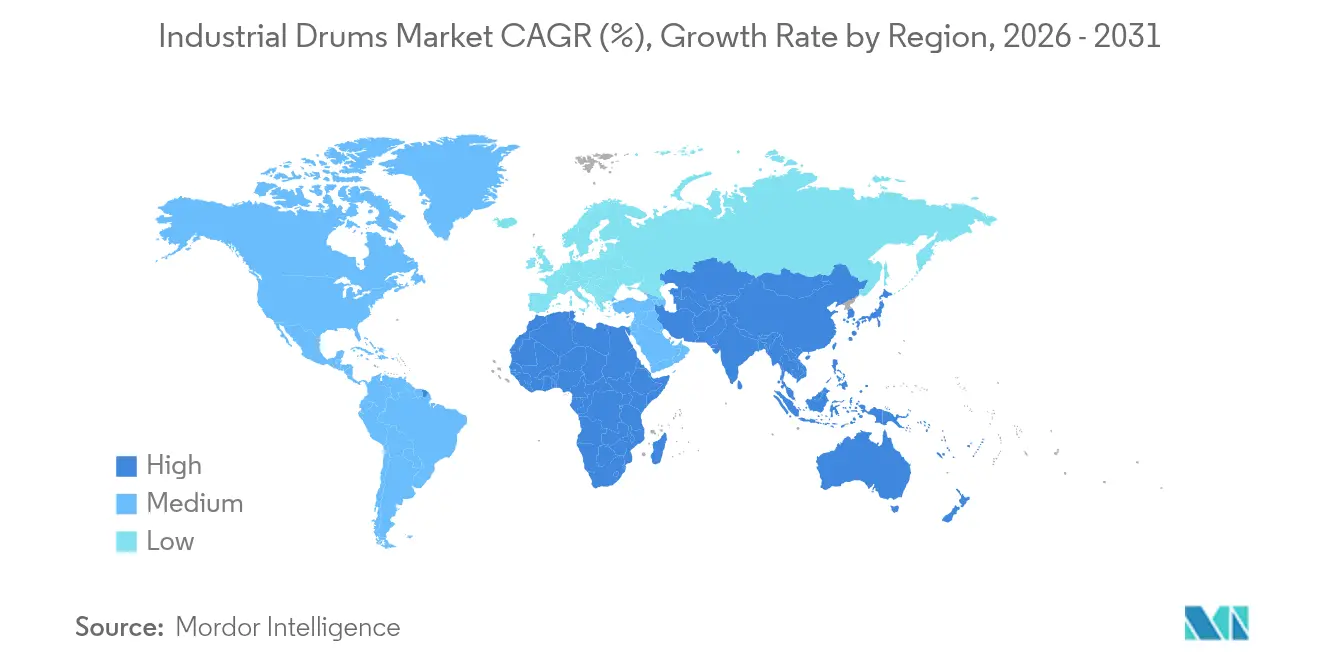
- By geography, Asia-Pacific captured 39.55% of the industrial drums market share in 2025 and is projected to expand at a 7.65% CAGR through 2031.
Note: Market size and forecast figures in this report are generated using Mordor Intelligence’s proprietary estimation framework, updated with the latest available data and insights as of 2026.
Market Trends and Insights
Drivers Impact Analysis of Industrial Drums Market*
| Driver | (~) % Impact on CAGR Forecast | Geographic Relevance | Impact Timeline |
|---|---|---|---|
| Growth in chemical and petrochemical output | +1.2% | Global with Asia-Pacific leadership | Medium term (2-4 years) |
| Expansion of food-grade export logistics | +0.8% | North America and Europe spreading to Asia | Long term (≥ 4 years) |
| Strengthening supply-chain resiliency needs | +0.9% | Global with North America focus | Short term (≤ 2 years) |
| Regulatory phase-out of single-use bulk bags | +0.7% | Europe core, ripple to North America | Medium term (2-4 years) |
| Circular-economy leasing and reconditioning | +0.5% | Europe and North America, pilots in Asia | Long term (≥ 4 years) |
| RFID-enabled drum tracking for haz-mat compliance | +0.4% | Global, led by North America | Short term (≤ 2 years) |
| Source: Mordor Intelligence | |||
Growth in Chemical and Petrochemical Output
Robust specialty-chemical builds in China, cracker expansions in the Middle East, and mergers among Japanese majors collectively increase drum throughput requirements. The American Chemistry Council notes sustained resilience in U.S. chemical production despite logistics bottlenecks, while India is targeting 12% compound growth, which keeps drum demand firmly on an upward path. Larger integrated complexes process greater batch sizes, pushing shippers toward 100-plus gallon formats and composite linings that withstand aggressive intermediates. SysKem Chemie ships Class 8 caprylic acid exclusively in coated drums that meet United Nations test codes, illustrating the higher specification trend.
Expansion of Food-Grade Export Logistics
Diversification of ingredient sourcing has lengthened supply chains for sweeteners, plant proteins, and fruit concentrates. CDF Corporation launched USDA-compliant liners in February 2025, showing suppliers’ response to stricter contamination thresholds. Harmonized documentation under the Codex Alimentarius enables multi-regional certification, supporting scale economies for manufacturers producing food-grade drums in bulk. Premium organic exporters have begun to pay price differentials for drums embedded with tamper-evident seals and QR-code lineage data, enhancing provenance claims in destination markets.
Strengthening Supply-Chain Resiliency Needs
After the 2024 congestion cycle, buyers now insist on local drum stocks and dual sourcing. Cummins’ RFID deployment cut replacement purchases by 18% in its first year and signaled a wider move toward viewing drums as capital assets rather than disposable consumables. Tag providers such as HID Global supply chemically durable UHF labels that feed live geolocation to ERP dashboards. [2] Locking in multi-year steel contracts has become a defensive tactic, given MEPS International’s USD 900 per-ton projection for April 2025 and the tariff uncertainty outlined in Ryerson’s metals outlook.
Regulatory Phase-Out of Single-Use Bulk Bags
The incoming EU Packaging and Packaging Waste Regulation mandates minimum reuse rates, causing some agrochemical exporters to replace poly-woven FIBCs with reconditioned tight-head drums. U.S. DOT code 1A1 for non-removable-head steel units remains the global benchmark for hazardous liquids. [3] North Coast Container conducts annual drop and hydrostatic tests that most start-ups find cost-prohibitive, further cementing incumbents’ positions. Early adopters in California align drums with Proposition 65 and PFAS restrictions, signaling deeper integration of chemical and packaging compliance regimes.
Restraints Impact Analysis of Industrial Drums Market*
| Restraint | (~) % Impact on CAGR Forecast | Geographic Relevance | Impact Timeline |
|---|---|---|---|
| Raw-material price volatility | -0.8% | Global with pronounced North America impact | Short term (≤ 2 years) |
| Environmental compliance cost for disposal | -0.5% | Europe and North America, expanding to Asia | Medium term (2-4 years) |
| Cannibalization by IBCs and flexitanks | -0.6% | Global, centered on bulk-liquid segments | Medium term (2-4 years) |
| On-site micro-blending cutting drum demand | -0.4% | North America and Europe clusters | Long term (≥ 4 years) |
| Source: Mordor Intelligence | |||
Raw-Material Price Volatility
Steel and resin swings squeeze margins as drum makers struggle to synchronize contracts with customer price lists. Ryerson’s 2025 forecast flags potential anti-dumping duties on Asian hot-rolled coil, adding another layer of unpredictability. Balmer Lawrie is piloting 0.5 mm-wall drums that allow 80 units per TEU, four more than traditional gauges, to offset rising coil costs; at INR 23.39 billion (USD 280.8 million) 2024 sales, the savings are material.
Cannibalization by IBCs and Flexitanks
Single-use flexitanks priced at USD 170 with 24,000 L capacity reduce per-liter freight by up to 35%, tempting edible-oil shippers to switch. Meanwhile, composite IBC producers integrate pallet bases and tracking chips, lowering warehouse labor. Nevertheless, drums retain strongholds in UN-regulated corrosive and flammable classes where multilayer liners or reinforced hoops are mandatory.
*Our forecasts treat driver/restraint impacts as directional, not additive. The impact forecasts reflect baseline growth, mix effects, and variable interactions.
Industrial Drums Market Segment Analysis
By Material:
Steel Dominance Adjusts to Composite UptakeSteel captured the lion’s share at 46.68% because refinery and agrochemical players favor its mechanical strength and straightforward reconditioning loops. At the same time, composite drums are on a 7.21% trajectory as buyers weigh freight savings against initial premiums. Recent audits at Indian ports show that lightweight steel accounted for 37% of outbound haz-chem shipments, underscoring cost reductions from thinner gauges. The industrial drums market benefits from global scrap incentives that make low-alloy steel a closed-loop asset, whereas virgin HDPE resin tracks propylene prices more closely.
Plastic and fiber variants address niche solute compatibility or weight constraints. Although fiber units lack UN credentials for liquids, they now incorporate moisture-resistant liners that extend shelf life for dry food powders. Composite models combine polymer barriers with steel ribs, targeting formulators of moisture-sensitive adhesive ingredients. Their rise illustrates how the industrial drums market evolves through hybridization rather than a binary material switch.

By Capacity:
Mid-Range Preference Shifts toward High-Volume SKUsSixty-to-one-hundred-gallon drums align with forklift clearance and remain the workhorse at 35.21% share. However, fully automated chemical clusters prefer 110-gallon drums that support fewer lifts per ton processed. Through 2031, above-100-gallon formats hold the fastest 6.08% expansion rate. Camco Chemical’s USD 3 million line allows dual fill heads for 30 and 110 gallon SKUs, underlining buyers’ preference for multi-volume flexibility. The industrial drums market size for capacities beyond 100 gallons is projected to touch USD 4.55 billion by 2031, reflecting wider adoption of palletless robotic handling cells.
Smaller drums serve specialty flavors, pharma actives, and lab reagents where lot segregation trumps bulk economics. Yet their share erodes as tank-to-fill micro-blending units shrink on-site intermediate inventories. Overall, capacity choice mirrors a trade-off between ergonomic safety, freight utilization, and regulatory caps on allowable mass per package in airborne routes.
By Closure Type:
Tight-Head Security versus Open-Head FlexibilityTight-heads, or closed-heads, generated nearly two-thirds of 2025 sales because their welded tops prevent seepage of flammables in transit. They dominate ISO-tank feeder legs and refinery loop returns. Open-heads, expanding at 6.47%, cater to viscous pastes and dry blends that require full-aperture filling. Pharmaceutical auditors insist on removable lids to validate swab cleanliness between batches, intensifying demand in contract drug manufacturing.
The industrial drums market is witnessing hybrid lug-ring designs that aim to marry tamper evidence with removable access, yet regulatory listing under DOT code 1A2 still involves months of stack, drop, and hydrostatic testing, a hurdle few new entrants overcome.
By End-User:
Chemical Leadership Elevated by Pharma MomentumChemicals and fertilizers command 32.11% owing to massive commodity volumes. Specialty makers layer in antistatic linings to comply with IEC 60079 zones, illustrating customization depth. Pharmaceutical growth at 6.85% stems from FDA cleaning validation letters that push contract fillers toward UN-certified, easily sanitized drums. The industrial drums industry captures premium margins here because documentation and extractables analysis raise barriers to cheaper substitutes.
Food and beverage shippers demand FDA - compliant resins and traceable lot coding, while paints and coatings specify solvent-resistant phenolic linings. Lubricant packers continue to rely on open-head steel for grease and tight-head plastic for DEF fluids, underscoring how the industrial drums market segments by chemical compatibility and viscosity profile rather than simple end-use labels.
Geography Analysis
APAC Industrial Drums Market
Asia-Pacific contributed 39.55% revenue in 2025, propelled by Chinese cracker projects and India’s chemicals roadmap. Balmer Lawrie leveraged eight plants to secure national contracts for agrochemical exporters and logged INR 23.39 billion (USD 280.8 million) turnover. Regional governments offer land rebates for packaging clusters adjacent to refinery corridors, shortening delivery lead times and reducing dent damage.
The Americas and EMEA Industrial Drums Market
North America benefits from shale-based feedstock and maintains stringent DOT oversight that drives demand for high-specification steel drums. Cummins’ returnable system illustrates how U.S. OEMs internalize packaging for circularity gains. Europe emphasizes circular economy compliance under the Packaging and Packaging Waste Regulation and has seen pilot leasing pools triple since 2023, mostly for food and personal-care ingredients. South America and the Middle East and Africa remain smaller but high-growth nodes. Brazilian biodiesel exporters pivot to composite drums to mitigate soy-oil oxidation, whereas Gulf petrochemical hubs procure thick-gauge steel variants to withstand extreme ambient temperatures. Cross-regional freight arbitrage also stimulates backhaul drum reconditioning networks, reinforcing global linkages within the industrial drums market.
Regulatory Landscape
Industrial drums used in regulated shipments are shaped by the UN Recommendations on the Transport of Dangerous Goods (Model Regulations), with the 23rd revised edition serving as a reference point for drum design, performance testing, and marking in international trade. In the United States, the Department of Transportation Pipeline and Hazardous Materials Safety Administration (PHMSA) enforces packaging requirements through the Hazardous Materials Regulations, including 49 CFR Part 178 provisions for drum construction and testing.
PHMSA continued harmonization activity with rulemaking updates published in 2024, followed by a further harmonization final rule published on February 10, 2026. These updates align elements of US requirements with updated international standards, affecting packaging authorizations and compliance details such as markings and performance testing expectations. For regulated drum makers and users, the operational impact is tied to maintaining current UN-certified designs, keeping validated test records, and applying compliant marking across cross-border and hazmat shipping lanes.
Value Chain Analysis
The industrial drums value chain starts with upstream inputs such as flat-rolled steel, coatings (epoxy/phenolic), and polymer resins and liners, then moves into drum fabrication (forming, welding, seaming, lining, curing) and UN/DOT performance testing and certification. Downstream, drums flow through distributors and industrial packaging networks to end users in chemicals, petroleum, food, and pharmaceuticals, supported by logistics providers and depot networks that handle collection, inspection, sorting, and repositioning for multi-trip programs.
Reconditioning and lifecycle services create a distinct value-added loop, covering collection, cleaning, relining, leak testing, and recertification to return drums to service. This layer is supported by trade bodies and reuse-focused programs (including the Reusable Industrial Packaging Association and the Industrial Packaging Alliance of North America). As reuse-oriented policy pressure and corporate circularity programs expand, drum suppliers either operate or partner for regional cleaning hubs, track-and-trace capabilities, and recycling access to secure compliant supplies of reconditioned units and post-consumer resin streams.
Competitive Landscape
Competition is moderate, with regional strongholds. The top five producers control roughly 42% of global sales, giving the market a concentration score of 6. Balmer Lawrie dominates Indian demand through end-to-end offerings, from steel rolling to in-house epoxy lining. Mauser and Greif leverage global footprints to service multinationals under single-invoice models. Berry Global’s April 2025 Amcor integration unlocks USD 650 million in synergistic savings, directly impacting bid pricing.
Technology is the new battleground. HID Global partners with drum fabricators to embed NFC tags during hoop welding, a shift that differentiates commodity steel shells via data services. Mid-tier firms invest in robotically welded chimes to reduce labor spend, while start-ups explore bio-based resins to meet emerging PFAS and VOC curbs. Flexitank suppliers such as Shandong Blue Whale blur category lines by courting bulk edible-oil traffic formerly handled by drum fleets.
Service models mature alongside hardware. Reconditioners bundle cleaning, relining, and end-of-life shredding to satisfy ISO 14001 audits. Subscription-based leasing, now 9% of North American steel-drum circulation, offers predictable OPEX versus CAPEX, resonating with CFOs chasing asset-light balance sheets. Such moves underscore how the industrial drums market continues to expand beyond mere container fabrication into lifecycle management ecosystems.
Industrial Drums Industry Leaders
-
Greif, Inc.
-
Mauser Packaging Solutions Holding Company
-
SCHUTZ GmbH & Co. KGaA
-
Time Technoplast Ltd.
-
Balmer Lawrie & Co. Ltd.
- *Disclaimer: Major Players sorted in no particular order
Industrial Drums Market Companies Covered in this Report
- Greif, Inc.
- Mauser Packaging Solutions Holding Company
- SCHUTZ GmbH & Co. KGaA
- Time Technoplast Ltd.
- Balmer Lawrie & Co. Ltd.
- Sicagen India Ltd.
- TPL Plastech Ltd.
- Peninsula Drums (Pty) Ltd.
- Eagle Manufacturing Company (Justrite Safety Group)
- U.S. Coexcell Inc.
- Industrial Container Services, Inc.
- Hoover Ferguson Group, Inc.
- Berry Global Group, Inc.
- Brambles Ltd.
- Myers Industries, Inc.
- Orlando Drum & Container Corp.
- Rahway Steel Drum Co., Inc.
- Re-Gen Drums Ltd.
- Palm Containers (Pty) Ltd.
- Schutz DSL (Asia) Pte Ltd.
Market Opportunities and Future Outlook
Circular services and compliant reuse infrastructure are emerging as a clear whitespace for suppliers to capture value beyond drum manufacturing. Mauser Packaging Solutions expanded IBC reconditioning capacity in Houston (with automation and quality testing capacity referenced at 800,000 containers annually), and it also opened an on-site reconditioning and recycling facility at BASF in Tarragona, Spain (June 2025). The BASF site move points to customer pull for integrated collection, cleaning, and recycling close to chemical production. For drum makers and service providers, this supports scaling depot networks, standardizing quality protocols, and adding digital traceability to support reuse programs, audits, and multi-site chemical customers.
Material transition and specification-driven innovation offer another opportunity zone, tied to decarbonization and performance optimization while keeping UN certification. Greif introduced EcoBalance low-carbon emission steel drums and supplied low-carbon steel drums to Oleon for a pilot at Ertvelde (April 2026). Greif also launched a lightweight, high-strength steel drum for paints and coatings with a cited 12% weight reduction while maintaining UN certification (March 2026). These product moves support premiumization in regulated and export-heavy lanes where shippers pay for validated compliance, lower weight per shipment, and documented footprint reductions, and they reinforce the demand case for composite, lined, and trackable formats in corrosives, solvents, and pharma-adjacent applications.
Recent Industry Developments in Industrial Drums Market
- February 2026: PHMSA published a hazardous materials harmonization final rule to align elements of the US Hazardous Materials Regulations with updated international standards referenced in the UN Model Regulations. The change updates packaging authorizations and compliance details that drum manufacturers and shippers must reflect in specifications, markings, and test documentation for regulated shipments. It increases the value of suppliers with up-to-date UN-certified designs and robust compliance support for hazmat customers.
- June 2025: Mauser Packaging Solutions opened a new on-site reconditioning and recycling facility at BASF in Tarragona, Spain. Locating recovery, cleaning, and recycling capabilities within a major chemical site tightens turnaround time and supports closed-loop use of industrial packaging. The facility expands Mauser’s Recover Syst-M footprint and raises competitive pressure on regional reconditioners and drum suppliers lacking integrated circular services.
- February 2024: PHMSA published a hazardous materials rulemaking update as part of ongoing maintenance and alignment of US hazardous materials requirements. Such federal updates reinforce the need for continuous compliance management across drum design types, including construction and performance testing expectations under 49 CFR frameworks. The update supports demand for higher-specification packaging and documentation in regulated chemical and industrial logistics.
Industrial Drums Market Report Scope and Research Methodology
Market Definition and Coverage
The industrial drums market, for this sizing, covers rigid drums used to store, handle, and transport industrial liquids and solids, typically across chemicals, petroleum products, and related manufacturing supply chains.
Scope exclusions: This sizing excludes intermediate bulk containers, flexitanks, and most third-party drum reconditioning service revenues unless they are bundled as part of a drum sale transaction.
Segments Covered in This Report
- By Material
- Steel Drum
- Plastic Drum
- Fiber Drum
- Composite/Hybrid Drum
- By Capacity
- Up to 30 Gallons
- 30 – 60 Gallons
- 60 – 100 Gallons
- Above 100 Gallons
- By Closure Type
- Tight-Head / Closed-Head
- Open-Head
- By End-user Industry
- Chemicals and Fertilizers
- Petroleum and Lubricants
- Food and Beverage
- Pharmaceuticals
- Paints, Coatings and Adhesives
- Building and Construction
- Other End-user Industries
- By Geography
- North America
- United States
- Canada
- Mexico
- South America
- Brazil
- Argentina
- Chile
- Rest of South America
- Europe
- Germany
- United Kingdom
- France
- Italy
- Spain
- Rest of Europe
- Asia-Pacific
- China
- Japan
- India
- South Korea
- Australia
- Rest of Asia-Pacific
- Middle East and Africa
- Middle East
- Saudi Arabia
- United Arab Emirates
- Turkey
- Rest of Middle East
- Africa
- South Africa
- Nigeria
- Kenya
- Rest of Africa
- Middle East
- North America
Data Sources, Market Sizing, and Validation
Desk Research
Desk research was used to set the market boundaries and to anchor the model with consistent, repeatable reference points. We mainly relied on public sources such as UN Comtrade trade statistics, USITC DataWeb, the US Census Bureau, and the European Commission packaging and waste publications. These sources help show trade volume movement, regulatory direction, and activity in key end markets.
Along with this, we reviewed company annual reports, investor presentations, and press releases to understand capacity additions, footprint changes, and product mix, followed by cross-checks using news and financials subscriptions and an import and export shipment-level database where needed. These sources also helped us keep pricing direction and demand signals aligned with what buyers in chemicals, lubricants, and food shipping are doing. The desk sources listed here are illustrative only, and we also used other public documents and datasets for data collection, validation, and clarification.
Primary Interviews and Surveys
Primary work focused on validating what drives drum demand by end use, what typically shifts mix between steel and plastic, and how pricing moves with input costs and supply tightness. We spoke with drum manufacturers, distributors, large industrial buyers, and logistics and packaging specialists across APAC, EMEA, and the Americas. The respondent input filled gaps left by public datasets and helped pressure-test key assumptions used in the model.
Distribution of primary research fieldwork respondents
| Company type | Respondent position | Region |
|---|---|---|
| Top tier: 27% | CXOs: 15% | APAC: 41% |
| Mid tier: 53% | Functional/Unit leaders: 42% | EMEA: 32% |
| Smaller Players: 20% | Managers: 43% | Americas: 27% |
Market-Sizing & Forecasting
Sizing was built using a top-down approach where packaging demand pools were reconstructed from end-use output and trade signals, and then converted into drum needs using penetration and packaging intensity assumptions. To keep the total realistic, we also ran selective bottom-up approximations using sampled supplier revenues, channel feedback on unit volumes, and average selling price ranges by material and capacity. These outputs were used to adjust the top-line number when gaps were detected.
Key inputs used in the model included chemical and fertilizer production trends, lubricant and petroleum product movements, hazardous goods shipping requirements that favor certified drums, the split of tight-head versus open-head use, and average price differences across steel and plastic drums by common capacity bands. Where data was thin for a country or a niche end use, we bridged the gap using regional packaging intensity benchmarks and then checked the implied per-unit pricing against interview guidance.
For forecasting, scenario analysis was used, because the market is sensitive to industrial activity, resin and steel price cycles, and regulation-led reuse and reconditioning trends. Growth paths were finalized only after the assumptions were reviewed with primary respondents, so the outlook remained practical rather than overly aggressive.
Data Validation & Update Cycle
Outputs were checked in several steps so that major variances get flagged early. The totals were compared against independent signals such as regional industrial production direction, trade movement for relevant packed goods, and announced capacity expansions, and then anomalies were reviewed and corrected before internal sign-off.
When an assumption materially shifted, such as a sharp change in steel or resin pricing or a regulation update that impacts reuse, the team re-contacted sources to confirm direction and magnitude. Reports are refreshed annually, with interim updates for material events, and a final pre-delivery review is done so clients receive the most current view available at the time of publishing.
Mordor Intelligence's Industrial Drums Market Size Measured Against Other Published Estimates
Published market sizes for industrial drums can vary quite a bit, even when they look like they cover the same product family. The main reasons are usually what is counted as a drum, which years are treated as the current sizing point, and how pricing is averaged across materials and capacity bands.
The biggest spread often comes from scope choices and pricing logic. Some estimates fold in adjacent bulk packaging formats or blend service value from reconditioning into product revenue. Different views also appear when one publisher anchors demand to industrial output indicators while another leans more heavily on company commentary and broad growth assumptions, and when currency conversion timing is not handled consistently.
Benchmark comparison
| Source | Market Size | Gaps in Research Methodology |
|---|---|---|
| Mordor Intelligence | USD 14.62 B (2025) | |
| Global Consultancy A | USD 16.40 B (2025) | Often reflects a wider packaging scope and a higher blended ASP, where reconditioning and sustainability-led reuse value can be implicitly rolled into the drum revenue line, thereby lifting the starting year total. |
| Industry Platform B | USD 17.11 B (2025) | Can be influenced by supplier-side capacity and pricing narratives with less explicit separation by capacity and closure type, which may overstate average drum pricing in regions with a higher mix of certified steel drums. |
The table shows that the gap is mainly explained by what is included and how the average price per drum is built up, rather than by a disagreement that drums are growing as industrial shipping expands. The main gap comes from counting rules for adjacent bulk packaging and reuse value, where Mordor Intelligence treats industrial drums as product revenue tied to defined drum formats and material and capacity bands, with reconditioning effects used as demand modifiers instead of being added as a separate revenue layer.
Key Questions Answered in the Report
How large is the industrial drums market today?
The industrial drums market size reached USD 15.41 billion in 2026 and is projected to climb to USD 20.06 billion by 2031 at a 5.42% CAGR.
Which region generates the highest demand for drums?
Asia-Pacific leads with 39.55% revenue owing to rapid chemical capacity additions and expanding export hubs.
What material type dominates global drum sales?
Steel remains dominant at 46.68% share because of its strength, recyclability, and regulatory familiarity.
Why are composite drums gaining popularity?
Composite and hybrid drums offer lighter weight and corrosion resistance, translating into freight savings and longer service life.
How are regulations affecting drum design?
EU and U.S. rules favor reusable packaging and mandate UN certification testing, steering buyers toward durable, track-and-trace steel and composite formats.
Are flexitanks threatening drum demand?
Flexitanks and IBCs gain traction in specific bulk-liquid lanes, yet drums maintain an edge for hazardous materials and closed-loop reconditioning models.