
Philippines OOH And DOOH Market Size and Share
Market Overview
| Study Period | 2020 - 2031 |
|---|---|
| Forecast Data Period | 2026 - 2031 |
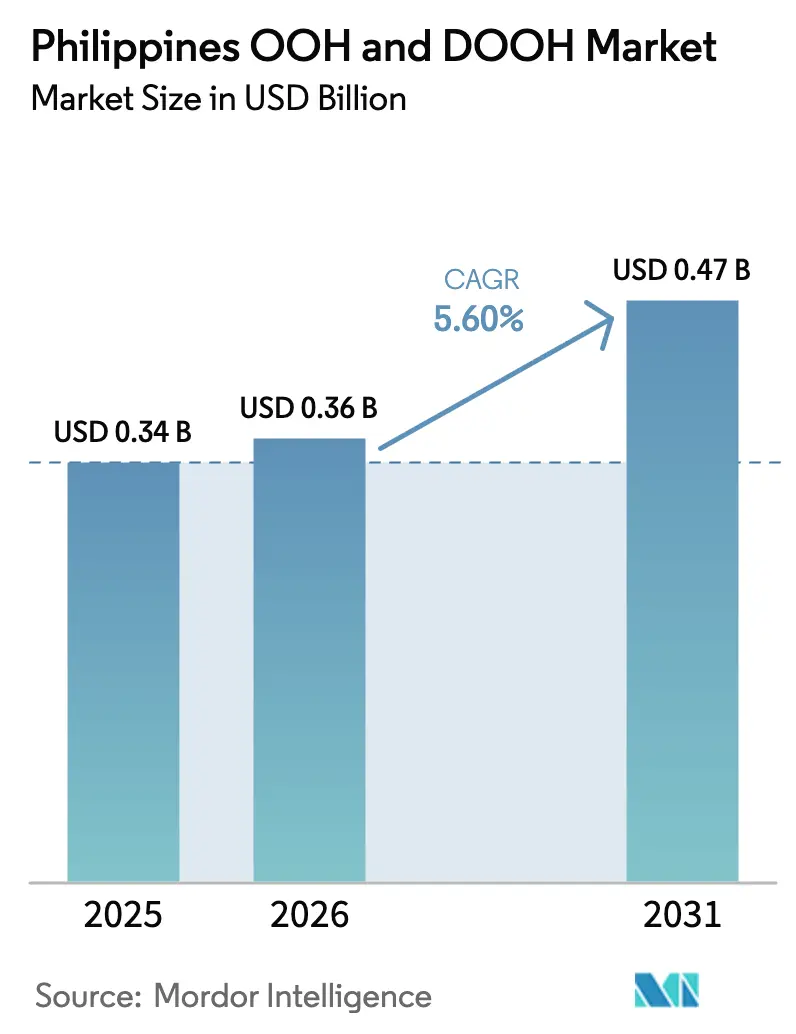
| Base Year Market Size (2025) | USD 0.34 Billion |
| Market Size (2026) | USD 0.36 Billion |
| Market Size (2031) | USD 0.47 Billion |
| Growth Rate (2026 - 2031) | 5.60 % |
| Market Concentration | Medium |
Major Players *Disclaimer: Major Players sorted in no particular order Image © Mordor Intelligence. Reuse requires attribution under CC BY 4.0. | |
Philippines OOH And DOOH Market Analysis by Mordor Intelligence
The Philippines OOH and DOOH market size in 2026 is estimated at USD 0.36 billion, growing from 2025 value of USD 0.34 billion with 2031 projections showing USD 0.47 billion, growing at 5.6% CAGR over 2026-2031. This upward trajectory reflects advertisers’ migration toward data-driven screens, the government’s digital-first public information push, and solar-powered LED rollouts that reduce operating costs in rural sites.[1] Billboards keep the lion’s share of spend, yet programmatic DOOH inventory sells faster as trading desks seek the same real-time flexibility enjoyed in mobile channels. Transportation terminals, from the Mactan-Cebu International Airport to the Parañaque Integrated Terminal Exchange, supply premium impressions that combine long dwell times with affluent traveler demographics. High mobile usage and social-media penetration enable closed-loop attribution that proves outdoor’s contribution to omnichannel journeys. At the same time, foreign-ownership caps of 30% protect local incumbents and encourage joint ventures that upgrade legacy structures without surrendering control.[2]
Key Report Takeaways
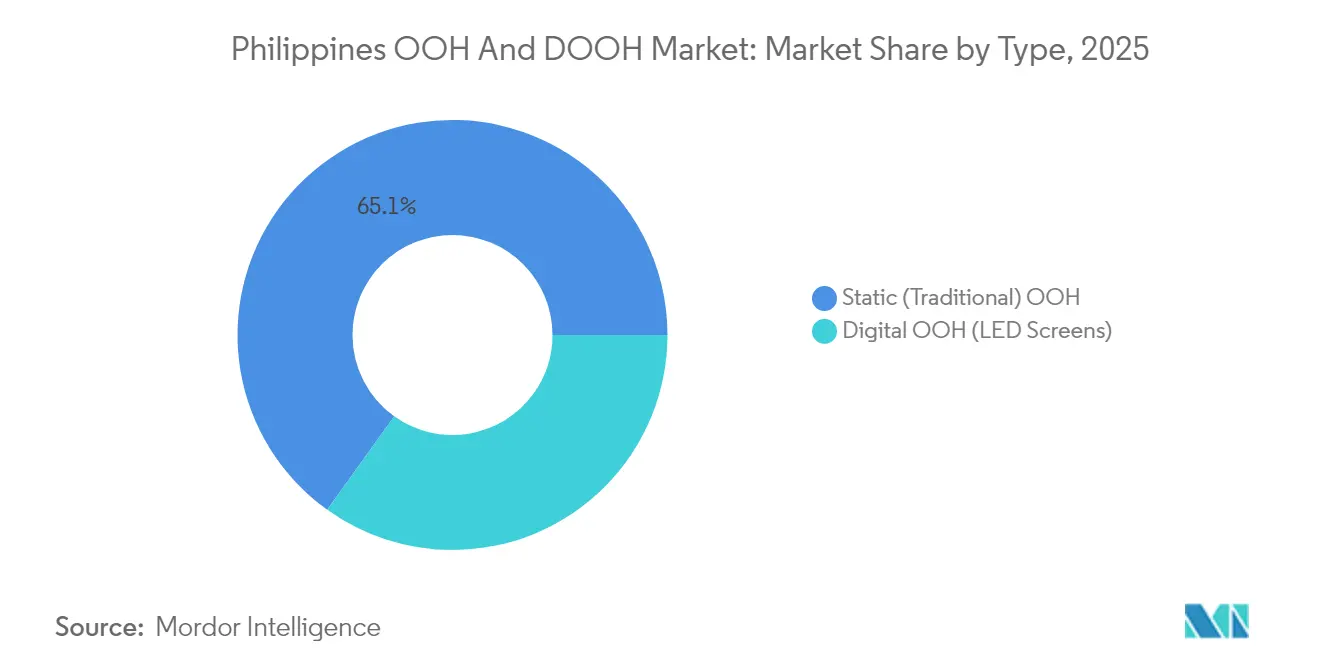
- By type, static formats commanded 65.10% of the Philippines OOH and DOOH market share in 2025, while programmatic DOOH is advancing at a 7.02% CAGR through 2031.
- By application, billboard media led with 49.08% of revenue in 2025 in the Philippines OOH and DOOH market; transportation-based placements are projected to grow at a 6.45% CAGR to 2031.
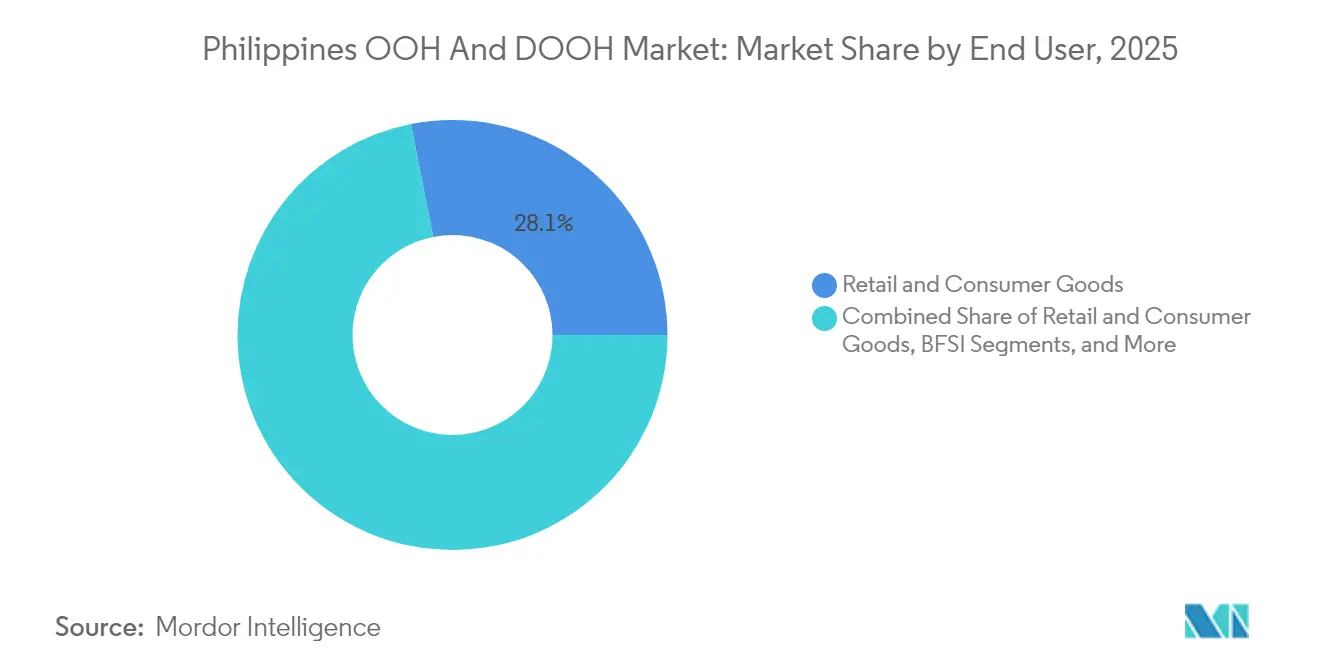
- By end user, retail and consumer goods held 28.10% share of the Philippines OOH and DOOH market size in 2025, whereas healthcare is set to expand at a 6.25% CAGR between 2026-2031.
Note: Market size and forecast figures in this report are generated using Mordor Intelligence’s proprietary estimation framework, updated with the latest available data and insights as of 2026.
Market Trends and Insights
Drivers Impact Analysis of Philippines OOH And DOOH Market*
| Driver | (~) % Impact on CAGR Forecast | Geographic Relevance | Impact Timeline |
|---|---|---|---|
| Ongoing shift toward digital advertising | +1.2% | National, concentrated in Metro Manila and Cebu | Medium term (2-4 years) |
| Rapid adoption of programmatic DOOH transactions | +0.8% | Metro Manila, expanding to regional cities | Short term (≤ 2 years) |
| Urban-rail and airport expansion delivering premium screen inventory | +0.6% | Metro Manila, Cebu, Davao with spillover to secondary cities | Long term (≥ 4 years) |
| High mobile and social penetration enabling omnichannel retargeting | +0.5% | National coverage with urban concentration | Medium term (2-4 years) |
| Government procurement of public-information LED networks | +0.4% | National, prioritizing disaster-prone areas | Long term (≥ 4 years) |
| Solar-powered LED deployments lowering rural OPEX | +0.3% | Rural and off-grid regions, Mindanao focus | Long term (≥ 4 years) |
| Source: Mordor Intelligence | |||
Ongoing Shift Toward Digital Advertising
Advertisers continue to reallocate budgets from print and TV to digital screens that combine sight, scale, and real-time triggers. Samsung’s first programmatic DOOH flight with Moving Walls proved that creative can change automatically with traffic congestion and weather feeds, giving planners a seamless bridge between online and offline channels. As agencies demand proof of effectiveness, digital measurement dashboards deliver impression counts, dwell times, and cross-device lift that static posters cannot match. Brands now schedule day-parted messaging to catch commuters at lunch breaks or shoppers during pay-day weekends, achieving inventory utilization gains for media owners. Falling LED prices and energy-saving diodes improve return on investment, further accelerating the switch from paste-on vinyl to dynamic pixels. The trend aligns with the Philippines’ mobile-first culture, reinforcing DOOH as a natural extension of social advertising strategies.
Rapid Adoption of Programmatic DOOH Transactions
Automated buying unlocks efficiencies by letting trading desks bid on screens the same way they purchase mobile-video impressions. Platforms such as Hivestack and Vistar Media plug into supply-side integrations at United Neon and Summit Outdoor Media, replacing email orders with real-time bidding. Standardized audience definitions established by the Out-of-Home Advertising Association of the Philippines (OHAAP) cut reconciliation cycles and improve transparency for multinational brands. Advertisers pause and resume flights instantly, reallocating spend toward hotspots with higher footfalls, thereby lowering waste. Dynamic pricing incentivizes operators to upgrade hardware capable of rendering high-resolution creatives that meet brand safety guidelines. Early case studies show cost-per-reach reductions of up to 18% versus manually traded loops, providing financial headroom for incremental spend.
Urban-Rail and Airport Expansion Delivering Premium Screen Inventory
The Department of Transportation’s multi-line rail build-out introduces concourse-wide LEDs, platform-edge panels, and carriage-mounted screens that generate fresh impressions every three minutes during peak hours. Mactan-Cebu International Airport’s new terminal houses wrap-around videowalls that sell at CPMs 2.5× higher than roadside equivalents due to affluent traveler mixes. Additional terminals in Clark and Davao embed content-management systems designed for programmatic triggers tied to flight arrivals. Beyond airports, the Cebu Bus Rapid Transit project reserves digital pylons at stations, providing advertisers with geo-fenced mobility audiences. These transportation nodes not only diversify inventory away from saturated EDSA highway corridors but also enable long-form storytelling thanks to extended dwell times.
High Mobile and Social Penetration Enabling Omnichannel Retargeting
Filipinos spend 5 hours 47 minutes daily on mobile devices, ranking among the world’s most engaged online audiences. DOOH networks now incorporate QR codes, NFC chips, and short URLs that push shoppers toward in-store or e-commerce checkouts within minutes of exposure. Geofencing allows brands to follow up with coupon ads on Facebook or TikTok after a commuter passes a station screen, closing the attribution loop. Aggregated mobility data reveals audience clusters around malls, universities, and business districts, guiding advertisers on where to deploy extra loops at minimal incremental cost. Insights from social listening further refine creative, resulting in contextual messaging that references trending hashtags or live sports scores. The outcome is a measurable uptick in click-through and conversion metrics that strengthens DOOH’s claim on mid-funnel budgets.
Restraints Impact Analysis of Philippines OOH And DOOH Market*
| Restarint | (~) % Impact on CAGR Forecast | Geographic Relevance | Impact Timeline |
|---|---|---|---|
| Fragmented audience-measurement standards | -0.7% | National, affecting programmatic adoption across all major cities | Medium term (2-4 years) |
| Stringent billboard zoning and permit caps | -0.4% | Metro Manila, Cebu, Davao with strict enforcement | Short term (≤ 2 years) |
| Grid unreliability and high energy costs outside NCR | -0.3% | Provincial markets, Mindanao, rural areas | Long term (≥ 4 years) |
| Budget diversion to 'fake-OOH' CGI social campaigns | -0.2% | National, concentrated in urban markets with high social media penetration | Medium term (2-4 years) |
| Source: Mordor Intelligence | |||
Fragmented Audience-Measurement Standards
Media owners use disparate methodologies, from camera-based footfall counts to mobile-device panels, leading to inconsistent audience definitions that discourage unified buying across suppliers. Global brands accustomed to GRP-equivalent metrics in mature markets hesitate to commit large budgets without standardized reach and frequency reporting. The resulting opacity forces demand-side platforms to apply conservative multipliers that undervalue Philippine impressions, suppressing yield. Smaller operators lacking analytics capabilities struggle to participate in programmatic deals, risking marginalization. Until OHAAP’s common currency gains marketwide adoption, advertisers will cap DOOH allocations, slowing the sector’s full revenue potential.
Stringent Billboard Zoning and Permit Caps
Supreme Court rulings affirming the Metropolitan Manila Development Authority’s oversight powers embolden local governments to impose tighter height, size, and distance regulations on new structures.[3] Permit moratoriums along EDSA and C-5 aim to mitigate driver distraction but inadvertently create scarcity that favors incumbents with grandfathered placements. Complex fee structures lengthen approval timelines to as much as 14 months, deterring new entrants and delaying digital upgrades. While self-regulatory efforts under the Metro Manila Outdoor Media Magna Carta seek compromise, stricter municipal ordinances persist, especially in heritage zones such as Intramuros. Inventory bottlenecks limit the pace at which programmatic suppliers can onboard screens, constraining scale for automated trading.
*Our forecasts treat driver/restraint impacts as directional, not additive. The impact forecasts reflect baseline growth, mix effects, and variable interactions.
Philippines OOH And DOOH Market Segment Analysis
By Type:
Programmatic DOOH Drives Digital TransformationTraditional static inventory controlled 65.10% of spending in 2025, underscoring the entrenched network of vinyl billboards lining national highways. Even so, programmatic-enabled screens are on track to register a 7.02% CAGR through 2031, the quickest sub-segment within the Philippines OOH and DOOH market. Advertisers value real-time triggers that adjust creatives based on weather, traffic, or event feeds, which drive premium CPMs that exceed static rates by up to 40%. Media owners are embedding solar panels and smart battery systems that reduce energy overhead outside the National Capital Region, accelerating the migration from traditional formats.
The Philippine OOH and DOOH market size for programmatic screens is predicted to grow from USD 0.1 billion in 2026 to USD 0.14 billion by 2031. Operators balance portfolios that cover both static roadside posters and digital LEDs to serve brands with diverse budget thresholds. Summit Outdoor Media’s Broadsign deployment exemplifies how legacy suppliers modernize without cannibalizing existing revenue streams. Lower diode and controller costs, combined with enhanced brightness, make it feasible to retrofit previously analog faces, thereby hastening the nationwide momentum for cross-inventory digitization.

By Application:
Transportation Hubs Command Premium GrowthBillboard media delivered 49.08% of revenue in 2025, fueled by the strategic placement of large-format canvases along Skyway and North Luzon Expressway corridors. Transportation venues, airports, light-rail stations, bus termini, will expand at a 6.45% CAGR thanks to sustained infrastructure investment in Clark, Cebu, and Davao that unlocks new display real estate. The Philippines OOH and DOOH market share for transportation formats is projected to reach 18.75% by 2031 as operators capitalize on captive audiences with extended dwell times.
Metro rail extensions encourage suppliers to adopt platform-edge screens that synchronize content with train arrivals. Airline lounges integrate facial-recognition anonymized analytics to tailor luxury goods messaging based on anonymized passenger demographics. Meanwhile, bus fleets in provincial routes test roof-mounted LEDs that geotarget ads to roadside communities. Together, these deployments diversify revenue beyond traditional roadside faces, cushioning operators against regulatory inventory caps inside city centers.
By End User:
Healthcare Accelerates Digital AdoptionRetail and consumer goods captured 28.10% of spend in 2025, reflecting FMCG brands’ need for high-frequency reminders near point-of-sale. Still, healthcare is on pace for a 6.25% CAGR as telemedicine providers and pharmaceutical firms use DOOH to educate patients about remote diagnosis options and seasonal vaccination drives. The Philippines OOH and DOOH market size tied to healthcare messaging is forecast to climb from USD 0.05 billion in 2026 to USD 0.07 billion by 2031, nudging other verticals to refine contextual storytelling.
Pandemic-era habits pushed consumers toward digital health portals, making outdoor displays a strategic touchpoint for appointment booking prompts. QR-enabled creative funnels viewers to sign-up pages while complying with data-privacy regulations. BFSI and automotive advertisers also step up DOOH activity, seeking to heighten brand trust and showroom foot traffic in an economy where mobility loans and car ownership rise in tandem with GDP per capita.
Geography Analysis
Metro Manila dominates revenue because it accommodates over 13 million residents and hosts 70% of corporate headquarters. Screens along EDSA, Ortigas, and BGC register occupancy rates above 90%, creating a dense network ideal for frequency-based campaigns. Cebu and Davao power the second tier, buoyed by airport expansions that introduce wrap-around LEDs in arrival halls and baggage claims. Together, these three metros account for just under 80% of Philippines OOH and DOOH market spend, a concentration driven by advertiser preference for urban footfall.
Regional prospects brighten as solar modules cut energy costs in Visayas and Mindanao, where grid electricity averages PHP 9.86 per kWh, triple Malaysia’s benchmark. Operators deploy hybrid battery arrays to maintain brightness during brownouts, preserving advertiser confidence in uptime SLAs. Island geography complicates hardware servicing, hence media owners with nationwide maintenance fleets secure competitive edges. LGUs differ in permit guidelines: Bacolod incentivizes smart city solutions by offering tax breaks for LED retrofits, whereas Baguio caps board density to preserve heritage vistas.
Government road-widening and expressway projects, including the Central Luzon Link Expressway, unlock new sightlines and stanchions. This supply eases Metro Manila congestion yet imposes logistical hurdles, such as barge transport for structures bound for island provinces like Palawan. The interplay of infrastructure build-out, local regulations, and divergent power costs defines the three-speed growth model: urban core, emergent metros, and rural frontier.
Competitive Landscape
The market exhibits a moderate concentration level: the top five players control roughly 46% of aggregated spend. JCDecaux leverages global design standards to win high-yield airport concessions, but foreign ownership caps necessitate joint ventures, as seen in its partnership for Ninoy Aquino International Airport Terminal 3. United Neon parries with long-standing relationships at Mactan-Cebu Airport, installing networked LEDs across boarding gates. Summit Outdoor Media, armed with Broadsign CMS, prioritizes provincial rollouts, tallying over 200 solar-powered faces by 2025.
Programmatic enablers, Moving Walls, Hivestack, and Vistar Media, sit upstream, integrating SSP modules that convert analog loops into bid-enabled slots. They sign exclusivity deals to lock in supply and embed SDKs for real-time impression tracking. OHAAP steers self-regulation, lobbying for measurement harmonization that benefits both multinationals and smaller independents. White-space pockets remain in secondary cities where real estate developers bundle ad rights with mixed-use projects. Operators that combine data analytics with energy-efficient hardware vie for these concessions, positioning themselves for above-average yield as urbanization broadens beyond NCR.
Philippines OOH And DOOH Industry Leaders
-
JCDecaux SE
-
Clear Channel Outdoor Holdings
-
United Neon Advertising Inc.
-
Broadsign International LLC
-
Outcomm Inc.
- *Disclaimer: Major Players sorted in no particular order

Philippines OOH And DOOH Market Companies Covered in this Report
- JCDecaux SE
- United Neon Advertising Inc.
- Summit Publishing Co. Inc. (Summit Outdoor Media)
- Outcomm Inc.
- Clear Channel Outdoor Holdings Inc.
- Hivestack Inc.
- Moving Walls Holdings Pte. Ltd.
- Vistar Media LLC
- VIOOH Ltd.
- Plan B Media Public Company Limited
- EYE Indonesia PT
- Pixel Inc. (Philippines)
- Jaris and K Advertising Corporation
- Moove Media Pte Ltd.
- Daktronics Inc.
- Broadsign International LLC
- Tag Digital Consultancy Inc.
- Big Ant Billboards Corp.
- Prime Ads Inc.
- HDI Adventures Inc.
Recent Industry Developments in Philippines OOH And DOOH Market
- December 2024: OHAAP marked its 56th anniversary with new leadership, underscoring its role in self-regulation and metrics unification.
- November 2024: Summit Outdoor Media expanded its Broadsign agreement to scale dynamic content management across its national network.
- March 2024: Senator Imee Marcos filed Senate Bill 2624 to classify billboards as lawful election propaganda, paving the way for higher campaign-season inventory demand.
- February 2024: Moving Walls and OHAAP partnered to craft unified audience-measurement standards for programmatic DOOH, reducing reporting friction for agencies.
Philippines OOH And DOOH Market Report Scope
Digital out-of-home (DOOH) advertising refers to dynamic, digital ads displayed in both indoor and outdoor public spaces. Essentially, it merges digital elements with conventional out-of-home advertising. This shift towards digital OOH has overtaken traditional offline out-of-home advertising.
The Philippines OOH and DOOH market is segmented by type (static (traditional) OOH, Digital OOH (LED Screens), programmatic OOH, and others), by application (billboard, transportation (transit) (airports, others (buses, etc.)), street furniture, and other place-based media), and by end-user industry (automotive, retail and consumer goods, healthcare, BFSI, and others). The market sizes and forecasts are provided in terms of value (USD) for all the above segments.
Segmentation Overview
| Static (Traditional) OOH | |
| Digital OOH (LED Screens) | Programmatic OOH |
| Others |
| Billboard | |
| Transportation (Transit) | Airports |
| Others (Buses, etc.) | |
| Street Furniture | |
| Other Place-based Media |
| Automotive |
| Retail and Consumer Goods |
| Healthcare |
| BFSI |
| Other End Users |
| By Type | Static (Traditional) OOH | |
| Digital OOH (LED Screens) | Programmatic OOH | |
| Others | ||
| By Application | Billboard | |
| Transportation (Transit) | Airports | |
| Others (Buses, etc.) | ||
| Street Furniture | ||
| Other Place-based Media | ||
| By End User | Automotive | |
| Retail and Consumer Goods | ||
| Healthcare | ||
| BFSI | ||
| Other End Users | ||
Key Questions Answered in the Report
What is the current value of the Philippines OOH and DOOH market?
The market is valued at USD 0.36 billion in 2026.
How fast is programmatic DOOH growing in the Philippines?
Programmatic inventory is projected to post a 7.02% CAGR through 2031.
Which application area is expanding the quickest?
Transportation-based screens, buoyed by airport and urban-rail projects, are forecast to grow at 6.45% CAGR.
Why do energy costs affect rural billboard digitization?
Provincial grid rates average PHP 9.86 per kWh, elevating operating costs and making solar solutions critical.
What regulatory change could impact election-season advertising?
Senate Bill 2624 proposes classifying billboards as lawful election propaganda, potentially widening campaign spending.