
Market Overview
| Study Period | 2020 - 2031 |
|---|---|
| Forecast Data Period | 2026 - 2031 |
| Base Year Market Size (2025) | USD 9.52 Billion |
| Market Size (2026) | USD 9.79 Billion |
| Market Size (2031) | USD 11.28 Billion |
| Growth Rate (2026 - 2031) | 2.86 % |
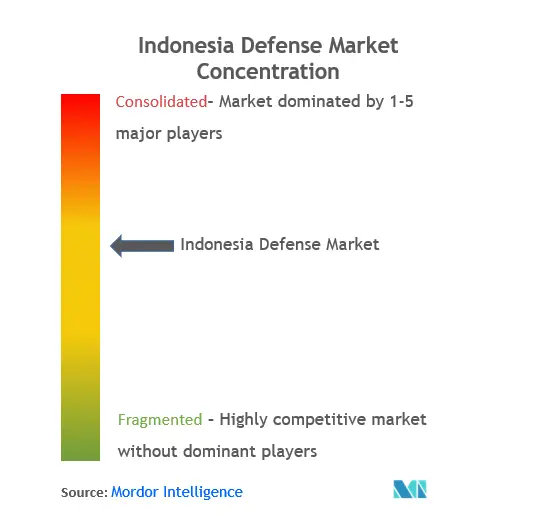
| Market Concentration | Medium |
Major Players *Disclaimer: Major Players sorted in no particular order Image © Mordor Intelligence. Reuse requires attribution under CC BY 4.0. | |
Indonesia Defense Market Analysis by Mordor Intelligence
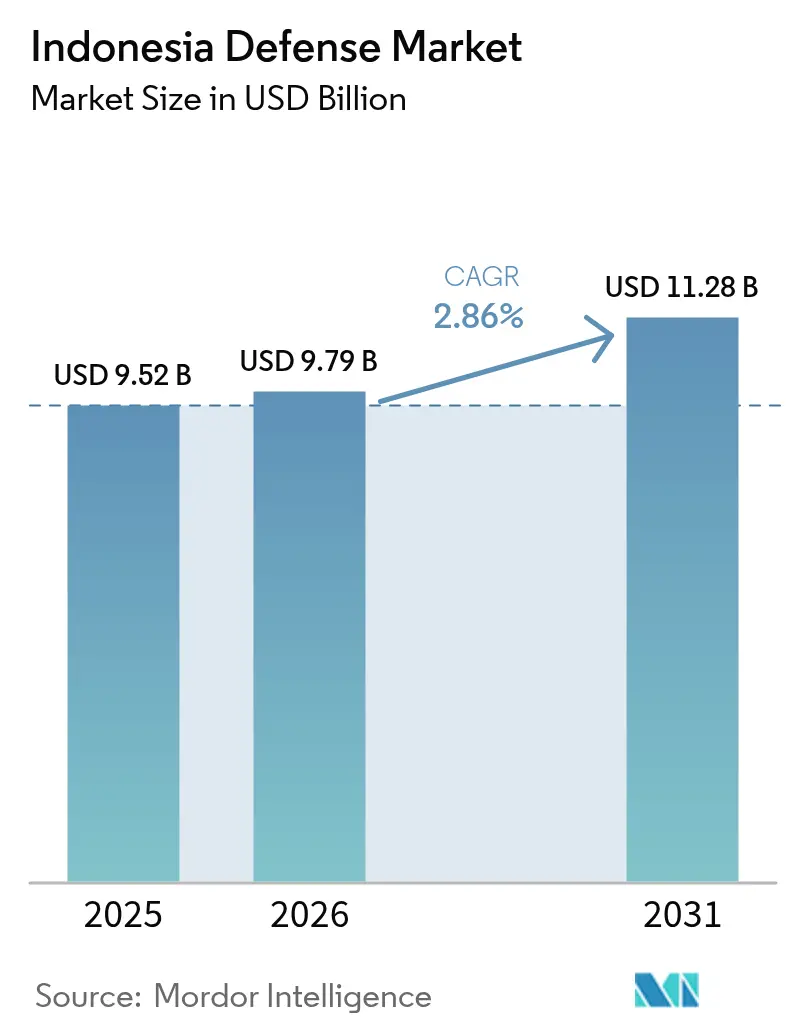
The Indonesia Defense Market size was valued at USD 9.52 billion in 2025 and estimated to grow from USD 9.79 billion in 2026 to reach USD 11.28 billion by 2031, at a CAGR of 2.86% during the forecast period (2026-2031).
Indonesia's military modernization strategy has entered a transformative phase, with the government implementing comprehensive reforms to enhance its defense capabilities. The country has announced plans to invest USD 125 billion over the next three years in upgrading and modernizing its defense equipment, with nearly two-thirds (USD 79.1 billion) allocated for new military equipment and USD 32.5 billion earmarked for contingencies and maintenance. This substantial investment reflects Indonesia's commitment to developing a robust military defense infrastructure capable of addressing evolving regional security challenges, particularly in response to territorial disputes in the South China Sea.
The Indonesian defense industry is witnessing a significant shift towards indigenous manufacturing capabilities through strategic partnerships and defense technology transfer agreements. The government's focus on developing local expertise has led to successful collaborations between domestic and international manufacturers, particularly in the development of land vehicles, arms, and missile systems. Indonesian state-owned enterprises are actively expanding their production capabilities, with companies like PT Pindad securing major contracts for local manufacturing of military equipment, including a USD 1.3 billion order for 4 billion ammunition units to be delivered by 2023.
The country's military modernization efforts are aligned with its Minimum Essential Force (MEF) initiative, which adopts a capability-based defense approach. This strategic framework has catalyzed several high-profile procurement programs, including plans to acquire 36 Dassault Rafale fighter jets and Boeing F-15EX Advanced Eagle multirole fighters. The air force modernization program also encompasses the procurement of Airbus A330 Multi-Role Tanker Transport aircraft and Lockheed Martin C-130J Super Hercules transports, demonstrating Indonesia's commitment to enhancing its aerial capabilities.
Naval modernization remains a crucial component of Indonesia's defense strategy, with significant investments in maritime capabilities to protect its vast archipelagic waters. The country has initiated several major naval defense procurement programs, including contracts with South Korean shipbuilder Daewoo Shipbuilding and Marine Engineering (DSME) worth USD 1 billion for the construction of three Nagapasa Type 209/1400 diesel-electric submarines. Additionally, Indonesia has engaged in partnerships with European manufacturers for the procurement of advanced defense systems, including negotiations with France for four Scorpene submarines armed with Exocet SM39 missiles and two 2,500-ton Gowind corvettes, highlighting the country's focus on strengthening its maritime military defense capabilities.
Note: Market size and forecast figures in this report are generated using Mordor Intelligence’s proprietary estimation framework, updated with the latest available data and insights as of 2026.
Indonesia Defense Market Trends and Insights
Growing Military Modernization Plans and Defense Budget
Indonesia has embarked on an ambitious military modernization initiative, with the presidential office announcing a substantial USD 125 billion investment plan extending through the mid-2040s. This comprehensive plan allocates USD 79 billion specifically for military equipment acquisition, while USD 32.5 billion is earmarked for sustainment over 25 years, demonstrating Indonesia's commitment to long-term military capability enhancement. The modernization efforts are evident in recent procurement activities, such as the completion of a 42-aircraft Rafale order in January 2024, with deliveries strategically phased across multiple installments. Additionally, the February 2024 order of three CN235-220 transport aircraft from PT Dirgantara Indonesia (PTDI) for USD 85 million further exemplifies the country's focus on expanding its defense logistics capabilities.
The Indonesian Ministry of Finance's strategic allocation of approximately 32% of the defense budget towards modernization projects in 2022 underscores the government's prioritization of military advancement. This substantial budgetary commitment encompasses both procurement and sustainment initiatives, reflecting a balanced approach to military modernization. The focus on acquiring advanced platforms like the Rafale fighter jets, which offer superior air combat capabilities, and the tactical transport aircraft CN-235, designed for efficient military logistics operations, demonstrates Indonesia's comprehensive approach to military modernization. These investments are particularly significant as they represent a shift towards more sophisticated military capabilities while maintaining operational efficiency through the acquisition of purpose-built platforms like the CN-235, which complements larger transport aircraft such as the C-130 Hercules.
Understand The Key Trends Shaping This Market
Download Sample
Rising Regional Security Concerns and Force Enhancement
Indonesia's defense strategy is significantly influenced by escalating regional security concerns, prompting substantial investments in force enhancement and capability development. The nation maintains a robust military force of approximately 404,500 personnel across its Army, Navy, and Air Force, equipped with various sophisticated defense weapons systems and platforms. This substantial force structure is continuously being enhanced through strategic procurement initiatives, as evidenced by the acquisition of 1,857 riot guns worth USD 3.3 million in July 2023, demonstrating the country's commitment to maintaining internal security while preparing for external challenges. The revision of the Minimum Essential Force (MEF) target to 70% for the 2019-2024 phase reflects a pragmatic approach to force development, balancing ambitious military objectives with practical constraints.
The enhancement of military capabilities is further demonstrated through the systematic modernization of existing platforms and the acquisition of new systems across all service branches. The Indonesian Air Force's initiative to upgrade its entire fleet of F-16 A/B airframes through the Falcon STAR (Structural Augmentation Roadmap) and enhanced mid-life upgrade (EMLU) program exemplifies this comprehensive approach to force enhancement. These upgrades include structural reinforcement, improved avionics, and enhanced weapon systems, including the integration of sophisticated identification friend-or-foe (IFF) systems. Such modernization efforts are crucial for maintaining operational effectiveness and interoperability with allied forces, particularly in addressing evolving regional security challenges.
Focus on Domestic Defense Industry Development
Indonesia has demonstrated a strong commitment to developing its domestic defense industrial base, implementing policies that prioritize local manufacturers while seeking strategic international partnerships for technology transfer and capability enhancement. This commitment was notably exemplified in August 2023 when Indonesia initiated discussions with Saudi Arabia to strengthen its defense sector, providing a platform for state-owned manufacturers like Pindad to showcase their capabilities and explore collaborative opportunities. The emphasis on technology transfers and offset agreements in defense procurement deals reflects a strategic approach to building indigenous capabilities while maintaining access to advanced defense technology. This focus on domestic industry development is particularly evident in the activities of key state-owned enterprises such as PT PAL Indonesia, PT Pindad, and PT Dirgantara Indonesia, which are actively expanding their product portfolios and manufacturing capabilities.
The government's support for domestic defense manufacturers is further demonstrated through strategic partnerships and production agreements with international defense companies. Local manufacturers have shown significant progress in developing indigenous platforms, from small arms and ammunition to more complex systems like the Anoa armored personnel carrier and CN-235 transport aircraft. The success of PT Dirgantara Indonesia in securing a USD 85 million contract for three CN235-220 transport aircraft in February 2024 demonstrates the growing capabilities and competitiveness of Indonesia's domestic defense industry. These developments are complemented by initiatives to enhance research and development capabilities, establish advanced manufacturing facilities, and create a sustainable ecosystem for defense technology innovation, ultimately reducing dependence on foreign suppliers while building a robust domestic defense industrial base.
Segment Analysis: By Type
Vehicles Segment in Indonesia Defense Market
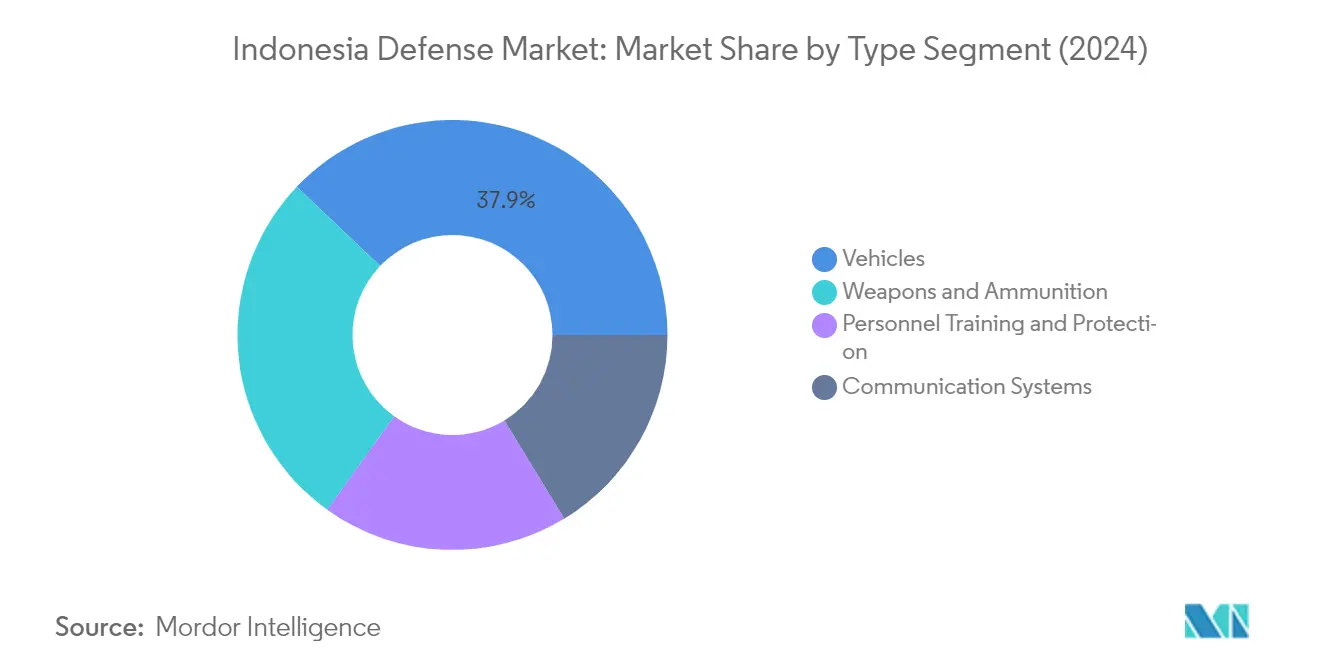
The defense vehicles segment continues to dominate the Indonesian defense market, accounting for approximately 37.40% of the total market share in 2025. This significant market position is driven by Indonesia's comprehensive fleet modernization initiatives across land, sea, and air domains. The country has been actively procuring various vehicles, including fighter aircraft, transport aircraft, tanks, frigates, hydrographic survey ships, and submarines. The Indonesian government's focus on developing local manufacturing capabilities through collaboration with foreign players has also strengthened this segment, with state-owned companies like PT PAL Indonesia and PT Dirgantara Indonesia playing crucial roles in defense vehicles production and maintenance.
Weapons and Ammunition Segment in Indonesia Defense Market
The defense ammunition segment is projected to exhibit the highest growth rate of approximately 4.37% during the forecast period 2026-2031. This growth is primarily driven by Indonesia's increasing focus on enhancing its indigenous manufacturing capabilities for small arms and ammunition. The government's encouragement of local manufacturers, coupled with several technology transfer agreements with foreign players, has strengthened domestic production capabilities. Local players are also investing in research and development of advanced weapon systems like missiles and rocket launchers. PT Pindad, the state-owned arms manufacturer, has been expanding its production capabilities and developing new weapon systems to meet the growing domestic demand for defense ammunition.
Remaining Segments in Indonesia Defense Market by Type
The personnel defense training and protection segment and military communications systems segment continue to play vital roles in Indonesia's defense modernization efforts. The personnel training and protection segment focuses on creating a force capable of meeting minimum response requirements for various strategic threats, while the communication systems segment emphasizes developing Network Centric Operations capabilities. These segments are crucial for enhancing interoperability among the armed forces and building a modern, well-trained military force. The implementation of new training programs, acquisition of advanced communication systems, and development of C4ISR capabilities demonstrate Indonesia's commitment to comprehensive military modernization across all defense systems.
Competitive Landscape
Top Companies in Indonesia Defense Market
The Indonesian defense market features a mix of domestic state-owned enterprises and global defense contractors. The industry demonstrates a strong focus on product innovation, particularly in areas like naval vessels, communication systems, and ammunition manufacturing. Companies are increasingly investing in research and development to enhance their technological capabilities, with particular emphasis on indigenous defense technology manufacturing capabilities. Operational agility is evidenced through strategic partnerships between local and international players, enabling technology transfer and knowledge sharing. Strategic moves in the market are characterized by long-term modernization programs and a focus on developing self-reliant defense systems capabilities. Market expansion is primarily driven by companies' efforts to diversify their product portfolios and establish a presence across multiple aerospace and defense domains, while also exploring opportunities in adjacent markets like cybersecurity and commercial aviation.
State-Owned Enterprises Lead Local Defense Production
The Indonesian defense market exhibits a unique structure where state-owned enterprises like PT PAL Indonesia, PT Pindad, and PT LEN Industri dominate the local manufacturing landscape, while global players like BAE Systems, Leonardo, and Airbus maintain a significant presence through partnerships and direct sales. These domestic companies operate as specialized entities focusing on specific segments such as naval vessels, ammunition, and communication systems, while international conglomerates offer comprehensive defense solutions across multiple domains. The market demonstrates moderate consolidation, with state-owned enterprises enjoying preferential status in government procurement programs while maintaining collaborative relationships with foreign players.
The market is characterized by an increasing emphasis on technology transfer agreements and joint development programs between local and international players. Merger and acquisition activities are primarily focused on strengthening domestic capabilities through strategic partnerships rather than outright acquisitions. The government's push for localization of defense manufacturing has created an environment where international players are incentivized to establish long-term partnerships with local companies, leading to a gradual transformation of the competitive landscape from pure import dependence to collaborative development and manufacturing.
Innovation and Localization Drive Market Success
For incumbent players to maintain and increase their market share, focus needs to be placed on developing advanced technological capabilities while maintaining strong relationships with government stakeholders. Success strategies include investing in research and development of indigenous technologies, establishing robust supply chains within Indonesia, and developing expertise in emerging areas like cybersecurity and autonomous systems. Companies must also demonstrate commitment to supporting Indonesia's goal of defense self-reliance through technology transfer and local manufacturing initiatives, while maintaining competitive pricing and quality standards.
New entrants and contenders in the market face both opportunities and challenges in gaining ground. The key to success lies in identifying niche capabilities that complement existing domestic capabilities while offering innovative solutions in emerging technology areas. Companies must navigate the complex regulatory environment that favors domestic producers while finding ways to participate in Indonesia's defense ecosystem through partnerships and joint ventures. The market shows moderate end-user concentration with the government as the primary customer, while substitution risks are mitigated by long-term contracts and established relationships. Regulatory frameworks continue to evolve, with increasing emphasis on local content requirements and technology transfer obligations. The integration of defense electronics and defense intelligence systems is becoming increasingly critical in meeting these evolving demands.
Indonesia Defense Industry Leaders
PT Pindad
PT PAL Indonesia
FINCANTIERI S.p.A.
Airbus SE
PT. Dirgantara Indonesia
- *Disclaimer: Major Players sorted in no particular order


Market Opportunities and Future Outlook
Indonesia's modernization drive continues to open room for procurement and industrial participation across air, land, and naval programs, and the 2026 fiscal allocation highlights major-weapon-system modernization under Presidential Regulation No. 118 of 2025. Opportunities are most visible where acquisitions are paired with local workshare and technology transfer, including PT PAL Indonesia starting pre-production for the Scorpene Evolved submarine project with Naval Group (May 2026), and the continuing role of state-owned enterprises (PT PAL Indonesia, PT Pindad, PT Dirgantara Indonesia) in platform production, MRO, and local supply-chain development.
Demand is also building beyond traditional platforms, particularly around missiles, unmanned systems, and aerospace ecosystem capability development. Indonesia's reported July 2026 BrahMos missile deal and related cooperation with Bharat Dynamics point to momentum in guided weapons and associated support infrastructure, while the 2025 Bappenas roadmap, A Resilient and Competitive Aerospace Industry Towards Golden Indonesia 2045, highlights targeted development areas including UAV cargo and flight simulators. Together, these initiatives correspond to the shift from Minimum Essential Force (MEF) toward an Optimum Essential Force approach, creating clearer openings for integrators and subsystem suppliers across C4ISR, training, and sustainment tied to fleet upgrades and newly inducted assets.
Recent Industry Developments
- June 2026: Fincantieri and REPUBLIKORP signed a memorandum of understanding to establish a strategic partnership for multi-role naval shipbuilding in Indonesia. The collaboration framework covers local construction of vessels such as LPDs, LHDs, frigates, and submarines, tightening the linkage between procurement and domestic industrial capability building.
- May 2026: Indonesia's Ministry of National Development Planning (Bappenas) and Airbus signed a Joint Declaration of Intent to strengthen the national aerospace ecosystem. The initiative focuses on manufacturing capability, alignment to international standards, and workforce development, supporting deeper integration of Indonesian industry into global aerospace supply chains.
- March 2024: Fincantieri signed a contract for the supply of two PPA (Pattugliatori Polivalenti d'Altura) vessels to Indonesia. The award reinforces Indonesia's naval fleet modernization pipeline and supports follow-on activity across training, spares, and lifecycle support for complex surface combatants.


Research Methodology Framework and Report Scope
Market Definition and Coverage
This market is defined as Indonesia's defense-related spending that turns into delivered defense capability, mainly through procurement and modernization of military equipment and supporting systems across land, naval, and air domains.
Scope exclusions: We exclude pure internal security and policing purchases, and we also exclude informal or unreported spend that cannot be tied to a defense program or contracting line.
Segmentation Overview
- By Type
- Personnel Training and Protection
- Communication Systems
- Weapons and Ammunitions
- Artillery and Mortar Systems
- Infantry Weapons
- Missile and Missile Defense Systems
- Ammunition
- By Vehicles
- Land-based Vehicles
- Sea-based Vehicles
- Air-based Vehicles
Data Sources, Market Sizing, and Validation
Desk Research
Desk research started with mapping the demand side using official and public statistics that anchor budget direction and the wider economic capacity to spend. Sources we leaned on include the SIPRI military expenditure database, World Bank WDI indicators for military spend and macro context, Indonesia budget documents and related releases from the Ministry of Finance, and selected publications from the Ministry of Defense and parliamentary materials when accessible.
On the supply and delivery side, we reviewed public procurement announcements, government audit-style documents, and reputable press coverage to understand what is being ordered and the delivery timing that follows from contracts. We also used company filings, investor presentations, and contract disclosures where they help link platforms to likely value bands. In parallel, a paid subscription for company financials and intelligence, plus a global contracts and tenders database, was used selectively to cross-check timelines and normalize deal values when only partial information is disclosed. The sources listed above are illustrative and not exhaustive, and additional public documents and datasets were also referenced to collect data, validate assumptions, and clarify open points.
Primary Interviews and Surveys
Primary work focused on validating what part of the defense budget typically converts into equipment and systems value in-year, and what portion shifts because of delivery slippages and multi-year contracting. We spoke with procurement and program stakeholders, local industry participants, and defense domain specialists in Indonesia, and then used those inputs to confirm assumptions on import content, local assembly, and likely unit-cost movement for key categories.
Because this is a single-country market, our questions were framed around Indonesia-specific buying cycles and approvals, and we used follow-ups when a program assumption changed or when a delivery milestone looked out of sync with public information.
Distribution of primary research fieldwork respondents
| Company type | Respondent position |
|---|---|
| Top tier: 30% | CXOs: 12% |
| Mid tier: 55% | Functional/Unit leaders: 43% |
| Smaller Players: 15% | Managers: 45% |
Market-Sizing & Forecasting
Sizing was built using a top-down and bottom-up logic, where we first reconstructed the spend pool from Indonesia defense outlays and then filtered it down to the addressable equipment and systems value that shows up in this market. What makes the model practical is that each filter is tied to observable signals, such as procurement allocations versus personnel-heavy lines, the split of modernization versus operating spend, and the timing of large platform deliveries.
To keep the totals realistic, we corroborated the results with selective bottom-up checks, mainly through sampled program values, typical unit costs by platform type, and channel checks on contract award timing. Where line-item clarity was missing, we used conservative gap-handling rules, such as carrying forward known multi-year obligations and applying delivery-based recognition instead of counting the full headline award in one year.
Forecasting was done using scenario analysis supported by simple trend smoothing, since defense budgets can shift with elections, fiscal space, and security posture. Inputs that were tested with experts included budget growth expectations, FX sensitivity for imports, delivery schedules for major platforms, local content policy direction, and replacement cycles for aging fleets, which together help explain the pace of change year to year.
Data Validation & Update Cycle
Validation was handled through several checks so the final numbers are not driven by one dataset or one assumption. We compared market totals against independent signals like defense spending trends, known procurement announcements, and expected delivery milestones, and then investigated outliers before final sign-off.
A second analyst review is built into the workflow to challenge the scope boundary, the conversion of budgets to market value, and the implied unit-cost progression. The report is refreshed annually, and interim updates are triggered when material events occur, such as a major procurement approval, cancellation, or a budget revision. Before delivery, an analyst performs a fresh pass on key assumptions so clients receive the most current view available at that time.
Mordor Intelligence's Indonesia Defense Market Size Measured Against Other Published Estimates
It is normal to see different market sizes for Indonesia defense because publishers often use different boundaries for what counts as the market, and they also time-align spending and deliveries in different ways. Even small choices, like whether to count support services or how to treat multi-year contracts, can change the number by a noticeable margin.
By checking delivery-linked recognition and refreshing import-sensitive pricing assumptions, Mordor Intelligence keeps the Indonesia defense total tied to equipment and systems that are procured and absorbed in-country, instead of blending in broader security outlays or counting full award values upfront.
Benchmark comparison
| Source | Market Size | Gaps in Research Methodology |
|---|---|---|
| Mordor Intelligence | USD 9.52 B (2025) | |
| Global Consultancy A | USD 10.80 B (2024) | Often aligns to total defense expenditure and may include personnel-heavy operating costs, which pushes the value above an equipment and systems-focused market definition. |
| Industry Association B | USD 8.60 B (2025) | Commonly reflects only major procurement and platform imports, and it can undercount domestic programs, communications, and protection systems that are smaller individually but meaningful in total. |
The spread in the table is largely explained by what is being counted and when it is being counted. Our steps stay consistent on scope and use repeatable checks on budgets, program timing, and pricing, which makes the estimate easier to trace and update as new procurement information becomes public.


Key Questions Answered in the Report
How big is the Indonesia Defense Market?
The Indonesia Defense Market size is expected to reach USD 9.79 billion in 2026 and grow at a CAGR of 2.86% to reach USD 11.28 billion by 2031.
What is the current Indonesia Defense Market size?
In 2026, the Indonesia Defense Market size is expected to reach USD 9.79 billion.
Who are the key players in Indonesia Defense Market?
PT Pindad, PT PAL Indonesia, FINCANTIERI S.p.A., Airbus SE and PT. Dirgantara Indonesia are the major companies operating in the Indonesia Defense Market.
What years does this Indonesia Defense Market cover, and what was the market size in 2025?
In 2025, the Indonesia Defense Market size was estimated at USD 9.79 billion. The report covers the Indonesia Defense Market historical market size for years: 2019, 2020, 2021, 2022, 2023 and 2024. The report also forecasts the Indonesia Defense Market size for years: 2026, 2027, 2028, 2029, 2030 and 2031.
Page last updated on:


 Your data is secure and never sold or shared.


