
Indonesia Automation And Control System Market Size and Share
Market Overview
| Study Period | 2020 - 2031 |
|---|---|
| Forecast Data Period | 2026 - 2031 |
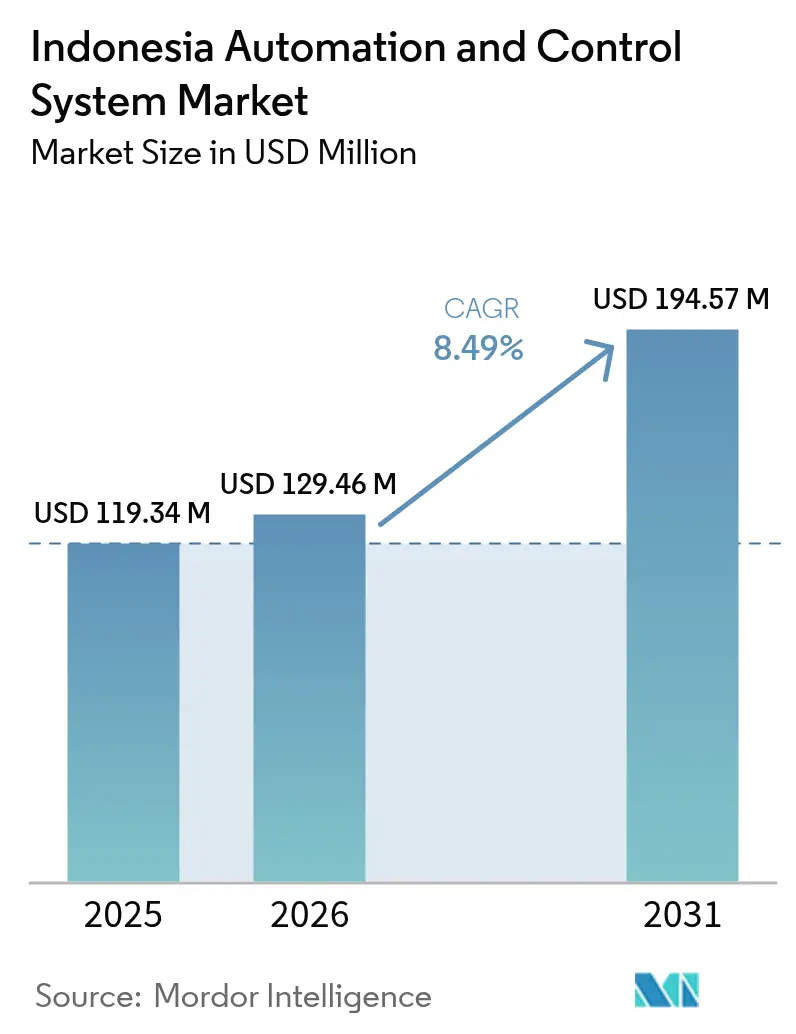
| Base Year Market Size (2025) | USD 119.34 Million |
| Market Size (2026) | USD 129.46 Million |
| Market Size (2031) | USD 194.57 Million |
| Growth Rate (2026 - 2031) | 8.49 % |
| Market Concentration | Medium |
Major Players *Disclaimer: Major Players sorted in no particular order Image © Mordor Intelligence. Reuse requires attribution under CC BY 4.0. | |
Indonesia Automation And Control System Market Analysis by Mordor Intelligence
The Indonesia Automation And Control System Market size is expected to grow from USD 119.34 million in 2025 to USD 129.46 million in 2026 and is forecast to reach USD 194.57 million by 2031 at 8.49% CAGR over 2026-2031. Robust capital formation in electric-vehicle (EV) battery manufacturing, steady utility investments in new power generation, and fiscal incentives under the government’s Making Indonesia 4.0 roadmap underpin this expansion. Brownfield modernization in oil, gas, and mining sustains baseline demand, while greenfield factories in renewables and consumer electronics add incremental volumes. The Indonesia automation and control system market is also lifted by stricter energy-efficiency mandates that accelerate sensor deployment and data-layer upgrades. Short-term volatility in commodity prices and the persistent skills gap act as speed bumps rather than structural brakes for the Indonesia automation and control system market.
Key Report Takeaways
- By product category, programmable logic controllers led with 24.13% revenue share in 2025; industrial robotics is projected to expand at a 10.23% CAGR through 2031.
- By component, hardware accounted for 58.36% of the Indonesia automation and control system market in 2025, while software is forecast to grow at a 9.73% CAGR through 2031.
- By deployment mode, on-premise solutions held 71.43% share of the Indonesia automation and control system market size in 2025, but cloud and IIoT-edge architectures are advancing at a 9.73% CAGR to 2031.
- By end-user industry, oil and gas represented 19.16% of 2025 revenue; EV battery manufacturing is set to expand at a 9.83% CAGR through 2031.
Note: Market size and forecast figures in this report are generated using Mordor Intelligence’s proprietary estimation framework, updated with the latest available data and insights as of 2026.
Indonesia Automation And Control System Market Trends and Insights
Drivers Impact Analysis*
| Driver | (~) % Impact on CAGR Forecast | Geographic Relevance | Impact Timeline |
|---|---|---|---|
| Surge in EV and Battery Manufacturing Investments | +1.8% | Java (Karawang, Bekasi), North Maluku, Central Java | Medium term (2-4 years) |
| Flourishing Power-Sector Capacity Additions | +1.5% | National, with concentration in Java, Sumatra, Kalimantan | Long term (≥4 years) |
| Domestic Making Indonesia 4.0 Incentives | +1.2% | National, prioritizing Java and Sumatra industrial zones | Short term (≤2 years) |
| Mandatory Energy-Efficiency Standards for Industry | +1.0% | National, enforced by Ministry of Energy and Mineral Resources | Medium term (2-4 years) |
| AI-Enabled Predictive-Maintenance Demand | +0.9% | Java, Sumatra, early adoption in large oil and gas, mining | Medium term (2-4 years) |
| Evolution of Wireless Sensor Networks and Protocols | +0.7% | National, accelerated in greenfield EV and food-processing plants | Short term (≤2 years) |
| Source: Mordor Intelligence | |||
Surge In EV And Battery Manufacturing Investments
Indonesia aims to supply one-fifth of global battery-cell output by 2030, a target that drives advanced automation spending across cathode, cell, and pack lines. Hyundai Motor Group and LG Energy Solution initiated mass production at their USD 1.1 billion Karawang gigafactory in 2024, using Siemens S7-1500 controllers and Profinet networks for sub-second synchronization of coating and stacking processes. CATL’s USD 6 billion integrated complex in North Maluku, announced in 2025, will deploy ABB’s 800xA platform to unify ore processing and cell assembly under a single historian. Local nickel-smelter upgrades, such as PT Vale Indonesia’s Yokogawa Centum VP retrofit, further enlarge the installed base of high-temperature PLCs. Demand radiates to separator-film extruders, electrolyte skids, and battery-management test rigs, broadening the Indonesia automation and control system market beyond traditional automotive assembly.
Flourishing Power-Sector Capacity Additions
State utility PLN plans 69.5 gigawatts of new generation under its 2025-2034 roadmap, spanning coal, gas, and renewables. The roll-out mixes legacy distributed control systems for baseload units with IIoT gateways for distributed solar and wind farms. Schneider Electric secured a USD 47 million substation-automation contract in 2025, embedding IEC 61850-based fault isolation across Java and Bali.[1]Schneider Electric, “PLN Substation Automation Contract,” se.com Honeywell’s Experion PKS helped PT Geo Dipa Energi’s Dieng geothermal plant attain 98.7% availability via predictive analytics in 2025. These projects lift demand for redundant controllers, ruggedized sensors, and cybersecurity layers across the Indonesia automation and control system market.
Domestic Making Indonesia 4.0 Incentives
The refreshed Making Indonesia 4.0 policy allocates IDR 23 trillion (USD 1.5 billion) in tax holidays, import-duty relaxations, and training subsidies through 2025 to accelerate digital transformation. Super-deduction credits of up to 300% of R&D outlays shorten payback periods for SCADA retrofits, prompting food, textile, and chemical manufacturers to migrate from paper-based logs to real-time dashboards. PT Indofood CBP invested USD 12 million in 2025 to deploy Rockwell’s FactoryTalk analytics, cutting changeover times by 60% across six plants. Government-funded training centers operated by Beckhoff and other vendors bolster the talent pool.
Mandatory Energy-Efficiency Standards For Industry
Presidential Regulation No. 22/2017, amended in 2024, obliges high-energy-use factories to trim specific energy consumption by 1% annually. PT Semen Indonesia retrofitted variable-frequency drives at two cement complexes in 2025, achieving 11% savings and a sub-two-year payback. Compliance requires monthly digital reporting, catalyzing adoption of power-quality analyzers, smart meters, and historian databases. Schneider Electric’s monitoring software delivered 8-12% demand-charge reductions for early-adopting textile mills. Preference for ISO 50001 alignment to unlock concessional bank loans further sustains momentum.
Restraints Impact Analysis*
| Restraint | (~) % Impact on CAGR Forecast | Geographic Relevance | Impact Timeline |
|---|---|---|---|
| High Upfront CAPEX for Brown-Field Retrofits | -1.2% | National, acute in Sumatra and Kalimantan legacy plants | Short term (≤2 years) |
| Skills Gap in Advanced Automation Engineering | -0.9% | National, most severe outside Java | Medium term (2-4 years) |
| Volatile Commodity Pricing Impacting O&G, Mining | -0.7% | Sumatra, Kalimantan, Papua (resource-dependent regions) | Short term (≤2 years) |
| Cyber-Security Concerns in OT Networks | -0.5% | National, prioritized by oil and gas, power utilities | Medium term (2-4 years) |
| Source: Mordor Intelligence | |||
High Upfront CAPEX For Brown-Field Retrofits
Replacing analog loops and relay interlocks with digital fieldbus networks costs USD 150-250 per control point, stretching cash flows of small and medium manufacturers that operate on single-digit EBITDA margins. A 2025 analysis by the Indonesian Chamber of Commerce showed palm-oil-mill SCADA upgrades yielding 3.8-year paybacks at baseline crude-palm-oil prices, extending beyond five years during price downturns. PT Chandra Asri Petrochemical deferred an USD 18 million DCS migration to conserve liquidity amid feedstock volatility. Retrofit projects also incur 30-40% extra civil-works costs to expand cable trays and power-distribution rooms, making standardized methodologies and financing support critical for broader uptake.
Skills Gap In Advanced Automation Engineering
Industry demand for PLC programmers and industrial-network specialists outstrips domestic supply by roughly 6,600 positions a year, according to the Ministry of Manpower’s 2024 survey. Only 14 universities teach IEC 61131-3 programming, and fewer than a third of graduates have hands-on experience with mainstream environments such as Siemens TIA Portal or Rockwell Studio 5000. PT Freeport Indonesia reported that 22% of automation-technician roles at its Grasberg mine remained vacant for more than six months in 2025, necessitating higher-cost expatriate hires. Omron’s mobile training lab reached just 240 trainees in its first year, underscoring the magnitude of the skills challenge.[2]Omron, “Mobile Training Lab Initiative,” omron.com Until certification pipelines scale, the Indonesia automation and control system market must contend with prolonged project-commissioning cycles and higher integration costs.
*Our forecasts treat driver/restraint impacts as directional, not additive. The impact forecasts reflect baseline growth, mix effects, and variable interactions.
Segment Analysis
By Product: Robotics Adoption Redefines Assembly
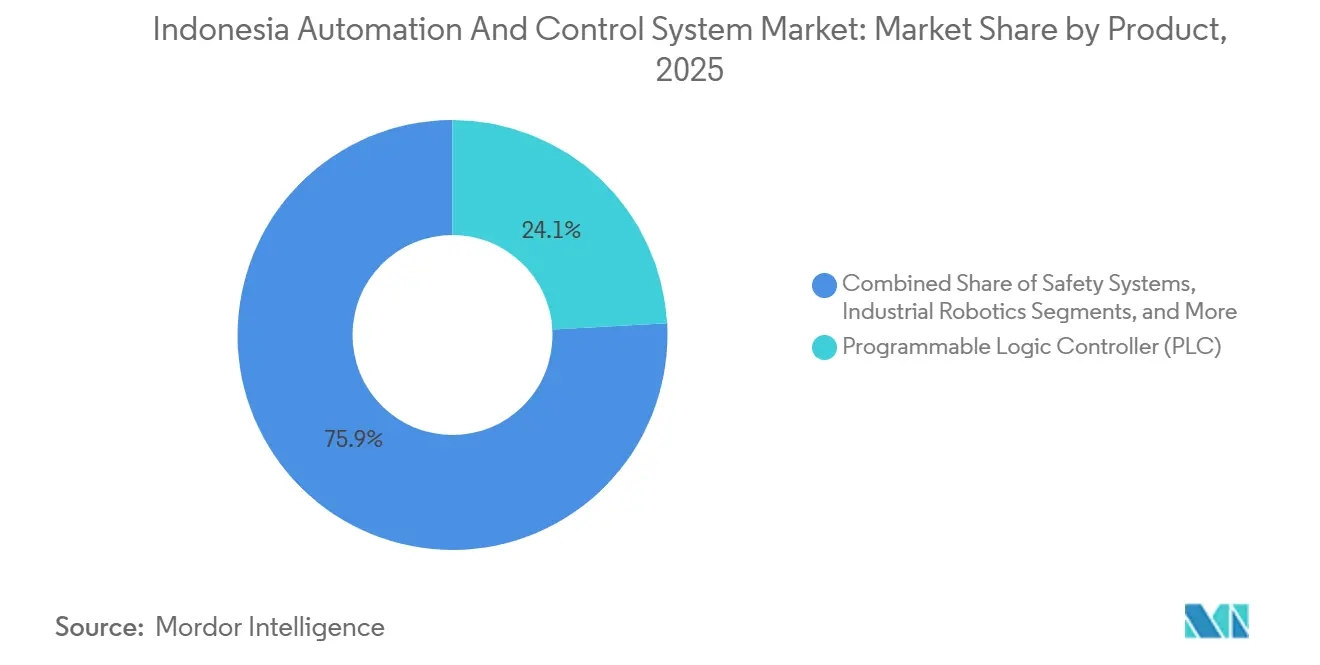
Industrial robotics is forecast to advance at a 10.23% CAGR between 2026 and 2031, the fastest rate among product categories within the Indonesia automation and control system market. Programmable logic controllers held a 24.13% Indonesia automation and control system market share in 2025, anchored by widespread use in palm-oil milling and cement grinding. Fanuc collaborative robots installed at PT Astra Daihatsu Motor’s Karawang line in 2025 trimmed takt time by 14%, demonstrating the productivity edge that drives adoption. SCADA platforms dominate pipeline monitoring and multi-site utilities, while distributed control systems remain favored for continuous petrochemical and pulp processes. Human-machine interfaces have shifted to thin-client architectures, easing remote diagnostics.
The Indonesia automation and control system market size associated with safety systems is poised to grow steadily as the 2024 update to the Occupational Safety and Health Law enforces SIL 2 compliance for hydrocarbon processes. Electric-motor and drive upgrades continue as energy-intensity targets tighten. Delta Electronics added 40% capacity at its Cikarang drive plant in 2024, underscoring demand for variable-frequency drives tailored to tropical operating conditions.



By Component: Software Subscriptions Gain Traction
Hardware captured 58.36% of 2025 revenue, but the share is set to slip as software subscriptions expand at a 9.73% CAGR. Operators prefer cloud-hosted historians and analytics that deliver over-the-air firmware updates and predictive diagnostics. Rockwell’s FactoryTalk Analytics deployment at PT Krakatau Steel cut unplanned downtime by 18% in 2025, illustrating the value proposition.[3]Rockwell Automation, “Krakatau Steel Predictive Maintenance Deployment,” rockwellautomation.com Services commissioning, calibration, and cyber-audits round out the spend mix, supported by vendor 24-hour remotely managed centers in Jakarta.
Indonesia’s 2024 data-localization decree obliges critical-infrastructure operators to host operational data domestically, prompting vendors to launch in-country cloud nodes with partners such as DCI Indonesia. Consequently, the Indonesia automation and control system market size for software is forecast to eclipse USD 60 million by 2031, even as hardware volumes remain healthy for sensor and controller refresh cycles.
By Deployment Mode: Hybrid Architectures Multiply
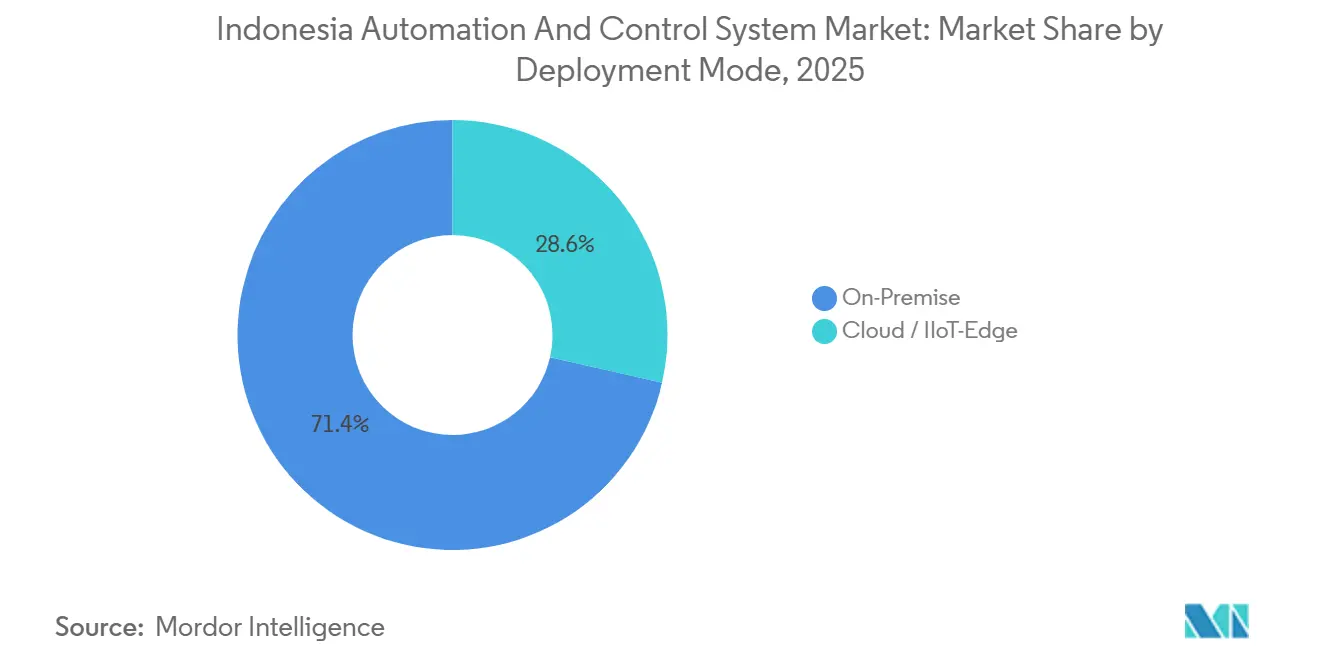
On-premise installations commanded 71.43% of 2025 expenditure, reflecting legacy procurement norms and latency sensitivities. The Indonesia automation and control system market is, however, seeing cloud and IIoT-edge deployments climb at 9.37% annually as operators embrace remote diagnostics. Schneider Electric’s Automation Expert project at the Rokan oil block streams real-time well data to a Jakarta data lake, saving weekly site visits. Private 5G spectrum in the 5.9-6.4 GHz band, released in 2024, enables ultra-reliable communication for mobile robots and augmented-reality maintenance.
Hybrid topologies dominate new bids, safety-critical loops execute locally, while asset-health analytics reside in the cloud. Concerns over monsoon-related fiber outages keep time-critical loops at the edge, but advances in deterministic networking are gradually closing the gap.
By End-User Industry: Battery Manufacturing Outpaces Legacy Segments
Oil and gas contributed 19.16% of 2025 revenue yet faces flat growth as domestic crude output declines. EV battery manufacturing is projected to book a 9.83% CAGR, lifting the Indonesia automation and control system market size for motion controllers and clean-room robotics. Power-generation automation benefits from PLN’s baseload and renewable build-out, while food and beverage processors adopt vision-guided robotics to meet export-quality norms.
Metals and mining projects particularly nickel laterite smelters and copper concentrators demand ruggedized PLCs rated to 85 °C ambient. Water and wastewater utilities, driven by rising urban effluent standards, rely on SCADA-controlled clarifiers and UV disinfection units. Textiles, logistics, and pharmaceuticals add incremental controller demand but remain fragmented.
Geography Analysis
Java’s Indonesia automation and control system market size dominance is underpinned by its 58% GDP share, clustered vendors, and responsive service networks. Jakarta-based digital labs from Siemens and Schneider Electric cut lead times for proof-of-concept trials, reinforcing the island’s primacy. Local automotive assemblers, food processors, and pharmaceutical firms continually refresh PLCs and HMIs to meet export standards, ensuring recurring demand.
Sumatra’s automation outlook hinges on palm-oil and refinery modernization. While crude-palm-oil price volatility can delay SCADA upgrades, energy-efficiency penalties are nudging mills toward variable-speed drives and smart metering. Southern Sumatra’s coal-fired plants also face DCS retrofits to meet 2024 emissions limits, anchoring hardware pull-through despite demand cyclicality.
Eastern provinces represent the growth frontier. Papua and West Papua require high-temperature PLCs for nickel smelters and advanced material-handling robotics at Grasberg. Kalimantan’s coal and bauxite mines adopt edge-based vibration monitoring to manage remote assets. Sulawesi’s Morowali stainless-steel complex deploys ABB Ability condition monitoring across drives, highlighting eastern appetite for premium analytics. Freight lead-time challenges catalyze local assembly and spare-parts depots, subtly shifting the Indonesia automation and control system market share toward localized value chains.
Competitive Landscape
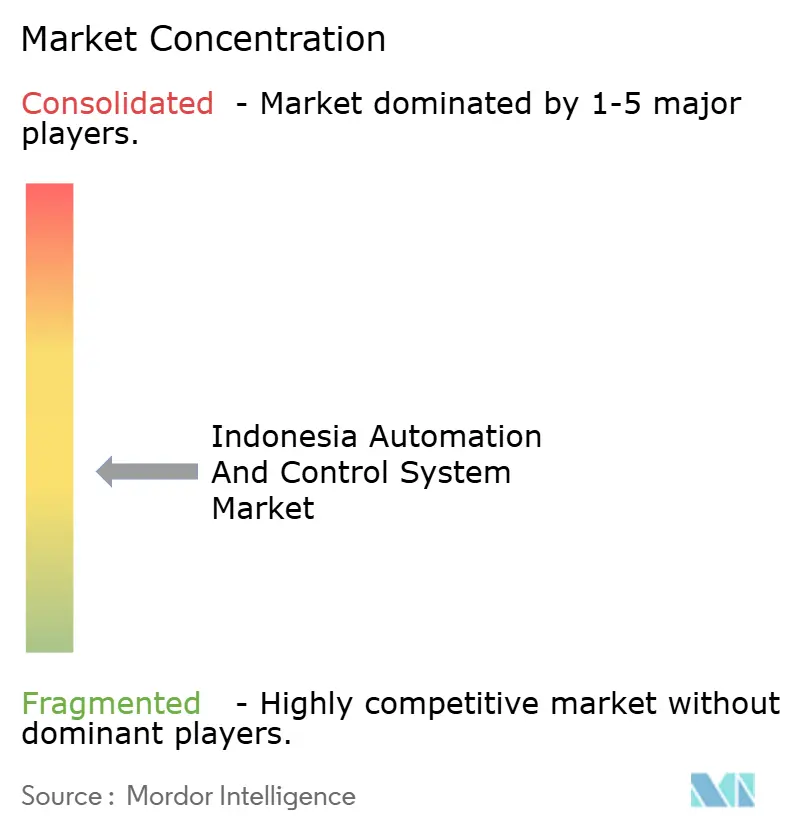
The Indonesia automation and control system market is moderately fragmented. The top five suppliers Siemens, ABB, Schneider Electric, Yokogawa, and Rockwell Automation collectively held about 48% share in 2025. They leverage embedded installed bases, proprietary programming suites, and multi-year service contracts to secure recurring revenue. Their Jakarta service hubs run 24-hour remote-monitoring centers that dispatch field engineers based on predictive-maintenance alerts, deepening customer stickiness.
Price pressure emerges from Chinese entrants such as Inovance Technology, which discount PLC-HMI bundles by up to 40%. Japanese specialists Mitsubishi Electric and Omron court mid-tier manufacturers through technical training centers that mitigate the skills gap. Local assembly operations by PT FANUC Indonesia and PT Omron Manufacturing lower lead times and meet 40% local-content rules on public projects. Joint ventures with Indonesian engineering firms unlock infrastructure tenders subject to domestic value-addition thresholds.
Competitive differentiation is migrating to software. Schneider Electric’s EcoStruxure Asset Advisor served 340 Indonesian sites in 2025, generating annuity revenue from cloud analytics. ABB connected 280 additional motors and drives under its Ability platform the same year.[4]ABB, “Ability Condition Monitoring Indonesia,” abb.com Yokogawa’s patent on hybrid edge-cloud control appeals to operators juggling data-localization and uptime mandates. Compliance with IEC 61508-certified safety and IEC 62443-certified cybersecurity is becoming a clear tender requirement, favoring vendors with validated reference projects.
Indonesia Automation And Control System Industry Leaders
Yokogawa Corporation
Siemens AG
Honeywell International Inc.
Rockwell Automation Inc.
Schneider Electric SE
- *Disclaimer: Major Players sorted in no particular order

Recent Industry Developments
- January 2026: Schneider Electric committed USD 22 million to expand its Cikarang plant, adding EcoStruxure controller lines and a 1,200 m² IIoT lab.
- December 2025: PT Pertamina Hulu Energi selected Yokogawa CENTUM VP and ProSafe-RS for the Abadi FLNG project under a USD 38 million contract.
- November 2025: ABB supplied 14 ACS880 drives and 22 M3000 motors to PT Semen Indonesia’s Rembang plant, cutting kiln energy use by 9.2% on commissioning.
- October 2025: Rockwell Automation and PT Len Industri agreed to establish a system-integration center in Bandung focused on turnkey FactoryTalk deployments.


Indonesia Automation And Control System Market Report Scope
Industrial automation is applying different and combined control systems to manage and operate machines and equipment in production facilities and factories. In addition to reducing costs, automation is being demanded to help increase productivity, aesthetics, efficiency, and delivery systems in the production of automotive assemblies, aircraft, steering and ship stabilization, heat-treating boilers and ovens, and other machinery.
The Indonesia Automation and Control System Market Report is Segmented by Product (PLC, SCADA, DCS, HMI, Safety Systems, Industrial Robotics, Electric Motors, Drives), Component (Hardware, Software, Services), Deployment Mode (On-Premise, Cloud/IIoT-Edge), End-User Industry (Oil and Gas, Power, Chemical, Food and Beverage, Metals, Water, Others), and Geography (Java, Sumatra, Kalimantan, Sulawesi, Bali and Nusa Tenggara, Papua and West Papua). Market Forecasts are Provided in Terms of Value (USD).
| Programmable Logic Controller (PLC) |
| Supervisory Control and Data Acquisition (SCADA) |
| Distributed Control System (DCS) |
| Human-Machine Interface (HMI) |
| Safety Systems |
| Industrial Robotics |
| Electric Motors (AC, DC, EC, Servo, Stepper) |
| Drives (AC, DC, Servo) |
| Hardware |
| Software |
| Services |
| On-Premise |
| Cloud / IIoT-Edge |
| Oil and Gas |
| Power Generation |
| Chemical and Petrochemical |
| Food and Beverage |
| Metals and Mining |
| Water and Wastewater |
| Other End-User Industries |
| By Product | Programmable Logic Controller (PLC) |
| Supervisory Control and Data Acquisition (SCADA) | |
| Distributed Control System (DCS) | |
| Human-Machine Interface (HMI) | |
| Safety Systems | |
| Industrial Robotics | |
| Electric Motors (AC, DC, EC, Servo, Stepper) | |
| Drives (AC, DC, Servo) | |
| By Component | Hardware |
| Software | |
| Services | |
| By Deployment Mode | On-Premise |
| Cloud / IIoT-Edge | |
| By End-User Industry | Oil and Gas |
| Power Generation | |
| Chemical and Petrochemical | |
| Food and Beverage | |
| Metals and Mining | |
| Water and Wastewater | |
| Other End-User Industries |


Key Questions Answered in the Report
What is the 2026 value of the Indonesia automation and control system market?
The market is valued at around USD 129.46 million in 2026, on its way to USD 194.57 billion by 2031.
Which product category is growing fastest in Indonesian factories?
Industrial robotics leads with a forecast 10.23% CAGR through 2031 as assemblers chase higher throughput and quality.
How large is Java’s share of Indonesian automation spending?
Java commands about 42.67% of national revenue thanks to its dense manufacturing base and ready talent pool.
What limits faster automation rollout in legacy plants?
High retrofit capital costs of USD 150-250 per control point and a shortage of skilled automation engineers slow adoption.
Why is software outpacing hardware growth?
Migration to subscription-based historians, analytics, and predictive-maintenance platforms fuels a 9.73% CAGR for software, while hardware remains essential but slower growing.
Which end-user segment shows the strongest future upside?
EV battery manufacturing, buoyed by multi-billion-dollar gigafactory investments, is projected to post a 9.83% CAGR through 2031.
Page last updated on:





