
India Recycling Market Size and Share
India Recycling Market Analysis by Mordor Intelligence
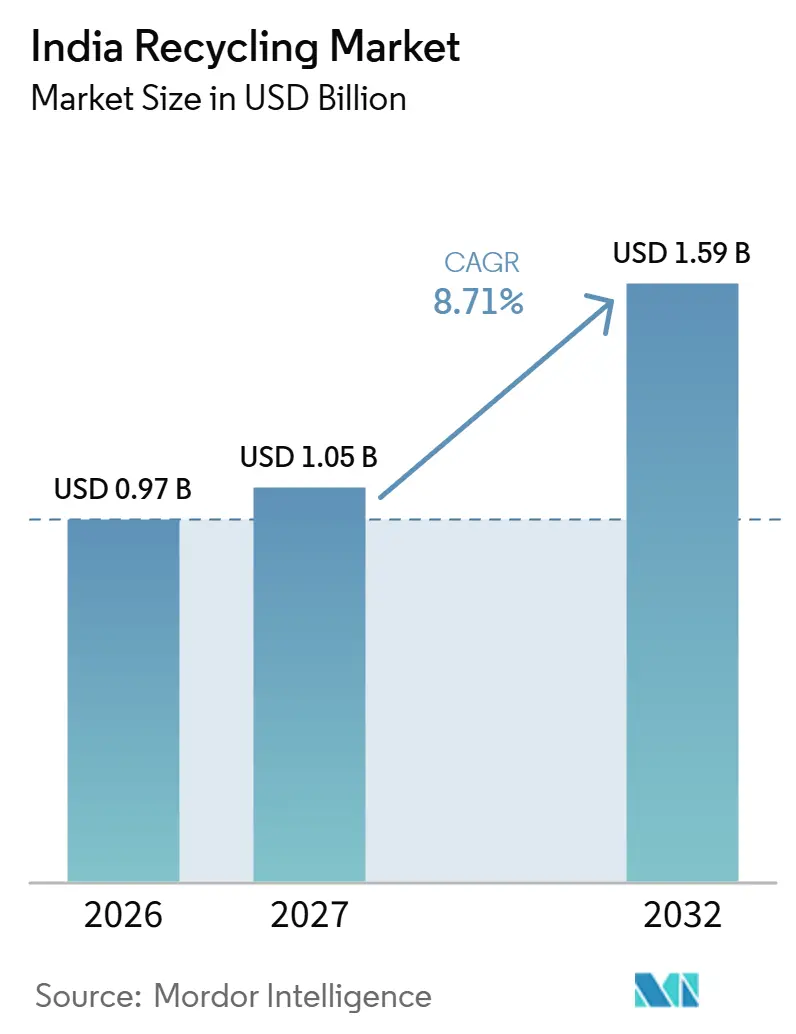
The India recycling market size is expected to increase from USD 0.97 billion in 2026 to USD 1.05 billion in 2027 and reach USD 1.59 billion by 2032, growing at a CAGR of 8.71% over 2027-2032.
In India, producer obligations and recycled-content adoption connect material recovery to demand from packaging users. Extraction incentives strengthen the case for deeper processing, while collection gaps and customer quality requirements constrain conversion into revenue. Competitive responses center on added e-waste, lead, and copper recovery capacity, making scrap availability a practical limit on expansion. Permitted packaging uses and project-specific construction applications give recovered output a more defined commercial destination. Recyclers that secure scrap can use the added capacity to supply packaging brand owners and construction projects bound by recycled-content or utilization requirements.
Key Report Takeaways
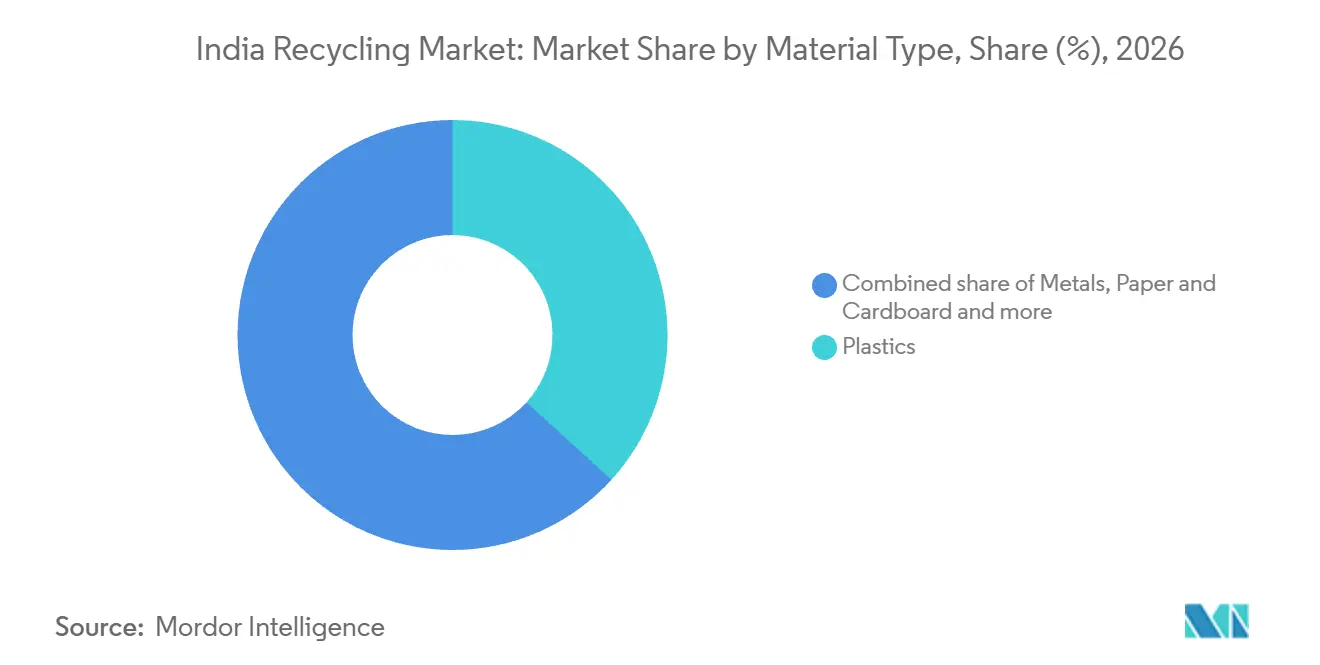
- By material type, plastics led with a 36.75% India recycling market share in 2026, while metals are forecast to be the fastest-growing segment at a CAGR of 9.3% over 2027-2032.
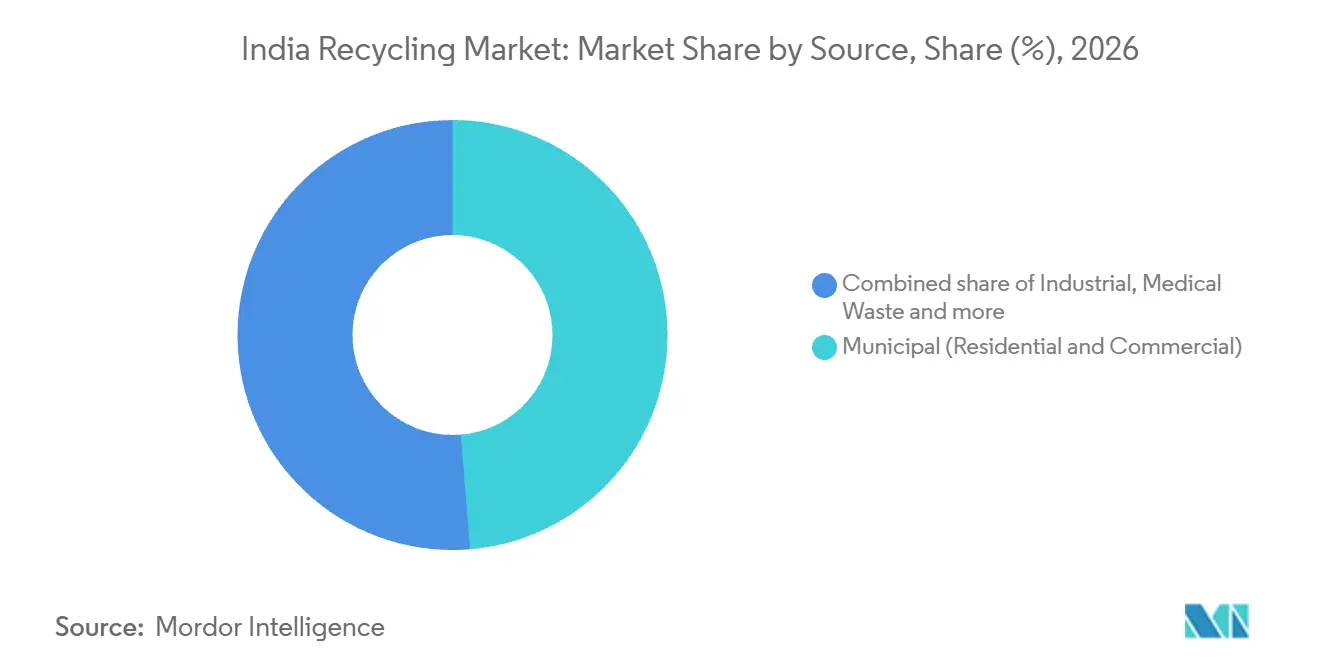
- Among waste sources, municipal residential and commercial waste led with a 48.69% share of the India recycling market size in 2026, and medical waste is forecast to grow fastest at a CAGR of 9.4% over 2027-2032.
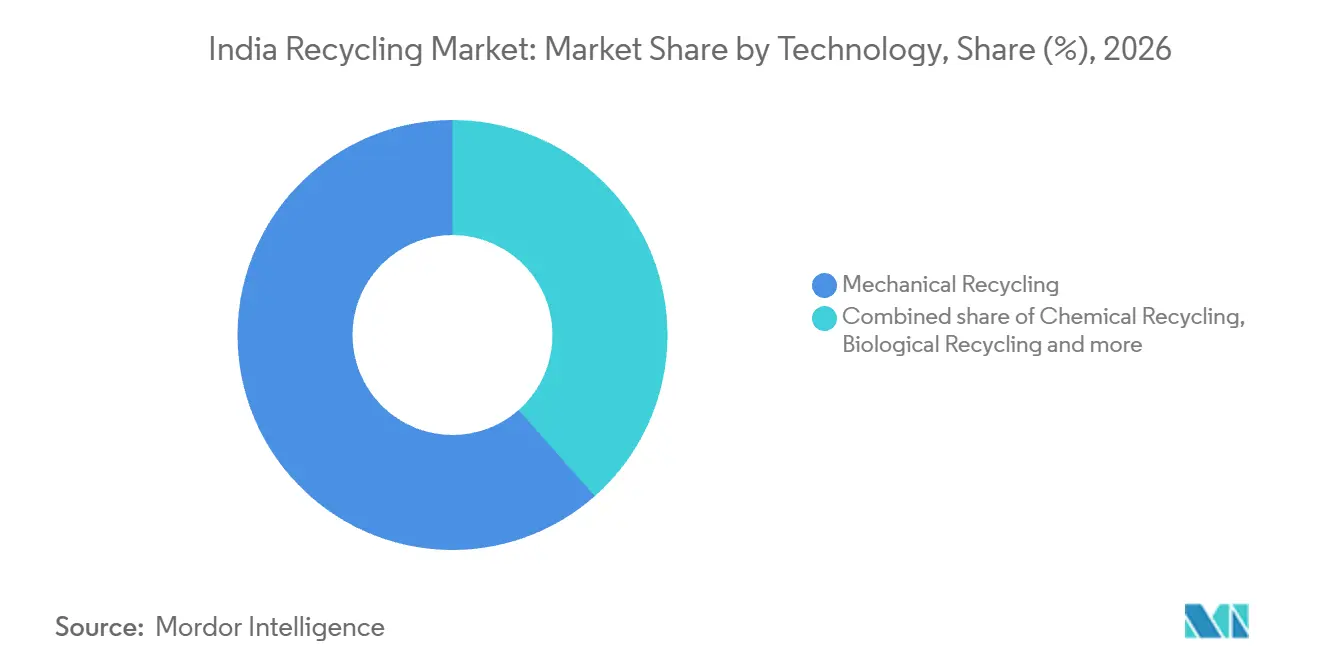
- Across recycling technologies, mechanical recycling held a 61.51% market share in 2026, while chemical recycling is forecast to be the fastest-growing segment at a CAGR of 9.7% over 2027-2032.
Note: Market numbers in this report are based on Mordor Intelligence's proprietary estimation framework, which combines nine months of actuals with Q4 projections for base year 2026.
India Recycling Market Trends and Insights
Drivers Impact Analysis*
| Driver | (~) % Impact on CAGR Forecast | Geographic Relevance | Impact Timeline |
|---|---|---|---|
| Extended EPR mandates across plastics and electronics | +3% | Nationwide | Short term (≤ 2 years) |
| Rising urban MSW volumes and landfill shortages | +2.4% | Urban areas across India | Medium term (2-4 years) |
| Surge in recycled-content demand from FMCG and packaging majors | +2.2% | Nationwide | Medium term (2-4 years) |
| Fiscal incentives for critical-mineral recycling plants | +1.8% | Nationwide | Medium term (2-4 years) |
| Lithium-ion battery end-of-life wave from Electric Vehicle adoption | +1.2% | Nationwide | Long term (≥ 4 years) |
| Source: Mordor Intelligence | |||
Extended EPR mandates across plastics and electronics
Extended producer responsibility (EPR) obligations connect demand for recovered materials with demand for documented recycling services. India's Plastic Waste Management (Amendment) Rules, 2026, effective March 31, 2026, impose category-specific recycled-content requirements on plastic packaging used in 2025-26. Exemptions apply where statutory requirements prohibit recycled plastic, with the applicable authority or requirement identified in the annual return. The E-Waste (Management) Rules, 2022 set producers a 70% by-weight recycling target for 2025-26, based on equipment placed on the market in the year corresponding to each product's average life. Producers must meet that obligation through registered recyclers and the Central Pollution Control Board (CPCB) portal, creating a defined route for formal processing. Together, these obligations favor recyclers able to connect material recovery with the compliance requirements of packaging buyers and electronics producers.
Rising urban MSW volumes and landfill shortages
Municipal recycling demand is reinforced by the scale and recurrence of urban waste flows. Urban local bodies reported municipal solid waste generation rising from 146,167 metric tons per day in 2022-23 to 161,157 metric tons per day in 2024-25. This daily flow represents a continuing management requirement, distinct from the one-time task of clearing an accumulated waste stock. Material-recovery operators can address that requirement by extracting usable fractions for resale, linking municipal service needs to recovered-material supply. The rise of about 15,000 metric tons per day over those 2 years enlarges the waste stream, although only the recoverable portion becomes recycling demand.
Surge in recycled-content demand from FMCG and packaging majors
Recycled-plastic adoption creates demand across packaging formats, with different levels of use among fast-moving consumer goods (FMCG) companies. In FY 2025-26, ITC's FMCG businesses used 35.5% recycled plastic across rigid packaging and 4.5% across flexible packaging.[1] Dabur used recycled plastic in Category I, II, and III packaging at rates of 2%, 6%, and 1%, respectively, in FY 2025-26. These figures demonstrate packaging uses for recovered plastic, with adoption varying by buyer and reported format. ITC's rigid-packaging rate was nearly 8 times its flexible rate, whereas Dabur's Category II rate of 6% exceeded Category I's 2%, showing that the leading packaging type differed by brand owner.
Fiscal incentives for critical-mineral recycling plants
Critical-mineral incentives make the depth of material recovery central to the investment case for battery and electronics recyclers. On October 2, 2025, the Ministry of Mines issued guidelines supporting new units and the expansion, modernization, or diversification of existing units processing e-waste, spent lithium-ion batteries, and other scrap. Eligibility requires actual critical-mineral extraction and excludes operations producing only black mass, directing support toward more complete recovery. The application window closed on April 1, 2026. Following decisions in March and April 2026, the Ministry reported 58 eligible entities and described project execution as the next stage. With about 850,000 metric tons per year pledged, the scheme's supply contribution depends on eligible entities moving from approval to producing recovered minerals.
Restraints Impact Analysis*
| Restraint | (~) % Impact on CAGR Forecast | Geographic Relevance | Impact Timeline |
|---|---|---|---|
| Fragmented, informal collection ecosystem | -1.1% | Urban areas across India | Medium term (2-4 years) |
| Limited domestic end-markets for lower-grade recycled polymers | -0.6% | Nationwide | Long term (≥ 4 years) |
| Volatility in scrap prices linked to global commodity cycles | -0.3% | Nationwide | Short term (≤ 2 years) |
| Source: Mordor Intelligence | |||
Fragmented, informal collection ecosystem
Recyclers cannot treat waste generated within a city as material reliably available at the processing gate. NITI Aayog reported in 2026 that gaps in solid-waste collection and transport left waste uncollected in some urban pockets and created informal secondary accumulation points outside formal collection. Its assessment identified inadequate staffing, source-storage infrastructure gaps, and poor synchronization between collection services, transfer depots, and transport. These connected failures make feedstock access dependent on the links between collection and processing, limiting the value of adding recovery capacity alone. Synchronizing collection services, transfer depots, and transport adds a coordination burden to the cost of supplying recovered output from regular material flows.
Limited domestic end-markets for lower-grade recycled polymers
For a recycler producing low-grade pellets, limited buyer acceptance narrows the route from material recovery to product sales. In 2023, NITI Aayog linked the limited market for post-consumer resin, or recycled plastic pellets, to low-grade output from fragmented operations. In November 2025, the Confederation of Indian Industry (CII) reported low acceptance of recycled plastics more broadly, with vendors preferring lower-cost virgin plastics. Quality and price create separate commercial tests for recovered resin, because completing the recycling process does not itself secure an outlet. The buyer's acceptable price therefore limits the cost a recycler can recover from additional processing to improve the pellet grade.
*Our forecasts treat driver/restraint impacts as directional, not additive. The impact forecasts reflect baseline growth, mix effects, and variable interactions.
Segment Analysis
By Material Type: Formal Plastics Supply and Metal Recovery Expansion
Plastics accounted for a 36.75% share of the India recycling market size in 2026. By March 5, 2026, registered Indian recyclers had recycled 19.7 million metric tons of plastic waste under EPR. India had 2,986 registered plastic-waste recyclers under EPR at that date. This combination of recorded recovery and registered participation gives producers seeking EPR-linked recycling a broad base of formal counterparties. Competition in the largest segment therefore extends beyond adding an individual plant, with the ability to connect material recovery to producer-facing recycling records becoming relevant across a distributed supplier base.
Metals are forecast to be the fastest-growing segment, with a CAGR of 9.3% over 2027-2032. In FY 2025-26, Gravita India expanded lead-recycling capacity at Mundra, Gujarat, by 80,300 metric tons per year to 145,100 metric tons per year.[2] It reported around 50% utilization at Mundra in April-June 2026, including the expansion completed in February, and management attributed utilization below expectations to scrap availability and supply-chain disruption. The expansion lifted Mundra's lead-recycling capacity from 64,800 to 145,100 metric tons per year, adding processing capacity ahead of scrap supply. Around 50% utilization in April-June 2026 shows that scrap availability, not plant size, limited output at Mundra.

By Source: Municipal Reach and Specialized Medical Recovery
Municipal residential and commercial waste represented a 48.69% India recycling market share in 2026. Operators serving the largest segment include Antony Waste Handling Cell Limited, which managed over 5.69 million metric tons of waste across its business in FY 2025-26. Its company-wide service base exceeded 4.57 million households and establishments. The integrated municipal-waste operator worked in partnership with urban local bodies, connecting its service footprint to public waste-management systems. Recyclers seeking municipal feedstock therefore depend on the contracts urban local bodies award to service operators of this kind.
Medical waste is forecast to be the fastest-growing segment, with a CAGR of 9.4% over 2027-2032. Biotic Waste Solutions operates Goa's Kundaim biomedical-waste facility, combining 28 metric tons per day of treatment capacity with a plastic shredder for recycling treated plastic scrap. The facility began operations in October 2021 and was operating in August 2026. Treatment followed by plastic recovery creates a specialized route from medical waste to usable scrap, with the recoverable fraction defining the recycling opportunity. Recovering treated plastic scrap can give a medical-waste operator a distinct material-recovery service within its broader treatment business.
By Technology: Installed Mechanical Networks and Integrated Chemical Conversion
Mechanical recycling was the largest segment, accounting for 61.51% of the market in 2026. CII's November 2025 framework reported approximately 4.78 million metric tons per year of installed mechanical plastic-recycling capacity across approximately 2,309 units in India. Within that plastic-waste base, polyolefins dominated the number of units, while PET had larger per-unit capacities. Those plastic-waste figures average about 2,070 metric tons per year of installed capacity per unit, so mechanical recycling rests on a dense network in which PET lines run larger than polyolefin units.
Chemical recycling is forecast to be the fastest-growing segment, with a CAGR of 9.7% over 2027-2032. In FY 2025-26, Reliance Industries' Jamnagar complex produced ISCC Plus-certified circular polymers from chemically recycled plastic-waste pyrolysis oil.[3] This route connects recovered feedstock to polymer production within an integrated refining and petrochemical complex, providing an industrial conversion outlet. Certification at the polymer-production stage ties the circular claim to a defined output. The competitive boundary consequently spans waste conversion and petrochemical production, so access to the final polymer-producing operation can shape where recycling value is captured.
Geography Analysis
Western India has substantial recorded e-waste processing in Maharashtra and Gujarat, while Karnataka provides a separate southern base for the same material stream. For FY 2025-26 through March 9, 2026, CPCB reported 47,314.8 metric tons recycled in Maharashtra and 59,637 metric tons in Gujarat. Karnataka recorded 27,379.3 metric tons of e-waste recycled over the same partial-year period. These completed recycling volumes show e-waste processing in western and southern states, so electronics recovery is not confined to a single local cluster.
Karnataka's textile-recovery channel showed how regional activity depended on industrial buyers beyond the location where discarded materials were aggregated. In January 2025, Bengaluru's Textile Recovery Facility made bulk sales of post-consumer polyester and blended textiles to buyers from Coimbatore and Tiruppur. Shipments increased from about 9 metric tons in January to about 30 metric tons in February 2025. Those buyers repurposed the textiles for industrial applications, including filler materials and building materials. Bulk orders later began to dry down before starting to re-emerge, so the facility's bulk sales varied over time.
Tamil Nadu's e-waste activity sits alongside a state-level effort to connect waste generators with authorized recyclers across several waste streams. CPCB reported 10,506.7 metric tons of e-waste recycled in the state during FY 2025-26 through March 9, 2026. In September 2025, the Tamil Nadu Pollution Control Board (TNPCB) published a recycler directory using authorization records dated August 31, 2025, to help generators and producers identify recycling counterparties. The board advised users to verify authorization before transactions or partnerships. Because the directory reflects records dated August 31, 2025, it narrows the search for a Tamil Nadu waste holder without replacing the check of a recycler's current authorization.
Regulatory Framework and Outlook
The comparison covers selected jurisdictions from the perspective of compliant plastic recyclers supplying legally permitted packaging applications. India's Solid Waste Management Rules, 2026 took effect on April 1, 2026, assigning environmental-compensation enforcement to state pollution-control boards and committees. Industrial, hazardous, biomedical, e-waste, and battery waste are among the separately regulated streams outside those rules. For a plastic recycler, the commercial balance combines compliance cost under these rules with the recycled-content schedule set out in the table.
Regulatory Table
| Decision factor | India | Tamil Nadu |
|---|---|---|
| Primary authority | State pollution-control boards and committees | Tamil Nadu Pollution Control Board |
| Key instruments or direction | Solid Waste Management Rules, 2026; producer targets based on packaging manufactured and brand-owner targets based on packaging used | National plastic-packaging framework and specified-item restrictions under the 2018 state order |
| Commercial effect | Enforcement exposure and a scheduled buyer-side requirement for recycled plastic | Qualifying-material demand within legally permitted plastic applications |
| Current policy attractiveness | Medium | Medium |
| Future direction of policy attractiveness | Easing | Easing |
| Source: Mordor Intelligence | ||
India's Medium rating balances the demand pathway created by packaging-content obligations against enforcement exposure for applicable waste-management activities. The brand-owner schedule moves to higher category-specific content requirements in 2027-28 than in 2025-26, subject to statutory exemptions documented in annual returns. Tamil Nadu's Medium rating also reflects its specified-item restriction, which narrows permissible plastic applications while the national content framework continues to apply. Easing in both columns reflects the scheduled rise in recycled-content demand, so a recycler's access to it depends on matching output to applications the law permits.
Value Chain Stages
The comparison follows collection, sorting, and material recovery, showing how participant roles and supplier earnings change along the chain. Antony Waste earns revenue from municipal solid-waste collection and transportation services, which sit upstream of the recycling transaction. In May 2025, the Brihanmumbai Municipal Corporation inaugurated a dry-waste sorting center in Andheri with capacity of 10 metric tons per day. Upstream service earnings support the recovery network, while recycling value arises at the processing-service transaction or the recycler's first recovered-output sale.
Value Chain Analysis Table
| Primary activity | Key participants | Value capture | Bottleneck | Resilience response |
|---|---|---|---|---|
| Collection and transport | Municipal service operators such as Antony Waste Handling Cell Limited | Collection and transportation service revenue | Dependence on collection-to-transfer coordination | Align routes with receiving-facility schedules |
| Dry-waste sorting and aggregation | Material recovery center operators such as Dalmia Polypro Industries Pvt. Ltd. | Sorted-material sales in the documented 2021 material recovery facility model | Mixed dry-waste material streams | Sort and aggregate by material for recycler handoff |
| Recycling and recovered-output supply | Recovered-material producers such as Dalmia Polypro Industries Pvt. Ltd. and Gravita India | Recovered plastic and metal product sales | Meeting customer quality requirements | Define the target output before configuring recovery |
| Source: Mordor Intelligence | ||||
A 2021 NITI Aayog and UNDP handbook described a material recovery facility model in which high-value recyclable sales supported collection and materials were sold to authorized or registered recyclers. That model makes sorting a link between the economics of collecting mixed waste and the needs of downstream processors. Customer quality requirements for Dalmia Polypro's recycled flakes and granules give downstream use a practical influence over earlier material separation and processing choices. As recovery focuses on specified outputs, supplier advantage can shift toward operators that connect upstream sorting with repeatable customer-grade production.
Competitive Landscape
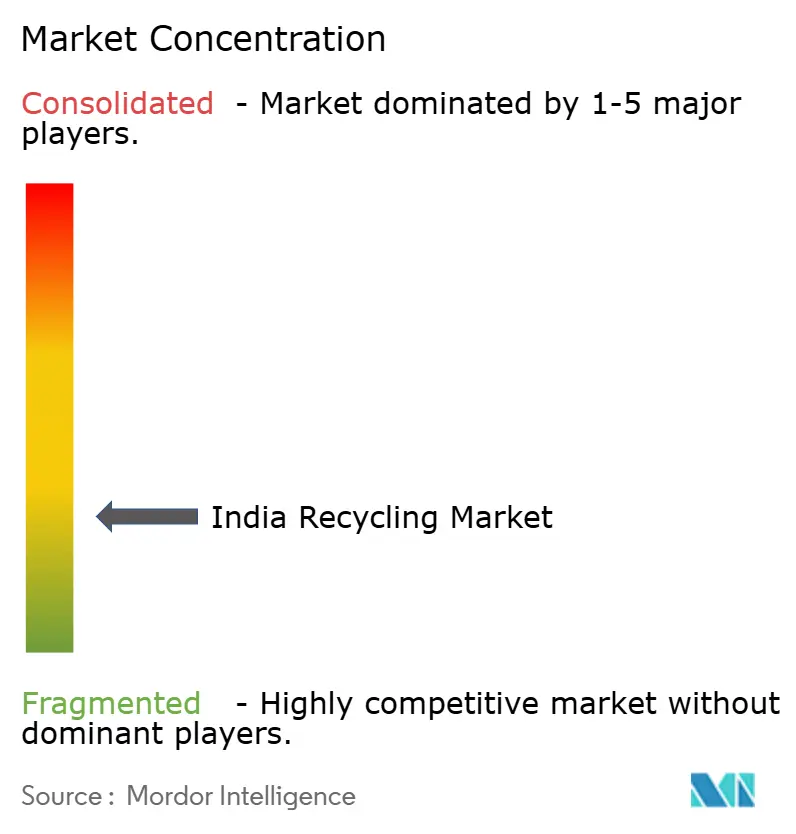
Competition has a fragmented structure spanning specialist recyclers, infrastructure providers, and municipal service groups, including Attero, NEST, Gravita India, Antony Waste Handling Cell Limited, and A2Z Group. In July 2026, Attero operated 3 e-waste recycling plants in Roorkee, Pune, and Jaipur. NEST, identified as NEPRA Environmental Solutions Technologies, presents NEPRA Projects as a delivery channel for recycling infrastructure and systems integration. A2Z Group's A2Z Infra Engineering Limited focused its municipal-waste business on collection and transportation under long-term civic-body contracts in FY 2025-26. This mixed structure gives infrastructure providers and municipal service groups a role in recyclers' access to processing facilities and discarded-material streams.
In December 2025, Attero announced 3 new e-waste plants in Pune, Bengaluru, and Faridabad, a copper-recycling facility in Reengus, and an expanded R&D center in Greater Noida. The announced e-waste and copper facilities together were to add around 100,000 metric tons of annual processing capacity. Antony Waste's construction and demolition (C&D) waste facility recovered 56,500 metric tons of manufactured sand and aggregates in FY 2025-26, achieving a 96% recycling rate. Attero's capacity plans would widen its e-waste and copper reach, whereas Antony Waste's result shows a municipal operator recovering construction materials.
On July 28, 2026, Gravita India said it had temporarily put planned rubber capacity on hold while fast-tracking copper expansion in the area earmarked for rubber machinery. Management described copper as a better opportunity while discussing higher logistics costs, illustrating how the choice of recovery stream shapes capacity allocation. Its Unit V in Kachchh received consent and hazardous-waste authorization on January 19, 2026, valid through September 25, 2030. The authorization covered lithium-ion battery-scrap dismantling and recycling at 12,000 metric tons per year. Gravita's rubber hold reallocates plant area toward management's preferred stream, while Unit V's consent bounds battery-scrap processing at that site, leaving the streams' expansion subject to different constraints.
India Recycling Industry Leaders
-
Attero
-
NEST
-
Gravita India
-
Antony Waste Handling Cell Limited
-
A2Z Group
- *Disclaimer: Major Players sorted in no particular order
Key Opportunities for Market Participants
The opportunities compare recovered-material sales and processing services that can help construction buyers meet project-specific utilization requirements. India's 2025 C&D waste rules, effective April 1, 2026, set a 5% processed-waste utilization target for projects approved in 2026-27, measured against total construction material required. Utilization follows an approved waste utilization plan and project-specific rules, with special-case exceptions where road-project waste use is infeasible. A recycler needs the project plan's application to specify recovered output for sale, while processing customer-owned waste earns a fee when the customer retains ownership.
Market Opportunities Table
| Opportunity | Why now | Buyer / lead segment | Recommended play | Main barrier | Likely beneficiaries |
|---|---|---|---|---|---|
| Project-specific recovered construction materials | Utilization target for 2026-27 approvals | Construction-project developers | Sell specified recovered material against the project plan | Matching output to the approved construction use | C&D material recyclers |
| Recovered materials for feasible road applications | Processed-waste use governed by project rules | Road-project contractors | Develop a recovery and delivery offer for a defined road application | Demonstrating application fit within the project plan | Road-material recovery operators |
| Toll recycling of customer-owned construction waste | Project utilization requirements create a recovered-material need | Project owners retaining waste and output ownership | Contract processing into material usable under the project plan | Aligning recoverable output with the owner's required use | Specialized toll-recycling service providers |
| Source: Mordor Intelligence | |||||
The central opening is to turn a project's utilization requirement into a specified recovered-material order. Supplying that output and processing customer-owned waste offer different routes to recycling revenue, with different feedstock-ownership arrangements. Once the project establishes a feasible application, a recycler can connect its processing specification to a defined material need and capture value through an output sale or a contracted processing fee.
Recent Industry Developments
- Sep 2026: Government e Marketplace and the Textiles Committee agreed to create dedicated procurement categories and seller links for recycled and upcycled textile products.
- Aug 2026: Gravita India announced plans to add 59,200 metric tons per year of copper-recycling capacity at Mundra, Gujarat, with phased commissioning expected by March 31, 2029.
- Apr 2026: The Ministry of Mines approved 58 entities as eligible to participate in the critical-mineral recycling incentive scheme, with about 850,000 metric tons per year of pledged capacity.
Research Methodology Framework and Report Scope
Market Definition and Coverage
The India recycling market measures annual value from processing waste into recovered materials and products in India. It counts recycler processing fees or first sales of recovered output at the recycling service transaction or recycler gate.
Scope exclusions: Separately sold waste collection and transport, landfill disposal and energy recovery without material recovery, virgin materials and products made from virgin feedstock, downstream finished goods containing recovered material, and recycling activity outside India are excluded.
Segmentation Overview
- By Material Type
- Plastics
- Metals
- Paper and Cardboard
- Glass
- Others
- By Source
- Municipal (Residential and Commercial)
- Industrial
- Medical Waste
- Construction Waste
- Other Sources
- By Technology
- Mechanical Recycling
- Chemical Recycling
- Biological Recycling
- Other Technologies
Data Sources, Market Sizing, and Validation
Desk Research
CPCB rules, annual reporting portals, and waste-generation series help establish regulated streams, reported processing, and the difference between waste generated and material recovered. NITI Aayog studies such as its India e-waste and lithium-ion battery assessment describe collection, formal processing, capacity, and recovery constraints. The Confederation of Indian Industry's National Circular Economy Framework provides industry capacity and value-chain context, while public company annual reports such as Antony Waste Handling Cell Limited's support checks on operating volumes, service mix, and reported revenue.
Company filings, investor presentations, public tenders, and reputable business reporting can supplement official and association evidence when they clarify facility changes, utilization, pricing, or customer channels. Analysts compare these operating disclosures with public market indicators and use focused India interviews to clarify conflicting definitions or missing links. The named sources are not exhaustive, and further sources inform collection, validation and clarification.
Primary Interviews and Surveys
Interviews and structured surveys with Indian recyclers, municipal and industrial waste-service operators, EPR program leads, and buyers of recovered materials examine feedstock access, processing volumes, realized output prices, and the route from collection to recycler-gate sales. Analysts use these responses to test secondary-source assumptions and segment shares, reconcile gaps against filings and official series, and seek follow-up clarification when an answer conflicts with documented operating evidence.
Distribution of primary research fieldwork respondents
| Company type | Respondent position | Region |
|---|---|---|
| Top tier: 32% | CXOs: 20% | |
| Mid tier: 43% | Functional/Unit leaders: 35% | |
| Smaller Players: 25% | Managers: 45% |
Market-Sizing & Forecasting
Analysts build an India-wide top-down value estimate from stream-level waste generation and processing, EPR-reported recycling, registered recycler capacity and utilization, recycler throughput, realized recovered-material prices, and recycler revenue. Because market totals can combine processing fees and recovered-output sales, analysts reconcile the transaction basis and remove duplicate value before establishing the annual USD total. Material, source, and technology shares follow reported flow evidence, facility capabilities, and output values, and analysts check the resulting splits for consistency with the total and with related operating evidence. A selective bottom-up check rolls up disclosed recycler revenue or multiplies sampled recovered-output volumes by realized selling prices, while gaps in supplier coverage are bridged with official series and adjacent-year evidence rather than treated as observed sales. For the forecast, scenario analysis varies feedstock availability, formal processing, EPR obligations, recycled-content demand, and recovered-material prices. India-based industry experts review those variable-level paths and challenge inconsistencies before the forecast is reconciled to the top-down total.
Data Validation & Update Cycle
Analysts triangulate regulator series, industry capacity data, company filings, interviews, and market indicators, then investigate mismatched years, duplicate transactions, unusual price or throughput movements, and gaps between installed capacity and reported processing before sign-off. A second analyst reviews definitions, source dates, segment sums, and major variances, with respondent re-contact triggered when a material answer conflicts with a filing or a reported operating change lacks a clear explanation. The model is refreshed annually, revisited between cycles after material regulatory, capacity, or market events, and given a fresh source and consistency review before delivery.
Mordor Intelligence's India Recycling Market Size Measured Against Other Published Estimates
Published estimates can differ in the transactions and products they count and the inputs used to model demand. The India recycling market measures annual value from processing waste into recovered materials and products in India.
Key Gap Drivers include the study's defined coverage and market-specific modeling choices. India-based industry experts review those variable-level paths and challenge inconsistencies before the forecast is reconciled to the top-down total.
Benchmark comparison
| Source | Market Size | Gaps in Research Methodology |
|---|---|---|
| Mordor Intelligence | USD 1.05 B (2027) | |
| Regional Consultancy A | USD 13.57 B (2025) | At its 2025 base, this estimate is 1192.4% above this report's 2027 value of USD 1.05 B, 2 years later. The total includes collection, transport, sorting, treatment, remediation, disposal, and EPR services in addition to recycling activity. |
| Global Consultancy B | USD 68.5 B (2025) | At its 2025 base, this estimate is 6423.8% above this report's 2027 value of USD 1.05 B, 2 years later. The estimate covers waste-management revenue, with collection, transportation, and disposal identified as service segments beyond the recycling transaction boundary. |
Mordor Intelligence's analysts triangulate regulator series, industry capacity data, company filings, interviews, and market indicators, then investigate mismatched years, duplicate transactions, unusual price or throughput movements, and gaps between installed capacity and reported processing before sign-off.
Key Questions Answered in the Report
What is the India recycling market size and growth outlook?
The market is expected to reach USD 1.05 billion in 2027 and USD 1.59 billion by 2032, growing at a CAGR of 8.71% over 2027-2032.
What drives demand for recycling services in India?
Producer responsibilities and packaging adoption support demand. ITC's FMCG businesses used 35.5% recycled plastic across rigid packaging in FY 2025-26.
Which material leads recycling activity in India?
Plastics led with 36.75% of the market in 2026. Metals are forecast to grow fastest at a CAGR of 9.3% over 2027-2032.
Which companies participate in India's recycling sector?
Examples include Attero, NEST, Gravita India, Antony Waste Handling Cell Limited, and A2Z Group. Their roles span material recovery, infrastructure delivery, and municipal services.
What can limit the recycling industry's expansion in India?
Feedstock access can limit the use of new capacity. Gravita reported around 50% utilization at Mundra in April-June 2026, including lead-recycling capacity expanded in February, amid scrap-supply disruption.
Where does regional recycling activity differ within India?
Maharashtra and Gujarat recorded e-waste processing in FY 2025-26 through March 9, 2026. Bengaluru's textile sales to Coimbatore and Tiruppur buyers rose in January-February 2025, before bulk orders declined and later began to return.