
India Data Center Networking Market Size and Share
Market Overview
| Study Period | 2020 - 2031 |
|---|---|
| Forecast Data Period | 2026 - 2031 |
| Base Year Market Size (2025) | USD 1.36 Billion |
| Market Size (2026) | USD 1.59 Billion |
| Market Size (2031) | USD 3.45 Billion |
| Growth Rate (2026 - 2031) | 16.78 % |
| Market Concentration | Medium |
Major Players *Disclaimer: Major Players sorted in no particular order Image © Mordor Intelligence. Reuse requires attribution under CC BY 4.0. | |
India Data Center Networking Market Analysis by Mordor Intelligence
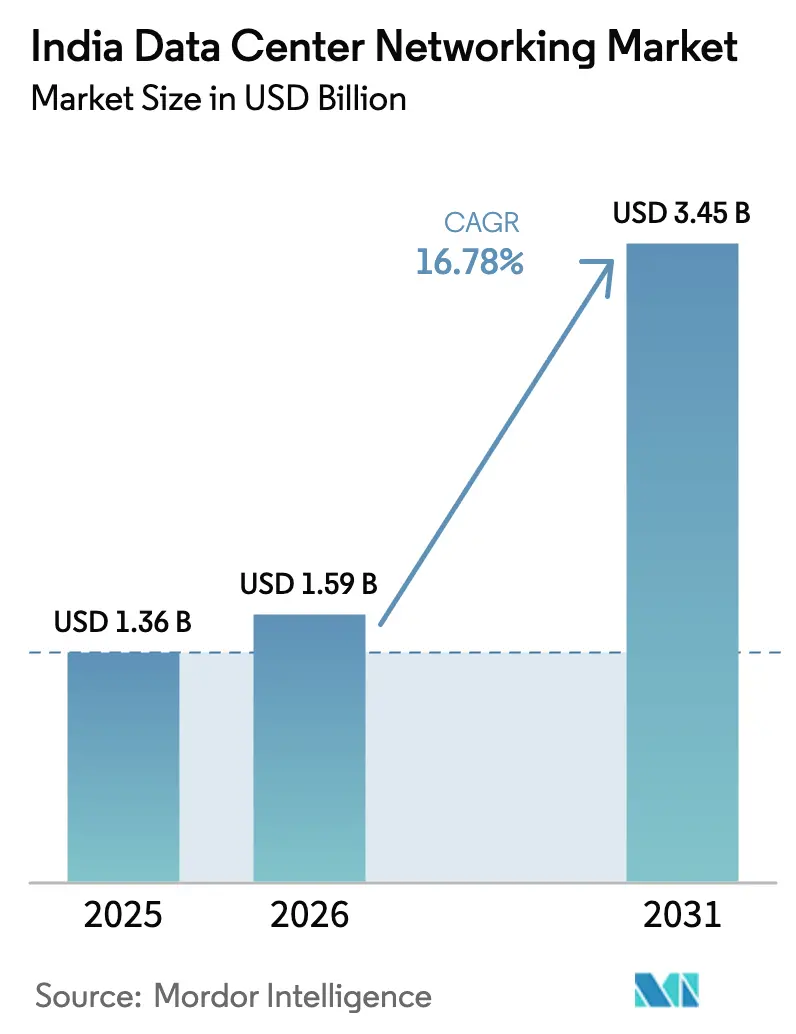
The India Data Center Networking Market size was valued at USD 1.36 billion in 2025 and is estimated to grow from USD 1.59 billion in 2026 to reach USD 3.45 billion by 2031, at a CAGR of 16.78% during the forecast period (2026-2031).
This rapid scale-up reflects the convergence of mandatory data-localization rules, hyperscale campus build-outs, and the rollout of 5G and AI-ready infrastructure, all of which demand high-performance switching, routing, and optical systems. Investment momentum is reinforced by a government production-linked incentive framework that lowers the cost of building locally, while private operators race to deploy 400 GbE and 800 GbE fabrics that can handle AI training clusters. Edge-focused deployments serving 5G and Open Network for Digital Commerce (ONDC) traffic further intensify the need for distributed, software-defined control. On the supply side, global vendors have responded by setting up domestic manufacturing lines, yet power quality constraints and a shortage of senior networking talent outside the top metros remain structural bottlenecks. Against this backdrop, the India data center networking market offers strong upside for vendors able to deliver simplified, AI-optimized solutions that offset operational complexity.
Key Report Takeaways
- By component, Products held 72.45% of India data center networking market share in 2025, while Services are projected to grow at a 20.7% CAGR through 2031.
- By end-user, IT & Telecommunications led with 36.02% revenue share in 2025; Manufacturing is advancing at a 19.6% CAGR to 2031.
- By data-center type, Colocation facilities commanded 55.90% share of the India data center networking market size in 2025; Hyperscalers/Cloud Service Providers segment is expanding at 21.9% CAGR.
- By bandwidth, 50–100 GbE configurations accounted for 33.90% of the India data center networking market size in 2025, while greater than100 GbE deployments are rising at a 19.2% CAGR.
- Cisco, Juniper Networks, and Arista Networks collectively held 46.35% combined market share in high-performance switches during 2025, underscoring a moderately concentrated hardware tier.
Note: Market size and forecast figures in this report are generated using Mordor Intelligence’s proprietary estimation framework, updated with the latest available data and insights as of 2026.
India Data Center Networking Market Trends and Insights
Drivers Impact Analysis*
| Driver | (~) % Impact on CAGR Forecast | Geographic Relevance | Impact Timeline |
|---|---|---|---|
| Accelerated hyperscale campus build-outs by domestic conglomerates | +4.2% | Mumbai, Chennai, Hyderabad clusters | Medium term (2–4 years) |
| Mandatory data-localization under Digital Personal Data Protection Act 2023 | +3.8% | Nationwide | Long term (≥ 4 years) |
| Rapid 400 GbE / 800 GbE migration in cloud PoPs | +2.9% | Metro clusters and tier-2 spillover | Short term (≤ 2 years) |
| Low-latency edge nodes for 5G and ONDC | +2.1% | High-density urban zones | Medium term (2–4 years) |
| PLI-linked local manufacturing of optical and switching gear | +1.8% | Gujarat, Tamil Nadu, Karnataka hubs | Long term (≥ 4 years) |
| AI-optimized fabrics for Gen-AI clusters | +1.4% | Bengaluru, Hyderabad, Pune | Medium term (2–4 years) |
| Source: Mordor Intelligence | |||
Accelerated hyperscale campus build-outs by domestic conglomerates
Indian conglomerates have earmarked multibillion-dollar capital outlays to deploy nationwide hyperscale grids, alleviating land-scarcity pressures in crowded metros by distributing capacity across emerging tier-2 and tier-3 cities. Adani ConneX’s pledge to install 10 GW of IT load and ST Telemedia Global Data Centres’ plan to add 550 MW underline a supply pipeline that far exceeds historical norms.[1]RCR Wireless News staff, “AdaniConneX targets 10 GW Indian data-center play,” rcrwireless.com These campuses require ultra-dense leaf-spine fabrics, software-defined overlays, and campus-to-edge optical backbones capable of line-rate encryption. Operators also demand transparent telemetry for power and cooling because regional grids experience wider voltage swings. Vendors able to bundle switching, optics, and intent-based automation, therefore, gain a strategic edge in this phase of the India data center networking market.
Mandatory data-localization under Digital Personal Data Protection Act 2023
The Act enforces in-country processing for sensitive personal data, forcing multinational cloud and SaaS providers to replicate complete workloads inside India. The localisation rule drives a sharp uptick in intra-India east–west traffic as enterprises migrate from cross-border links to domestic availability zones, reinforcing growth momentum across the wider data center market in India.[2]Lexology editors, “Digital Personal Data Protection Act 2023: obligations for data fiduciaries,” lexology.com Latency ceilings tighten because workloads that formerly traversed submarine cables now stay within sovereign borders, requiring city-level interconnects and high-throughput encryption. In financial services and healthcare, regulators also mandate in-flight encryption across campus fabrics, spurring demand for MACsec-enabled switches and zero-trust segmentation engines.
Rapid 400 GbE / 800 GbE migration timelines in Indian cloud PoPs
Competitive parity with global hyperscalers has compressed upgrade roadmaps; domestic operators are transitioning from 100 GbE to 400 GbE/800 GbE within two refresh cycles. Cisco’s Silicon One-powered 64-port 800 G switch provides the building block for flatter, ultra-low-latency AI clusters.[3]Cisco Systems, “Silicon One G200 powers 800G switching,” cisco.com East-west traffic generated by large language model (LLM) training frequently saturates 100 GbE links, so operators adopt 4:1 oversubscription caps and deploy dynamic load balancing. High-speed optics also cut the number of cables, reducing rack congestion and operating costs vital in power-constrained tier-2 environments.
Low-latency edge nodes for 5G and ONDC commerce traffic
India’s 5G rollout and the ONDC mandate place real-time transaction processing at the network edge, often inside micro-facilities colocated with telco base stations. These nodes use Layer-4-7 service meshes to handle rapid traffic bursts from mobile commerce while enforcing deterministic latency caps below 15 ms. Packet-based load-balancers and container-aware firewalls, therefore, complement high-density leaf switches. Edge fabrics also rely on satellite microwave failover links in regions where fiber paths remain single-threaded, adding another design variable that increases the appeal of intent-based orchestration tools rely on satellite microwave failover links in regions where fiber paths remain single-threaded, adding another design variable that increases the appeal of intent-based orchestration tools.
Restraints Impact Analysis*
| Restraint | (~) % Impact on CAGR Forecast | Geographic Relevance | Impact Timeline |
|---|---|---|---|
| Chronic power-supply deficits in tier-2 DC clusters | -2.8% | Tier-2 and tier-3 cities across multiple states | Long term (≥ 4 years) |
| Long-cycle MoEF clearances for large DC campuses | -2.1% | National, particularly affecting greenfield projects | Medium term (2-4 years) |
| Scarcity of CCIE / JNCIE-level talent outside top metros | -1.9% | Non-metro areas, particularly in eastern and northeastern regions | Medium term (2-4 years) |
| Heightened capex due to rupee depreciation on imported optics | -1.5% | National, with higher impact on import-dependent operators | Short term (≤ 2 years) |
| Source: Mordor Intelligence | |||
Chronic power-supply deficits in tier-2 DC clusters
Frequent voltage fluctuations and multi-hour brownouts in second-tier cities compel operators to over-provision diesel generation and energy-storage systems, adding as much as 22% to capex per MW. High-speed optics and AI-optimized switches push rack power density above 20 kW, making battery runtime and transformer sizing critical. Although the National Broadband Mission earmarks USD 100 billion for grid upgrades, execution schedules stretch beyond the 2030 horizon, perpetuating risk for investors. Consequently, some hyperscalers adopt modular microgrid architectures with solar PV, but energy-yield variability complicates network capacity planning.
Scarcity of CCIE/JNCIE-level talent outside top metros
Advanced routing, software-defined segmentation, and GPU-cluster interconnects require deep protocol knowledge rarely found beyond Bengaluru, Mumbai, and Delhi. Operators thus incur relocation premiums or rely heavily on automation frameworks such as closed-loop intent validation. While the National AI Mission plans to train 10 million citizens in advanced ICT skills by 2028, short-term scarcity inflates day rates for freelance network architects by 35% year-on-year. Managed network services and remote hands contracts therefore grow rapidly, but they cannot fully substitute for on-site troubleshooting during cut-overs or power events.
*Our forecasts treat driver/restraint impacts as directional, not additive. The impact forecasts reflect baseline growth, mix effects, and variable interactions.
Segment Analysis
By Component: Services accelerate despite product dominance
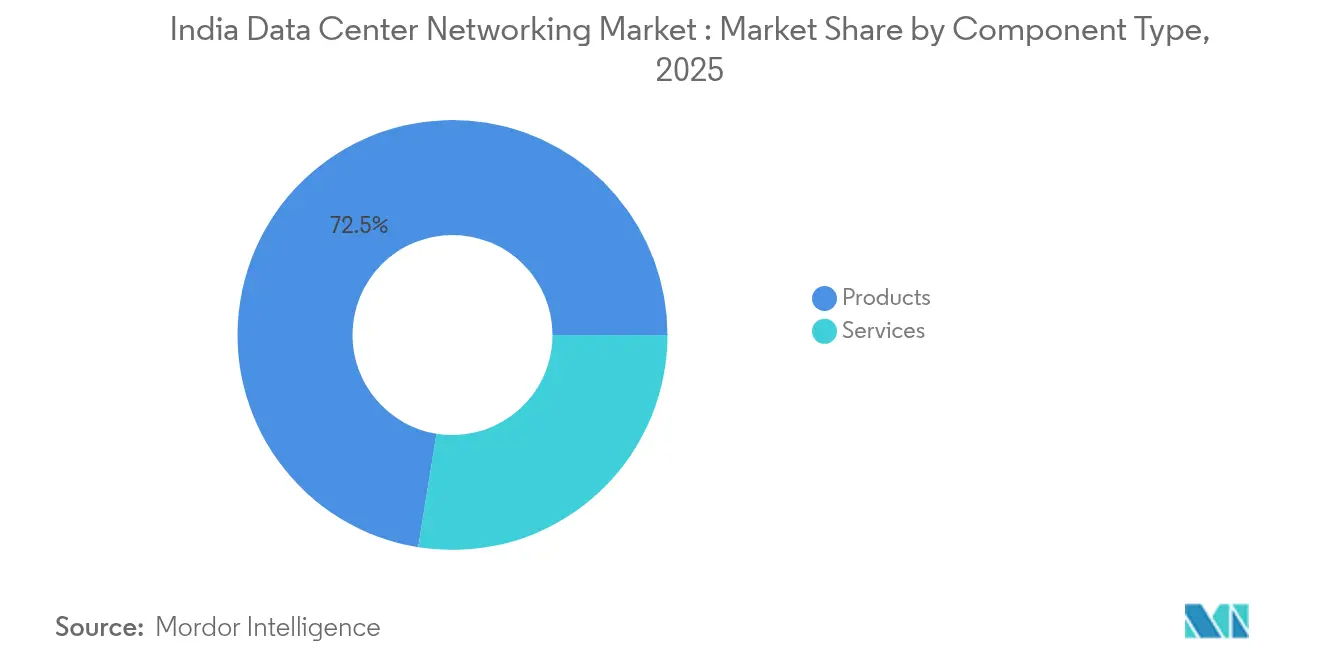
Products contributed USD 985.32 million in revenue during 2025, equal to 72.45% of total spend, underpinned by large orders for 400 GbE-capable leaf and spine switches. The India data center networking market size for Services reached USD 374.68 million and is projected to expand 20.7% CAGR through 2031 as enterprises outsource integration, testing, and lifecycle management. Installation and integration workstreams represent over half of Services revenue because AI-ready fabrics require precision timing and lossless queue tuning. Managed network services appeal to mid-market cloud providers that lack in-house Layer-3/Layer-4 expertise. Cisco’s co-innovation with NVIDIA on end-to-end AI fabrics exemplifies a hardware-plus-services model that compresses deployment timelines.
Product vendors are simultaneously embedding telemetry agents to ease predictive maintenance, thereby blurring hardware-software boundaries. Field-replaceable optics produced locally under PLI subsidies shorten spares logistics, a decisive advantage in power-constrained tier-2 sites. Over the forecast period, professional services linked to zero-trust segmentation and intent-based orchestration will outpace traditional break-fix contracts.



By End-User: Manufacturing disrupts traditional IT leadership
IT & Telecommunications retained 36.02% share in 2025 as 5G backhaul upgrades and cloud availability-zone rollouts consumed high-capacity switches. Manufacturing, however, is set to log a 19.6% CAGR, propelled by Industry 4.0 data lakes, digital twins, and PLI incentives for electronics assembly. Automotive and semiconductor fabs now deploy deterministic Ethernet rings inside plants, driving fresh demand for low-latency aggregation switches. Banking and Financial Services continue steady upgrades to meet data-sovereignty guidelines, while Healthcare accelerates adoption of tele-ICU and robotic surgery workflows requiring encrypted 400 GbE uplinks. The diversity of use cases reduces concentration risk within the India data center networking market and spurs vendors to offer vertical-specific templates.
By Data-Center Type: Hyperscalers challenge colocation supremacy
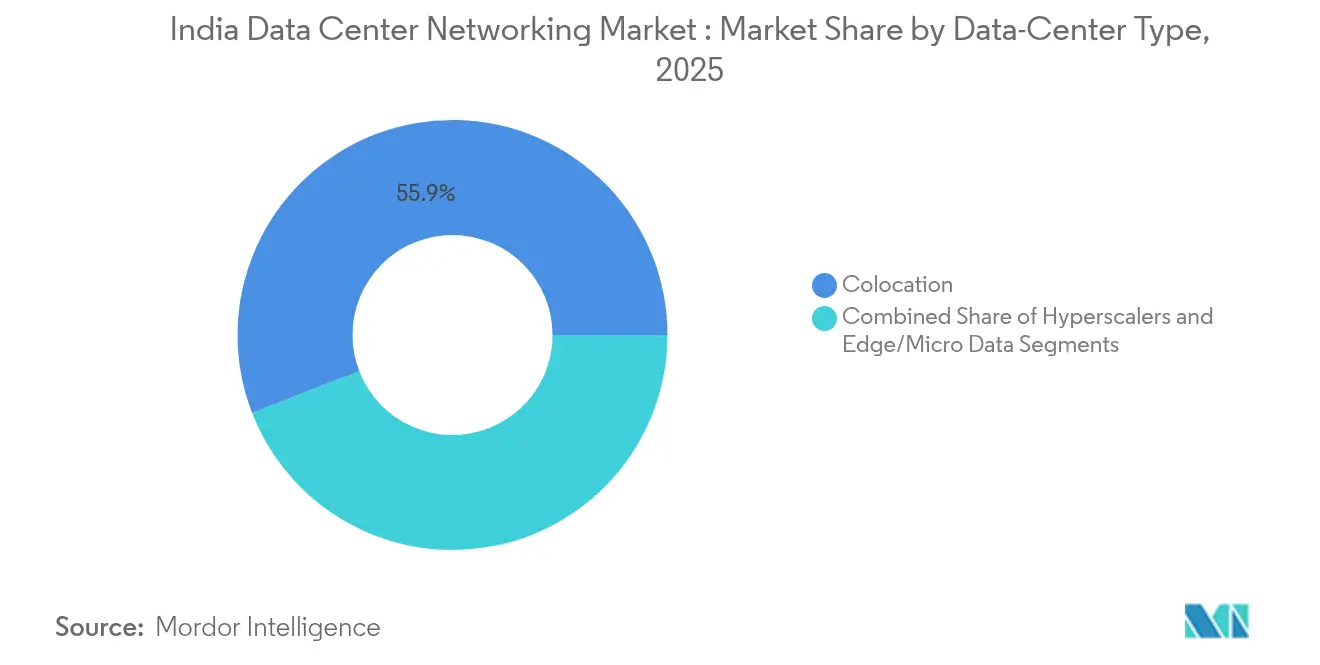
Colocation campuses accounted for 55.90% of spend in 2025 as enterprises pursued asset-light models and connectivity-rich ecosystems. Yet hyperscalers show the strongest trajectory, compounding 21.9% annually because AWS, Microsoft, Google, and Adani ConneX are racing to localize AI training clusters. The India data center networking market share held by hyperscalers is expected to pass 40% before 2031 as fresh capacity comes online. Edge and micro-facilities, although small in rack count, multiply rapidly around 5G base-stations to host ONDC commerce caches and CDN termination points. Their growth reinforces demand for lightweight, remotely managed switching platforms with zero-touch provisioning.
By Bandwidth: High-speed migration accelerates
50–100 GbE links remained mainstream at 33.90% share in 2025, yet deployments above 100 GbE are scaling 19.2% CAGR on the back of AI workloads. The India data center networking market size attached to greater than 100 GbE lanes is forecast to reach USD 1.39 billion by 2031, equal to 40.25% of total spend. Operators are leapfrogging intermediate speeds to land directly on 800 GbE in high-density GPU pods. Keysight’s validation suites ensure lossless cut-overs, lowering risk for early adopters. Meanwhile, ≤10 GbE ports persist in some edge sites where fiber feeds remain limited, underscoring the fragmentary nature of network-upgrade cycles across India’s vast geography.
Geography Analysis
Mumbai alone houses 48% of installed IT load, leveraging submarine-cable gateways and strong power grids, yet land scarcity and premium real-estate costs push new builds toward Navi Mumbai and Thane. Chennai, Bengaluru, and the Delhi-NCR cluster comprise the next tier, collectively accounting for 38% of capacity. Hyderabad’s growth rests on proximity to semiconductor fabs and AI research parks. The western corridor dominates financial-services hosting; the southern belt excels in SaaS exports and chip design; the northern cluster hosts government data vaults and public-sector clouds.
Tier-2 cities such as Kochi, Jaipur, and Kolkata are emerging hot spots thanks to BharatNet fiber backbones and state-level tax incentives. CtrlS’s INR 2,200 crore, 60 MW campus in Kolkata exemplifies east-coast momentum. Equinix’s 33 MW renewable power purchase in Maharashtra illustrates how sustainability commitments shape site selection. Renewables integration is vital because creative tariff structures allow operators to mitigate grid unreliability while meeting ESG targets.
International connectivity further boosts the India data center networking market as new submarine cables land on both coasts, reducing latency to Asia-Pacific peers. The government’s USD 1.2 billion IndiaAI mission parcels funds to state innovation hubs, accelerating regional demand for AI-optimized fabrics. Collectively, these forces diffuse capacity beyond the traditional metro nexus, driving vendors to establish regional staging warehouses and co-locate technical staff.
Regulatory Landscape
India data center networking demand is shaped by privacy, telecom, and electronics-manufacturing policy, with the Digital Personal Data Protection Act, 2023 acting as the central anchor for in-country processing and security controls. The Act is operationalized via the DPDP Rules, 2025 (notified 14 November 2025) under the Data Protection Board of India, which drives auditability, encryption, and segmentation requirements across data center fabrics and interconnects as operators align governance and incident-response processes.
On the telecom side, the Department of Telecommunications (DoT) continues to influence how enterprise and cloud connectivity is provisioned, including OSP-linked compliance obligations, while reforms have removed some legacy burdens, for example the 2021 changes that removed mandatory security deposits for OSPs. On 23 June 2026, DoT notified the Telecommunications (Authorisation for Captive Telecommunication Services) Rules, 2026, formalizing an authorization framework for private enterprise networks (including Captive Non-Public Networks), which increases the need for policy-compliant routing, secure edge aggregation, and managed network controls within campuses and distributed micro facilities.
Value Chain Analysis
The India data center networking value chain spans silicon and optics suppliers, OEMs and system vendors (including switching, routing, optical interconnects, security, and SDN control), and a sizable integration layer that designs and validates fabrics for hyperscale, colocation, and edge environments. As operators move to 400 GbE and 800 GbE fabrics and roll out AI-ready architectures, solution delivery increasingly depends on integrated lifecycle partners that coordinate planning and build-out with power and cooling teams, handle network design, testing and commissioning, and support ongoing optimization, rather than treating networking as a standalone procurement.
Downstream, specialist system integrators, managed network service providers, and colocation interconnection ecosystems turn hardware into operational outcomes through day-2 automation, telemetry, and remote operations, especially where senior routing and fabric-tuning skills are scarce outside top metros. Network design and performance also depend on carrier and fiber ecosystem inputs, including redundant long-haul connectivity and peering via Internet Exchange Points (IXPs), which makes partnerships with connectivity providers and operations-focused service layers a determinant of time-to-serve for new availability zones and edge nodes.
Competitive Landscape
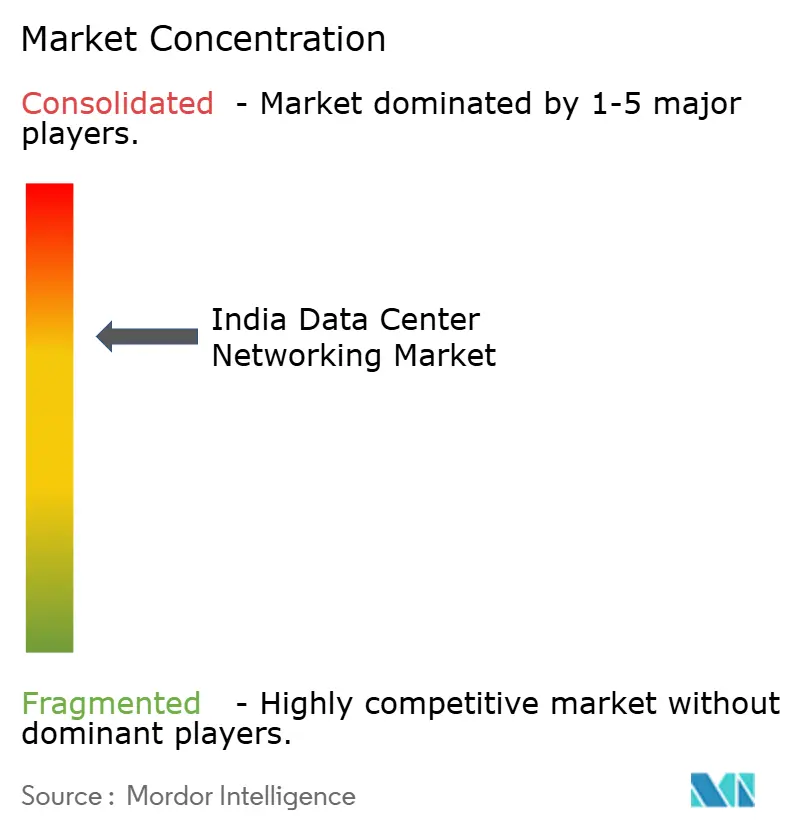
Global vendors maintain scale advantages in silicon road-maps and software ecosystems, yet domestic firms gain ground through faster customization and localization rebates. Cisco, Juniper, and Arista together held 47% switch revenue in 2024, while Huawei faces import restrictions that limit traction. The proposed HPE–Juniper merger would combine server, storage, and routing lines under one roof, creating a full-stack alternative to Cisco for AI fabrics. NVIDIA’s Ethernet push blurs the line between compute and network, especially as Spectrum-X bundles herb packs with GPU clusters.
Local contenders such as Sterlite Technologies and Tejas Networks supply carrier-grade optics and packet-transport gear under the PLI umbrella. Adani ConneX’s vertically integrated strategy includes renewable power and undersea cable stakes, translating into differentiated SLAs for hyperscale tenants. Managed services providers like Sify Technologies capture mid-market clients who struggle with skills shortages, often wrapping SD-WAN and zero-trust edges into a single as-a-service bill.
Strategic moves during 2024–2025 spotlight AI alignment. Cisco invested in Gruve.ai to bolster application-layer inference libraries, while ST Telemedia Global Data Centres signed the country’s first AI City MoU with Uttar Pradesh. Vendor road-maps now prioritize telemetry, closed-loop automation, and compliance tool-chains that map directly to Digital Personal Data Protection audits. Competitive intensity remains high, but price erosion is partially offset by escalating port speeds and software-feature tiers.
India Data Center Networking Industry Leaders
Cisco Systems Inc.
Dell Technologies Inc.
Hewlett Packard Enterprise Company LP
Juniper Networks Inc.
Arista Networks Inc.
- *Disclaimer: Major Players sorted in no particular order

Market Opportunities and Future Outlook
Compliance-led localization under the Digital Personal Data Protection Act, 2023, alongside the DPDP Rules, 2025 and oversight by the Data Protection Board of India, creates room for vendors that package security, encryption, segmentation, and audit tooling into data center switching and SDN operations. This is reinforced by enterprise-network policy evolution, including the DoT notification of the Telecommunications (Authorisation for Captive Telecommunication Services) Rules, 2026 on 23 June 2026, which supports managed, policy-controlled private networks connecting campuses, micro facilities, and cloud on-ramps.
AI and sovereign compute build-outs are translating into practical demand for high-bandwidth Ethernet fabrics, lossless transport features, and validated reference designs that reduce deployment risk in GPU-dense environments. A specific proof point is the January 2026 announcement by Dell Technologies and NxtGen AI to build an AI factory in India using Dell AI Factory with NVIDIA, deploying Spectrum-X Ethernet networking and large-scale GPU systems; deployments like this pull through high-speed switches, optics, and fabric operations services. Additional opportunities show up in lifecycle services, including integration, testing, and managed network operations, as well as in metro-to-tier-2 expansion where operators standardize remotely managed switching stacks to handle power variability and tighter on-site skills availability.
Recent Industry Developments
- June 2026: Hewlett Packard Enterprise (HPE) introduced HPE Juniper Networking QFX5140 switches for inference clusters and QFX5252 switch trays for AMD Helios rack-scale AI platforms, deepening integration of Juniper networking into its AI Data Center Solution. The launch strengthens AI fabric capabilities for India-based deployments.
- January 2026: Dell Technologies announced partnership with NxtGen AI to build India's largest AI factory using Dell AI Factory with NVIDIA, deploying over 4,000 NVIDIA Blackwell GPUs and Spectrum-X Ethernet networking. The partnership expands locally hosted AI manufacturing and related high-speed networking demand in India.
- April 2025: Adani Group pledged an additional USD 10 billion to scale national capacity to 10 GW, targeting edge data centers in Patna and Lucknow. The capacity expansion accelerates nationwide data-center build-out and associated networking requirements.


Research Methodology Framework and Report Scope
Market Definition and Coverage
This market covers networking infrastructure and related services used inside India-based data centers, including connectivity between servers and storage and links to external networks, plus security and uptime focused capabilities. The sizing is captured in value terms in USD for the period tracked in the report.
Scope exclusions: We exclude generic enterprise campus networking that is not deployed for data center operations, even if it uses similar switch and router families.
Segmentation Overview
- By Component
- Products
- Ethernet Switches
- Routers
- Storage Area Network (SAN)
- Application Delivery Controllers (ADC)
- Network Security Appliances
- Software-Defined Networking (SDN) Controllers
- Optical Interconnects
- Services
- Installation and Integration
- Training and Consulting
- Support and Maintenance
- Managed Network Services
- Products
- By End-User
- IT and Telecommunications
- Banking, Financial Services and Insurance (BFSI)
- Government and Defense
- Media and Entertainment
- Healthcare and Life Sciences
- Manufacturing and Industrial
- Other End-Users
- By Data-Center Type
- Colocation
- Hyperscalers/Cloud Service Providers
- Edge/Micro Data Centers
- By Bandwidth
- Less Than equals to 10 GbE
- 25–40 GbE
- 50–100 GbE
- Greater Than 100 GbE
Data Sources, Market Sizing, and Validation
Desk Research
Desk research was used to set the market boundaries, build the India demand story, and collect base inputs that can be checked independently. Public sources helped us understand data center build activity, connectivity upgrades, and the wider digital infrastructure environment that drives networking refresh cycles.
We referred to sources such as Ministry of Electronics and Information Technology (MeitY) policy releases, Telecom Regulatory Authority of India (TRAI) publications on broadband and traffic, and Department of Telecommunications (DoT) notifications that influence network architecture. For supporting indicators, we also used data and updates from organizations such as the Reserve Bank of India (digital payments volumes as a proxy for latency-sensitive workloads), the International Telecommunication Union (telecom benchmarks), and peer-reviewed papers on data center network design trends. Company annual reports, investor presentations, and reputable press coverage were used to cross-check capacity announcements and procurement timing. Where public detail was thin, we used a paid subscription for company financials and a shipment level import-export database to validate directionally. The sources listed here are illustrative only, and many other credible references were used for data collection, cross checks, and clarification.
Primary Interviews and Surveys
Primary work focused on discussions with data center operators, system integrators, and networking focused service teams, followed by cross checks with buyers responsible for facility-level expansions and refreshes. These interviews helped confirm which components are typically purchased together, what upgrade cadence looks realistic in India, and how bandwidth changes are being planned across colocation and cloud-style facilities.
Distribution of primary research fieldwork respondents
| Company type | Respondent position |
|---|---|
| Top tier: 28% | CXOs: 16% |
| Mid tier: 54% | Functional/Unit leaders: 36% |
| Smaller Players: 18% | Managers: 48% |
Market-Sizing & Forecasting
Market sizing starts from a top-down build where India data center expansion activity is reconstructed through installed and upcoming capacity signals, then translated into networking demand using adoption and refresh assumptions by facility type. The model is kept practical by tying each step to observable indicators, and then adjusting it when expert feedback indicates a mismatch with actual buying behavior.
To keep totals realistic, we also run selective bottom-up checks. This includes supplier and channel feedback on switching and routing demand, sampled bill-of-material logic for typical racks and pods, and an approximate ASP by bandwidth class multiplied by expected unit volumes. When gaps appear, we handle them by using ranges for ASP movement and deployment ratios, and then narrowing those ranges using what respondents say about current procurement cycles and preferred architectures.
Key model inputs include data center capacity additions and utilization direction, the share of colocation versus cloud-style builds, shifts in bandwidth needs (for example, moves from 10 GbE toward higher speeds), replacement cycles for switches and optics, and service attach rates for design, deployment, and managed support. Forecasting is done using scenario analysis with a base case stress-tested against alternative capex timing and expansion pace, while keeping the final year-by-year path consistent with what primary contacts expect for upgrades and new site commissioning.
Data Validation & Update Cycle
Validation is done through multiple checks so the final numbers do not depend on a single assumption. Outputs are compared against independent signals such as capacity build announcements, high level network equipment import patterns, and the implied spend per MW or per rack suggested by interviews. We then revisit any outliers before final sign-off.
Each draft goes through an analyst review cycle where unit economics, growth steps, and year-to-year changes are tested for reasonableness. If a large variance shows up versus expected demand indicators, we re-contact relevant participants to confirm the drivers. Reports are refreshed annually, and interim updates are added when a material change affects the supply pipeline, regulation, or pricing direction. Before delivery, we run a final review pass so clients receive an updated view aligned to the latest available information.
Mordor Intelligence's India Data Center Networking Market Sizing Compared With Other Published Estimates
Published market size numbers for India data center networking can vary even when they appear to cover the same topic, because the underlying scope and counting rules are often different. Variances usually come from what is treated as in-scope networking, whether services are included, how bandwidth mix is assumed, and how base years are converted into USD.
The main gap comes from whether only on-floor data center networking is counted, or whether adjacent WAN and broader enterprise networking spend gets bundled. Mordor Intelligence counts networking tied to data center deployments and related services while keeping non-data-center campus networks out of scope. Additional variance shows up when older base years are used without adjusting for India specific ASP movement, and when forecasts assume an aggressive upgrade cycle without validating it through operator-level checks.
Benchmark comparison
| Source | Market Size | Gaps in Research Methodology |
|---|---|---|
| Mordor Intelligence | USD 1.36 B (2025) | |
| Regional Consultancy A | USD 1.00 B (2024) | Uses a narrower definition that leaves out several network-related services and typically relies more on tier-1 metro rack footprints, which can undercount tier-2 city expansions and related switching demand. |
| Trade Journal B | USD 1.17 B (2024) | Applies broad global pricing and product bundling assumptions, which can mix data center switching with external WAN gear, and it may not reflect India specific bandwidth mix changes year by year. |
The spread across sources is mainly explained by what gets included as data center networking, plus how services and pricing are treated over time. By keeping the model tied to India data center expansion signals and checking the outputs through interviews and sanity checks on implied spend intensity, the final estimate stays traceable to clear variables and repeatable steps.


Key Questions Answered in the Report
What is the current size of the India data center networking market?
The market generated USD 1.59 billion in 2026 and is on track to reach USD 3.45 billion by 2031, reflecting a 16.78% CAGR.
Which segment is expanding fastest within the India data center networking market?
Services, particularly installation and managed network operations, are rising at 20.7% CAGR as enterprises seek help deploying AI-ready fabrics.
How quickly are Indian operators adopting 400 GbE and 800 GbE?
Migration timelines have compressed to one or two refresh cycles, with greater than 100 GbE ports already growing at a 19.2% CAGR and poised to represent 40.25% of spend by 2031.
What role does data-localization play in market growth?
Mandatory in-country processing under the Digital Personal Data Protection Act 2023 forces multinationals to build local capacity, directly boosting demand for high-capacity, secure networking gear.
Why are tier-2 cities important to future growth?
Land scarcity and high power tariffs in metros are driving hyperscalers to invest in tier-2 hubs, which in turn require robust networking and edge-connectivity solutions.
Which vendors are leading in AI-optimized data center networking?
Cisco, NVIDIA, Juniper, and Arista lead the race by combining high-speed silicon with intent-based automation that lowers complexity in GPU-dense clusters.
Page last updated on:
- Germany Data Center Networking Market
- France Data Center Networking Market
- United Kingdom Data Center Networking Market
- Japan Data Center Networking Market
- Canada Data Center Networking Market
- Brazil Data Center Networking Market
- Mexico Data Center Networking Market
- South Korea Data Center Networking Market
- Italy Data Center Networking Market
- China Data Center Networking Market
- Data Center Server Market Servers worldwide, split by tier, facility size and facility type.
- Data Center Construction Market Construction across the global market, covering tier, facility size and facility type.
- Data Center Cooling Market Cooling across the global market, covering cooling technology, cooling component and facility type.





