
India Data Center Rack Market Size and Share
Market Overview
| Study Period | 2025 - 2032 |
|---|---|
| Forecast Data Period | 2026 - 2032 |
| Base Year Market Size (2025) | USD 1 Million |
| Market Size (2026) | USD 4.99 Million |
| Market Size (2032) | USD 13.74 Million |
| Growth Rate (2026 - 2032) | 18.42 % |
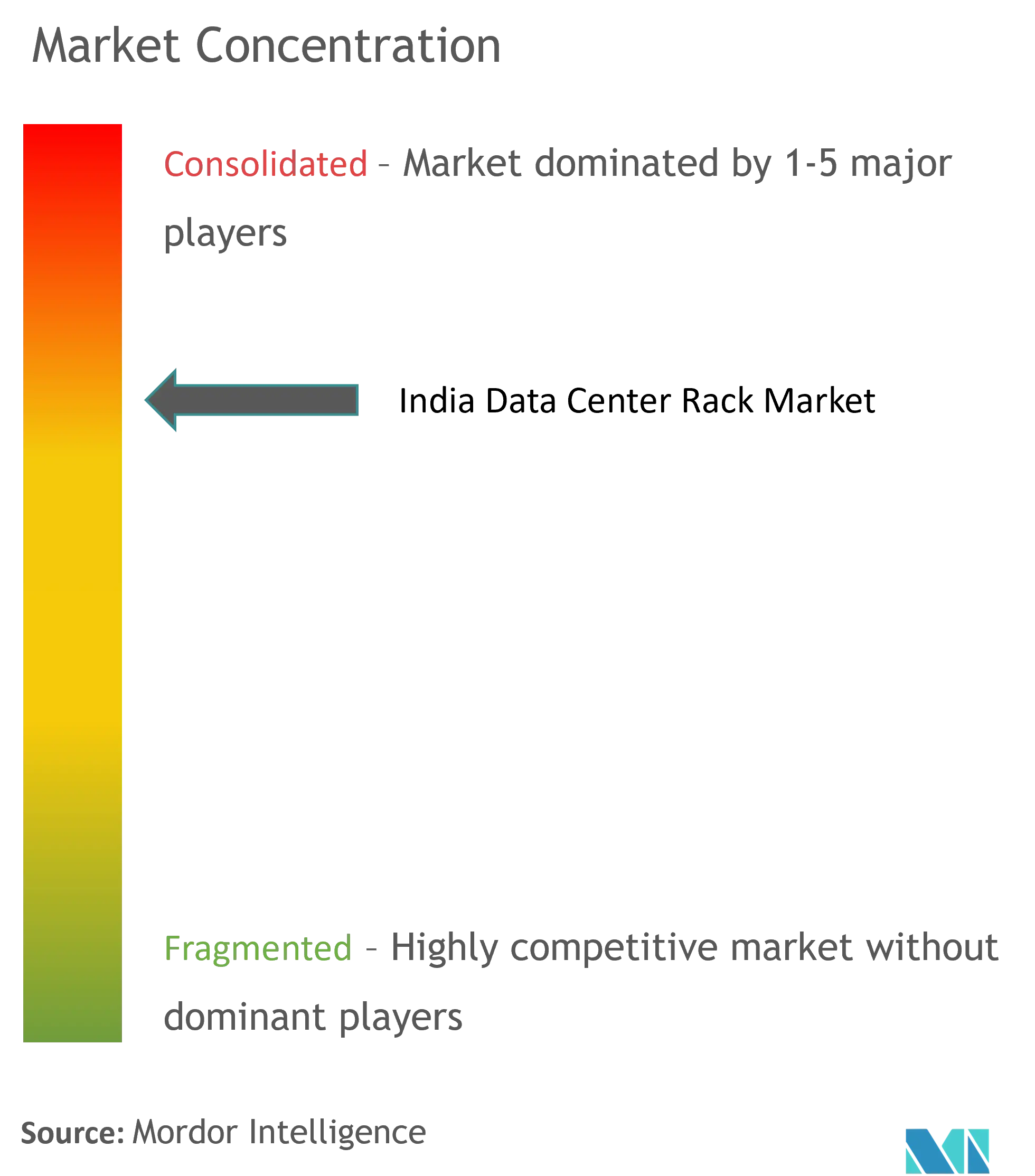
| Market Concentration | High |
Major Players *Disclaimer: Major Players sorted in no particular order Image © Mordor Intelligence. Reuse requires attribution under CC BY 4.0. | |
India Data Center Rack Market Analysis by Mordor Intelligence
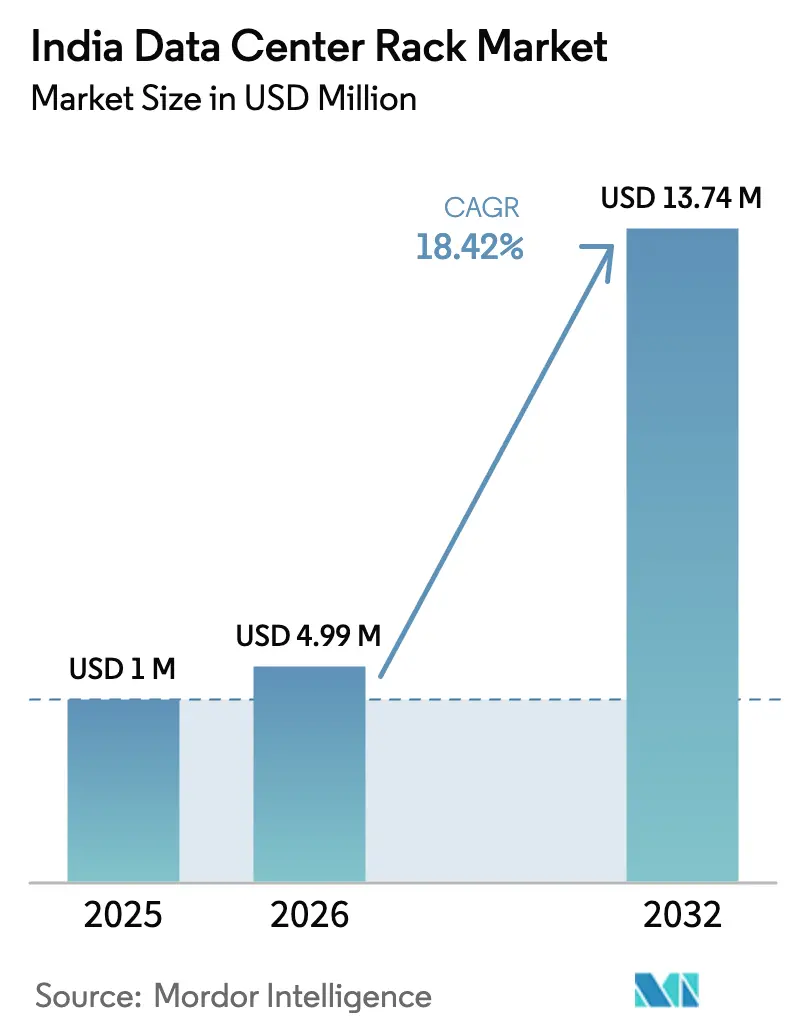
The India data center rack market size was valued at USD 4.21 million in 2025 and estimated to grow from USD 4.99 million in 2026 to reach USD 13.74 million by 2032, at a CAGR of 18.42% during the forecast period (2026-2032). A surge of hyperscale investments, supportive government policies, and rapid edge-computing roll-outs are combining to push capacity from 1 GW in 2025 toward 17 GW by 2030. Foreign direct investment by Google, AWS, Microsoft, and Colt is translating into fast-tracked build-outs that demand standardized, high-density rack designs. Rising electricity costs are reinforcing the shift toward liquid-cooling-ready rack formats, while domestic value-addition norms under Make in India are tilting procurement toward local manufacturers that can certify 25-45% indigenous content. Meanwhile, edge facilities in Patna, Jaipur, and Kochi are expanding the geographic footprint beyond Mumbai, Chennai, and Hyderabad to support latency-sensitive AI workloads.
Key Report Takeaways
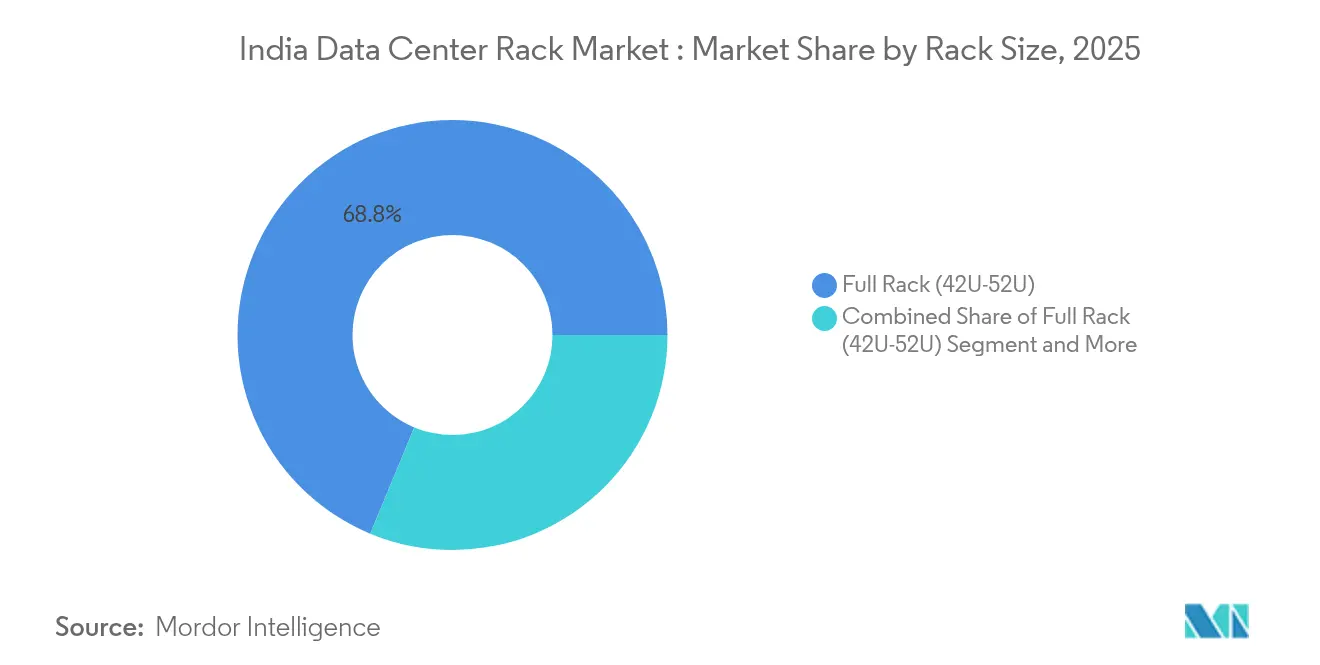
- By rack size, full-rack formats captured 68.75% of India data center rack market share in 2025, while half racks are pacing the field with a 19.02% CAGR through 2032.
- By rack type, enclosed server cabinets commanded 72.35% revenue share in 2025; soundproof racks are forecast to expand at a 20.01% CAGR between 2026-2032.
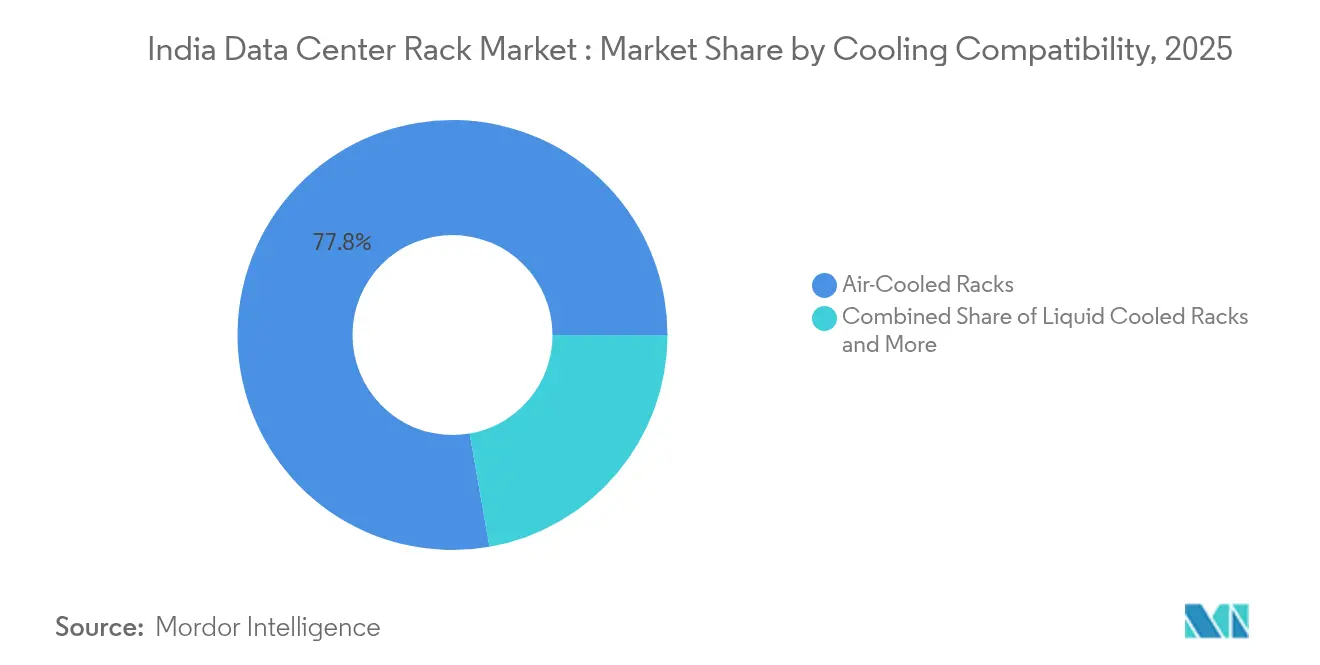
- By cooling compatibility, air-cooled designs held 77.75% of the India data center rack market size in 2025, whereas liquid-cooled models are expected to grow at a 19.34% CAGR to 2032.
- By end user, IT and telecommunication accounted for 39.45% of 2025 spending; healthcare and life sciences is advancing at a 19.56% CAGR through 2032.
Note: Market size and forecast figures in this report are generated using Mordor Intelligence’s proprietary estimation framework, updated with the latest available data and insights as of 2026.
India Data Center Rack Market Trends and Insights
Drivers Impact Analysis*
| DRIVER | (~) % IMPACT ON CAGR FORECAST | GEOGRAPHIC RELEVANCE | IMPACT TIMELINE |
|---|---|---|---|
| Increasing deployment of data-center facilities | +4.2% | Mumbai, Chennai, Hyderabad | Medium term (2-4 years) |
| Growing cloud-computing and hyperscale investments | +3.8% | South dominant, spreading North and West | Long term (≥ 4 years) |
| Government-led digital initiatives | +2.9% | Nationwide, Tier-2/3 focus | Long term (≥ 4 years) |
| Rising demand for colocation and managed hosting | +2.1% | Metros plus emerging cities | Medium term (2-4 years) |
| Edge-computing expansion in Tier-2 and Tier-3 cities | +1.8% | Patna, Jaipur, Kochi, Ahmedabad | Short term (≤ 2 years) |
| Standardization for high-density AI/ML racks | +1.6% | Bangalore, Hyderabad, Pune | Medium term (2-4 years) |
| Source: Mordor Intelligence | |||
Increasing Deployment of Data Center Facilities
India’s build-out wave is anchored by Google’s USD 6 billion Visakhapatnam project and Reliance’s planned 3 GW AI campus in Gujarat.[1]NDTV, “Andhra Pradesh, Google Sign USD 6 Billion Worth Major Data Centre Deal,” ndtv.com Central and state incentives, such as Maharashtra’s USD 20 billion Green Integrated Data Centre Parks, are bundling land, power, and single-window clearances. New guidelines on renewable procurement are prompting developers to embed solar and wind offsets at the design stage. Standard 42U–52U racks that support 15–100 kW loads are therefore becoming the default spec. Domestic rack makers benefit because proximity allows custom fabrication to meet site-specific seismic and thermal codes.
Growing Cloud Computing and Hyperscale Investments
AWS has earmarked USD 12.7 billion through 2030 to roll out AI-ready zones,[2]Business Standard, “Amazon Web Services bets big on India's talent in the global AI race,” business-standard.com while Microsoft, Oracle, and Equinix continue to scale 50-100 MW campuses. Workloads such as generative AI are pushing rack densities to 100 kW, making liquid-cooling readiness mandatory. Hyperscalers prefer uniform rack enclosures that streamline logistics across multi-region footprints. In response, suppliers are integrating quick-connect manifolds and rear-door heat exchangers as factory options. Procurement volumes from just three hyperscale buyers already exceed combined demand from the top fifty enterprises, underscoring their outsized influence on standards.
Government-Led Digital Initiatives
Digital India’s localization mandates require financial-payment and public-sector data to reside onshore, spurring fresh capacity in non-metro zones. MeitY now links procurement preference to racks with 25-45% domestic value addition, nudging integrators toward local welders, powder-coaters, and cable-tray vendors. The forthcoming data-center policy promises fast-track land conversion and dual-feed power at regulated tariffs, de-risking project economics. As a result, certified Indian Standards Organization racks with seismic rating, smoke seals, and biometric bays are gaining traction across state tenders.
Rising Demand for Colocation and Managed Hosting Services
Enterprises are migrating legacy workloads into shared facilities that promise 99.99% uptime without heavy capital outlay. Yotta’s partnership with NVIDIA showcases how colocation providers are pre-installing GPU-dense racks to attract AI clients.[3]Yotta Infrastructure, “Yotta Data Services Collaborates with NVIDIA,” yotta.com BFSI tenants demand acoustic and EMI shielding to comply with RBI norms, raising demand for sound-dampened enclosures. Sustainability is an additional lever; CtrlS targets carbon neutrality by 2030, and Nxtra’s AI-driven SmartSense platform trims non-IT power by 10%.
Restraints Impact Analysis*
| RESTRAINTS | (~) % IMPACT ON CAGR FORECAST | GEOGRAPHIC RELEVANCE | IMPACT TIMELINE |
|---|---|---|---|
| Availability of cheap and counterfeit racks | -2.4% | Nationwide, notably Tier-2/3 | Short term (≤ 2 years) |
| High upfront CAPEX and compliance costs | -1.9% | Metro zones with strict norms | Medium term (2-4 years) |
| Volatile CRCA steel supply chain | -1.7% | National, with higher impact on domestic manufacturers | Short term (≤ 2 years) |
| Land acquisition and power-provisioning delays | -1.4% | Metropolitan areas and emerging Tier-2/Tier-3 cities | Medium term (2-4 years) |
| Source: Mordor Intelligence | |||
Availability of Cheap and Counterfeit Racks
Price-sensitive buyers sometimes select non-certified enclosures fabricated from thin-gauge steel, heightening fire risk and load failure. Steel cost swings between INR 63 500-68 500 per tonne intensify the temptation to down-spec materials, undermining reliability. Substandard units rarely support the 1 200-kg static loads common in hyperscale deployments. To curb counterfeit imports, customs authorities now mandate BIS traceability codes, but enforcement gaps persist in secondary markets.
High Upfront CAPEX and Compliance Costs
ISO 27001, ISO 14001, and MeitY empanelment together add 12-15% to rack acquisition costs, squeezing margins for small operators. Healthcare deployments must also meet HIPAA-aligned acoustic criteria, pushing buyers toward premium soundproof racks that can cost 35% more than standard cabinets. Power distribution units rated for 100 A per phase and redundant busways raise total build costs further. Smaller carriers often defer upgrades, slowing penetration in underserved districts.
*Our forecasts treat driver/restraint impacts as directional, not additive. The impact forecasts reflect baseline growth, mix effects, and variable interactions.
Segment Analysis
By Rack Size: High-Density Full Racks Anchor Core Sites
Full racks claiming 68.75% of 2025 shipments underscore how hyperscalers favor tall, deep frames that optimize floor utilization. The India data center rack market size for full racks is poised to expand at 17.98% CAGR, reflecting uniform deployment templates across new 100 MW campuses. Half racks, though a smaller base, are gaining momentum in edge sites, and their India data center rack market share could reach double digits by 2032 as operators balance space and power constraints. Quarter racks remain niche, serving telecom shelters and retail back-offices where weight limits cap equipment loads.
Second-generation full racks incorporate brush grommets, perforated doors, and BMS-ready sensor arrays, enabling airflow tuning without major retrofits. Half-rack designs now ship with slide-out sections that accept additional U-spaces, protecting initial capex while allowing future scaling.



By Rack Type: Enclosed Cabinets Dominate, Acoustic Designs Surge
Enclosed cabinets captured 72.35% sales because multi-tenant sites require lockable, dust-resistant compartments. The India data center rack market size for enclosed models will rise steadily as BFSI and government workloads move into colocation halls. Open-frame racks thrive in captive hyperscale halls, where perimeter security and structured airflow make doors redundant. Soundproof racks, advancing at a 20.01% CAGR, are entering hospital data rooms and urban micro-edge pods that need to stay within 60 dB noise limits. Wall-mount units hold a minor slice, yet remain relevant for 5G base-band units and branch-office routers.
Manufacturers are embedding composite panels and mass-loaded vinyl in acoustic racks without expanding overall footprint. Compliance with ISO 3744 noise-emission standards is becoming a bid requirement in healthcare tenders, bolstering adoption.
By Cooling Compatibility: Air Leads, Liquid Gains Traction
Air-cooled enclosures still command 77.75% revenue because brownfield sites rely on perimeter CRAC units. However, the India data center rack market size for liquid-cooled cabinets is forecast to triple by 2032 alongside ramping AI adoption. Operators opt for hybrid-ready frames that can start with air and retrofit to cold-plate loops later, safeguarding capex. Early liquid-ready installs report 15-20% PUE improvement once servers switch to direct-chip coolant, offsetting higher upfront costs.
Rack vendors now pre-drill for quick-disconnect fittings and integrate drip-less valves, reducing on-site retro-fit time. Standard 600 mm widths are favored because they leave 200 mm of side clearance in 1 200 mm aisles, simplifying hose management.
By End User: IT and Telecom Leads, Healthcare Ramps Up
IT and telecommunication buyers held 39.45% of 2025 outlay as CSPs and carriers rolled out regional availability zones. The India data center rack market size for healthcare is projected to climb fastest, buoyed by tele-ICU, imaging PACS, and regulatory digitization drives. BFSI continues to expand secure pods that require dual-factor locks and vibration isolation. Media-streaming firms position cache nodes close to population centers, driving quarter-rack demand in mall rooftops and stadium basements.
Specialized needs such as MRI image archiving push healthcare buyers toward sound-damped, EMI-shielded cabinets. Manufacturers supplying antimicrobial powder coats and negative-pressure plinths gain an edge when bidding hospital projects.
By Data Center Type: Hyperscale Growth Reshapes Traditional Models
Colocation facilities dominated the India data center rack market with 66.20% market share in 2025, underlining enterprise preference for shared halls that optimize capital efficiency and operational expertise. Hyperscale/self-built facilities are racing ahead at a 20.25% CAGR through 2032, driven by Google’s USD 6 billion Visakhapatnam campus and AWS’s USD 12.7 billion outlay to 2031. These AI-centric builds require racks engineered for 80-100 kW loads and manifold liquid loops.
Others, comprising enterprise and edge deployments, fill specialized needs where proximity or compliance dictates dedicated halls. CtrlS’s Patna site, valued at INR 400 crore (USD 48.2 million), exemplifies the edge trend that balances cost with reliability. Colocation providers now bundle hybrid offers, mixing shared aisles with dedicated cages, enabling rack suppliers to leverage standardized manufacturing while catering to varied service-level agreements.
Geography Analysis
South India remains the epicenter, contributing over half of active MW capacity and a 65% pipeline toward 2030. Chennai and Bangalore benefit from submarine cable proximity and talent density, while Hyderabad’s tax holidays deepen its allure. Land parcels bundled with green-power wheeling agreements cut project lead time by up to six months, supporting continued dominance.
West India, anchored by Mumbai and Navi Mumbai, retains strategic weight thanks to BFSI workloads and international gateway cables. Maharashtra’s green-park policy offering concessional tariffs for 100% renewable operation is attracting USD 20 billion of planned investments. High land prices encourage taller rack aisles and multi-story data halls, making enclosure strength and seismic compliance critical.
North and East corridors are emerging on the back of state incentives. The Rs 600 crore Northeast facility targets underserved logistics and government workloads. CtrlS’s 60 MW Kolkata campus signals confidence in lower-cost power grids and cooler ambient temperatures that trim cooling bills. Together, these regions diversify risk from coastal weather events and decongest prime metros.
Regulatory Landscape
India's rack demand sits within a tightening policy and standards environment shaped by MeitY, sector regulators, and the Bureau of Indian Standards (BIS). On 25 February 2026, India notified its first-ever national standards for cloud computing and data center performance aligned to ISO/IEC frameworks through BIS, raising the bar for audited design and operational practices that flow down into rack specifications (load ratings, grounding, safety, and monitoring provisions). In parallel, Digital India localization mandates for sensitive data and MeitY procurement preference tied to 25-45% domestic value addition are reinforcing compliant, traceable sourcing over informal fabrication.
Data governance compliance is also becoming a procurement gate for operators and their suppliers. The DPDP Rules notified on 13 November 2025 set an 18-month runway ending 13 May 2027 and reference penalties up to INR 250 crore per breach, pushing colocation and enterprise data centers to formalize controls that cascade into secure, lockable enclosures and documented supply chains. Investment-side measures, including Union Budget 2026 incentives and infrastructure-status treatment for larger facilities (commonly referenced for sites above 5 MW), plus state-level single-window clearance programs (for example, Rajasthan's 2025 policy framework), are shortening project cycles and increasing the share of racks procured through standardized tenders rather than spot buying.
Value Chain Analysis
The rack value chain in India spans upstream steel and component sourcing, midstream fabrication and system integration, and downstream channel delivery to colocation, hyperscale/self-build, and edge sites. Upstream, cabinet frames depend on sheet steel and finishing inputs, while adjacent data center electrical infrastructure required alongside racks remains heavily import-dependent, with core equipment such as transformers, switchgear, and CRGO steel often sourced from markets including Japan, South Korea, and China. This import exposure contributes to long lead times for critical power equipment (often cited around 12 months), which can delay rack row commissioning even when cabinets are available.
Midstream, India has a mix of local sheet-metal fabricators and global vendors that bundle racks with power, cooling, and management accessories. Schneider Electric's India manufacturing expansions are an example of localization efforts that support the ecosystem around rack deployments, including an INR 184 crore expansion at its Kolkata facility to raise output to 250,000 medium-voltage component units per year, and a 500,000 sq ft manufacturing facility in Tamil Nadu developed with Horizon Industrial Parks to support IT business infrastructure needs. Downstream, systems integrators and contractors perform site-specific assembly (PDUs, busway interfaces, sensors, and access controls), but the chain faces constraints from shortages of skilled commissioning labor and limited domestic manufacturing depth for advanced liquid-cooling subsystems, increasing reliance on imported parts and specialist services for high-density AI-ready rack rows.
Competitive Landscape
Hanut India and Rohan Infotech are capitalizing on Make in India preferences by offering 45% local content and rapid customization. Vertiv, Schneider Electric, and Rittal leverage global supply chains to supply rear-door heat exchangers and high-capacity busways demanded by hyperscalers. Sustainability pledges are reshaping purchasing:
Edge deployments in Tier-2/3 towns open white-space for modular, quick-ship racks that fit 2.4 m doors and elevators. Global players partner with local sheet-metal firms to trim freight and import duties, eroding domestic price advantages. Value-added services—factory-integrated PDUs, sensor kits, and lifecycle support—are becoming decisive, pushing pure-play metal-benders to upgrade capabilities or exit.
Looking ahead, consolidation is probable as component inflation rewards scale economies. Vendors able to bundle racks with power, cooling, and DCIM software can anchor long-term managed services revenues, differentiating in an increasingly crowded field.
India Data Center Rack Industry Leaders
Eaton Corporation
Black Box Corporation
Rittal GMBH & Co.KG
Schneider Electric SE
Vertic Group Corp.
- *Disclaimer: Major Players sorted in no particular order

Market Opportunities and Future Outlook
AI-driven densification and compliance-led standardization are expanding whitespace for higher-spec racks in both core metros and new Tier-2/3 edge builds. As installed data center capacity in India is cited around 1.5-1.7 GW in early 2026 with policy and investment programs targeting multi-gigawatt expansion by 2030, operators are moving from conventional 12-15 kW rows toward AI-ready layouts that require liquid-cooling-ready frames, higher static load ratings, and integrated sensing for thermal and power governance. This shift supports opportunities in hybrid cooling-ready cabinets, acoustic and EMI-managed enclosures for regulated tenants (notably BFSI and healthcare), and standardized full-rack formats that can be replicated across multi-site footprints.
Local manufacturing and deeper integration with power distribution create additional opportunity, particularly where procurement preference is linked to domestic value addition and traceable compliance. Schneider Electric has publicly indicated that data center operations account for roughly 15-20% of its India business with ongoing growth, and it is investing in Indian capacity (for example, the Kolkata medium-voltage component expansion and the Tamil Nadu manufacturing footprint), signaling sustained demand for locally available, integrated infrastructure around rack deployments. The supply-chain constraints highlighted by industry analyses, including long procurement cycles for electrical equipment and limited domestic liquid-cooling manufacturing, leave room for rack suppliers and integrators that can shorten lead times through local fabrication, pre-integration of PDUs and monitoring kits, and service capabilities that reduce on-site commissioning bottlenecks.
Recent Industry Developments
- July 2026: Rittal India shifts from product supplier to a total solutions provider in the Indian IT and electrical sectors, with a focus on precise cooling solutions for data centers and HPC. Rittal India is also emphasizing integrated cooling and rack solutions for AI and HPC workloads in the Indian market. The company frames this as expanding end-to-end capability for deployment support across racks and cooling.
- June 2026: Eaton launches a new Low Voltage Switchboard Solution in India, engineered and manufactured locally to support hyperscale AI data center rack power distribution. The launch expands power infrastructure offerings for Indian hyperscale racks. Eaton's localized manufacturing and integrated power management are geared toward faster deployment of AI ready racks.
- May 2026: Black Box Limited completes the acquisition of Brazil based 2S Inovações Tecnológicas to expand digital infrastructure and data center services capability. The acquisition broadens Black Box’s cross border data center services and portfolio in markets connected to India. Black Box positions the addition as an expansion of its data center management services footprint.


Research Methodology Framework and Report Scope
Market Definition and Coverage
For this methodology, the India data center rack market covers revenue earned from selling racks used to mount and secure IT and networking equipment inside Indian data centers, across common cabinet and open-frame formats and standard unit heights.
Scope exclusions: We exclude servers, storage, networking hardware, PDUs, cooling equipment, and full data center construction services, even if they are bought in the same project.
Segmentation Overview
- By Rack Size
- Quarter Rack (9U–22U)
- Half Rack (23U–27U)
- Full Rack (42U–52U)
- By Rack Type
- Open-Frame Racks
- Enclosed Server Cabinets
- Wall-Mount Racks
- Soundproof / Acoustic Racks
- By Cooling Compatibility
- Air-Cooled Racks
- Liquid-Cooled Racks
- Hybrid Cooling-Ready Racks
- By End User Industry
- IT and Telecommunication
- BFSI
- Government and Public Sector
- Media and Entertainment
- Healthcare and Life Sciences
- Manufacturing
- Other End Users
- By Data Center Type
- Colocation Facilities
- Hyperscale/ Self-built Facilities
- Others (Enterprise, Edge among others)
Data Sources, Market Sizing, and Validation
Desk Research
Desk research was used to set the boundary of what counts as a rack sale, and to build the demand context for India data centers that ultimately drives rack ordering. We reviewed public releases from government and regulator sources such as MeitY, the Ministry of Power, and state-level IT and industrial promotion agencies to understand capacity additions and policy signals that impact new builds.
We also used non-paywalled sources such as the Telecom Regulatory Authority of India (TRAI) and the Reserve Bank of India (RBI) for signals related to digital payment adoption, plus publications from standards bodies and technical journals to cross-check cabinet sizing conventions and high-density readiness. Company annual reports, investor presentations, reputed press coverage, and a paid subscription for company financials and news were referenced to sanity-check activity levels and pricing direction, and then all assumptions were rechecked for consistency. The sources listed here are illustrative, and many other public documents and datasets were also used during data collection and validation.
Primary Interviews and Surveys
Primary interviews and structured surveys were used to validate rack demand by data center type and to clarify pricing and shipment timing that is not visible in public documents. We spoke with a mix of rack suppliers, data center operators, system integrators, and procurement teams. The fieldwork was balanced across key Indian metro clusters plus emerging locations, so the share of new IT load reflected where rack purchases are likely to be placed first.
Distribution of primary research fieldwork respondents
| Company type | Respondent position |
|---|---|
| Top tier: 36% | CXOs: 15% |
| Mid tier: 45% | Functional/Unit leaders: 25% |
| Smaller Players: 19% | Managers: 60% |
Market-Sizing & Forecasting
Sizing is built using a top-down approach where India data center expansion signals are translated into rack demand through practical conversion factors, and then the value is derived using typical rack mix and pricing. In the model, variables such as announced and under-construction capacity, observed rack density ranges (including higher density needs for AI-ready halls), the mix of colocation versus enterprise deployments, and the share of open-frame versus enclosed cabinets are used to form the yearly rack requirement.
To keep the totals realistic, we apply selective bottom-up checks using supplier discussions, sampled price bands by rack type and unit height, and channel checks around delivery lead times and project phasing. When a portion of demand cannot be directly observed (for example, small enterprise sites), it is handled through calibrated penetration assumptions that are repeatedly tested in interviews and adjusted only when multiple signals point in the same direction.
Forecasting is done using scenario analysis, because India data center build schedules can move with power availability, permitting timelines, and leasing absorption. The base case is anchored to the most consistent pipeline outlook from interviews. Sensitivity ranges are then applied to rack density and average selling price progression so the forecast remains explainable and repeatable.
Data Validation & Update Cycle
Each major step is checked for internal consistency, and then the outputs are compared with independent demand indicators such as facility expansion news flow, procurement timing patterns, and rack density trends discussed by practitioners. If a value looks out of line, the assumption is revisited, and respondents are re-contacted when a mismatch persists after desk rechecks.
Before sign-off, the model goes through multi-step analyst review so arithmetic, units, and currency handling are consistent across years. Reports are refreshed annually, with interim updates when material events occur (for example, large campus announcements, policy changes, or sharp input cost shifts). Before delivery, a fresh pass is completed to ensure the latest public developments are reflected in the final numbers.
Mordor Intelligence's India Data Center Rack Market Sizing Compared With Other Published Estimates
Published market sizes can vary a lot for data center racks because the product boundary is often mixed up with broader data center equipment, and because different studies treat shipment timing and pricing very differently. We see the largest spread when a model uses data center industry value as a proxy, or when it counts adjacent hardware that sits inside the rack.
Installed capacity signals, rack density discussions in India, and buyer-side procurement checks are the evidence that keeps Mordor Intelligence's estimate tied to actual rack demand and rack-only revenue, rather than facility capex or IT hardware totals.
Benchmark comparison
| Source | Market Size | Gaps in Research Methodology |
|---|---|---|
| Mordor Intelligence | USD 4.21 M (2024) | |
| Industry Publisher A | USD 207.46 M (2025) | This estimate appears to include a much wider equipment and application scope, and its scale suggests that non-rack categories or broader data center spend may be counted within the same number. |
| Industry Report B | USD 10.00 B (2024) | This figure represents the overall India data center industry value rather than racks, so it blends land, power, construction, and operations with hardware, which inflates the rack-specific market size. |
The comparison mainly shows that scope is the deciding factor, and once racks are separated from facility build and IT hardware, the market becomes much smaller and easier to trace. By anchoring the model to observable expansion signals and then validating pricing and mix with practitioner checks, the final number stays transparent, repeatable, and aligned to what buyers pay for racks in India.


Key Questions Answered in the Report
How big is the India Data Center Rack Market?
The India Data Center Rack Market size is expected to reach USD 4.99 million in 2026 and grow at a CAGR of 18.42% to reach USD 13.74 million by 2032.
What is the current India Data Center Rack Market size?
In 2026, the India Data Center Rack Market size is expected to reach USD 4.99 million.
Who are the key players in India Data Center Rack Market?
Eaton Corporation, Black Box Corporation, Rittal GMBH & Co.KG, Schneider Electric SE and Vertic Group Corp. are the major companies operating in the India Data Center Rack Market.
What years does this India Data Center Rack Market cover, and what was the market size in 2025?
In 2025, the India Data Center Rack Market size was estimated at USD 4.99 million. The report covers the India Data Center Rack Market historical market size for years: 2024. The report also forecasts the India Data Center Rack Market size for years: 2026, 2027, 2028, 2029, 2030, 2031 and 2032.
Page last updated on:
- Artificial Intelligence (AI) Data Center Market AI facilities worldwide, split by facility type, component and tier.
- Data Center Server Market Servers across all regions, split by tier, facility size and facility type.
- Data Center Construction Market Global construction demand, split by tier, facility size and facility type.
- India Data Center Server Market India servers, split by form factor, processor architecture and deployment model.
- Malaysia Data Center Server Market Servers demand across Malaysia, covering data-center tier, form factor and application / workload.
- India Hyperscale Data Center Market Hyperscale sites demand across India, covering facility type, component and tier.
- Chile Data Center Water Consumption Market Water use demand across Chile, covering source of water procurement, facility type and facility size.





