
India Contract Logistics Market Size and Share
Market Overview
| Study Period | 2020 - 2031 |
|---|---|
| Forecast Data Period | 2026 - 2031 |
| Base Year Market Size (2025) | USD 20.78 Billion |
| Market Size (2026) | USD 22.28 Billion |
| Market Size (2031) | USD 31.58 Billion |
| Growth Rate (2026 - 2031) | 7.22 % |
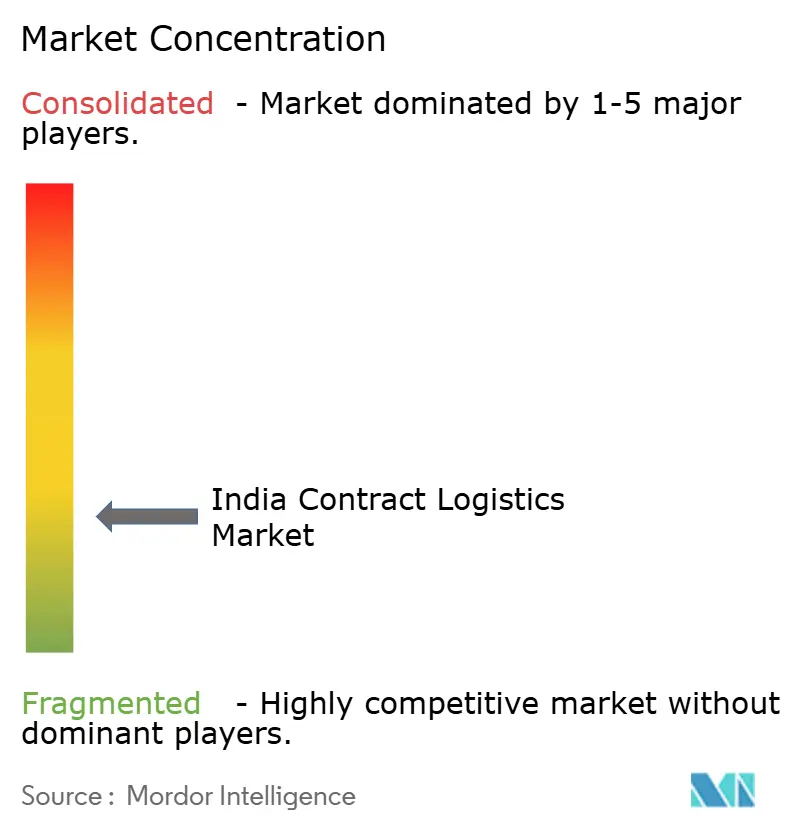
| Market Concentration | Low |
Major Players *Disclaimer: Major Players sorted in no particular order Image © Mordor Intelligence. Reuse requires attribution under CC BY 4.0. | |
India Contract Logistics Market Analysis by Mordor Intelligence
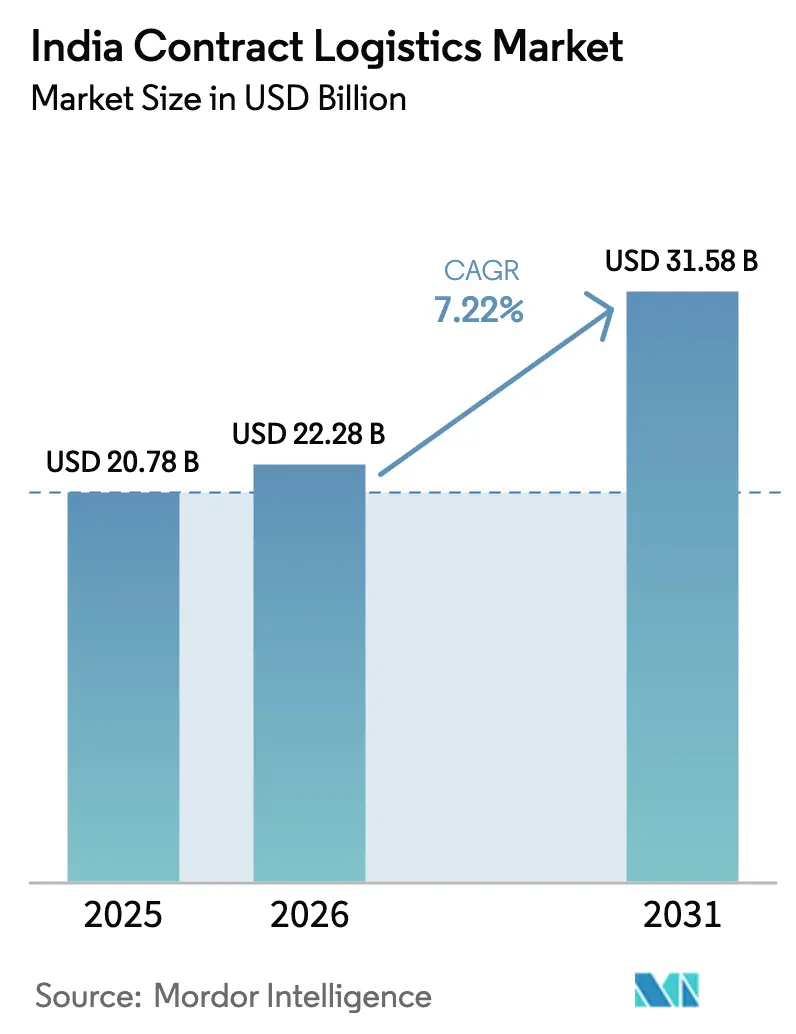
The India Contract Logistics Market size was valued at USD 20.78 billion in 2025 and estimated to grow from USD 22.28 billion in 2026 to reach USD 31.58 billion by 2031, at a CAGR of 7.22% during the forecast period (2026-2031).
Volume growth aligns with lower logistics costs, which fell to 10% of GDP on the back of expressway build-outs, FASTag-enabled tolling, and policy-driven modal shifts. Demand accelerators include the PM Gati Shakti Master Plan, the National Logistics Policy, and surging e-commerce penetration that now spans tier-II and III cities. Competitive pressure is moderate, with full-service providers strengthening digital control towers while quick-commerce specialists pursue hyperlocal micro-warehousing. Bottlenecks revolve around skilled warehouse labor shortages, high automation CAPEX, and cybersecurity risks, yet sustained policy support and post-GST network consolidation continue to unlock profitability levers for scale players.
Key Report Takeaways
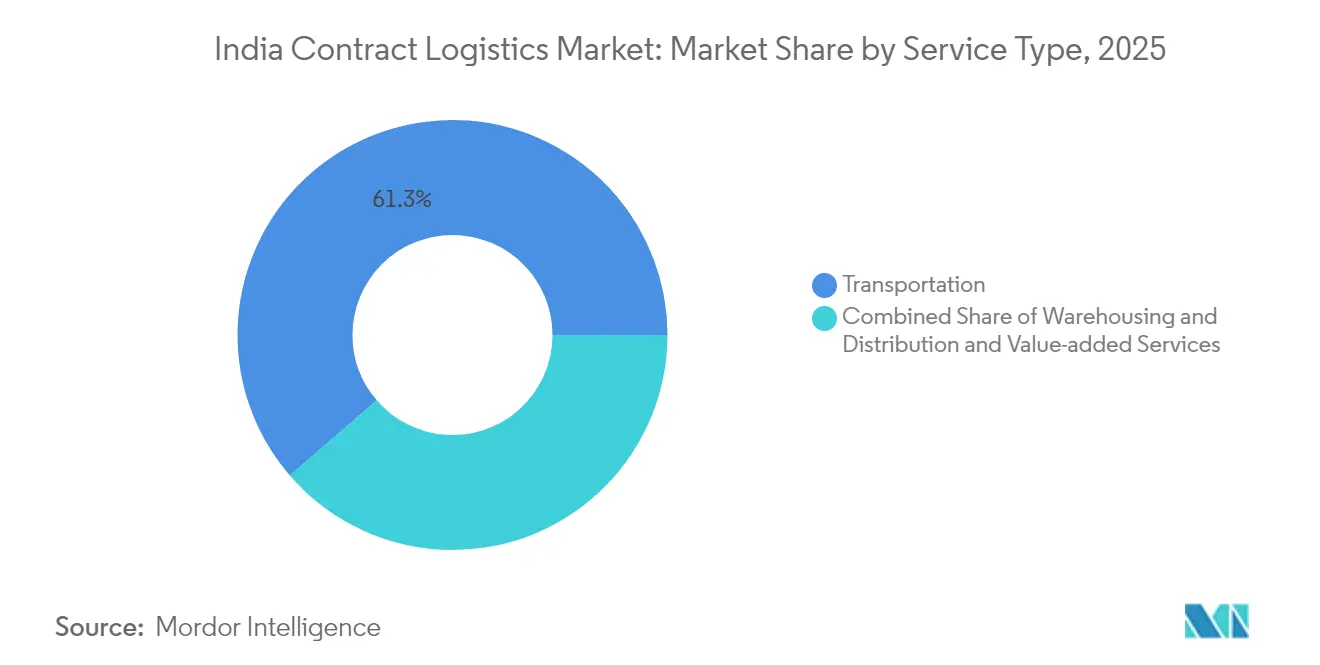
- By service type, transportation services commanded 61.34% of the India contract logistics market share in 2025. Value-added services are forecast to expand at a 6.18% CAGR to 2031.
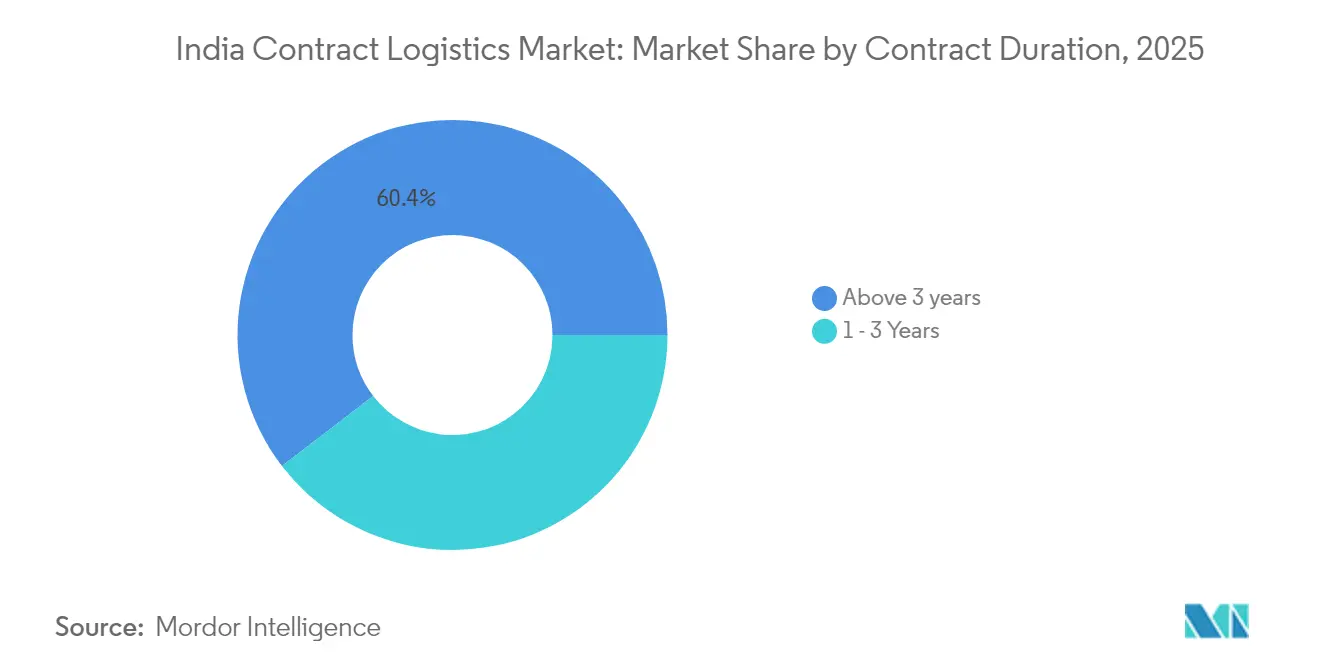
- By contract duration, agreements above 3 years held a 60.42% share of the India contract logistics market size in 2025 and are projected to grow at a 5.98% CAGR through 2031.
- By end-user, retail and e-commerce led with 26.55% revenue share in 2025; healthcare and pharmaceuticals is advancing at a 6.63% CAGR through 2031.
Note: Market size and forecast figures in this report are generated using Mordor Intelligence’s proprietary estimation framework, updated with the latest available data and insights as of 2026.
India Contract Logistics Market Trends and Insights
Drivers Impact Analysis*
| Driver | (~) % Impact on CAGR Forecast | Geographic Relevance | Impact Timeline |
|---|---|---|---|
| Surge in e-commerce & omni-channel retail | +1.8% | National; tier-I expanding to tier-II/III | Medium term (2-4 years) |
| Government infrastructure push (NLP, Gati-Shakti) | +1.5% | National; priority corridors in industrial belts | Long term (≥ 4 years) |
| Rising 3PL outsourcing by manufacturers | +1.2% | Manufacturing hubs in Gujarat, Maharashtra, Tamil Nadu, Karnataka | Medium term (2-4 years) |
| Post-GST network consolidation benefits | +0.9% | National; hub optimization in key metros | Short term (≤ 2 years) |
| Tier-II/III hyper-local dark-store boom | +0.8% | Emerging cities such as Pune, Ahmedabad, Kochi, Indore | Medium term (2-4 years) |
| CLaaS demand from D2C & quick-commerce brands | +0.7% | Urban centers with high consumer density | Short term (≤ 2 years) |
| Source: Mordor Intelligence | |||
Surge in e-commerce & omni-channel retail
E-commerce volumes continue to double-digit climb, with online grocery alone tracking toward INR 2.1 lakh crore (USD 24.6 billion) by 2027. More than 4,000 dark stores now dot major metros, and network densification is migrating into tier-II and III clusters where last-mile costs remain elevated. Retailers adopting omni-channel models require synchronized inventory and reverse-logistics flows, prompting 3PLs to deploy micro-fulfillment sites within 2–3 km of customers. The India contract logistics market thus pivots toward dynamic routing software and on-demand capacity to uphold sub-30-minute delivery promises. As organized retail penetration is expected to reach 60% by 2028, integrated service providers that combine B2B replenishment with direct-to-consumer fulfillment gain a competitive edge.
Government infrastructure push (NLP, Gati-Shakti)
The PM Gati Shakti platform has onboarded 44 central ministries, mapping 200+ projects to a single GIS interface to accelerate multimodal corridor execution[1]. Expressway mileage, dedicated freight corridors, and logistics parks receive synchronized clearances, shrinking cross-state transit at erstwhile choke points. The Unified Logistics Interface Platform unifies shipment visibility across ports, railways, and road transport, trimming documentation time that earlier inflated travel duration by 60%. While land acquisition delays persist, standardized asset specifications and digital permits are steadily lifting asset utilization rates for fleet owners and warehouse operators within the India contract logistics market.
Rising 3PL outsourcing by manufacturers
Post-pandemic cost rationalization has nudged manufacturers to outsource non-core logistics. Electronics, pharmaceuticals, and automotive firms tapping Production-Linked Incentives demand Grade-A warehouses with over 10,000-pallet capacity and IoT-enabled material-handling equipment. End-to-end visibility platforms allow real-time SKU tracking, enabling vendors to cut buffer stock days. Integrated providers offering kitting, sub-assembly, and reverse logistics unlock efficiency gains that widen adoption of long-tenure 3PL contracts in the India contract logistics market.
Post-GST network consolidation benefits
Unified GST replaced state-wise tax optimization with demand-driven network design, letting shippers shutter redundant depots and cluster inventory into mega-hubs. Large retailers and steel producers have trimmed logistics outlay by up to 20% and rerouted goods through multimodal corridors radiating from seven metros. E-Way Bills and FASTag reduce dwell times, elevating fleet turns across the India contract logistics market, although residual state-level compliance gaps still curb seamless flow in select corridors.
Restraints Impact Analysis*
| Restraint | (~) % Impact on CAGR Forecast | Geographic Relevance | Impact Timeline |
|---|---|---|---|
| Skilled warehouse & SCM labor shortage | −1.4% | National; acute in metros and industrial belts | Long term (≥ 4 years) |
| High CAPEX for Grade-A automation | −1.1% | Tier-I cities and industrial corridors | Medium term (2-4 years) |
| Inter-state compliance frictions post-GST | −0.8% | Border states with sector-specific clearances | Short term (≤ 2 years) |
| Cyber-security risks to digital control towers | −0.6% | Cloud-centric logistics hubs | Medium term (2-4 years) |
| Source: Mordor Intelligence | |||
Skilled warehouse & SCM labour shortage
Only 5% of India’s 150 million blue-collar workforce is formally trained, resulting in chronic shortages for forklift operators, inventory analysts, and robotics technicians[2]. Employers in manufacturing hubs extend overtime and boost wages to secure talent, inflating operating costs for the India contract logistics market. Automation alleviates repetitive tasks yet raises demand for specialized maintenance roles, reinforcing the training imperative.
High CAPEX for Grade-A automation
Automated storage and retrieval systems cut picking time but carry a steep upfront investment. Clad-rack designs offset civil costs; nonetheless, IoT sensors, AGVs, and WMS licenses push payback periods beyond five years in several tier-II zones. Financing hurdles slow warehouse modernization, constraining service scalability in the India contract logistics market.
*Our forecasts treat driver/restraint impacts as directional, not additive. The impact forecasts reflect baseline growth, mix effects, and variable interactions.
Segment Analysis
By Service Type: Road Transport Dominance Drives Automation
Transportation services stood at 61.34% of the India contract logistics market in 2025, with road fleets carrying the bulk of e-commerce and FMCG loads despite rail corridor gains. Value-added services represent the swiftest trajectory, registering a 6.18% CAGR through 2031. The segment benefits from manufacturers outsourcing kitting and labeling to 3PLs equipped with handheld scanners and AI slotting engines. Blue Dart’s Delhi hub, capable of processing 550,000 parcels daily via automated sorters, typifies the shift toward high-throughput nodes.
Warehousing and distribution thrive on GST-driven depot consolidation, lifting large-box Grade-A stock across Mumbai, NCR, and Bengaluru. Modal mix diversification progresses as dedicated freight corridors attract bulk cargo, yet road retains primacy for last-mile flexibility. Tech adoption across service types accelerates; Allcargo Gati introduced machine-learning-guided handheld printers to shave mis-sort errors and boost on-time performance within the India contract logistics market.

By Contract Duration: Long-term Partnerships Strengthen
Contracts exceeding three years captured a 60.42% share in 2025, reflecting shippers’ willingness to lock in capacity and jointly amortize automation investments. Long-tenure deals enable providers to plan robotics rollouts and solar rooftop retrofits that improve energy efficiency. Manufacturers tied to Production-Linked Incentive schemes value stable 3PL alliances that support lean inventories and synchronized replenishments.
One-to-three-year contracts retain relevance for seasonal product launches and pilot dark-store deployments, but the capital intensity of Grade-A assets inclines both parties toward multiyear engagements. Delhivery’s roadmap to adjusted-EBITDA breakeven hinges on such extended agreements, which anchor network utilization in the India contract logistics market.
By End-user Industry: Healthcare Acceleration Outpaces Retail Leadership
Retail and e-commerce preserved 26.55% of 2025 revenue, yet healthcare and pharmaceuticals climb fastest at a 6.63% CAGR through 2031. Pharma’s forecast to hit USD 130 billion by 2030 necessitates GDP-compliant cold chains, serialization, and batch-level traceability. Snowman Logistics scales temperature-controlled space to meet vaccine and biologics flows, mirroring affluent household growth that pushes protein consumption and specialty drug demand.
Automotive, food and beverage, and chemicals sectors contribute steady volumes requiring hazardous-goods handling, returnable packaging, and strict shelf-life adherence. These nuanced requirements spur specialized sub-segments, reinforcing the versatility imperative for operators in the India contract logistics market.
Geography Analysis
Mumbai and the National Capital Region jointly house more than half of India’s Grade-A warehousing stock, underscoring the west-north axis concentration. Western corridors benefit from JNPT port connectivity and dedicated freight corridors funneling cargo toward consumption hubs. Maharashtra alone contributes a sizable slice of industrial GDP, attracting multi-client facilities with cross-dock efficiencies.
Southern clusters, led by Bengaluru and Chennai, leverage electronics and automotive exports; new logistics parks in Chennai integrate rail sidings to cut first-mile drayage. Andhra Pradesh’s deep-sea ports add coastal-shipping options that diversify modal choices within the India contract logistics market.
Northern India capitalizes on population density; Blue Dart’s Bijwasan hub near Indira Gandhi International Airport offers air-road interoperability to speed inbound and outbound e-commerce flows.
Regulatory Landscape
India's contract logistics operations sit within a multi-agency framework spanning indirect taxation, transport regulation, and border compliance. Post-GST processes such as e-Way Bills and FASTag-enabled tolling continue to shape network design and transit-time reliability, while the National Logistics Policy is monitored under the PM GatiShakti National Master Plan through the Empowered Group of Secretaries (EGoS) and a Services Improvement Group (SIG) focused on process and regulatory reforms.
In 2026, policy and compliance updates relevant to contract logistics included customs facilitation measures (single-window clearances for regulated categories and wider use of non-intrusive, AI-enabled scanning at major ports) and Union Budget 2026-27 provisions touching cross-border parcel flows and bonded operations. On the infrastructure side, the Ministry of Road Transport and Highways (MoRTH) issued a revised Model Concession Agreement for Multi-Modal Logistics Parks, adding clearer performance metrics and dispute-resolution mechanisms for larger contracts. This update supports bankability and execution discipline for logistics-park-linked supply chains.
Value Chain Analysis
The India contract logistics value chain starts with demand generation by manufacturers and retailers (including e-commerce and pharma), then moves through solution design (network engineering, SOPs, and IT integration), core execution (line-haul transportation, warehousing, and distribution), and value-added services such as labeling, kitting, returns processing, and temperature-controlled handling. Execution depends on upstream inputs including warehouse real estate developers, material-handling and automation OEMs, fleet owners and drivers, packaging suppliers, and IT vendors supporting WMS/TMS and control towers. Downstream performance is influenced by last-mile partners, reverse-logistics channels, and customer service operations.
Infrastructure and corporate reconfiguration are also changing how capacity is assembled and managed. Dedicated Freight Corridor convergence points and emerging multimodal hubs (for example, nodes such as Dadri, Surat, and Dankuni) support a more synchronized road-rail operating model for long-haul movements, while larger 3PL groups are reorganizing assets and operating units to sharpen service lines. After a multi-year restructuring, the Allcargo Group split into separately listed entities covering international supply chain, domestic supply chain, and CFS/ICD operations. The structure highlights a broader value-chain trend toward specialized platforms that still interoperate for end-to-end contract logistics delivery.
Competitive Landscape
The India contract logistics market exhibits moderate fragmentation. Top domestic providers—Delhivery, Allcargo Logistics, and Transport Corporation of India—combine with global multinationals such as Deutsche Post DHL and FedEx to form a diverse service spectrum. Scale players invest heavily in robotics and data lakes; Allcargo Gati recently integrated machine-learning route planners, while Blue Dart’s solar-powered sorting plant reduces carbon footprint. Private-equity inflows, which captured 66% of logistics capital deployment in H1 2024, fund both consolidation and technology pilots.
Quick-commerce entrants intensify hyperlocal competition by promising sub-20-minute deliveries through dense dark-store grids. Start-ups such as CargoFL raise capital for AI-driven platforms serving SMB shippers. Healthcare cold chain and CLaaS modules represent white spaces where specialized certifications offer defensible niches. Compliance proficiency under GST remains a moat for established players, yet cybersecurity posture differentiates best-in-class providers as control-tower digitization deepens within the India contract logistics market.
M&A momentum continues: Delhivery’s planned USD 169 million purchase of Ecom Express signals volume aggregation for network density, pending regulatory nod. CEVA’s acquisition of Stellar Value Chain Solutions underscores foreign interest in local assets. Competitive intensity will hinge on technology resale models, geographic coverage, and ability to service regulated industries at scale.
India Contract Logistics Industry Leaders
-
Allcargo Logistics Ltd
-
TVS Supply Chain Solutions
-
Transport Corporation of India (TCI)
-
Mahindra Logistics Ltd
-
Delhivery Ltd
- *Disclaimer: Major Players sorted in no particular order
Market Opportunities and Future Outlook
Export-linked e-commerce and MSME shipments create an actionable whitespace for contract logistics providers that can bundle pickup, compliant documentation, consolidation, and cross-border handoffs. Union Budget 2026-27 removed the INR 10 lakh per-consignment value cap on courier exports, which supports higher-value outbound parcels through courier and express networks. The LIFT scheme under the Export Promotion Mission offers partial freight-cost reimbursement to MSME exporters from specified districts (subject to a cumulative cap per IEC per financial year). Together, these moves support integrated offerings that connect domestic fulfillment nodes to gateways with predictable clearance and track-and-trace.
A second opportunity area sits in regulated and specialized logistics, where service depth matters more than footprint. Customs facilitation measures such as longer duty deferral windows for Tier 2 and Tier 3 Authorised Economic Operators and extended validity of advance rulings improve planning certainty for importers and logistics partners managing bonded and time-sensitive flows. At the same time, operators are aligning portfolios to higher-complexity segments and faster fulfillment models. For instance, Mahindra Logistics scaling e-commerce and quick commerce operations and Allcargo focusing on technology-led integrated solutions for MSMEs in manufacturing clusters indicate active commercialization of contract logistics modules beyond standard transport-plus-warehousing.
Recent Industry Developments
- June 2026: TVS Supply Chain Solutions formed 51:49 joint venture with Italy-based ALA Group to enter aerospace and defence supply chain market. The collaboration unlocks access to high-margin, regulated segments and expands TVS’s contract logistics capabilities in aerospace value chains. The joint venture broadens its portfolio and strengthens margins in an area with growing government and defense demand.
- February 2026: Allcargo Logistics completed integration of express and contract logistics business units following organizational restructuring. This consolidation tightens the core contract and logistics network and may yield scale benefits across its Indian footprint. The change positions Allcargo to optimize operations and enhance service levels in a competitive market.
- February 2026: Allcargo Logistics launched initiative to strengthen network for E-commerce and Quick-Commerce infrastructure. The expansion targets enhanced last-mile and urban delivery capabilities to capture fast-growth segments in India’s commerce landscape. The move supports scale and service resilience as e-commerce penetration accelerates.
Research Methodology Framework and Report Scope
Market Definition and Coverage
This market is the revenue earned in India from outsourced logistics services that are run under a contract, where a provider manages warehousing and related fulfillment operations for shippers, usually with transport coordination as part of the solution.
Scope exclusions: It excludes in-house logistics operated by shippers and pure asset rental without an operating service component.
Segmentation Overview
- By Service Type
- Transportation
- Road
- Rail
- Air
- Sea
- Warehousing & Distribution
- Value-added Services (Assembly, Labelling, Kitting)
- Transportation
- By Contract Duration
- 1 – 3 Years
- Above 3 years
- By End-user Industry
- Manufacturing & Automotive
- Food & Beverage
- Retail & E-commerce
- Healthcare & Pharmaceuticals
- Chemicals
- Other Industries
Data Sources, Market Sizing, and Validation
Desk Research
Desk work starts with mapping demand signals and operating context for India logistics, then building a fact base that can be reused across the model. Public sources are used to anchor macro and sector movement, including releases from the National Statistical Office, Ministry of Commerce and Industry trade statistics, Ministry of Road Transport and Highways road freight indicators, Indian Railways freight data, and Customs and port authority throughput publications.
We then layer in company filings, annual reports, investor decks, and reputable business press to understand service mixes, pricing language, capacity additions, and whether arrangements are described as contract operations versus one-off deals. For cross checks, we also use paid subscriptions that support company financial intelligence, shipment level import and export visibility, and tender and contract tracking, which is useful when public disclosure is thin. The desk sources listed above are illustrative only, and many other references were used for data collection, validation, and clarification.
Primary Interviews and Surveys
Primary work is used to pressure test the desk assumptions on what gets outsourced, typical contract scope, and what drives price resets across lanes and warehouses. We speak with a mix of logistics providers, warehouse operators, large shippers, and channel intermediaries across major industrial and consumption corridors, and then use the feedback to align volumes, utilization, and realized pricing with on-ground reality.
Distribution of primary research fieldwork respondents
| Company type | Respondent position |
|---|---|
| Top tier: 25% | CXOs: 12% |
| Mid tier: 61% | Functional/Unit leaders: 39% |
| Smaller Players: 14% | Managers: 49% |
Market-Sizing & Forecasting
Sizing starts with a top-down build where India freight and storage activity is reconstructed into an outsourceable pool, and then filtered by contract logistics penetration by shipper type and industry. To keep the totals realistic, we corroborate the result with selective bottom-up approximations using sampled provider revenue splits, warehouse area operated under contract, and typical billing constructs (storage, handling, and value-added services) multiplied by observed activity.
Key inputs used in the model include organized warehousing capacity additions, industrial output and consumption trends that change fulfillment intensity, e-commerce and omnichannel fulfillment adoption, freight movement indicators by mode, and contract duration and escalation patterns that affect realized pricing. Where coverage gaps exist for smaller operators, estimates are filled using peer benchmarks on utilization and yield and then adjusted through interview feedback so the implied revenue per square foot and per shipment stays within plausible bands.
For forecasting, we use scenario analysis supported by a simple multivariate regression layer, where demand drivers like manufacturing output, consumption, and trade activity help shape the central case, and then pricing and utilization assumptions are tuned with expert inputs. The final outlook is checked for internal consistency so growth does not outrun capacity and labor availability for prolonged periods.
Data Validation & Update Cycle
Numbers are validated through triangulation across independent signals such as warehouse leasing momentum, freight movement trends, and reported financial performance patterns for logistics services. Outliers are investigated by revisiting assumptions, checking for one-time contract wins or losses, and then re-contacting sources when a gap cannot be explained through public data.
Before sign-off, the model goes through multi-step analyst reviews where unit economics, implied penetration, and year-on-year jumps are tested for reasonableness. The report is refreshed annually, and interim updates are made when material events occur that can shift capacity, pricing, or outsourcing behavior. Right before delivery, we do a fresh review pass so the published view reflects the most recent information available.
Mordor Intelligence's India Contract Logistics Market Size Measured Against Other Published Estimates
Published market sizes for India contract logistics can look far apart because the service bundle is defined differently and because the year labeling can shift between calendar year and fiscal year. Differences also come from how firms treat pass-through transportation revenue, how they convert currency, and how frequently they refresh assumptions for utilization and pricing.
Pure freight forwarding and brokerage revenue sits outside Mordor Intelligence's scope here, which usually pulls estimates down versus sources that group forwarding with contract warehousing operations. On the other end, some estimates lean on aggressive outsourcing penetration without verifying it against warehouse operating intensity, contract tenures, and typical escalation clauses, which can push totals up quickly in later years.
Benchmark comparison
| Source | Market Size | Gaps in Research Methodology |
|---|---|---|
| Mordor Intelligence | USD 20.78 B (2025) | |
| Industry Data Publisher A | USD 26.42 B (2024) | Uses fiscal-year framing and a broader revenue bucket that can blend forwarding and transportation-heavy 3PL turnover, which inflates the addressable contract logistics pool versus operations-led contracts. |
| Trade Journal B | USD 22.84 B (2028) | Reported as a volume-led regional figure in EUR and then converted, with limited visibility on India-only service scope and whether pricing is held constant or allowed to rebase with inflation and fuel surcharges. |
The spread across sources is mostly explained by what is included in the service definition, the year convention used, and whether penetration and pricing assumptions are checked against operating indicators. Our approach keeps the total traceable to observable activity, and it can be repeated with clear steps as new capacity, utilization, and contract structures evolve.
Key Questions Answered in the Report
What is the projected value of the India Contract Logistics Market in 2031?
The market is projected to reach USD 31.58 billion by 2031.
Which service type currently dominates Indian contract logistics?
Transportation services lead, holding 61.34% share in 2025.
Which end-user vertical is expected to grow the fastest?
Healthcare and pharmaceuticals, with a forecast 6.63% CAGR through 2031.
How does the National Logistics Policy influence contract logistics?
It lowers logistics costs via unified digital systems and multimodal infrastructure, boosting 3PL efficiency.
Why are long-term contracts preferred by shippers?
They allow amortization of automation investments and ensure stable capacity amid supply chain volatility.