
India CCTV Market Size and Share
Market Overview
| Study Period | 2020 - 2031 |
|---|---|
| Forecast Data Period | 2026 - 2031 |
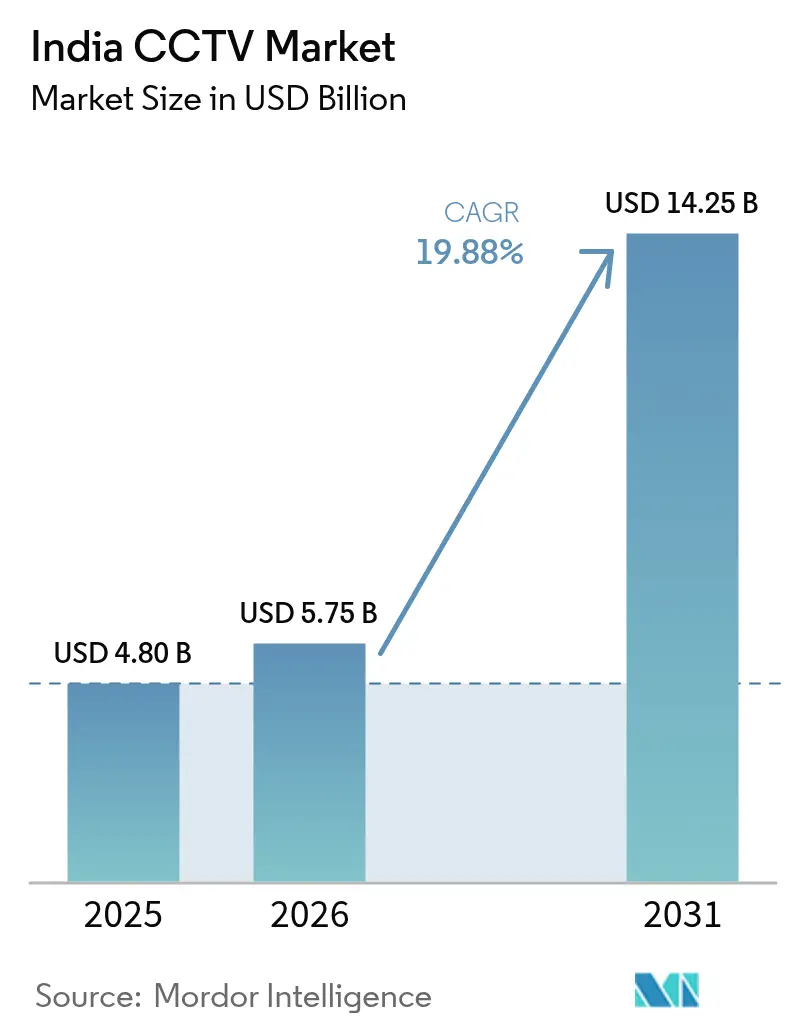
| Base Year Market Size (2025) | USD 4.8 Billion |
| Market Size (2026) | USD 5.75 Billion |
| Market Size (2031) | USD 14.25 Billion |
| Growth Rate (2026 - 2031) | 19.88 % |
| Market Concentration | Medium |
Major Players *Disclaimer: Major Players sorted in no particular order Image © Mordor Intelligence. Reuse requires attribution under CC BY 4.0. | |
India CCTV Market Analysis by Mordor Intelligence
The India CCTV market size was valued at USD 4.8 billion in 2025 and estimated to grow from USD 5.75 billion in 2026 to reach USD 14.25 billion by 2031, at a CAGR of 19.88% during the forecast period (2026-2031). Smart Cities Mission rollouts, mandatory public-safety regulations, and a push for indigenous manufacturing, spurred by the STQC certification mandate, fuel the current growth. These initiatives aim to enhance urban infrastructure, improve public safety, and promote self-reliance in technology manufacturing, creating a favorable environment for market expansion. Additionally, the government's focus on digital transformation and smart infrastructure development further accelerates the adoption of advanced technologies in urban planning and public safety systems.
With 76,000 cameras installed in 100 cities and ongoing upgrades at airports and metros, demand remains robust. The deployment of surveillance systems in urban areas and transportation hubs underscores the growing emphasis on security and operational efficiency, further driving the market's momentum. Moreover, the integration of advanced analytics and artificial intelligence in these systems is expected to enhance their effectiveness, contributing to sustained growth in the forecast period.
Key Report Takeaways
- By type, analog cameras controlled 51.65% of the India CCTV market share in 2025; AI-enabled cameras are projected to advance at a 20.55% CAGR through 2031.
- By end-user, government accounted for 38.05% revenue share in 2025, while residential and smart-home deployments are poised for a 20.15% CAGR to 2031.
- By connectivity, wired solutions secured 67.95% of the India CCTV market size in 2025; wireless installations are forecast to rise at a 21.05% CAGR between 2026 and 2031.
- By region, North India led with 42.25% revenue share of the India CCTV market in 2025, whereas South India is estimated to witness a 20.40% CAGR through 2031.
Note: Market size and forecast figures in this report are generated using Mordor Intelligence’s proprietary estimation framework, updated with the latest available data and insights as of 2026.
Worldwide, activity is shaped by contributions from multiple countries and regions, with India representing one among them. The global report on cctv market by Mordor Intelligence reflects how these countries and regional layers combine into a single system.
India CCTV Market Trends and Insights
Drivers Impact Analysis*
| Driver | (~) % Impact on CAGR Forecast | Geographic Relevance | Impact Timeline |
|---|---|---|---|
| Government smart-city surveillance push | +4.2% | National, concentrated in 100 Smart Cities | Medium term (2-4 years) |
| Mandatory surveillance regulations for public spaces | +3.8% | National, with early adoption in metro cities | Short term (≤ 2 years) |
| Rapid infrastructure expansion of airports and metros | +3.1% | Metro cities, major transport hubs | Medium term (2-4 years) |
| AI-driven compliance and safety analytics adoption | +2.9% | Urban centers, government facilities | Long term (≥ 4 years) |
| Shift toward indigenous manufacturing post STQC/BIS norms | +2.7% | National manufacturing hubs | Medium term (2-4 years) |
| Solar-powered edge CCTV deployments in rural schemes | +1.8% | Rural India, border areas | Long term (≥ 4 years) |
| Source: Mordor Intelligence | |||
Government Smart-City Surveillance Push
The Smart Cities Mission elevated surveillance from reactive policing to predictive city management. With 90% of projects worth INR 1.44 trillion (USD 16.06 billion) finalized by March 2025, 76,000 cameras now integrate with command-and-control centers that funnel data to traffic, waste, and emergency modules. Standardized procurement favors suppliers able to meet interoperability benchmarks. Cloud-hosted platforms, such as Madhya Pradesh’s Integrated Control and Command Centre, illustrate resource optimization across utilities. The same backbone supports predictive analytics that pre-empt congestion and criminal activity, reinforcing steady demand across the India CCTV market.
Mandatory Surveillance Regulations for Public Spaces
State legislation is turning CCTV expenditure into a compliance item. Karnataka’s Public Safety Enforcement Act requires establishments with 500-plus monthly footfall to connect cameras to police networks, impacting roughly 10,000 Bengaluru outlets. Similar statutes follow Supreme Court directives for police-station coverage, exposing non-compliance gaps that spur immediate procurement. specifications standardize frame rates, encryption, and retention periods, elevating product quality while weeding out sub-standard imports.
Rapid Infrastructure Expansion of Airports and Metro Systems
Transport corridors are demanding biometric-ready surveillance. Delhi Metro introduced facial-recognition cameras on its Airport Express Line and will outfit 45 more stations in Phase 4. Mumbai Airport’s USD 1.2 billion upgrade includes integrated CCTV, full-body scanners, and self-service kiosks, all feeding a unified threat-detection layer. Noida International Airport opened with 24/7 AI-assisted monitoring, setting blueprints for future brownfield projects. Such projects lock in multi-year equipment and service contracts, bolstering volume across the India CCTV market.
AI-Driven Compliance and Safety Analytics Adoption
Artificial intelligence shifts video security toward real-time exception management. The Ministry of Road Transport and Highways pilots AI camera networks targeting a 50% cut in road fatalities by 2030. Academic trials using v8 achieved 98.6% accuracy in helmet-violation detection, proving readiness for mass deployment. Delhi Police is planning citywide facial recognition surveillance, while retrospective analytics upgrades unlock replacement demand for legacy analog estates.
Restraints Impact Analysis*
| Restraint | (~) % Impact on CAGR Forecast | Geographic Relevance | Impact Timeline |
|---|---|---|---|
| High total cost of ownership for multi-site rollouts | -2.8% | National, particularly affecting SME segment | Short term (≤ 2 years) |
| Rising privacy and data-protection obligations (DPDP Act) | -2.1% | National, with stricter enforcement in metros | Medium term (2-4 years) |
| Cyber-security certification burden slowing launches | -1.9% | National, affecting all manufacturers | Short term (≤ 2 years) |
| Semiconductor and import restrictions disrupting supply | -1.6% | National, concentrated in manufacturing hubs | Medium term (2-4 years) |
| Source: Mordor Intelligence | |||
High Total Cost of Ownership for Multi-Site Rollouts
Large networks incur costs far beyond hardware, covering maintenance, bandwidth, and cloud storage that can outstrip initial capital outlay within three years. Dispersed sites often need satellite or private fiber links costing INR 50,000–100,000 yearly per location. High-definition video can generate several terabytes monthly, pushing enterprises toward edge storage or higher-tier cloud plans. Skilled labor shortages in tier-2 and tier-3 cities inflate installation fees and delay commissioning. These dynamics slow adoption among SMEs and may cap the expansion speed of the India CCTV market in less bankable segments.
Rising Privacy and Data-Protection Obligations (DPDP Act)
The Digital Personal Data Protection Act 2023 demands explicit consent, robust encryption, and local grievance mechanisms, requirements that add compliance costs for end users.[1]Nishith Desai Associates, “India’s Digital Personal Data Protection Act, 2023,” nishithdesai.com Cross-border vendors must set up domestic processing or risk penalties, narrowing the supplier field. Consent capture in public venues is difficult, driving interest in privacy-by-design architectures such as pixelation or selective recording. Pending Data Protection Board guidelines create uncertainty, prompting some buyers to delay procurement. When biometric data are processed, additional safeguards amplify hardware and software costs, trimming near-term growth headroom.
*Our forecasts treat driver/restraint impacts as directional, not additive. The impact forecasts reflect baseline growth, mix effects, and variable interactions.
Segment Analysis
By Type: Analog Dominance Faces AI Disruption
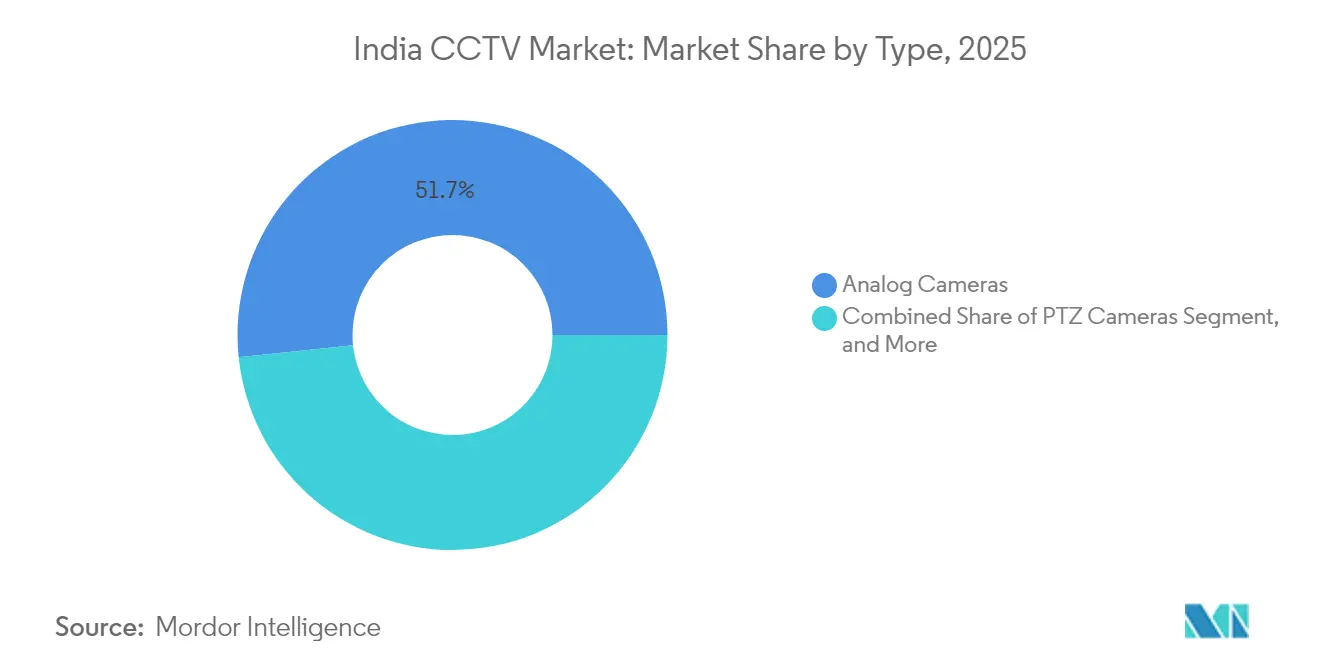
Analog units retained a 51.65% share of the India CCTV market in 2025, supported by cost-sensitive public-sector tenders and legacy coaxial cabling. IP models reached 40.55% share thanks to remote monitoring and PoE convenience. PTZ cameras contributed 5.85%, addressing large-area coverage in airports and oil terminals. AI-enabled smart cameras, although niche, are forecast to expand at a 20.55% CAGR, directly lifting the India CCTV market size for intelligent endpoints.
Low acquisition cost and ease of swap-out keep analog in play, yet STQC rules that took effect in April 2025 push buyers toward cyber-secure, upgradeable devices. Domestic firms such as Aditya Infotech and Prama Hikvision now bundle on-device analytics and secure boot to comply with the Ministry of Electronics mandates. AI-ready models thereby erode analog headroom, reshaping future India CCTV market share trajectories.



By End-User Verticals: Government Leadership Drives Market Evolution
Government accounted for 38.05% of the India CCTV market in 2025, propelled by Safe City and border-security funds. Industrial and manufacturing sites followed at 28.75% on the back of workplace-safety mandates. BFSI branches and ATMs secured a 14.10% share under Reserve Bank audit norms.
Residential and smart-home demand is the fastest-growing at 20.15% CAGR, supported by sub-USD 25 Wi-Fi camera kits sold via e-commerce. Transportation and logistics clock in at 8.65% share but gain from e-commerce warehousing. Retail and hospitality spend on people-counting analytics, while healthcare and education favor privacy-compliant edge storage. Such varied use cases extend the India CCTV market size across both public and private domains.
By Connectivity: Wired Infrastructure Meets Wireless Innovation
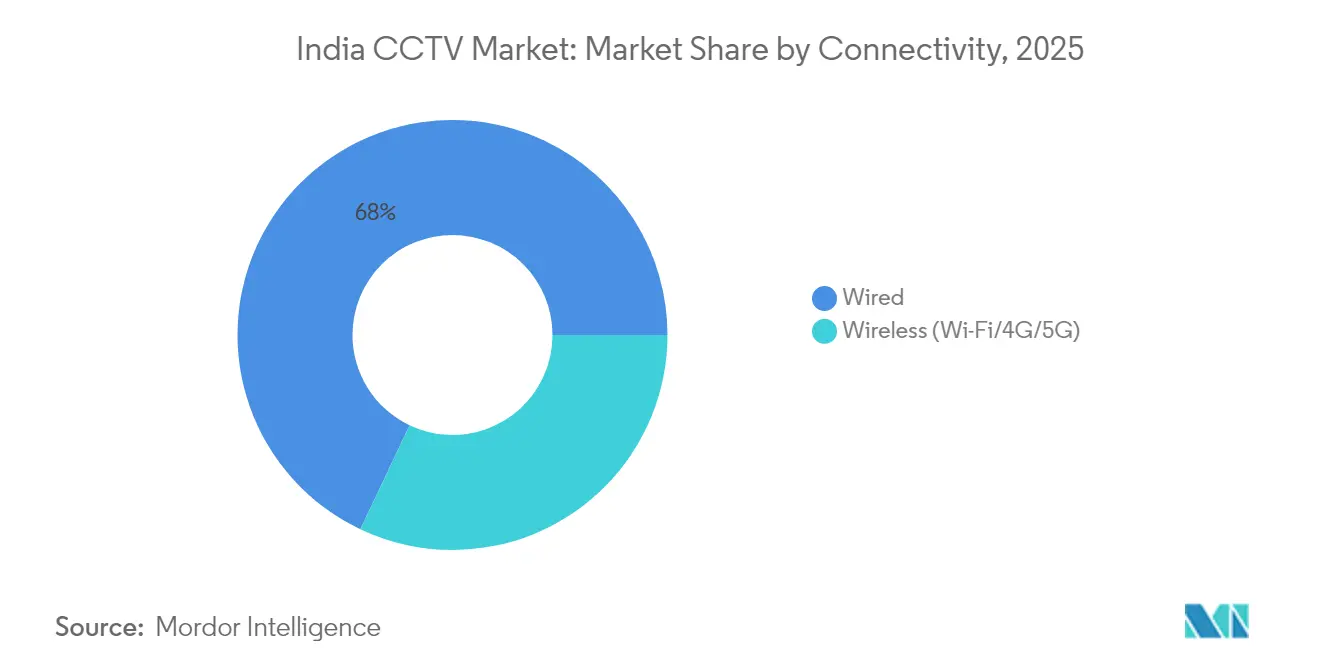
Wired solutions claimed 67.95% India CCTV market share in 2025, anchored by PoE reliability for 24/7 public-safety feeds. Gigabit switching costs have fallen, reinforcing this hold.
Wireless deployments, however, are climbing at a 21.05% CAGR, buoyed by 5G, Wi-Fi 6, and solar-powered edge appliances. Rural schemes use LTE back-up to circumvent fiber gaps, and mesh topologies lower trenching costs. Edge compute trims bandwidth by relaying only flagged events, making wireless a viable alternative for new smart-city phases and boosting future India CCTV market share in connectivity-flexible segments.
Geography Analysis
North India led with a 42.25% share in 2025, underpinned by Delhi’s 700,000-camera network and Punjab’s border grids. West India contributed 18.10% on the strength of Gujarat’s public-safety acts and Maharashtra’s housing boom.
South India leads growth with a 20.40% CAGR outlook. Bengaluru’s police, aviation, and metro agencies jointly deploy facial recognition under an INR 496 crore (USD 55.2 million) budget. Foxconn’s 1,170-camera housing complex and the Rs 27,000 crore (USD 301.0 million) Brand Bengaluru corridor guarantee ongoing procurement. Tamil Nadu’s industrial corridors standardize AI-ready surveillance, accelerating adoption through local integrators.
West India secured an 18.10% share on the back of Ahmedabad’s 25,000-camera grid that helped it top the 2025 safety index. Maharashtra’s housing policy embeds CCTV as a planning prerequisite, expanding residential uptake. East India, at 13.15%, benefits from West Bengal’s perimeter-intrusion sensors and Odisha’s facial recognition corridor at Puri temple. Central India closes at 7.85%, yet Bhopal’s AI-equipped border nodes and India’s first smart-city control center underscore latent upside. Uniform STQC compliance across zones ensures consistent baseline quality, favoring certified vendors across the India CCTV market.
Regulatory Landscape
India's CCTV procurement is shaped by MeitY and MHA guidance within the security and public-safety framework. STQC certification for internet-connected CCTV devices became mandatory as of April 1, 2026, adding testing and vulnerability assessment obligations for vendors. The March 6, 2024 MeitY Gazette Notification and the April 9, 2024 amendment established CCTV Essential Requirements covering SoC and PCBA disclosures, along with firmware transparency, which in turn influences supplier design and documentation.
Public procurement also references the Public Procurement (Preference to Make in India) Order 2017, as outlined in an MHA office memorandum dated April 2024. Certification workflows cite IS 13252 (Part 1): 2010 and IEC 60950-1 testing in accredited laboratories, helping anchor safety, cybersecurity, and interoperability considerations in procurement decisions.
Value Chain Analysis
The India CCTV value chain runs from semiconductor sourcing, image sensors, and memory, to connectivity modules and surveillance-grade SoCs, followed by camera and recorder assembly. It then extends to firmware and VMS software, distribution networks, and system integration. Supply-chain shifts toward Taiwanese and US components, with import reliance for advanced semiconductors, are also accompanied by STQC and BIS compliance checks that affect component selection, firmware governance, and manufacturing documentation.
Domestic capability gaps in volume surveillance SoCs remain, which is driving in-country R&D and increased design ownership by Indian OEMs. Partnerships to develop indigenous IP SoCs for AI-enabled cameras are starting to emerge as a way to support local value addition and align supply chains with public-sector security and governance requirements.
Competitive Landscape
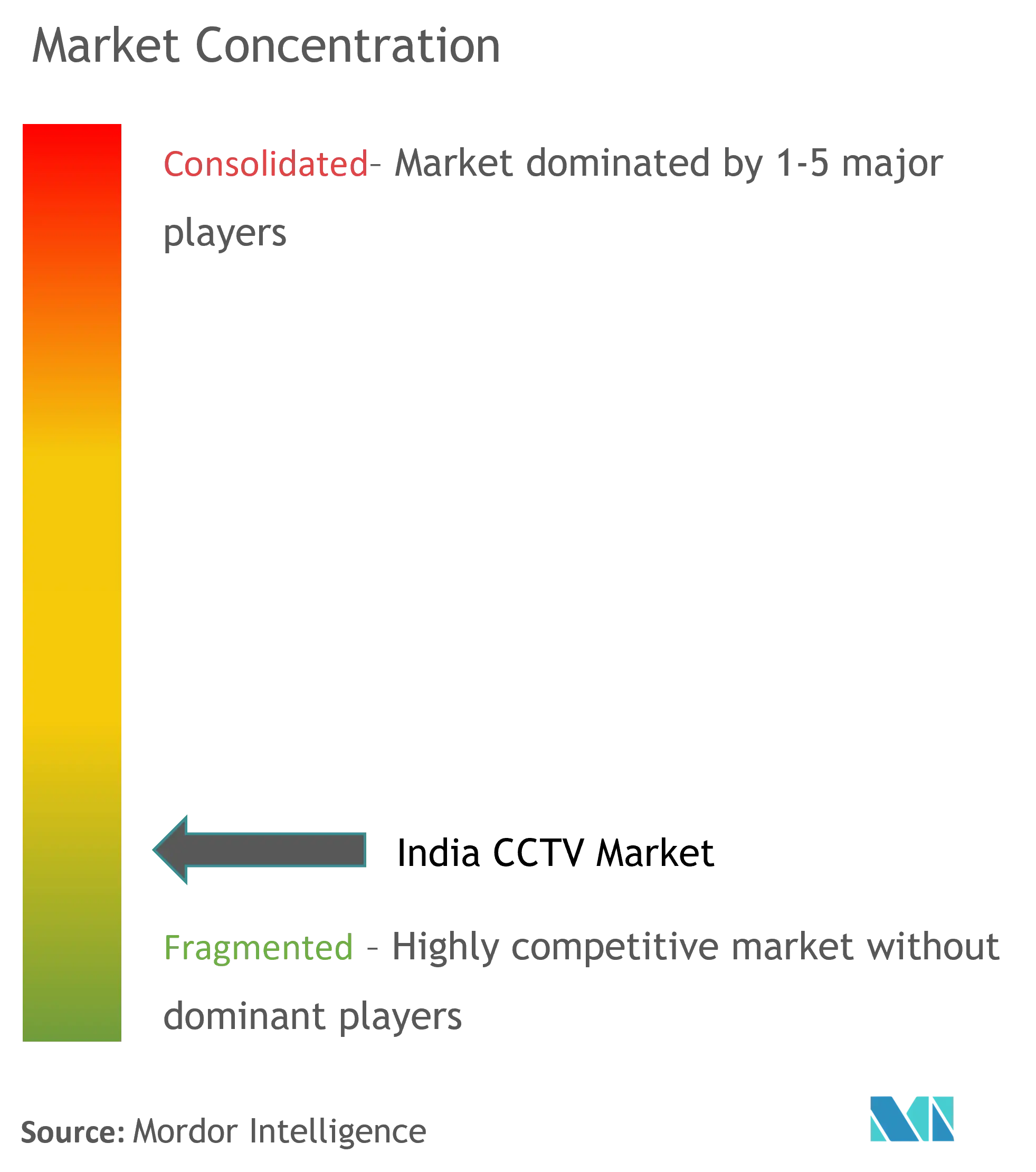
Moderate consolidation characterizes the India CCTV market, where the top five suppliers held about 55% share in 2024. CP Plus (Aditya Infotech) led with 20.8%, leveraging the world’s third-largest CCTV plant in Andhra Pradesh and a 1,000-strong distributor web. Its July 2025 IPO, oversubscribed 106 × and listing at a 50% premium, evidences investor faith in localized supply chains.[3]Moneycontrol Markets Desk, “Aditya Infotech Shares Debut at 50% Premium,” moneycontrol.com
Honeywell teamed with VVDN to release the India-made 50-Series cameras that bundle real-time motion and facial analytics, meeting STQC cybersecurity norms.[4]Honeywell India, “Made in India: New Security Cameras,” honeywell.com Bosch divested its Building Technologies arm to Keenfinity India for INR 595 crore to tighten its focus on specialized security platforms. Prama Hikvision opened an INR 500 crore Vasai factory targeting 1.5 million units monthly with 50% localization, a hedge against possible import blacklists.
Strategic alliances now pivot on silicon access and AI stacks. Aditya Infotech is linked with L&T Semiconductor to co-develop edge-AI chipsets. Dixon Technologies swapped its 50% JV stake for a 6.5% equity slice in Aditya Infotech, securing downstream demand. Foreign majors chase high-value niches, Axis for critical infra, Hanwha for airport analytics, while domestic newcomers seek opportunities in solar-powered rural kits. Cyber-secure firmware, STQC labels, and AI features remain the decisive differentiators across the India CCTV market.
India CCTV Industry Leaders
HIKVISION Digital Technology Co. Ltd (Hikvision India)
Dahua Technology India Pvt. Ltd
Aditya Infotech Ltd (CP Plus)
Godrej Security Solutions
Honeywell Commercial Security
- *Disclaimer: Major Players sorted in no particular order

Market Opportunities and Future Outlook
Opportunities are concentrated in India-based, certified camera portfolios that can clear public tenders without extensive requalification. This is supported by the 76,000 cameras deployed across 100 Smart Cities and the ongoing upgrades at airports and metro systems. Indian brands have been gaining share, with CP Plus rising to 39% by the second quarter of fiscal year 2026, indicating substitution away from Chinese vendors in selected procurements.
Demand conditions also point to continued focus on domestic manufacturing and edge analytics. Investments in indigenous AI-powered surveillance SoCs and design by firms such as L&T Semiconductor Technologies are reinforcing local value creation. At the same time, supply diversification is translating into cost pressure, with price increases in the 15-20% range, alongside tighter attention to edge storage and privacy-by-design features aligned with DPDP obligations.
Recent Industry Developments
- June 2026: Godrej Enterprises Group released a new Wi-Fi and 4G-enabled smart security camera portfolio certified under BIS-ER standards. The BIS-ER compliant domestic devices expand local manufacturing capabilities and align with regulatory requirements. This supports regulatory alignment and domestically-sourced product expansion.
- June 2026: Hikvision India unveiled WonderOS 4.0, Interactive Display Panels, Active LED, and Digital Signage at PALM AV-ICN Expo in Mumbai. The release targets security installations with advanced analytics and AI-enabled displays. It strengthens the India portfolio with integrated AI/IoT display capabilities.
- May 2026: Hikvision India launched new DFMD and HHMD security inspection portfolio for airports, metros, and government buildings. The expansion focuses on critical infrastructure and extends addressable segments. It adds newer inspection capabilities for these deployments.


Research Methodology Framework and Report Scope
Market Definition and Coverage
For this report, we size the India CCTV market as revenue earned from CCTV camera hardware sold for security and surveillance use across India, counted at the point of sale into the country across major customer groups.
Scope exclusions: We exclude non-CCTV security products, such as access control and intrusion alarms, and we also exclude unrelated IT spend that is not tied to CCTV camera demand.
Segmentation Overview
- By Type
- Analog Cameras
- IP Cameras (Non-PTZ)
- PTZ Cameras
- AI-enabled Smart Cameras
- By End-user Verticals
- Government
- Industrial and Manufacturing
- BFSI
- Transportation and Logistics
- Residential and Smart Homes
- Retail and Hospitality
- Healthcare and Education
- Other End-user Verticals
- By Connectivity
- Wired
- Wireless (Wi-Fi/4G/5G)
- By Region
- North India
- South India
- East India
- West India
- Central India
Data Sources, Market Sizing, and Validation
Desk Research
Desk work starts by mapping the demand story and the supply environment for CCTV in India, then aligning that to measurable data points. We typically review public sources such as Ministry of Housing and Urban Affairs updates on urban programs, Bureau of Indian Standards and certification-related notifications, National Crime Records Bureau publications, and Directorate General of Commercial Intelligence and Statistics trade statistics for electronics categories that link to cameras and components.
To keep the model grounded, we also review company annual reports and investor decks, reputed press coverage, association websites, and import-export shipment databases where available for directional checks on unit movement and pricing. Patent databases help us track which camera features move from premium to mainstream, and we use that pattern later for assumptions on ASP change. These desk sources are not exhaustive, and we use additional public and paid references during data collection, cross-checking, and clarification.
Primary Interviews and Surveys
Primary work is used to sanity check camera type mix, channel margins, procurement cycles, and how pricing differs by project-led versus retail-led demand. We speak with manufacturers, distributors, system integrators, installers, and large buyers across government, commercial, and residential use, and then we re-check any material variance by region in India before locking assumptions.
Distribution of primary research fieldwork respondents
| Company type | Respondent position |
|---|---|
| Top tier: 38% | CXOs: 15% |
| Mid tier: 46% | Functional/Unit leaders: 42% |
| Smaller Players: 16% | Managers: 43% |
Market-Sizing & Forecasting
Sizing is built using top-down and bottom-up logic, where we reconstruct a demand pool from India security adoption signals and project activity, then cross-check it using selective supplier and channel roll ups. In practice, we start from indicators that explain why cameras are bought, and then translate those indicators into units and value using average selling prices that differ by camera type and buying channel.
Inputs used in the model include the mix shift between analog and IP, the share of PTZ and AI-enabled smart cameras in large deployments, wired versus wireless adoption, public infrastructure program activity, and replacement cycles in commercial sites. Forecasting is done using scenario analysis with shortlists of variables that interviewees most often connect to ordering behavior, including project pipeline visibility, price movement in key electronics parts, and typical tender timing. Where bottom-up views are incomplete, such as fragmented installer networks, we fill gaps through sampled channel checks and then scale using the most consistent regional demand signals.
Data Validation & Update Cycle
Validation is done through repeated cross-checks, where model outputs are compared with independent signals such as trade movement direction, public program cadence, and distributor feedback on sell-through and inventory. Any sharp jumps in unit growth or ASP are flagged, reviewed by a second analyst, and then taken back to primary contacts when the explanation is not clear.
The report is refreshed annually, and interim updates are triggered when material events affect demand or pricing, including policy changes, certification shifts, or large public project announcements. Before delivery, we perform a final pass to incorporate the latest available data so clients receive an updated view rather than an older snapshot.
Mordor Intelligence's India Cctv Market Size Compared With Other Published Estimates
Published market sizes for India CCTV can differ even when the topic name looks identical, because the counted products, the counted revenues, and the timing assumptions are not always consistent. Some estimates include a wider electronic security basket or services, while others focus only on camera hardware, which changes the total quickly.
The benchmark table mainly reflects spread from scope boundaries and how pricing is treated across camera types. Under Mordor Intelligence's model, the value is tied to CCTV camera hardware revenue in India, with type mix (including analog, IP, PTZ, and AI-enabled smart cameras) and region-level demand checks, while other figures may fold in recording equipment, software, installation, or use different ASP step-ups without channel validation.
Benchmark comparison
| Source | Market Size | Gaps in Research Methodology |
|---|---|---|
| Mordor Intelligence | USD 4.80 B (2025) | |
| Trade Journal A | USD 3.98 B (2024) | This figure appears to use an earlier base year with a different value chain cut, and it may treat the market as cameras only without explicitly separating higher priced smart camera mixes and large project-led deployments. |
| Industry Portal B | USD 4.22 B (2024) | The number is anchored to a single-year estimate and tends to be quoted with a broad product label, where adjacent surveillance components and simplified currency timing can shift the value away from a camera-only, type-mix-based build. |
The table mainly highlights that small differences in what is included, and how unit and ASP assumptions are refreshed, can create large gaps in a fast-moving market. By keeping the model traceable to camera type mix, channel-informed pricing, and repeatable demand indicators, we can explain each step and adjust assumptions when new signals emerge.


Key Questions Answered in the Report
What is the current size of the India CCTV market?
The market stood at USD 5.75 billion in 2026 and is forecast to hit USD 14.25 billion by 2031.
Which camera type dominates sales in India?
Analog cameras led with a 51.65% share in 2025, though AI-enabled smart cameras show the fastest growth trajectory.
How fast is residential adoption growing?
Residential and smart-home installations are expanding at an 20.15% CAGR through 2031 as camera prices fall and DIY kits proliferate.
What regulations impact CCTV procurement the most?
The Digital Personal Data Protection Act 2023 and mandatory STQC certification drive compliance costs and influence supplier selection.
Page last updated on:




