
India Adhesives And Sealants Market Analysis by Mordor Intelligence
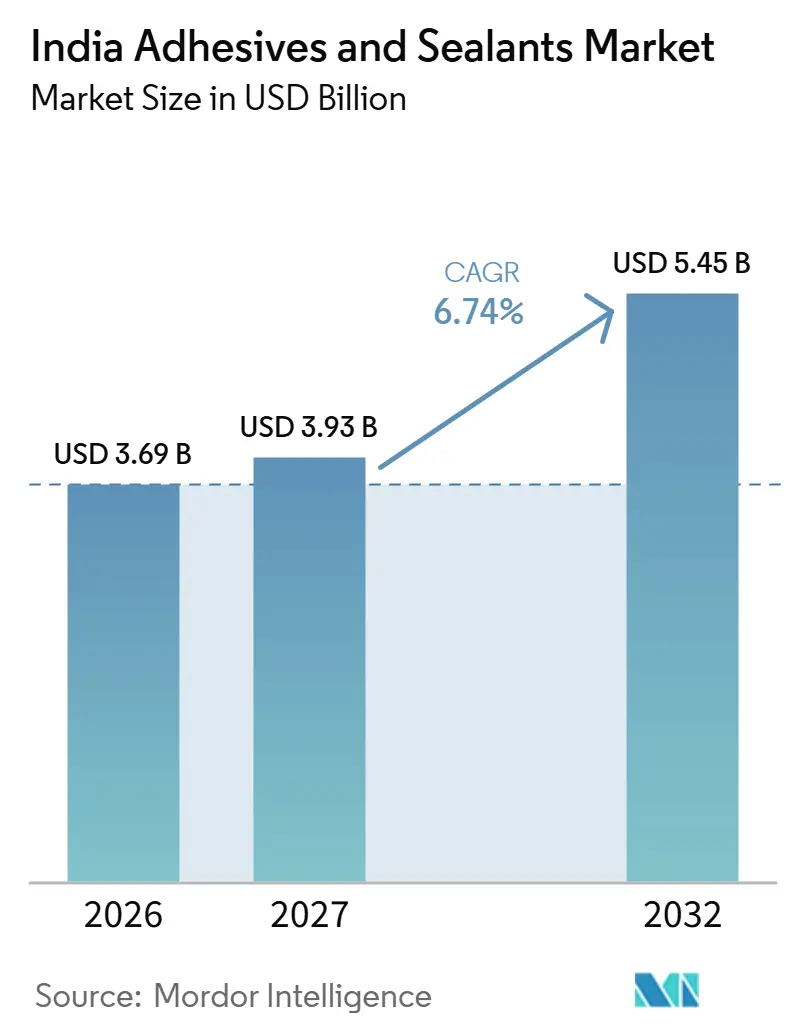
The India adhesives and sealants market size is expected to increase from USD 3.69 billion in 2026 to USD 3.93 billion in 2027 and reach USD 5.45 billion by 2032, growing at a CAGR of 6.74% over 2027-2032.
India's construction and manufacturing activity supports bonding demand, while e-commerce fulfillment adds packaging requirements. Local production and application engineering let hot-melt and electronics adhesive suppliers work with customers during product development and production. The Iran conflict in West Asia triggered supply-chain disruption from February 2026, adding availability pressure on imported petrochemical inputs. Feedstock repricing and project-specific low-VOC criteria can limit how much industrial activity converts into commercial demand, so affordability and application access become the commercial constraints.
Key Report Takeaways
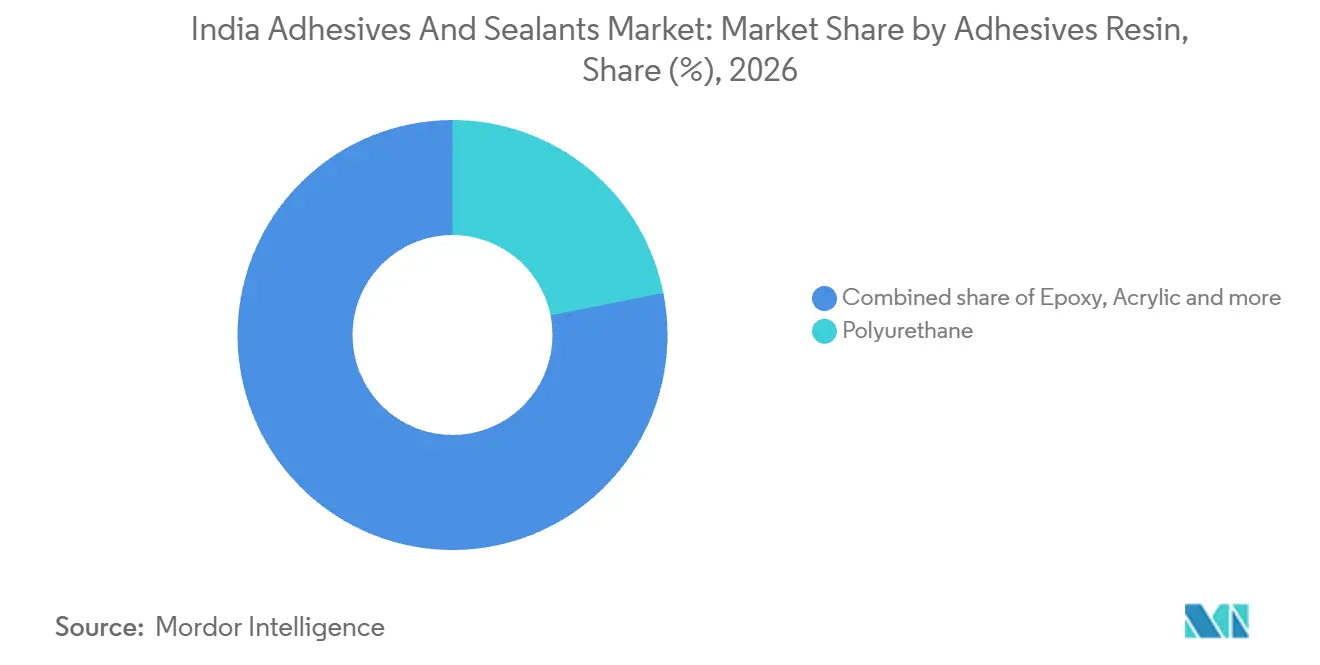
- Among adhesive resins, polyurethane held a 21.87% India adhesives and sealants market share in 2026, while VAE / EVA is forecast to grow fastest at a CAGR of 7.62% during 2027-2032.
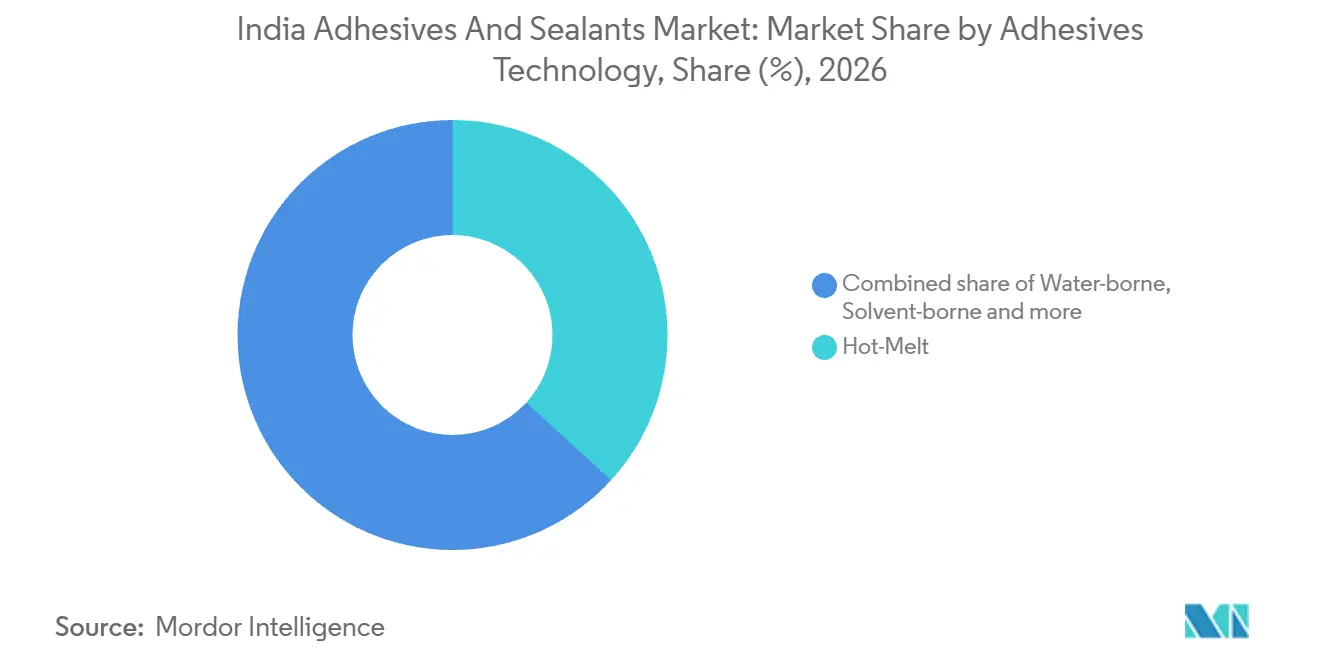
- Across adhesive technologies, hot-melt adhesives held a 36.8% share of the India adhesives and sealants market size in 2026 and are projected to grow fastest at a CAGR of 7.08% during 2027-2032.
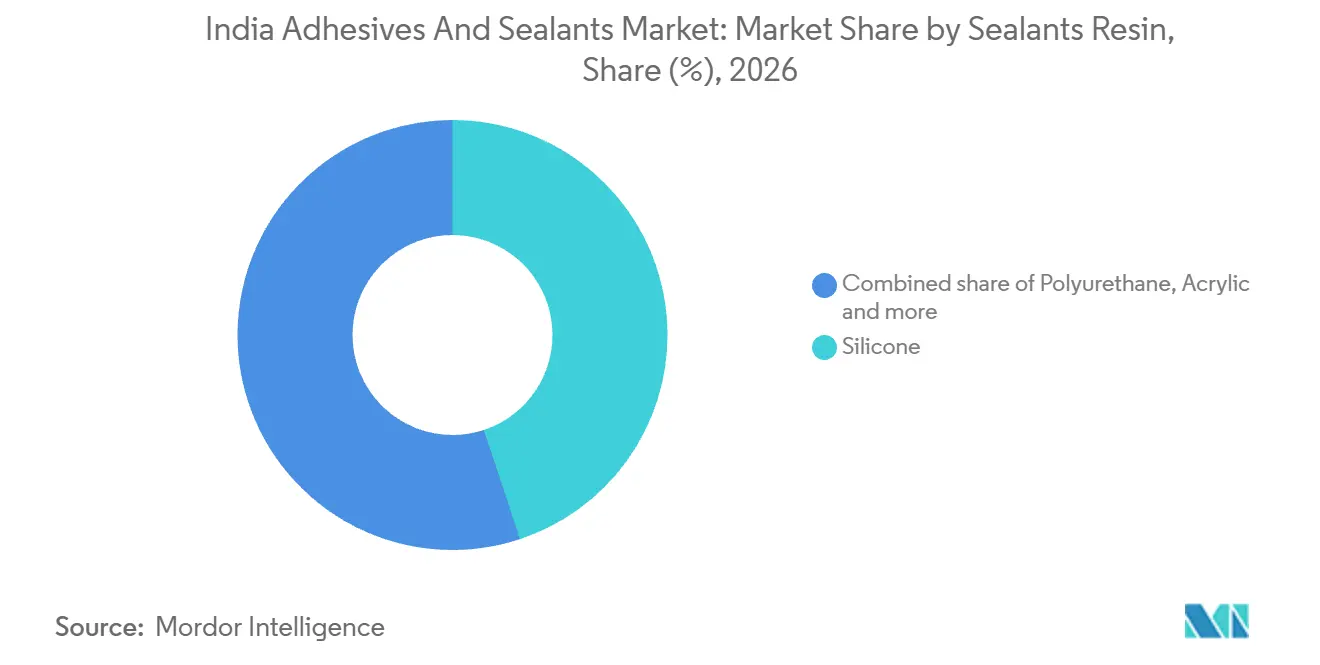
- Silicone led sealant resins with a 44.92% share of market revenue in 2026, whereas polyurethane is projected to grow fastest at a CAGR of 6.83% during 2027-2032.
- Among end-user industries, packaging accounted for 41.36% of market revenue in 2026, and aerospace is forecast to grow fastest at a CAGR of 7.21% during 2027-2032.
- Geographically, western states led in 2024, while Pune's industrial cluster and electronics application engineering in Chennai and Bengaluru illustrate distinct regional roles.
Note: Market numbers in this report are based on Mordor Intelligence's proprietary estimation framework, which combines nine months of actuals with Q4 projections for base year 2026.
Market Trends and Insights
Drivers Impact Analysis of India Adhesives And Sealants Market*
| Driver | (~) % Impact on CAGR Forecast | Geographic Relevance | Impact Timeline |
|---|---|---|---|
| Rising residential and infrastructure construction demand | +2.7% | Nationwide | Short term (≤ 2 years) |
| Booming e-commerce-led packaging requirements | +2.5% | Nationwide | Short term (≤ 2 years) |
| Automotive lightweighting and localization push | +1.8% | Nationwide, including Hansalpur in Gujarat | Medium term (2-4 years) |
| Woodworking and modular furniture uptake | +1.4% | Nationwide, including Khalapur in Maharashtra | Medium term (2-4 years) |
| Make-in-India defense / aerospace offsets fuel high-spec bonding | +0.6% | Nationwide | Long term (≥ 4 years) |
| Source: Mordor Intelligence | |||
Rising residential and infrastructure construction demand
Residential construction supports bonding demand through a combination of approved urban projects and substantial rural building activity. On February 23, 2026, the Ministry of Housing and Urban Affairs sanctioned 287,618 urban houses across 16 states and union territories under Pradhan Mantri Awas Yojana-Urban 2.0 (PMAY-U 2.0).[1] Separately, the Ministry of Rural Development reported 2.66 million houses completed under Pradhan Mantri Awaas Yojana-Gramin (PMAY-G) during FY 2025-26, including houses sanctioned in earlier financial years. Their commercial significance differs because an approval creates a project pipeline, while a completion records construction already undertaken. Adhesive and sealant demand therefore depends on how quickly sanctioned housing moves into building activity, so execution timing matters as much as the approval total.
Booming e-commerce-led packaging requirements
Fulfillment preparation creates potential packaging requirements before a festive order becomes a completed shipment. For The Big Billion Days 2026, Flipkart pre-positioned more than 25 million units of products from micro, small and medium enterprises (MSMEs), small sellers, artisans and weavers in Ekart fulfillment centers for faster festive fulfillment. Flipkart also reported 24% year-over-year growth in supply-chain units during its 2025 festive season in India. Prepared merchandise represents potential fulfillment work, while the earlier growth in supply-chain units reflects realized activity within the operation. For bonding suppliers, merchandise preparation opens a potential demand window before shipment activity is recorded.
Automotive lightweighting and localization push
Expanding domestic vehicle output supports demand for local automotive bonding supply. India produced 5.54 million passenger vehicles in FY 2025-26, compared with 5.06 million in FY 2024-25. In July 2026, Maruti Suzuki India Limited began commercial production at Plant D in Hansalpur, Gujarat, adding annual capacity of 250,000 passenger vehicles and taking the facility's total annual capacity to 1 million vehicles.[2] Henkel ANAND India, a joint venture of Henkel and ANAND Group, supplies body-in-white products and solutions, with structural adhesives among its product range. In June 2025, Henkel ANAND India named Tata Motors and Maruti Suzuki among its key customers. These localized supply capabilities make vehicle-body applications a route for bonding producers to participate in India's expanding assembly base.
Woodworking and modular furniture uptake
Move-in-ready household needs give furniture adhesives a demand trigger tied to integrated furnishing decisions. During India's 2025 wedding season, more customers chose modular and integrated furniture for functional, move-in-ready homes. On January 7, 2025, Interio by Godrej reported capacity of up to 250 kitchens per day at its Khalapur, Maharashtra, facility. The combination of integrated-furniture demand and sizable kitchen-manufacturing capacity creates a potential route for bonding suppliers through furniture producers.
Restraints Impact Analysis of India Adhesives And Sealants Market*
| Restraint | (~) % Impact on CAGR Forecast | Geographic Relevance | Impact Timeline |
|---|---|---|---|
| Stringent VOC and EHS regulations | -0.6% | Nationwide | Medium term (2-4 years) |
| Petro-feedstock price volatility | -1.2% | Nationwide | Short term (≤ 2 years) |
| Import-dependency for specialty monomers (isocyanates, silanes) | -0.5% | Nationwide | Medium term (2-4 years) |
| Source: Mordor Intelligence | |||
Stringent VOC and EHS regulations
Low-VOC specifications constrain product choice when a building project elects to pursue a related environmental rating point. For projects seeking the optional Green Rating for Integrated Habitat Assessment (GRIHA) rating point, the Version 2019 manual requires adhesives and sealants to meet application-specific low-VOC limits. The restriction therefore operates at the selected application and project level, making a formulation eligible for one use potentially unsuitable for another. A supplier serving these projects must align its offer with the applicable limit rather than treat a general low-emissions description as sufficient. The commercial constraint is a narrower set of qualifying products, even when a higher-emission alternative could otherwise perform the bonding task.
Petro-feedstock price volatility
Petro-feedstock volatility creates a cost constraint when input increases reach a supplier's selling prices. In its assessment of Pidilite, CRISIL reported that vinyl acetate monomer prices rose 63% quarter on quarter in Q1 FY2027 and subsequently moderated.[3] Pidilite Industries Ltd. implemented price increases of 11% to 15% in April and May 2026 to address increases in that monomer and other key raw materials. The selling-price response shifted the cost issue from the producer's inputs to its customers' product prices.
*Our forecasts treat driver/restraint impacts as directional, not additive. The impact forecasts reflect baseline growth, mix effects, and variable interactions.
India Adhesives And Sealants Market Segment Analysis
By Adhesives Resin:
Process Integration and Finished FormulationsPolyurethane accounted for a 21.87% share of the India adhesives and sealants market size in 2026, making it the largest adhesive resin segment. Pidilite Industries Ltd. absorbed the adhesive portion of polyurethane sealant and adhesive manufacturing technology in FY 2025-26, after receiving it in FY 2023-24. Receipt and absorption occurred in different financial years, showing that access to the process and its internal integration were separate steps.
VAE / EVA is the fastest-growing adhesive resin segment, with a projected CAGR of 7.62% during 2027-2032. Super Bond Adhesives produces EVA and polyolefin hot-melt adhesive ranges alongside other formulations across 3 plants near Mumbai. The company's formulations are aimed at packaging, graphic arts, bookbinding, labels and tapes, woodworking and hygiene product manufacturing.

By Adhesives Technology:
Local Capacity and Application ConversionHot-melt adhesives represented a 36.8% India adhesives and sealants market share in 2026 and are projected to be the fastest-growing segment, with a CAGR of 7.08% during 2027-2032. Tex Year Group reported the December 2025 start of mass production at its second hot-melt adhesive plant in Mahad, operated by Tex Year Technologies India Pvt. Ltd., with 3 first-phase production lines. The expansion increased Tex Year's total annual Indian hot-melt capacity from 3,400 to 10,000 metric tons. The expanded Indian footprint gives industrial customers a larger local hot-melt supply option.
On October 31, 2025, Pidilite management reported hot-melt traction in woodworking and joinery and advanced packaging and conversion. Solvent-borne supply includes SPEB Adhesives Ltd., which manufactures its solvent-based adhesives in-house for B2B customers including woodworking, footwear, foam and furnishing. The shared woodworking application gives hot-melt suppliers an established industrial use to pursue alongside existing solvent-based offers.
By Sealants Resin:
Silicone Sales and Polyurethane DevelopmentSilicone was the largest sealant resin segment, with a 44.92% share of market revenue in 2026. HP Adhesives reported silicone sealants at 18.27% of its own product-wise gross sales in FY 2025-26. The gross-sales measure precedes credit notes, annual discounts, schemes and goods returns, so the producer's net revenue also depends on those adjustments.
Polyurethane is the fastest-growing sealant resin segment, with a forecast CAGR of 6.83% during 2027-2032. Pidilite absorbed the sealant portion of its polyurethane manufacturing technology during FY 2024-25. Completed absorption gives Pidilite an internal technology base for a polyurethane sealant offer.
By End-user Industry:
Packaging Throughput and Aircraft ProgramsPackaging was the largest end-user industry segment, accounting for 41.36% of market revenue in 2026. UFlex Limited produced 118,671 metric tons of packaging films in India in FY 2025-26, down 2.6% from 121,842 metric tons in FY 2024-25. Its capacity utilization was 72.3% in FY 2025-26, compared with 74.2% in FY 2024-25. The India Brand Equity Foundation's May 2026 report described more than 22,000 packaging units in India, 85% of them small and medium enterprises. A proposition built only for large film producers would overlook the sector's predominantly smaller operating base.
Aerospace is the fastest-growing end-user industry segment, with a forecast CAGR of 7.21% during 2027-2032. In September 2025, the Ministry of Defence contracted Hindustan Aeronautics Limited to supply 97 LCA Mk1A aircraft, including 68 fighters and 29 twin-seaters, to the Indian Air Force. Separately, the Ministry of Civil Aviation reported 2,056 aircraft on order nationwide on July 23, 2026. For a bonding supplier, a named aircraft program can offer a more defined application-development route than the size of an aggregate order book. Commercial participation depends on matching a program's material requirements with a specific bonding or sealing proposal.
Geography Analysis
Western states Adhesives And Sealants Market
Western states led the India adhesives and sealants market in 2024 due to integrated petrochemical complexes in Gujarat and the automotive cluster surrounding Pune. Pidilite's FY 2025-26 company-wide major plant footprint included Kamothe, Taloja, Mahad, Karad and Shirwal in Maharashtra, and Dahej, Vapi, Amod and Paria in Gujarat. This footprint places a major adhesives and sealants producer across both states associated with the region's leadership.
Pune hosts an automotive manufacturing and ancillary cluster in Pimpri-Chinchwad, providing a concentrated industrial setting for vehicle-focused suppliers. Henkel's 2025 expansion also included an adhesive-materials manufacturing plant at Kurkumbh near Pune tailored to the electronics sector. These activities give the area distinct roles in downstream vehicle production and the manufacture of materials for electronics applications. A supplier considering the region consequently faces different entry points depending on whether it serves an assembly operation or participates in specialized materials production.
Southern India's electronics activity includes adhesive application engineering. Henkel inaugurated an application engineering center in Chennai in February 2025 with 5 specialized labs for adhesive and thermal-management materials used in consumer electronics. The center was designed to accelerate new product introductions for smartphones, wearables and other consumer electronics. Henkel followed with a customer application center in Bengaluru in March 2026, adding a second southern location for electronics co-development and testing. Chennai's product-development remit provides adhesive specialists an entry point for combined bonding and thermal-management proposals to smartphone and wearable manufacturers.
Regulatory Framework and Outlook
The selected jurisdictions compare India's product-certification framework with Maharashtra's facility-consent regime from the perspective of a domestic adhesive and sealant manufacturer. Bureau of Indian Standards (BIS) certification is generally voluntary, while Central Government Quality Control Orders make selected product standards compulsory. Industrial processes that pollute water or air through discharges or emissions require Maharashtra consent before establishment and operation, with required pollution-control systems in place before operation.
Regulatory Table of India Adhesives And Sealants Market
| Decision factor | India | Maharashtra |
|---|---|---|
| Primary authority | Bureau of Indian Standards | Maharashtra Pollution Control Board |
| Key instruments or direction | Generally voluntary BIS certification; compulsory certification for QCO-covered products | Water and Air Act consents; Red classification for glue and gelatin manufacturing using coal or liquid fuel |
| Commercial effect | Certification obligations depend on notified product coverage | Polluting processes need staged consents and periodic operating-consent renewal |
| Current policy attractiveness | Medium | Medium |
| Future direction of policy attractiveness | No change | Easing |
| Source: Mordor Intelligence | ||
The Department for Promotion of Industry and Internal Trade proposed BIS marking for plywood adhesives under IS 848:2006 in its 2025 draft Synthetic Resin Adhesives (Quality Control) Order. Its narrow scope, notification-dependent deadlines, later dates for small and micro enterprises and exemption for domestically manufactured exports support medium attractiveness and No change for India's broader manufacturing framework. Maharashtra's medium rating reflects consent to establish and consent to operate for polluting processes, periodic operating-consent renewal and the separate September 2026 Red classification for glue and gelatin manufacturing using coal or liquid fuel. The Maharashtra Pollution Control Board (MPCB) announced self-declaration auto-renewal in August 2025 and consent-timeline reforms in February 2026, supporting easing for qualifying processes alongside pollution-control and consent duties.
Value Chain Stages
Manufacturing, application qualification and commercial distribution are compared here as distinct contributors to adhesive-product revenue. A January 17, 2026, fire at HP Adhesives' Unit-1 facility in Village Narangi, Raigad, damaged assets and inventories and disrupted certain manufacturing operations. The incident illustrates why production availability can become a commercial constraint even when a supplier has an established product offering.
Value Chain Analysis Table of India Adhesives And Sealants Market
| Primary activity | Key participants | Value capture | Bottleneck | Resilience response |
|---|---|---|---|---|
| Formulation and manufacturing | Industrial adhesive producers such as Pidilite Industries Ltd. and Henkel's India adhesive technologies business | Formulated adhesive product sales | Site-level production disruption | Qualify alternate production routes and protect critical stocks |
| Application qualification | Adhesive application-support providers such as Henkel's India adhesive technologies business | Adhesive sales supported by application qualification | Fit between material and customer process | Validate the intended application before committing production resources |
| Commercial distribution | Manufacturer-led dealer networks such as Pidilite Industries Ltd.; direct sales teams such as H.B. Fuller Company | Product sales through dealer or direct channels | Coordination across multiple sales routes | Set service responsibilities by channel |
| Source: Mordor Intelligence | ||||
Distribution connects a manufacturer's product revenue with its dealer and distributor network. Dealers and distributors accounted for 89% of Pidilite's company-wide sales in FY 2025-26, compared with 88% in FY 2024-25. The number of dealers and distributors receiving sales declined from 9,082 to 8,955 over the same period. The smaller network carried a larger share of Pidilite's sales, so intermediary count alone understates the channel's commercial weight.
Competitive Landscape
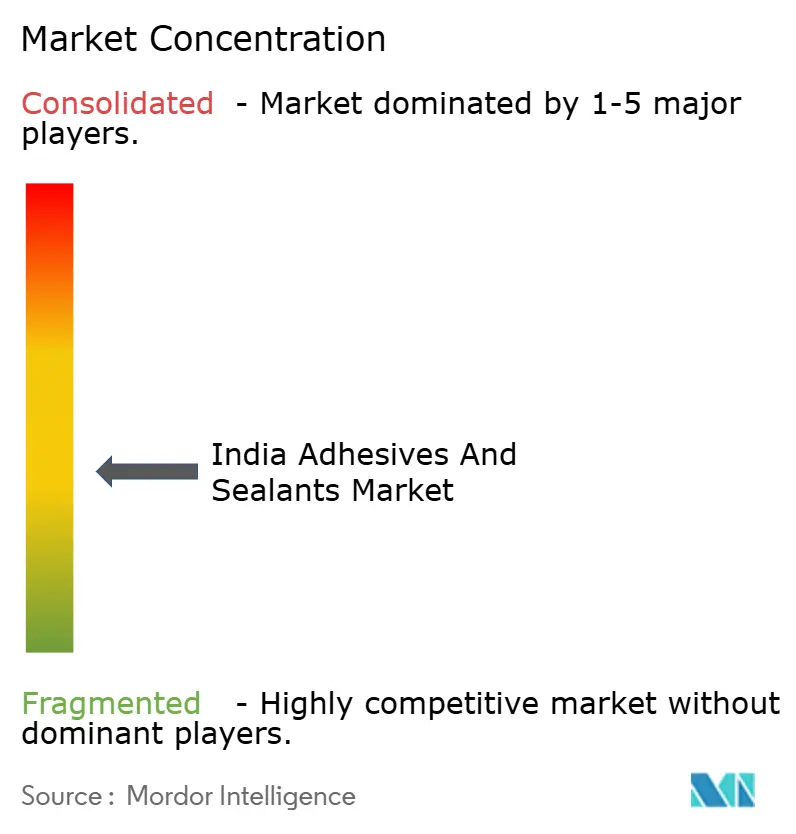
Competition combines global suppliers and India-based manufacturers, including 3M, H.B. Fuller Company, Henkel AG & Co. KGaA, Pidilite Industries Ltd. and Sika AG. 3M reported worldwide Industrial Adhesives and Tapes sales of USD 1.88 billion in the 9 months ended September 30, 2026, versus USD 1.7 billion in the comparable 2025 period. 3M India Limited's Safety & Industrial business serves customers with industrial adhesives and tapes alongside other industrial products. This mix places diversified industrial groups and India-based manufacturers such as Pidilite Industries Ltd. in the same field, so challengers face both product breadth and an established domestic operating base.
H.B. Fuller reported 4.4% year-over-year global organic revenue growth for the quarter ended August 29, 2026, as 7.4% pricing gains offset lower volume. The organic measure excluded currency, acquisitions and divestitures, while lower volume reduced revenue by 3%. Pidilite Industries Ltd. reported 22.2% net sales growth with underlying volume growth of 11.3% for the quarter ended June 30, 2026, a whole-company standalone measure.
Application engineering offers a route to competitive positioning by helping a customer evaluate a material within its intended product-development task. On March 24, 2026, Henkel launched a customer application center in Bengaluru for joint development, testing and validation of adhesive and thermal-management solutions for electronics manufacturing. Its 5,000-square-foot facility includes approximately 2,400 square feet of laboratory and testing space where customers can evaluate materials and processes before production scale. Because Bureau of Indian Standards certification is compulsory only for products covered by a Quality Control Order, suppliers outside that coverage can compete through process testing during material selection.
India Adhesives And Sealants Industry Leaders
-
3M
-
H.B. Fuller Company
-
Henkel AG & Co. KGaA
-
Pidilite Industries Ltd.
-
Sika AG
- *Disclaimer: Major Players sorted in no particular order
India Adhesives And Sealants Market Companies Covered in this Report
- 3M
- Arkema
- Ashland
- Astral Adhesives
- Atul Ltd
- AVERY DENNISON CORPORATION
- BASF
- Dow
- H.B. Fuller Company
- Henkel AG & Co. KGaA
- HP Adhesives
- Huntsman International LLC
- Jubilant Agri and Consumer Products Limited (JACPL)
- Mapei SpA
- Parker Hannifin Corp
- Pidilite Industries Ltd.
- Sika AG
- Soudal India Private Limited
Key Opportunities for Market Participants
New-line qualification, changes at operating plants and customer-specific formulation development offer different routes into electronics adhesive demand. On August 17, 2026, the Ministry of Electronics and Information Technology reported 106 projects approved under the Electronics Components Manufacturing Scheme, 38 plants producing and 16 projects in advanced construction or machinery installation. The combination of operating facilities and projects under installation creates different entry points for suppliers, depending on when a proposed adhesive application can be evaluated.
Market Opportunities Table of India Adhesives And Sealants Market
| Opportunity | Why now | Buyer / lead segment | Recommended play | Main barrier | Likely beneficiaries |
|---|---|---|---|---|---|
| Adhesive qualification for new component lines | Electronics-component plant installation activity | Component manufacturers preparing production lines | Qualify the adhesive with the intended process before proposing supply | Material fit with the planned production process | Electronics adhesive suppliers such as Henkel AG & Co. KGaA |
| Adhesive conversion at operating plants | An operating component-plant base | Electronics manufacturers already producing components | Test candidate adhesives against the established application before conversion | Validation of a material change in an operating process | Electronics adhesive suppliers such as Henkel AG & Co. KGaA |
| Customer-specific bonding formulations | Local co-development and testing capability | Electronics product and process engineering teams | Co-develop a formulation and validate its intended bonding use | Turning a custom formulation into a qualified commercial application | Application-focused adhesive suppliers such as Henkel AG & Co. KGaA |
| Source: Mordor Intelligence | |||||
Installation-stage projects give suppliers a point at which to align a material proposal with a defined manufacturing task. The proposal should distinguish initial material selection from a change to production already underway, because these are separate commercial decisions. Component-plant preparation is therefore the clearest initial target, where adhesive qualification can become part of bringing a specific production process into use.
Recent Industry Developments in India Adhesives And Sealants Market
- Sep 2026: Maharashtra Pollution Control Board classified glue and gelatin manufacturing using coal or liquid fuel as Red under its Environmental Pollution Index framework for state consent management.
- Apr 2026: Pidilite Industries Ltd. began price increases of 11% to 15%, implemented during April and May 2026, to address increases in vinyl acetate monomer and other key raw-material prices.
- Mar 2026: Henkel launched a customer application center in Bengaluru for joint development, testing and validation of adhesive and thermal-management solutions for electronics manufacturing.
India Adhesives And Sealants Market Report Scope and Research Methodology
Market Definition and Coverage
The India adhesives and sealants market measures annual spending on adhesives and sealants sold for use in India. It covers product sales to industrial and consumer end uses, with value attributed to the adhesive or sealant product sale.
Scope exclusions: Separately sold raw materials and chemical inputs, finished goods such as furniture and packaged food, standalone installation, bonding, sealing, or repair services, and separately sold adhesive or sealant application equipment are excluded.
Segments Covered in This Report
- By Adhesives Resin
- Polyurethane
- Epoxy
- Acrylic
- Silicone
- Cyanoacrylate
- VAE / EVA
- Other Resins
- By Adhesives Technology
- Water-borne
- Solvent-borne
- Reactive
- Hot-Melt
- UV Cured
- By Sealants Resin
- Silicone
- Polyurethane
- Acrylic
- Epoxy
- Other Resins
- By End-user Industry
- Aerospace
- Automotive
- Building and Construction
- Footwear and Leather
- Healthcare
- Packaging
- Woodworking And Joinery
- Other End-user Industries
Data Sources, Market Sizing, and Validation
Desk Research
Public and official sources such as the Society of Indian Automobile Manufacturers, which provides vehicle production and sales series to track demand from automotive assembly, the Ministry of Rural Development, whose housing completion data indicate construction-related applications, the Bureau of Indian Standards, which explains how voluntary standards and product-specific Quality Control Orders shape compliance, and CRISIL Ratings, whose company analyses help interpret raw-material cost changes and their transmission into product prices, support the analysis.
Company annual reports, investor presentations, statutory filings, and reputable Indian business coverage can add product, channel, capacity, and pricing context and can cross-check these sector indicators. These sources are illustrative, not exhaustive, and further sources inform collection, validation and clarification.
Primary Interviews and Surveys
A structured interview and survey program would include senior executives, product and application leaders, sales and channel managers, and procurement or technical staff at Indian adhesive and sealant producers, distributors, and end users. Their input would check secondary findings on product coverage, selling prices, channel markups, resin and technology mix, end-use demand, and the timing of customer orders. Unresolved gaps would be recorded and tested against independent company, industry, and trade indicators. Analysts would compare inconsistent responses by product and use case, seek clarification from relevant respondents where possible, and triangulate before adopting an assumption.
Distribution of primary research fieldwork respondents
| Company type | Respondent position | Region |
|---|---|---|
| Top tier: 30% | CXOs: 20% | |
| Mid tier: 45% | Functional/Unit leaders: 38% | |
| Smaller Players: 25% | Managers: 42% |
Market-Sizing & Forecasting
The model estimates annual Indian product sales value from a top-down view of adhesive and sealant demand across end uses, then tests the result with selective supplier roll-ups and sampled average selling price times volume checks. Construction activity, including completed housing, informs building-product demand. Vehicle production and sales indicate automotive bonding activity. Packaging and other manufacturing output inform industrial use, while feedstock prices and applicable product rules help explain selling-price changes and shifts in formulation. Analysts derive resin, technology, and end-user shares from supplier product mixes, channel evidence, application patterns, and reported end-use demand, then reconcile each set of shares to the total product-sales pool. Scenario analysis projects these indicators across 2027-2032, with separate assumptions for underlying application volumes and product prices where evidence supports a price or mix change. Respondent evidence would check each driver and the resulting segment paths. Where historical indicators or channel coverage are incomplete, analysts would use the nearest comparable official series, preserve the gap as an explicit assumption, and widen scenario ranges rather than treating an unsupported point as observed data.
Data Validation & Update Cycle
Analysts triangulate supplier and channel evidence against independent construction, vehicle, manufacturing, trade, price, and regulatory signals, then investigate material differences in product coverage, year, unit, and value before sign-off. A reviewer checks totals, segment shares, year-on-year movements, forecast assumptions, and unusual supplier or application values. The analyst documents the resolution and re-contacts a relevant respondent when a definition, timing, price, or volume explanation remains unclear. The model is refreshed annually, updated between cycles when a material event changes supply, regulation, or end-use demand, and given a fresh source and calculation review before delivery.
Mordor Intelligence's India Adhesives and Sealants Market Sizing Compared With Other Published Estimates
Published estimates can differ in the transactions and products they count and the inputs used to model demand. The India adhesives and sealants market measures annual spending on adhesives and sealants sold for use in India.
Key Gap Drivers include the study's defined coverage and market-specific modeling choices. Where historical indicators or channel coverage are incomplete, analysts would use the nearest comparable official series, preserve the gap as an explicit assumption, and widen scenario ranges rather than treating an unsupported point as observed data.
Benchmark comparison
| Source | Market Size | Gaps in Research Methodology |
|---|---|---|
| Mordor Intelligence | USD 3.93 B (2027) | |
| Global Consultancy A | USD 1.69 B (2024) | At its 2024 base, this estimate is 57.0% below this report's 2027 value of USD 3.93 B, 3 years later. The earlier base year and its published growth projection place this estimate below a later-year market measure. |
| Global Consultancy B | USD 3.5 B (2026) | At its 2026 base, this estimate is 10.9% below this report's 2027 value of USD 3.93 B, 1 year later. Its published 2026 base precedes the report year, and its forecast projects further market growth. |
Mordor Intelligence's analysts triangulate supplier and channel evidence against independent construction, vehicle, manufacturing, trade, price, and regulatory signals, then investigate material differences in product coverage, year, unit, and value before sign-off.
Key Questions Answered in the Report
What is the India adhesives and sealants market size and growth outlook?
The size is projected at USD 3.93 billion in 2027 and USD 5.45 billion by 2032, with a CAGR of 6.74% during 2027-2032.
What is driving demand for adhesives and sealants in India?
Residential construction, e-commerce fulfillment and automotive assembly support demand. India produced 5.54 million passenger vehicles in FY 2025-26, compared with 5.06 million in FY 2024-25.
Which end-user industry leads adhesives and sealants demand in India?
Packaging accounted for 41.36% of market revenue in 2026. Aerospace is forecast to grow fastest at a CAGR of 7.21% during 2027-2032.
Which companies compete in India's adhesives and sealants industry?
Major participants include 3M, H.B. Fuller Company, Henkel AG & Co. KGaA, Pidilite Industries Ltd. and Sika AG.
What is a key constraint on adhesive and sealant demand in India?
Raw-material volatility prompted Pidilite to raise prices. The company raised prices by 11% to 15% in April and May 2026 to address vinyl acetate monomer and other raw-material cost increases.
Which Indian regions are important for adhesives and sealants?
Western states led in 2024. Henkel launched a customer application center in Bengaluru in March 2026 for electronics adhesive and thermal-management development.