India Adhesives Market Analysis by Mordor Intelligence
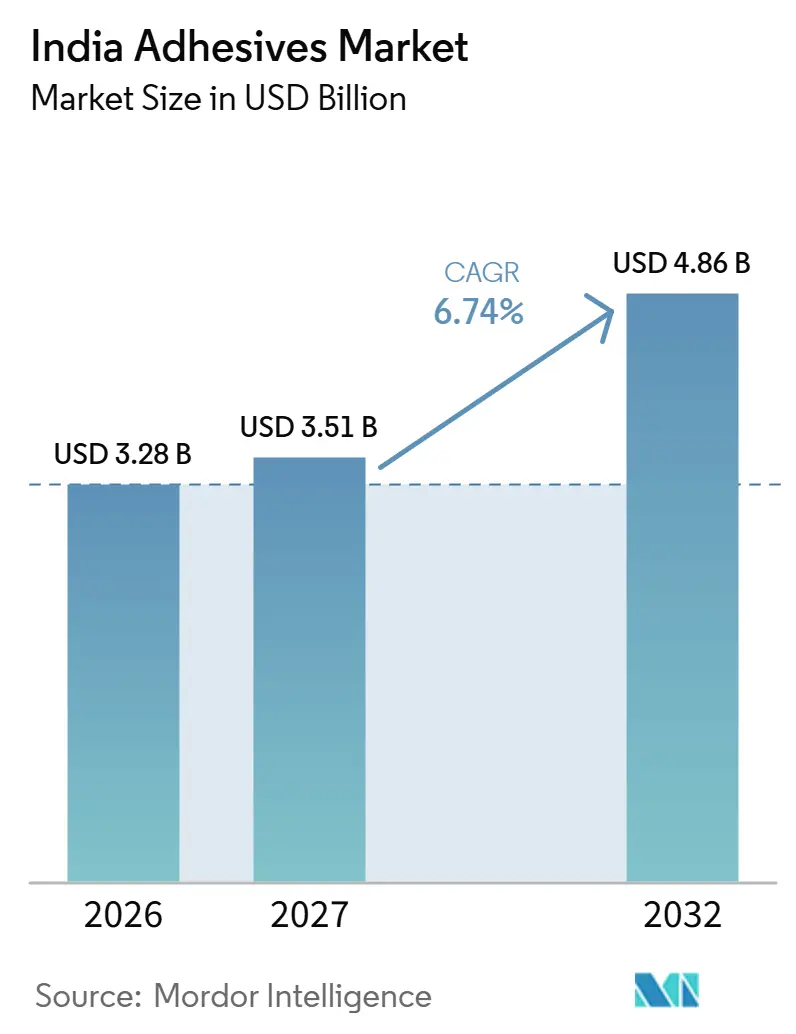
The India adhesives market size is expected to increase from USD 3.28 billion in 2026 to USD 3.51 billion in 2027 and reach USD 4.86 billion by 2032, growing at a CAGR of 6.74% over 2027-2032.
Construction investment and flexible-packaging redesign in India support demand through project execution and changes in the bonding materials buyers select. Local vehicle and electronics manufacturing creates openings for complex bonding functions, including battery interfaces and semiconductor underfill. Suppliers are responding through Indian production capacity and application-engineering capabilities that connect formulation development with manufacturing decisions. Raw-material price pressure and environmental approval requirements can limit how quickly these opportunities become profitable sales. Capturing these applications requires qualifying a formulation inside the buyer's manufacturing process while absorbing raw-material and compliance costs.
Key Report Takeaways
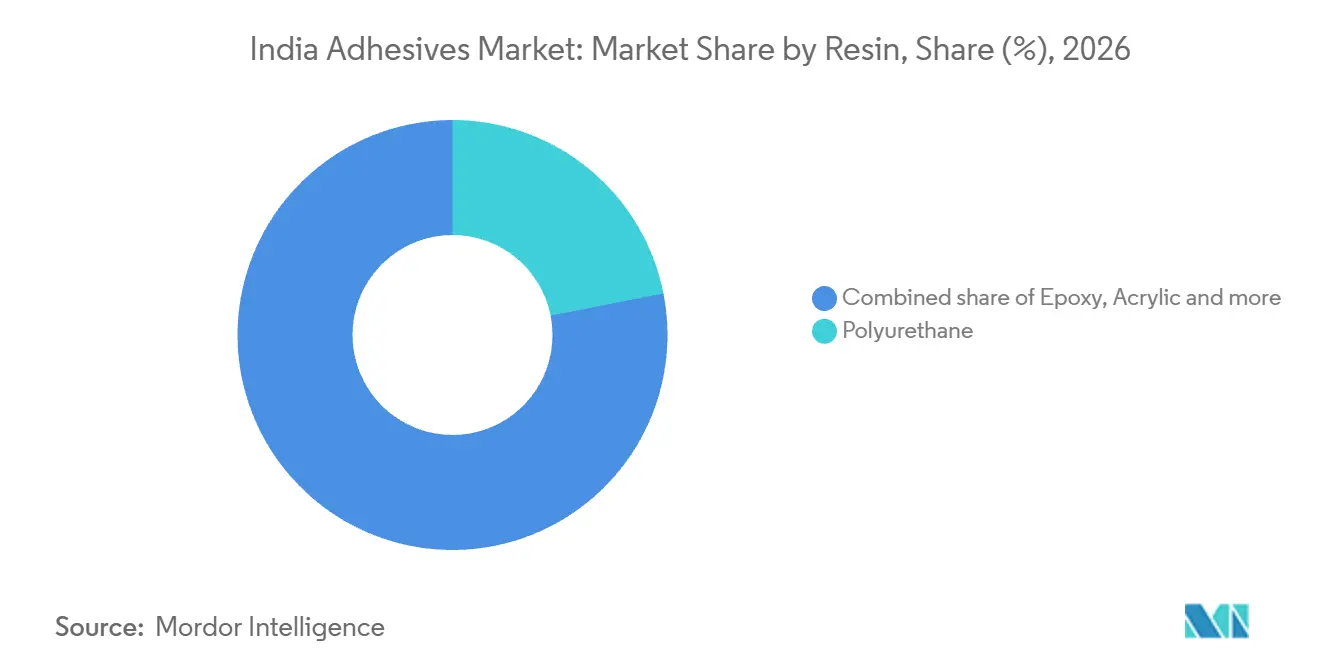
- By resin, polyurethane led with a 21.9% share of the India adhesives market size in 2026, while VAE / EVA is forecast to grow fastest at a 7.55% CAGR over 2027-2032.
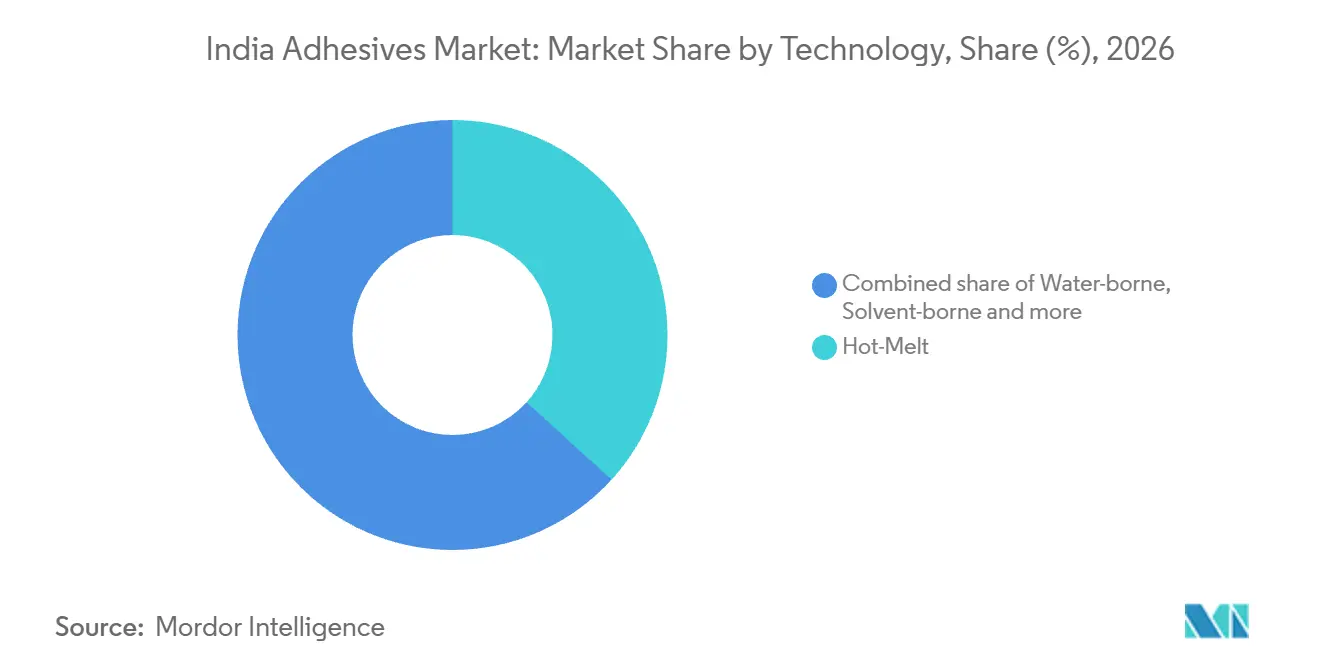
- Among adhesive technologies, hot-melt held a 36.74% India adhesives market share in 2026 and is forecast to be the fastest-growing segment at a 7% CAGR over 2027-2032.
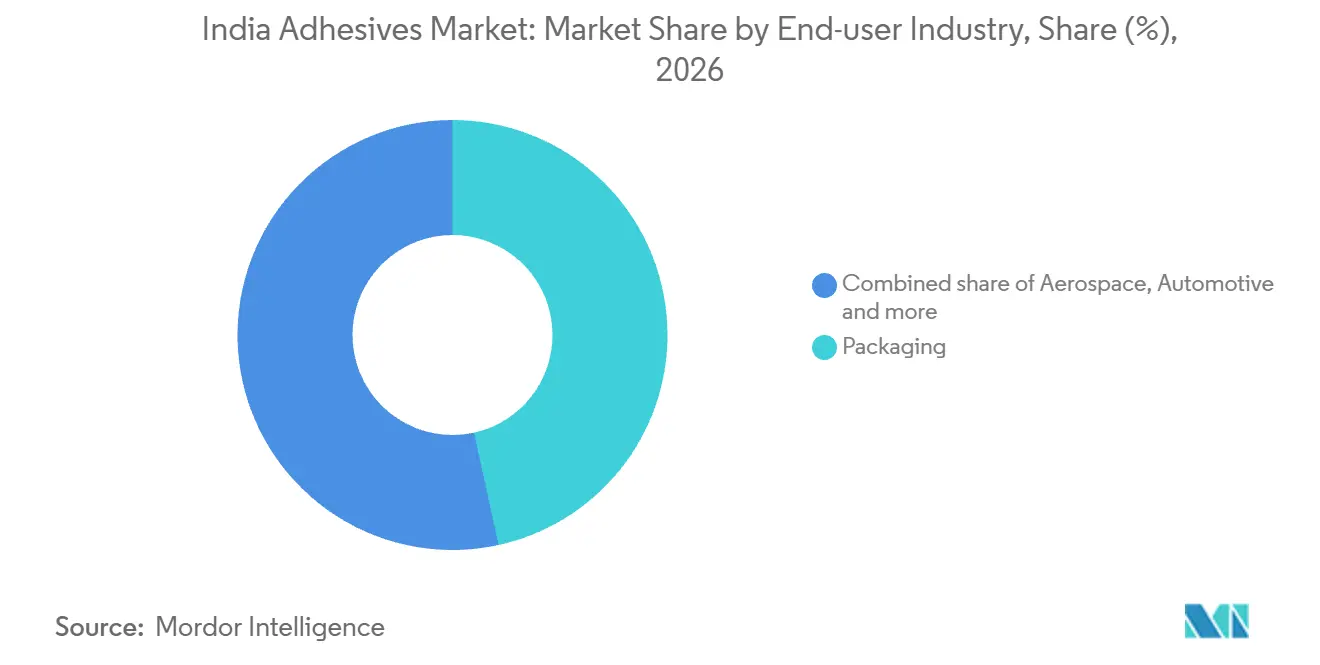
- Across end-user industries, packaging accounted for 46.56% of India's adhesive sales value in 2026, and aerospace is forecast to grow fastest at a 7.1% CAGR over 2027-2032.
Note: Market numbers in this report are based on Mordor Intelligence's proprietary estimation framework, which combines nine months of actuals with Q4 projections for base year 2026.
India Adhesives Market Trends and Insights
Drivers Impact Analysis*
| Driver | (~) % Impact on CAGR Forecast | Geographic Relevance | Impact Timeline |
|---|---|---|---|
| Government mega-infrastructure push fuels construction adhesive demand | +2% | Nationwide | Medium term (2-4 years) |
| Rapid e-commerce growth drives sustainable packaging adhesives | +2.5% | Nationwide | Short term (≤ 2 years) |
| Auto-EV localization needs lightweight and battery-grade adhesives | +1.9% | Hansalpur in Gujarat | Medium term (2-4 years) |
| PLI-led electronics manufacturing boosts high-performance adhesives | +1.5% | Nationwide | Medium term (2-4 years) |
| Bio-/water-based shift under VOC norms spurs research and development investment | +0.7% | Nationwide | Long term (≥ 4 years) |
| Source: Mordor Intelligence | |||
Government mega-infrastructure push fuels construction adhesive demand
Government infrastructure investment gives construction-adhesive suppliers a demand base extending beyond individual private developments. India's Union Budget proposed increasing public capital expenditure by about 9% in FY 2026-27 from the FY 2025-26 budget estimate.[1] Execution provides a separate signal, as the National Highways Authority of India (NHAI) constructed 5,313 kilometers of national highways in FY 2025-26, about 15% above its 4,640-kilometer target. For adhesive manufacturers, the combination supports demand through a broader funded construction workload, with commercial opportunities where project specifications require bonding. Actual delivery is the stronger signal for near-term supply decisions because a budget allocation becomes adhesive demand only as relevant construction work proceeds.
Rapid e-commerce growth drives sustainable packaging adhesives
Parcel throughput supports packaging demand, while adhesive selection determines which formulations benefit from a packaging redesign. Delhivery reported 322 million express-parcel shipments across its operating network in April-June 2026. Flexible-packaging design adds a material-selection consideration, as India Plastics Pact guidance favors solvent-less or polyurethane-based adhesives at no more than 5% of pack weight. The voluntary guidance treats adhesive chemistry and loading as parts of packaging recyclability design. Converters following that approach need a bond that fits the chosen structure within its adhesive-weight allowance. Additional parcel packaging can expand the opportunity for qualified polyurethane or solvent-less systems when converters adopt this design guidance.
Auto-EV localization needs lightweight and battery-grade adhesives
Local EV manufacturing creates an opportunity for adhesive suppliers to address demanding bonding applications close to vehicle production. In August 2025, Suzuki Motor Gujarat, Maruti Suzuki India Limited's wholly owned subsidiary, began producing the e VITARA battery electric vehicle in Gujarat.[2] Separately, cell-to-pack and structural battery designs can use adhesives as load-bearing, thermally active, electrically insulating interfaces. Combining those roles makes material selection a system-design decision. Where a design requires those functions together, a single-function grade leaves the buyer to qualify additional materials, narrowing suppliers able to compete for the integrated interface.
PLI-led electronics manufacturing boosts high-performance adhesives
Electronics assembly creates distinct adhesive opportunities across phone components and semiconductor packaging. By March 2026, cumulative production under India's Production Linked Incentive (PLI) Scheme for Large Scale Electronics Manufacturing reached 142% of its 5-year target. Smartphone assembly uses adhesives with different performance requirements for motherboards, display modules, covers, frames, keys, and antennas. Separately, insulating epoxy underfill between the die and substrate absorbs mechanical stress and improves reliability in flip-chip semiconductor assembly. Semiconductor assembly inspection can examine underfill and encapsulation quality through X-ray imaging and 3D automated optical inspection to identify latent defects. Manufacturing scale broadens the potential customer base, but the particular bonding interface and its quality checks determine which formulation can capture the opportunity.
Restraints Impact Analysis*
| Restraint | (~) % Impact on CAGR Forecast | Geographic Relevance | Impact Timeline |
|---|---|---|---|
| Crude-linked raw-material price volatility squeezes margins | -1% | Nationwide | Short term (≤ 2 years) |
| BIS and CPCB compliance raises formulation cost and time-to-market | -0.6% | Industrial areas in Maharashtra | Medium term (2-4 years) |
| Fragmented SME supply base limits quality and scale economics | -0.3% | Nationwide | Long term (≥ 4 years) |
| Source: Mordor Intelligence | |||
Crude-linked raw-material price volatility squeezes margins
Input-price pressure can restrict profitable adhesive supply even when downstream demand supports revenue growth. In FY 2025-26, Jubilant Agri and Consumer Products Limited reported that higher raw-material and packaging prices pressured EBIT margins in its adhesives business. Revenue growth alone cannot protect profitability when the materials used to supply it become more expensive. The company identified recipe optimization and raw-material qualification among its broader margin-protection measures in FY 2025-26. Where such measures do not offset higher inputs, formulators must absorb the margin pressure or pass it through to buyers, restricting the earnings available for expansion or raising the adhesive bill.
BIS and CPCB compliance raises formulation cost and time-to-market
For covered adhesive facilities, environmental compliance is part of the route to starting production. The Central Pollution Control Board's (CPCB) 2025 classification places glue and gelatin manufacturing using coal or liquid fuel in the Red category and processes using biomass or cleaner fuel in the Orange category. In Maharashtra, facilities likely to discharge effluent or emit air pollution need Consent to Establish before setup and Consent to Operate after required pollution-control systems are installed. This sequence makes pollution-control readiness part of the investment needed before commercial production can begin. The January 2026 framework provides deemed Consent to Establish for qualifying micro and small units in duly notified industrial areas that submit a self-certified application. Required pollution-control systems nevertheless add a facility-readiness cost before covered adhesive production can start.
*Our forecasts treat driver/restraint impacts as directional, not additive. The impact forecasts reflect baseline growth, mix effects, and variable interactions.
Segment Analysis
By Resin: Substrate Versatility Supports Polyurethane Leadership
Polyurethane accounted for a 21.9% share of the India adhesives market size in 2026, making it the largest segment. In FY 2025-26, IVP Limited described polyurethane-based adhesives as the preferred flexible-packaging choice for bond strength, versatility, and reliability across substrates. For converters running several packaging structures, a chemistry that bonds reliably across substrates can reduce the number of separate bonding approaches to qualify.
VAE / EVA is the fastest-growing segment, with a forecast CAGR of 7.55% over 2027-2032. In paper-box bonding, VAE-based adhesives form joints that resist tearing and cracking while preserving the box's flexibility and toughness. For a converter, that makes adhesive selection part of the box's mechanical design rather than a separate bond-strength specification, so formulators compete on joint behavior in the finished pack.

By Technology: Hot-Melt Scale Encourages Application Focus
Hot-melt represented a 36.74% India adhesives market share in 2026, making it the largest segment, and is forecast to be the fastest-growing segment at a 7% CAGR over 2027-2032. Tex Year Group's total Indian hot-melt adhesive production capacity reached 10,000 metric tons by February 2026 following the addition of its second plant in Mahad, Maharashtra. That investment expands the local manufacturing base available to serve industrial applications using the technology. Supplier profitability then depends on filling the expanded capacity with formulations matched to customer requirements, making conversion of production capability into regular adhesive orders critical after physical investment.
Hot-melt application economics also depend on the packaging line and the package's later temperature exposure. These adhesives are applied molten and set on cooling in carton sealing, case and tray forming, labeling, and selected lamination. Their short setting times permit rapid handling on high-throughput packaging lines. Thermal resistance is lower than for reactive systems, particularly where packages face elevated temperatures during storage, transport, or use. A converter's qualification decision must balance rapid setting against temperature exposure, limiting the applications that an expanded production base can serve.
By End-user Industry: Packaging Scale Contrasts With Aerospace Expansion
Packaging was the largest segment, accounting for 46.56% of India's adhesive sales value in 2026. Brilliant Polymers operates an Ambernath, Maharashtra, facility with annual capacity for 60,000 metric tons of flexible-packaging laminating adhesives. The scale of a dedicated laminating-adhesive plant illustrates how packaging creates industrial demand for formulated bonding materials as part of routine production. Keeping an adhesive in a converter's production program supports repeat volume across ongoing manufacturing runs, making retention within existing laminating applications central to supplier economics.
Aerospace is the fastest-growing segment, with a forecast CAGR of 7.1% over 2027-2032. On October 17, 2025, Defence Minister Rajnath Singh inaugurated Hindustan Aeronautics Limited's (HAL) third Tejas Mk1A line and second HTT-40 line at Nashik and flagged off the first Tejas Mk1A produced there. Expanded aircraft production provides adhesive suppliers a manufacturing context for application development, with sales depending on winning a specified bonding use. Automotive has a distinct supply-channel example in Henkel's July 2025 Chakan warehouse inauguration, which was designed for manufacturing customers and just-in-time delivery.
Geography Analysis
Maharashtra and Gujarat offer adhesive suppliers different routes into industrial manufacturing, with automotive electronics in one location and semiconductor packaging in the other. In October 2025, HARMAN, a wholly owned Samsung Electronics subsidiary, inaugurated an expansion of its automotive electronics plant in Chakan, Pune, Maharashtra, increasing production capacity by 50%. Commercial chip-packaging production began at CG Semi's Sanand facility in Gujarat in August 2026. Proximity has commercial value when it helps solve the assembly requirement specific to each process, linking regional presence to specialized bonding expertise.
Southern manufacturing additions create an opportunity to serve several production categories from a regional technical base, although their adhesive requirements need separate qualification. Syrma SGS Technology's laptop assembly line was inaugurated in Chennai in January 2025 as Tamil Nadu's first operating unit under IT hardware PLI 2.0. Zetwerk Electronics' Bengaluru, Karnataka, facility for defense, automotive, and IT hardware electronics manufacturing was inaugurated in February 2026. A regional sales base could spread its commercial dependence across several manufacturing programs, combining a focused laptop-assembly entry point in Chennai with a wider range of industrial customer applications in Bengaluru.
Uttar Pradesh and Haryana provide component-manufacturing opportunities with different technical boundaries, affecting how an adhesive supplier identifies the application it can serve. Optiemus Electronics and Corning inaugurated a Noida, Uttar Pradesh, facility for tempered glass used in mobile devices in August 2025. TDK Corporation's lithium-ion battery plant in Sohna, Haryana, was inaugurated on September 4, 2025. At inauguration, the facility was intended to manufacture batteries for mobile phones, wearables, hearables, and laptops. Component-level application mapping distinguishes the Noida glass facility from Sohna's intended battery applications, because each bonding interface determines a separate formulation opportunity.
Regulatory Framework and Outlook
The comparison covers selected jurisdictions, India and Maharashtra, from the perspective of an adhesive manufacturer operating a facility that discharges effluent or emits pollutants. The national framework sets consent rules, while the Maharashtra Pollution Control Board (MPCB) administers the process in Maharashtra. A covered manufacturer's approval route and pollution-control capability impose distinct commercial requirements.
Regulatory Table
| Decision factor | India | Maharashtra |
|---|---|---|
| Primary authority | State Pollution Control Boards and Pollution Control Committees | Maharashtra Pollution Control Board |
| Key instruments or direction | Uniform Consent Guidelines under the Air and Water Acts, amended in January 2026 | MPCB consent process and February 2026 processing-timeline reform |
| Commercial effect | Deemed establishment consent for eligible micro and small units in duly notified industrial estates or areas after project-proponent Form-I self-certification | Consent administration for covered emitting or effluent-discharging units |
| Current policy attractiveness | Medium | Medium |
| Future direction of policy attractiveness | Easing | Easing |
| Source: Mordor Intelligence | ||
India's Medium rating reflects a defined route alongside refusal and cancellation safeguards for noncompliance, consent violations, environmental damage, and prohibited locations. Its Easing direction follows the January 27, 2026 provision deeming Consent to Establish granted for micro and small units in industrial estates or areas duly notified by a state government, union territory administration, or local body after the project proponent submits self-certified Form-I. Maharashtra also merits Medium because covered operators must provide required pollution-control systems, while its Easing direction reflects the nationwide January amendments and MPCB's February 23, 2026 consent-processing reform. Together, the changes improve the administrative route for eligible projects while preserving the environmental-performance conditions that manufacturers must meet.
Value Chain Stages
The value chain compares resin supply, formulated-adhesive manufacturing, and distribution, with each stage earning from a different product or selling role. Pidilite manufactures consumer and industrial adhesives in India. It reported sales to 8,955 dealers and distributors in FY 2025-26, illustrating the scale of its company-wide sales channel.
Value Chain Analysis Table
| Primary activity | Key participants | Value capture | Bottleneck | Resilience response |
|---|---|---|---|---|
| Resin and formulation-input supply | Resin producers such as Atul Ltd and D.R. Coats Ink & Resins | Resin and related input sales | Limited substitution before alternative inputs are qualified | Qualify alternatives against formulation requirements |
| Formulated-adhesive manufacturing | Adhesive manufacturers such as Pidilite Industries Ltd. and Atul Ltd | Finished adhesive product sales | Consistent formulation performance across production batches | Validate batches against the target application |
| Distribution and local supply | Adhesive distributors such as Mac-Chem and SAR Tech Solutions Private Limited | Adhesive resale earnings | Cost of servicing small orders | Pool local stock and group deliveries |
| Source: Mordor Intelligence | ||||
Atul's participation in both inputs and finished adhesives shows how one company can retain revenue at more than one stage. Integration can improve coordination of material changes, while the finished formulation must satisfy the intended bonding application. Distribution adds a separate commercial capability by making suppliers' products available through channel partners, so factory integration and market access address different constraints.
Competitive Landscape
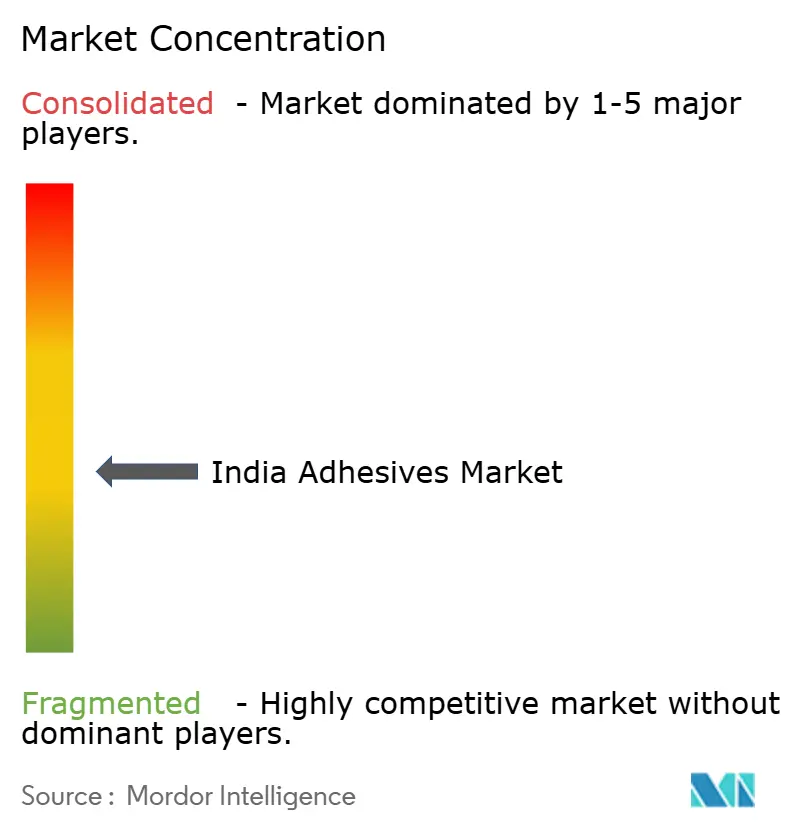
Competition spans established international adhesive groups and domestic producers, with major players including 3M, H.B. Fuller Company, Henkel AG & Co. KGaA, Pidilite Industries Ltd., and Arkema. H.B. Fuller operates in India through H.B. Fuller India Adhesives Private Limited, with an office in Pune, while Arkema participates through its Bostik adhesive-solutions business and Bostik India Private Limited in Thane, Maharashtra. In FY 2025-26, Pidilite's operations included manufacture of consumer and industrial adhesives, and its industrial adhesive products represented 4.9% of standalone sales. Comparisons based only on this industrial category would omit Pidilite's consumer adhesive operations, so the relevant competitive overlap depends on the buyer application.
Electronics competition spans local application engineering for production validation and materials supply at the assembly stage. Henkel launched an electronics Application Engineering Center in Chennai on February 27, 2025, to support advanced adhesive solutions and product validation.[3] At its March 12, 2026 investor meeting, 3M India Limited said it supplied adhesives and abrasives for Indian electronics assembly, where investment focused mainly on assembly and much component-level activity remained imported. Henkel's Chennai center connects formulation validation with a particular electronics design, allowing technical selection to precede the buyer's commitment to production supply.
Arkema's portfolio integration creates a different competitive route by bringing related adhesive offers under a common business identity. On April 20, 2026, Bostik introduced ADCOTE as the main brand for its global flexible-material laminating adhesives and coatings portfolio following integration of Dow's acquired business. The announced portfolio spans solvent-based, solvent-free, and water-based laminating adhesives, alongside heat-seal, cold-seal, reseal, and functional coatings. Bostik said the single brand was intended to bring greater clarity to customers and other flexible-materials businesses after the portfolio expanded. Combining acquired product families under ADCOTE shifts the sales task toward explaining application fit across the enlarged portfolio.
India Adhesives Industry Leaders
-
3M
-
H.B. Fuller Company
-
Henkel AG & Co. KGaA
-
Pidilite Industries Ltd.
-
Arkema
- *Disclaimer: Major Players sorted in no particular order
Recent Industry Developments
- Dec 2025: Tex Year Technologies India Pvt. Ltd.'s second plant in Mahad, Maharashtra, commenced mass production, with 3 main production lines in its first phase.
- Jul 2025: Henkel Adhesive Technologies India inaugurated an automotive warehouse in Chakan, Pune, designed for just-in-time delivery to automotive manufacturers and management of nonstandard prototype materials with SAP batch and date traceability.
Scope and Methodology
By Resin
| Polyurethane |
| Epoxy |
| Acrylic |
| Silicone |
| Cyanoacrylate |
| VAE / EVA |
| Other Resins |
By Technology
| Water-borne |
| Solvent-borne |
| Reactive |
| Hot-Melt |
| UV Cured |
By End-user Industry
| Aerospace |
| Automotive |
| Building and Construction |
| Footwear and Leather |
| Healthcare |
| Packaging |
| Woodworking And Joinery |
| Other End-user Industries |
| By Resin | Polyurethane |
| Epoxy | |
| Acrylic | |
| Silicone | |
| Cyanoacrylate | |
| VAE / EVA | |
| Other Resins | |
| By Technology | Water-borne |
| Solvent-borne | |
| Reactive | |
| Hot-Melt | |
| UV Cured | |
| By End-user Industry | Aerospace |
| Automotive | |
| Building and Construction | |
| Footwear and Leather | |
| Healthcare | |
| Packaging | |
| Woodworking And Joinery | |
| Other End-user Industries |
Market Definition
- End-user Industry - Building & Construction, Packaging, Automotive, Aerospace, Woodworking & Joinery, Footwear & Leather, Healthcare, and Others are the end-user industries considered under the adhesives market.
- Product - All adhesive products are considered in the market studied
- Resin - Under the scope of the study, resins like Polyurethane, Epoxy, Acrylic, Cyanoacrylate, VAE/EVA, and Silicone are considered
- Technology - For the purpose of this study, Water-borne, Solvent-borne, Reactive, Hot Melt, and UV Cured adhesive technologies are taken into consideration.
| Keyword | Definition |
|---|---|
| Hot-melt Adhesive | Hot melt adhesives are generally 100% solid formulations, based on thermoplastic polymers. They are solid at room temperature and are activated upon heating above their softening point, at which stage they are liquid, and hence, can be processed. |
| Reactive Adhesive | A reactive adhesive is made up of monomers that react in the adhesive curing process and do not evaporate from the film during use. Instead, these volatile components become chemically incorporated into the adhesive. |
| Solvent-borne Adhesive | Solvent-borne adhesives are mixtures of solvents and thermoplastic, or slightly cross-linked polymers, such as polychloroprene, polyurethane, acrylic, silicone, and natural and synthetic rubbers (elastomers). |
| Water-borne Adhesive | Water-borne adhesives use water as a carrier or diluting medium to disperse a resin. They are set by allowing the water to evaporate or be absorbed by the substrate. These adhesives are compounded with water as a diluent, rather than a volatile organic solvent. |
| UV Cured Adhesive | UV curing adhesives induce curing and create a permanent bond without heating by using ultraviolet (UV) light or other radiation sources. An aggregation of monomers and oligomers is cured or polymerized by ultraviolet (UV) or visible light in a UV adhesive. Because UV is a radiating energy source, UV adhesives are often referred to as radiation curing or rad-cure adhesives. |
| Heat-resistant Adhesive | Heat-resistant Adhesives refer to those that do not break down under high temperatures. One aspect of a complicated system of circumstances is the adhesive's capacity to withstand disintegration brought on by high temperatures. As the temperature rises, adhesives may liquefy. They can withstand stresses resulting from differing coefficients of expansion and contraction, which might be an additional advantage. |
| Reshoring | Reshoring is the practice of moving commodity production and manufacturing back to the nation where the business was founded. Onshoring, inshoring, and back shoring are further terms used. Offshoring, the practice of producing items abroad to lower labor and manufacturing costs, is the opposite of this. |
| Oleochemicals | Oleochemicals are compounds produced from biological oils or fats. They resemble petrochemicals, which are substances made from petroleum. The oleochemical business is built on the hydrolysis of oils or fats. |
| Nonporous Materials | Nonporous materials are substances that do not permit the passage of liquid or air. Nonporous materials are those that are not porous, such as glass, plastic, metal, and varnished wood. Since no air can get through, less airflow is required to raise these materials, negating the requirement for high airflow. |
| EU-Vietnam Free Trade Agreement | A trade agreement and an investment protection agreement were concluded between the European Union and Vietnam on June 30, 2019. |
| VOC content | Compounds with limited solubility in water and high vapor pressure are known as Volatile Organic Compounds (VOCs). Many VOCs are human-made chemicals that are used and produced in the manufacture of paints, pharmaceuticals, and refrigerants. |
| Emulsion Polymerization | Emulsion polymerization is a method of producing polymers or connected groups of smaller chemical chains known as monomers, in a water solution. The method is often used to make water-based paints, adhesives, and varnishes, in which the water stays with the polymer and is marketed as a liquid product. |
| 2025 National Packaging Targets | In 2018, the Australian Environment Ministry set the following 2025 National Packaging Targets: 100% of the packaging must be reusable, recyclable, or compostable by 2025, 70% of plastic packaging must be recycled or composted by 2025, 50% of average recycled content must be included in packaging by 2025, and problematic and unnecessary single-use plastic packaging must be phased out by 2025. |
| Russian Government’s Import Substitution Policy | The Western sanctions suspended the distribution of several high-tech items to Russia, including those required by the raw material export sectors and the military-industrial complex. In response, the government launched an "import substitution" scheme, appointing a special commission to oversee its implementation in early 2015. |
| Paper Substrate | Paper substrates are paper sheets, reels, or boards with a base weight of up to 400 g/m2 that has not been converted, printed or otherwise altered. |
| Insulation Material | A material that inhibits or blocks heat, sound, or electrical transmission is known as Insulation Material. The variety of insulation materials includes thick fibers like fiberglass, rock and slag wool, cellulose, and natural fibers as well as stiff foam boards and sleek foils. |
| Thermal Shock | A temperature change known as thermal shock generates stress in a material. It commonly results in material breakdown and is especially prevalent in brittle materials like ceramics. When there is a quick temperature change, either from hot to cold or vice versa, this process occurs abruptly. It occurs more frequently in materials with poor heat conductivity and insufficient structural integrity. |
Research Methodology
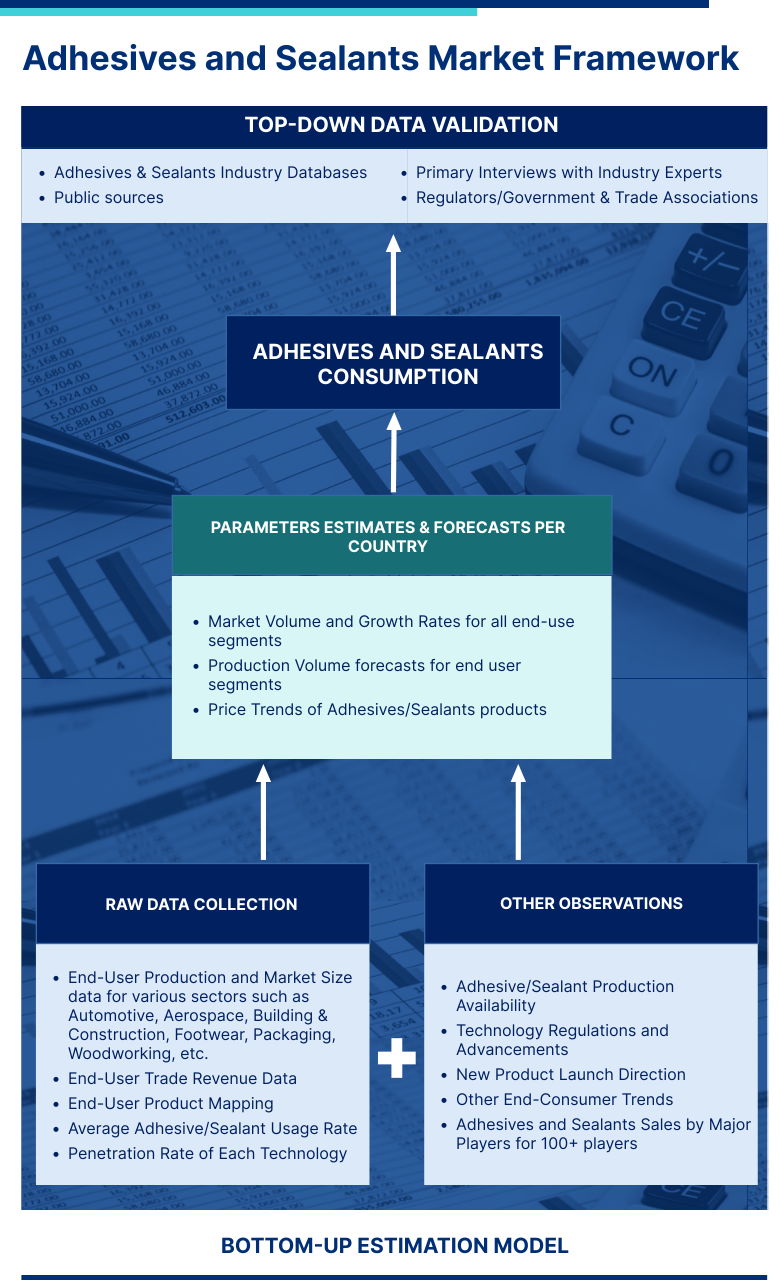
Mordor Intelligence follows a four-step methodology in all our reports.
- Step-1: Identify Key Variables: The quantifiable key variables (industry and extraneous) pertaining to the specific product segment and country are selected from a group of relevant variables & factors based on desk research & literature review; along with primary expert inputs. These variables are further confirmed through regression modeling (wherever required).
- Step-2: Build a Market Model: In order to build a robust forecasting methodology, the variables and factors identified in Step-1 are tested against available historical market numbers. Through an iterative process, the variables required for market forecast are set and the model is built on the basis of these variables.
- Step-3: Validate and Finalize: In this important step, all market numbers, variables and analyst calls are validated through an extensive network of primary research experts from the market studied. The respondents are selected across levels and functions to generate a holistic picture of the market studied.
- Step-4: Research Outputs: Syndicated Reports, Custom Consulting Assignments, Databases & Subscription Platforms