
Implantable Defibrillators Market Size and Share
Market Overview
| Study Period | 2020 - 2031 |
|---|---|
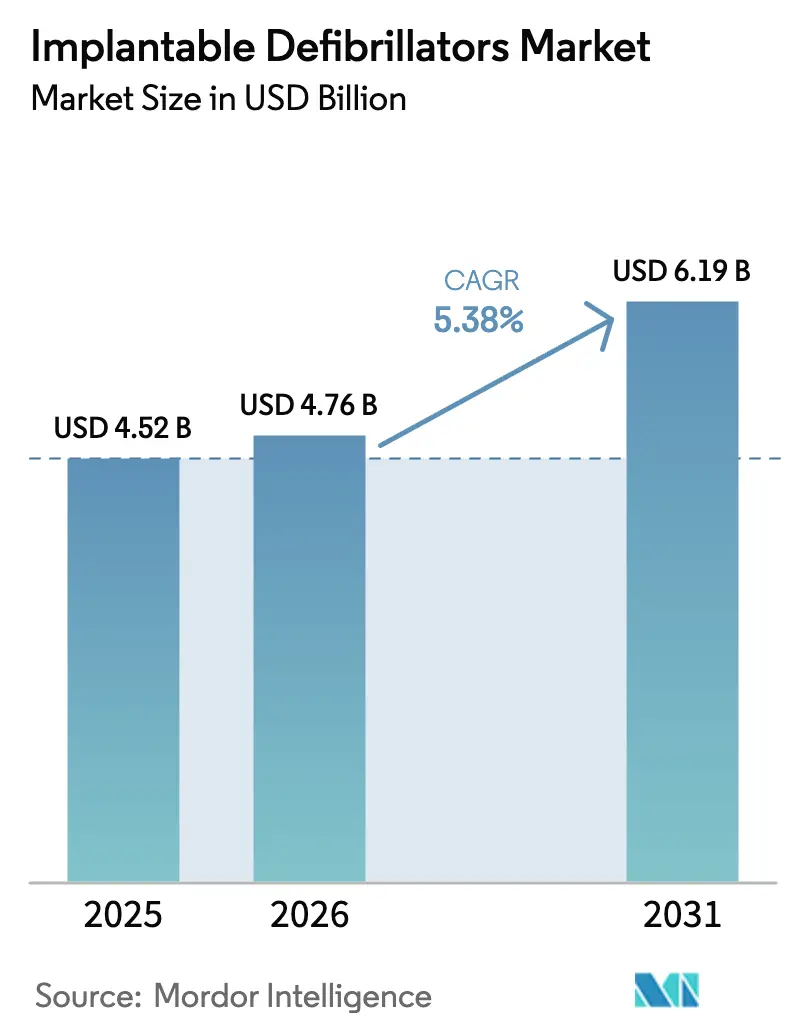
| Market Size (2026) | USD 4.76 Billion |
| Market Size (2031) | USD 6.19 Billion |
| Growth Rate (2026 - 2031) | 5.38 % |
| Fastest Growing Market | Asia Pacific |
| Largest Market | North America |
| Market Concentration | High |
Major Players *Disclaimer: Major Players sorted in no particular order Image © Mordor Intelligence. Reuse requires attribution under CC BY 4.0. | |
Implantable Defibrillators Market Analysis by Mordor Intelligence
implantable cardioverter defibrillator market size in 2026 is estimated at USD 4.76 billion, growing from 2025 value of USD 4.52 billion with 2031 projections showing USD 6.19 billion, growing at 5.38% CAGR over 2026-2031. Growth stems from the transition toward AI-integrated devices that predict arrhythmic events, extended-life batteries that reduce replacement procedures, and rising prophylactic use in high-risk heart-failure cohorts. Mature health systems prioritize longevity and remote monitoring, while emerging regions focus on first-time access. Subcutaneous and extravascular systems are reshaping surgical practice by eliminating transvenous leads, and pediatric applications are expanding swiftly as miniaturized platforms address congenital conditions. Heightened regulatory scrutiny and cybersecurity demands temper momentum yet spur investment in secure firmware and post-market surveillance.
Key Report Takeaways
- By product type, transvenous systems led with 70.92% revenue share in 2025, whereas subcutaneous devices are forecast to expand at a 6.44% CAGR through 2031.
- By end user, hospitals and cardiac centers held 79.63% of the implantable cardioverter defibrillator market share in 2025, while ambulatory surgical centers record the highest projected CAGR at 6.18% to 2031.
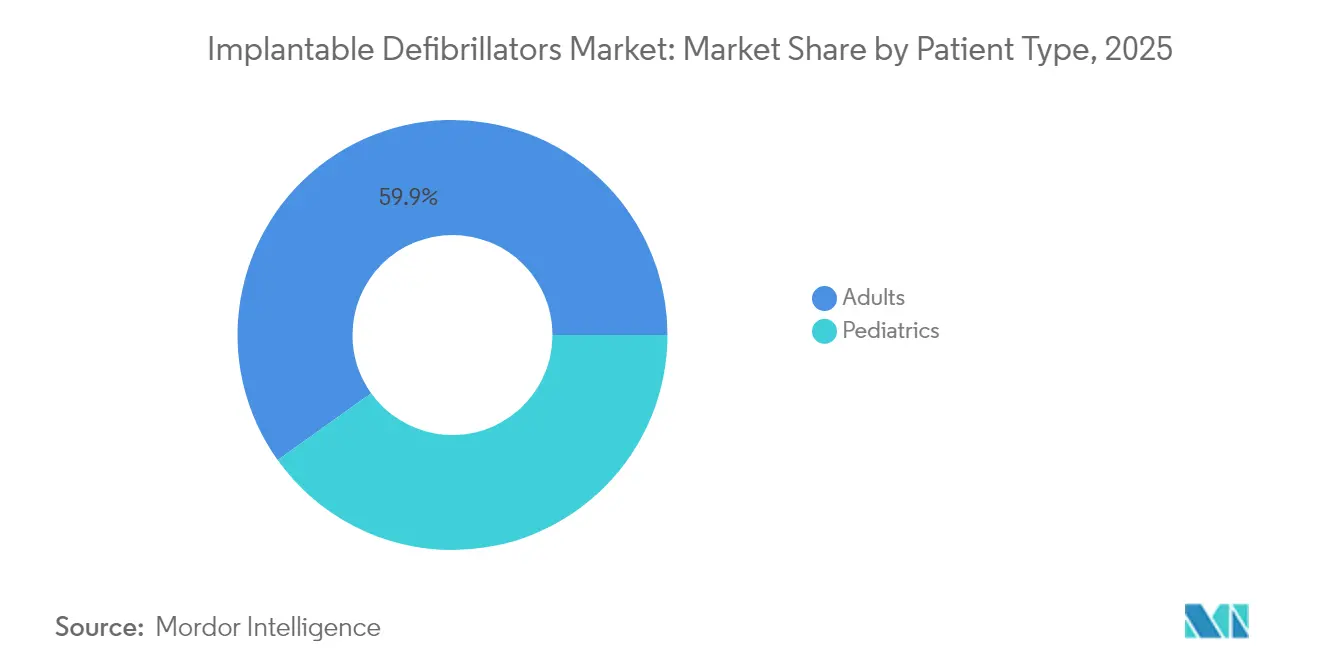
- By patient type, adults accounted for 59.88% share of the implantable cardioverter defibrillator market size in 2025; the pediatric segment is advancing at a 6.74% CAGR through 2031.
- By geography, North America commanded 42.11% of global revenue in 2025, whereas Asia-Pacific is poised for a 7.02% CAGR to 2031.
Note: Market size and forecast figures in this report are generated using Mordor Intelligence’s proprietary estimation framework, updated with the latest available data and insights as of 2026.
Market Trends and Insights
Drivers Impact Analysis of Implantable Defibrillators Market*
| Driver | (~) % Impact on CAGR Forecast | Geographic Relevance | Impact Timeline |
|---|---|---|---|
| Rising prevalence of arrhythmias & sudden cardiac death risk | +1.5% | North America & Europe | Long term (≥ 4 years) |
| Battery-longevity and device miniaturization breakthroughs | +1.2% | Global, early in developed markets | Medium term (2-4 years) |
| Uptake of MRI-conditional & connected ICDs | +0.8% | North America & EU leading | Medium term (2-4 years) |
| “Shock-less” algorithms lowering patient anxiety | +0.6% | Quality-focused markets | Short term (≤ 2 years) |
| Extravascular/Leadless ICD Trial Success Expanding Eligibility | +0.4% | North America & EU initial rollout | Long term (≥ 4 years) |
| AI-Driven Predictive Analytics Boosting Prophylactic Implants | +0.3% | Developed markets with advanced healthcare infrastructure | Long term (≥ 4 years) |
| Source: Mordor Intelligence | |||
Rising Prevalence of Cardiac Arrhythmias & SCD Risk
Global aging and higher post-infarction survival have enlarged the population vulnerable to sudden cardiac death. Roughly 400,000 U.S. residents suffer cardiac arrest each year, and survival remains close to 10% [1]. Guideline-backed evidence supports prophylactic ICD use in heart-failure cohorts with reduced ejection fraction, pushing clinicians to screen earlier using family history and genetic markers. As a result, primary‐prevention implants constitute the fastest-growing indication, ensuring sustained demand across the implantable cardioverter defibrillator market.
Continuous Miniaturization & Battery-Longevity Improvements
Boston Scientific’s EnduraLife cell delivers 1.9 Ah, extending projected service lives to 17.5 years and cutting replacement procedures by 40% [2]. Longer life translates to Medicare savings of USD 15,120 per recipient, reinforcing health-system preference for premium platforms. Miniaturization also supports subcutaneous placement, avoiding lead complications that previously affected 15% of patients.
Wider Adoption of MRI-Conditional & Connected ICDs
MRI-conditional labeling removes lifetime scan bans that once deterred eligible candidates. Remote telemetry transmits device and rhythm data within 18.5 hours and receives clinician review in under one day, achieving 97% patient compliance. Continuous monitoring reframes ICDs as holistic disease-management hubs, lowering hospitalizations by 25% and improving medication adherence.
“Shock-Less” ICD Algorithms Easing Patient Anxiety
Modern discrimination algorithms now reach 95% specificity, trimming inappropriate shocks by 60%. Lower shock burden lifts patient quality-of-life scores by 40% and boosts physician confidence, expanding the implantable cardioverter defibrillator market among risk-averse cohorts.
Restraints Impact Analysis of Implantable Defibrillators Market*
| Restraint | (~) % Impact on CAGR Forecast | Geographic Relevance | Impact Timeline |
|---|---|---|---|
| Stringent regulatory hurdles & recent recalls | -0.9% | Regulated markets | Short term (≤ 2 years) |
| High device and follow-up costs in low-income settings | -0.7% | Emerging APAC & MEA | Long term (≥ 4 years) |
| Cyber-Security Concerns With Wireless ICD Telemetry | -0.5% | Developed markets with advanced connectivity | Medium term (2-4 years) |
| Rise Of Catheter-Ablation Curbing Implant Growth | -0.4% | Global, with higher impact in advanced markets | Medium term (2-4 years) |
| Source: Mordor Intelligence | |||
Stringent Regulatory Hurdles & Product Recalls
Medtronic’s Cobalt and Boston Scientific’s EMBLEM recalls in 2024 affected more than 100,000 devices, triggering FDA demands for tighter cybersecurity and lengthening approval cycles by up to 18 months [3]. Smaller firms struggle to absorb the 25% compliance-cost spike, which restrains near-term product flow and tempers adoptive enthusiasm.
High Device & Follow-Up Costs in Low-Income Settings
In Kenya and Kazakhstan, fewer than 5% of indicated patients receive ICD therapy, as unit prices equal up to 12 months of household earnings. Import tariffs can inflate landed costs by 60%, and scarce electrophysiology expertise heightens procedural barriers, slowing implantable cardioverter defibrillator market diffusion across emerging economies.
*Our forecasts treat driver/restraint impacts as directional, not additive. The impact forecasts reflect baseline growth, mix effects, and variable interactions.
Implantable Defibrillators Market Segment Analysis
By Product Type:
Subcutaneous Disruption Versus Transvenous ScaleTransvenous systems maintained 70.92% dominance in 2025, yet subcutaneous devices are clocking a 6.44% CAGR through 2031 as practitioners embrace lead-free implantation. The PRAETORIAN trial confirmed equal shock efficacy with fewer lead-related complications. The implantable cardioverter defibrillator market size for subcutaneous platforms is therefore expanding faster than the mature transvenous segment.
Extravascular and leadless designs add another frontier. Medtronic’s Aurora EV-ICD received FDA clearance in 2024, combining lead-free safety with pacing capability. Appropriate shock success reached 95% and reduced procedural time, positioning extravascular systems to siphon share from both incumbent categories while elevating overall implantable cardioverter defibrillator market resilience.


By End User:
Outpatient MomentumHospitals and cardiac centers controlled 79.63% revenue in 2025, reflecting embedded infrastructure. Nevertheless, ambulatory surgical centers are accelerating at 6.18% CAGR as streamlined protocols cut same-day discharge times and facility fees. Specialty clinics handle pediatric and revision cases requiring advanced skills, whereas home-based remote-monitoring programs register 97% compliance, reinforcing lifetime oversight and fueling broader implantable cardioverter defibrillator market adoption.
By Patient Type:
Pediatric InnovationsAdults accounted for 59.88% of 2025 volume, yet pediatric implants are rising at 6.74% CAGR. Children benefit from miniaturized generators and algorithms distinguishing exercise tachycardia from pathology. Pediatric-specific subcutaneous and leadless prototypes promise to shrink procedural revision frequency, further cultivating the implantable cardioverter defibrillator market.
Geography Analysis
North America Implantable Defibrillators Market
North America’s 42.11% share stems from universal reimbursement and a dense electrophysiology workforce. Yet market expansion moderates as insurers demand evidence of cost efficacy, pivoting procurement toward extended-life batteries and robust cybersecurity audits.
Europe Implantable Defibrillators Market
Europe ranks second and emphasizes sustainability: cardiac societies endorse biodegradable materials and recycling workflows, influencing purchasing criteria and cultivating eco-centric design mandates. Diverse reimbursement models create fragmented uptake, but harmonized CE-marking accelerates multi-country launches.
APAC Implantable Defibrillators Market
Asia-Pacific, paced by 7.02% CAGR, offers the deepest runway. Japan leads premium adoption, while populous nations such as India exhibit implant rates 10-20-fold below clinical need, mainly due to affordability gaps and limited electrophysiology talent. Government-sponsored training and local manufacturing incentives aim to narrow the disparity, ultimately broadening the implantable cardioverter defibrillator market footprint.

Regulatory Landscape
Implantable cardioverter defibrillators (ICDs) are regulated as high-risk implantable devices, and in the United States they fall under FDA Class III controls with Premarket Approval (PMA) oversight through the Center for Devices and Radiological Health, including the Office of Cardiovascular Devices. The compliance bar extends beyond initial approval to lifecycle change control via PMA supplements for manufacturing, sterilization, and packaging updates, as reflected by ongoing supplement activity in 2026.
Standards and post-market expectations are increasingly tied to market access as devices add MRI-conditional labeling and wireless telemetry. For example, AAMI/ANSI PC76:2021 is used as an anchor standard for the safety of ICD patients exposed to magnetic resonance imaging, while heightened attention to cybersecurity and surveillance is reinforced by the 2024 recall environment cited in the report context, which has elevated regulator scrutiny for connected cardiac rhythm management systems.
Value Chain Analysis
The ICD value chain starts with specialty components, including high-voltage ceramic capacitors, hermetically sealed titanium housings, and custom medical-grade integrated circuits, alongside critical materials such as lithium-based battery cells and biocompatible polymers used in lead insulation. These inputs flow into precision subassembly of pulse generators and leads, with performance and reliability tied to component qualification, supplier controls, and the ability to sustain consistency for long-life batteries and miniaturized form factors.
Downstream, final assembly, calibration, and end-of-line testing occur in ISO 13485-certified cleanroom environments subject to FDA inspection, followed by validated sterilization and packaging release, commonly using ethylene oxide processes with tightly controlled cycles and documentation. Distribution is predominantly direct-to-hospital and cardiac center channels, with remote-monitoring platforms extending the service layer after implant through device data transmission, firmware management, and field support. This makes quality systems, traceability, and post-market servicing central to overall supply chain economics.
Competitive Landscape
Medtronic, Boston Scientific, and Abbott collectively control majority of revenue, underlining moderate consolidation. Differentiation hinges on battery chemistry, AI-driven diagnostics, and secure cloud telemetry. The competitive focus has shifted from hardware commoditization to data services; remote-monitoring subscriptions generate recurring revenue and deepen patient lock-in.
Acquisition activity underscores vertical integration. Johnson & Johnson’s USD 1.7 billion V-Wave purchase augments heart-failure therapy adjacency and expands total addressable market. Emerging entrants target niche terrain—biodegradable generators, pediatric leadless devices, and predictive analytics engines—pressuring incumbents to accelerate R&D.
The ascent of catheter ablation, posting success rates above 85% for select arrhythmias, challenges ICD growth in certain phenotypes. In response, leading vendors pilot hybrid offerings that bundle ablation solutions with next-generation defibrillators, preserving relevance and diversifying revenue within the broader implantable cardioverter defibrillator market.
Implantable Defibrillators Industry Leaders
-
Boston Scientific Corporation
-
Medtronic PLC
-
LivaNova PLC
-
Abbott
-
Biotronik
- *Disclaimer: Major Players sorted in no particular order

Implantable Defibrillators Market Companies Covered in this Report
- Medtronic
- Boston Scientific
- Abbott Laboratories (St. Jude)
- BIOTRONIK
- MicroPort CRM (MicroPort Scientific)
- LivaNova
- Integer Holdings Corp.
- Lepu Medical Technology Co.
- Shree Pacetronix
- Medico S.p.A.
- OSYPKA
- Sorin Group (legacy)
- Greatbatch Medical
- Jingjing Medical Equipment
- EBR Systems
- EBR Extravascular Solutions
- CathRx Ltd.
Market Opportunities and Future Outlook
A key white-space opportunity is the expansion of extravascular and lead-reducing defibrillation solutions that address complications associated with transvenous leads while keeping needed therapy capabilities. Market activity in 2026 provides concrete proof points: Medtronic highlighted one-year real-world Enlighten data for its Aurora EV-ICD system, showing 95.8% freedom from chronic major system-related complications. The result is supportive of provider confidence in alternative implant routes and enables broader protocol standardization and training.
Another opportunity area is the convergence of defibrillation therapy with conduction system pacing and MRI-conditional pathways, which can shift purchasing criteria toward platforms and lead portfolios that cover more clinical scenarios without additional invasive hardware. Medtronic received FDA approval in March 2026 for its OmniaSecure defibrillation lead for conduction system pacing, and AtaCor Medical, together with Abbott, initiated the ALARION-EV pivotal trial with first patient enrollment in May 2026 for a parasternal extravascular ICD system. This points to active competition and pipeline depth in next-generation leads and EV-ICD architectures.
Recent Industry Developments in Implantable Defibrillators Market
- May 2026: Abbott/AtaCor reports ALARION-EV trial first patient enrollment for parasternal EV-ICD system using AtaCor lead and Abbott pulse generator. The development directly impacts the EV-ICD market niche and lead technology. The collaboration signals progress on parasternal EV-ICD solutions and a parasternal lead ecosystem.
- April 2026: Medtronic announces CE mark and first commercial implants in Europe for OmniaSecure defibrillation lead and expanded FDA approval for left bundle branch area pacing via OmniaSecure lead. The vector maps to lead hardware advancement and CSP integration in the ICD market. The regulatory progress supports uptake of CSP-enabled defibrillation leads.
- March 2026: Medtronic's OmniaSecure defibrillation lead receives expanded FDA approval for conduction system pacing left bundle branch area. The expansion broadens CSP-specific indications for a defibrillation lead. It strengthens Medtronic's lead portfolio in the CSP-enabled ICD segment.
Implantable Defibrillators Market Report Scope and Research Methodology
Market Definition and Coverage
This market covers the global revenues earned from implantable defibrillators used to detect and treat life-threatening ventricular arrhythmias. It includes the device value and the associated implant procedure focused hardware value captured by manufacturers and standard sales channels.
Scope exclusions: We exclude external defibrillators, wearable defibrillators, and broad remote monitoring service fees that are billed separately from the implantable device sale.
Segments Covered in This Report
- By Product Type
- Transvenous ICDs
- Single-Chamber ICD
- Dual-Chamber ICD
- Cardiac Resynchronization Therapy-Defibrillator (CRT-D)
- Subcutaneous ICDs (S-ICD)
- Extravascular / Leadless ICDs
- Transvenous ICDs
- By End User
- Hospitals & Cardiac Centers
- Ambulatory Surgical Centers
- Specialty Clinics
- Home-care / Remote Monitoring Programs
- By Patient Type
- Adults
- Pediatrics
- By Geography
- North America
- United States
- Canada
- Mexico
- Europe
- Germany
- United Kingdom
- France
- Italy
- Spain
- Rest of Europe
- Asia-Pacific
- China
- Japan
- India
- Australia
- South Korea
- Rest of Asia-Pacific
- Middle East & Africa
- GCC
- South Africa
- Rest of Middle East & Africa
- South America
- Brazil
- Argentina
- Rest of South America
- North America
Data Sources, Market Sizing, and Validation
Desk Research
Desk research was used to anchor the model on real world demand signals, and to keep medical definitions consistent across regions. Public sources such as the US CDC, the World Health Organization, the OECD health statistics, and agencies like the US FDA (device approvals and safety communications) were used to map patient pools, therapy usage, and replacement cycles.
We also reviewed clinical guideline and outcomes publications from groups such as the American Heart Association and the European Society of Cardiology, along with peer reviewed cardiology journals on ICD indications, shocks, and complications. On the supply side, we used company annual reports, earnings decks, and reputable press releases to track portfolio changes and pricing direction, then used selective paid subscriptions for company financials, patent searches, and shipment level trade checks where it improved traceability of assumptions. This list is not exhaustive, and other sources were referenced for data collection, validation, and clarification.
Primary Interviews and Surveys
Primary work centered on structured interviews and surveys with hospital procurement teams, electrophysiology clinicians, distributors, and component or device manufacturing experts, so pricing and adoption assumptions could be cross-checked against practice. We also used the discussions to confirm adoption speed for subcutaneous and newer leadless style systems, how much of volume is replacements versus first implants, and which reimbursement or pathway frictions are most material by region.
Distribution of primary research fieldwork respondents
| Company type | Respondent position | Region |
|---|---|---|
| Top tier: 33% | CXOs: 12% | APAC: 41% |
| Mid tier: 48% | Functional/Unit leaders: 36% | EMEA: 35% |
| Smaller Players: 19% | Managers: 52% | Americas: 24% |
Market-Sizing & Forecasting
Sizing starts with a top-down build where epidemiology and treated cohort logic are translated into implant volumes by region. Those volumes are then priced using typical device ASP bands and mix shifts observed in the channel. To keep results realistic, we used selective bottom-up checks, including sampled ASP times unit volume by geography, distributor feedback on annual procedure counts, and supplier and importer signals where visibility was available.
Key inputs that move the model include ICD implantation rates per eligible heart failure and arrhythmia patients, replacement timing driven by battery longevity, and the split between transvenous and subcutaneous systems. We also model hospital versus ambulatory setting penetration, plus reimbursement or tender driven price pressure. Where unit data is incomplete, we handle gaps using proxy indicators such as cardiac procedure growth, cath lab expansion, and counts of implanting centers, then adjust using primary feedback on utilization.
Forecasting is run using scenario analysis. The base case blends historical procedure trends with expert views on guideline adherence and adoption speed for newer form factors. Assumptions on ASP progression and mix are refreshed each cycle so the forecast reflects current pricing behavior rather than a single fixed erosion rate.
Data Validation & Update Cycle
Outputs are validated through triangulation across independent signals, including procedure trend direction, replacement cycle math, and observed pricing and mix changes, so single source noise does not drive the final value. Variance checks are performed at the region level and at major end-user levels. When a number falls outside the expected range, the underlying drivers are revisited, and respondents are re-contacted if needed to confirm what changed.
Before sign-off, the model and assumptions go through multi-step analyst review to catch calculation errors and inconsistent definitions early. Reports are refreshed annually, with interim updates when material events occur, followed by a final pre-delivery pass to ensure clients receive the latest view.
Mordor Intelligence's Implantable Defibrillators Market Size Versus Other Published Estimates
Published estimates for implantable defibrillators can look far apart, even when the topic sounds similar on the surface. Differences usually come from what is counted as revenue, which years are used for pricing, and whether procedure volume assumptions are tied back to real treated patient pools.
The biggest gaps typically show up when some sources blend in external defibrillillators or add monitoring service revenues, or when they use a single global average price without reflecting the transvenous versus subcutaneous mix. When replacement cycles are assumed too aggressively, or currency conversions are taken from a different month than the pricing inputs, totals can move by hundreds of millions. A stricter separation of implantable device revenue from adjacent categories, combined with checks using implantation rate logic and replacement timing, is what keeps the estimate aligned, which is how the number is treated in Mordor Intelligence.
Benchmark comparison
| Source | Market Size | Gaps in Research Methodology |
|---|---|---|
| Mordor Intelligence | USD 4.76 B (2026) | |
| Global Consultancy A | USD 5.44 B (2024) | Uses an earlier base year and applies a broad ICD umbrella with blended global ASPs, which can overstate markets where procedure volumes are constrained by implanting center capacity and reimbursement rules. |
| Industry Publisher B | USD 6.58 B (2024) | Combines external and implantable defibrillator revenues in one total, and the mix assumption inflates the value when external AED placements are rising faster than ICD implantation. |
The table shows that most of the spread comes from scope and pricing mechanics rather than a true disagreement on demand direction. When adjacent external categories are removed, and when implant volumes are tied to indication and replacement cycle logic before applying realistic ASPs, the total becomes easier to trace and repeat year after year.
Key Questions Answered in the Report
How big is the Implantable Defibrillators Market?
The Implantable Defibrillators Market size is expected to reach USD 4.76 billion in 2026 and grow at a CAGR of 5.38% to reach USD 6.19 billion by 2031.
Which product type is expanding the quickest?
Subcutaneous systems are the fastest-growing category, projected to post a 6.44% CAGR through 2031 thanks to lead-free implantation and lower complication risks.
Who are the key players in Implantable Defibrillators Market?
Boston Scientific Corporation, Medtronic PLC, LivaNova PLC, Abbott and Biotronik are the major companies operating in the Implantable Defibrillators Market.
Which is the fastest growing region in Implantable Defibrillators Market?
Asia-Pacific is expected to expand at a 7.02% CAGR through 2031, driven by rising cardiac disease prevalence and improving healthcare infrastructure.
Which region has the biggest share in Implantable Defibrillators Market?
In 2026, the North America accounts for the largest market share in Implantable Defibrillators Market.