
AHU Market Size and Share
Market Overview
| Study Period | 2020 - 2031 |
|---|---|
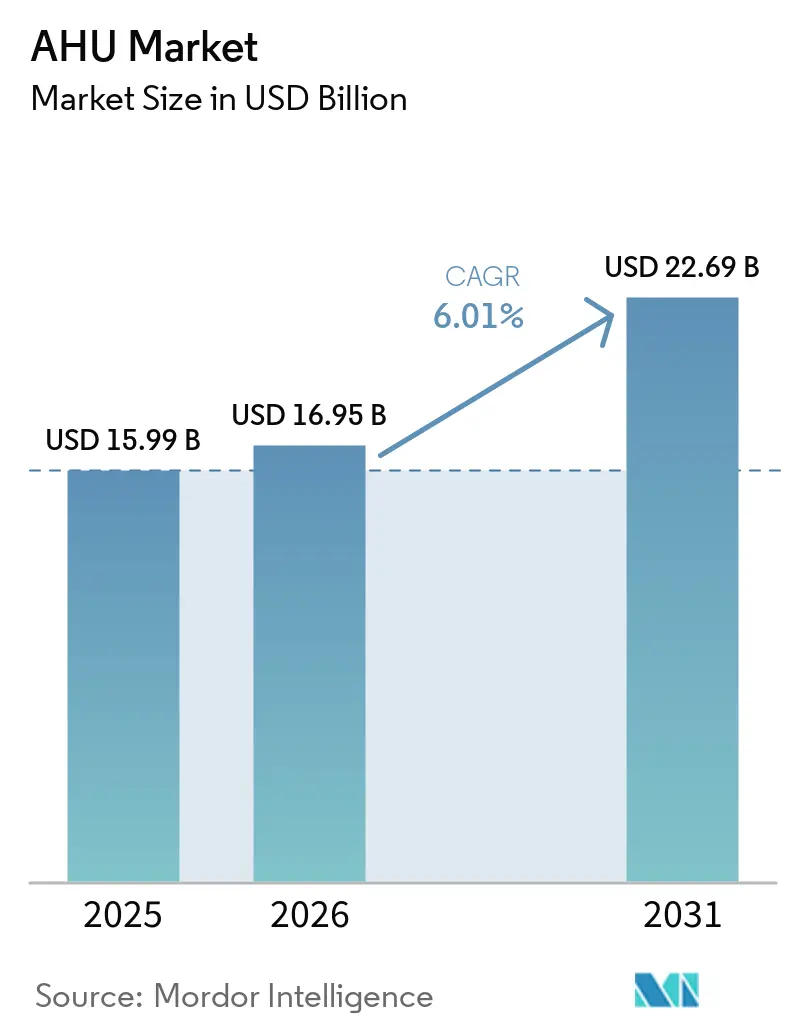
| Market Size (2026) | USD 16.95 Billion |
| Market Size (2031) | USD 22.69 Billion |
| Growth Rate (2026 - 2031) | 6.01 % |
| Fastest Growing Market | Middle East and Africa |
| Largest Market | Asia-Pacific |
| Market Concentration | Medium |
Major Players
*Disclaimer: Major Players sorted in no particular order Image © Mordor Intelligence. Reuse requires attribution under CC BY 4.0. |
|
AHU Market Analysis by Mordor Intelligence
The air handling units market size in 2026 is estimated at USD 16.95 billion, growing from 2025 value of USD 15.99 billion with 2031 projections showing USD 22.69 billion, growing at 6.01% CAGR over 2026-2031. This expansion follows rising energy-efficiency mandates, the shift to low-GWP refrigerants and stronger demand from data-center and pharmaceutical clean-room operators. The 2024 EU Ecodesign Regulation is already steering equipment designs toward lower specific fan power and ≥73% heat-recovery effectiveness. Asia-Pacific leads today’s air handling units market with 32% revenue share, supported by China’s 185 million-unit air-conditioner output and robust export growth. Data-center build-outs in North America and Europe are accelerating modular AHU demand, while material cost inflation and skilled-labor shortages temper near-term project execution.
Key Report Takeaways
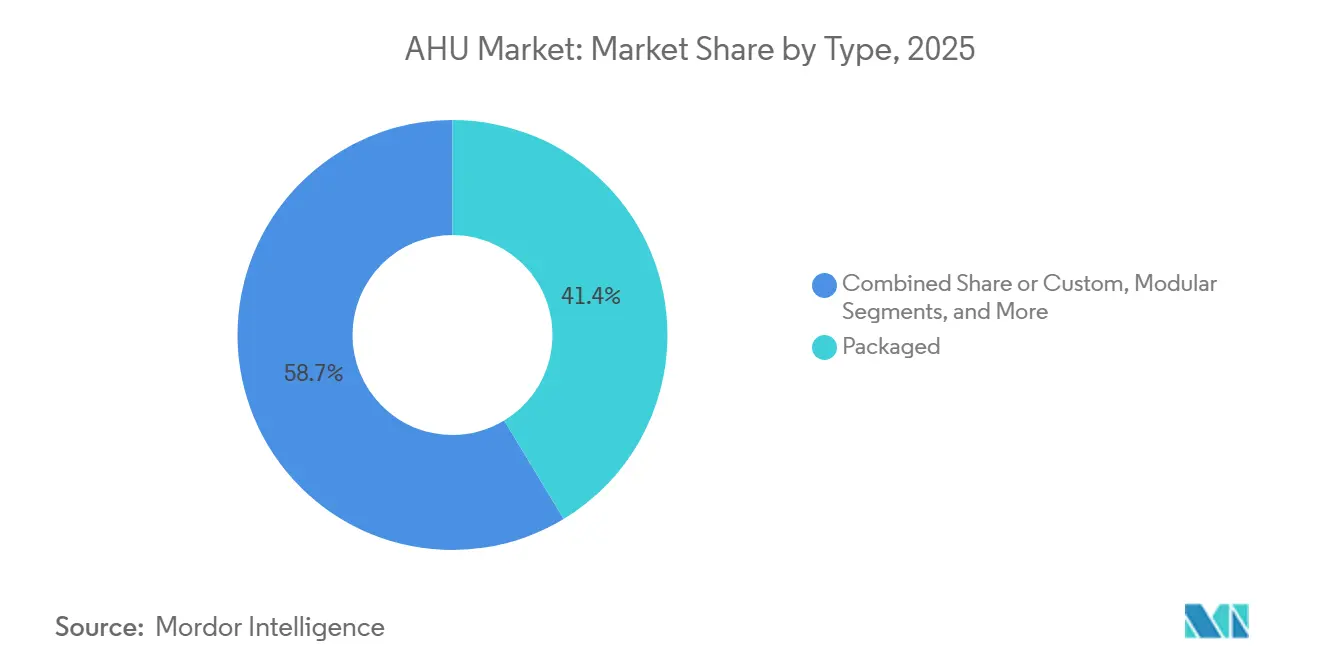
- By type, packaged units held 41.35% of the air handling units market share in 2025, whereas modular systems post the quickest 8.52% CAGR to 2031.
- By capacity, 5,001-15,000 m³/h systems accounted for 47.40% of the air handling units market size in 2025; units above 15,000 m³/h expand at 9.25% CAGR.
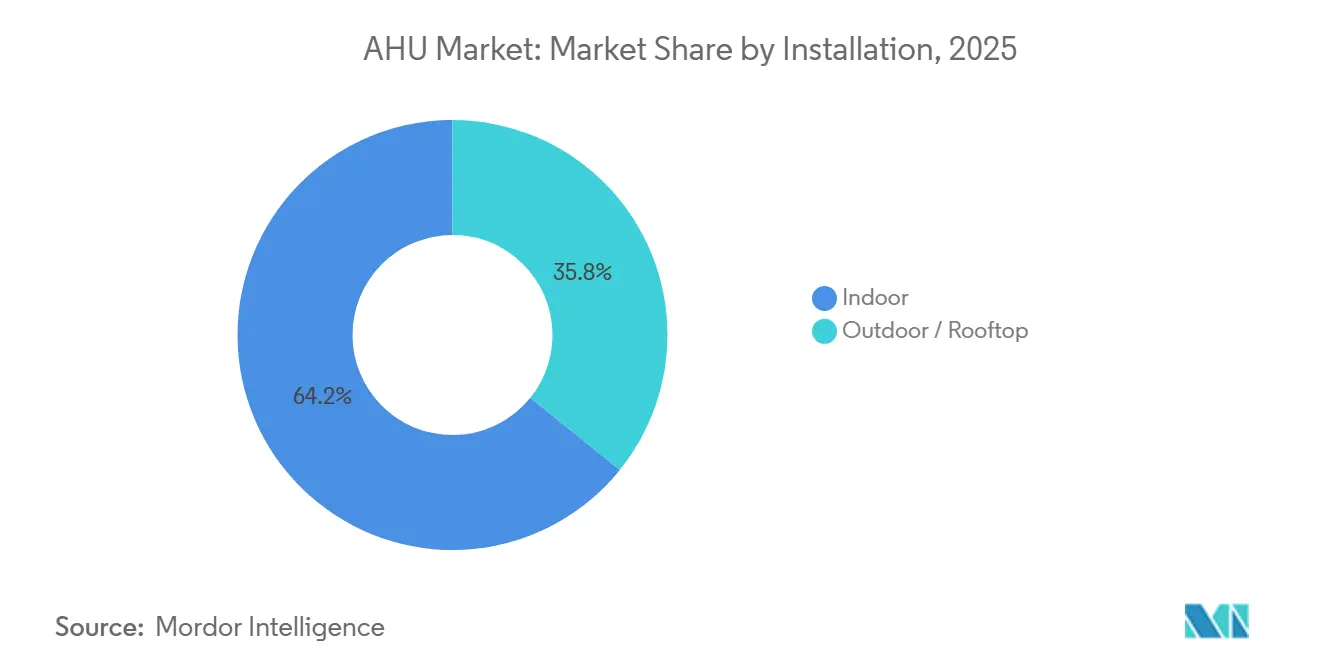
- By installation, indoor units retained 64.20% share in 2025 while outdoor/rooftop installations advance at an 7.95% CAGR.
- By component, fans and blowers dominated with 29.60% 2025 revenue, yet energy-recovery wheels rise at a 9.60% CAGR.
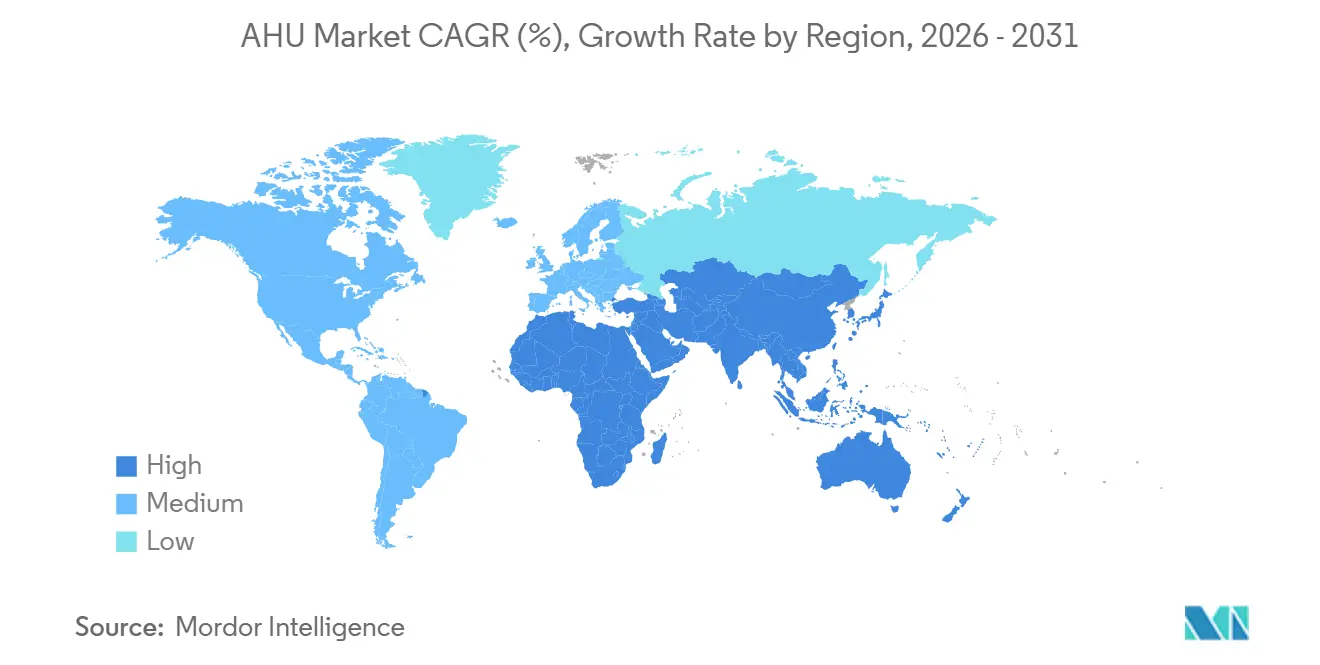
- By region, Asia-Pacific commanded 31.55% revenue in 2025; the Middle East is forecast to post a 9.02% CAGR through 2031.
Note: Market size and forecast figures in this report are generated using Mordor Intelligence’s proprietary estimation framework, updated with the latest available data and insights as of 2026.
Market Trends and Insights
Drivers Impact Analysis of AHU Market*
| DRIVER | (~) % IMPACT ON CAGR FORECAST | GEOGRAPHIC RELEVANCE | IMPACT TIMELINE |
|---|---|---|---|
| Healthcare & pharma clean-room filtration uptick in Asia | +1.2% | Asia-Pacific core, spill-over to MEA | Medium term (2-4 years) |
| EU Ecodesign 2023/813 mandating lower SFP & higher heat-recovery | +0.8% | Europe with adoption in North America | Long term (≥ 4 years) |
| Hyperscale data-centre build-outs requiring modular indirect adiabatic AHUs | +1.5% | North America & EU, expanding to APAC | Short term (≤ 2 years) |
| Retrofit demand for energy-recovery ventilation in Japan & South Korea | +0.6% | APAC core, demonstration effect globally | Medium term (2-4 years) |
| GCC district-cooling projects spurring custom high-ambient rooftop AHUs | +0.7% | Middle East core, hot-climate transfer | Medium term (2-4 years) |
| Electrification of industrial heat loads driving heat-pump AHUs > 15,000 m³/h | +0.9% | Europe core, North America accelerating | Long term (≥ 4 years) |
| Source: Mordor Intelligence | |||
Healthcare and Pharma Clean-room Filtration Uptick in Asia
Asia’s pharmaceutical build-out is boosting demand for AHUs that maintain ISO 14644-1 Class 5-to-8 spaces while balancing energy use. Manufacturers tailor units to divergent FDA and EU GMP Annex 1 velocity criteria to serve cross-border production requirements. China and India now specify HEPA-filtered air systems for biotech and semiconductor fabs, integrating real-time particle monitoring with building controls for compliance and efficiency.[1]
EU Ecodesign 2023/813 Mandating Lower SFP and Higher Heat-Recovery
Regulation 2024/1781 requires AHUs to curb fan power and exceed 73% heat-recovery effectiveness, pushing energy wheels from option to baseline. Industrial fans from 125 W to 500 kW must also meet tighter efficiency rules, a change forecast to save 31 TWh by 2030. Lifecycle digital passports extend compliance beyond first sale and create after-sales differentiation.
Hyperscale Data-Centre Build-outs Requiring Modular Indirect Adiabatic AHUs
AI compute growth lifts orders for modular adiabatic units that combine air and emerging liquid-cooling loops. AAON secured USD 174.5 million in data-center thermal-management contracts for 2025 deliveries. Investments such as Daikin’s USD 121 million Mexico plant improve North American supply of purpose-built modules
Retrofit Demand for Energy-Recovery Ventilation in Japan and South Korea
Building-code revisions in Japan and Korea elevate retrofit activity. Seoul’s underground shopping-mall project cut CO₂ 33% and TVOCs 74% with energy-recovery ventilation. Payback spans 6-36 months, supporting rapid adoption of wheels and plate exchangers delivering 40-80% effectiveness.
Restraints Impact Analysis of AHU Market*
| RESTRAINTS | (~) % IMPACT ON CAGR FORECAST | GEOGRAPHIC RELEVANCE | IMPACT TIMELINE |
|---|---|---|---|
| Volatile aluminium & copper prices inflating coil/fan costs | -0.9% | Global, acute in North America & Europe | Short term (≤ 2 years) |
| Skilled-labour shortages delaying on-site assembly of large custom AHUs | -0.7% | North America core, emerging Europe | Medium term (2-4 years) |
| Decentralised DOAS adoption as substitute in small commercial spaces | -0.5% | North America & Europe | Long term (≥ 4 years) |
| Lengthy EU approvals for low-GWP refrigerant equipment | -0.4% | Europe core, global spill-over | Medium term (2-4 years) |
| Source: Mordor Intelligence | |||
Volatile Aluminium and Copper Prices Inflating Coil/Fan Costs
Tariffs drove 25% spikes in aluminum and steel costs, compressing AHU margins and deferring projects in 2025. Copper volatility adds risk to heat-exchanger budgets that can represent 30% of unit material value. Manufacturers hedge purchases, redesign for reduced material intensity and renegotiate supply contracts, but engineering cycles lengthen.[2]
Skilled-Labour Shortages Delaying On-site Assembly of Large Custom AHUs
The HVAC sector faces 42,500 unfilled technician roles and 500,000 construction-trade vacancies, slowing installation of multi-section rooftop units. A2L refrigerant training adds complexity, prompting firms to expand apprenticeships while integrating factory-pre-assembled modules to curb field labor.
*Our forecasts treat driver/restraint impacts as directional, not additive. The impact forecasts reflect baseline growth, mix effects, and variable interactions.
AHU Market Segment Analysis
By Type:
Modular Systems Drive InnovationPackaged units held 41.35% 2025 revenue as standard offices favored predictable selection. Modular systems, however, show 8.52% CAGR as data-center developers demand capacity blocks that install quickly and expand without downtime. Custom configurations thrive in pharmaceuticals and electronics manufacturing where bespoke filtration and humidity targets preclude catalog solutions. The air handling units market sees suppliers shifting to configurable frames that shorten lead times while preserving customization. Modular construction also limits skilled-labor exposure by transferring more assembly to the factory, a key advantage in tight labor markets.
Growth momentum stems from hyperscale data processing, where indirect adiabatic modules and liquid-cooling ready coils dominate. Flexible footprints permit phasing that aligns capital spending with rack deployment. As a result, the air handling units market integrates skid-mounted fans, coils and controls into plug-and-play packages validated in-house before shipment.

By Capacity:
Large Systems Capture Industrial GrowthThe 5,001-15,000 m³/h tier accounts for 47.40% 2025 revenues, serving hospitals, higher-education and mixed-use developments. Yet units exceeding 15,000 m³/h expand at 9.25% CAGR driven by electrified process heat and district networks. The air handling units market size for >15,000 m³/h installations is supported by European industrial heat-pump projects totaling 23 GW potential, worth EUR 4.6-11.5 billion. MAN’s 20-33 MW CO₂ heat-pump illustrates momentum toward mega-scale AHUs integrated with thermal loops.
Smaller capacity units (<5,000 m³/h) stay relevant in premium residential towers where central treatment improves indoor air quality. Variable-speed EC fans and compact heat-recovery wheels help meet tight acoustical and spatial constraints, though market growth lags larger systems.
By Installation Type:
Outdoor Systems Gain MomentumIndoor mechanical-room placement dominates with 64.20% 2025 share, but rooftops grow 7.95% CAGR as developers seek rentable floor area. High-ambient designs for the GCC employ UV-resistant panels and 3 000-Pa static fans to cope with desert dust and long duct runs. Weatherized enclosures and service corridors allow maintenance without disrupting occupants. This shift reduces building-core complexity and aligns with fast-track construction schedules.
Outdoor preference also supports retrofit projects where interior space is limited. Pre-assembled penthouse units crane-lifted to the roof minimize business interruption and compress project timelines, enhancing the air handling units market appeal for commercial renovations.
By Technology:
Heat Recovery Drives EfficiencyHeat-pipe wraps lower reheat loads by 32% against conventional coils heatpipe.com. Run-around coils achieve up to 80% recovery when air streams are segregated, as documented in TROX tests trox.de. Plate exchangers offer no-moving-parts reliability for public facilities with limited maintenance budgets. Desiccant wheels paired with heat pumps secure supply-air dewpoints below -15 °C and deliver paybacks under three years in food-processing plants.
Thermodynamic heat-pump AHUs exhibit the quickest adoption, especially in Europe’s electrification programs where units provide simultaneous cooling and 140 °F process water. Vendors integrate variable-speed compressors and microchannel condensers to elevate seasonal COPs beyond 4.0.
Geography Analysis
APAC AHU Market
Asia-Pacific leads the air handling units market with 31.55% 2025 revenue. China’s 185 million-unit air-conditioner production base anchors the regional supply chain, while India’s HVAC spending trajectory toward USD 30 billion by 2030 at 15.8% CAGR boosts domestic AHU demand. Japan and South Korea advance retrofit activity through stringent IAQ revisions and successful underground-facility demonstrations that cut radon 98%. Local players collaborate with global OEMs to supply modular systems that satisfy diverse project timelines.
Europe AHU Market
Europe’s mature regulatory environment accelerates technology turnover. The Ecodesign framework pushes heat-recovery effectiveness and digital product passports, enlarging the air handling units market share of high-efficiency models. Industrial heat-pump deployment from Scandinavia to Germany drives >15,000 m³/h unit demand. Suppliers navigate extended conformity assessments for A2L refrigerants, but eventual approvals unlock a replacement cycle across aging installations.
Middle East and North America AHU Market
The Middle East records the fastest 9.02% CAGR thanks to mega-projects in Saudi Arabia, Qatar and the UAE. District-cooling networks specify desert-ready rooftop AHUs that thrive at 50 °C. Government visions prioritize sustainability, rewarding equipment that reduces peak electricity loads. Meanwhile North America faces raw-material surcharges and technician shortages, yet hyperscale data centers are ordering modular thermal-management systems in volumes unprecedented for the region. The air handling units market size linked to data-center build-outs is projected to expand at double-digit rates through 2031.
Regulatory Landscape
Energy-performance and indoor air quality rules are tightening AHU design and control requirements across major regions. In Europe, the 2024 EU Energy Performance of Buildings Directive (EPBD) recast (Directive (EU) 2024/1275) raises expectations for building automation and indoor air quality monitoring in non-residential buildings toward 2030, reinforcing demand for AHUs that can integrate sensors, reporting, and BMS connectivity. At the same time, the EU Ecodesign framework for non-residential ventilation units continues to steer product engineering toward lower specific fan power and higher heat-recovery effectiveness, with the report already reflecting the 2024 Ecodesign push toward >=73% heat-recovery effectiveness. Industry bodies such as Eurovent have also issued 2025 guidance (Rec 6/20) on AHU controls to support EPBD-aligned compliance.
Outside Europe, national codes and refrigerant transition rules continue to affect specifications and project timing. The UK Part L framework sets limits around fan power and heat-recovery performance for larger ventilation systems, keeping selection pressure on high-efficiency fans and energy recovery. In the United States, the EPA Technology Transitions rulemaking for HFCs includes provisions affecting high-GWP HVAC equipment timelines, including VRF-related compliance dates around 2026-2027, which supports broader adoption of lower-GWP solutions and prompts OEMs to accelerate compliant product lines and documentation readiness.
Value Chain Analysis
The AHU value chain starts with upstream metals and component suppliers (coils, fans/blowers, filters, heat-recovery devices, dampers, controls), moves into OEM engineering and modular fabrication, and then passes through mechanical contractors, EPCs, and distributors to cover installation, commissioning, and lifecycle service. The report's cost and labor constraints, including aluminum/copper volatility and technician shortages, are reinforcing factory-built modularization, pre-tested sections, and simplified field assembly, especially for larger custom and rooftop systems.
Downstream value capture is shifting toward controls, compliance documentation, and service. EPBD-related requirements and Eurovent's 2025 recommendations on AHU controls reinforce BMS integration, monitoring, and remote diagnostics as differentiators in commercial buildings and mission-critical sites such as data centers. Product strategies also reflect component and platform choices that reduce regulatory risk, including integrated heat-pump AHUs and natural/low-GWP refrigerant architectures (for example, Systemair's 2026 R290-integrated heat-pump AHU launch), which influences supplier qualification, safety design, and aftersales training across the broader supply chain.
Competitive Landscape
The air handling units industry remains moderately fragmented. Global leaders such as Daikin, Carrier, Trane Technologies and Johnson Controls combine broad portfolios with geographic reach. Acquisition activity is high: Rheem’s parent bought Fujitsu’s HVAC arm for USD 1.6 billion, signaling consolidation toward integrated solutions. CSW Industrials acquired Aspen Manufacturing for USD 313.5 million to strengthen coil and AHU capabilities.
Technology competition centers on heat-pump integration, modular scalability and digital diagnostics. Daikin’s Trailblazer® heat-pump chiller and AAON’s low-ambient Alpha Class heat pumps illustrate differentiation through extreme-temperature performance. Partnerships with controls specialists enable predictive maintenance, minimizing downtime for mission-critical sites.
Niche manufacturers thrive by focusing on clean-room, high-ambient or deep-dehumidification niches. Barriers include certification costs for A2L refrigerants and the engineering heft needed to meet EU digital-passport requirements. Nonetheless, specialized expertise commands premium margins in pharma and semiconductor segments, influencing overall air handling units market dynamics.
AHU Industry Leaders
-
Daikin Industries Ltd
-
Carrier Corporation
-
TRANE Inc. (Trane Technologies PLC)
-
Johnson Controls International PLC
-
Systemair AB
- *Disclaimer: Major Players sorted in no particular order

AHU Market Companies Covered in this Report
- Daikin Industries Ltd.
- Carrier Global Corp.
- Trane Technologies plc
- Lennox International Inc.
- Johnson Controls International plc
- Systemair AB
- TROX GmbH
- Swegon Group AB
- Hitachi Ltd.
- Blue Star Ltd.
- FlaktGroup
- Greenheck Fan Corp.
- Nortek Air Solutions
- GEA Group AG
- Mitsubishi Electric Hydronics (Climaveneta)
- Dantherm A/S
- VTS Group
- Munters AB
- Howden Group
- Modine Manufacturing Co.
- CIAT Group (Carrier)
- TICA Industries
- Trosten Industries Co. LLC
- Johnson Controls-Hitachi Air Conditioning
Market Opportunities and Future Outlook
Compliance-driven upgrades create room for high-efficiency ventilation packages that combine heat recovery, smart controls, and verifiable performance. Europe is the clearest focal point because of the EPBD recast (Directive (EU) 2024/1275) and the Ecodesign push toward lower fan power and higher heat recovery, which increases demand for AHUs with integrated sensors, advanced control sequences, and BMS-ready connectivity aligned with Eurovent's 2025 AHU controls guidance. That also extends opportunity into service revenue tied to commissioning, monitoring, and ongoing optimization, covering both new builds and retrofits where meeting fan-power and heat-recovery thresholds requires equipment replacement rather than minor tuning.
Near-term product and project requirements are also being shaped by mission-critical cooling needs and the refrigerant transition. Data-center build-outs are translating into demand for modular, quickly deployable air-side systems and higher-density thermal management. In February 2026, Johnson Controls flagged this shift through the YORK YDAM chiller positioned for multistory data centers and AI factories, reinforcing OEM investment in data-center-specific architectures and control strategies. In parallel, OEM activity around lower-GWP and natural refrigerants is widening the specification set in regulated markets; Systemair's June 2026 Geniox HP DFN integrated heat-pump AHU using R290 shows how suppliers are aligning packaged air treatment with F-gas compliance and electrification trends, supporting opportunities in commercial, industrial, and public-sector IAQ projects that treat both energy and refrigerant footprints as design constraints.
Recent Industry Developments in AHU Market
- July 2026: Launched Daikin NEXIO Max inverter-driven rooftop package heat pump for light commercial applications using R-32 refrigerant. The launch expands Daikin's AHU modular offerings and R-32 refrigerant footprint for commercial segments. It demonstrates a broader push toward energy efficient, low-GWP cooling solutions in packaged AHUs.
- July 2026: Daikin Industries Ltd commenced a joint proof of concept with NTT DATA to develop AI-driven cooling optimization for data centers. The collaboration gives AI-driven AHU optimization for data-center environments. It accelerates digital diagnostics and proactive energy management in mission-critical AHU deployments.
- June 2026: Systemair introduced Geniox HP DFN air handling unit featuring integrated heat pump using natural R290 refrigerant. The capacity addition strengthens Systemair's AHU with integrated heat pump and natural refrigerant. It demonstrates shift to low-GWP refrigerants and integrated HP within AHU architectures.
AHU Market Report Scope and Research Methodology
Market Definition and Coverage
The air handling units market covers factory-built units that condition and circulate air within HVAC systems by moving, filtering, heating, cooling, humidifying, or dehumidifying air for buildings and industrial spaces.
Scope exclusions: It excludes standalone room air conditioners, chillers, heat pumps, and simple exhaust fans that do not function as an AHU assembly.
Segments Covered in This Report
-
By Type
- Custom
- Packaged
- Modular
- DX Integrated
- Heat-Recovery Units
-
By Capacity
- Less than 5,000
- 5,001 - 15,000
- Greater than 15,000
-
By Installation Type
- Indoor
- Outdoor / Rooftop
-
By Technology
- Heat-Pipe
- Run-Around Coil
- Plate Heat Exchanger
- Desiccant-Based
- Thermodynamic Heat Pump AHU
-
By Application
- Comfort Ventilation
- Process Ventilation and Dehumidification
-
By End-user
- Residential
-
Commercial
- Offices
- Hospitality and Leisure
- Healthcare Facilities
- Educational Institutions
- Retail and Shopping Malls
-
Industrial
- Food and Beverage
- Pharmaceuticals and Biotech
- Oil and Gas / Petrochemicals
- Automotive and Machinery
- Other Industrial
-
By Geography
-
North America
- United States
- Canada
- Mexico
-
Europe
- United Kingdom
- Germany
- France
- Italy
- Rest of Europe
-
Asia-Pacific
- China
- Japan
- India
- South Korea
- Rest of Asia-Pacific
-
Middle East
- Israel
- Saudi Arabia
- United Arab Emirates
- Turkey
- Rest of Middle East
-
Africa
- South Africa
- Egypt
- Rest of Africa
-
South America
- Brazil
- Argentina
- Rest of South America
-
North America
Data Sources, Market Sizing, and Validation
Desk Research
Desk research was used to anchor demand to measurable construction and building-operation indicators, and then translate that into AHU value by region. Public and official references were reviewed from sources such as the International Energy Agency for buildings energy trends, the US Energy Information Administration for power and heating context, the US Census Bureau for construction spending signals, and Eurostat for building and macro series that help explain equipment demand patterns.
To interpret specification shifts, we also checked guidance and public-facing material from bodies such as ASHRAE and other national energy-efficiency regulators, because fan power and ventilation rules affect what gets purchased and at what price. Company annual reports, investor presentations, and reputable press were used to understand product mix, regional exposure, and pricing commentary, and then a paid subscription for company financials and news was used to cross-check revenue splits and major project activity where disclosures were available. These examples are not exhaustive, and many other sources were also reviewed to collect, validate, and clarify data points during the study.
Primary Interviews and Surveys
Primary work centered on expert interviews and structured surveys with manufacturers, distributors, HVAC contractors, consultants, and facility teams that specify or procure AHUs. We used these conversations to confirm typical price bands, replacement cycles, the split between new-build and retrofit demand, and region-level differences in specifications (for example, heat recovery and filtration expectations), and then we re-contacted sources when desk signals and modeled outputs did not align.
Distribution of primary research fieldwork respondents
| Company type | Respondent position | Region |
|---|---|---|
| Top tier: 30% | CXOs: 13% | APAC: 44% |
| Mid tier: 54% | Functional/Unit leaders: 36% | EMEA: 36% |
| Smaller Players: 16% | Managers: 51% | Americas: 20% |
Market-Sizing & Forecasting
Sizing starts with a top-down build where construction activity and installed base needs are translated into AHU demand pools, and then scaled by adoption rates for centralized ventilation in commercial and industrial buildings. We mapped demand across major end-use building types and climates because the required airflow, filtration level, and heat recovery setup can change the unit value materially.
The model is informed by a short list of practical variables that can be traced and explained, such as nonresidential floor space additions, retrofit intensity in older building stock, the share of projects requiring higher-efficiency fans or heat recovery, typical unit capacity mix used in projects, and regional price progression tied to material and labor trends. Results are then corroborated with selective bottom-up approximations, including sampled average selling price multiplied by estimated unit volumes from channel checks, plus sanity checks against disclosed HVAC segment revenues where reporting allows, with gaps handled through conservative interpolation when a country-level split is not consistently published.
Forecasts were produced using scenario analysis supported by primary expert views, where macro drivers (construction outlook, energy-efficiency regulation tightening, and ventilation upgrade cycles) were stressed up and down, and then normalized into a single base case for the final numbers.
Data Validation & Update Cycle
Model outputs are checked against independent signals such as construction spending direction, policy changes impacting ventilation design, and stated order trends from public company commentary, which helps us spot numbers that are too high for a given region. Variances are reviewed in multiple analyst passes, and when a large mismatch appears, assumptions like capacity mix, pricing progression, or retrofit share are re-tested and respondents are contacted again for confirmation.
The report is refreshed annually, and interim updates are added when material events occur that can change demand or pricing quickly, such as major regulation revisions or abrupt construction slowdowns. Before delivery, a final analyst review is completed so clients receive the latest updated view rather than an older draft model run.
Mordor Intelligence's Global Air Handling Units Market Size Compared With Other Published Estimates
Published market values for air handling units often vary because analysts do not always count the same product scope, and the timing of price assumptions can shift the totals when input costs move quickly. Differences also show up when one estimate leans heavily on construction outlook only, while another gives more weight to retrofit and indoor air quality upgrade cycles.
In practice, the biggest gaps usually come from whether adjacent HVAC equipment is blended into the total, how replacement demand is estimated from building stock, and whether currency conversion uses a single-year average rate or a multi-year smoothing approach. Some sources also apply a faster price escalation across the forecast window without checking it against contractor bids and manufacturer commentary, which is why the USD 16.95 B (2026) value is kept tied to AHU-only revenue and rechecked through specification-led demand checks before sign-off by Mordor Intelligence.
Benchmark comparison
| Source | Market Size | Gaps in Research Methodology |
|---|---|---|
| Mordor Intelligence | USD 16.95 B (2026) | |
| Global Consultancy A | USD 18.60 B (2026) | This figure appears to widen scope by blending AHUs with nearby ventilation equipment in packaged configurations, and it assumes a higher share of premium heat-recovery and filtration options without consistent region-level validation. |
| Industry Association B | USD 14.80 B (2025) | This figure is anchored to member shipment and production visibility, which can undercount imported units and non-member sales, and it reflects one-year pricing that may not capture mix shifts in large commercial retrofit projects. |
The comparison mainly points to scope alignment and price and mix handling as the drivers of spread, rather than a single right or wrong number. By keeping inputs tied to observable construction and replacement signals, and then stress-testing them with interviews, we deliver a market value that buyers can trace back to clear assumptions and repeatable steps.
Key Questions Answered in the Report
What is the current value of the air handling units market?
The air handling units market stands at USD 16.95 billion in 2026.
How fast is the market expected to grow through 2031?
It is projected to post a 6.01% CAGR, reaching USD 22.69 billion by 2031.
Which region leads global demand?
Asia-Pacific leads with 31.55% 2025 revenue, driven by China’s large HVAC manufacturing base.
Why are modular AHUs gaining popularity?
Hyperscale data centers require scalable, pre-engineered cooling blocks that modular designs provide, resulting in an 8.52% segment CAGR.
What are the main challenges facing manufacturers?
Volatile raw-material prices, skilled-labor shortages and lengthy refrigerant approval processes are key restraints.
How are regulations shaping future AHU designs?
The EU Ecodesign Regulation mandates lower fan power and ≥73% heat-recovery, pushing adoption of energy-recovery wheels and digital lifecycle passports.