
Identity As A Service Market Size and Share
Market Overview
| Study Period | 2020 - 2031 |
|---|---|
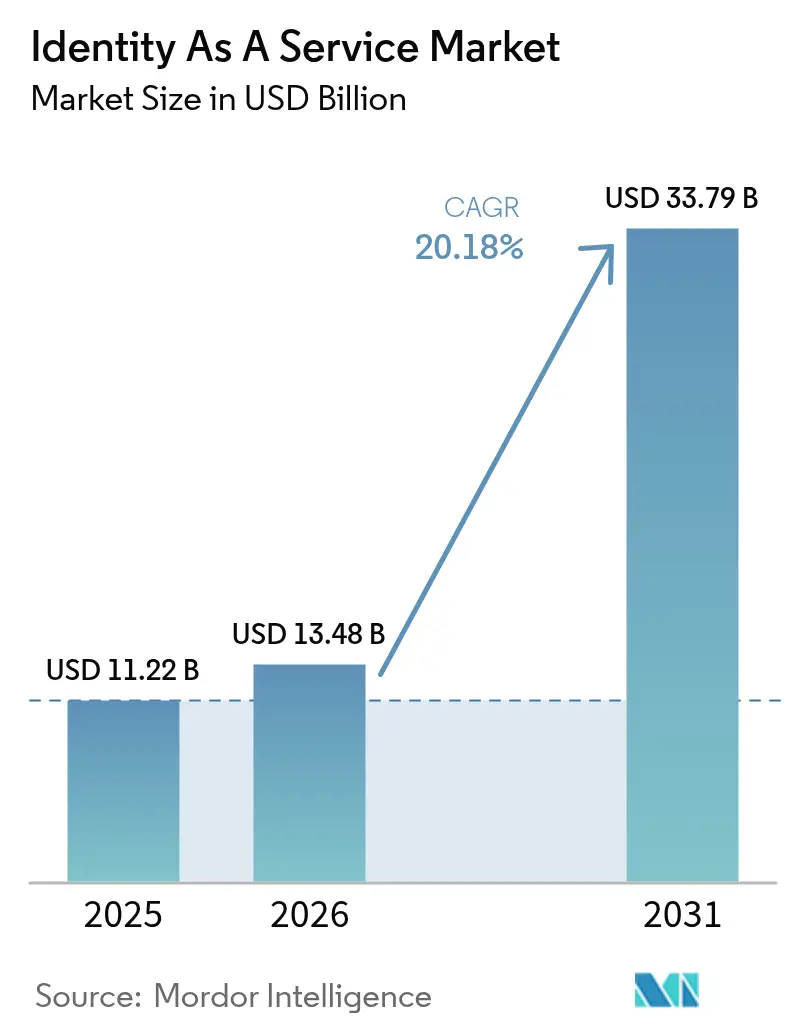
| Market Size (2026) | USD 13.48 Billion |
| Market Size (2031) | USD 33.79 Billion |
| Growth Rate (2026 - 2031) | 20.18 % |
| Fastest Growing Market | Asia Pacific |
| Largest Market | North America |
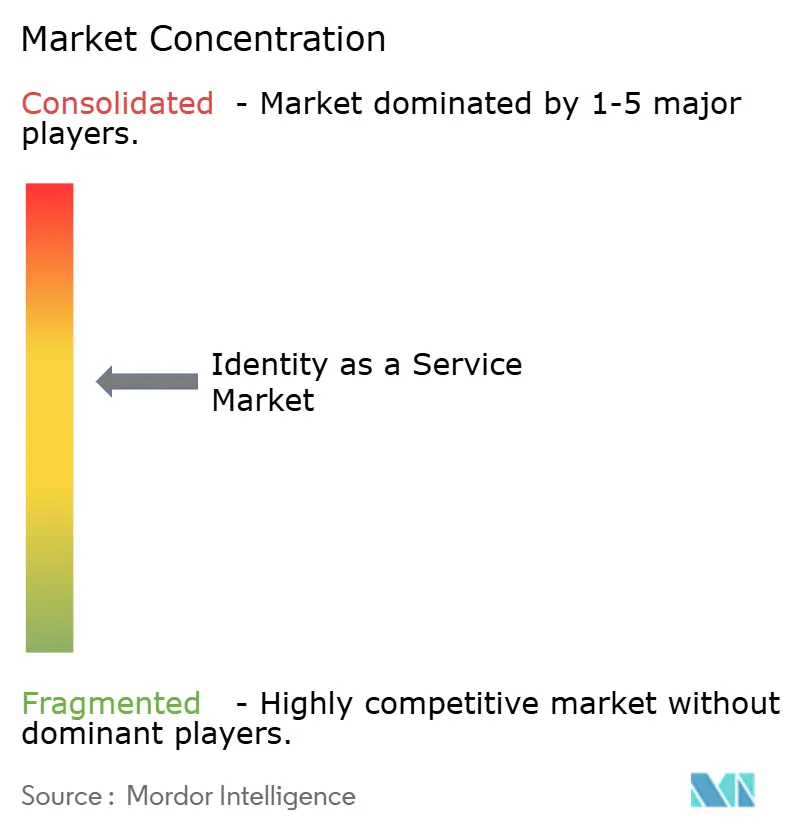
| Market Concentration | Medium |
Major Players *Disclaimer: Major Players sorted in no particular order Image © Mordor Intelligence. Reuse requires attribution under CC BY 4.0. | |
Identity As A Service Market Analysis by Mordor Intelligence
The Identity-as-a-Service market size is expected to grow from USD 11.22 billion in 2025 to USD 13.48 billion in 2026 and is forecast to reach USD 33.79 billion by 2031 at 20.18% CAGR over 2026-2031. Heightened board-level focus on zero-trust architecture, rapid cloud migration, and the accelerating volume of machine identities underpin demand for subscription-based identity security platforms. Vendors that bundle passwordless authentication, machine-identity governance, and real-time risk scoring into a single control plane are capturing wallet share as enterprises consolidate point solutions. Government-backed national digital identity programs in Asia-Pacific and prescriptive zero-trust mandates in North America are further amplifying platform adoption, while horizontal acquisitions by hyperscalers and security-first software firms are redefining competitive boundaries.
Key Report Takeaways
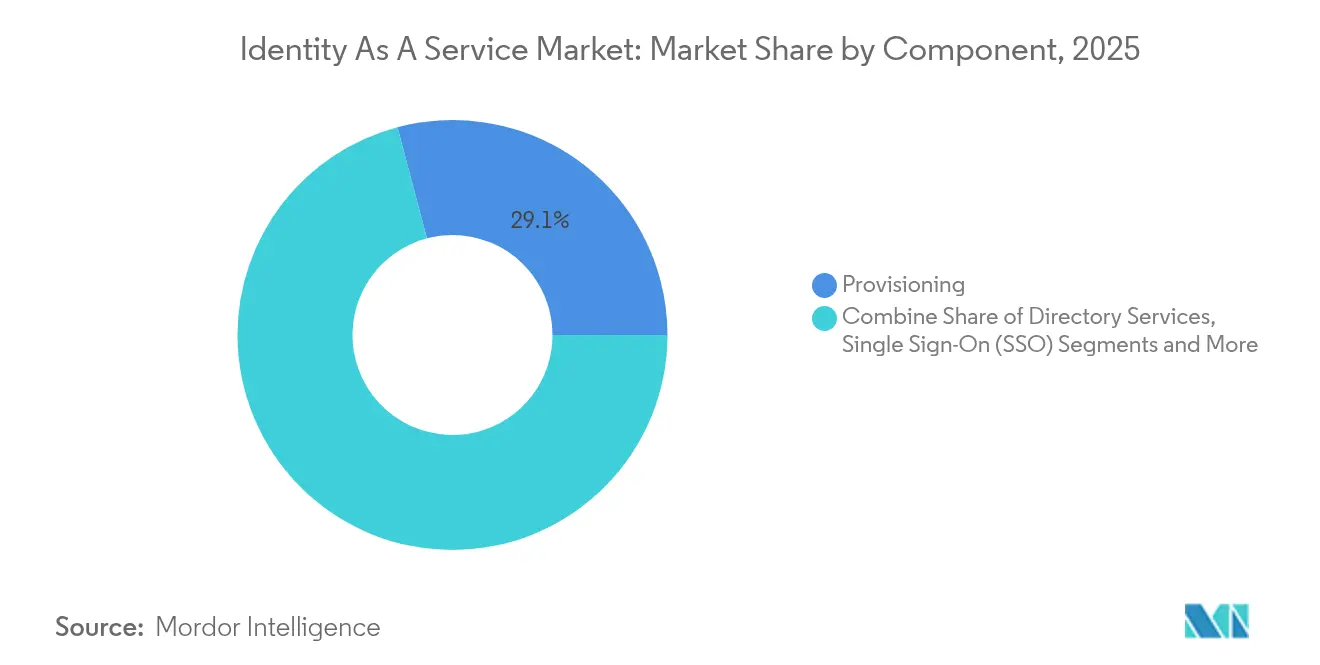
- By component, Provisioning held 29.12% of Identity-as-a-Service market share in 2025, whereas Multi-factor/Advanced Authentication is projected to advance at a 21.96% CAGR to 2031.
- By authentication type, single-factor methods retained 45.62% revenue share Identity-as-a-Service market size in 2025; Passwordless mechanisms, is set to outgrow at a 21.34% CAGR to 2031.
- By deployment mode, public cloud captured 62.55% share of the Identity-as-a-Service market size in 2025; hybrid cloud is forecast to expand at 21.78% CAGR through 2031.
- By user type, workforce identity comprised 56.42% share of the Identity-as-a-Service market size in 2025, while customer identity solutions are growing at 20.64% CAGR through 2031.
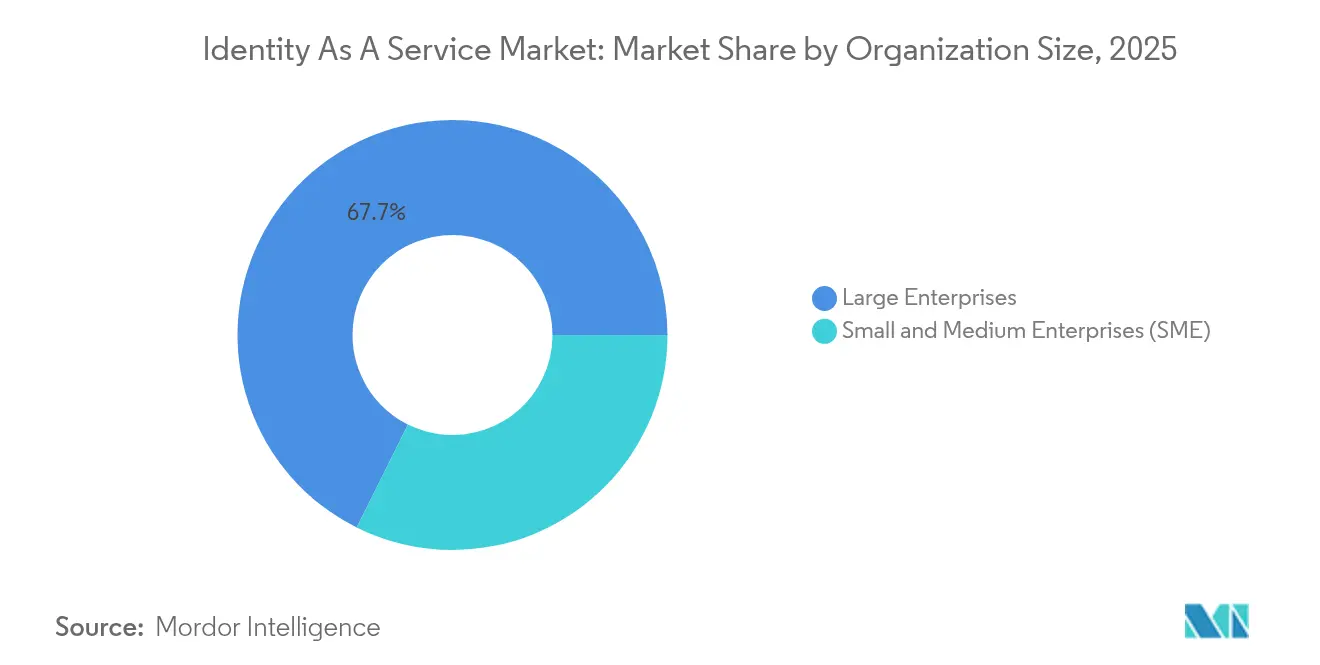
- By organization size, large enterprises accounted for 67.65% of the Identity-as-a-Service market size in 2025, while mall and mid-sized enterprises is poised for a 20.05% CAGR through 2031..
- By end-user vertical, the public sector accounted for 25.74% of the Identity-as-a-Service market size in 2025, while BFSI leads growth at a 20.26% CAGR to 2031.
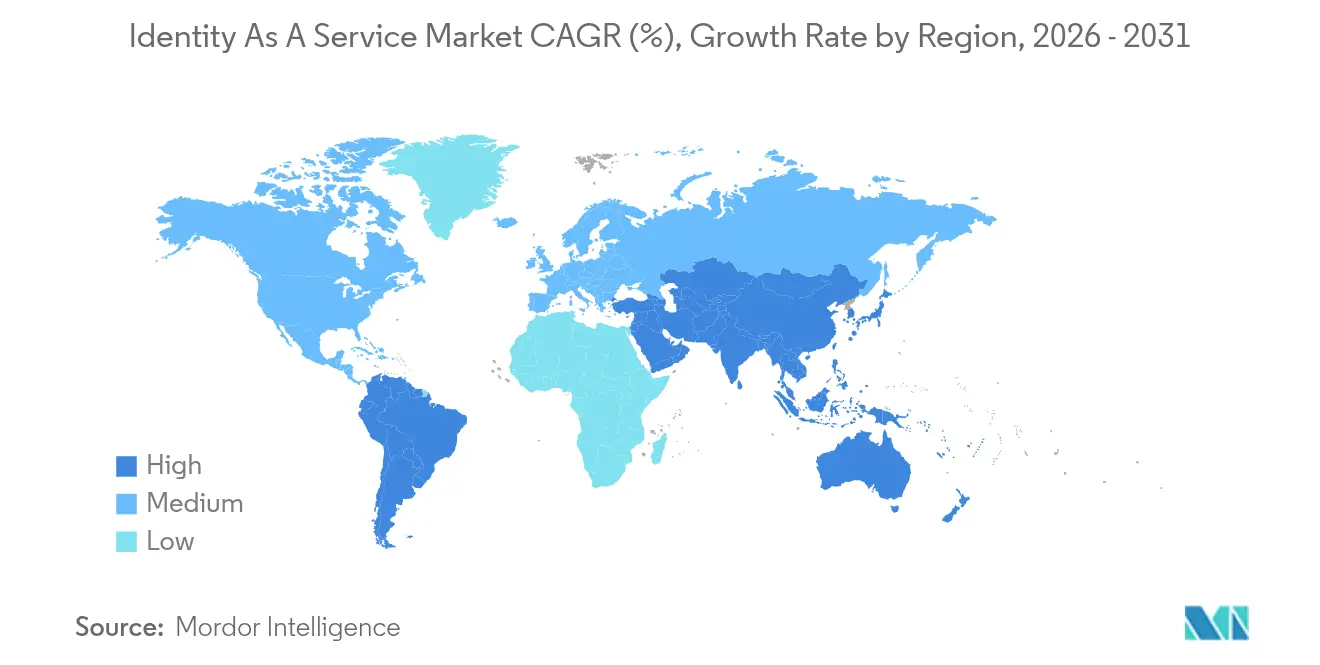
- By geography, North America dominated with 38.35% revenue share of the Identity-as-a-Service market in 2025; Asia-Pacific is poised for a 23.02% CAGR through 2031.
Note: Market size and forecast figures in this report are generated using Mordor Intelligence’s proprietary estimation framework, updated with the latest available data and insights as of 2026.
Market Trends and Insights
Drivers Impact Analysis of Identity As A Service Market*
| Driver | (~) % Impact on CAGR Forecast | Geographic Relevance | Impact Timeline |
|---|---|---|---|
| Cloud-native Zero-Trust Adoption in U.S.-Centric Highly Regulated Sectors | +4.2% | North America, EU financial services | Medium term (2-4 years) |
| Proliferation of API-based Micro-Services Accelerating CI/CD IDaaS Demand in Europe | +3.8% | Europe, North America tech hubs | Short term (≤ 2 years) |
| Asia's "Digital Public Goods" (eKYC, Aadhaar, Singpass) Triggering Country-wide Workforce IDaaS Roll-outs | +5.1% | Asia-Pacific, selective MEA adoption | Long term (≥ 4 years) |
| Passwordless FIDO2 Pilots Converting to Enterprise-wide Licences in Financial Services | +3.9% | Global, concentrated in BFSI | Medium term (2-4 years) |
| Vendor-bundled IAM Analytics Using Generative-AI for Real-time Risk Scoring | +2.7% | Global, early adoption in North America | Short term (≤ 2 years) |
| MandA-Driven Horizontal Suite-Building by Hyperscalers (Azure, AWS) Boosting Integrated IDaaS Uptake | +4.3% | Global, strongest in cloud-mature markets | Medium term (2-4 years) |
| Source: Mordor Intelligence | |||
Cloud-native zero-trust adoption in regulated U.S. sectors
Executive Order 14028 requires U.S. federal agencies to implement zero-trust architectures, making identity verification the first line of defense. NIST’s draft practice guide codifies an interoperable blueprint that cuts deployment risk for private and public stakeholders.[1]National Institute of Standards and Technology, “Implementing a Zero Trust Architecture,” csrc.nist.govHospitals, insurers, and capital-markets firms are leveraging the guidance to shift from perimeter controls to continuous verification, turning Identity-as-a-Service market subscriptions into essential operating expenditure.
Proliferation of API-based micro-services requiring CI/CD identity controls
European adoption of micro-services has outpaced legacy IAM capabilities. The EU Digital Identity Regulation obliges Member States to issue cross-border digital wallets by 2026, creating uniform APIs for authentication. [2]European Commission, “European Digital Identity Regulation,” digital-strategy.ec.europa.euDevOps teams now require platforms that auto-provision tokens during each CI/CD run, positioning Identity-as-a-Service market providers that specialize in machine-identity governance for outsized growth.
Asia-Pacific digital public-goods programs (eKYC, Aadhaar, Singpass)
Regional governments are lowering verification costs by offering nationwide identity rails. Indonesia’s Digital Population Identity program and Singapore’s SingPass enable employers to bind workforce credentials to state-verified identities, widening the addressable Identity-as-a-Service market for multi-national corporations operating across ASEAN.
Enterprise-wide passwordless FIDO2 roll-outs in financial services
Banks moving from pilots to full production have documented 86% reductions in credential-stuffing incidents after deploying passkeys. Capital One has removed passwords from more than 1,000 internal applications, elevating passwordless authentication from innovation project to mainstream control.
Restraints Impact Analysis of Identity As A Service Market*
| Restraint | (~) % Impact on CAGR Forecast | Geographic Relevance | Impact Timeline |
|---|---|---|---|
| Legacy Mainframe Entanglement Slowing IDaaS Migration in Tier-1 Banks | -2.8% | Global, concentrated in established financial markets | Long term (≥ 4 years) |
| Fragmented Data-Residency Statutes in the Middle East Inflating Compliance Costs | -1.9% | Middle East, selective impact on global providers | Medium term (2-4 years) |
| High Latency Concerns Among IIoT Users for Cloud-hosted Authentication | -1.4% | Global industrial sectors, edge computing environments | Short term (≤ 2 years) |
| Vendor-lock-in Fears around Proprietary SSO Protocol Extensions | -1.6% | Global, strongest in multi-vendor enterprise environments | Medium term (2-4 years) |
| Source: Mordor Intelligence | |||
Legacy mainframe entanglement in Tier-1 banks
Tier-1 financial institutions face significant technical debt from mainframe systems that resist integration with modern IDaaS platforms, creating migration timelines that extend beyond typical enterprise deployment cycles. ING’s migration of 1.5 million COBOL lines illustrates the complexity of decoupling IAM logic trapped inside core banking systems softwaremining.com. Hybrid coexistence with mainframes prolongs testing cycles, tempering Identity-as-a-Service market acceleration among global banks.
Fragmented Middle-East data-residency statutes
Divergent localization mandates in the UAE and Saudi Arabia force providers to build redundant data zones, shrinking economies of scale and raising compliance cost per customer. The fragmented regulatory environment may slow market penetration until regional harmonization efforts mature or IDaaS providers develop specialized compliance capabilities.
*Our forecasts treat driver/restraint impacts as directional, not additive. The impact forecasts reflect baseline growth, mix effects, and variable interactions.
Identity As A Service Market Segment Analysis
By Component:
Provisioning Dominates Amid Authentication InnovationThe provisioning segment generated 29.12% of Identity-as-a-Service market revenue in 2025, underlining the universal need for automated joiner-mover-leaver workflows across hybrid cloud estates. Directory services and single sign-on remain table stakes, yet adoption now concentrates on suites that orchestrate lifecycle controls for both human and machine principals.
Multi-factor and passwordless authentication services are forecast to grow 21.96% annually as regulatory guidance rewards phishing-resistant mechanisms. Vendors such as CyberArk are integrating biometric passkey orchestration following the USD 1.66 billion Venafi acquisition, signaling that unified suites will outpace isolated toolsets investors.



By Authentication Type:
Passwordless Revolution AcceleratesSingle-factor methods retained 45.62% revenue share in 2025, largely due to legacy workloads that cannot yet support modern protocols. Passwordless mechanisms, however, are set to outgrow the Identity-as-a-Service market at a 21.34% CAGR as FIDO2 certification becomes table stakes for regulated industries. The Federal Reserve Bank of Boston attributes USD 35 billion in 2024 fraud losses to synthetic identities, a statistic that spurs enterprises to prioritize continuous biometric and behavioral authentication.
Multi-factor tools serve as transitional safeguards, but board-level risk committees now favor passkeys that eliminate shared secrets entirely. This pivot reinforces a structural shift from occasional to continuous identity assurance.
By Deployment Mode:
Hybrid Cloud Gains MomentumPublic cloud deployments commanded 62.55% of Identity-as-a-Service market size in 2025. Scalability and rapid time-to-value favor SaaS delivery, yet data sovereignty and latency-sensitive workloads fuel the hybrid cloud sub-segment, which is projected to climb 21.78% annually. Microsoft’s federated identity credentials for Entra illustrate industry intent to harmonize on-premises policies with cloud guardrails.
Edge computing in industrial settings requires authentication decisions within milliseconds, prompting enterprises to anchor policy engines in cloud while caching risk scores at the edge. Providers that deliver policy consistency across deployment modes are set to gain share.
By User Type:
Consumer Identity AcceleratesWorkforce identity comprised 56.42% of 2025 revenue, but customer identity solutions are growing at 20.64% CAGR. The surge reflects digital-commerce priorities frictionless onboarding and consent management where one failed login translates directly into lost revenue. Okta’s Customer Identity Cloud shows how providers are modularizing consumer workflows while reusing the same policy stack that protects employees.
Consumer identity platforms must handle significantly higher transaction volumes and more diverse authentication methods compared to workforce solutions, requiring specialized infrastructure and user experience design. The convergence of workforce and consumer identity requirements creates opportunities for unified platforms that can serve both use cases while maintaining appropriate security and compliance controls.
By Organization Size:
SME Adoption QuickensLarge enterprises generated 67.65% of 2025 billings, anchored by complex hybrid estates and regulatory scrutiny. Small and mid-sized enterprises now expand 20.05% per year as subscription pricing removes the barrier of large-scale capital approvals. SailPoint’s USD 11.5 billion IPO valuation underscores the investment community’s conviction that midsized customers will migrate from rudimentary SSO to full lifecycle governance.
Turnkey, template-driven deployments resonate with resource-constrained IT teams, positioning cloud-native providers to capture lifetime value as SMEs scale operations. SME organizations increasingly require sophisticated identity management capabilities to support remote work, cloud application adoption, and regulatory compliance, creating sustained demand for simplified IDaaS solutions.
By End-User Vertical:
BFSI Leads Growth TrajectoryThe public sector represented 25.74% of 2025 consumption, propelled by sovereign digital-government initiatives. BFSI’s 20.26% CAGR outpaces every other industry as regulators direct financial institutions to adopt phishing-resistant credentials. 1Kosmos’ USD 194.5 million Blanket Purchase Agreement for the U.S. Login.gov program exemplifies how federal procurement influences private-sector buying criteria.
Healthcare, manufacturing, and energy customers follow, motivated by zero-trust mandates that harden industrial control systems and safeguard patient data. The vertical segmentation reflects industry-specific requirements for identity management, with regulated sectors driving premium solution adoption while commercial sectors focus on cost-effective scalability.
Geography Analysis
North America Identity As a Service Market
North America accounted for 38.35% of Identity-as-a-Service market revenue in 2025. Federal zero-trust edicts and early passwordless roll-outs among tier-one banks sustain spending momentum. Canada’s cloud-first program and Mexico’s cross-border trade platforms add incremental demand, all underpinned by mature hyperscaler infrastructure.
APAC Identity As a Service Market
Asia-Pacific is the fastest-growing region at 23.02% CAGR. National digital ID frameworks, coupled with accelerated public-cloud adoption in Indonesia, India, and Vietnam, multiply workforce and citizen-access use cases. Enterprises leverage government-issued credentials to bind employees and contractors, compressing onboarding time and reducing KYC costs.
Europe Identity As a Service Market
Europe exhibits steady expansion, catalyzed by the EU Digital Identity Regulation that obliges members to deploy interoperable wallets by 2026. Germany’s EUDI pilot and France’s health-data localization rules drive joint procurement models between ministries and enterprises. Providers able to guarantee regional data residency while integrating cross-border workflows will consolidate gains.

Regulatory Landscape
In North America, U.S. federal zero-trust direction continues to pull IDaaS requirements into formal guidance, with NIST Digital Identity Guidelines (SP 800-63, Revision 4, published July 2025) expanding identity proofing and authenticator guidance for modern threats such as forged media and injection attacks. These updates also reinforce procurement and compliance checks around phishing-resistant authentication and higher-assurance digital identity flows, affecting both workforce identity and CIAM deployments used by regulated sectors.
In Europe, the European Digital Identity Framework entered into application in 2024 and requires Member States to provide European Digital Identity Wallets by end-2026, bringing interoperability and assurance requirements into enterprise onboarding and authentication stacks. The European Commission further tightened technical direction with Implementing Regulation (EU) 2026/798 (April 2026), setting specifications for high-assurance remote onboarding to EUDI Wallets. Standards bodies added cross-border building blocks such as ISO/IEC 25831-1:2026 (May 2026) and the OpenID Foundation iGov Profile for OAuth 2.0 (Implementer Draft, June 2026) to standardize verified claims exchange and government assurance assertions.
Value Chain Analysis
The IDaaS value chain begins with identity data capture and assurance (proofing, fraud checks, and credential binding) and then extends into core platform capabilities, including directory services, SSO, lifecycle provisioning (joiner-mover-leaver), access governance, and authentication (MFA and passwordless). Upstream dependencies include standards and trust frameworks (for example, OAuth/OpenID-based profiles and government wallet specifications), cryptographic components and keys or certificates for machine identities, and cloud infrastructure for global availability, logging, and policy evaluation.
Downstream, delivery and adoption depend on integration, migration, and managed services that connect IDaaS to enterprise apps, APIs, and DevOps pipelines, particularly where legacy protocols and mainframe-linked identity logic slow modernization. Go-to-market channels include direct enterprise sales and cloud marketplaces, alongside hyperscaler-native identity offerings. Global system integrators and MSPs increasingly package IDaaS as an operational program, for example, SailPoint and HCLTech (September 2025) partnered to combine SailPoint Identity Security Cloud with HCLTech managed delivery for automated lifecycle controls and identity risk monitoring at enterprise scale. Key bottlenecks remain hybrid identity operational talent gaps, application incompatibility with modern authentication protocols, and the need to implement data-residency and audit controls consistently across regions.
Competitive Landscape
The market is moderately fragmented. Okta posted USD 2.61 billion in fiscal-2025 revenue and leverages a 19,450-customer flywheel to cross-sell risk-based access controls investor.okta.com. CyberArk surpassed USD 1 billion in 2024 revenue following its Venafi purchase, positioning the firm as the only top-tier vendor with symmetrical control of human and machine identities investors.[4]SEC EDGAR, “CyberArk–Venafi Acquisition Filing,”
Private-equity roll-ups alter competitive dynamics: Thoma Bravo combined Ping Identity and ForgeRock into a portfolio nearing USD 800 million ARR, demonstrating the strategic premium placed on scale and wallet-share economics. SailPoint’s IPO brings fresh capital for horizontal expansion into adjacent data-access governance, while Saviynt’s 35% ARR growth highlights the appeal of AI-driven least-privilege analytics saviynt.com.
Strategically, leading vendors now differentiate through: 1) machine-identity lifecycle management baked into core platforms; 2) platformized generative-AI risk scoring; and 3) open standards for passkey orchestration to avoid locking customers into proprietary protocols.
Identity As A Service Industry Leaders
Ping Identity Corporation
OneLogin Inc.
IDaptive LLC
Microsoft Corporation
Oracle Corporation
- *Disclaimer: Major Players sorted in no particular order
Identity As A Service Market Companies Covered in this Report
- Microsoft Corporation
- Okta Inc.
- Ping Identity Corporation
- IBM Corporation
- IDaptive LLC
- CyberArk Software Ltd.
- SailPoint Technologies
- ForgeRock Inc.
- One Identity LLC
- Oracle Corporation
- Amazon Web Services (AWS Cognito)
- Google LLC (Cloud Identity)
- Thales Group (Gemalto)
- SAP SE
- Cisco Systems Duo Security
- Auth0 (now Okta)
- OneLogin Inc.
- Saviynt
- Simeio Solutions
- Entrust Corporation
- Transmit Security

Market Opportunities and Future Outlook
A near-term whitespace involves identity signals beyond one-time passwords, driven by fraud pressure and declining trust in SMS codes for authentication. In July 2026, Aduna worked with major U.S. carriers (AT&T, T-Mobile, and Verizon) to introduce network-based authentication as an alternative to SMS codes, creating a new integration surface for IDaaS and CIAM providers. It allows operator-level signals (for example, SIM and device status) to feed risk-based access decisions without adding steps for end users.
A second opportunity centers on high-assurance, interoperable digital wallet onboarding and verified-claims exchange as governments tighten technical requirements and timelines. The EU requirement for Member States to provide European Digital Identity Wallets by end-2026, alongside the European Commission Implementing Regulation (EU) 2026/798 for high-assurance remote onboarding and emerging standards such as ISO/IEC 25831-1:2026 and the OpenID iGov profile, supports demand for IDaaS capabilities that map wallet-based credentials into enterprise access governance, CI/CD machine-identity controls, and cross-border customer onboarding while maintaining regional data residency and auditability.
Recent Industry Developments in Identity As A Service Market
- July 2026: Barracuda Networks acquired Evo Security to add identity and access management capabilities into the BarracudaONE platform. The acquisition supports tighter convergence between IAM controls and broader cybersecurity operations, which shapes how buyers source identity capabilities as part of consolidated security stacks.
- June 2026: Ping Identity extended its Runtime Identity capabilities for AI agents with integrations across AWS, Google Cloud, and Cloudflare. The expansion aligns identity control planes with agentic and non-human identity use cases across multi-cloud and edge-adjacent environments.
- April 2025: CyberArk launched an identity-security solution designed to secure AI agents at scale. The release broadened vendor positioning around machine and agent identities, reinforcing consolidation of human and non-human identity controls within a unified identity security platform.


Identity As A Service Market Report Scope and Research Methodology
Market Definition and Coverage
For this study, Identity as a Service (IDaaS) is defined as cloud-delivered identity and access capabilities used to authenticate users, manage access, and administer identities across applications and devices.
Scope exclusions: This sizing excludes on-premise only IAM deployments, internal labor-only identity administration that is not purchased as a service, and non-identity cybersecurity tools that do not manage authentication or access.
Segments Covered in This Report
- By Component
- Provisioning
- Directory Services
- Single Sign-On (SSO)
- Password Management
- Advanced / Multi-factor Authentication
- Access Governance and Compliance
- By Authentication Type
- Single-Factor (Password-based)
- Multi-Factor (Token, OTP, Mobile Push)
- Passwordless (Biometric, FIDO2)
- By Deployment Mode
- Public Cloud
- Private Cloud
- Hybrid Cloud
- By User Type
- Workforce Identity
- Customer / Consumer Identity (CIAM)
- By Organization Size
- Large Enterprise
- Small and Medium Enterprise (SME)
- By End-User Vertical
- BFSI
- Telecom and IT
- Public Sector and Government
- Healthcare and Life-Sciences
- Energy and Utilities
- Manufacturing
- Retail and E-commerce
- Education
- Others
- By Geography
- North America
- United States
- Canada
- Mexico
- South America
- Brazil
- Argentina
- Rest of South America
- Europe
- Germany
- United Kingdom
- France
- Nordic Countries
- Rest of Europe
- Asia Pacific
- China
- India
- Japan
- South Korea
- Australia
- New Zealand
- Rest of Asia Pacific
- Middle East and Africa
- Middle East
- Africa
- North America
Data Sources, Market Sizing, and Validation
Desk Research
Desk work starts with building a clean fact base on identity and cybersecurity adoption, cloud usage, and regulatory signals that drive buying behavior. We referenced public sources such as NIST guidance, ENISA publications, U.S. SEC cybersecurity disclosures, US-CERT/CISA advisories, and OECD or World Bank digital economy indicators. These sources help anchor assumptions around identity risk and cloud readiness.
We also reviewed vendor financial filings, investor presentations, product documentation, reputable press coverage, and technical standards references that clarify what is typically bundled under IDaaS (for example SSO, MFA, and user provisioning), versus adjacent security spend. When needed, paid subscriptions for company financials and news, patent databases, and public contracts and tenders were used to corroborate timelines, product focus, and demand signals. The sources listed above are illustrative, and we also consulted additional public references for data collection, cross-checks, and clarification.
Primary Interviews and Surveys
Primary inputs were gathered through expert interviews and structured questionnaires with solution providers, channel and integration partners, and enterprise buyers who manage identity programs. For a global market like IDaaS, discussions covered demand patterns across the Americas, EMEA, and APAC, so assumptions on adoption, pricing, and renewal behavior could be tested against real buying cycles and procurement timing.
We used respondent input to refine how organizations translate MFA and SSO requirements into IDaaS contract scope and how often identity-related features are expanded through add-ons during the term.
Distribution of primary research fieldwork respondents
| Company type | Respondent position | Region |
|---|---|---|
| Top tier: 30% | CXOs: 14% | APAC: 49% |
| Mid tier: 51% | Functional/Unit leaders: 39% | EMEA: 31% |
| Smaller Players: 19% | Managers: 47% | Americas: 20% |
Market-Sizing & Forecasting
Sizing was built using a top-down approach where enterprise security and cloud spending pools were reconstructed and then filtered through identity-related use cases that map to IDaaS purchasing. The inputs that mattered most included enterprise cloud application counts, remote and hybrid workforce penetration, MFA and SSO rollout rates, regulatory pressure for stronger authentication, and typical contract terms and renewal cycles that influence recognized revenue.
To keep the numbers realistic, we then corroborated totals with selective bottom-up approximations, including sampled average contract values by organization size, channel checks on implementation and managed-service attach rates, and supplier-side revenue splits between identity categories. Where direct pricing was inconsistent across buyers, gaps were handled by using price bands and normalizing to comparable user counts (employees, customers, or partners) before being rolled up.
For forecasting, we used scenario analysis, supported by expert views on how fast MFA adoption, passwordless transitions, and cloud migration progress by region. Growth rates were adjusted when the assumed identity deployment pace conflicted with observed hiring, compliance deadlines, or IT budget guidance shared during interviews.
Data Validation & Update Cycle
Results are checked through multiple passes so the final totals stay consistent with independent signals, such as cloud security spend direction, reported subscription growth patterns, and shifts in authentication mandates. Variances are investigated at the region level and also at the use case level, and then corrected only after the driver behind the deviation is clearly documented.
Before sign-off, the model and assumptions go through analyst reviews, and re-contact is triggered when interview feedback conflicts with desk signals or when a large outlier appears in pricing or adoption. Reports are refreshed annually, with interim updates when material events occur, and a fresh final review is completed right before delivery so clients receive the latest updated view.
Mordor Intelligence's Identity As A Service Market Estimate Compared With Other Published Estimates
Published IDaaS market values do not always match because firms count different product scope, apply different rules for what qualifies as service revenue, and use different timing for currency conversion and updates. The spread is usually widened further when long forecast periods are reported without clearly showing the demand indicators used to get there.
The main gap comes from whether adjacent IAM categories are blended into IDaaS, where Mordor Intelligence counts cloud-delivered identity access and administration functions but avoids folding in broader on-prem IAM tools and non-identity security controls that inflate totals.
Benchmark comparison
| Source | Market Size | Gaps in Research Methodology |
|---|---|---|
| Mordor Intelligence | USD 11.22 B (2025) | |
| Global Consultancy A | USD 9.68 B (2025) | Uses a narrower revenue capture that can undercount managed and integration-led services, and the scope appears to treat some identity governance and access security items differently across regions. |
| Trade Publisher B | USD 8.45 B (2025) | Applies a more conservative base-year build with stricter rules around only end-consumer traded value, which can exclude parts of bundled IDaaS offerings and reduce the starting-year total. |
Looking at the table, the differences mainly trace back to how each publisher separates pure cloud-delivered identity services from adjacent IAM and security spending, and also how bundled service value is treated. Our approach stays traceable to clear demand cues like adoption rates, user counts, and contract patterns, which makes it easier for readers to repeat the logic and understand what is actually being counted.


Key Questions Answered in the Report
What is the current size of the Identity-as-a-Service market?
The market is valued at USD 13.48 billion in 2026 and is forecast to reach USD 33.79 billion by 2031 at a 20.18% CAGR over 2026-2031.
Which component generates the highest revenue?
Provisioning contributes 29.12% of 2025 revenue due to its critical role in automating user lifecycle management.
Which is the fastest growing region in Identity as a Service Market?
Asia Pacific is estimated to grow at the highest CAGR over the forecast period (2026-2031).
Why is passwordless authentication growing so quickly?
Regulatory mandates and the proven 86% reduction in credential-stuffing incidents make FIDO2 passkeys the preferred replacement for passwords.
Which region is expanding the fastest?
Asia-Pacific leads with a projected 23.02% CAGR through 2031, driven by national digital-identity programs and cloud adoption.
How fragmented is the vendor landscape?
A market concentration score of 6 indicates that while the top providers hold a majority share, room remains for niche specialists, particularly in machine-identity governance.
What deployment mode will dominate by 2031?
Hybrid cloud is forecast to grow fastest at 21.78% CAGR as firms balance data-sovereignty obligations with public-cloud scalability. Continue
Page last updated on:


 Your data is secure and never sold or shared.


