
Hydraulic Reservoir Market Size and Share
| Study Period | 2020 - 2030 |
| Market Size (2025) | USD 2.18 Billion |
| Market Size (2030) | USD 3.05 Billion |
| CAGR (2025 - 2030) | 6.95% |
| Fastest Growing Market | North America |
| Largest Market | Asia Pacific |
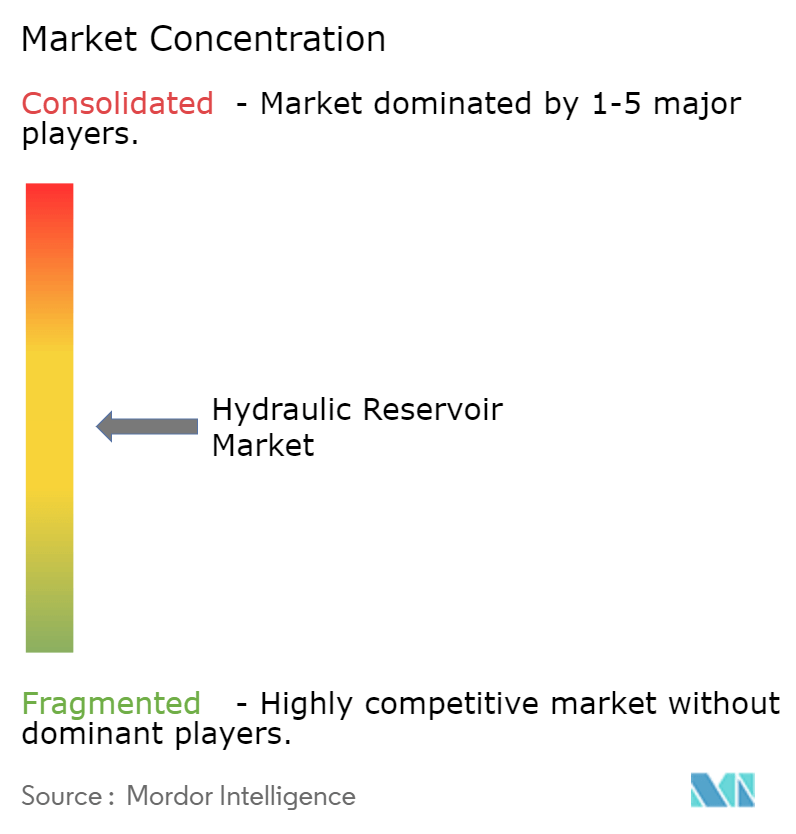
| Market Concentration | Medium |
Major Players *Disclaimer: Major Players sorted in no particular order |
Hydraulic Reservoir Market Analysis by Mordor Intelligence
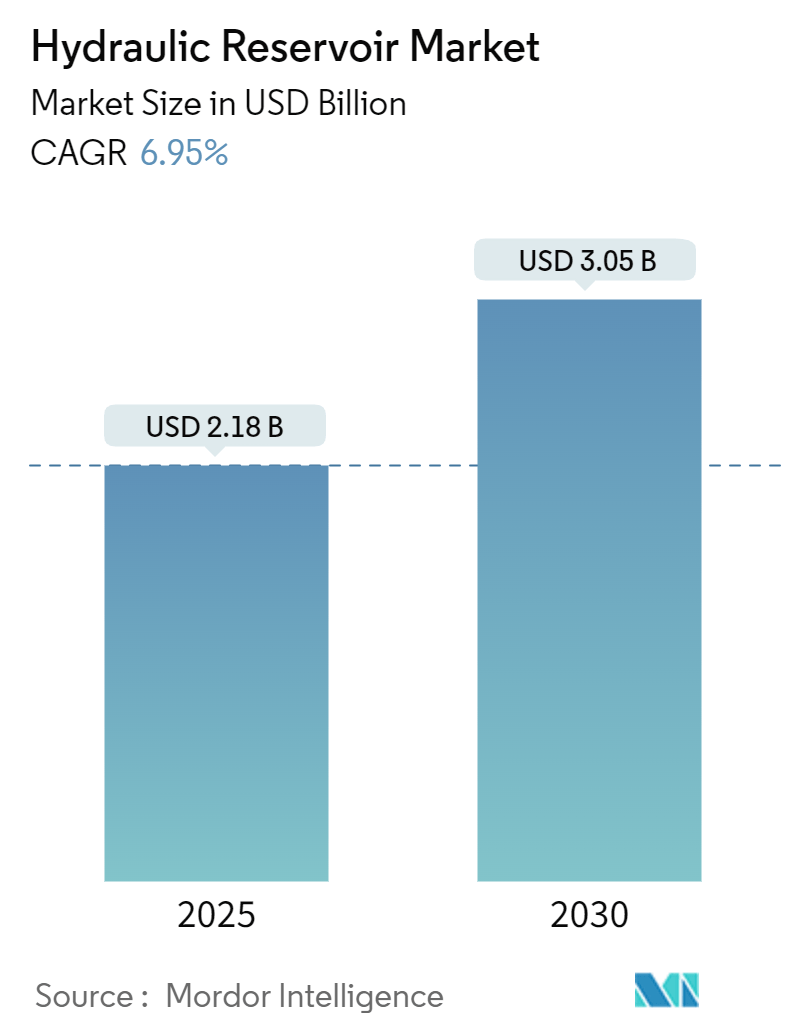
The Hydraulic Reservoir Market size is estimated at USD 2.18 billion in 2025, and is expected to reach USD 3.05 billion by 2030, at a CAGR of 6.95% during the forecast period (2025-2030).
- Manufacturing, construction, and mining sectors, especially in emerging economies, are increasingly relying on hydraulic systems. These systems, integral to heavy machinery, including excavators, cranes, and bulldozers, drive significant market growth.
- As automotive, aerospace, and agriculture industries lean towards automation, the demand for hydraulic systems and their components, notably reservoirs, surges. This mechanization trend amplifies the need for efficient hydraulic fluid storage and management.
- Technological advancements in hydraulics, focusing on pressure management, materials, and fluid maintenance, have boosted hydraulic reservoir performance. As industries adopt these innovations, the demand for specialized hydraulic reservoirs rises. Furthermore, the melding of IoT (Internet of Things) and AI with hydraulic systems paves the way for real-time monitoring. This evolution necessitates integrating advanced hydraulic reservoirs with these smart technologies, ensuring peak performance and maintenance.
- While hydraulic reservoirs play a pivotal role in mining, construction, and agriculture, their environmental footprint raises concerns. Issues like water usage, pollution, and ecosystem disruption have prompted stricter regulations. Consequently, companies must navigate these complexities to ensure compliance with evolving environmental standards.
Global Hydraulic Reservoir Market Trends and Insights
Construction Segment is Estimated to Have the Largest Market Share
- Hydraulic systems are evolving, becoming more efficient and versatile. Innovations in hydraulic technologies, such as advanced pumps, actuators, and valves, are fueling the demand for reliable and efficient hydraulic fluid storage systems. Hydraulic reservoirs are crucial for maintaining optimal fluid levels, cooling, and filtration, ensuring hydraulic systems operate at peak performance. These reservoirs are now being redesigned to accommodate higher pressures and larger fluid volumes, underscoring their importance in modern construction equipment.
- Hydraulic systems are essential for the performance and safety of construction equipment. As construction projects demand greater efficiency, precision, and lifting capacity, machinery like cranes, excavators, and backhoes increasingly rely on hydraulic power. This trend drives the need for larger and more advanced hydraulic reservoirs. As a result, the growing demand for high-performance, multifunctional machinery amplifies the need for these enhanced hydraulic reservoirs.
- Hydraulic reservoirs enable construction companies to enhance productivity by ensuring the smooth operation of hydraulic systems. By providing a steady flow of clean, filtered hydraulic fluid, reservoirs reduce downtime, leading to lower maintenance and repair costs. Additionally, the straightforward monitoring and management of fluid levels not only optimize hydraulic system efficiency but also lower overall operational costs, driving market growth.
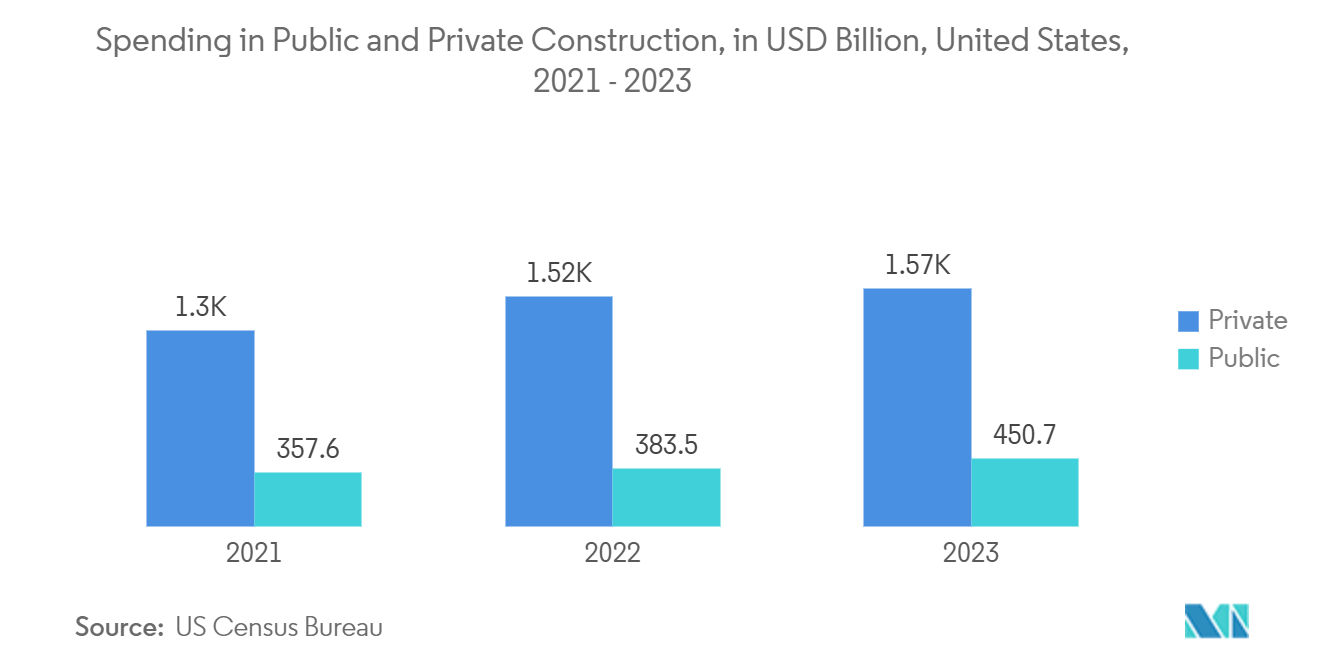
- The United States has ramped up infrastructure spending, focusing on roads, bridges, and public utilities. Hydraulic systems power construction equipment including excavators, cranes, and loaders, all of which depend on hydraulic reservoirs for optimal performance. Data from the United States Census Bureau highlights that private construction spending in the U.S. not only grew in 2023 but also outpaced public sector construction spending by over three times.


Asia Pacific Expected to Hold High Market Share
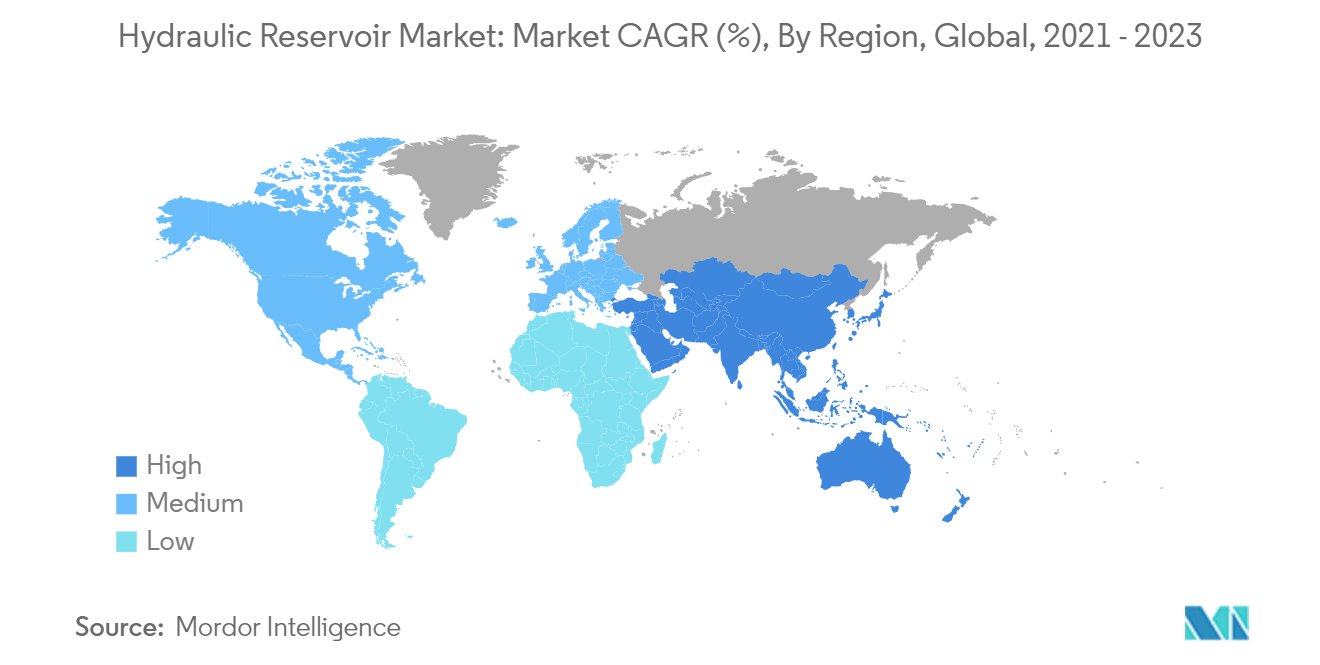
- Countries including China, India, Japan, and South Korea are rapidly urbanizing, driving a heightened demand for infrastructure development. This uptick in construction, encompassing roads, bridges, and residential complexes, subsequently boosts the need for hydraulic systems and reservoirs in machinery like excavators, cranes, and bulldozers.
- Australia, China, and India, among others in the Asia-Pacific, boast abundant natural resources. The mining sector, dependent on hydraulic machinery for tasks like drilling and lifting, underscores the importance of reliable reservoirs to sustain fluid levels and pressure.
- To address escalating energy demands and environmental challenges, the region is channeling substantial investments into renewable energy, with a pronounced focus on hydropower. Hydraulic reservoirs play a pivotal role in these systems, ensuring water storage and energy efficiency. Notably, countries including China and India are aggressively bolstering their hydropower capacities, amplifying the demand for these reservoirs.
- Countries, driven by the demand for sustainable energy, are increasingly weaving renewable sources into their power grids. Central to this shift is hydropower, especially systems utilizing hydraulic reservoirs. This move is vital for nations like China and Japan, which are steadfast in their pursuit of carbon neutrality.

Competitive Landscape
The Hydraulic Reservoir market is moderately consolidated, with players such as Zeus Hydratech, Donaldson Company Inc., Target Hydraulics Co. Ltd. and Enerpac Tool Group vying for higher market share. These players focus on providing innovative solutions for various end-user industries. They are vying for a stronger market presence and higher market share by implementing strategies such as innovation, research and development, expansion, and mergers and acquisitions in the global market.
Hydraulic Reservoir Industry Leaders
Zeus Hydratech
Donaldson Company Inc.
Target Hydraulics Co. Ltd.
Enerpac Tool Group
Hydac International GmbH
- *Disclaimer: Major Players sorted in no particular order

Recent Industry Developments
- October 2024: TAQA, with headquarters in Dharan, Saudi Arabia, and Abu Dhabi, UAE, has unveiled its advanced inflow control system. This innovative system seeks to enhance reservoir performance and empower operators to manage fluid production sustainably. Through meticulous force field analysis, validated by both single-phase flow testing and multi-phase flow testing, the device is calibrated to have an open operating point for oil while being significantly choked for water.
- August 2024: Wipro Hydraulics opened its sixth manufacturing facility in Jaipur, Rajasthan, with an investment of approximately INR 250 crore. Currently, the company produces 1,000 hydraulic cylinders daily, focusing on the hydraulic cylinders and components segment of Wipro Infrastructure Engineering.


Global Hydraulic Reservoir Market Report Scope
A hydraulic reservoir is a storage chamber designed to contain hydraulic fluid. Rising energy demands, a push for better water management, and a worldwide pivot to renewable energy sources are fueling the surge in hydraulic reservoir usage. The research also examines underlying growth influencers and significant industry vendors, all of which help support market estimates and growth rates throughout the anticipated period. The market estimates and projections are based on the base year factors and arrive at using top-down and bottom-up approaches.
The hydraulic reservoir market is segmented by type (Pressurized and Non-Pressurized), by material (Aluminium and Steel), by end-user industry (Construction, Agriculture, Industrial, Aerospace & Defence and Other Industries), and geography (North America, Europe, Asia Pacific, South America, and Middle East & Africa). The market size and forecasts are provided in terms of value (USD) for all the above segments.
| Pressurized |
| Non-Pressurized |
| Aluminum |
| Steel |
| Construction |
| Agriculture |
| Industrial |
| Aerospace & Defence |
| Other Industries |
| North America | United States |
| Canada | |
| Europe | Germany |
| France | |
| Italy | |
| Spain | |
| Rest of Europe | |
| Asia Pacific | China |
| India | |
| Japan | |
| Rest of Asia Pacific | |
| Latin America | Brazil |
| Mexico | |
| Rest of Latin America | |
| Middle East and Africa | Saudi Arabia |
| United Arab Emirates | |
| South Africa | |
| Rest of Middle East & Africa |
| By Type | Pressurized | |
| Non-Pressurized | ||
| By Material | Aluminum | |
| Steel | ||
| By End-User Industry | Construction | |
| Agriculture | ||
| Industrial | ||
| Aerospace & Defence | ||
| Other Industries | ||
| By Geography | North America | United States |
| Canada | ||
| Europe | Germany | |
| France | ||
| Italy | ||
| Spain | ||
| Rest of Europe | ||
| Asia Pacific | China | |
| India | ||
| Japan | ||
| Rest of Asia Pacific | ||
| Latin America | Brazil | |
| Mexico | ||
| Rest of Latin America | ||
| Middle East and Africa | Saudi Arabia | |
| United Arab Emirates | ||
| South Africa | ||
| Rest of Middle East & Africa | ||


Key Questions Answered in the Report
How big is the Hydraulic Reservoir Market?
The Hydraulic Reservoir Market size is expected to reach USD 2.18 billion in 2025 and grow at a CAGR of 6.95% to reach USD 3.05 billion by 2030.
What is the current Hydraulic Reservoir Market size?
In 2025, the Hydraulic Reservoir Market size is expected to reach USD 2.18 billion.
Who are the key players in Hydraulic Reservoir Market?
Zeus Hydratech, Donaldson Company Inc., Target Hydraulics Co. Ltd., Enerpac Tool Group and Hydac International GmbH are the major companies operating in the Hydraulic Reservoir Market.
Which is the fastest growing region in Hydraulic Reservoir Market?
North America is estimated to grow at the highest CAGR over the forecast period (2025-2030).
Which region has the biggest share in Hydraulic Reservoir Market?
In 2025, the Asia Pacific accounts for the largest market share in Hydraulic Reservoir Market.
What years does this Hydraulic Reservoir Market cover, and what was the market size in 2024?
In 2024, the Hydraulic Reservoir Market size was estimated at USD 2.03 billion. The report covers the Hydraulic Reservoir Market historical market size for years: 2020, 2021, 2022, 2023 and 2024. The report also forecasts the Hydraulic Reservoir Market size for years: 2025, 2026, 2027, 2028, 2029 and 2030.
Page last updated on:
Hydraulic Reservoir Market Report
Statistics for the 2025 Hydraulic Reservoir market share, size and revenue growth rate, created by Mordor Intelligence™ Industry Reports. Hydraulic Reservoir analysis includes a market forecast outlook for 2025 to 2030 and historical overview. Get a sample of this industry analysis as a free report PDF download.





