
Hydraulic Pumps Market Size and Share
Market Overview
| Study Period | 2020 - 2031 |
|---|---|
| Market Size (2026) | USD 14.64 Billion |
| Market Size (2031) | USD 18.99 Billion |
| Growth Rate (2026 - 2031) | 5.35 % |
| Fastest Growing Market | Middle East and Africa |
| Largest Market | Asia Pacific |
| Market Concentration | Medium |
Major Players
*Disclaimer: Major Players sorted in no particular order Image © Mordor Intelligence. Reuse requires attribution under CC BY 4.0. |
|
Hydraulic Pumps Market Analysis by Mordor Intelligence
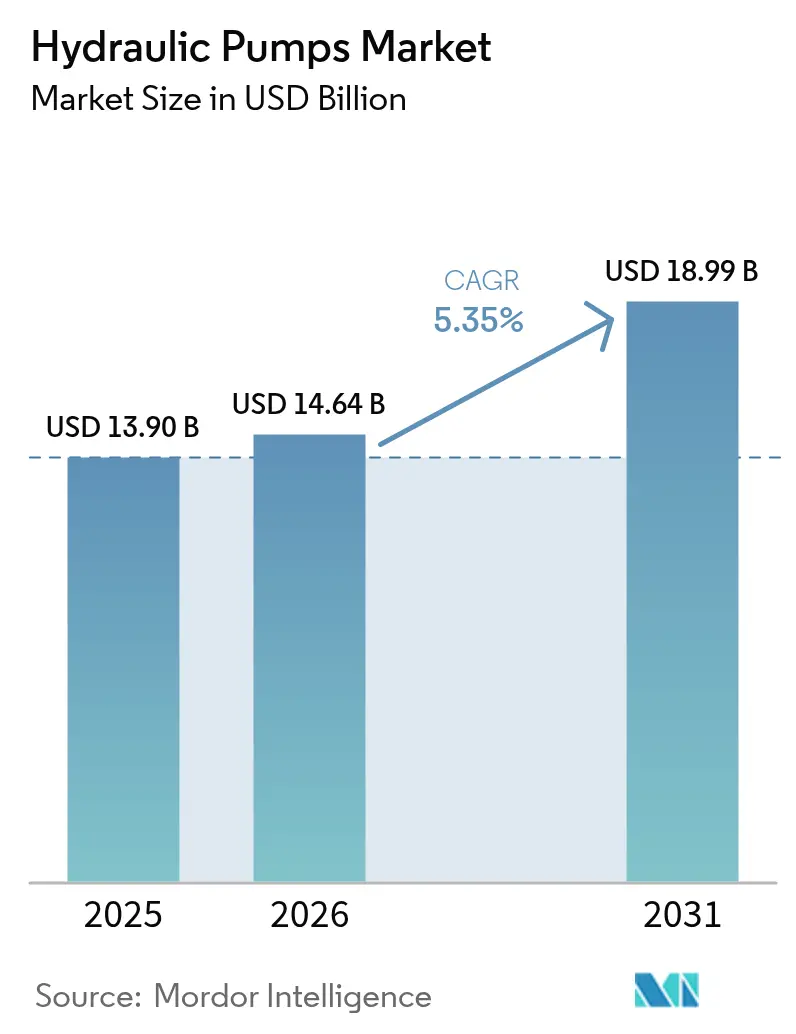
The hydraulic pumps market size was valued at USD 13.9 billion in 2025 and estimated to grow from USD 14.64 billion in 2026 to reach USD 18.99 billion by 2031, at a CAGR of 5.35% during the forecast period (2026-2031). Robust demand for high-capacity fluid-power equipment in construction, renewable energy, and automated manufacturing keeps the market on a steady expansion path. Infrastructure renewal programmes in China and India, combined with process-industry upgrades in the European Union and North America, continue to anchor baseline demand. Energy transition investments are unlocking new opportunities in wind-turbine pitch and yaw systems, hydrogen electrolyser compression modules, and grid-scale battery storage cooling circuits. Manufacturers are responding with higher-efficiency piston pump designs, intelligent control packages, and remanufacturing services that align with circular-economy mandates. Competition remains moderate, with global leaders reinforcing digital portfolios while regional suppliers target cost-sensitive applications. [1]European Commission, “Circular Economy Action Plan,” ec.europa.eu
Key Report Takeaways
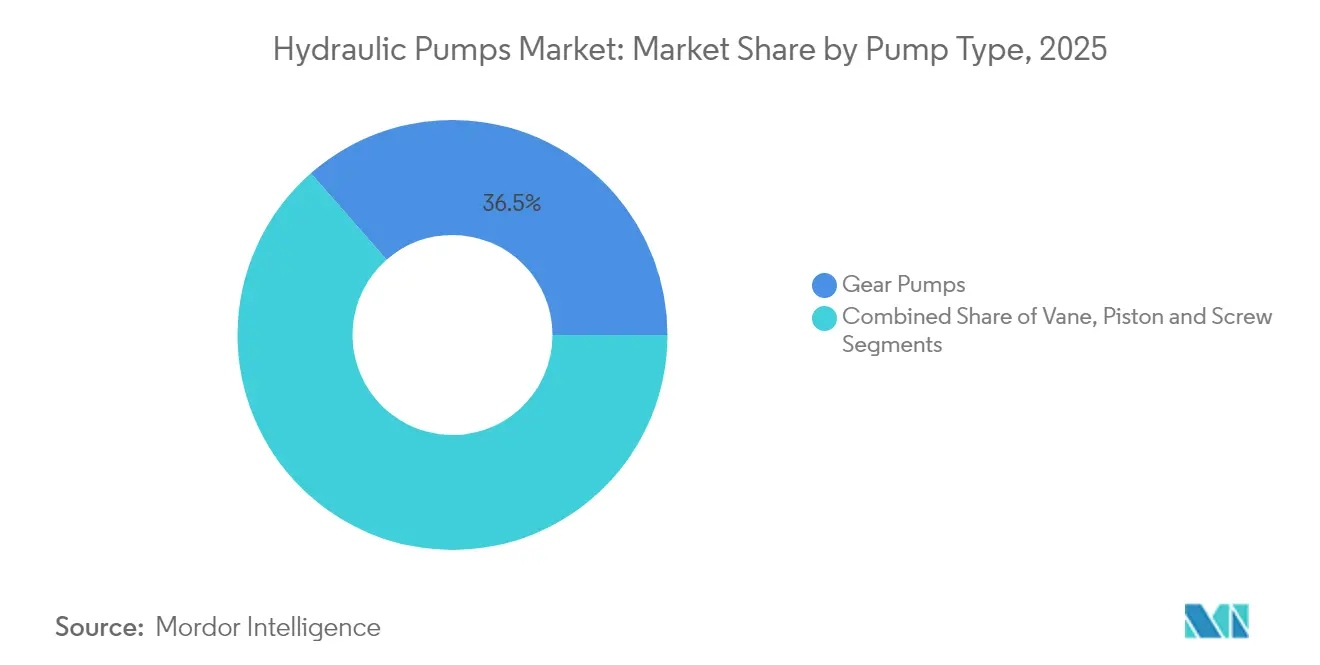
- By pump type, gear pumps led with 36.45% revenue share in 2025, while piston pumps are projected to expand at a 6.45% CAGR to 2031.
- By operating pressure, the 3000-5000 psi range held 41.35% of the hydraulic pumps market size in 2025; the >5000 psi bracket is advancing at an 7.95% CAGR through 2031.
- By application, Mobile Hydraulics accounted for 54.35% of the hydraulic pumps market share in 2025; Process & Energy is the fastest-growing application at 7.05% CAGR to 2031.
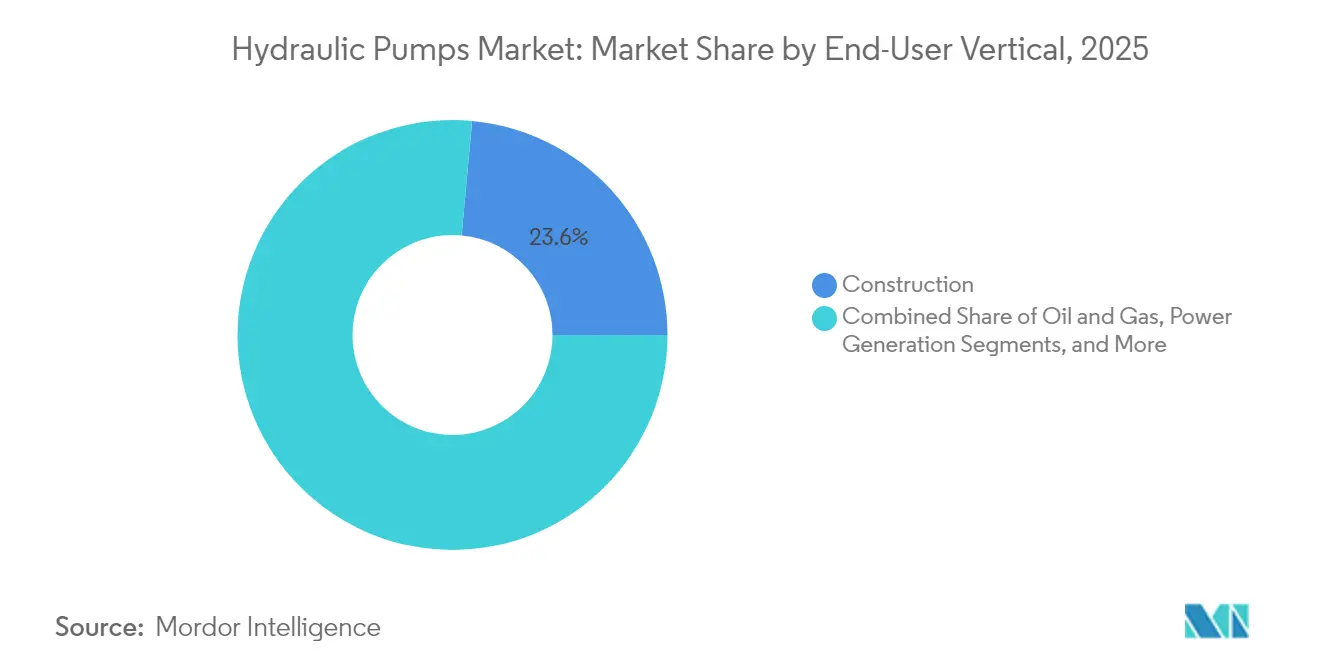
- By end-user vertical, Construction remained the largest with 23.55% share in 2025, while Power Generation is progressing at 6.85% CAGR.
- By geography, APAC dominated with 41.45% share in 2025; the Middle East is the fastest-growing region at 6.20% CAGR.
- Bosch Rexroth, Parker Hannifin, and Danfoss Power Solutions collectively held an estimated 28% of global revenue in 2024.
Note: Market size and forecast figures in this report are generated using Mordor Intelligence’s proprietary estimation framework, updated with the latest available data and insights as of 2026.
Global Hydraulic Pumps Market Trends and Insights
Drivers Impact Analysis*
| Driver | (~) % Impact on CAGR Forecast | Geographic Relevance | Impact Timeline |
|---|---|---|---|
| Infrastructure renewal programs in China and India | +1.20% | APAC core, spill-over to MEA | Medium term (2-4 years) |
| Industrial automation (Industry 4.0 retrofits) | +0.90% | Global, concentrated in North America and EU | Long term (≥ 4 years) |
| Off-highway electrification needs electro-hydraulic pumps | +0.80% | North America and EU, expanding to APAC | Medium term (2-4 years) |
| Wind-turbine yaw and pitch system demand | +0.70% | Global, concentrated in offshore markets | Long term (≥ 4 years) |
| Hydrogen electrolyser build-out (>1000 bar pumps) | +0.60% | EU and North America, pilot projects in APAC | Long term (≥ 4 years) |
| Mandatory remanufacturing quotas (EU Circular Economy) | +0.40% | EU primary, expanding globally | Medium term (2-4 years) |
| Source: Mordor Intelligence | |||
Infrastructure renewal programs in China and India
Government-funded construction pipelines in both nations sustain annual demand for more than 13.5 million hydraulic pump units by 2025. Localization rules for public-sector projects incentivise joint ventures, channelling roughly USD 4.2 billion into high-tech pump production and accelerating domestic capability building. Regional contractors adopting Chinese equipment standards are extending the supply chain into the Middle East and Africa, broadening export prospects for APAC manufacturers. These programmes are expected to underpin baseline demand through 2027, particularly for units rated above 5000 psi. [2]Cybersecurity and Infrastructure Security Agency, “Osprey Pump Controller advisory,” cisa.gov
Industrial automation (Industry 4.0 retrofits)
Smart power units equipped with variable-frequency drives trim idle-time energy consumption by 25%. IoT gateways stream real-time data into predictive-maintenance platforms, cutting operating costs by 45% and reducing unplanned emissions events by 75%, as shown in UK water-utility trials with Sulzer controllers. Digital twin models enable remote optimisation that delivers 30% energy savings and 20% reduction in total cost of ownership. Cyber-security remains a rising concern following US CISA advisories on pump-controller vulnerabilities carrying CVSS scores up to 9.8.
Off-highway electrification needs electro-hydraulic pumps
Hybrid work machines require compact, high-flow electro hydrostatic units such as Moog’s EPU-G, which delivers 20-85 l/min at up to 345 bars while lowering system oil volume 90%. Construction-equipment makers embed these pumps within electric power-take-off drives to meet emissions targets without sacrificing load-handling performance. Demand is especially strong in aerial-lift and material-handling segments where precise, low-noise operation is mandatory.
Hydrogen electrolyser build-out (>1000 bar pumps)
Green-hydrogen projects across Europe and North America require multi-stage booster pumps fabricated from AISI 316 stainless steel and certified for ATEX zones. Flowrates and duty cycles demand piston designs that maintain volumetric efficiency above 92% at discharge pressures beyond 1000 bar. Suppliers offering service packages and remote-monitoring functions are securing long-term procurement contracts with electrolyser OEMs.
Restraints Impact Analysis*
| Restraint | (~) % Impact on CAGR Forecast | Geographic Relevance | Impact Timeline |
|---|---|---|---|
| Volatile nickel-steel prices | -0.80% | Global, concentrated in manufacturing hubs | Short term (≤ 2 years) |
| Rapid penetration of all-electric actuators | -1.10% | North America & EU, expanding to APAC | Medium term (2-4 years) |
| Cyber-security risks in smart pumps | -0.30% | Global, concentrated in critical infrastructure | Short term (≤ 2 years) |
| Shortage of certified fluid-power technicians | -0.50% | Global, acute in developed markets | Long term (≥ 4 years) |
| Source: Mordor Intelligence | |||
Volatile nickel-steel prices
Nickel-bearing alloy costs climbed through late-2024 on renewed US infrastructure spending before receding, then rebounded in early-2025, compressing pump-maker margins and complicating inventory planning. High-pressure (>3000 psi) models suffer the most, as safety codes mandate premium steel grades. Chinese producers, reliant on imported high-grade alloy, face added currency risk and logistics surcharges.
Rapid penetration of all-electric actuators
Electric cylinders deliver 75–80% mechanical efficiency versus 40–55% for conventional hydraulics, in addition to leak-free operation and simplified maintenance. They gain fast ground in light-payload and precision-assembly lines, reducing addressable volume for smaller hydraulic units. Heavy-duty tasks still favour hydraulics for superior force density and thermal robustness, preserving market relevance in off-road and energy sectors.
*Our forecasts treat driver/restraint impacts as directional, not additive. The impact forecasts reflect baseline growth, mix effects, and variable interactions.
Segment Analysis
By Pump Type: Piston pumps advance efficiency targets
Gear pumps retained 36.45% revenue share in 2025 on the strength of mobile-machinery demand. Piston pumps are outpacing at 6.45% CAGR to 2031 as OEMs migrate toward higher volumetric efficiency and precise displacement control. Parker Hannifin’s PV140 piston series recorded 14,000 operating hours between overhauls in Australian mining vehicles, illustrating lifecycle cost advantages. Vane and screw pumps continue serving niche applications requiring smooth flow or marine-grade reliability.
Second-generation piston designs use hardened spool valves and reinforced swash plates to extend mean-time-between-failure to 15,000 hours, doubling service life relative to legacy units. Their adoption in telehandlers, excavators, and injection-moulding machines underscores a systemic pivot toward energy optimisation and reduced CO₂ footprints. The hydraulic pumps market size for piston technology is expected to capture an incremental share in both industrial and renewable-energy installations.



By Operating-Pressure Range: >5000 psi segment accelerates
The 3000-5000 psi class represented 41.35% of global value in 2025, covering mainstream construction and agricultural rigs. Pumps rated above 5000 psi are growing 7.95% annually, propelled by hydrogen compression, offshore wind, and advanced machining centres. North Ridge Pumps’ multi-stage boosters, certified for ATEX zones, meet electrolyser developers’ need for continuous duty at 1000 bar. Below-3000-psi units maintain volume stability in cost-sensitive markets where performance thresholds remain modest.
Upstream innovation focuses on sealing systems and micro-finish surfaces to curb leakage at extreme pressures. Material-science breakthroughs in duplex stainless and nano-coatings aim to raise fatigue resistance, while real-time pressure-derating algorithms prevent catastrophic failures. These advances reinforce the hydraulic pumps market share held by high-pressure specialists amid energy-transition projects.
By End-user Vertical: Power Generation accelerates
Construction remained top of the table with 23.55% revenue in 2025, supported by megaproject pipelines across Asia, the Middle East, and the Americas. Power Generation is progressing at 6.85% CAGR, stemming from turbine, hydroelectric, and storage deployments. OEMs incorporate hydraulic tracking in utility-scale solar arrays to maximise irradiation capture, while hydro stations rely on variable-displacement pumps for governor systems. Oil and Gas, Food and Beverage, and Water and Wastewater retain steady baselines, demanding corrosion-resistant and sanitary-design pumps.Grid-modernisation incentives in the United States and Europe elevate funding for pumped-storage hydro and flexible peaking assets, each requiring rugged high-flow pumps. Manufacturers offering service-exchange programmes and remanufactured spares align with EU circular-economy directives, broadening lifecycle revenue.
By Application: Process and Energy segment leads growth
Mobile Hydraulics commanded 54.35% of the 2025 demand, covering earthmovers, tractors, and forklifts that underpin global construction and agriculture. The Process and Energy category is expanding 7.05% per year, driven by wind-turbine pitch systems and refinery modernisation programmes. Closed-loop hydraulic pitch drives in 600 kW turbines integrate bladder-accumulator energy storage, enabling smoother grid integration. Industrial-machinery users continue adopting smart power units that deploy condition monitoring to trim downtime by 30%.
The hydraulic pumps market size attached to Process and Energy is benefiting from ESG capital flows, which prioritise high-efficiency fluid-power circuits in renewable assets. Service providers bundling cloud-based analytics with field maintenance contracts are capturing premium margins. As electrolyser, carbon-capture, and biomass facilities proliferate, so does demand for specialised pumps able to withstand corrosive media and variable duty cycles.
Geography Analysis
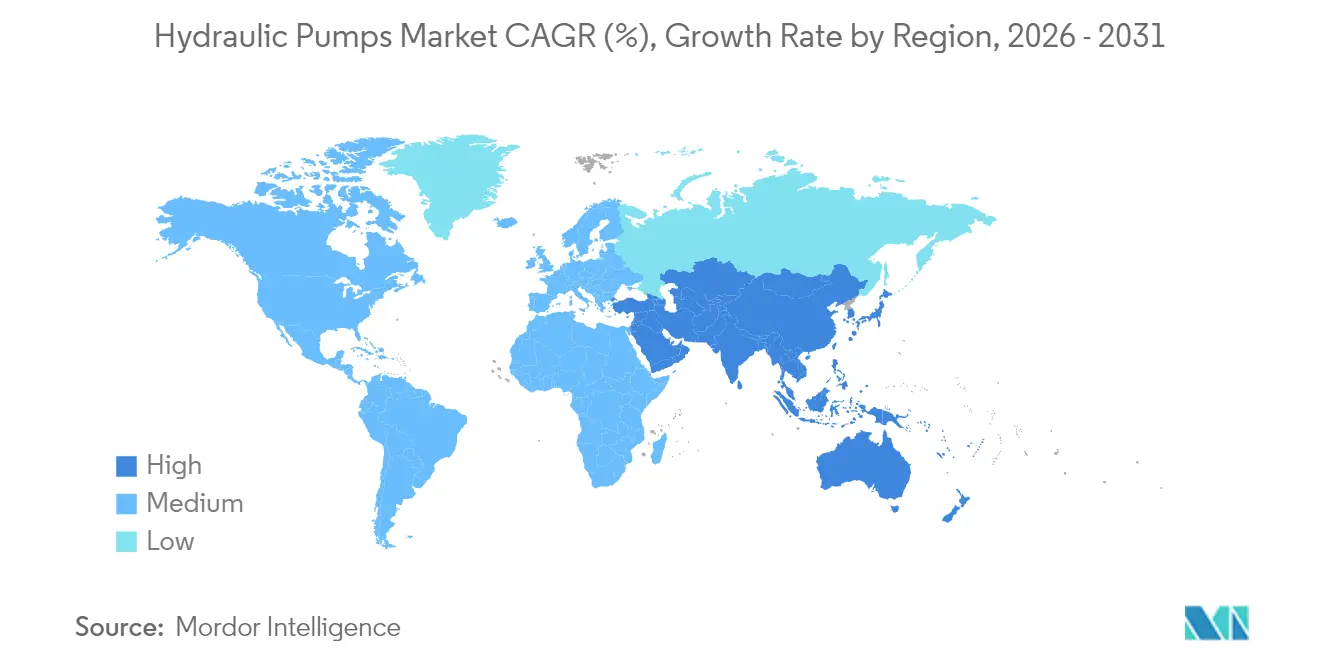
APAC’s leadership derives from unmatched production scale and domestic consumption, with China alone purchasing 13.5 million units in 2025. Government programmes such as India’s Smart Cities Mission funnel capital into water-management, metro-rail, and affordable-housing projects requiring high-pressure hydraulic systems. Japanese suppliers continue to set benchmarks for reliability; Kawasaki’s K3VL axial piston line is frequently specified on premium excavators. Supply-chain disruptions and skilled-labour shortages encourage automation and regional diversification into Vietnam and Indonesia.
The Middle East’s swift growth rests on oil-and-gas reinvestment and renewable diversification agendas. Saudi Arabia’s Public Investment Fund channels billions into solar- and wind-farm construction, where hydraulic yaw and pitch drives underpin turbine uptime. UAE’s transmission grid upgrades import high-pressure pumps for substation cooling and seawater desalination. Joint-venture manufacturing in Dammam and Abu Dhabi shortens lead times and meets local-content mandates.
North America and Europe maintain technologically advanced fleets. The US Infrastructure Investment and Jobs Act revived civil works outlays, fuelling replacements across skid-steer loaders and pavers. EU regulations promoting circular-economy compliance create new remanufacturing revenue and elevate demand for eco-design pumps certified under EN ISO 14971. Both regions contend with an ageing technician workforce, prompting wider deployment of remote diagnostics to ease service bottlenecks.

Regulatory Landscape
Compliance for hydraulic pumps is shaped by machinery-safety rules, eco-design and fluid stewardship expectations, and a growing set of digital-security requirements as pumps integrate sensors, drives, and connectivity. In the European Union, Regulation (EU) 2023/1230 on machinery (replacing the Machinery Directive 2006/42/EC) applies from January 20, 2027, raising requirements that affect pump-powered systems, including documentation and obligations around digital elements such as cybersecurity and AI-enabled functions where relevant.
For mobile equipment, EU Regulation (EU) 2025/14 (adopted in December 2024) sets technical and administrative procedures for EU type-approval of non-road mobile machinery circulating on public roads, influencing OEM platform choices and validation workflows for electro-hydraulic pumps used in construction and material-handling fleets. At the component and system level, safety and environmental compliance commonly reference ISO 4413 for hydraulic fluid power system safety and ISO 15380:2023 for environmentally acceptable hydraulic fluids, supporting procurement specifications in regulated end-user industries and public procurement programs.
Value Chain Analysis
The value chain starts with upstream metals and engineered materials (ductile iron, steel, aluminum, bronze), along with critical bought-in components such as precision bearings, seals, and surface treatments, then moves into high-precision machining, heat treatment, and contamination-controlled assembly and testing. As electrification and Industry 4.0 retrofits expand, the chain increasingly incorporates electronics (sensors, controllers, drives) and software integration. This adds new supplier tiers and qualification steps alongside traditional hydraulic design and manufacturing.
Downstream, pumps are sold either as standalone components via distributors and integrators or embedded by OEMs into mobile hydraulics, industrial machinery, and process and energy skids, with aftermarket service, remanufacturing, and spares becoming a larger share of lifecycle value. Bottlenecks tend to center on skilled commissioning and data quality, where missing or inconsistent technical information and parameter-change communication can delay system start-up and increase warranty risk, especially in digitally integrated installations. Interoperability initiatives and standardized digital product data, including the Asset Administration Shell used alongside AutomationML or OPC UA, are used to streamline commissioning and support cross-vendor lifecycle service, while supplier and OEM collaborations (for example, Danfoss Power Solutions and HYDAC working with OEMs on controls and telematics) reflect the shift toward mechatronic, software-enabled hydraulic systems.
Competitive Landscape
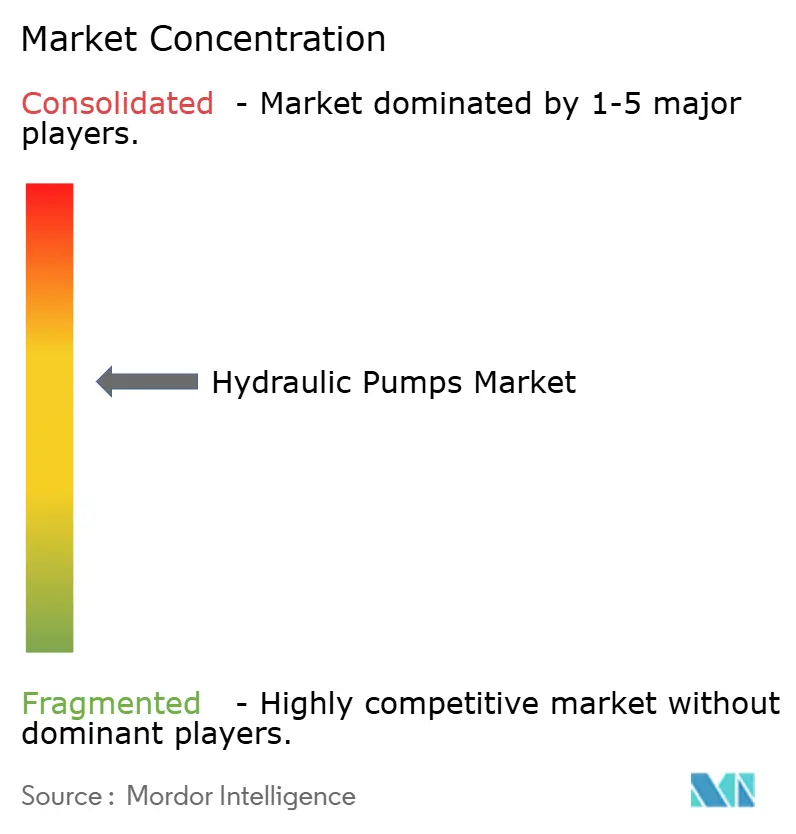
Global suppliers hold relatively balanced shares, yielding a moderately concentrated field. Bosch Rexroth lifted 2023 sales to EUR 7.6 billion after integrating HydraForce, reinforcing compact-hydraulics capacity and widening North American reach. Parker Hannifin posted USD 19.9 billion in fiscal-2024 revenue and reported a 25.2% EBITDA margin, leveraging aerospace and filtration divisions for cross-cycle resilience. Danfoss Power Solutions expanded its D1P pump family to 160 cc to target high-power excavators, emphasising modular electronics.[4]Danfoss Power Solutions, “D1P pump series expansion,” danfoss.com
R and D pipelines highlight electro hydrostatic pumps, noise-attenuation casings, and AI-driven fault detection. Patent filings for variable-swash-plate control algorithms grew 12% year-over-year, reflecting intensifying digital competition. Chinese entrants’ narrow quality gaps while maintaining low unit prices, prompting incumbents to focus on systems integration and aftermarket service bundles. Strategic alliances in hydrogen infrastructure and offshore wind offer new footholds for pump makers specialised in ultra-high-pressure and corrosion-resistant solutions.
Hydraulic Pumps Industry Leaders
-
Bosch Rexroth Ltd.
-
Parker Hannifin Corporation
-
Eaton Corporation plc
-
Danfoss Power Solutions A/S
-
Kawasaki Heavy Industries Ltd.
- *Disclaimer: Major Players sorted in no particular order

Market Opportunities and Future Outlook
White space is emerging where hydraulic pumps need to function as energy-managed, software-integrated assets rather than standalone components, particularly in industrial automation retrofits and electrified off-highway equipment. Variable-speed and frequency-controlled architectures that reduce idle losses, along with standardized interfaces between electric motors and hydraulic pumps, create room for suppliers to package pumps, drives, sensors, and controls into validated, drop-in modules for OEM platforms and plant upgrades. Demonstrated energy and runtime benefits in modernized hydraulic systems are also moving procurement toward integrated electro-hydraulic solutions rather than discrete pump replacements.
Capacity and localization investments point to near-term opportunity in aftermarket and regional supply resilience for construction, mining, and water infrastructure. In June 2026, ZWZT Hydraulic announced a technical upgrade project for hydraulic pump manufacturing with 50,000 units of annual capacity for construction and mining aftermarket demand, underscoring competitive focus on serviceable, high-uptime products for fleet refresh cycles. Manufacturing expansions such as NETZSCH Pumps & Systems commissioning a new production facility in Goa, India (2026) and KSB breaking ground on a EUR 70 million modernization and expansion at Frankenthal, Germany to raise Eta pump output by 2030, reinforce broader investment in capacity, automation, and proximity to end markets, which can benefit hydraulic pump suppliers serving process plants, utilities, and industrial machinery.
Recent Industry Developments
- June 2026: Danfoss Power Solutions validated its Dextreme Max digital hydraulic system on a 30-ton battery-electric excavator, reporting a 35% reduction in power consumption and a 53% increase in runtime. The result strengthens digital displacement and system-level optimization as a route to make electro-hydraulic architectures more competitive in electrified mobile machinery.
- October 2025: Ingersoll Rand acquired APSCO, Blutek, and UT Pumps for USD 135 million, adding about USD 50 million in annual revenue to the portfolio. The move broadens channel access and product coverage in pump and fluid-power adjacent categories, increasing competitive pressure in parts of the aftermarket and distribution ecosystem.
- February 2024: Bosch Rexroth disclosed EUR 460 million in R and D investment aimed at smart-hydraulics platforms alongside reporting EUR 7.6 billion in 2023 sales. Higher R and D intensity supports faster commercialization of connected pump solutions, including efficiency-oriented controls and diagnostics that align with automation retrofit demand.


Research Methodology Framework and Report Scope
Market Definition and Coverage
This market covers hydraulic pumps that convert mechanical energy into hydraulic flow and pressure, which is then used to power motion in equipment and industrial systems. We size the market based on the value of hydraulic pump units sold across major end-use industries and regions.
Scope exclusions: Excludes complete hydraulic power units, hydraulic motors, valves, cylinders, hoses, and aftermarket fluids unless they are bundled and priced as part of the pump sale.
Segmentation Overview
-
By Pump Type
- Gear
- Vane
- Piston
- Screw
-
By Operating-Pressure Range
- <3,000 psi
- 3,000 - 5,000 psi
- >5,000 psi
-
By End-user Vertical
- Construction
- Oil and Gas
- Power Generation
- Food and Beverage
- Water and Waste-water
- Chemicals
- Others (Agriculture, Mining, Automotive)
-
By Application
- Mobile Hydraulics
- Industrial Machinery
- Process and Energy (incl. wind, hydro, hydrogen)
-
By Geography
-
North America
- United States
- Canada
- Mexico
-
South America
- Brazil
- Argentina
- Rest of Latin America
-
Europe
- Germany
- United Kingdom
- France
- Italy
- Spain
- Rest of Europe
-
Asia-Pacific
- China
- Japan
- South Korea
- India
- Australia
- New Zealand
- Rest of Asia-Pacific
-
Middle East and Africa
- United Arab Emirates
- Saudi Arabia
- South Africa
- Rest of Middle East and Africa
-
North America
Data Sources, Market Sizing, and Validation
Desk Research
Desk work is used to set the demand context and to anchor the model with clean, public signals. We rely on sources such as US Census Bureau manufacturing data, Eurostat industrial production series, UN Comtrade trade flows for pumps and related parts, and IEA energy and industrial outlook datasets. Where it helps explain end-market pull, we also refer to sources such as World Bank macro indicators and public construction and mining equipment shipment updates from industry bodies.
Company annual reports, investor presentations, and product catalogs are reviewed to understand pump families, typical use cases, and mix shifts toward higher pressure or variable displacement designs. We also use paid subscriptions focused on company financials and intelligence, patent databases, and shipment-level import-export data to cross-check supply footprints and pricing direction. The desk sources listed above are illustrative, and many other public references were also used for data collection, validation, and clarification.
Primary Interviews and Surveys
Primary work was done through expert interviews and structured questionnaires with pump manufacturers, component distributors, system integrators, and large end users that buy pumps for fleets and plants. Since this is a global market, discussions were balanced across APAC, EMEA, and the Americas to test assumptions around OEM build rates, replacement cycles, and average selling price changes before finalizing outputs.
Distribution of primary research fieldwork respondents
| Company type | Respondent position | Region |
|---|---|---|
| Top tier: 28% | CXOs: 19% | APAC: 47% |
| Mid tier: 51% | Functional/Unit leaders: 34% | EMEA: 35% |
| Smaller Players: 21% | Managers: 47% | Americas: 18% |
Market-Sizing & Forecasting
Sizing starts with a top-down build where production and trade indicators, industrial output, and equipment activity are used to reconstruct the addressable demand pool for hydraulic pumps by region and major application. Those totals are then checked with selective bottom-up approximations, such as sample supplier revenue splits, channel checks on unit volumes, and a simple ASP times volume sanity test for key pump types.
Inputs used in the model include construction and earthmoving activity, industrial machinery output, mining and materials handling utilization, replacement cycle behavior in mobile fleets, and mix shifts by pump type (gear, vane, piston) and pressure class. Pricing is handled through a blended ASP approach that adjusts for inflation, higher pressure adoption, and the share of variable displacement units, then gets tested in interviews against what buyers are seeing in quotes. For forecasting, we mainly use scenario analysis supported by a light multivariate regression, where the demand drivers are projected and then adjusted using expert views on cycle timing and capital spending. When bottom-up signals are missing for smaller regions, we fill gaps using peer-region intensity ratios and then re-check the result against import patterns and end-market output.
Data Validation & Update Cycle
Validation is done by triangulating the modeled value against independent signals like trade trends, industrial production, and end-market equipment shipments, then checking whether the implied unit counts and pricing look realistic. Outliers are reviewed in steps, first at the regional level and then at the application and pump-type level, before a final analyst review is completed.
The model is revisited annually so assumptions, such as pump mix and pricing progression, stay aligned with current conditions. If a material event happens during the year, such as a major demand shock in construction or a large pricing swing, we re-contact selected interviewees and refresh the key inputs. Before delivery, the latest public data is rechecked so clients receive the most current view we can support.
Mordor Intelligence's Hydraulic Pumps Market Size Compared With Other Published Estimates
Published market values for hydraulic pumps can look far apart, even when the topic name is similar, because the scope and pricing logic are not always aligned. Differences usually come from what is counted as revenue (factory gate versus channel value), whether related services are included, and how pump mix and pressure class are treated over the base year.
The main gap comes from revenue scope, where Mordor Intelligence treats the market as pump unit sales value without rolling in broader hydraulic systems or non-pump components, and that choice can push totals away from estimates that add services or adjacent equipment value. Timing also matters because some sources report a base year that is earlier and then apply a smoother price curve, while others use higher short-term price lift assumptions tied to inflation and product mix. Currency conversion timing and how trade and production checks are applied can further widen the spread if they are not reviewed against on-the-ground buyer feedback.
Benchmark comparison
| Source | Market Size | Gaps in Research Methodology |
|---|---|---|
| Mordor Intelligence | USD 14.64 B (2026) | |
| Global Consultancy A | USD 10.87 B (2025) | Uses factory gate valuation and also states inclusion of related services sold by manufacturers, which can change the counted revenue base versus a pump-unit-only view and shifts the year basis to 2025. |
| Industry Publisher B | USD 10.93 B (2024) | Anchors the estimate to a 2024 base year and applies a lower growth path, and the public summary provides limited clarity on how pump mix, pressure class, and pricing progression were validated with end-market checks. |
Seen together, the spread is mostly explained by what gets counted as revenue and which year is used as the starting point, followed by how pricing and mix are carried forward. Our approach stays traceable because each regional total is tied back to a defined demand driver set and then rechecked with practical unit and ASP sanity tests.


Key Questions Answered in the Report
What is the current size of the hydraulic pumps market?
The hydraulic pumps market reached USD 14.64 billion in 2026 and is projected to grow to USD 18.99 billion by 2031 at a 5.35% CAGR.
Which pump type is growing fastest?
Piston pumps are expanding at a 6.45% CAGR thanks to superior efficiency and precision control that fit modern automation needs.
Which application area offers the highest growth potential?
Process and Energy, covering wind, hydrogen, and industrial process plants, is forecast to grow 7.05% annually through 2031.
Which region is poised for the highest CAGR?
The Middle East is the fastest-growing regional market, set to rise 6.20% per year due to large infrastructure and renewable-energy projects.
What key restraint could slow market growth?
Rapid adoption of all-electric actuators in light-duty precision applications may displace hydraulic solutions and reduce addressable demand.
Who are the leading companies in the hydraulic pumps industry?
Bosch Rexroth, Parker Hannifin, and Danfoss Power Solutions together hold an estimated 28% of global revenue, leveraging digital innovations to maintain share.
Page last updated on:





