
Market Overview
| Study Period | 2020 - 2031 |
|---|---|
| Market Size (2026) | USD 10.15 Billion |
| Market Size (2031) | USD 13.42 Billion |
| Growth Rate (2026 - 2031) | 5.74 % |
| Fastest Growing Market | Asia Pacific |
| Largest Market | Asia Pacific |
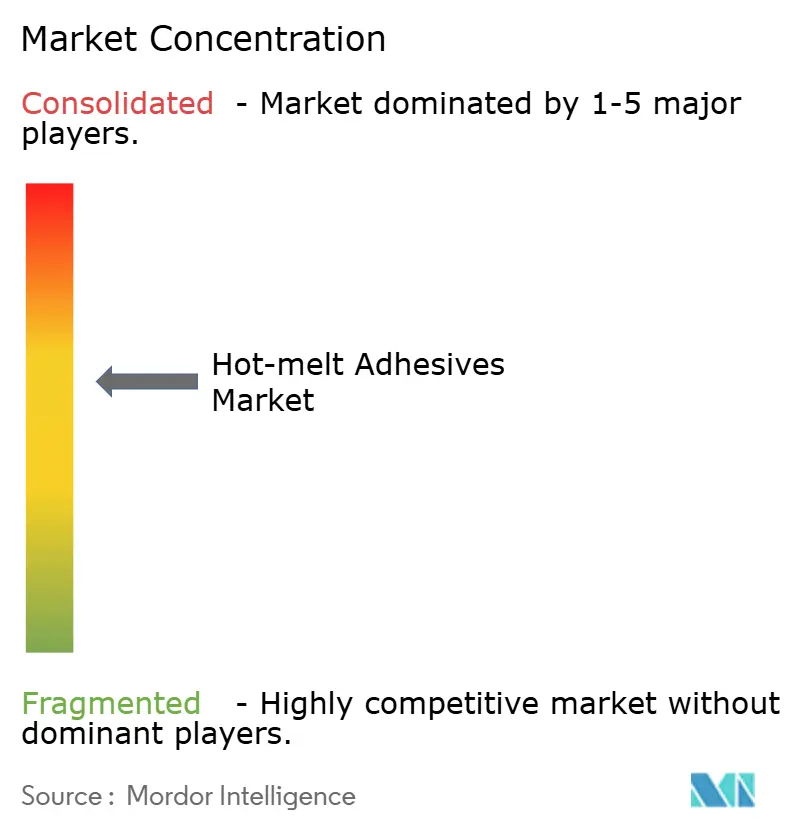
| Market Concentration | Medium |
Major Players *Disclaimer: Major Players sorted in no particular order Image © Mordor Intelligence. Reuse requires attribution under CC BY 4.0. | |
Hot-melt Adhesives Market Analysis by Mordor Intelligence
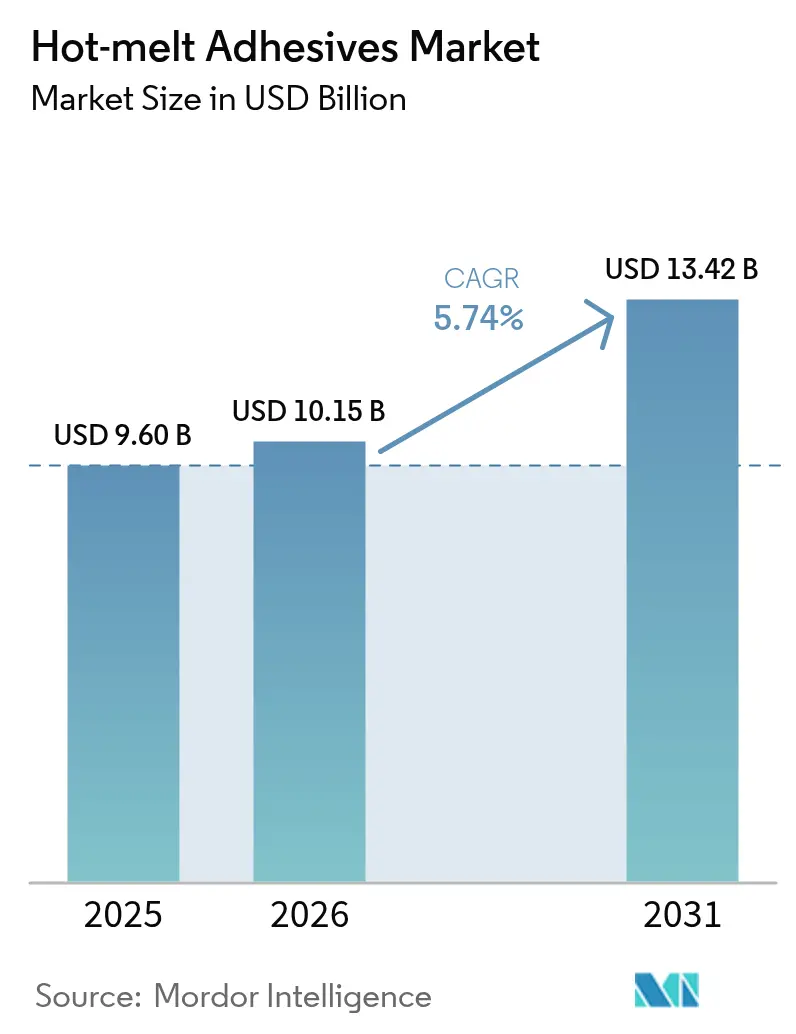
The Hot-melt Adhesives Market size was valued at USD 9.60 billion in 2025 and estimated to grow from USD 10.15 billion in 2026 to reach USD 13.42 billion by 2031, at a CAGR of 5.74% during the forecast period (2026-2031). The expansion is propelled by the migration from solvent-borne chemistries to thermoplastic systems that eliminate volatile organic compounds, speed up packaging lines, and cut energy use. Fast-moving consumer goods companies rely on millisecond-precision dispensing equipment that supports case-sealing, label‐stock bonding, and flexible-film lamination without drying ovens. E-commerce in Asia continues to drive corrugated packaging volumes, while healthcare device makers adopt solvent-free bonding to satisfy sterilization and biocompatibility rules. Supply-side strategies emphasize vertical integration into polymer and tackifier production as insulation against crude-oil swings, and innovators are rolling out bio-based resins that command 15-20% price premiums in sustainability-focused niches.
Key Report Takeaways
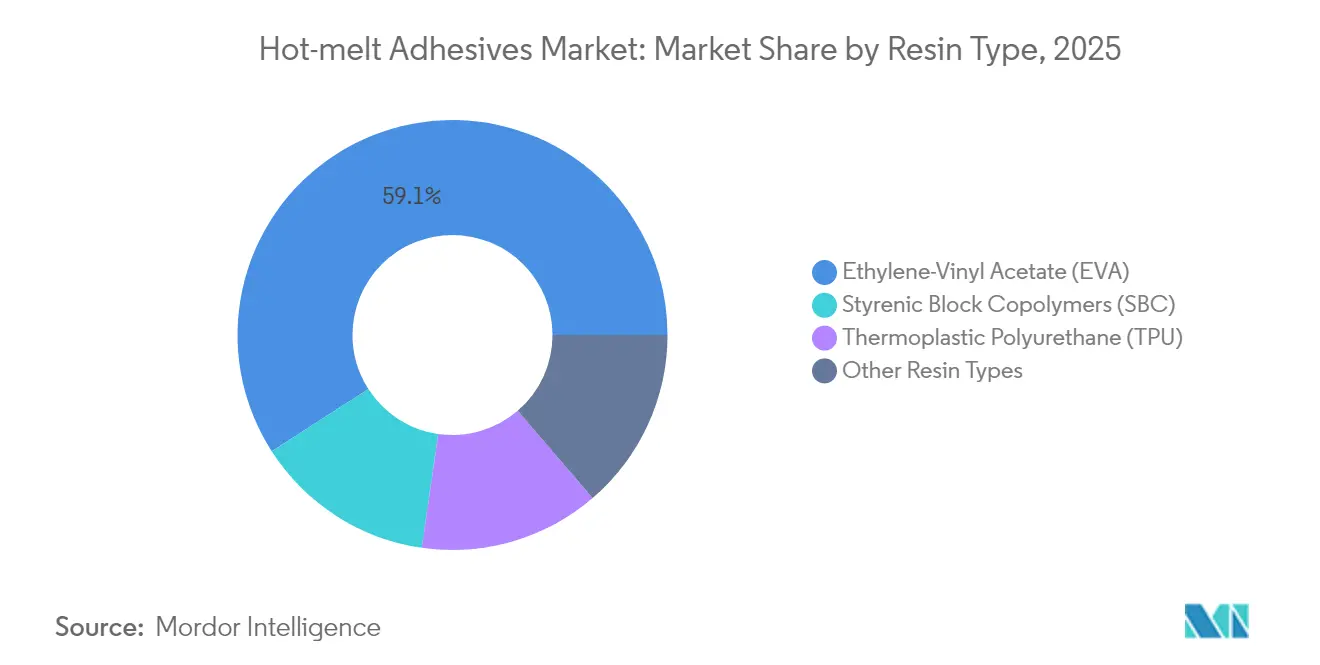
- By resin type, Ethylene-Vinyl Acetate maintained 59.10% of the market in 2025, and its 6.25% CAGR through 2031 is the fastest among major polymers.
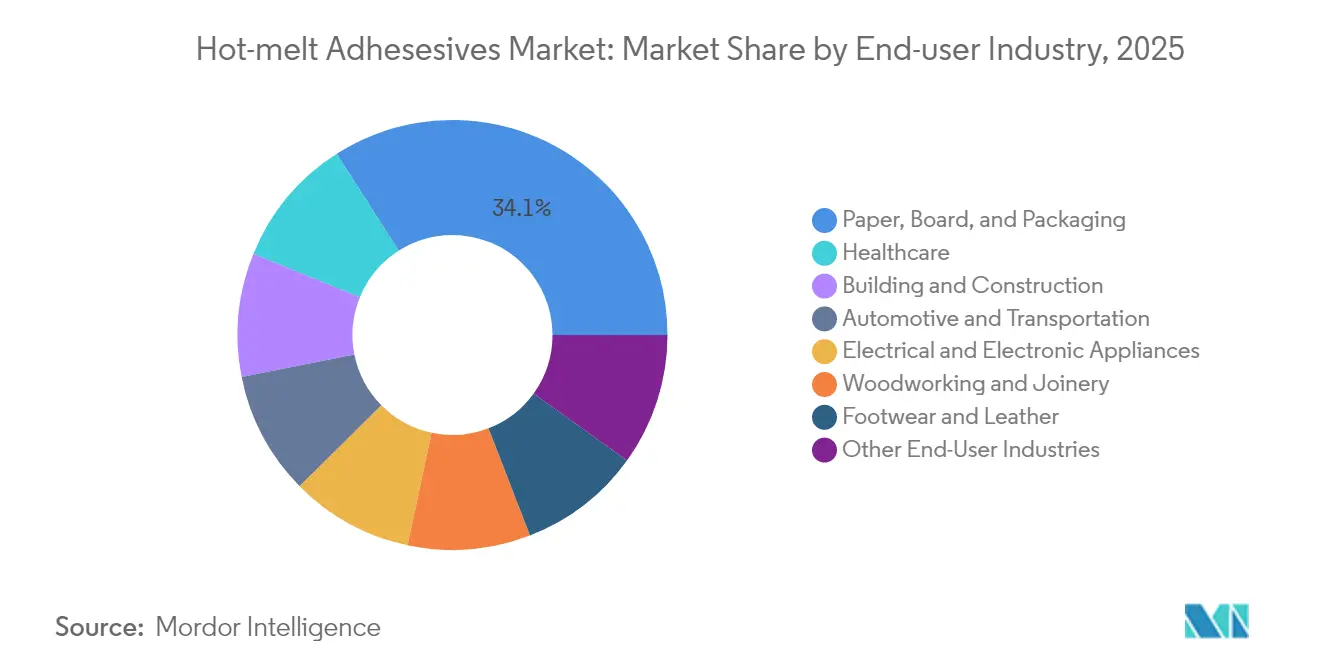
- By end-user industry, paper, board, and packaging led with 34.05% revenue share in 2025; healthcare is projected to record the highest CAGR at 6.02% through 2031.
- By geography, Asia-Pacific held 48.20% of the hot melt adhesives market share in 2025, while it is also forecast to expand at a 6.60% CAGR to 2031.
Note: Market size and forecast figures in this report are generated using Mordor Intelligence’s proprietary estimation framework, updated with the latest available data and insights as of 2026.
Market Trends and Insights
Drivers Impact Analysis of Hot-melt Adhesives Market*
| Driver | (~) % Impact on CAGR Forecast | Geographic Relevance | Impact Timeline |
|---|---|---|---|
| Shift From Solvent-Borne to Hot-Melt Systems in Fast-Moving Packaging Lines | +1.8% | Global, with APAC leading adoption | Medium term (2-4 years) |
| Explosive Growth of Asian E-Commerce Fulfilment Hubs Demanding Eco-Friendly Case-Sealing Adhesives | +1.5% | APAC core, spill-over to MEA | Short term (≤ 2 years) |
| Surge in Bio-Based Resin Capacity (Soy, Tall-Oil, Starch) Unlocking New Premium Niches | +1.2% | North America and EU leading, APAC following | Long term (≥ 4 years) |
| Automation of Furniture and Mattress Production Driving PUR And MPO Hot-Melts | +0.9% | Global, concentrated in manufacturing hubs | Medium term (2-4 years) |
| EV Lightweighting and Battery Module Bonding Requirements | +1.0% | Global, with China and EU leading EV adoption | Medium term (2-4 years) |
| Source: Mordor Intelligence | |||
Shift from Solvent-Borne to Hot-Melt Systems in Fast-Moving Packaging Lines
Production lines have cut cycle times by 40-60% by eliminating solvent flash-off and adopting melt-on-demand units that keep viscosity stable for entire shifts. Robatech’s Volta platform trims energy draw by 30% while meeting REACH and FDA food-contact rules, making it a template for upgrades across beverage multipack and snack pouch plants.
Explosive Growth of Asian E-Commerce Fulfilment Hubs Demanding Eco-Friendly Case-Sealing Adhesives
China processed more than 130 billion parcels in 2024, and fulfilment centers specify starch-based hot melts that compost within 180 days, curbing landfill loads. India and ASEAN follow, pushing corrugators to install high-speed gluers compatible with low-temperature bio-formulations that prevent board warping in humid climates.
Surge in Bio-Based Resin Capacity (Soy, Tall-Oil, Starch) Unlocking New Premium Niches
H.B. Fuller’s investments in renewable raw materials cut cradle-to-gate CO₂ by up to 40%. Soy-based polyols widen service temperature windows, and tall-oil tackifiers leverage pulp-mill by-products to lower fossil exposure, positioning suppliers for price‐premium contracts in personal-care wipes and infant-nutrition closures[1].
Automation of Furniture and Mattress Production Driving PUR and MPO Hot-Melts
SCM Group’s edgebanders deliver 20 m min⁻¹ feed rates with precise PUR bead control, enabling seamless joins on radius panels. Mattress lines adopt flame-retardant MPOs that retain elasticity after repeated compression tests, reducing polyurethane foam scrap rates in lean factories.
Restraints Impact Analysis of Hot-melt Adhesives Market*
| Restraint | (~) % Impact on CAGR Forecast | Geographic Relevance | Impact Timeline |
|---|---|---|---|
| Crude-Oil-Linked Price Volatility of Tackifier Resins | -1.1% | Global, with emerging markets most affected | Short term (≤ 2 years) |
| Limited Heat-Resistance Window Versus Structural Epoxies | -0.8% | Global, concentrated in automotive and aerospace | Medium term (2-4 years) |
| Growing VOC Scrutiny on Traditional SBC Tackifiers In EU | -0.6% | EU primary, with regulatory spillover to other regions | Long term (≥ 4 years) |
| Source: Mordor Intelligence | |||
Crude-Oil-Linked Price Volatility of Tackifier Resins
C5 and C9 hydrocarbon tackifiers make up 15-25% of conventional formulations and saw 30-40% price swings during 2024 energy shocks. Large buyers secure multi-year supply contracts; smaller converters absorb margin squeeze or reduce adhesive load rates, risking bond failure in humid transit environments.
Limited Heat-Resistance Window Versus Structural Epoxies
Under-hood parts must survive up to 150 °C, yet EVA softens near 85 °C, restricting adoption for engine components. High-temperature polyamides exist but cost three to five times more, so they remain confined to aerospace cabin interiors and premium electronics that can absorb the price delta.
*Our forecasts treat driver/restraint impacts as directional, not additive. The impact forecasts reflect baseline growth, mix effects, and variable interactions.
Hot-melt Adhesives Market Segment Analysis
By Resin Type:
EVA Dominance Drives Market StabilityEVA accounted for 59.10% of the hot melt adhesives market size in 2025 and is forecast to compound at 6.25% annually to 2031. Its balance of flexibility, adhesion, and cost keeps converters loyal, and decades of installed slot-die and spray equipment dampen switching incentives. The segment also benefits from a deep feedstock base in Asia and North America that cushions against isolated supply shocks.
Heightened sustainability goals push buyers toward metallocene polyolefins with 65% renewable content, such as Dow’s AFFINITY RE, which cuts carbon footprint by 40-50% while matching bond strength. Thermoplastic polyurethane captures share in footwear, offering abrasion resistance that withstands 100,000 flex cycles. Specialty polyamides and polyimides cater to electronics potting, leveraging high-temperature stability that EVA and SBC cannot match, but volumes remain niche due to price premiums.

By End-User Industry:
Packaging Leadership Amid Healthcare AccelerationPaper, board, and packaging consumed 34.05% of 2025 volume thanks to surge orders from e-commerce and beverage multipacks. Automation favors bead and swirl patterns that create tear-fibrous failure modes in corrugated case-sealing, boosting tamper evidence. Multi-substrate compatibility reduces SKUs for contract packers handling coated board, foil-lined pouches, and filmic overwraps in the same plant.
Healthcare is the fastest expander at 6.02% CAGR to 2031. Device makers require USP Class VI and ethylene-oxide sterilization resistance, which reactive hot melts fulfill without plasticizers. Pharmaceutical blister packs adopt low-application-temperature grades that avoid heat deformation of thin-gauge aluminum. Elsewhere, automotive harness wrapping, footwear toe-puff bonding, and electronics wire management all choose hot melts for weight savings and recyclability, underpinning a diverse demand base.
Geography Analysis
APAC Hot-melt Adhesives Market
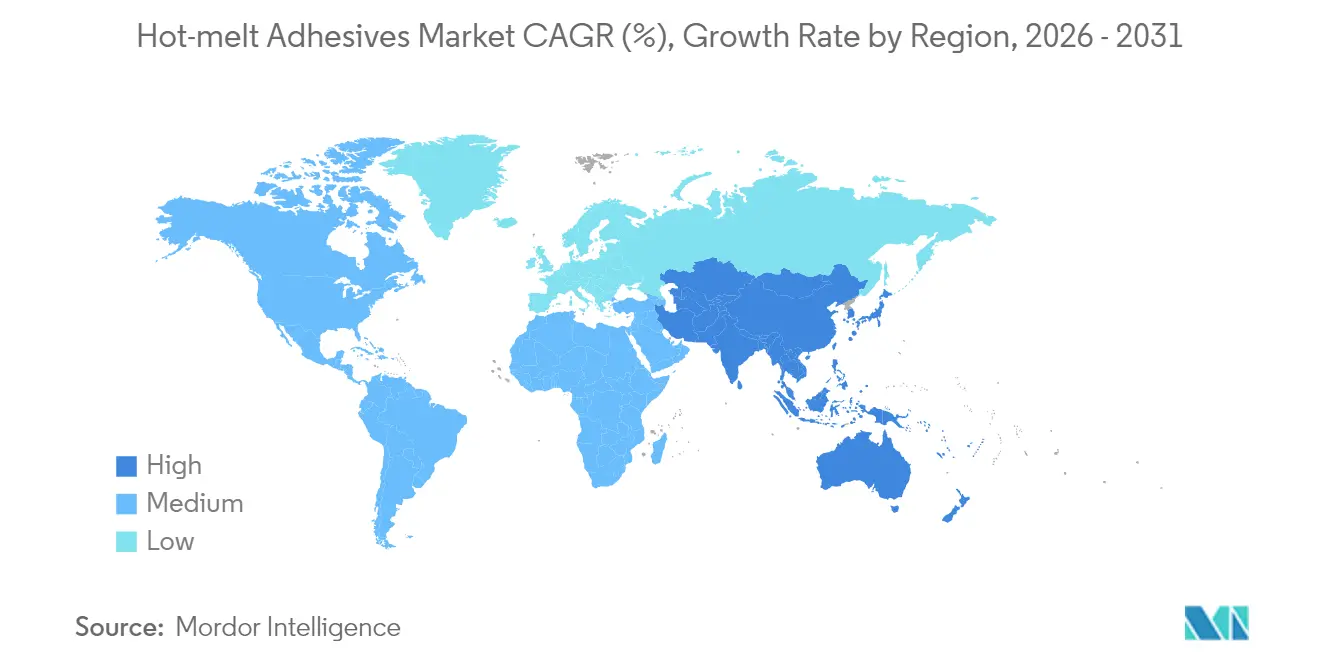
Asia-Pacific’s 48.20% dominance in 2025 stems from integrated supply corridors linking polymer crackers, tackifier reactors, and high-volume corrugators. Chinese converters sit adjacent to cell phone and appliance plants, ensuring just-in-time adhesive deliveries that minimize heated-tank idle time. India’s consumer-goods boom lifts demand for all-temperature carton sealing, and Southeast Asia benefits from printed-circuit board migration that needs precision jetting.
North America Hot-melt Adhesives Market
North American buyers prioritize premium performance and sustainability. U.S. automakers specify reactive polyolefins that permit end-of-life dismantling, while Canadian forestry residuals feed tall-oil tackifier streams that lower fossil intensity. Mexico’s maquiladoras amplify regional volumes with appliance assembly lines that require thermal-shock-resistant bonds.
EMEA and South America Hot-melt Adhesives Market
Europe’s stringent VOC caps accelerate substitution of solvented laminating adhesives with melt-based grades. German vehicle makers co-develop lightweight cockpit modules using PUR that passes crash pulse tests. The United Kingdom focuses on compostable bag seals to meet municipal waste targets, and Nordic players leverage bio-refineries to supply renewable waxes that trim CO₂ footprints. South America and MEA trail but invest in infrastructure insulation and consumer goods packaging, though currency volatility periodically tempers import demand.
Value Chain Analysis
The hot-melt adhesives value chain begins with upstream petrochemical and bio-based inputs, including base polymers (EVA, polyolefins, TPU, polyamides), tackifiers (rosin and hydrocarbon resins), waxes, plasticizers, antioxidants, and additives. These materials flow into adhesive formulators that compound and pelletize finished hot melts using heated, high-shear processing and filtration, then package in bulk, pellets, or sticks for shipment. Downstream, applicator and dispensing equipment providers support installation, maintenance, and process optimization on customer lines, particularly in high-speed packaging, hygiene nonwovens, woodworking, and assembly applications that require controlled viscosity and consistent open time.
Distribution typically combines direct supply to large FMCG, packaging, and OEM accounts with regional distributors serving converters and small-to-midsize manufacturers. Supply chain risk concentrates around crude-oil-linked intermediates and specialty resins, where volatility can tighten availability and shorten quotation validity periods. This has been highlighted by reported disruption-driven feedstock pressure for European formulators in 2026, impacting key inputs such as vinyl acetate monomer and hydrogenated hydrocarbon resins. In response, leading producers emphasize dual sourcing, safety stocks, and closer integration with ingredient partners. Henkel, for example, formalized a supply partnership with Synthomer to incorporate lower-carbon CLIMA-branded polymers into TECHNOMELT, and Arkema subsidiary Bostik invested USD 27 million (May 2025) in its Middleton, Massachusetts site to expand specialty hot melt technology platforms (including copolyamide and TPU capabilities), strengthening local supply resilience and shortening lead times for high-value grades.
Competitive Landscape
Henkel, 3M, and H.B. Fuller together held around 38% of revenue in 2024, indicating moderate concentration. Leaders integrate backward into ethylene and rosin feedstocks to buffer crude swings and command margin. Product pipelines highlight bio-content credentials and digital services: Henkel’s IoT dispensers alert operators before char forms; 3M promotes low-fogging interior trim adhesives for EV cabins; H.B. Fuller markets renewable-label adhesives that enable PET bottle recycling streams.
Mid-tier firms such as Bostik and Jowat focus on furniture, hygiene, and tapes, differentiating through application equipment partnerships that bundle consumables with maintenance plans. Start-ups target reversible bonding chemistries triggered by heat or microwave fields, aiming to unlock circular-economy dismantling. Barriers to entry include FDA 21 CFR compliance, REACH dossier costs, and the need for global technical-service footprints. Buyers favor suppliers that can validate line trials, deliver rapid color-match, and guarantee batch-to-batch rheology.
Hot-melt Adhesives Industry Leaders
-
3M
-
Arkema
-
Henkel AG & Co. KGaA
-
H.B. Fuller Company
-
Sika AG
- *Disclaimer: Major Players sorted in no particular order
Hot-melt Adhesives Market Companies Covered in this Report
- 3M
- Arkema
- Ashland
- Avery Dennison Corporation
- Daubert Chemical Company
- Dow
- Franklin International
- H.B. Fuller Company
- Henkel AG & Co. KGaA
- Hexcel Corporation
- Huntsman
- Jowat Corporation
- KLEIBERIT SE & Co. KG
- NANPAO RESINS CHEMICAL GROUP
- Paramelt B.V.
- Pidilite Industries Limited
- Power Adhesives Ltd.
- Sika AG
Market Opportunities and Future Outlook
Whitespace exists in scaling lower-carbon, circularity-enabling hot melts that fit high-throughput packaging and recycling-oriented label and substrate systems. Packaging remains the largest end-use (34.05% share in 2025), and brand-owner requirements for recyclability and lower emissions are translating into supplier actions such as Henkel updating its Technomelt portfolio with quantified cradle-to-gate carbon reductions and label solutions designed for clean separation from PET. These moves create room for formulators that can pair validated sustainability claims with line-speed performance, supported by dispensing platforms that reduce energy draw and adhesive char formation on equipment.
Another opportunity is growing regional capacity and specialization, particularly in Asia supply corridors and India-focused manufacturing footprints serving corrugated, flexible packaging, and assembly markets. Recent investments point to active capacity addition and localization: Henkel announced a EUR 20 million expansion and modernization at Bopfingen, Germany (October 2024) targeting hot melt and polyurethane adhesives, and it also announced plans for a dedicated hot-melt adhesives manufacturing unit in Udhamsingh Nagar, Uttarakhand with 5,010 metric tons annual capacity (February 2024). In North America, Bostik initiated a USD 27 million upgrade at Middleton, Massachusetts (May 2025) to expand specialty hot melt platforms, supporting higher-performance grades used in durable goods and heat-activated applications. With 2024 energy shocks driving 30-40% price swings in tackifiers cited in the report context, procurement programs increasingly reward suppliers that secure feedstock optionality and provide consistent rheology across batches. This reinforces the business case for backward integration, certified renewable inputs, and regional manufacturing redundancy.
Recent Industry Developments in Hot-melt Adhesives Market
- May 2026: Henkel introduced Technomelt PA 6370, an ultra-low viscosity polyamide-based hot melt designed for low-pressure molding to protect electronic components from demanding environmental exposure. The launch broadens hot-melt penetration in electronics protection applications where flow at low viscosity and robust encapsulation performance are decisive, supporting higher-value specialty demand.
- August 2025: Henkel introduced Technomelt EM 335 RE, a hot melt adhesive designed to enable clean separation of labels from PET bottles in high-speed labeling operations. The product aligns hot-melt label bonding with recycling-oriented packaging requirements while maintaining throughput and operational reliability on packaging lines.
- February 2024: Henkel Adhesives Technologies India Private Limited announced plans to establish a new hot-melt adhesives manufacturing unit in Udhamsingh Nagar, Uttarakhand, with 5,010 metric tons of annual capacity. The project signals continued localization of hot-melt supply for packaging and assembly customers in India, helping reduce reliance on imports and improve service levels for converters.
Hot-melt Adhesives Market Report Scope and Research Methodology
Market Definition and Coverage
For this report, the hot melt adhesives market is defined as the revenue generated from thermoplastic adhesive materials sold in solid form (pellets, pillows, sticks, or blocks) that are melted and applied to bond substrates across industrial and consumer uses.
Scope exclusions: This sizing excludes solvent-borne and water-based liquid adhesives that are not supplied or used as hot melt systems.
Segments Covered in This Report
- By Resin Type
- Ethylene-Vinyl Acetate (EVA)
- Styrenic Block Copolymers (SBC)
- Thermoplastic Polyurethane (TPU)
- Other Resin Types
- By End-user Industry
- Paper, Board, and Packaging
- Building and Construction
- Woodworking and Joinery
- Automotive and Transportation
- Footwear and Leather
- Healthcare
- Electrical and Electronic Appliances
- Other End-User Industries
- By Geography
- Asia-Pacific
- China
- India
- Japan
- South Korea
- ASEAN Countries
- Rest of Asia-Pacific
- North America
- United States
- Canada
- Mexico
- Europe
- Germany
- United Kingdom
- France
- Italy
- Russia
- NORDIC Countries
- Rest of Europe
- South America
- Brazil
- Argentina
- Rest of South America
- Middle East and Africa
- Saudi Arabia
- South Africa
- Rest of Middle East and Africa
- Asia-Pacific
Data Sources, Market Sizing, and Validation
Desk Research
Desk research was used to build the initial demand and supply picture and to keep basic assumptions consistent across regions. We reviewed public trade and industry data for chemical manufacturing activity and downstream packaging demand, then checked it against pricing and capacity commentary shared in company filings and investor presentations.
Sources used for orientation and cross-checks included, for example, US Census Bureau manufacturing data, USITC trade statistics, Eurostat industrial production series, UN Comtrade customs data, and publications from associations linked to packaging and adhesives. Patent databases were also reviewed to gauge how quickly reactive and specialty hot melt chemistries are being adopted, and a paid subscription for company financials and news helped validate timing of expansions and plant utilization narratives. These examples are not exhaustive, and many other public and paid sources were referred to for data collection, validation, and research clarification.
Primary Interviews and Surveys
Primary work focused on confirming where hot melt adhesives are specified and purchased, and how pricing moves through contracts across packaging, nonwovens, woodworking, and assembly uses. We spoke with producers, distributors, and downstream converters across the Americas, EMEA, and APAC so coverage gaps from public sources could be closed, and we retested the assumptions before finalizing totals.
Distribution of primary research fieldwork respondents
| Company type | Respondent position | Region |
|---|---|---|
| Top tier: 29% | CXOs: 16% | APAC: 43% |
| Mid tier: 55% | Functional/Unit leaders: 39% | EMEA: 32% |
| Smaller Players: 16% | Managers: 45% | Americas: 25% |
Market-Sizing & Forecasting
The main sizing route uses top-down logic, where packaging, hygiene, woodworking, and assembly activity levels are rebuilt by region and then converted into hot melt adhesive demand using penetration and usage rate assumptions gathered from interviews. The totals are corroborated through selective bottom-up approximations, such as sampled price per kilogram multiplied by estimated consumption volumes for key end uses, then adjusted using distributor channel checks to account for coverage gaps.
Inputs that matter most in this market included corrugated and flexible packaging output growth, diaper and hygiene product production trends, furniture and panel manufacturing activity, resin feedstock price movements (EVA and polyolefin related), and the share shift toward higher performance hot melts in faster packaging lines. Where interview feedback indicated a wide spread, we used scenario analysis around utilization, pricing pass-through speed, and mix changes, and then carried the mid case into the forecast. Forecasts were guided using multivariate regression at the regional level, where downstream production indicators and resin price indices helped explain historical demand, and expert inputs were used to confirm the direction and timing of inflection points.
Data Validation & Update Cycle
Model outputs were checked against independent signals like packaging throughput trends, trade flows for relevant polymer resins, and reported commentary on adhesive demand from public filings. When a region showed an unexpected jump, we reviewed assumptions, revisited price series timing, and re-contacted selected respondents to confirm whether the variance reflected real demand shifts or model-driven factors.
Before sign-off, the work went through multi-step analyst reviews, followed by consistency checks across regions and end uses so totals reconciled cleanly. The report is refreshed annually, with interim updates triggered by material events such as sharp feedstock price swings, meaningful capacity additions, or demand shocks in packaging and hygiene. Before delivery, an analyst performs a fresh pass so clients receive the latest updated view.
Mordor Intelligence's Hot Melt Adhesives Market Estimate Compared With Other Published Estimates
Published hot melt adhesives market values often differ because the counted product set, base year pricing, and the treatment of specialty chemistries do not align across sources. Differences also show up when some publishers use end-use demand indicators, while others rely more on supplier revenue shares without enough adjustment for mix and regional price levels.
Some external estimates fold in adjacent adhesive categories and present a single broad total, which can raise the number depending on what is bundled into the definition. In Mordor Intelligence, the value is counted only for hot melt adhesive revenues aligned to the defined resin types and end-user coverage, and then reconciled using packaging and hygiene demand checks plus price timing by region.
Benchmark comparison
| Source | Market Size | Gaps in Research Methodology |
|---|---|---|
| Mordor Intelligence | USD 10.15 B (2026) | |
| Industry Publisher A | USD 9.46 B (2025) | Uses a different base year and pricing window, and the scope is organized by product groups that may not consistently separate reactive and specialty hot melts across regions, which can compress the stated total. |
| Research Group B | USD 8.79 B (2024) | Anchors the estimate to an earlier base year and applies a higher growth curve, and the published method gives limited visibility on how regional price differences and end-use penetration rates were validated. |
The spread in values is mainly explained by year choice and how tightly the market definition is kept to hot melt systems versus broader adhesive groupings. By tying the total to clear downstream demand pools, regional price timing, and interview-backed penetration assumptions, the estimate stays traceable and repeatable even when public data is uneven.
Key Questions Answered in the Report
What is current size of hot melt adhesives market?
It is estimated at USD 10.15 billion in 2026 and projected to reach USD 13.42 billion, reflecting a 5.74% CAGR from 2026.
Which resin dominates current demand?
EVA accounts for 59.10% of global volume, sustaining its lead with a 6.25% forecast CAGR.
Why is Asia-Pacific the largest regional consumer?
The region hosts integrated polymer supply chains and high parcel volumes that require automated case-sealing.
What end-use industry is growing the fastest?
Healthcare industry is expanding at a 6.02% CAGR due to device assembly and pharmaceutical packaging needs.