
UAE Hospitality Market Analysis by Mordor Intelligence
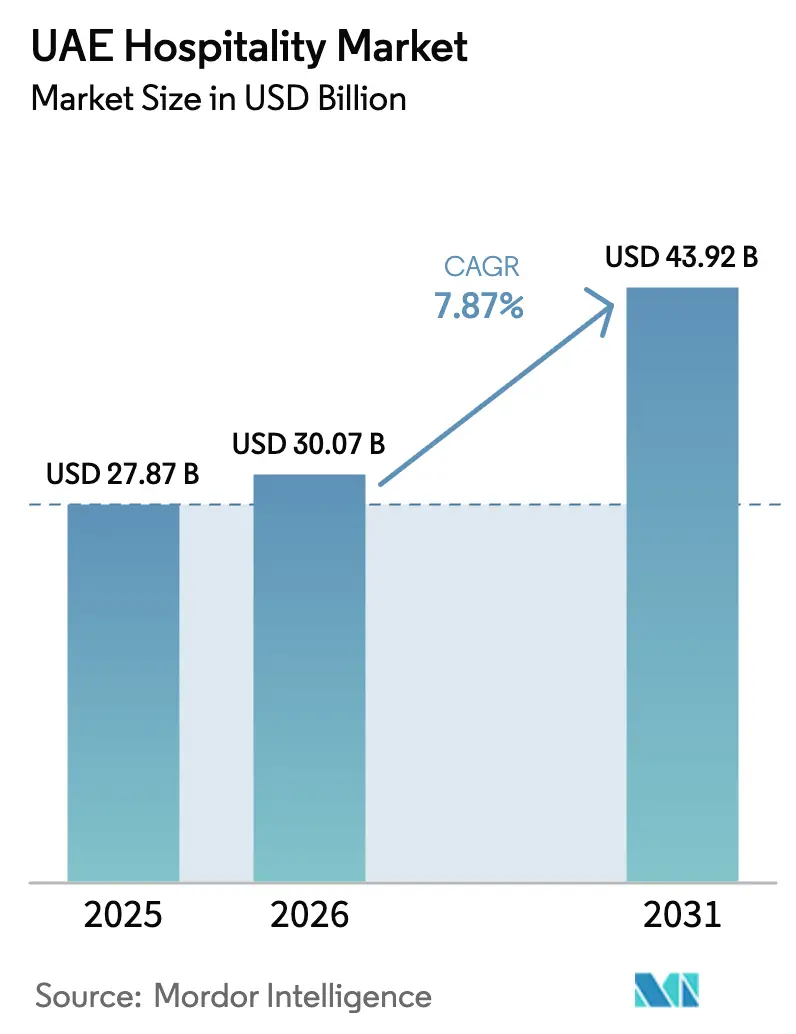
The UAE hospitality market size was valued at USD 30.07 billion in 2026 and estimated to grow from USD 32.44 billion in 2027 to reach USD 46.4 billion by 2032, at a CAGR of 7.42% during the forecast period (2027-2032).
Destination development and business activity broaden reasons to stay in the United Arab Emirates, creating room for hotels to combine accommodation with on-property services. Travel disruption following US-Israel strikes on Iran and subsequent Iranian attacks across the Gulf from February 28, 2026, exposed hotels' dependence on international access. Iran war-related construction disruption and material-cost pressure in Ras Al Khaimah from February 2026 also complicated new resort delivery. Brand and management partnerships help structure expansion around distinct development and operating roles, with prospective hotel capacity tied to different project schedules. Hotel investment can add capacity without removing the dependence of room sales on international access.
Key Report Takeaways
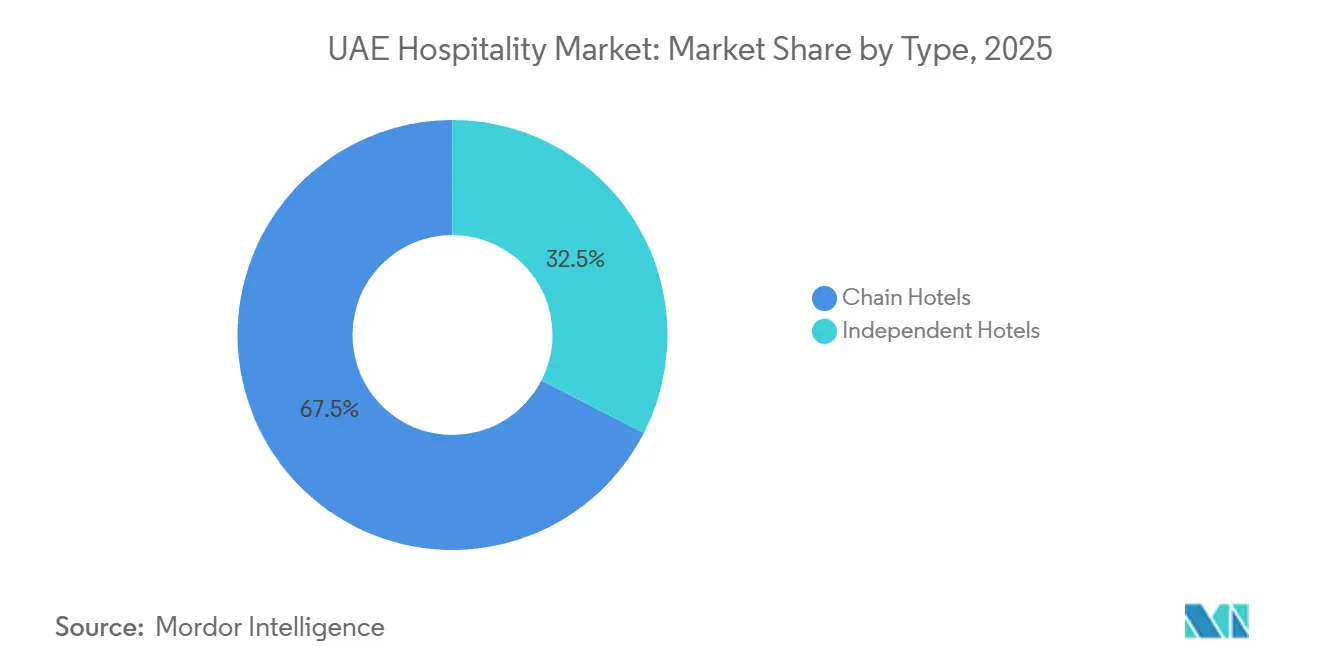
- By type, chain hotels held a 66.73% UAE hospitality market share in 2026, while independent hotels are the fastest-growing segment at a forecast CAGR of 9.85% during 2027-2032.
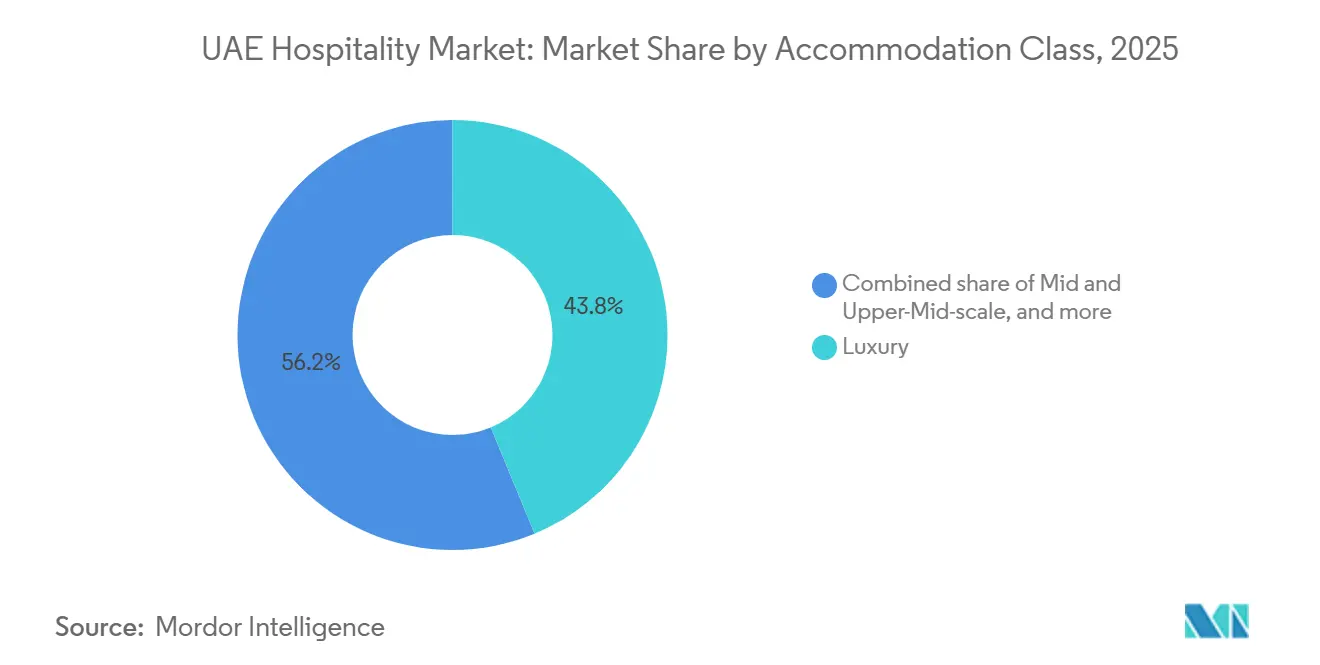
- Among accommodation classes, luxury represented a 43.54% share of the UAE hospitality market size in 2026, and service apartments are forecast to grow fastest at a CAGR of 11.3% during 2027-2032.
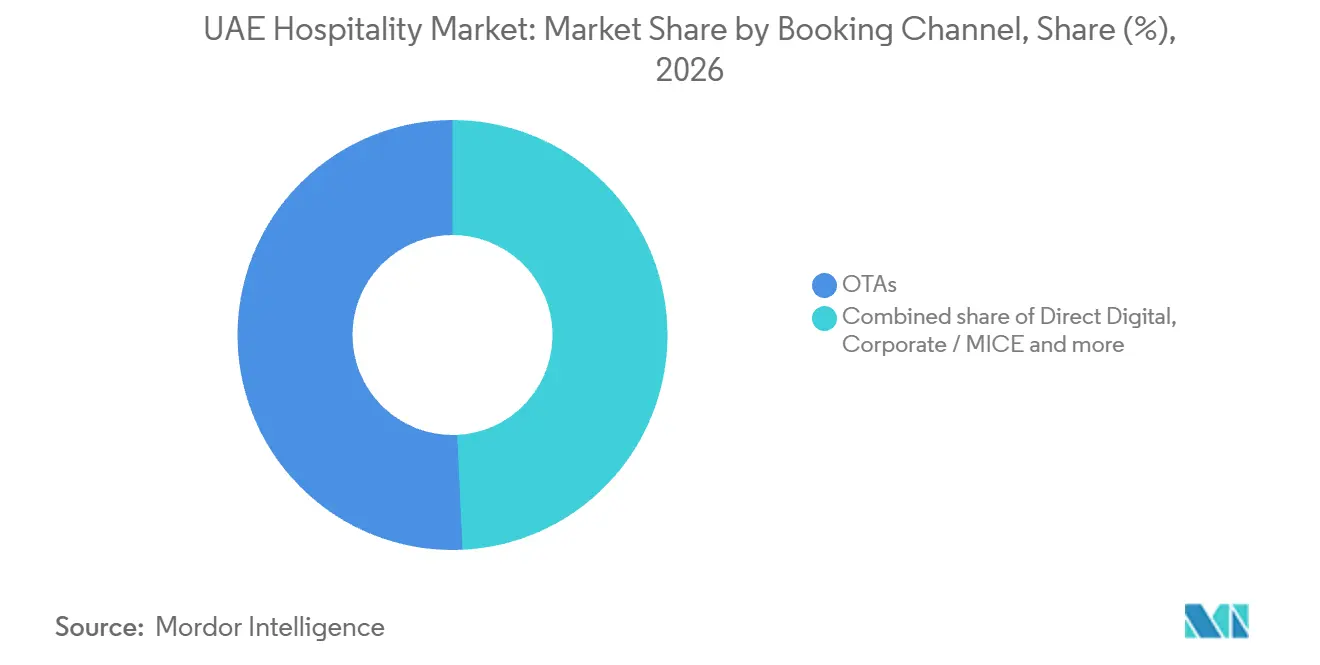
- Within booking channels, OTAs led with a 50.75% share in 2026, whereas direct digital is the fastest-growing segment at a forecast CAGR of 13.95% during 2027-2032.
- Across emirates, Dubai led with a 63.33% share in 2026, while Ras Al Khaimah is forecast to grow fastest at a CAGR of 10.4% during 2027-2032.
Note: Market numbers in this report are based on Mordor Intelligence's proprietary estimation framework, which combines nine months of actuals with Q4 projections for base year 2026.
Market Trends and Insights
Drivers Impact Analysis of UAE Hospitality Market*
| Driver | (~) % Impact on CAGR Forecast | Geographic Relevance | Impact Timeline |
|---|---|---|---|
| Transformation Into a Global Lifestyle and Entertainment Destination | +3.4% | Nationwide | Long term (≥ 4 years) |
| High-Net-Worth Visitor Economy Supporting Premium Spending | +1.6% | Nationwide | Medium term (2-4 years) |
| Free Zone Economy Creating International Business Visitor Demand | +2.3% | Dubai World Trade Centre | Medium term (2-4 years) |
| Mixed-Use Real Estate Models Integrating Hospitality Assets | +1.5% | Downtown Dubai area | Long term (≥ 4 years) |
| Mega-Attraction Ecosystem Expanding Leisure Tourism Segments | +0.8% | Emirate of Dubai | Long term (≥ 4 years) |
| Family Entertainment and Indoor Tourism Infrastructure Supporting Year-Round Visits | +0.5% | Yas Island, Abu Dhabi | Short term (≤ 2 years) |
| Source: Mordor Intelligence | |||
Transformation Into a Global Lifestyle and Entertainment Destination
New cultural attractions give accommodation operators additional reasons around which to build a stay, beyond selling a room in isolation. In April 2025, teamLab Phenomena Abu Dhabi opened on Saadiyat Island. UAE hotel establishments hosted more than 32 million guests in 2025, up 5.1% from 2024. New destination experiences alongside that substantial hotel-use base create an opening for properties to connect accommodation with a more specific purpose for visiting. The attraction supplies a reason to visit, while hotels can compete for the accommodation and on-property service spending attached to a cultural stay.
High-Net-Worth Visitor Economy Supporting Premium Spending
With luxury the UAE's largest accommodation class, high-net-worth visitor demand can increase hotel earnings through higher-value accommodation and personalized services. In Dubai, a premium stay could be organized around suites, residence-style space, and private dining rather than standard guestrooms alone. Serving fewer high-spending guests would concentrate revenue in individual stays and require staffing to match the promised degree of attention. Additional service income must cover that labor and operating commitment. If the offer fails to secure those stays, the property carries specialized space and staffing costs without the associated revenue.
Free Zone Economy Creating International Business Visitor Demand
Business expansion and international events create complementary opportunities for hotels serving Dubai's commercial districts. Dubai World Trade Centre (DWTC) Free Zone issued 850 new licenses in 2025, a 41% increase from 2024. Separately, Dubai World Trade Centre hosted 134 MICE events that attracted 2.19 million participants in 2025, up 8% year over year. Approximately 951,000 participants were international, accounting for 43% of attendance. For nearby hotels, this combination supports an accommodation proposition spanning event visits and company-related travel, with meeting services offering another potential source of establishment revenue. The strongest commercial fit is a property that can serve concentrated event demand while offering business visitors reasons to use its services between major gatherings.
Mixed-Use Real Estate Models Integrating Hospitality Assets
Wasl Tower combines hotel accommodation, private residences, and dining venues within one mixed-use development. Mandarin Oriental opened its Downtown Dubai hotel within Wasl Tower on November 7, 2025, with 259 guestrooms and suites, 224 private residences, and 10 dining venues.[1] Wasl Hospitality was the development partner, linking the accommodation operation with the tower's wider property proposition. The hotel rooms, private homes, and dining venues remain distinct components of the development. The dining venues give Mandarin Oriental a separate sales opportunity within the tower, alongside the hotel's room business.
Restraints Impact Analysis of UAE Hospitality Market*
| Restraint | (~) % Impact on CAGR Forecast | Geographic Relevance | Impact Timeline |
|---|---|---|---|
| High Competition Among Luxury Hospitality Destinations Pressuring Differentiation | -1% | Emirate of Dubai | Medium term (2-4 years) |
| Dependence on International Visitors Creates Exposure to Global Travel Disruptions | -1.2% | Nationwide | Short term (≤ 2 years) |
| Oversupply Risk in Premium Hotel Segments Due to Rapid Accommodation Expansion | -0.3% | Nationwide | Long term (≥ 4 years) |
| Climate Conditions and Seasonality Challenges Affect Outdoor and Resort Operations | -0.2% | Nationwide | Short term (≤ 2 years) |
| Source: Mordor Intelligence | |||
High Competition Among Luxury Hospitality Destinations Pressuring Differentiation
A premium hotel proposition becomes harder to monetize when guests question whether its additional services justify the room rate. KPMG's 2025 Dubai hospitality report said guests were becoming more price-sensitive and luxury hotels were adjusting prices and average daily rates because of competition. The same report described competition-driven price decreases as a challenge for Dubai hospitality businesses. That combination constrains an operator's ability to rely on luxury positioning alone when setting the commercial terms of a stay. Distinctive experiences can provide a reason to choose a property, but their operating cost must be supported by what guests will pay. The resulting constraint is a narrower margin for service investment that adds cost without securing a stronger room-rate proposition.
Dependence on International Visitors Creates Exposure to Global Travel Disruptions
Regional travel disruption followed US-Israel strikes on Iran and subsequent Iranian attacks across the Gulf from February 28, 2026, affecting hotel demand in the UAE. In March 2026, Rove Hotels said international bookings in its UAE portfolio had slowed significantly after the conflict began. In April 2026, Centara Mirage Beach Resort Dubai reported a direct impact on bookings and cancellations. These operator experiences show how destination access can constrain the customer flow on which a property's accommodation proposition depends. Each missed stay also removes the opportunity to earn from dining and other on-property services, extending the exposure across the hotel's revenue model.
*Our forecasts treat driver/restraint impacts as directional, not additive. The impact forecasts reflect baseline growth, mix effects, and variable interactions.
UAE Hospitality Market Segment Analysis
By Type:
Brand Scale and Owner Control Shape Different ModelsChain hotels accounted for a 66.73% share of the UAE hospitality market size in 2026. The largest segment includes Ciel Dubai Marina, which opened within IHG's Vignette Collection on November 17, 2025, with 1,004 guestrooms. The First Group led the development project, and The First Group Hospitality managed the property. Collection affiliation therefore need not place daily hotel management with the international brand company. For owners, collection affiliation and property management are distinct commercial decisions, even when both support the same hotel identity.
Independent hotels are the fastest-growing segment, with a forecast CAGR of 9.85% during 2027-2032. Chambers and Partners' 2026 UAE guide describes these properties as privately owned hotels without major-chain affiliation whose owners control operations, branding, and management. Control over branding and operations gives the owner a mechanism to differentiate the stay around an individual property's identity. For a new independent property, the owner must establish both its hotel identity and its operating organization from the outset.

By Accommodation Class:
Luxury Service Breadth Meets Apartment ExpansionLuxury represented a 43.54% UAE hospitality market share in 2026. As the largest segment, luxury's commercial proposition can span accommodation and a broad set of on-property hospitality services. Dubai's ultra-luxury Jumeirah Marsa Al Arab resort opened in March 2025 with 300 rooms, 86 suites, 82 separate private residences, 11 restaurants, 4 bars, and a 3,500-square-meter spa. For an operator, the additional service capacity creates more potential guest-spending occasions, while also widening the operating responsibilities attached to each stay. The operating challenge is to monetize dining and wellness alongside rooms, since room inventory alone cannot represent this resort's full earning potential.
Service apartments are the fastest-growing segment, with a forecast CAGR of 11.3% during 2027-2032. Cheval Collection opened Cheval Maison Expo City Dubai in 2025 after announcing 151 serviced apartments for the property. Apartment accommodation gives an operator a way to organize a stay around self-contained space, distinguishing the unit's use from a conventional guestroom. Budget and economy hotels serve a different price-sensitive proposition, with the UAE Ministry of Economy and Tourism describing budget hotels as small to medium-sized properties with basic services for travelers with limited budgets. For apartment operators, self-contained accommodation offers a way to compete on living space alongside budget hotels' emphasis on low room rates.
By Booking Channel:
Intermediary Reach and Direct Relationships CoexistOnline travel agencies (OTAs) were the largest segment, with a 50.75% share of hospitality operating revenue in 2026. Trip.com recorded triple-digit year-over-year growth in hotel room nights on its GCC local sites in the first half of 2026. Dubai was its leading hotel-booking destination across the GCC. For a Dubai hotel, an intermediary with a substantial regional booking base offers a route to travelers comparing accommodation across destinations. Demand arriving through that intermediary can generate stays for Dubai hotels without creating a direct booking relationship with the property.
Direct digital is the fastest-growing segment, with a forecast CAGR of 13.95% during 2027-2032. Through a direct website or app relationship, a hotel can organize its accommodation offer and subsequent service communication within the same commercial channel. The opportunity lies in connecting the booking with the property's own guest-service proposition throughout the stay. Corporate and MICE travel has a separate event-related basis, with Dubai hosting 481 Dubai Business Events-supported business events in 2025. For this buyer group, an accommodation offer can be organized around a business event's stay and meeting requirements, giving the operator a different service-design task from an individual leisure booking.
Geography Analysis
Dubai UAE Hospitality Market
Dubai accounted for a 63.33% share of the UAE hospitality market size in 2026. Its hotel inventory reached 154,264 rooms across 827 establishments by the end of 2025. Dubai hotels recorded 44.85 million occupied room nights in 2025, up 4% from 43.03 million in 2024. Accommodation activity on that scale supports an opportunity spanning rooms and the services that an establishment can sell to its guests. The large occupied-room-night base gives operators substantial demand to contest, while the extensive room inventory prevents scale alone from distinguishing an individual property.
Ras Al Khaimah UAE Hospitality Market
Ras Al Khaimah is the fastest-growing geography, with a forecast CAGR of 10.4% during 2027-2032. The Ras Al Khaimah Tourism Development Authority reported more than 670,000 destination visitors in the first half of 2026, a record first-half total, while domestic arrivals rose 47% year over year. In its H1 2026 update, RAK Properties reported advanced management-agreement discussions with operators for 2 new hotels, with commercial terms still being finalized. Those prospective management mandates offer operators a route to turn destination visits into paid stays through additional accommodation, with entry dependent on concluding commercial terms.
Abu Dhabi combines business-event and cultural demand, with 2.2 million MICE delegates and 4.2 million culture and leisure event attendees in 2025. Sharjah recorded 1.18 million hotel guest nights and 81% occupancy in the fourth quarter of 2025, illustrating intensive quarterly use of its accommodation base. In Ajman, Abu Dhabi National Hotels manages Radisson Blu Hotel Ajman, providing a local example of a specialized hotel-management role. Fujairah's 2025 tourism report recorded average hotel occupancy above 60% and weekend occupancy above 90%, making peak-period service capacity commercially relevant. Umm Al Quwain's Vida Beach Resort in Al Raudah, Al Khor 1 combines rooms, chalets, dining, and event spaces, linking beachfront accommodation with several on-property service uses.
Regulatory Framework and Outlook
The comparison examines selected jurisdictions from a taxable hotel operator's perspective, pairing national business-operating duties with Dubai's hotel-specific requirements. UAE taxable persons must register for corporate tax, with returns due to the Federal Tax Authority (FTA) within 9 months of each tax period's end and payment generally due by that deadline. Dubai establishments, including those in special development zones and free zones, need licensing and classification before operating and prior written approval before construction or conversion, subject to other legislation. Dubai hotel owners must also maintain fire-prevention systems, comply with Civil Defence safety requirements, and notify the authority and obtain approval for safety-affecting modifications.
Regulatory Table of UAE Hospitality Market
| Decision factor | United Arab Emirates | Dubai |
|---|---|---|
| Primary authority | Federal Tax Authority | Dubai Department of Economy and Tourism; Dubai Civil Defence General Command |
| Key instruments or direction | Corporate tax for financial years beginning on or after June 1, 2023 | Decree No. 17 of 2013; Law No. 4 of 2025 |
| Commercial effect | Taxable-person registration; returns within 9 months of period end; payment generally due by that deadline | Prior development approval; owners' fire-safety maintenance and modification approvals; compliance certification for licensing and insurance |
| Current policy attractiveness | Medium | Medium |
| Future direction of policy attractiveness | No change | No change |
| Source: Mordor Intelligence | ||
The national Medium rating reflects recurring registration and filing obligations for taxable operators. On October 7, 2026, the FTA issued scope and registration guidance for the Qualified Domestic Minimum Top-up Tax, applicable to qualifying multinational groups for fiscal years beginning on or after January 1, 2025. Its focus on implementing the existing regime supports a No change outlook for the national column. Dubai's Medium rating and No change outlook reflect ongoing project approvals, owners' recurring safety duties, and compliance certification that conditions licensing and insurance.
Value Chain Stages
The value chain compares asset development, management contracting, and delivery of hotel services, which expose participants to different earnings risks. Iran war-related construction disruption and material-cost pressure affected Ras Al Khaimah from February 2026. In August 2026, Wynn delayed its planned resort opening to September 2027 amid construction disruptions. Reported construction costs rose by USD 600 million to approximately USD 5.7 billion, partly because of rising material costs linked to the war.
Value Chain Analysis Table of UAE Hospitality Market
| Primary activity | Key participants | Value capture | Bottleneck | Resilience response |
|---|---|---|---|---|
| Develop and own hospitality assets | Hotel developers such as AVENEW Development and Wynn | Income from owned hotel operations | Construction disruption delays the start of operating income | Sequence delivery around critical works and retain schedule flexibility |
| Contract hotel brands and managers | Hotel brand partners such as Hilton; hotel managers such as Rotana Hotels | Brand and management-service fees | Owner and operator responsibilities must align before service delivery | Agree handover milestones and operating accountability |
| Deliver accommodation and on-property services | Hotel owner-operators such as Abu Dhabi National Hotels and National Corporation for Tourism & Hotels | Room, dining and other on-property service sales | Peak room use can outpace dining or event-service capacity | Match service schedules and staffing to booked room and event demand |
| Source: Mordor Intelligence | ||||
The separation of ownership and management lets capital investment and hospitality expertise enter the same property through different organizations. In October 2025, SKH Private Family Office announced the acquisition and redevelopment of The Cove Rotana Resort, with Rotana to resume full management and operations for 15 years from December 1, 2025. Cove Holding Resort, wholly owned by SKH Family Office, owns the Ras Al Khaimah property. Existing assets can therefore support a management-contract opportunity without requiring another hotel to be built, widening the route into hospitality beyond new construction.
Competitive Landscape
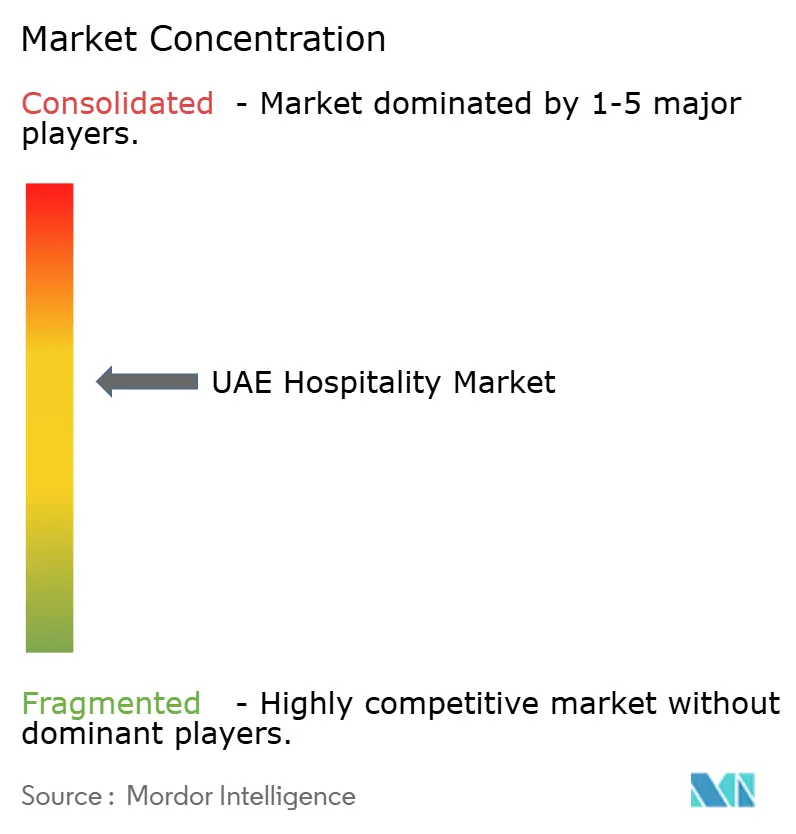
The competitive field includes Marriott International, Accor, Hilton Worldwide, IHG Hotels & Resorts, and Rotana Hotels. Brand portfolios, including Hilton-branded Conrad Abu Dhabi Etihad Towers and Rotana-portfolio Beach Rotana in Abu Dhabi, coexist with developer-partnered projects. In October 2025, Marriott International and Shamal Holding announced a signed agreement for a planned EDITION hotel and branded residences at Dubai Harbour, with completion scheduled for 2029. The agreement illustrates a structure in which a hotel brand company and a development partner contribute different roles to the same property. For Shamal, EDITION supplies a branded hotel proposition, while Marriott's planned supply addition depends on the development partnership delivering the project.
Accor's announced expansion illustrates how a hotel brand can participate in a developer's broader coastal property strategy. On April 28, 2025, Fairmont Hotels & Resorts, part of Accor, and Ardee Developments announced a partnership for a planned hotel and residences in Ras Al Khaimah.[2] The hotel was scheduled to open by the end of 2028 with 250 keys, while the separate residential component comprised 519 planned residences. Accor said its Accor One Living platform, which focuses on designing and operating mixed-use hospitality solutions for investors and homeowners, supports the project.
Announced brand expansions imply staggered additions to competition, with project delivery and operating approvals determining when planned hotel capacity can begin serving guests. In April 2025, IHG Hotels & Resorts signed a management agreement with API Hotels & Resorts for a planned 280-room Kimpton hotel in Dubai. That announcement scheduled the opening for the first quarter of 2026 and described 3 dining concepts and 7 flexible meeting spaces. Fairmont's end-2028 opening schedule and EDITION's 2029 completion schedule place those planned additions beyond Kimpton's original target. Dubai hotel establishments, including free-zone properties, must obtain Dubai Department of Economy and Tourism licensing and classification before operating, so the Dubai additions also depend on that approval.
UAE Hospitality Industry Leaders
-
Marriott International
-
Accor
-
Hilton Worldwide
-
IHG Hotels & Resorts
-
Rotana Hotels
- *Disclaimer: Major Players sorted in no particular order
UAE Hospitality Market Companies Covered in this Report
- Marriott International
- Accor
- Hilton Worldwide
- IHG Hotels & Resorts
- Rotana Hotels
- Emaar Hospitality Group
- Jumeirah Group
- Hyatt Hotels Corporation
- Wyndham Hotels & Resorts
- Millennium & Copthorne
- Minor Hotels (Anantara / Avani / Oaks)
- Rove Hotels
- Kerzner International (Atlantis / One&Only)
- DAMAC Hotels & Resorts
- Address Hotels + Resorts
- Fairmont Hotels & Resorts
- Shaza Hotels
- Aleph Hospitality
- Four Seasons
Key Opportunities for Market Participants
The opportunities compare policy-supported hotel development, eligible hotel-apartment projects, and planned accommodation additions within a destination pipeline. Dubai's 2025 hotel incentive offers eligible establishments a 100% refund of the Municipality Fee on room sales and the Tourism Dirham Fee.[3] Eligible hotels, resorts, and hotel apartments must be licensed after the resolution's effective date and designated by the Dubai Department of Economy and Tourism (DET) in coordination with the General Secretariat and Department of Finance. DET may extend the operating deadline by one year in coordination with the General Secretariat and Department of Finance, so extra delivery time depends on administrative approval.
Market Opportunities Table of UAE Hospitality Market
| Opportunity | Why now | Buyer / lead segment | Recommended play | Main barrier | Likely beneficiaries |
|---|---|---|---|---|---|
| Eligible new hotel and resort capacity | Dubai's 2025 initiative refunds the Municipality Fee on room sales and the Tourism Dirham Fee for qualifying establishments | New hotel and resort owners | Align launch sequencing with incentive eligibility | Meeting the required operating deadline | Eligible hotel and resort owners |
| Qualifying hotel-apartment development | Hotel apartments are included in the incentive's eligible formats | New hotel-apartment owners and operators | Combine an apartment operating model with a compliant application | Sustaining the required licensed operations | Eligible hotel-apartment owners and managers |
| Accommodation within the Yas Island pipeline | Miral's September 2026 plan includes additional hotel rooms | Destination developer and prospective hotel operators | Develop a hotel-service proposition suited to the planned destination expansion | Coordinating hotel delivery with a broader phased development | Miral and prospective hotel operators |
| Source: Mordor Intelligence | |||||
On September 14, 2026, Miral announced a planned 5-year Yas Island development and attraction-expansion pipeline that also includes additional hotel rooms. For prospective operators, this creates a potential accommodation opening alongside a broader destination investment, with delivery coordination central to when guest-service revenue can begin. Dubai's refund requires operations within 3 years of application, subject to the possible extension, so delivery timing determines whether a qualifying developer can capture the benefit.
Recent Industry Developments in UAE Hospitality Market
- Sep 2026: Miral announced a planned 5-year expansion of Yas Island's destination offering, including additional hotel rooms alongside new developments and attraction enhancements.
- Sep 2026: The 175-room Vida Aljada hotel, owned and developed by Arada, officially opened in Sharjah, with Emaar Hospitality Group operating it under its Vida Hotels & Resorts brand.
- Aug 2026: Wynn delayed its planned Ras Al Khaimah resort opening to September 2027 amid construction disruptions.
UAE Hospitality Market Report Scope and Research Methodology
Market Definition and Coverage
UAE hospitality market covers paid guest accommodation and on-property hospitality services provided by hotels, resorts, and serviced apartments across the United Arab Emirates. Its value is the annual operating revenue recognized by these establishments for those services.
Scope exclusions: Airline and transport sales, attraction and tour-operator sales, sales by standalone restaurants, bars and event venues, and separately charged OTA commissions and travel-agent fees are excluded.
Segments Covered in This Report
- By Type
- Chain Hotels
- Independent Hotels
- By Accommodation Class
- Luxury
- Mid & Upper-Mid-scale
- Budget & Economy
- Service Apartments
- By Booking Channel
- Direct Digital
- OTAs
- Corporate / MICE
- Wholesale & Traditional Agents
- By Geography
- Dubai
- Abu Dhabi
- Sharjah
- Ras Al Khaimah
- Ajman
- Fujairah
- Umm Al Quwain
Data Sources, Market Sizing, and Validation
Desk Research
The Federal Competitiveness and Statistics Centre's tourism-statistics methodology identifies hotel and hotel-apartment establishments as its target community and separates accommodation, food and drink, and other hotel revenues. The Ministry of Economy and Tourism's releases provide national hotel revenue, guest, room and occupancy series, while Government of Dubai Media Office releases, such as its 2025 national tourism results and Dubai's annual visitor and hotel performance results, add emirate-level room-night, average-rate and available-room indicators.
Company annual filings and investor materials can clarify portfolio formats, planned openings and operating roles, while reputable UAE business press can cross-check project timing and reported hotel activity. These examples are not exhaustive, and further sources inform collection, validation and clarification.
Primary Interviews and Surveys
Interviews with hotel and resort operators, serviced-apartment managers, asset owners, revenue-management leaders and tourism or emirate-level officials in the United Arab Emirates can test how revenue is recorded across accommodation and on-property services. Discussions can check the secondary evidence on occupancy, room rates, service mix, booking routes and property openings, then clarify material gaps or differences in coverage. Analyst estimates can be triangulated against establishment and room data, reported guest nights and operator disclosures, with unresolved inputs carried as ranges or tested under alternative demand and yield scenarios.
Distribution of primary research fieldwork respondents
| Company type | Respondent position | Region |
|---|---|---|
| Top tier: 30% | CXOs: 20% | |
| Mid tier: 45% | Functional/Unit leaders: 35% | |
| Smaller Players: 25% | Managers: 45% |
Market-Sizing & Forecasting
The model starts top down with national hotel-establishment revenue and builds a 2027 value and forecast for the United Arab Emirates, using hotel guests and guest nights to measure demand, room inventory and openings to track capacity, occupancy to estimate room use, average daily rates and revenue per available room to capture price and utilization, and food, beverage and event activity to reflect on-property service revenue. Scenario analysis can project how visitor demand, room additions, utilization and yield develop together, while selective bottom-up checks multiply sampled room counts by occupied nights and local room rates, then add supported on-property service revenue, and operator or emirate roll-ups can test the result. Geography and segment shares are built from establishment and room supply, available revenue disclosures, occupancy and rate evidence, and the distribution of booking routes, with source coverage checked before each input is assigned. Experts can check the direction and plausibility of the visitor, capacity, utilization, yield and service-revenue forecasts, and gaps in emirate or segment data can be estimated from comparable national indicators and tested with alternate weights before reconciliation.
Data Validation & Update Cycle
Analysts triangulate reported establishment revenue against guest nights, room supply, occupancy and rate indicators, checking that national and emirate signals move consistently. They investigate anomalies such as a revenue change unsupported by room use or rates, reconcile differences against source definitions, and complete sequential analyst review before sign-off. Re-contact is triggered when an operator disclosure, source update or material event changes a key input or leaves conflicting coverage unresolved. The evidence is refreshed annually, reviewed between cycles after material events such as major openings or travel disruption, and checked again in a fresh pre-delivery pass.
Mordor Intelligence's the United Arab Emirates Hospitality Market Size Measured Against Other Published Estimates
Published estimates can differ in the transactions and products they count and the inputs used to model demand. UAE hospitality market covers paid guest accommodation and on-property hospitality services provided by hotels, resorts, and serviced apartments across the United Arab Emirates.
Key Gap Drivers include the study's defined coverage and market-specific modeling choices. Experts can check the direction and plausibility of the visitor, capacity, utilization, yield and service-revenue forecasts, and gaps in emirate or segment data can be estimated from comparable national indicators and tested with alternate weights before reconciliation.
Benchmark comparison
| Source | Market Size | Gaps in Research Methodology |
|---|---|---|
| Mordor Intelligence | USD 32.44 B (2027) | |
| Market Research Publisher A | USD 13.4 B (2025) | At its 2025 base, this estimate is 58.7% below this report's 2027 value of USD 32.44 B, 2 years later. Its published value is anchored to the earlier 2025 hotel-establishment revenue base, and its stated forecast pace is below the report's rate. |
| Market Research Publisher B | USD 25.17 B (2025) | At its 2025 base, this estimate is 22.4% below this report's 2027 value of USD 32.44 B, 2 years later. Its published value uses an earlier 2025 base and its stated forecast rate is lower, both pointing to a lower value against the later report year. |
Mordor Intelligence's analysts triangulate reported establishment revenue against guest nights, room supply, occupancy and rate indicators, checking that national and emirate signals move consistently.
Key Questions Answered in the Report
What is the UAE hospitality market size and growth outlook?
The size is estimated at USD 32.44 billion in 2027 and forecast to reach USD 46.4 billion by 2032, at a CAGR of 7.42% during 2027-2032.
What drives demand for hotel stays in the UAE?
UAE hotel establishments hosted more than 32 million guests in 2025, while cultural destination development and free-zone business activity broaden reasons for stays.
Which hotel type leads UAE hospitality revenue?
Chain hotels led with a 66.73% share in 2026. Independent hotels are forecast to grow fastest at a CAGR of 9.85% during 2027-2032.
Which companies are major competitors in UAE hotel services?
Major competitors include Marriott International, Accor, Hilton Worldwide, IHG Hotels & Resorts, and Rotana Hotels. Marriott International and Shamal Holding signed an agreement in 2025 for a planned EDITION hotel and residences at Dubai Harbour.
What is a major demand challenge for UAE hotels?
International travel disruption can interrupt demand. Rove Hotels reported significantly slower international bookings in its UAE portfolio in March 2026.
Which UAE emirate leads hospitality revenue and which is growing fastest?
Dubai led with a 63.33% share in 2026. Ras Al Khaimah is forecast to grow fastest at a CAGR of 10.4% during 2027-2032.