
High Strength Aluminum Alloys Market Size and Share
Market Overview
| Study Period | 2021 - 2031 |
|---|---|
| Market Size (2026) | USD 50.03 Billion |
| Market Size (2031) | USD 74.68 Billion |
| Growth Rate (2026 - 2031) | 8.34 % |
| Fastest Growing Market | Asia Pacific |
| Largest Market | Asia Pacific |
| Market Concentration | Medium |
Major Players *Disclaimer: Major Players sorted in no particular order Image © Mordor Intelligence. Reuse requires attribution under CC BY 4.0. | |
High Strength Aluminum Alloys Market Analysis by Mordor Intelligence
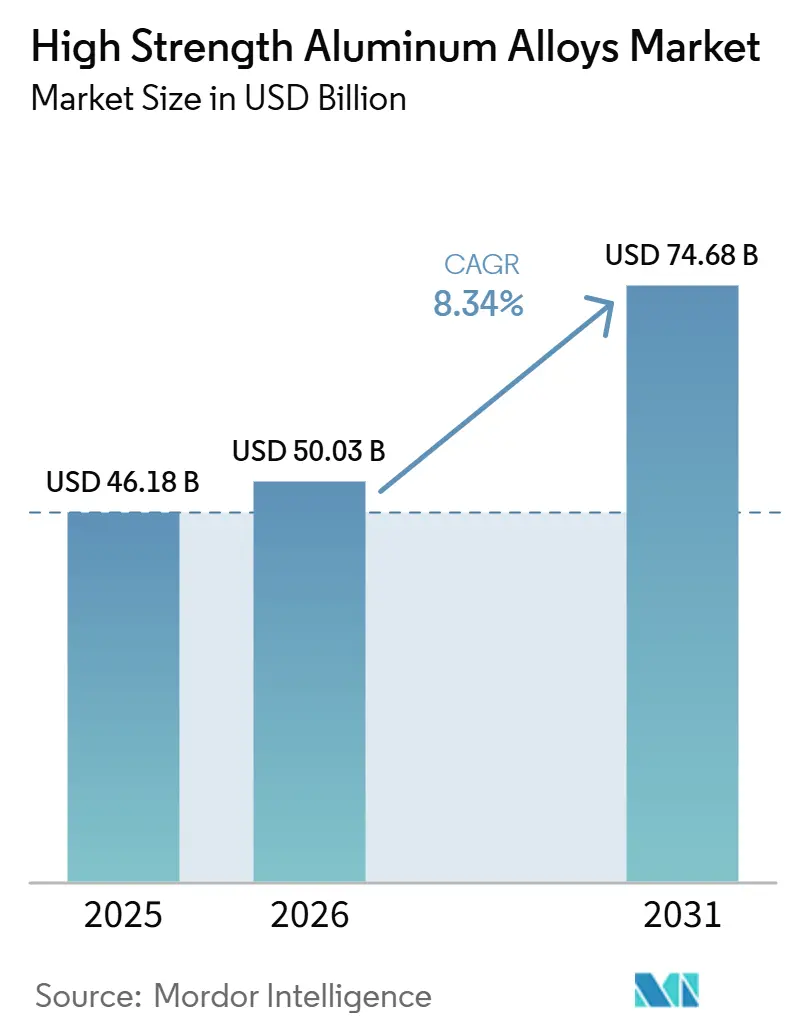
The High Strength Aluminum Alloys Market size is expected to grow from USD 46.18 billion in 2025 to USD 50.03 billion in 2026 and is forecast to reach USD 74.68 billion by 2031 at 8.34% CAGR over 2026-2031. Ramp-ups in single-aisle aircraft production, rapid penetration of battery-electric vehicles, and defense procurement of lighter naval platforms are changing procurement patterns across the value chain. Aerospace primes have locked in multi-year supply agreements for 7xxx-series plate, while automotive OEMs (original equipment manufacturers) are converting battery-enclosure trials into production contracts that specify 6xxx-series extrusions capable of withstanding 1.5-meter side-pole crash tests. High-speed rail projects, especially in China and Japan, are absorbing heat-treated 6xxx extrusions for car-body shells rated for 30-year service lives at 350 km/h. Simultaneously, cryogenic hydrogen-storage initiatives and reusable launch vehicles are validating scandium- and lithium-bearing grades for extreme environments.
Key Report Takeaways
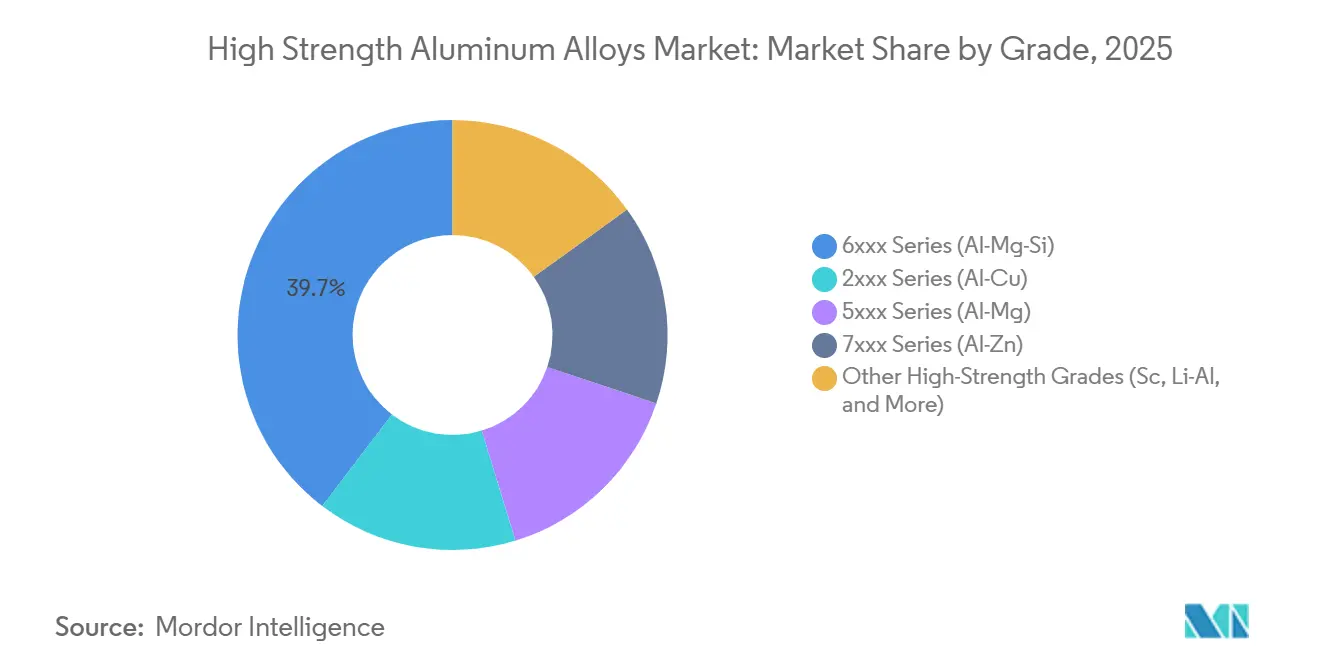
- By grade, the 6xxx series commanded 39.65% of the high strength aluminum alloys market share in 2025, whereas the 7xxx series is set to expand at 9.22% CAGR during the forecast period (2026-2031).
- By product form, plates and sheets led with 41.02% revenue share in 2025, while other forms (powders, foils, and wires) are projected to advance at an 9.57% CAGR during the forecast period (2026-2031).
- By processing technique, heat-treated variants held 54.67% of the high strength aluminum alloys market size in 2025; powder metallurgy and additive manufacturing are growing at 9.72% CAGR during the forecast period (2026-2031).
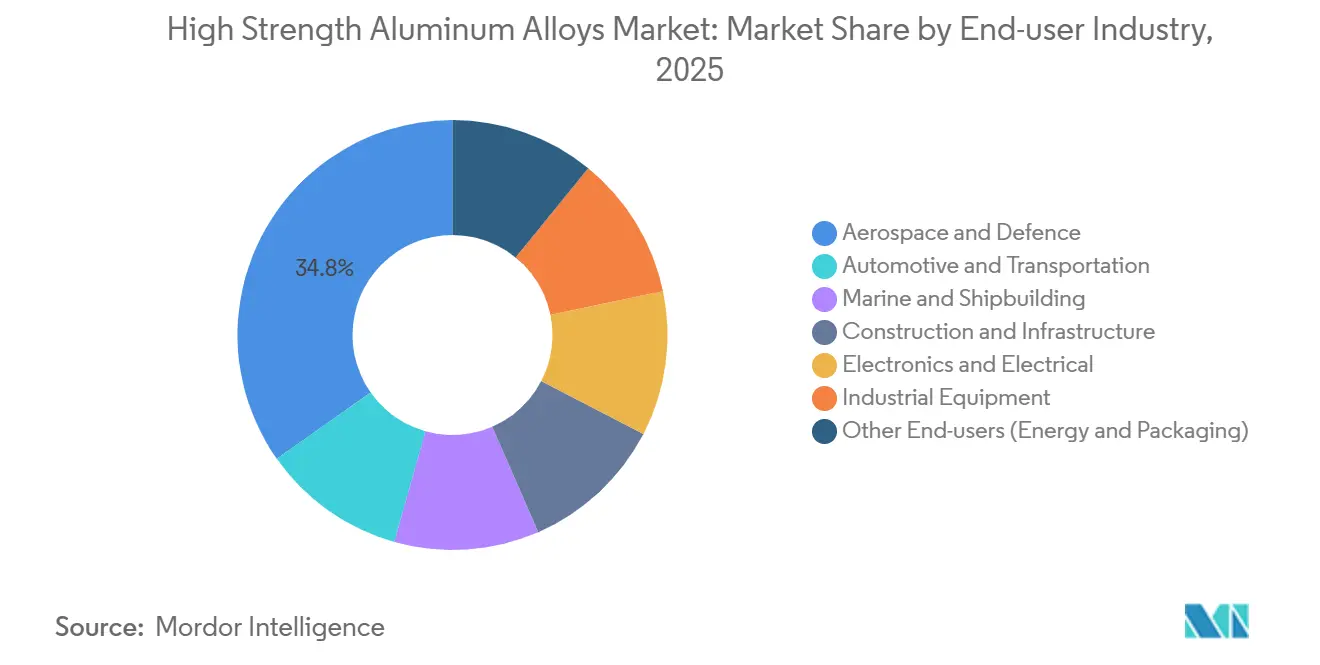
- By end-user industry, aerospace and defense accounted for 34.76% share of the high strength aluminum alloys market size in 2025, whereas automotive and transportation is the fastest-growing segment at 9.98% CAGR during the forecast period (2026-2031).
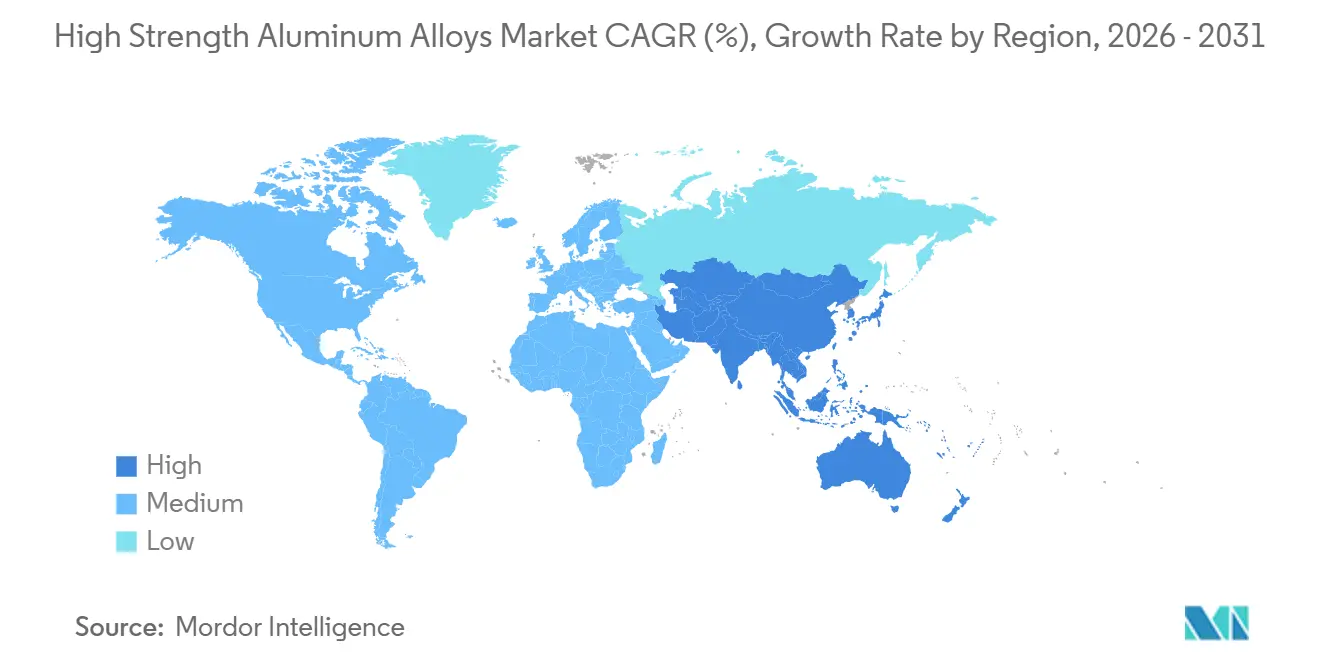
- By geography, Asia-Pacific held 44.69% revenue in 2025 and is poised to record the highest regional CAGR of 9.56% during the forecast period (2026-2031).
Note: Market size and forecast figures in this report are generated using Mordor Intelligence’s proprietary estimation framework, updated with the latest available data and insights as of January 2026.
Market Trends and Insights
Drivers Impact Analysis of High Strength Aluminum Alloys Market*
| Driver | (~) % Impact on CAGR Forecast | Geographic Relevance | Impact Timeline |
|---|---|---|---|
| Growing demand from aerospace and defense for lightweighting | +1.8% | Global (North America, Europe, Asia-Pacific) | Medium term (2-4 years) |
| Increasing adoption in EV battery enclosures and platforms | +1.5% | North America, Europe, China | Short term (≤ 2 years) |
| Expansion of high-speed rail and urban transit projects | +1.2% | Asia-Pacific core, spill-over to Europe & Middle East | Long term (≥ 4 years) |
| Lightweighting push in construction and industrial equipment | +0.9% | Global | Medium term (2-4 years) |
| Uptake in cryogenic hydrogen-storage vessels | +0.7% | Europe, Japan, South Korea, California | Long term (≥ 4 years) |
| Demand from satellite constellations and reusable launchers | +0.6% | Global, led by U.S. space sector | Medium term (2-4 years) |
| Source: Mordor Intelligence | |||
Growing Demand from Aerospace and Defense for Lightweighting
Airframe manufacturers are embedding high strength aluminum alloys market specifications into new platforms to hit stringent fuel-burn targets. Boeing and Airbus increased single-aisle build rates to 38 and 75 units per month, respectively, in 2026, each fuselage skin containing more than 800 kg of 7xxx and 2xxx plate. In naval programs, the U.S. Navy’s DDG-51 Flight III destroyer mandates 5xxx-series marine plate to cut topside weight by 12%, permitting heavier radar systems without compromising stability[1]D. Tuck, “DDG-51 Flight III Design Note,” Naval News, navalnews.com. Rocket manufacturers such as SpaceX employ Al-Li stringers in reusable stages to survive repeated cryogenic cycles. Regulators at the European Union Aviation Safety Agency (EASA) and the Federal Aviation Administration (FAA) enforce AMS 4999 and AMS 7003 compliance, driving mills to tighten process control. The cumulative effect lifts multi-year demand visibility, incentivizing integrated producers to expand forging and heat-treat capacity adjacent to final-assembly lines.
Increasing Adoption in EV Battery Enclosures and Platforms
Automotive architects are converging on aluminum-intensive underbodies to offset battery mass. Novelis shipped more than 500,000 tons of 6xxx automotive sheet in 2025, half earmarked for battery enclosures that outperform steel in IIHS crash protocols. One-piece extrusion trays eliminate up to 40 fasteners, cutting assembly time 15% and reducing warranty claims tied to water ingress. China’s MIIT awards subsidies to EVs under 12 kWh/100 km, nudging OEMs toward aluminum-rich platforms like BYD Seal. While thicker gauges are needed versus press-hardened steel, total curb-weight savings of 80-100 kg justify a USD 150-200 per vehicle material premium. Suppliers co-locate extrusion, stamping, and friction-stir welding cells near OEM plants to shorten design iterations.
Expansion of High-Speed Rail and Urban Transit Projects
China added more than 1,000 km of 350 km/h track annually in 2025, each kilometer absorbing around 180 tons of heat-treated 6xxx profiles for car-body shells. Japan’s Chuo Shinkansen maglev specifies 7xxx forgings for bogie frames tested for 30-year fatigue lives. EU TEN-T corridors invest EUR 1.8 billion in cross-border routes, with Alstom adopting aluminum car bodies to meet traction-energy caps of 2.5 kWh per seat-kilometer. Metro systems from Delhi to Riyadh now procure 6xxx car sets that cut tare weight 18%, improving dwell time without adding rolling stock. EN 15085 welding certification concentrates on fabrication among large tier-1 rail builders capable of amortizing compliance overheads.
Lightweighting Push in Construction and Industrial Equipment
Caterpillar’s 2025 excavator line integrated 7xxx booms, reducing structural mass 12% and enabling a 1.5-ton higher payload without breaching road-transport limits. Liebherr mobile cranes inserted 6xxx extrusions in telescopic sections, trimming counterweights 8% to speed urban job-site setup. EU Stage V off-road regulations tighten fuel-consumption ceilings, making every kilogram of permanent weight critical. Konecranes specifies 5xxx plate for container spreaders to lengthen salt-spray durability in port environments. Weldability limits confine 7xxx to niche high-strength zones; 6xxx dominates broader construction and industrial demand where modest strength and good joinability suffice.
Restraints Impact Analysis of High Strength Aluminum Alloys Market*
| Restraint | (~) % Impact on CAGR Forecast | Geographic Relevance | Impact Timeline |
|---|---|---|---|
| High cost of processing and critical alloying elements | -1.2% | Global, acute in aerospace supply chains | Short term (≤ 2 years) |
| Weldability and stress-corrosion sensitivities in some grades | -0.8% | Marine, aerospace, automotive | Medium term (2-4 years) |
| Competition from advanced steels and carbon-composite hybrids | -0.9% | Automotive, construction across major regions | Medium term (2-4 years) |
| Supply risk of scandium/lithium for ultra-high-strength series | -0.6% | Aerospace, hydrogen storage | Long term (≥ 4 years) |
| Source: Mordor Intelligence | |||
High Cost of Processing and Critical Alloying Elements
Solution heat treatment at up to 530°C and artificial aging regimes consume 1,500 kWh per ton, exposing European mills to energy shocks that pushed electricity prices 40% higher in 2024. Scandium master alloy trades around USD 4,000/kg, 200 times base aluminum, restricting economic viability to aerospace bulkheads or cryogenic tanks[2]U.S. Geological Survey, “Mineral Commodity Summary: Scandium 2026,” usgs.gov. Lithium at USD 12,000-15,000/ton also stresses cost structures, and geopolitical concentration heightens risk. Kaiser Aluminum shuttered its Spokane heat-treat line, citing unsustainable power tariffs, underscoring a two-tier market where only integrated producers running renewable power can achieve sub-USD 1,800/ton cash costs.
Weldability and Stress-Corrosion Sensitivities in Some Grades
Fusion welding of 7xxx plate reduces heat-affected-zone yield strength up to 50% and invites intergranular corrosion in chloride environments. Friction-stir welding mitigates these losses but requires USD 2-3 million robotic cells suitable only for flat seams. Naval experience with 5xxx superstructures indicated cracking after 5-7 years in saltwater, prompting a partial reversion to steel despite a 20% weight penalty. Automotive OEMs thus adopt 6xxx extrusion trays, accepting 15% lower yield strength to avoid SCC risk and preserve conventional resistance-spot welding lines.
*Our forecasts treat driver/restraint impacts as directional, not additive. The impact forecasts reflect baseline growth, mix effects, and variable interactions.
High Strength Aluminum Alloys Market Segment Analysis
By Grade:
7xxx Series Strengthens Share on Aerospace MomentumThe 6xxx series remains the volume leader, securing 39.65% market share in 2025 on the back of EV battery-enclosure contracts and rail-car extrusions. The high-strength aluminum alloys market share advantage is expected to narrow as cost-effective scandium micro-additions enable thinner 6xxx profiles without sacrificing crashworthiness. Meanwhile, 2xxx and 5xxx series maintain niche defensibility in legacy wide-body aircraft and cryogenic tanks, respectively, with research and development dollars mostly channeling toward aluminum-lithium hybrids for next-generation reusable launchers.
The 7xxx series is projected to expand at 9.22% CAGR to 2031. High zinc content delivers ultimate tensile strength above 570 MPa, indispensable for fuselage frames and naval radar masts. Boeing’s and Airbus’s production surges anchor forward-purchase agreements through 2030, ensuring consistent mill utilization. Additive manufacturing further lifts 7xxx demand as LPBF achieves density within 0.5% of wrought plate after HIP consolidation.



By Product Form:
Powders and Foils Accelerate on Additive & Battery DemandPlates and sheets delivered 41.02% revenue share in 2025 by serving aircraft skins, rail roofs, and EV body panels. However, powders, foils, and wires are forecast to outpace with a 9.57% CAGR, riding on additive manufacturing and solid-state battery opportunities. The high-strength aluminum alloys market size for ultra-thin battery foil alone is projected to increase significantly between 2026 and 2031 as solid-state developers specify 10-20 micron collectors.
Extrusions continue to underpin automotive and building segments thanks to favorable weight-to-stiffness economics and mature welding methods. Forgings secure ultra-high reliability niches, landing gear, and naval shafts, where grain-flow orientation and fatigue life trump cost. Mass-reduction imperatives nonetheless steer capital toward powder atomization and ultra-thin rolling capabilities, reshuffling the profitability hierarchy among semi-fabricators.
By Processing Technique:
Heat Treatment Retains Majority Amid AM GrowthHeat-treated material dominated with 54.67% revenue share in 2025 and is expected to hold a significant share through 2031, given stringent aerospace, rail, and automotive mechanical-property targets. Yet powder metallurgy and additive manufacturing, growing at 9.72% CAGR to 2031, represent the most vibrant pocket within the high-strength aluminum alloys market. FAA-mandated ASTM F3318 qualification still adds two months to program timelines, but design freedom and scrap reduction justify the investment for high-value parts.
Cold-worked 5xxx grades supply marine, cryogenic, and beverage-can producers that prize corrosion resistance and formability. Non-heat-treated plate remains attractive where energy costs exceed USD 0.15/kWh, further segmenting market demand by regional utility tariffs.
By End-user Industry:
Automotive Catches Up to Aerospace LeadershipAerospace and defense led with 34.76% share in 2025, but automotive is the fastest-moving vertical at 9.98% CAGR as battery-electric platforms displace steel subframes with giga-cast aluminum rear underbodies. The high-strength aluminum alloys market size for battery enclosures alone is forecast to approach a substantial value by 2031, closing the historical gap with aerospace sheet and plate.
Marine, rail, and construction segments adopt aluminum for corrosion immunity, energy efficiency, and regulatory credits, respectively. Industrial equipment OEMs follow emissions-driven lightweighting pathways, inserting 6xxx extrusion booms and 7xxx forgings in high-duty pivots. Electronics, energy, and packaging round out diversified but lower-growth applications.
Geography Analysis
APAC High Strength Aluminum Alloys Market
Asia-Pacific held 44.69% of 2025 demand and will compound at 9.56% CAGR through 2031, fueled by China’s rail build-out and Japan’s aerospace forgings export program. India’s extrusion hubs in Gujarat and Maharashtra supply European tier-1s, leveraging labor advantages to offset logistics costs. Southeast Asian nations chase substitution opportunities as OEMs de-risk China exposure.
North America High Strength Aluminum Alloys Market
North America scales capacity under reshoring mandates: Alcoa’s San Ciprián rebuild, and Novelis’s Bay Minette mill inject a combined 675,000 tons of annual sheet and forging output by 2027. Defense budgets channel steady 7xxx orders, while the U.S. Infrastructure Act allocates rail modernizations that consume 6xxx extrusions.
Europe, South America and Middle East High Strength Aluminum Alloys Market
Europe balances aggressive carbon policy with automotive lightweighting. Norsk Hydro’s hydropower smelters supply premium low-carbon billet, qualifying for CBAM relief. Rail corridor investments and OEM multi-material bodies force mills to juggle plate, extrusion, and foil specialties. South America and the Middle East stay sub-scale but attract 5xxx plate demand for LNG carriers and offshore wind-support vessels.

Competitive Landscape
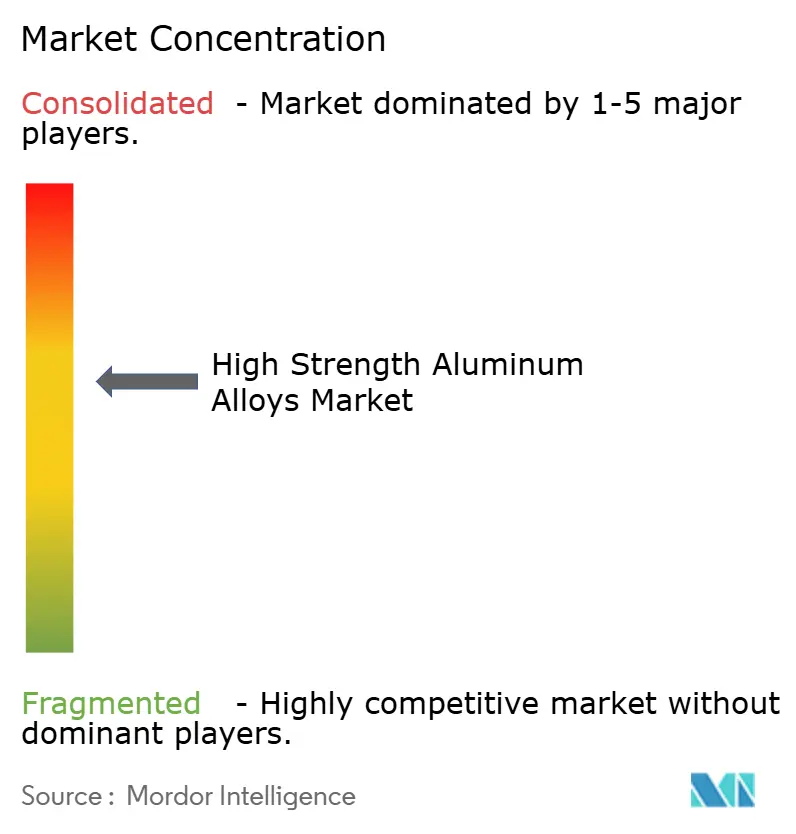
The High Strength Aluminum Alloys market is moderately concentrated. Energy costs and carbon policy increasingly dictate plant economics. Hydropower-sourced aluminum from Norway or Quebec commands premiums, while energy-intensive European heat-treat lines face shutdown risk unless retrofitted for renewables. This divergence accelerates consolidation around players that can internalize smelting, rolling, and recycling under low-carbon power.
High Strength Aluminum Alloys Industry Leaders
Hindalco Industries Ltd.
Constellium
Arconic
Norsk Hydro ASA
Alcoa Corporation
- *Disclaimer: Major Players sorted in no particular order
High Strength Aluminum Alloys Market Companies Covered in this Report
- Akshay Aluminium Alloys
- Alcoa Corporation
- Aluminum Corporation of China (Chalco)
- AMAG Austria Metall AG
- Arconic
- Belmont Metals
- Constellium SE
- ElvalHalcor
- Emirates Global Aluminium PJSC
- Fischer Group
- GARMCO
- Gränges
- Hindalco Industries Ltd.
- Kaiser Aluminum Corp.
- KOBE STEEL, LTD.
- Norsk Hydro ASA
- Rio Tinto
- UACJ Corporation

Recent Industry Developments in High Strength Aluminum Alloys Market
- January 2026: Emirates Global Aluminium (EGA) and Century Aluminum Company forged a joint development agreement, marking the establishment of the inaugural primary aluminum production plant in the U.S. The plant will rise in Inola, Oklahoma, with an anticipated annual output of 750,000 tons of aluminum.
- November 2025: Novelis announced plans to commission its cold mill at the Bay Minette facility in Alabama, United States, in the latter half of 2026. This move aims to bolster domestic capacity in response to surging demand for beverage packaging, automotive, and specialty aluminum products.


Global High Strength Aluminum Alloys Market Report Scope
High-strength aluminum alloys, primarily from different series, offer superior strength-to-weight ratios suitable for aerospace, defense, and automotive applications.
The high strength aluminum alloys market is segmented by grade, product form, processing technique, end-user industry, and geography. By grade, the market is segmented into 6xxx series (Al-Mg-Si), 2xxx series (Al-Cu), 5xxx series (Al-Mg), 7xxx series (Al-Zn), and other high-strength grades (Sc, Li-Al, and more). By product form, the market is segmented into plates and sheets, extrusions, forgings, castings, bars, rods, and tubes, and other forms (powders, foils, and wires). By processing technique, the market is segmented into heat-treated, non-heat-treated, cold-worked, and powder metallurgy and additive manufacturing. By end-user industry, the market is segmented into aerospace and defence, automotive and transportation, marine and shipbuilding, construction and infrastructure, electronics and electrical, industrial equipment, and other end-users (energy and packaging). The report also covers the market size and forecasts for high strength aluminum alloys in 17 countries across major regions. The market sizes and forecasts are provided in terms of value (USD).
| 6xxx Series (Al-Mg-Si) |
| 2xxx Series (Al-Cu) |
| 5xxx Series (Al-Mg) |
| 7xxx Series (Al-Zn) |
| Other High-Strength Grades (Sc, Li-Al, and More) |
| Plates and Sheets |
| Extrusions |
| Forgings |
| Castings |
| Bars, Rods and Tubes |
| Other Forms (Powders, Foils, and Wires) |
| Heat-Treated |
| Non-Heat-Treated |
| Cold-Worked |
| Powder Metallurgy and Additive Manufacturing |
| Aerospace and Defence |
| Automotive and Transportation |
| Marine and Shipbuilding |
| Construction and Infrastructure |
| Electronics and Electrical |
| Industrial Equipment |
| Other End-users (Energy and Packaging) |
| Asia-Pacific | China |
| Japan | |
| India | |
| South Korea | |
| ASEAN Countries | |
| Rest of Asia-Pacific | |
| North America | United States |
| Canada | |
| Mexico | |
| Europe | Germany |
| United Kingdom | |
| France | |
| Italy | |
| Spain | |
| Russia | |
| Rest of Europe | |
| South America | Brazil |
| Argentina | |
| Rest of South America | |
| Middle East and Africa | Saudi Arabia |
| South Africa | |
| Rest of Middle East and Africa | |
| Rest of MEA |
| By Grade | 6xxx Series (Al-Mg-Si) | |
| 2xxx Series (Al-Cu) | ||
| 5xxx Series (Al-Mg) | ||
| 7xxx Series (Al-Zn) | ||
| Other High-Strength Grades (Sc, Li-Al, and More) | ||
| By Product Form | Plates and Sheets | |
| Extrusions | ||
| Forgings | ||
| Castings | ||
| Bars, Rods and Tubes | ||
| Other Forms (Powders, Foils, and Wires) | ||
| By Processing Technique | Heat-Treated | |
| Non-Heat-Treated | ||
| Cold-Worked | ||
| Powder Metallurgy and Additive Manufacturing | ||
| By End-user Industry | Aerospace and Defence | |
| Automotive and Transportation | ||
| Marine and Shipbuilding | ||
| Construction and Infrastructure | ||
| Electronics and Electrical | ||
| Industrial Equipment | ||
| Other End-users (Energy and Packaging) | ||
| By Geography | Asia-Pacific | China |
| Japan | ||
| India | ||
| South Korea | ||
| ASEAN Countries | ||
| Rest of Asia-Pacific | ||
| North America | United States | |
| Canada | ||
| Mexico | ||
| Europe | Germany | |
| United Kingdom | ||
| France | ||
| Italy | ||
| Spain | ||
| Russia | ||
| Rest of Europe | ||
| South America | Brazil | |
| Argentina | ||
| Rest of South America | ||
| Middle East and Africa | Saudi Arabia | |
| South Africa | ||
| Rest of Middle East and Africa | ||
| Rest of MEA | ||


Key Questions Answered in the Report
What is the forecast value for high strength aluminum alloys market by 2031?
The high strength aluminum alloys market is projected to reach USD 74.68 billion by 2031, growing at an 8.34% CAGR from USD 50.03 billion in 2026.
Which alloy series leads current demand?
6xxx series holds 39.65% of 2025 volume thanks to automotive battery-tray and rail-car usage
Why are 7xxx alloys gaining share?
Aerospace and defense programs require tensile strengths above 570 MPa, accelerating 7xxx adoption at 9.22% CAGR for the forecast period (2026-2031).
How fast is additive manufacturing growing in this space?
Powder metallurgy and additive manufacturing aluminum alloys are rising at 9.72% CAGR as aerospace primes qualify LPBF parts under AMS 4999.
Page last updated on:


 Your data is secure and never sold or shared.


