
High-Purity Citric Acid Market Size and Share
Market Overview
| Study Period | 2021 - 2031 |
|---|---|
| Market Size (2026) | USD 0.61 Billion |
| Market Size (2031) | USD 0.82 Billion |
| Growth Rate (2026 - 2031) | 7.21 % |
| Fastest Growing Market | Europe |
| Largest Market | Asia-Pacific |
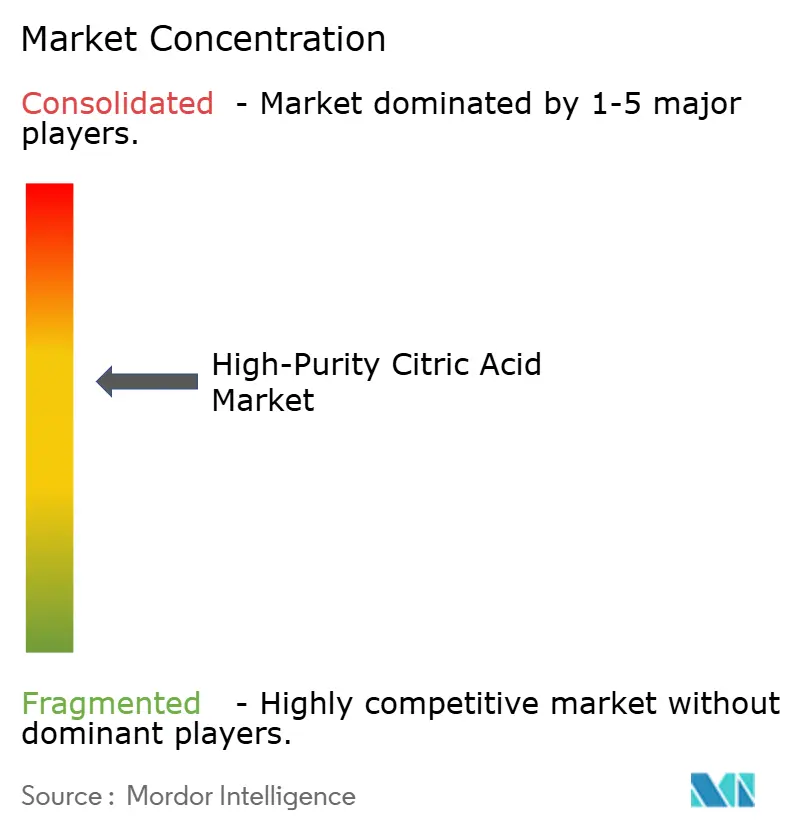
| Market Concentration | Medium |
Major Players *Disclaimer: Major Players sorted in no particular order Image © Mordor Intelligence. Reuse requires attribution under CC BY 4.0. | |
High-Purity Citric Acid Market Analysis by Mordor Intelligence
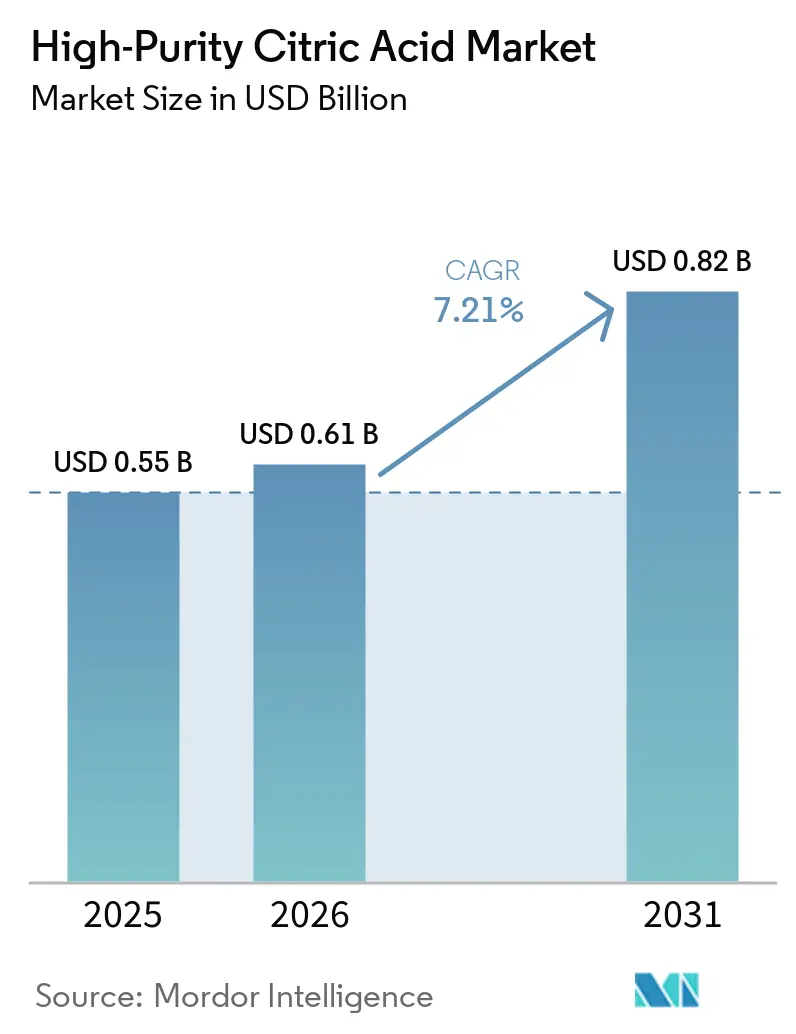
The high-purity citric acid market size is expected to increase from USD 0.55 billion in 2025 to USD 0.61 billion in 2026 and reach USD 0.82 billion by 2031, growing at a CAGR of 7.2% over 2026-2031. The high-purity citric acid market is expanding faster than the broader citric acid space because buyers in pharmaceuticals and specialty food manufacturing are shifting toward certified grades with tighter purity control and multi-compendial compliance requirements. The high-purity citric acid market also benefits from the wider use of citric acid as a chelating agent, pH buffer, and formulation aid in oral drugs, effervescent products, and biologics processing. Food reformulation is adding another layer of demand as sugar reduction programs and clean label positioning require more consistent acidulation and batch performance in premium products. The high-purity citric acid market is therefore moving away from a simple commodity model and toward a certification-driven supply model that favors producers with strong purification systems, analytical control, and reliable documentation. The high-purity citric acid market also leaves room for suppliers that can offer diversified regional production and application-specific grades as customers try to reduce quality and supply risk
Key Report Takeaways
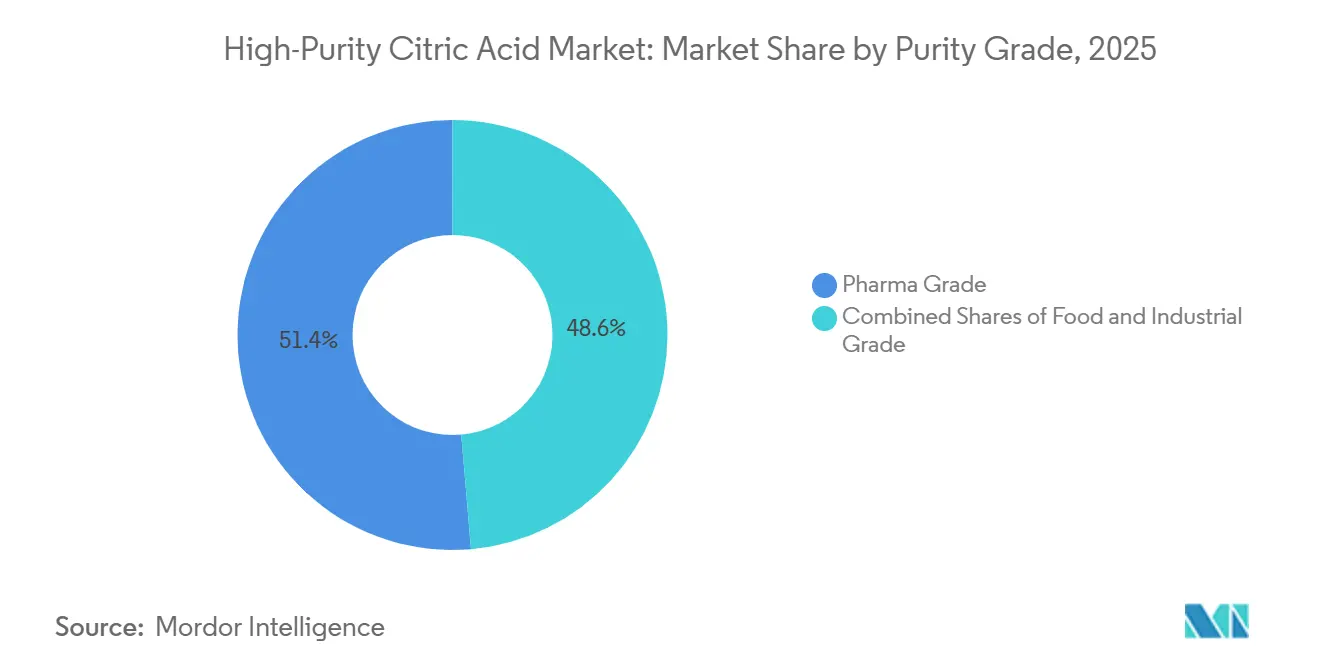
- By purity grade, Pharma Grade held 51.38% of the market in 2025, while Food Grade is forecast to expand at an 8.68% CAGR through 2031.
- By form, Powder or Crystalline held 67.21% of the high-purity citric acid market share in 2025, while Liquid recorded the highest projected CAGR at 8.35% through 2031.
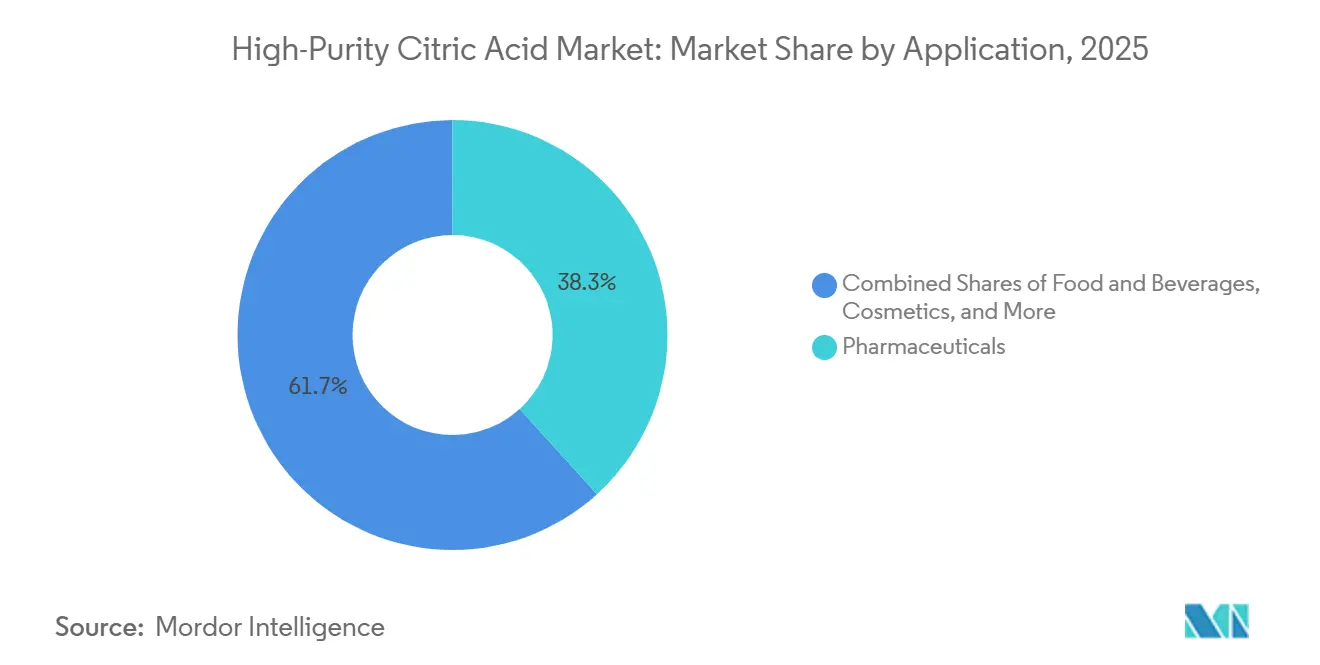
- By application, Pharmaceuticals accounted for 38.28% of the high-purity citric acid market size in 2025, while Food and Beverages are advancing at an 8.55% CAGR through 2031.
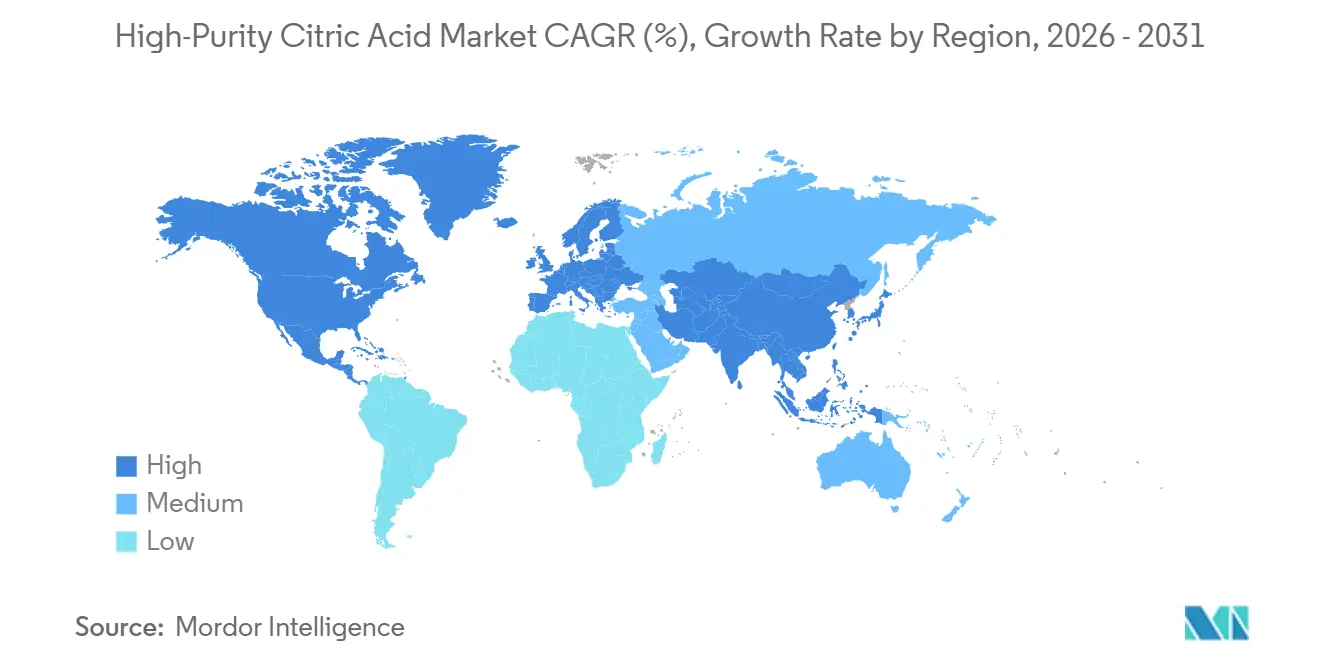
- By geography, Asia-Pacific led with a 42.64% revenue share in 2025, while Europe is forecast to grow at an 8.15% CAGR through 2031.
Note: Market size and forecast figures in this report are generated using Mordor Intelligence’s proprietary estimation framework, updated with the latest available data and insights as of January 2026.
Market Trends and Insights
Drivers Impact Analysis of High-Purity Citric Acid Market*
| Drivers | (~) % Impact on CAGR Forecasts | Geographic Relevance | Impact Timeline |
|---|---|---|---|
| Growing Use In Pharmaceutical Excipients And Oral Drug Formulations | +1.8% | North America and Europe | Medium term (2-4 years) |
| Rising Use In Biotechnology Fermentation Media And Cell Culture Applications | +1.2% | North America and APAC core | Medium term (2-4 years) |
| Increasing Use In Premium Confectionery And Sugar-Free Candies | +1.0% | Asia-Pacific and Europe | Short term (≤ 2 years) |
| Growing Use In Effervescent Tablets And Powders | +0.9% | Europe and APAC | Short term (≤ 2 years) |
| Increasing Demand From Infant Formula And Clinical Nutrition Products | +0.7% | APAC core, spill over to North America | Medium term (2-4 years) |
| Nutraceutical Gummies And Dietary Supplements Facing Stronger Demand | +0.6% | North America, Europe, and APAC | Short term (≤ 2 years) |
| Source: Mordor Intelligence | |||
Growing Use in Pharmaceutical Excipients and Oral Drug Formulations
In the pharmaceutical industry, citric acid has transitioned from being merely an acidulant to serving a broader range of critical functions. It is now widely utilized as a chelating agent, effectively protecting sensitive active ingredients in tablets, syrups, and oral liquid formulations from degradation caused by metal ions. This expanded role highlights its importance in ensuring the stability and efficacy of drug products. Additionally, major regulated markets mandate the use of USP and EP-compliant materials in pharmaceutical filings, creating a clear distinction between certified high-purity supplies and lower-grade alternatives. The high-purity citric acid market is also experiencing growth due to its application in reformulating low-solubility drugs[1]Source: E. Aydın et al., “Mechanistic and Thermodynamic Evaluation of Sodium Citrate-Mediated Hydrotropism for the Biopharmaceutical Optimization of BCS Class II Drug Atorvastatin Calcium,” EM Consulte, em-consulte.com. Citrate-based systems are increasingly employed to enhance bioavailability, addressing a key challenge in drug development. This dual capability of supporting regulatory compliance and improving formulation performance ensures a steady and durable demand for high-purity citric acid in the pharmaceutical sector.
Rising Use in Biotechnology Fermentation Media and Cell Culture Applications
Biotechnology processes, which depend on tightly controlled raw materials, play a significant role in driving the high purity citric acid market. In fermentation media and cell culture systems, citric acid performs multiple critical functions, including serving as a carbon source, acting as a chelation aid, and stabilizing pH levels. This multifunctionality reduces the likelihood of substitution, as maintaining process consistency is as crucial as managing costs in both upstream and downstream biologics operations. Furthermore, ongoing research into non-conventional yeasts and advancements in organic acid bioproduction are expanding the range of systems that can effectively utilize citrate-based supplementation. As a result, the high purity citric acid market continues to benefit from the rapid expansion of the biotechnology sector, even in scenarios where commodity citric acid prices remain under pressure.
Increasing Use in Premium Confectionery and Sugar-Free Candies
Premium confectionery and sugar-reduced formats are significantly driving the demand for high-purity citric acid. In Europe, the implementation of sugar reduction policies and the growing preference for clean-label products are enhancing the functional importance of acidulants. These acidulants are essential in preserving sweetness perception and intensifying flavor, as noted by CBI.EU[2]Source: Centre for the Promotion of Imports, “Which Trends Offer Opportunities or Pose a Threat on the European Natural Food Additives Market?,” CBI, cbi.eu. Within the sour candy and premium confectionery coatings segments, manufacturers require consistent tartness and reliable coating behavior. This need for precision has led to an increased demand for tightly specified crystalline materials. Consequently, the high-purity citric acid market is experiencing notable growth, as achieving such consistency is more challenging with lower-specification materials. Furthermore, certified grades of citric acid are better positioned to withstand commodity price fluctuations, particularly in premium food applications, ensuring their continued relevance and demand in the market.
Growing Use in Effervescent Tablets and Powders
The demand for high-purity citric acid continues to grow, driven by its critical role in effervescent tablets and powders. These systems require citric acid with exceptionally high purity and minimal moisture content, as excess moisture can lead to premature reactions, rendering the product ineffective before it reaches consumers. To address these challenges, suppliers are developing application-specific solutions, such as coated and agglomerated systems, which enhance handling efficiency and improve storage stability during tablet production processes. Furthermore, the increasing popularity of sugar-free vitamin and supplement formats is contributing to this demand, especially in formulations where direct compression and long-term product stability are essential. As a result, the high-purity citric acid market is experiencing growth fueled by both rising consumption and the need to meet the advanced performance requirements of effervescent dosage forms.
Restraints Impact Analysis of High-Purity Citric Acid Market*
| Restraints | (~) % Impact on CAGR Forecasts | Geographic Relevance | Impact Timeline |
|---|---|---|---|
| High Production And Purification Costs | -1.5% | Global, most acute outside China | Medium term (2-4 years) |
| Supply Chain Disruptions For Feedstocks | -1.0% | Global, with acute exposure in APAC | Short term (≤ 2 years) |
| Competition From Alternative Acidulants | -0.8% | North America and Europe | Short term (≤ 2 years) |
| Stringent Regulatory Compliance Requirements | -0.5% | Global, with early gains in EU, U.S., and Japan | Long term (≥ 4 years) |
| Source: Mordor Intelligence | |||
High Production and Purification Costs
Producing high-purity citric acid involves high costs due to the stringent requirements for pharmaceutical and premium food grades. These grades necessitate advanced processes such as multi-stage crystallization, ion exchange purification, and comprehensive heavy metals testing, all of which substantially increase production expenses compared to lower-grade citric acid. Producers outside China often face additional challenges, including higher structural costs stemming from weaker feedstock integration, elevated energy expenses, and stricter compliance requirements. Consequently, the market increasingly favors larger, integrated suppliers capable of spreading purification and testing costs across higher production volumes, thereby achieving greater cost efficiency. Although smaller players can still compete in niche segments, their ability to influence pricing is progressively determined by their scale of operations and the breadth of their certifications, which are becoming critical factors in maintaining competitiveness.
Supply Chain Disruptions for Feedstocks
The high purity citric acid market faces significant challenges due to the volatility of agricultural feedstocks, as fermentation processes are heavily dependent on glucose and molasses. When the availability of corn- or sugar-based inputs tightens, producers encounter increased margin pressures, which restrict their ability to sustain high utilization rates. High purity producers are particularly vulnerable compared to standard producers because stringent traceability requirements limit their flexibility in switching feedstocks across batches and customers. Efforts to enhance feedstock flexibility are evident through ongoing research into alternative substrates, such as apple pomace. However, the adoption of these alternatives at a commercial scale remains limited. As a result, despite consistent end-use demand, the high purity citric acid market is expected to continue facing periodic cost pressures driven by feedstock constraints.
*Our forecasts treat driver/restraint impacts as directional, not additive. The impact forecasts reflect baseline growth, mix effects, and variable interactions.
High-Purity Citric Acid Market Segment Analysis
By Purity Grade:
Pharmaceutical Dominance Tested by Food-Grade MomentumPharma Grade held 51.38% of the market in 2025, which made it the largest purity segment in the high-purity citric acid market. This position reflects the fact that regulated drug products require material aligned with USP, EP, JP, or similar standards, which keeps demand relatively captive. The high-purity citric acid market continues to rely on pharmaceutical use as an anchor because excipient performance and compliance are both essential in oral and parenteral formulations. Suppliers with multi-compendial certification hold an advantage because they reduce qualification complexity for global buyers.
Food Grade is projected to grow at an 8.68% CAGR from 2026 to 2031, which makes it the fastest-growing purity segment in the high-purity citric acid market. This rise does not weaken the pharmaceutical premium because much of the momentum comes from applications such as infant formula, clinical nutrition, and nutraceutical products, where specification standards are also strict. The high-purity citric acid industry is therefore seeing more overlap between advanced food applications and pharma-linked quality expectations. Industrial Grade remains smaller within this report's scope because its end uses are less sensitive to the purity and documentation requirements that define premium demand. The segment mix shows that volume growth is broadening, while value capture still depends heavily on certification depth.


By Form:
Crystalline Still Leads, but Liquid Gains Strategic GroundPowder or Crystalline held 67.21% of the high-purity citric acid market share in 2025, which kept it as the dominant form segment. This leadership comes from long-established use in dry blend foods, solid dosage pharmaceuticals, and effervescent systems where storage stability and handling are central. Anhydrous crystalline material remains especially important in moisture-sensitive applications because it supports stable processing and predictable reaction behavior in tablet production. The high-purity citric acid market still leans on this format because it fits existing manufacturing lines and multiple granulation requirements.
Liquid is projected to expand at an 8.35% CAGR through 2031, making it the fastest-growing form segment in the high-purity citric acid market. Demand is rising in syrups, oral solutions, and pediatric formulations where precise pH control and homogeneous dispersion matter more than dry handling convenience. Biologics processing also supports this shift because liquid citrate buffer systems help maintain consistent concentration and stability during downstream use. The high-purity citric acid market is therefore seeing liquid gain strategic importance even while crystalline material remains the volume base. This change reflects a broader move toward application specific supply rather than one form serving every use case.
By Application:
Pharma Anchors Value, Food and Beverages Drives Volume GrowthPharmaceuticals accounted for 38.28% of the high-purity citric acid market size in 2025, which kept it as the largest application in the high-purity citric acid market. The segment benefits from several concurrent functions, including pH adjustment, buffering, chelation, effervescence, and support for bioavailability enhancement. These roles make certified citric acid difficult to replace because product quality and regulatory acceptance depend on consistent input specifications. The high-purity citric acid market also sees this application retain pricing resilience because buyers cannot simply move down the grade ladder when compliance is involved.
Food and beverages are forecast to grow at an 8.55% CAGR to 2031, making it the fastest-growing application in the high-purity citric acid market. Clean label reformulation, sugar reduction, functional beverages, and gummy supplements are widening the number of products that need steady tartness and pH performance. Producers of pectin-based gummies and premium beverages need more batch consistency than standard acidulation uses, which strengthens demand for higher specification material. Cosmetics and Personal Care, Analytical and Laboratory Use, and Others remain relevant complementary outlets in the high purity citric acid market. The application mix shows that pharmaceuticals still anchor value, while food linked innovation is widening the growth base.

Geography Analysis
APAC High-Purity Citric Acid Market
Asia-Pacific held 42.64% of the market in 2025, giving it the leading position in the high-purity citric acid market. The region combines large-scale fermentation capacity with strong downstream demand from pharmaceuticals and food processing. China remains central because its production system benefits from feedstock access, fermentation scale, and integrated manufacturing structures that support cost efficiency. India strengthens the regional demand picture through its large pharmaceutical formulation base and continuing need for certified excipients in regulated products. The high-purity citric acid market in Asia-Pacific therefore reflects both production strength and expanding local consumption.
Europe High-Purity Citric Acid Market
Europe is projected to grow at an 8.15% CAGR from 2026 to 2031, making it the fastest-growing regional segment in the high-purity citric acid market. Demand is being supported by pharmaceutical, nutraceutical, premium food, and personal care buyers who value tightly documented supply and certified grades. The region also places a higher premium on dependable sourcing after recent years of freight and supply disruption. The high-purity citric acid market in Europe is therefore growing on quality assurance and sourcing strategy rather than on low cost production.
The Americas and MEA High-Purity Citric Acid Market
North America remains an important part of the high purity citric acid market because it has major domestic ingredient producers and a large base of pharmaceutical and food customers. Strategic investment is reshaping the region, as Jungbunzlauer closed its Illinois facility acquisition in 2025 to establish a U.S. manufacturing footprint for premium ingredients. South America and the Middle East and Africa are smaller in current scale, but they continue to add demand through food processing expansion and regional pharmaceutical trade flows. The high purity citric acid market across these regions remains less mature, yet their incremental demand supports a broader global customer base.

Competitive Landscape
The high-purity citric acid market shows medium concentration and a clear two-tier structure. One group consists of large integrated producers with fermentation scale, purification capability, and broad pharmacopeial certification coverage. Another group serves selected applications or regions with narrower product portfolios and less extensive documentation depth. The high-purity citric acid market rewards suppliers that can combine quality assurance, multi-region delivery, and application-specific technical support. Certification breadth remains a basic requirement for access to many higher-value accounts.
A visible strategy in the high-purity citric acid market is geographic diversification of production. Jungbunzlauer strengthened that approach when it closed the acquisition of the Thomson, Illinois, site in November 2025 and established its first U.S. manufacturing base. The same company also advanced expansion at Port Colborne in 2026 as part of a broader investment program tied to fermentation-based ingredients. These steps show that the high-purity citric acid market is placing more value on regional manufacturing resilience and shorter customer lead times.
Another strategic pattern in the high purity citric acid market is process improvement and research led differentiation. Jungbunzlauer’s collaboration with TU Wien focused on refining Aspergillus niger strains to improve citric acid production efficiency and sustainability linked metrics. RZBC also remained relevant in regulated trade flows after U.S. authorities maintained a zero antidumping rate in the 2023 to 2024 review period, reinforcing its compliance position in the U.S. market[3]Source: U.S. Department of Commerce, “Citric Acid and Certain Citrate Salts From the People's Republic of China: Final Results of Antidumping Duty Administrative Review, 2023-2024,” Federal Register, govinfo.gov. The high purity citric acid market is therefore competing not only on output volume, but also on documentation strength, process control, and the ability to serve tightly regulated end uses. Suppliers that align grade purity with specific applications are likely to hold the strongest position.
High-Purity Citric Acid Industry Leaders
Jungbunzlauer Suisse AG
Cargill, Incorporated
COFCO Biotechnology Co., Ltd.
Archer Daniels Midland Company
Citribel NV
- *Disclaimer: Major Players sorted in no particular order
High-Purity Citric Acid Market Companies Covered in this Report
- Jungbunzlauer Suisse AG
- Cargill, Incorporated
- Archer Daniels Midland Company
- COFCO Biotechnology Co., Ltd.
- TTCA CO., LTD.
- Shandong Ensign Industry Co., Ltd.
- Citribel NV
- Gadot Biochemical Industries Ltd.
- RZBC Group Co., Ltd.
- Huangshi Xinghua Biochemical Co., Ltd.
- Foodchem International Corporation
- Merck KGaA
- Brenntag SE
- Roquette Frères
- Tate and Lyle PLC
- Corbion N.V.
- Xitrical Co., Ltd.
- ECSA Chemicals AG
- Hubei Xingfa Chemicals Group Co., Ltd.
- Jiangsu Guoxin Union Energy Co., Ltd.

Recent Industry Developments in High-Purity Citric Acid Market
- April 2026: Brenntag Pharma introduced BYPHAR, a specialized biopharma manufacturing brand designed to provide high-quality raw materials, regulatory support, and value-added services across the entire biopharmaceutical production lifecycle.Through partnerships with leading ingredient suppliers such as Budenheim, Citribel, K+S, and Kerry, the platform offers high-purity phosphates, citric acid and citrates, pharmaceutical-grade salts, and acetates for applications.
- January 2025: Brenntag Pharma has extended its partnership with Citribel for the distribution of citric acids and citrate pharma excipients, expanding beyond France, Spain, Germany, and Benelux to now include Israel, Turkey, and South Africa.
- November 2024: Jungbunzlauer announced a collaboration with the Technical University of Vienna (TU Wien) to support research at the newly established Christian Doppler Laboratory focused on optimizing citric acid production through advanced fungal strain development. The research aims to improve citric acid yields by identifying and enriching naturally efficient fungal strains using molecular analysis, genetic screening, and innovative mRNA measurement techniques.


Global High-Purity Citric Acid Market Report Scope
| Pharma Grade |
| Food Grade |
| Industrial Grade |
| Powder/Crystalline |
| Liquid |
| Food and Beverages |
| Pharmaceuticals |
| Cosmetics and Personal Care |
| Analytical and Laboratory Use |
| Others |
| North America | United States |
| Canada | |
| Mexico | |
| Rest of North America | |
| Europe | Germany |
| United Kingdom | |
| France | |
| Italy | |
| Spain | |
| Netherlands | |
| Sweden | |
| Rest of Europe | |
| Asia-Pacific | China |
| India | |
| Japan | |
| Australia | |
| South Korea | |
| Rest of Asia-Pacific | |
| South America | Brazil |
| Argentina | |
| Rest of South America | |
| Middle East and Africa | United Arab Emirates |
| South Africa | |
| Rest of Middle East and Africa |
| By Purity Grade | Pharma Grade | |
| Food Grade | ||
| Industrial Grade | ||
| By Form | Powder/Crystalline | |
| Liquid | ||
| By Application | Food and Beverages | |
| Pharmaceuticals | ||
| Cosmetics and Personal Care | ||
| Analytical and Laboratory Use | ||
| Others | ||
| By Geography | North America | United States |
| Canada | ||
| Mexico | ||
| Rest of North America | ||
| Europe | Germany | |
| United Kingdom | ||
| France | ||
| Italy | ||
| Spain | ||
| Netherlands | ||
| Sweden | ||
| Rest of Europe | ||
| Asia-Pacific | China | |
| India | ||
| Japan | ||
| Australia | ||
| South Korea | ||
| Rest of Asia-Pacific | ||
| South America | Brazil | |
| Argentina | ||
| Rest of South America | ||
| Middle East and Africa | United Arab Emirates | |
| South Africa | ||
| Rest of Middle East and Africa | ||


Key Questions Answered in the Report
What is the 2031 outlook for high purity citric acid?
The market is forecast to reach USD 0.82 billion by 2031 from USD 0.61 billion in 2026, at a 7.21% CAGR over 2026 to 2031.
Which purity segment leads demand for high specification citric acid?
Pharma Grade led in 2025 with 51.38% share because regulated drug products require tightly certified input materials.
Which form is growing fastest in citric acid for regulated applications?
Liquid is projected to grow the fastest at an 8.35% CAGR through 2031, supported by oral liquid drugs and biologics buffer use.
Which region offers the strongest growth opportunity through 2031?
Europe is expected to post the fastest regional growth at 8.15% CAGR, supported by demand for dependable certified supply.
Page last updated on:


 Your data is secure and never sold or shared.


