
High-Pressure Oil And Gas Separator Market Size and Share
Market Overview
| Study Period | 2021 - 2031 |
|---|---|
| Forecast Data Period | 2026 - 2031 |
| Historical Data Period | 2021 - 2024 |
| Growth Rate | 1.04 % |
| Fastest Growing Market | Asia Pacific |
| Largest Market | North America |
| Market Concentration | Medium |
Major Players *Disclaimer: Major Players sorted in no particular order Image © Mordor Intelligence. Reuse requires attribution under CC BY 4.0. | |
High-Pressure Oil And Gas Separator Market Analysis by Mordor Intelligence
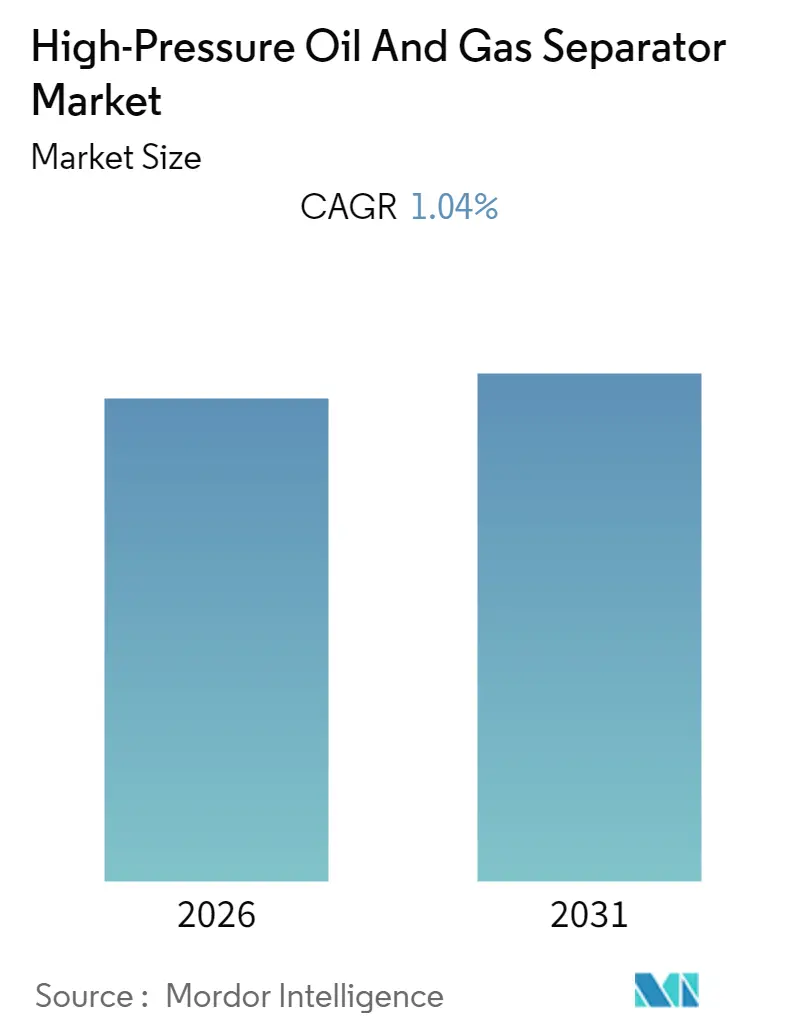
The High-Pressure Oil and Gas Separator Market size is expected to register a CAGR of 1.04% during the forecast period.
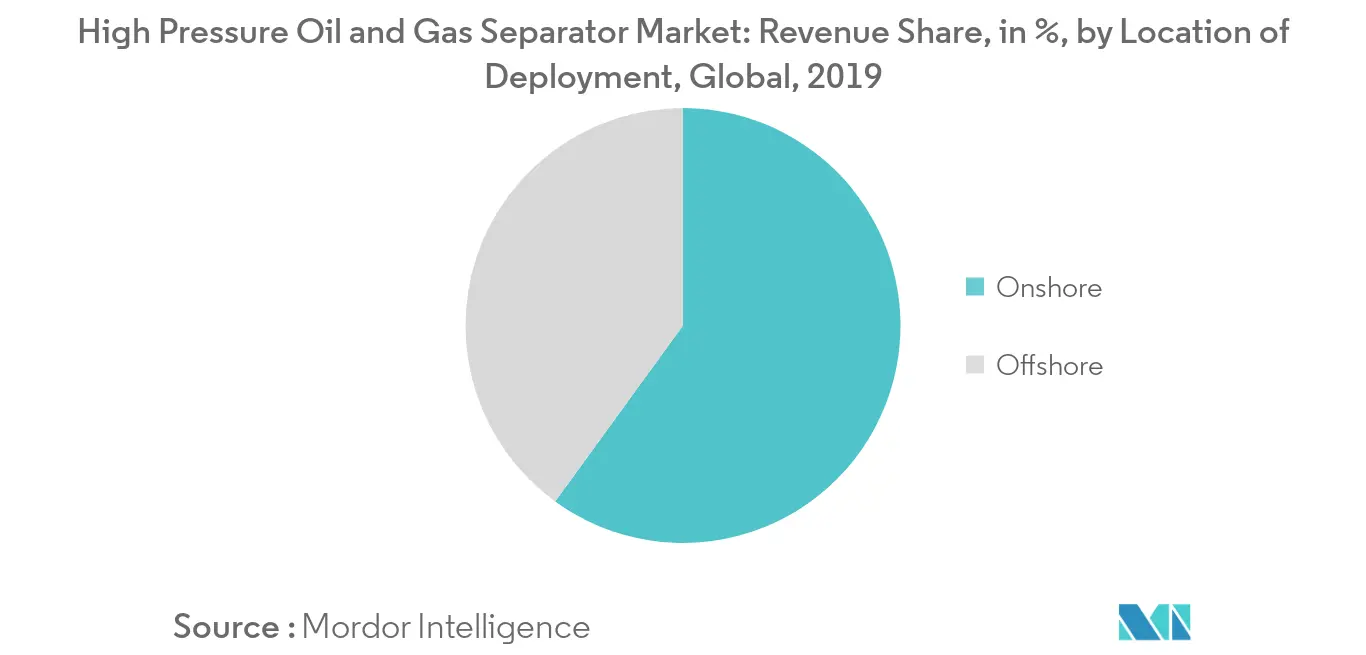
- The onshore segment is expected to dominate in the high pressure oil and gas separator market during the forecast period.
- Oil and gas separator manufacturers are conducting R&D activities to reduce the equipment cost and increase efficiency. Therefore technological advancement in the components of oil and gas separators is likely to provide an opportunity in market in the future.
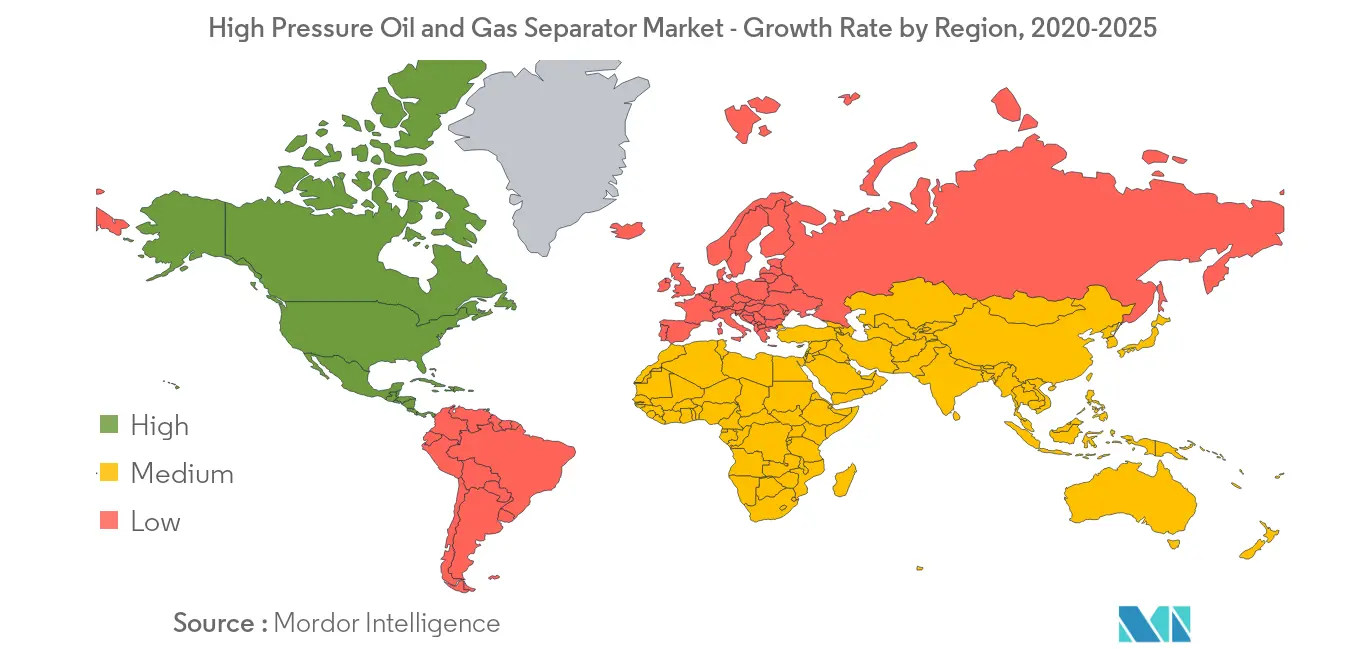
- North America expected to dominate in the high pressure oil and gas separator market during the forecast period owing to the rise in oil & gas activities in the region.
Note: Market size and forecast figures in this report are generated using Mordor Intelligence’s proprietary estimation framework, updated with the latest available data and insights as of 2026.
Global High-Pressure Oil And Gas Separator Market Trends and Insights
Onshore Segment to Dominate the Market
- Onshore refers to the development of oil fields, gas deposits, and geothermal energy on land which calls for the demand for rigs and related E&P equipment, including high-pressure separators.
- The onshore segment is expected to dominate owing to the number of onshore rigs operational across the globe. According to Baker Hughes, the onshore rig count holds a value of 610 whereas offshore rig count holds a value of 195 as of May 2020.
- Based on vessel type, the horizontal vessel segment has the largest share since these vessels can handle large volumes under high pressures, and major countries such as United States, Venezuela, Saudi Arabia, and Canada have a high demand for them.
- Based on product type, high pressure separators can be categorized into two-phase, three-phase and four-phase, wherein the two-phase type typically deals with oil and gas, the three-phase type deals with water, oil and gas and four phase-type deals with water, oil, gas, and solid.
North America is Expected to Dominate in the Market
- In terms of geography, North America accounts for the significant market share among all other regions in the high pressure oil and gas separator market and is expected to dominate over the coming years. The market for high pressure oil and gas separators is on the rise, mainly in the United States, due to the discovery of multiple reservoirs of shale oil and gas and rising offshore exploration activities in the region.
- Since the number of conventional deposits is decreasing, crude oil is increasingly being extracted from unconventional deposits such as oil sands or oil shale. There are large amounts of unconventional hydrocarbon reserves in regions of North America, especially in countries like the United States, and Canada.
- In 2019, the crude oil and condensate production has reached 18620 thousand barrels per day with a growth rate of 6.9% which is expected to boost the market owing to the significant increase in oil and gas activities across the region.
- Unconventional onshore gas is expected to retain an important share of gas supply in North America with production increasing towards 2025 which is likely to boost up the demand for high pressure oil and gas separators.
Regulatory Landscape
High-pressure separator specification and deployment are shaped by air-emissions and methane rules that push operators toward tighter control of venting, flaring, and flowback handling. In the United States, EPA standards under 40 CFR Part 60 (NSPS OOOOb/EG OOOOc) include requirements relevant to separators used during initial flowback and well completions, and EPA finalized a rulemaking with technical changes in April 2026 that adjusted elements tied to temporary flaring provisions and monitoring requirements for vent gas from flares and enclosed combustion devices.
In Europe, EU Regulation (EU) 2024/1787 (effective 4 August 2024) raises the compliance bar for methane management across the energy sector. It includes provisions that ban routine venting and flaring with an effective date of 5 February 2026 where technically feasible, and it introduces structured methane reporting and mitigation obligations (including timelines affecting inactive and temporarily plugged wells by 5 August 2026). Separators and associated gas-handling equipment selections are increasingly evaluated against these methane-related operational constraints, alongside established industry design practices such as API RP 12J (9th edition, September 2024) for process design of separators and scrubbers.
Value Chain Analysis
The value chain for high-pressure oil and gas separators starts with raw materials and engineered components, then moves into pressure vessel fabrication, integration into skids or processing trains, and delivery through EPC and service channels to upstream operators. Upstream inputs include plate and forgings for pressure-containing shells, along with specialized internals such as inlet devices, baffles, mist eliminators, and instrumentation (pressure, level, and temperature measurement and controls). Mechanical integrity and code compliance sit at the center of manufacturing, anchored by pressure vessel requirements such as ASME Section VIII, while process design and performance practices are commonly aligned with API RP 12J (9th edition, September 2024).
OEMs and packagers assemble vessels and modular separation packages, and EPC/EPCI contractors integrate separators into onshore facilities and offshore topsides or subsea processing architectures. Lead times and availability can tighten around specialized fabrication capacity and critical internals (including demisting elements) and around materials and qualification needs for sour service, where material selection and verification commonly reference NACE MR0175 practices. Increasing adoption of modular, pre-engineered packages shifts more engineering and assembly work upstream into OEM workshops, reducing field labor and supporting faster deployment for multi-well pads and complex offshore developments.
Competitive Landscape
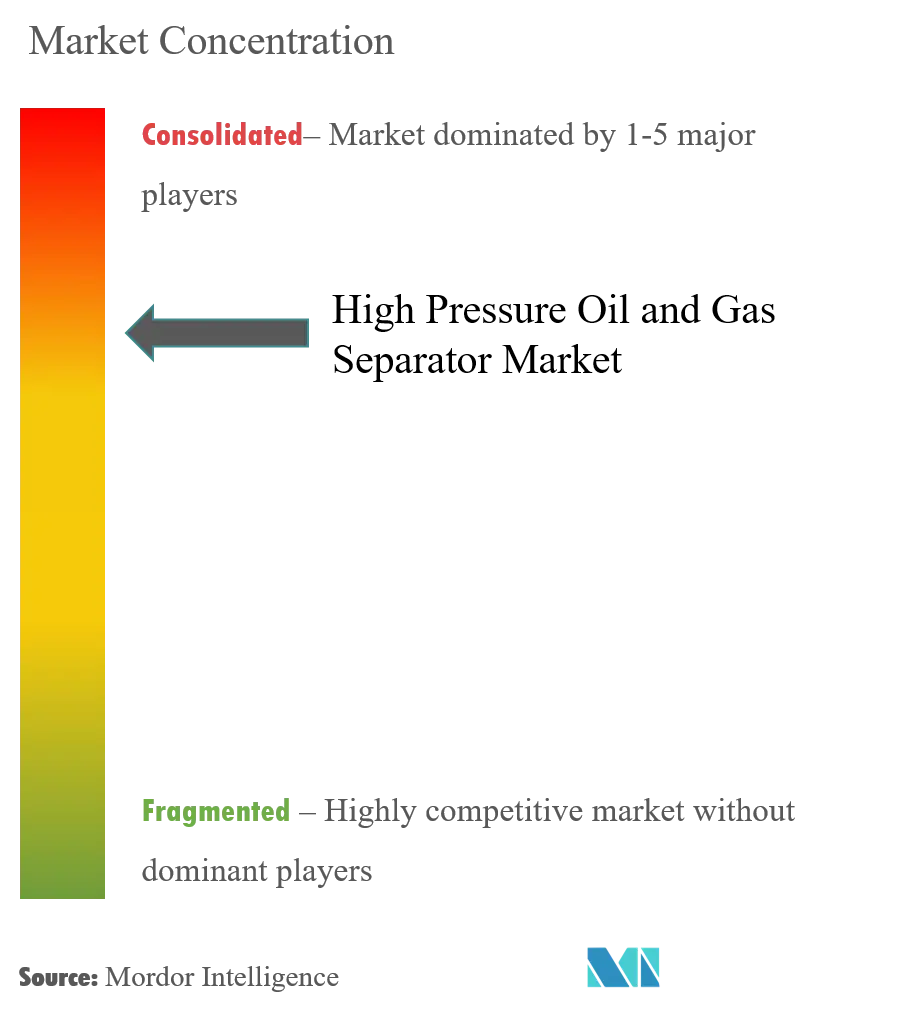
The high pressure oil and gas separator market is moderately consolidated. Some of the major players in the market include Schlumberger Limited, Sulzer Ltd., TechnipFMC plc, Frames Group BV, and Exterran Corporation.
High-Pressure Oil And Gas Separator Industry Leaders
-
Sulzer Ltd.
-
TechnipFMC plc
-
Frames Group BV
-
Exterran Corporation
-
Schlumberger Limited
- *Disclaimer: Major Players sorted in no particular order
Market Opportunities and Future Outlook
Methane-focused operating constraints and equipment standards create a clearer opening for separator designs and add-ons that reduce venting and improve handling of transient and high-variability streams. EU Regulation (EU) 2024/1787, effective since August 2024, includes an effective 5 February 2026 ban on routine venting and flaring where technically feasible, which increases the value of separation systems that stabilize operations and improve gas handling at high pressure with fewer emissions-intensive workarounds.
Technology-driven debottlenecking in mature assets is another active opportunity area, particularly where rising water cuts increase the load on surface facilities. In July 2026, SLB completed the acquisition of Sulzer Vessel Internal Electrostatic Coalescer (VIEC) technology to strengthen oil-water separation performance, indicating continued investment in vessel-internal separation upgrades that can be applied within existing separator footprints. Offshore HP/HT development activity also supports higher-spec equipment needs, and 2026 industry discussions around 20,000 psi production systems and adjacent processing strategies reinforce demand for high-pressure-rated separation solutions and compact processing concepts in challenging reservoirs.
Recent Industry Developments
- July 2026: SLB completed the acquisition of Sulzer Vessel Internal Electrostatic Coalescer (VIEC) technology to enhance oil-water separation performance, particularly for aging assets. The move strengthens SLB's separation portfolio around vessel-internal upgrades that can debottleneck existing facilities and improve separation efficiency without fully replacing pressure vessels.
- January 2025: Tracerco secured a contract to supply its Profiler measurement and control systems for the Mero 3 HISEP separator unit with TechnipFMC. The award highlights the role of advanced measurement and control in high-pressure separation, supporting stable operation and performance verification in complex offshore processing environments.
- June 2024: Sulzer announced it would supply three customized 6 MW high-pressure centrifugal pumps to TechnipFMC for the Mero 3 HISEP pilot project in Brazil's pre-salt. Supplying high-power, high-pressure pumping hardware for subsea separation systems supports the shift toward subsea processing architectures that reduce topside processing loads and enable handling of CO2-rich streams offshore.
Research Methodology Framework and Report Scope
Market Definition and Coverage
This market is defined as revenue from equipment that separates oil, gas, and produced water under high-pressure operating conditions in upstream facilities, including sales linked to onshore and offshore installations, and related configuration decisions needed for safe phase separation.
Scope exclusions: we exclude downstream refinery separators, low-pressure production separators, and standalone replacement parts and routine service work that are billed separately from equipment supply.
Segmentation Overview
- Type
- Two-Phase Separator
- Three-Phase Separator
- Four-Phase Separator
- Vessel Type
- Horizontal
- Spherical
- Vertical
- Location of Deployment
- Onshore
- Offshore
- Geography
- North America
- Europe
- Asia-Pacific
- Middle-East and Africa
- South America
Data Sources, Market Sizing, and Validation
Desk Research
Desk research starts with public energy activity signals that shape separator demand, then we map those signals to equipment needs by application. We typically use sources such as the US Energy Information Administration for production trends, the Bureau of Ocean Energy Management for offshore project activity, and OPEC and IEA publications for upstream outlook and investment direction.
To anchor the equipment side, we also review sources such as API and ISO references for separation and pressure vessel related practices, along with trade and customs releases where available to sense shipment movement by region. Company filings, investor presentations, and credible industry press are used to cross-check capacity additions, new field tie-ins, and order timing. Where helpful, paid subscriptions for company financials and patent databases are consulted to verify product positioning and the direction of enabling technologies. These examples are not exhaustive, and many other public and internal reference points are reviewed to clarify definitions, validate assumptions, and resolve data gaps.
Primary Interviews and Surveys
Primary work is used to confirm what is purchased for a high-pressure separation train, how specifications change by basin and fluid conditions, and how project timing shifts across regions. We speak with a balanced mix of upstream operators, EPC and package integrators, and equipment-focused engineering and sales roles, then use their feedback to test volumes, typical pricing ranges, and the share of brownfield replacements versus new builds across major geographies.
Distribution of primary research fieldwork respondents
| Company type | Respondent position | Region |
|---|---|---|
| Top tier: 30% | CXOs: 13% | APAC: 47% |
| Mid tier: 49% | Functional/Unit leaders: 33% | EMEA: 29% |
| Smaller Players: 21% | Managers: 54% | Americas: 24% |
Market-Sizing & Forecasting
Sizing is built using top-down and bottom-up methods, where upstream activity indicators are converted into equipment demand and then checked against supplier and channel realities. On the top-down side, production and project development data are used to reconstruct the likely count of new or upgraded separation trains, then we allocate them to high-pressure duties based on reservoir pressure regimes and facility design choices.
To keep the model practical, we track a small set of inputs closely, such as active rig counts and well completions, offshore project sanctions and FPSO related developments, onshore facility expansions, typical separator sizing needs by throughput, and lead times that shift order booking between years. Pricing is handled through a simple ASP ladder that reflects materials and fabrication cost movement, the share of two-phase versus three-phase packages, and the premium for offshore codes and testing requirements. Results are then corroborated with selective bottom-up approximations using sampled ASP times estimated unit volumes by region, along with channel checks from integrators. Where gaps remain, we use conservative ranges and tighten them after interview validation.
Forecasting is based on scenario analysis, since upstream capex and offshore approvals can change quickly. Each scenario is tied to clear drivers like oil and gas price outlook, operator budget guidance, and region-specific project pipelines. The final forecast uses the scenario that aligns best with what interviewees describe as the most likely ordering environment over the forecast window.
Data Validation & Update Cycle
Validation is done in steps, where model outputs are compared against independent signals like upstream spending trends, project award news, and observed changes in lead times and quoted pricing. When a number looks unusual, we revisit the assumptions behind unit counts, pressure duty share, or ASP progression, and we trigger targeted follow-up discussions with relevant respondents before sign-off.
A multi-review process is followed internally, and the report is refreshed annually, with interim updates when material events occur, such as major project sanctions, sharp commodity price moves, or large regulatory shifts affecting offshore development. Before delivery, we do a final pass to reflect the latest available public indicators and interview feedback, so clients receive an updated view that matches current market conditions.
Mordor Intelligence's High Pressure Oil and Gas Separator Market Estimate Compared With Other Published Estimates
Published market values for high-pressure oil and gas separators can vary because different studies do not always count the same equipment boundary, and they also treat pricing and project timing differently across onshore and offshore work. Currency timing, the way ASP changes are applied over the forecast years, and how replacement demand is separated from new project demand can each move the final number.
In this study, the refresh cadence matters because oilfield activity, steel-driven fabrication costs, and quote-to-order conversion can shift within a year. Those checks are re-run using consistent currency timing and interview-validated ASP steps, which is why Mordor Intelligence may not match figures built from older project lists or flat pricing assumptions.
Benchmark comparison
| Source | Market Size | Gaps in Research Methodology |
|---|---|---|
| Mordor Intelligence | USD 0.00 B (2026) | |
| Industry Association A | USD 0.00 B (2026) | Often reported as part of broader separation or surface facilities spend, which can blend high-pressure units with standard production separators and use aggregated budgeting values instead of equipment-level ASP steps. |
| Global Consultancy B | USD 0.00 B (2026) | May rely on a project-pipeline snapshot with limited mid-year refresh and simplified currency conversion, which can miss repricing and schedule slippage effects that shift ordering between years. |
The spread mainly comes from what is counted as high-pressure separation equipment, and from how pricing and timing are updated when upstream plans change. By keeping the scope tied to high-pressure separator demand and using repeatable checks on activity, mix, and ASP movement, the estimate stays traceable to clear inputs that can be reviewed and adjusted when new information appears.
Key Questions Answered in the Report
What is the current High Pressure Oil and Gas Separator Market size?
The High Pressure Oil and Gas Separator Market is projected to register a CAGR of 1.04% during the forecast period (2026-2031)
Who are the key players in High Pressure Oil and Gas Separator Market?
Sulzer Ltd., TechnipFMC plc, Frames Group BV, Exterran Corporation and Schlumberger Limited are the major companies operating in the High Pressure Oil and Gas Separator Market.
Which is the fastest growing region in High Pressure Oil and Gas Separator Market?
Asia Pacific is estimated to grow at the highest CAGR over the forecast period (2026-2031).
Which region has the biggest share in High Pressure Oil and Gas Separator Market?
In 2025, the North America accounts for the largest market share in High Pressure Oil and Gas Separator Market.
What years does this High Pressure Oil and Gas Separator Market cover?
The report covers the High Pressure Oil and Gas Separator Market historical market size for years: 2020, 2021, 2022, 2023 and 2024. The report also forecasts the High Pressure Oil and Gas Separator Market size for years: 2026, 2027, 2028, 2029, 2030 and 2031.