
Marine Oil Water Separator Market Size and Share
Market Overview
| Study Period | 2021 - 2031 |
|---|---|
| Forecast Data Period | 2026 - 2031 |
| Historical Data Period | 2021 - 2024 |
| Growth Rate | 2.86 % |
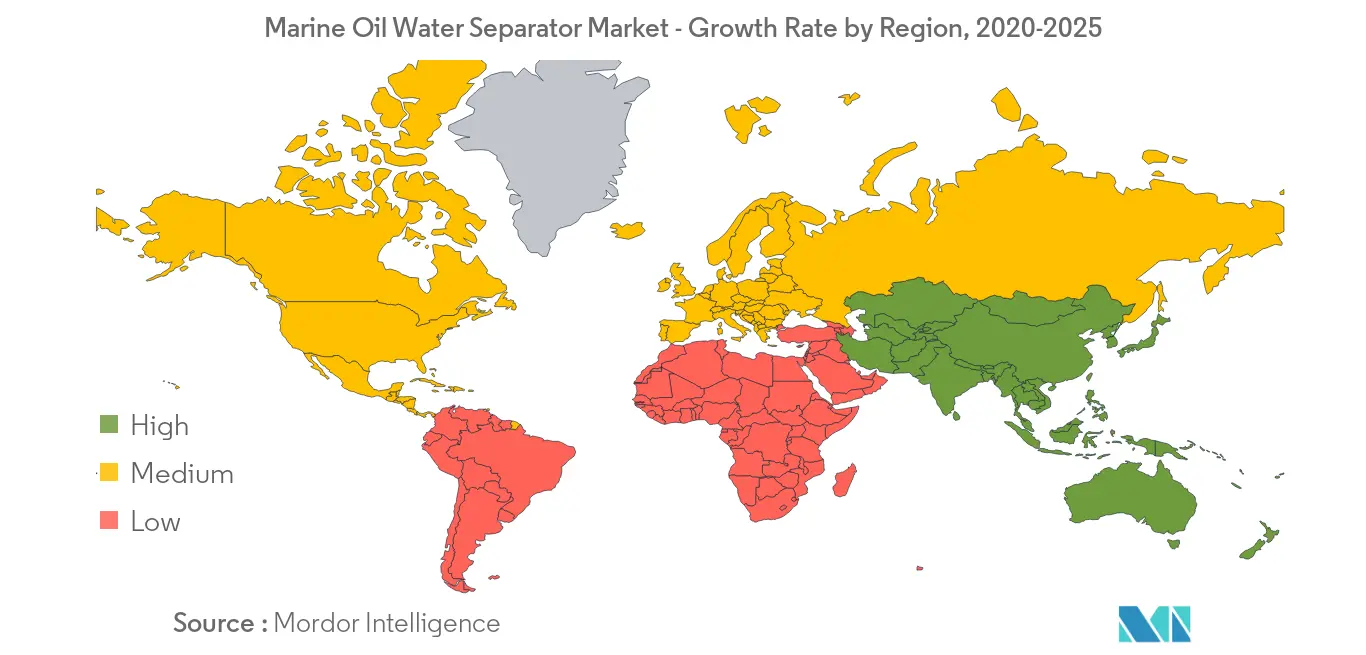
| Fastest Growing Market | Asia Pacific |
| Largest Market | North America |
| Market Concentration | High |
Major Players *Disclaimer: Major Players sorted in no particular order Image © Mordor Intelligence. Reuse requires attribution under CC BY 4.0. | |
Marine Oil Water Separator Market Analysis by Mordor Intelligence
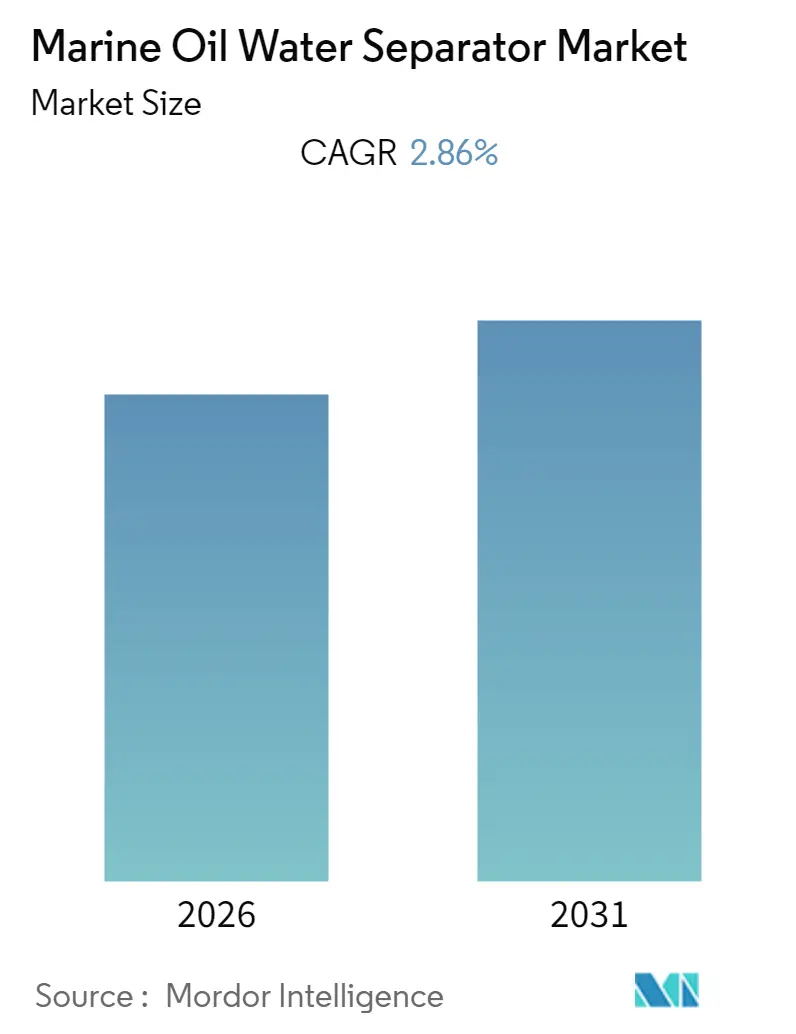
The Marine Oil Water Separator Market size is expected to register a CAGR of 2.86% during the forecast period (2026-2031).
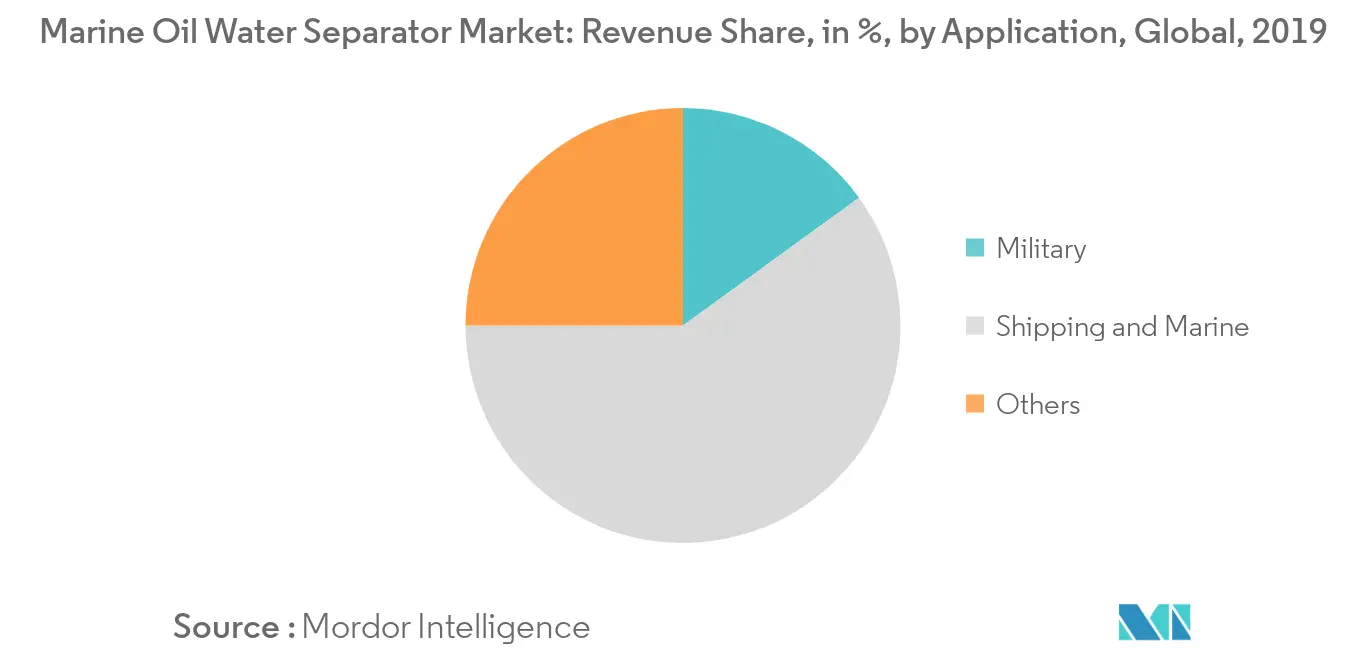
- The shipping and marine industry segment is expected to dominate the market over the forecast period.
- Multiple processing technologies used in combination for the purpose of high efficiency, environmental protection, economy, and energy conservation are the future development trend for marine oil water separators, which, in turn, is likely to provide an opportunity for the players involved in the market in the near future.
- Europe is expected to account for the major share in the marine oil water separator market during the forecast period owing to its dominance in world shipping fleet.
Note: Market size and forecast figures in this report are generated using Mordor Intelligence’s proprietary estimation framework, updated with the latest available data and insights as of 2026.
Global Marine Oil Water Separator Market Trends and Insights
Shipping and Marine Industry Segment to Dominate in the Market
- Governments across different countries are continuously working on enhancing the conditions for the flora and fauna in the aquatic ecosystem and protecting the environment by passing MARPOL's "ANNEX I' regulations which limit the oil content in the bilge water that vessels can legitimately discharge into the sea. It is now a compulsory requirement for all vessels to have an oil discharge monitoring and control system along with an oil-water separator.
- With the rapid development of the global shipping industry, the marine oil water separator market is expected to have significant growth during the forecast period.
- The international shipping industry is responsible for the carriage of around 90% of world trade. Intercontinental trade, the bulk transport of raw materials, and the import/export of affordable food and manufactured goods are held through shipping.
- Seaborne trades are expected to expand further, there are over 50000 merchant ships trading internationally, transporting every kind of cargo. Hence, with the rise in shipping industry activities and stringent government regulations, the demand for marine oil water separator is expected to increase over the forecast period.


Europe to Dominate the Market
- Europe is home to the world's largest shipping fleet. The European Union (EU) controls around 40% of the world's tonnage and can boast of the world's youngest and most innovative fleet. It is also home to a thriving maritime services sector and marine equipment industry.
- Europe contributed significantly towards the growth of global marine oil water separators market due to strict rules related to wastewater generation from various industries in this region.
- As 75% of European external trade transits through EU ports, the growing trade influence the growth of end-user industries in Europe, which, in turn, boosts the demand for the marine oil water separator in the region.
- Europe's offshore and service vessels are expected to have the fastest-growing segment of the EU shipping industry. As of May 2020, Europe's offshore active rig count was 26. Europe's ongoing offshore exploration and production activities are attributed to boosting the demand for marine oil water separators since the necessary supplies while undertaking exploration, drilling, and construction activities are provided by offshore support vessels.
- Therefore, since major portion of the trade occurs through ships, the demand for marine oil water separators is expected to grow further in the region during the forecast period.

Regulatory Landscape
International requirements for marine oil-water separators are anchored in the International Maritime Organization (IMO) framework under MARPOL Annex I. This includes the 15 ppm discharge limit for machinery-space bilge water and the requirement for oil filtering equipment on applicable vessels. IMO Resolution MEPC.107(49) also remains a key global reference for type approval and testing of oily water separators, bilge alarms, and associated automatic stopping arrangements, shaping equipment design, sampling, and alarm performance criteria.
National and regional enforcement adds tighter compliance expectations through port State control and market-access rules. In the United States, 33 CFR 155.380 sets requirements for oil filtering equipment on U.S.-inspected ships, with approvals aligned to Coast Guard requirements (including 46 CFR 162.050 approval pathways) and MARPOL acceptance for foreign ships. In Australia, AMSA Marine Notice 2025/06 reinforced inspection and testing practices for oil filtering equipment, highlighting tamper and calibration issues commonly identified during inspections. In the European Union, the Marine Equipment Directive framework continues to codify IMO-based standards for equipment placed on the EU market, while Directive (EU) 2024/3101 strengthened the administrative-penalty regime for ship-source pollution infringements, raising the stakes for accurate monitoring and defensible discharge records.
Value Chain Analysis
The value chain starts with upstream component supply for separation and monitoring subsystems, including coalescers, filters, valves, pumps, sensors (oil content meters), and control electronics. System engineering and assembly by OEMs then deliver the separator package alongside bilge alarms, automatic stopping devices, and control logic designed around MEPC.107(49) test and type-approval requirements. An important midstream step is independent testing and certification (type approval and conformity assessment), which supports acceptance during port State control inspections as well as installation on newbuilds and retrofits.
On the downstream side, demand is executed through shipyards for newbuild integration and through retrofit contractors and shipowners or managers for ongoing fleet operations. OEM service networks support these deployments with spares, calibration, and verification. Compliance verification at the point of operation is shaped by inspection bodies and regulators. For example, AMSA Marine Notice 2025/06 emphasized inspection focus areas and response-time behavior of the automatic stopping device during over-limit events. Technical standards updates can also drive redesign across adjacent onboard systems; DIN 86735:2025-06 updated requirements for bilge water tank-system design and linkages between the automatic stop device and oil content meter system, affecting how OEMs integrate monitoring, sampling, and safety interlocks across the installed base.
Competitive Landscape
The marine oil water separator market is fragmented. Some of the major players in the market include Compass Water Solutions, Inc., Freytech Inc., Promac B.V., Sulzer Ltd, and Wartsila Oyj Abp.
Marine Oil Water Separator Industry Leaders
Compass Water Solutions, Inc.
Freytech Inc.
Promac B.V.
Sulzer Ltd
Wartsila Oyj Abp
- *Disclaimer: Major Players sorted in no particular order


Market Opportunities and Future Outlook
Compliance-driven replacement and retrofit activity is a key opportunity area, since oily water separators, bilge alarms, and automatic stopping devices must meet the IMO MEPC.107(49) approval framework and perform reliably under port State control scrutiny. Operational guidance updates, including AMSA Marine Notice 2025/06, keep attention on correct testing, intact sampling arrangements, and system behavior during exceedance events. This raises the value of tamper-resistant architectures, faster response integration between oil content meters and stop devices, and service offerings that maintain certified performance.
Product and portfolio moves in adjacent onboard wastewater streams also open room for more integrated, modular treatment suites that extend beyond conventional bilge separation while using existing shipboard installation channels. In May 2026, Wärtsilä introduced its GREASE TRAP GM Series for onboard grease separation, signaling continued emphasis on modular wastewater management building blocks that can be deployed across vessel types. The June 2026 repositioning of Hamworthy as an independent marine water and waste systems specialist following Solix Group AB’s acquisition of Wärtsilä’s Water and Waste division underscores the push toward portfolio specialization in onboard water systems. Digital monitoring and aftermarket support are expanding as well, including the July 2026 appointment of Separator Spares and Equipment, LLC as an Authorized Rivertrace Limited Distributor for marine environmental monitoring systems and OEM spare parts, which aligns distribution capacity with compliance-led maintenance needs.
Recent Industry Developments
- May 2026: Wärtsilä launched the GREASE TRAP GM Series, a modular product line for onboard grease separation on merchant vessels, cruise ships, and offshore platforms. By targeting fats, oils, and grease in galley wastewater, the offering broadens onboard wastewater management beyond standard bilge treatment. The modular approach supports retrofit-friendly installations and complements compliance-focused equipment packages used across mixed fleets.
- November 2025: Compass Water Solutions delivered a SPIR-O-LATOR unit to an FPSO off the coast of West Africa, targeting overboard discharge performance below 5 ppm. The deployment highlights demand from offshore assets for higher-separation performance than the 15 ppm compliance threshold and for equipment suited to continuous operation. It also reinforces the role of offshore projects as a channel for specialized oily water separation systems and associated service support.
- September 2025: Compass Water Solutions completed installation of its ULTRA-SEP 1000-G bilge water separator system for a major oil and gas marine service provider, bringing deployments to nearly 50 units across the fleet. Fleet-level standardization on a single separator platform streamlines compliance procedures, spares, and operator training while reducing operational variability in discharge control. The scale of the rollout highlights the importance of retrofittable systems and lifecycle support for multi-vessel operators.


Research Methodology Framework and Report Scope
Market Definition and Coverage
This market covers marine oil water separators used to remove oil from oily water streams on ships and marine platforms, typically to meet discharge limits and protect onboard systems. We size demand from newbuild installations and replacement or retrofit activity tied to vessel operations.
Scope exclusions: Excludes shore based industrial oil water separators used in factories, refineries, and municipal wastewater plants.
Segmentation Overview
- Type
- Gravity Oil Water Separator
- Bioremediation Oil Water Separator
- Electrochemical Oil Water Separator
- Others
- Application
- Military
- Shipping & Marine Industry
- Others
- Geography
- North America
- Europe
- Asia-Pacific
- Middle-East and Africa
- South America
Data Sources, Market Sizing, and Validation
Desk Research
We start by mapping the compliance and vessel demand base that drives separator purchases, and then connect it to equipment shipment value and typical replacement cycles. Public rules and technical guidance are especially useful here because they specify what the equipment must achieve, which then anchors what gets counted.
Key non paywalled inputs were taken from sources such as the International Maritime Organization (MARPOL Annex I discharge rules), US Coast Guard and EPA vessel discharge guidance, EMSA maritime safety publications, UN Comtrade trade statistics for relevant separator equipment categories, and classification society technical guidance notes that describe oily water equipment requirements. We also reviewed shipbuilding and fleet signals from public port state control releases, ship registries and shipyard announcements, plus annual reports and investor presentations of major marine equipment suppliers, which help validate product mix and pricing direction. Some supporting checks were also taken from paid subscriptions focused on company financials, patents, and shipment level trade data where available. The desk research sources listed are illustrative only, and many other public documents and datasets were used for data collection, cross checks, and clarification.
Primary Interviews and Surveys
Primary work was used to pressure test the assumptions that desk sources do not fully answer, especially replacement timing, retrofit triggers, and realized pricing by capacity and compliance rating. We spoke with a mix of vessel operators, ship repair and retrofit decision makers, marine engineers, and equipment distributors across major buying regions, and then used the feedback to fine tune adoption rates and exclude adjacent equipment that is not bought as an oily water separator.
Distribution of primary research fieldwork respondents
| Company type | Respondent position | Region |
|---|---|---|
| Top tier: 28% | CXOs: 12% | APAC: 42% |
| Mid tier: 54% | Functional/Unit leaders: 34% | EMEA: 31% |
| Smaller Players: 18% | Managers: 54% | Americas: 27% |
Market-Sizing & Forecasting
Sizing was built using a top-down demand pool that reconstructs equipment needs from the active fleet and newbuild pipeline, and then converts that need into revenue using typical unit values by capacity range and compliance configuration. To keep the totals realistic, results were corroborated with selective bottom-up approximations, such as rolling up sampled supplier revenues, channel checks with distributors, and a simple ASP times volume build using retrofit plus newbuild counts.
Inputs that mattered most included: fleet size by vessel class and age profile, newbuild deliveries and orderbook direction, port state control intensity and non compliance risk, typical separator capacity installed by vessel type, retrofit rates after major rule enforcement periods, and expected price movement linked to steel and component costs. Where direct volume data was missing by country, we used regional vessel counts and trade flows as proxies, and then adjusted with interview based shares so small markets were not overstated.
For the forecast, scenario analysis was used so that fleet growth, retrofit intensity, and average selling price progression can be flexed in a consistent way by region. The final curve was selected only after the scenarios were checked with expert views on shipyard capacity, maintenance cycles, and near term regulatory enforcement focus.
Data Validation & Update Cycle
We validate the model through several rounds of cross checks, where outputs are compared against independent signals like fleet additions, shipyard activity, and trade movement patterns for related marine equipment categories. If a segment shows a sudden step change that does not match vessel deliveries or compliance timing, the assumptions are revisited and the relevant experts are re contacted.
Before sign off, the estimates go through analyst reviews that look for variance by region, pricing realism, and logical consistency between historical years and the forecast drivers. Reports are refreshed annually, with interim updates when material events occur, such as major regulatory changes, supply disruptions, or sharp shifts in shipbuilding demand. Right before delivery, an analyst runs a final update pass so clients receive the latest available view.
Mordor Intelligence's Marine Oil Water Separator Market Size Compared Against Other Published Estimates
Published market values for marine oil water separators often look different because each study draws the line around what equipment counts, and then applies its own pricing logic and timing for fleet and retrofit demand. Variation also comes from currency conversion timing, and from whether the forecast assumes a base case or includes faster retrofit enforcement.
Some external figures appear to include a wider set of oily water handling equipment, including parts of onboard wastewater treatment or broader bilge management packages. In Mordor Intelligence, the revenue is counted only for dedicated marine oil water separators sold for oily water separation duties, and adjacent treatment modules are excluded unless they are priced and shipped as part of the separator unit.
Benchmark comparison
| Source | Market Size | Gaps in Research Methodology |
|---|---|---|
| Mordor Intelligence | USD 0.80 B (2024) | |
| Trade Publisher A | USD 1.22 B (2024) | The estimate is aligned to an oily bilgewater separator view that can broaden the counted scope to include a wider set of bilgewater separation systems, and it also emphasizes shipment based totals which can lift value when bundled systems are treated as one line item. |
| Industry Portal B | USD 0.50 B (2023) | The figure is anchored to a narrower reported base year and can undercount retrofit and replacement demand, especially when only shipboard bilge separators are included and pricing is kept flat without adjusting for capacity mix and compliance driven upgrades. |
The table shows that most of the spread comes from what gets included as part of the separator sale, and from how retrofit demand is treated in the base year. Our approach keeps the count tied to a defined shipboard separator demand pool, with practical checks on fleet drivers and realized pricing so the final number is traceable and repeatable.


Key Questions Answered in the Report
What is the current Marine Oil Water Separator Market size?
The Marine Oil Water Separator Market is projected to register a CAGR of 2.86% during the forecast period (2026-2031)
Who are the key players in Marine Oil Water Separator Market?
Compass Water Solutions, Inc., Freytech Inc., Promac B.V., Sulzer Ltd and Wartsila Oyj Abp are the major companies operating in the Marine Oil Water Separator Market.
Which is the fastest growing region in Marine Oil Water Separator Market?
Asia Pacific is estimated to grow at the highest CAGR over the forecast period (2026-2031).
Which region has the biggest share in Marine Oil Water Separator Market?
In 2025, the North America accounts for the largest market share in Marine Oil Water Separator Market.
What years does this Marine Oil Water Separator Market cover?
The report covers the Marine Oil Water Separator Market historical market size for years: 2020, 2021, 2022, 2023 and 2024. The report also forecasts the Marine Oil Water Separator Market size for years: 2026, 2027, 2028, 2029, 2030 and 2031.
Page last updated on:


 Your data is secure and never sold or shared.


