
Hematology Analyzers Market Size and Share
Market Overview
| Study Period | 2020 - 2031 |
|---|---|
| Market Size (2026) | USD 7.12 Billion |
| Market Size (2031) | USD 9.87 Billion |
| Growth Rate (2026 - 2031) | 6.75 % |
| Fastest Growing Market | Asia Pacific |
| Largest Market | North America |
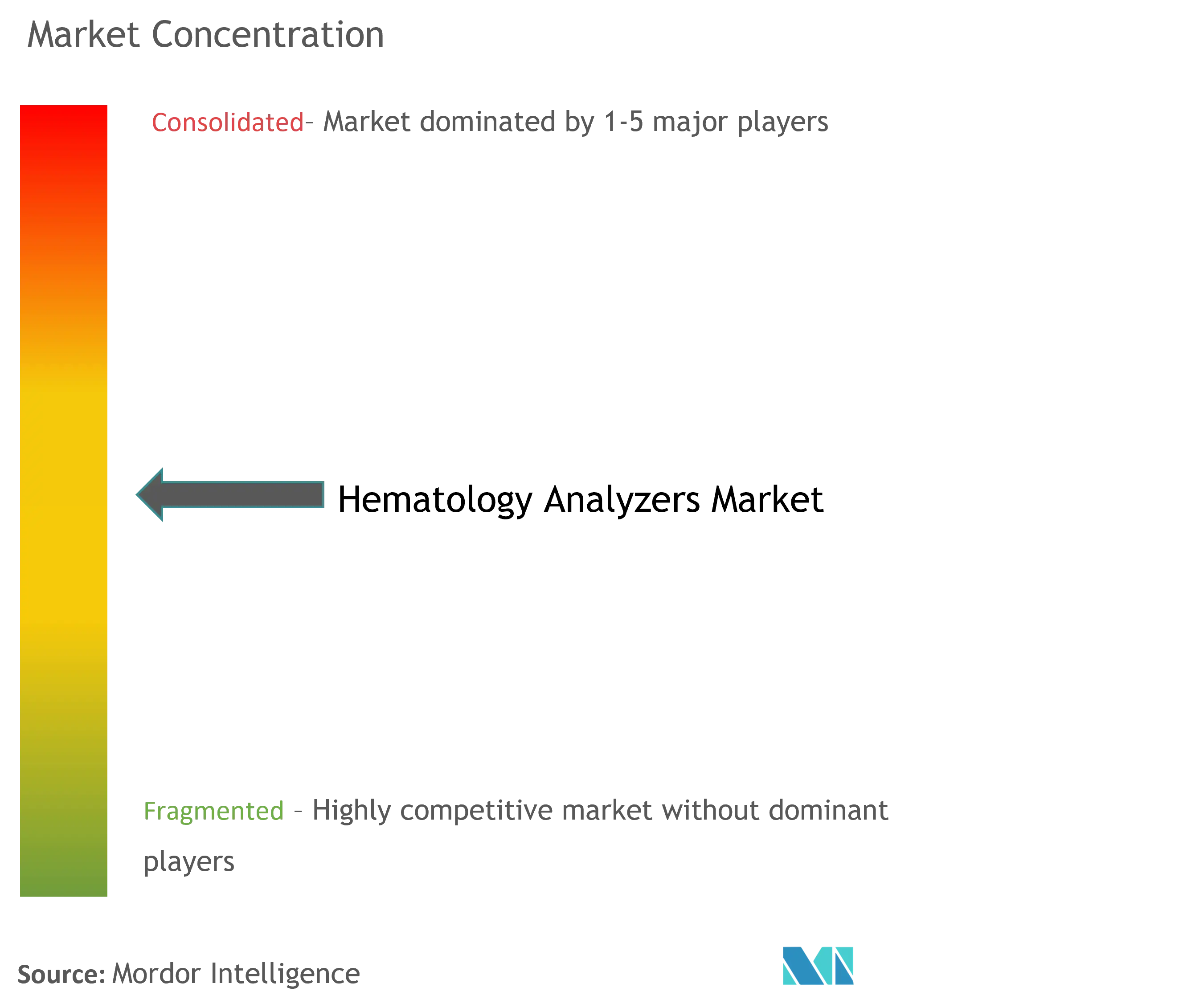
| Market Concentration | Medium |
Major Players *Disclaimer: Major Players sorted in no particular order Image © Mordor Intelligence. Reuse requires attribution under CC BY 4.0. | |
Hematology Analyzers Market Analysis by Mordor Intelligence
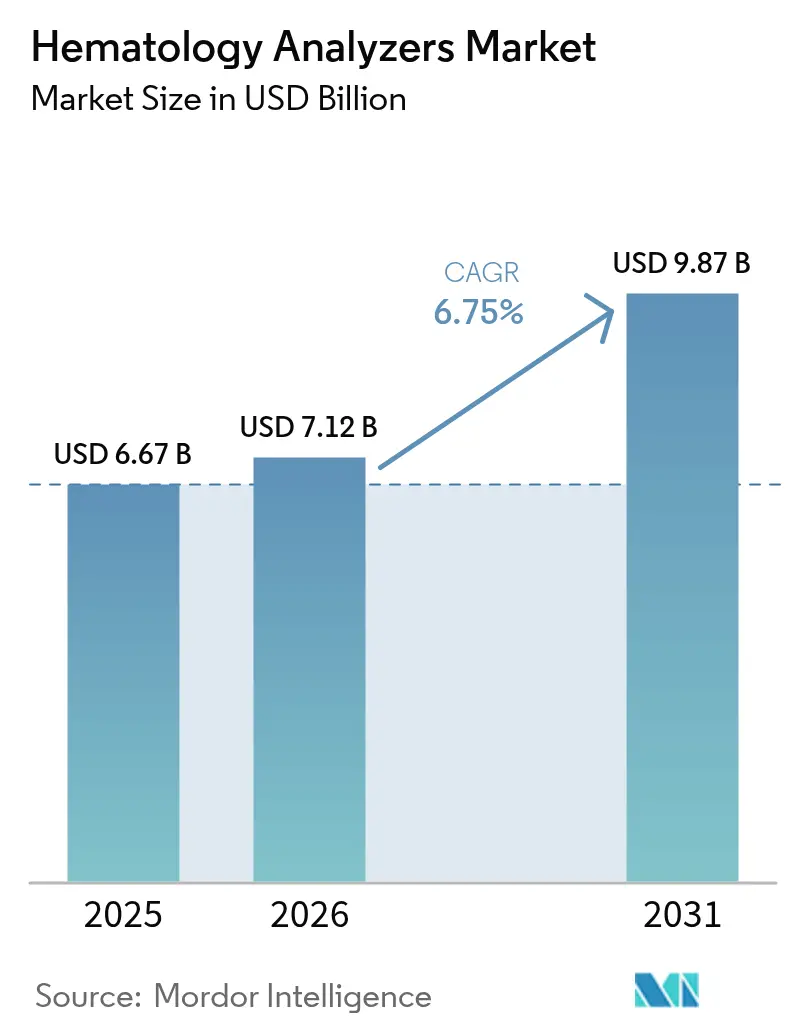
Hematology analyzers market size in 2026 is estimated at USD 7.12 billion, growing from 2025 value of USD 6.67 billion with 2031 projections showing USD 9.87 billion, growing at 6.75% CAGR over 2026-2031. Continued growth rests on three structural shifts: rapid migration from 3-part to 5- and 6-part differential systems across middle-income nations, public-sector screening mandates for neonatal and geriatric disorders, and steady integration of artificial-intelligence tools that merge morphology, flow cytometry, and chemistry data into a single workcell. Upstream, reagent consumption accelerates because advanced differentials require proprietary diluents, surfactants, and calibrators, locking laboratories into long-term supply contracts. Downstream, hospital consolidation and the rise of centralized mega-labs intensify demand for high-throughput automation that can clear two-hour turnaround targets while maintaining traceability across multi-site networks. Finally, AI-powered pre-classification slashes manual smear review times, mitigating technologist shortages and lifting analyzer utilization rates, a trend most pronounced in North America and increasingly visible across top-tier Chinese and Indian reference labs.
Key Report Takeaways
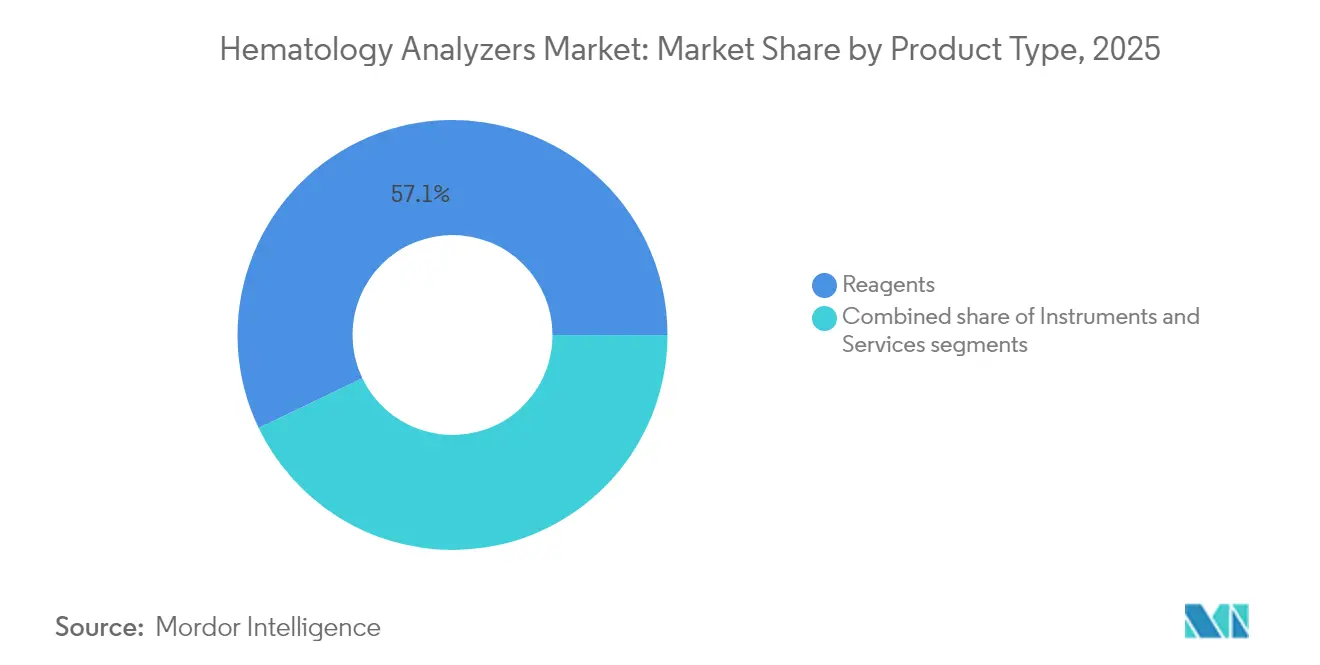
- By product type, reagents captured 57.12% of global revenue in 2025 and are projected to expand at an 8.15% CAGR through 2031.
- By modality, fully automated systems remained the dominant platform in 2024, processing the highest daily sample volumes; semi-automated models showed lower uptake and no separate growth figure was reported.
- By end user, hospital laboratories commanded the greatest share of test volumes in 2024, while commercial reference providers represented the quickest-expanding customer group even though a specific CAGR was not disclosed.
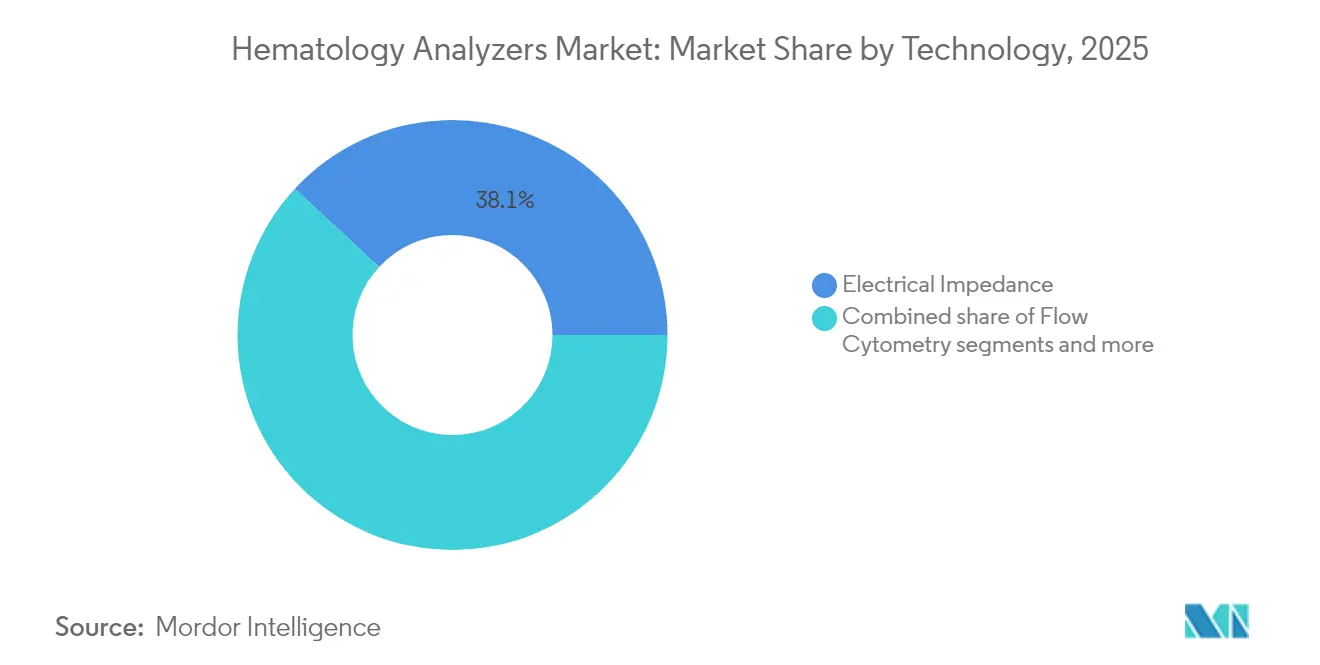
- By technology, electrical impedance led with 38.10% revenue share in 2025; flow cytometry platforms posted the fastest adoption pace, although a quantified CAGR was not provided.
- By application, anemia testing accounted for 37.45% of 2025 sales, whereas blood-cancer diagnostics is projected to expand at a 7.55% CAGR to 2031.
- By geography, North America held 39.85% of global revenue in 2025, while Asia-Pacific is forecast to register a 6.95% CAGR through 2031.
Note: Market size and forecast figures in this report are generated using Mordor Intelligence’s proprietary estimation framework, updated with the latest available data and insights as of 2026.
Market Trends and Insights
Drivers Impact Analysis of Hematology Analyzers Market*
| Driver | (~) % Impact on CAGR Forecast | Geographic Relevance | Impact Timeline |
|---|---|---|---|
| Rising incidence of hematologic disorders | +1.8% | North America, Europe | Long term (≥ 4 years) |
| Adoption of 5- & 6-part analyzers in mid-income nations | +1.2% | Asia-Pacific, Latin America, MEA | Medium term (2-4 years) |
| Consolidation of central-lab networks | +0.9% | North America, EU | Medium term (2-4 years) |
| Shift toward integrated hematology-chemistry workcells | +0.7% | Global | Long term (≥ 4 years) |
| AI-driven pre-classification | +1.1% | Developed markets | Short term (≤ 2 years) |
| Government neonatal screening mandates | +0.8% | Asia-Pacific | Medium term (2-4 years) |
| Source: Mordor Intelligence | |||
Rising Incidence of Hematologic Disorders
Escalating prevalence of leukemias, lymphomas, and myelomas fuels sustained demand for advanced differential analysis. Cancer registries in high-income countries recorded another uptick in non-Hodgkin lymphoma cases during 2024 despite plateaued mortality, underscoring the need for sensitive cell-flagging algorithms that standard 3-part instruments cannot deliver. Aging populations compound testing volume; Medicare beneficiaries exhibited a 2.68% blood-cancer diagnosis rate versus 0.31% among employer-insured cohorts in 2024, demonstrating how demographic load alone steers analyzer upgrades. Laboratories therefore prioritize platforms that integrate high-resolution optical pathways, AI classifiers, and digital reporting to reduce false negatives and accelerate therapeutic decisions.
Growing Adoption of 5- & 6-Part Differential Analyzers in Mid-Income Countries
Governments in China, India, Brazil, and Egypt accelerate infrastructure modernization programs that replace legacy 3-part devices with five-class or six-class leukocyte systems. Economic modeling shows point-of-care HbA1c screening via advanced analyzers to be cost-effective across urban and rural health centers in China, creating parallels for hematology rollouts. Vendors capitalize by bundling multi-year reagent contracts and remote-service packages, establishing recurring revenue streams within these high-growth territories.
Consolidation of Central-Lab Networks in the U.S. & EU
Hospital mergers and private-equity roll-ups shrink the overall count of independent clinical labs but sharply raise average daily test volume per site. Large networks demand high-throughput analyzers able to auto-route samples, auto-verify results, and deliver consistent performance across geographically dispersed draw centers. Labcorp’s continental workflow demonstrates the scale benefit: standardized platforms lower per-test costs and reinforce purchasing power when negotiating reagent supply agreements.
AI-Driven Pre-Classification Reducing Review Time
Artificial-intelligence modules now achieve 91% sensitivity for myeloblasts and 88% for atypical lymphocytes in routine smears, cutting manual review time by more than half in early adopter labs. This capability counters persistent shortages of medical technologists and reduces overtime bills. Early installations also show a measurable drop in slide retries, boosting analyzer uptime and throughput.
Restraints Impact Analysis of Hematology Analyzers Market*
| Restraint | (~) % Impact on CAGR Forecast | Geographic Relevance | Impact Timeline |
|---|---|---|---|
| Capital budget freezes at sub-200-bed hospitals | -1.4% | Global, with highest impact in rural and community hospitals | Medium term (2-4 years) |
| Re-use of refurbished analyzers in South America | -0.6% | South America core, with spillover to other emerging markets | Medium term (2-4 years) |
| Shortage of qualified hematopathologists slowing test menu expansion | -0.8% | Global, with acute shortages in developing regions | Long term (≥ 4 years) |
| Supply-chain fragility for semiconductor flow cells | -0.5% | Global, with highest impact during geopolitical tensions | Short term (≤ 2 years) |
| Source: Mordor Intelligence | |||
Capital Budget Freezes at Sub-200-Bed Hospitals
Community hospitals confront rising labor expenses and declining reimbursements, pushing capital projects to the back burner. Vacancy surveys reveal double-digit staffing gaps across laboratory departments, making it difficult for boards to justify million-dollar analyzer replacements. Smaller facilities therefore stretch service contracts on aging devices, increasing downtime risk and limiting access to advanced diagnostics for rural populations.
Shortage of Qualified Hematopathologists Slowing Test Menu Expansion
An estimated deficit of 20,000–25,000 U.S. lab technologists constrains the rollout of complex abnormal-cell assays even when new analyzers are installed. Attrition has only deepened the talent shortfall, leaving many labs unable to exploit extended test menus that differentiate next-generation platforms. Continued workforce pressure threatens to mute near-term revenue upside from premium analyzers.
*Our forecasts treat driver/restraint impacts as directional, not additive. The impact forecasts reflect baseline growth, mix effects, and variable interactions.
Hematology Analyzers Market Segment Analysis
By Product Type:
Reagents Sustain Recurring Revenue MomentumReagents generated 57.12% of the hematology analyzers market size in 2025, driven by test-volume growth and proprietary formulations that tie customers to a single vendor. Their predictable replacement cycle underpins an 8.15% CAGR through 2031, outpacing hardware additions as central labs maximize instrument utilization before purchasing new units. Advanced surfactant mixes, nucleic-acid dyes, and stabilization buffers tailored to AI-based morphology further lift average selling prices and margin profile.
Instrument revenues trail reagent contribution yet remain pivotal to platform penetration, particularly as mid-income buyers leapfrog to 5-part systems that promise lower per-test reagent consumption over time. Point-of-care analyzers carve a niche in trauma bays and oncology infusion centers, offering 60-second turnaround albeit at premium reagent costs. Services, though the smallest slice, gain strategic weight because algorithm updates and remote-performance monitoring are now mission-critical for sustaining AI classifier accuracy.



By Modality:
Fully Automated Systems Command Laboratory WorkflowsAutomated instruments accounted for the dominant value share in 2024 as central labs chased consistency, barcode-driven traceability, and 98% first-pass accuracy benchmarks. The hematology analyzers market share for automated units is set to widen further as “dark-lab” concepts move from pilot to production, leveraging robotics that load racks 24/7 without human intervention. Semi-automated models retain relevance inside satellite clinics and blood banks with unpredictable workflows or tight capital budgets.
AI-infused autotesting pushes error-rate curves downward, freeing technologists for manual differentials on flagged samples. In parallel, vendors bundle cloud dashboards that benchmark analyzer utilization across sites, enabling multi-hospital groups to redeploy under-used units rather than approve new purchases. This asset-optimization logic locks customers further into vendor ecosystems, reinforcing lifetime value of each hardware install.
By End User:
Hospital Laboratories Anchor Testing VolumeHospital labs handle the bulk of inpatient and outpatient CBCs, creating scale economics that justify high-end analyzers with integrated slide makers. Their procurement committees increasingly adopt enterprise-wide refresh cycles that synchronize hematology, chemistry, and immunoassay platforms every eight years, a cadence favored by service-agreement pricing models. Commercial reference providers grow faster in percentage terms, outsourcing coagulation and advanced flow panels for smaller hospitals and physician offices lacking subspecialty personnel.
Academic and research centers demand open-tube sampling ports, advanced flagging, and raw-data export for clinical-trial protocols, making them early adopters of digital-imaging enhancements. Blood banks favor analyzers certified for donor screening with low carryover coefficients and high red-cell impedance resolution. Collectively, these distinct requirements push vendors to maintain multi-form-factor portfolios that cover bedside cartridges through 500-sample-per-hour automation lines.
By Technology:
Electrical Impedance Retains Leadership Amid Hybrid InnovationElectrical impedance contributed 38.10% revenue in 2025 because of its low cost per test and rugged design suited to high-volume environments. Flow cytometry, although more expensive, climbs fastest as immunophenotyping becomes core to oncology pathways. Portable magnetic flow cytometry prototypes now promise CD4 counts at the point of care, signaling future opportunities in primary-care clinics.
Laser scattering and fluorescence occupy specialty niches such as body-fluid cell counts, while digital imaging bridges gap by pairing high-resolution slide scans with AI morphology. Imaging flow cytometry blends the best of both worlds, capturing quantitative fluorescence signals alongside cell photographs, enabling single-cell analytics at throughputs close to classical impedance counters. Vendors therefore pursue hybrid pipelines that embed multiple detection channels within a single chassis, widening addressable menus without multiplying footprint.
By Application:
Anemia Dominates, Oncology Drives Incremental GrowthAnemia panels produced 37.45% of global revenue in 2025 thanks to universal reliance on CBCs across inpatient, outpatient, and preventive-care settings. Their absolute volume secures reagent pull-through even in low-incidence geographies. Conversely, blood cancer diagnostics, posting a 7.55% CAGR, adds high-margin incremental tests that demand advanced immunophenotyping and digital imaging capabilities.
Hemorrhagic-condition monitoring remains a steady revenue contributor, particularly within surgical centers deploying platelet mapping and viscoelastic testing. Genetic disorder panels expand as hereditary anemia and thalassemia screening programs mature; India’s multicenter sickle-cell cohort alone will screen multiple million newborns annually by 2027. Infection detection benefits from sepsis-alert algorithms that track left-shift patterns and immature granulocytes, further lifting analyzer usage during emergency-department surges.
Geography Analysis
North America Hematology Analyzers Market
North America held 39.85% of global sales in 2025 and continues to prioritize integrated workcells that link hematology, chemistry, and molecular assays through unified middleware. Medicare reimbursement reforms, including new DRGs for gene therapies, indirectly bolster demand for precision CBC parameters used in eligibility and toxicity monitoring. Canada and Mexico add incremental growth as provincial modernization funds and private-sector expansions replace aging 3-part counters with AI-ready instruments.
APAC Hematology Analyzers Market
Asia-Pacific, expanding at a 6.95% CAGR, gains momentum from demographic weight and public-health mandates. China’s 8.95% thalassemia carrier prevalence pushes provincial funding for mass-screening networks equipped with mid-tier analyzers that can process 120 samples per hour while maintaining cost discipline. India’s national sickle-cell elimination mission uses a hub-and-spoke model where high-throughput systems in district hospitals receive dried blood-spot cards from rural clinics, a workflow reliant on reagent stability and robust remote diagnostics. Japan and South Korea deploy mature automation suites yet continue to upgrade to AI morphology for workforce efficiency.
Europe Hematology Analyzers Market
Europe demonstrates steady replacement demand complicated by In-Vitro Diagnostic Medical Device Regulation (IVDR) timelines. The 2024/1860 extension gives laboratories breathing room but nudges procurement toward CE-certified platforms supported by rigorous post-market surveillance, advantaging incumbents with deep regulatory expertise. Germany illustrates the automation imperative; MVZ’s adoption of ABB robots boosts sample throughput by 25% and sets a precedent for other high-wage economies.
Regulatory Landscape
Hematology analyzers are regulated as in vitro diagnostic medical devices, with market access shaped by premarket review, quality-system compliance, and country-specific performance standards. In the United States, automated hematology analyzers are typically classified as Class II devices (21 CFR 864.5220, product code GKX) and often use the 510(k) pathway. Recent clearances in 2025 for systems such as Abbott's Alinity h-series (K243283) and Sysmex's XR-10 (K250943) track ongoing platform refresh cycles supported by substantial-equivalence claims and recognized standards.
Quality and conformity requirements tightened in 2026 as the FDA Quality Management System Regulation (QMSR) became effective on February 2, 2026. This aligned 21 CFR Part 820 with ISO 13485:2016 and raised the emphasis on design controls, supplier management, and post-market processes across instruments and reagents. In Europe, IVDR implementation continues to affect certification capacity and documentation depth for hematology systems and companion reagents, while China added another compliance anchor with the National Health Commission's WS/T 406-2024 standard implemented on November 1, 2024 for routine clinical hematology analytes. That change reinforces expectations for analytical performance verification and laboratory quality procedures.
Value Chain Analysis
The hematology analyzers value chain covers specialized component suppliers (precision fluidics, pumps/valves, optical modules and lasers for scatter/fluorescence, detectors, and electronic boards), reagent formulators (lysing agents, dyes, buffers, calibrators, and controls), instrument OEMs that integrate hardware with middleware and algorithms, and distributors/service networks that install, validate, and maintain systems in hospital labs and commercial reference networks. With reagents holding the largest revenue pool in this market (57.12% share in 2025), OEMs design platforms around proprietary consumables and QC materials, which keeps reagent quality consistency and cold-chain or stability management central to both performance and recurring revenue.
Downstream, adoption depends on workflow integration with laboratory information systems and automation tracks, backed by field service, remote monitoring, and periodic software and algorithm updates to sustain flagging performance and traceability for multi-site customers. Partnerships that extend digital morphology and AI into the installed base also sit within the commercialization chain. Scopio Labs, for instance, expanded its strategic alliance with Siemens Healthineers in January 2025 to include global distribution of a full-field bone marrow aspirate digital solution, reinforcing how imaging, analytics, and channel reach are increasingly bundled with core hematology hardware and service contracts.
Competitive Landscape
Industry concentration remains moderate anchored by large installed bases and reagent exclusivity. Sysmex leverages its alliance with CellaVision to secure roughly 85% slice of the U.S. hematology analyzers market, bundling digital-morphology scanners with XN-series counters under unified QC software. Beckman Coulter, Siemens Healthineers, and Abbott Laboratories differentiate via chemistry-hematology integration, enabling single-tube reflex testing for anemia etiologies or oncology protocols.
Strategic M&A reshapes supply dynamics: Advanced Instruments’ USD 2.2 billion takeover of Nova Biomedical extends the buyer into electrolyte and glucose testing, forming a one-stop consumables platform that competes head-to-head with established reagent franchises. Roche deepens vertical integration by committing EUR 600 million to a German reagent megaplant that will internalize 450 core raw materials by 2028, improving supply certainty for its cobas hematology line.
Partnerships with AI specialists accelerate product refresh cycles without heavy R&D spend. Siemens Healthineers’ pact with Scopio Labs embeds full-field digital morphology inside Atellica 2200 units, streamlining smear review and reducing external slide scanners. BD teams with Biosero to integrate robotic liquid handlers onto FACS analyzers, targeting pharma clients who need high-content screening for cell-therapy pipelines. Start-ups exploit white-space by focusing on single-cell analytics or micro-fluidic platforms tuned to decentralized oncology centers, winning Series-A funding on the back of workforce-efficiency metrics.
Hematology Analyzers Industry Leaders
Abbott Laboratories
HORIBA Ltd
Siemens Healthineers
Sysmex Corporation
Danaher Corporation
- *Disclaimer: Major Players sorted in no particular order
Hematology Analyzers Market Companies Covered in this Report
- 3M
- Abbott Laboratories
- Johnson & Johnson
- Novartis
- Teva Pharmaceutical Industries
- Hisamitsu Pharmaceutical
- GlaxoSmithKline
- Bayer
- Viatris
- LTS Lohmann Therapie-Systeme
- Nitto Denko
- Corium LLC
- Agile Therapeutics Inc.
- UCB
- Luye Pharma Group Ltd.
- Zydus Lifesciences Ltd.
- Sparsha Pharma International Pvt Ltd
- Tapemark Inc.
- AdhexPharma

Market Opportunities and Future Outlook
A key opportunity is shifting routine CBC testing toward higher-value decision support by embedding digital morphology, AI pre-classification, and integrated workcell connectivity into daily hematology workflows. Product activity in 2026 reflects that direction: Sysmex America introduced the next-generation XR-Series (including the XR-10 module and XR-9000 configuration for high-volume labs), and Siemens Healthineers debuted the Atellica HEMA 580 in the U.S. for mid- to high-volume laboratories, with both announcements centered on throughput, automation integration, and more consistent sample handling. These developments match the report's emphasis on high-throughput automation in centralized mega-labs and the need to reduce manual smear review time amid technologist constraints.
Regulatory and standards alignment also opens space for vendors that can bundle compliant instruments, reagents, and documentation into faster deployment playbooks across regions. The FDA QMSR effective February 2, 2026 increases the leverage of ISO 13485-aligned quality systems and tighter supplier controls, while China tightened analytical performance expectations through WS/T 406-2024 implemented on November 1, 2024. That can support adoption of standardized QC and verification toolkits packaged with analyzer placements. Separately, compact multi-parameter designs that extend menus from a single tube, such as hematology plus inflammation markers, offer a differentiated placement option in settings balancing capital constraints with demand for more actionable results.
Recent Industry Developments in Hematology Analyzers Market
- July 2026: Siemens Healthineers announced the U.S. market debut of the Atellica HEMA 580 Analyzer for mid- to high-volume laboratories. The system highlights continuous sample mixing and automation-oriented design to improve consistency at higher throughput. The launch strengthens Siemens Healthineers' competitive position in integrated workcells where hematology is increasingly linked to broader automation and digital review workflows.
- February 2025: Abbott Laboratories received FDA 510(k) clearance (K243283) for its Alinity h-series system under the Class II hematology device framework. The clearance supports commercialization and installed-base expansion in the United States through a familiar regulatory route for substantial-equivalence devices. It also reinforces the importance of regulatory cadence in driving replacement cycles among hospital and reference laboratories.
- December 2024: Roche broke ground on a EUR 600 million diagnostics production center in Penzberg, Germany, aimed at securing reagent supply across hematology and other disciplines. The investment targets vertical integration and supply assurance for high-volume consumables that underpin analyzer economics. Expanded manufacturing capacity at a major European site also helps stabilize procurement for large lab networks that depend on uninterrupted reagent availability.


Hematology Analyzers Market Report Scope and Research Methodology
Market Definition and Coverage
This market is counted as revenues generated from hematology analyzers used to run routine and advanced blood cell testing in clinical settings, including systems installed in labs and hospitals, plus the related analyzer-driven service activity tied to those systems.
Scope exclusions: We exclude broader hematology diagnostics that are not analyzer-based, and we also exclude general lab IT, sample-collection items, and unrelated lab automation hardware.
Segments Covered in This Report
- By Release Technology (Value)
- Drug-in-adhesive
- Reservoir
- Matrix
- Microneedle-assisted
- Others
- By Therapeutic Area (Value)
- Smoking Cessation
- Hormone Replacement Therapy
- Pain Management
- Neurological Disorders
- Cardiovascular Disorders
- Contraception
- Others
- By Adhesive Technology (Value)
- Acrylate Adhesives
- Silicone Adhesives
- Hydrogel Adhesives
- Other Adhesives
- By Distribution Channel (Value)
- Hospital Pharmacies
- Retail Pharmacies
- Online Pharmacies
- Others
- By Geography (Value)
- North America
- United States
- Canada
- Mexico
- Europe
- Germany
- United Kingdom
- France
- Italy
- Spain
- Rest of Europe
- Asia-Pacific
- China
- India
- Japan
- South Korea
- Australia
- Rest of Asia-Pacific
- South America
- Brazil
- Argentina
- Rest of South America
- Middle East and Africa
- GCC
- South Africa
- Rest of Middle East and Africa
- North America
Data Sources, Market Sizing, and Validation
Desk Research
Desk research starts by grounding the demand pool and testing volumes in public health and lab-utilization signals. We referenced sources such as the US CDC, the World Health Organization, the World Bank, OECD health statistics, and public regulator pages, including US FDA product clearance and related technology shift information.
To keep the model realistic by country, we also used company annual reports, investor presentations, and reputable press coverage to understand placements, test throughput, and typical replacement patterns. Where available, we pulled supporting signals from paid subscriptions focused on company financials and intelligence, news and financials, and patent databases to time technology adoption and cross-check revenue mix assumptions. These examples are not exhaustive, and many other public sources were reviewed to collect data, validate inputs, and clarify open questions.
Primary Interviews and Surveys
Primary work was used to pressure-test the model assumptions that are hard to see in public data, especially pricing ranges, install base dynamics, and the split between mid to high throughput analyzers across end users. We spoke with a mix of manufacturers, distributors, independent labs, hospital lab leaders, and service organizations across APAC, EMEA, and the Americas, so gaps from desk research could be addressed and the final sizing could be reconciled with stated buying patterns.
Distribution of primary research fieldwork respondents
| Company type | Respondent position | Region |
|---|---|---|
| Top tier: 39% | CXOs: 15% | APAC: 49% |
| Mid tier: 46% | Functional/Unit leaders: 39% | EMEA: 32% |
| Smaller Players: 15% | Managers: 46% | Americas: 19% |
Market-Sizing & Forecasting
For sizing, the top-down approach reconstructs the addressable testing workload and matches it with analyzer deployment economics, then translates that into annual revenue by geography. To avoid over-counting, we separate analyzer instrument revenue from adjacent spend that can inflate totals, and we adjust for the typical replacement cycle rather than treating placements as one-time events.
The model uses practical inputs such as CBC test volumes as a proxy for hematology throughput, the share of tests processed on 3-part versus 5-part systems, average daily throughput by analyzer class, analyzer replacement and service-coverage rates, and regional price bands for instruments and service contracts. When gaps exist for smaller countries, we use proxy indicators like population age mix and hospital and lab capacity trends first, and then correct them using interview feedback.
Forecasting is done using scenario analysis with a multivariate regression check, where demand growth is linked to test volumes, lab consolidation, and automation adoption rates. Results are corroborated with selective bottom-up approximations, such as sampled ASP times estimated placements and channel checks on procurement timing, and supplier revenue mix signals, which are then used to adjust the final totals.
Data Validation & Update Cycle
Validation uses cross-checks that compare the output to independent signals, including regional lab-testing trends, installed base directionality, and published clearance and launch activity. When a country-level result looks unusual, we recheck the drivers for price, replacement cycle, and throughput assumptions, and then complete a second analyst review before sign-off.
The report is refreshed annually, and interim updates are triggered when material events occur, such as large policy shifts, major technology rollouts, or meaningful pricing changes in key regions. Before delivery, a final pass is performed so the numbers reflect the most recent public indicators and the latest primary feedback we have on record.
Mordor Intelligence's Hematology Analyzers Market Sizing Compared With Other Published Estimates
Published market sizes for hematology analyzers often do not match because the scope gets mixed with adjacent categories, and because firms use different base years and price logic when they convert volumes into revenue.
The main gap comes from whether consumables and broad hematology diagnostics are bundled into the total. Mordor Intelligence counts the market around analyzer-led revenue and validates the figure using throughput, replacement-cycle, and region-level pricing checks, rather than letting reagents-heavy definitions inflate the value.
Benchmark comparison
| Source | Market Size | Gaps in Research Methodology |
|---|---|---|
| Mordor Intelligence | USD 7.12 B (2026) | |
| Global Consultancy A | USD 5.80 B (2025) | Uses an earlier base year and a longer horizon, and the scope emphasizes analyzer hardware without consistently normalizing for replacement cycles and service attachment rates across regions. This can pull the current-year value down versus a throughput-linked demand pool. |
| Industry Publisher B | USD 4.14 B (2024) | Relies on a manufacturer-centric revenue view tied to a different base year, and it can miss channel-led sales and mid-tier placements in emerging markets when regional price bands and procurement timing are not rechecked with lab buyers. |
The spread is mainly explained by what is counted as part of the market, which year is treated as the starting point, and how pricing is carried forward. By tying revenue to a clear testing workload, realistic placement and replacement behavior, and interview-based price validation, our estimate stays traceable to inputs that can be reviewed and repeated.


Key Questions Answered in the Report
How large is the hematology analyzers market in 2026?
The hematology analyzers market size reached USD 7.12 billion in 2026 and is projected to rise to USD 9.87 billion by 2031.
What annual growth rate is expected for hematology analyzers through 2031?
Global revenue is forecast to grow at a 6.75% CAGR over the 2026-2031 period.
Which product segment generates the highest revenue?
Reagents contribute the largest share, accounting for 57.12% of 2025 sales and expanding at an 8.15% CAGR.
Which geographic region is expanding fastest?
Asia-Pacific leads growth with a projected 6.95% CAGR, supported by national screening mandates and infrastructure upgrades.
How is artificial intelligence changing hematology workflows?
AI-enabled pre-classification flags abnormal cells with 91% sensitivity, cutting manual review time and mitigating technologist shortages.
What recent merger reshaped competitive dynamics?
Advanced Instruments USD 2.2 billion acquisition of Nova Biomedical in 2025 created a diversified platform spanning instruments and consumables.
Page last updated on:


 Your data is secure and never sold or shared.


