
Handheld Backscatter X-Ray Devices Market Size and Share
Market Overview
| Study Period | 2020 - 2031 |
|---|---|
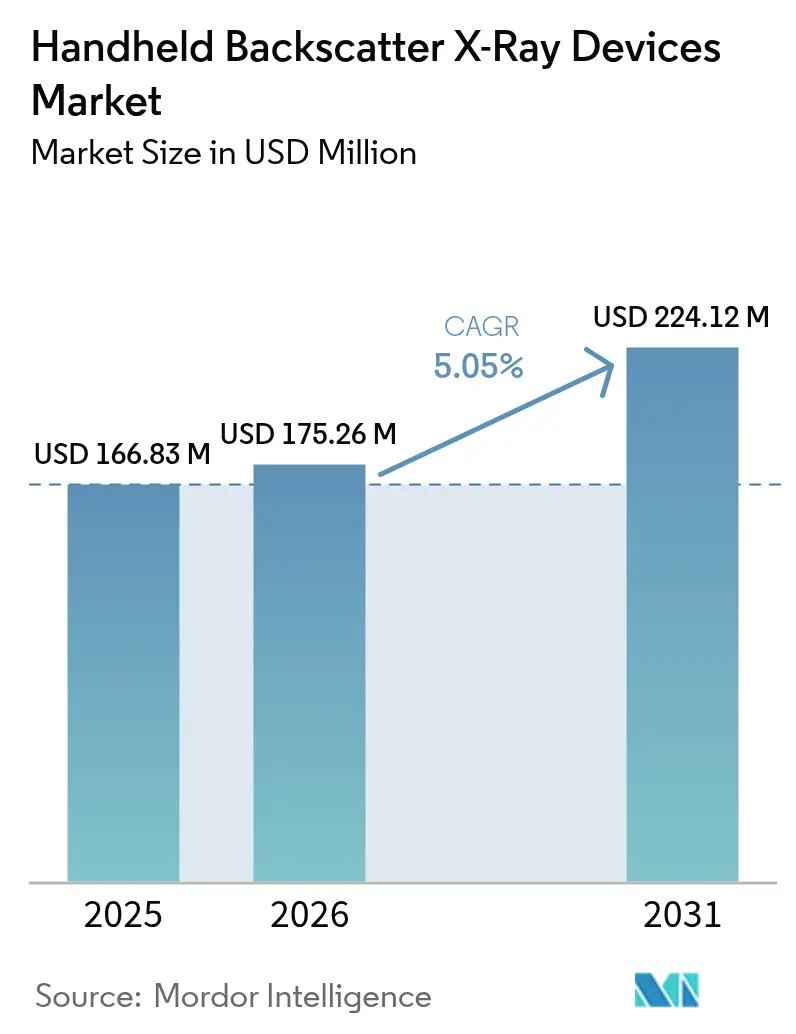
| Market Size (2026) | USD 175.26 Million |
| Market Size (2031) | USD 224.12 Million |
| Growth Rate (2026 - 2031) | 5.05 % |
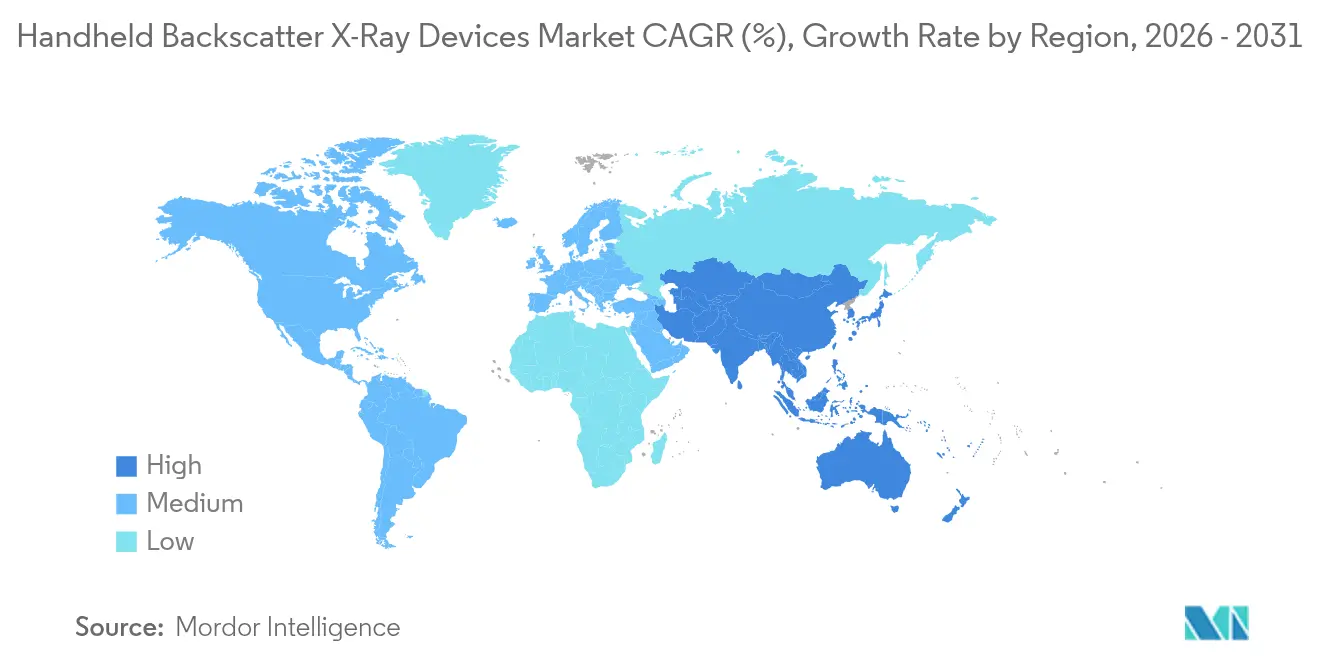
| Fastest Growing Market | Asia Pacific |
| Largest Market | North America |
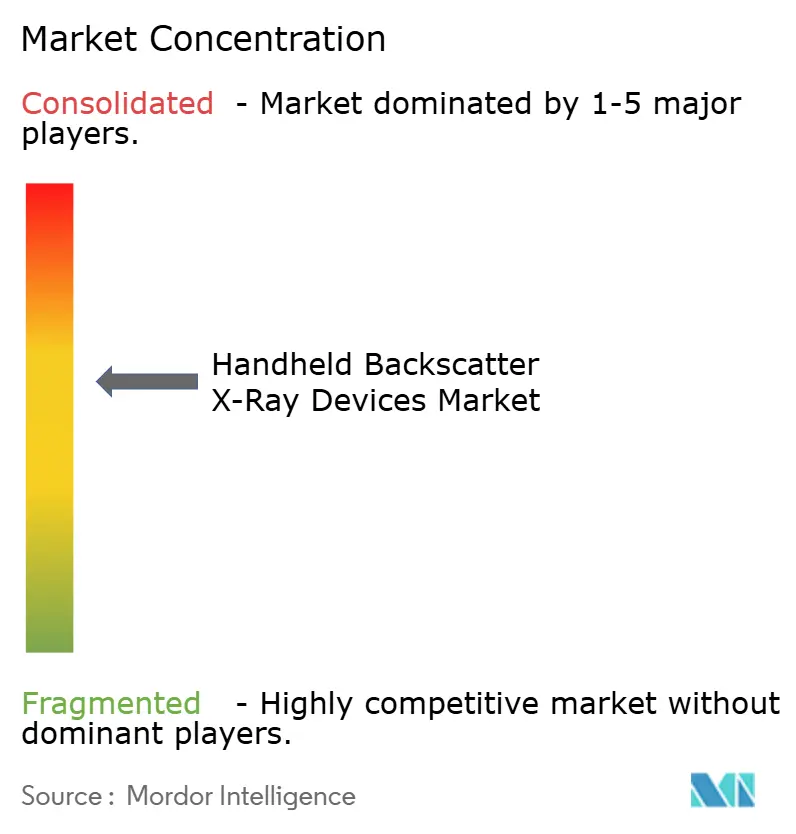
| Market Concentration | Medium |
Major Players *Disclaimer: Major Players sorted in no particular order Image © Mordor Intelligence. Reuse requires attribution under CC BY 4.0. | |
Handheld Backscatter X-Ray Devices Market Analysis by Mordor Intelligence
Handheld Backscatter X-Ray Devices Market size in 2026 is estimated at USD 175.26 million, growing from 2025 value of USD 166.83 million with 2031 projections showing USD 224.12 million, growing at 5.05% CAGR over 2026-2031. Demand rises as customs agencies search for portable, non-intrusive tools that can reveal contraband concealed inside dense cargo while keeping inspection lines moving. Investments in border infrastructure across North America, trade-driven security upgrades in Asia-Pacific, and steady improvements in tube miniaturization keep the handheld backscatter X-ray devices market on a stable yet competitive growth path. Component supply risks tied to rare earth export limits and the emergence of millimeter-wave alternatives temper near-term momentum but stimulate product innovation. Established vendors with proven regulatory compliance records and deep government relationships continue to secure multi-year contracts that cushion revenue volatility.
Key Report Takeaways
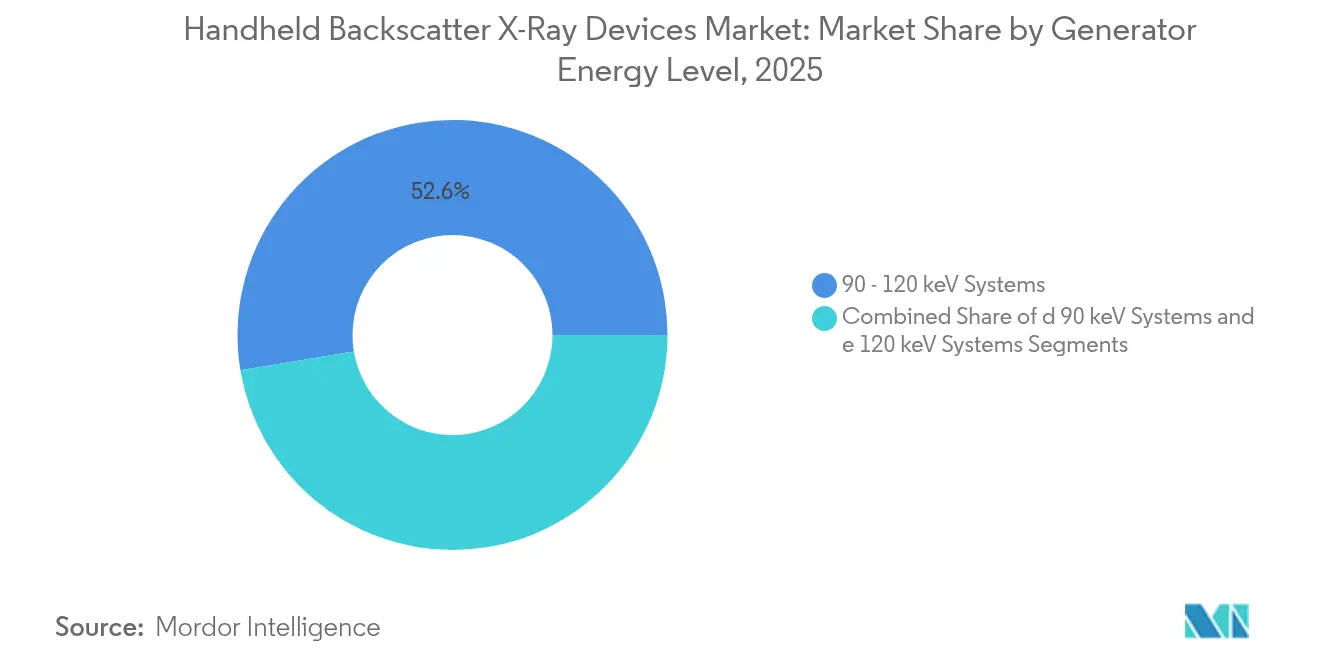
- By generator energy level, 90-120 keV systems captured 52.62% of the handheld backscatter X-ray devices market share in 2025; ≥120 keV units are projected to expand at a 7.05% CAGR through 2031.
- By sales channel, direct government procurement held 67.35% of 2025 revenue, while distributor and integrator sales are forecast to grow at an 7.6% CAGR to 2031.
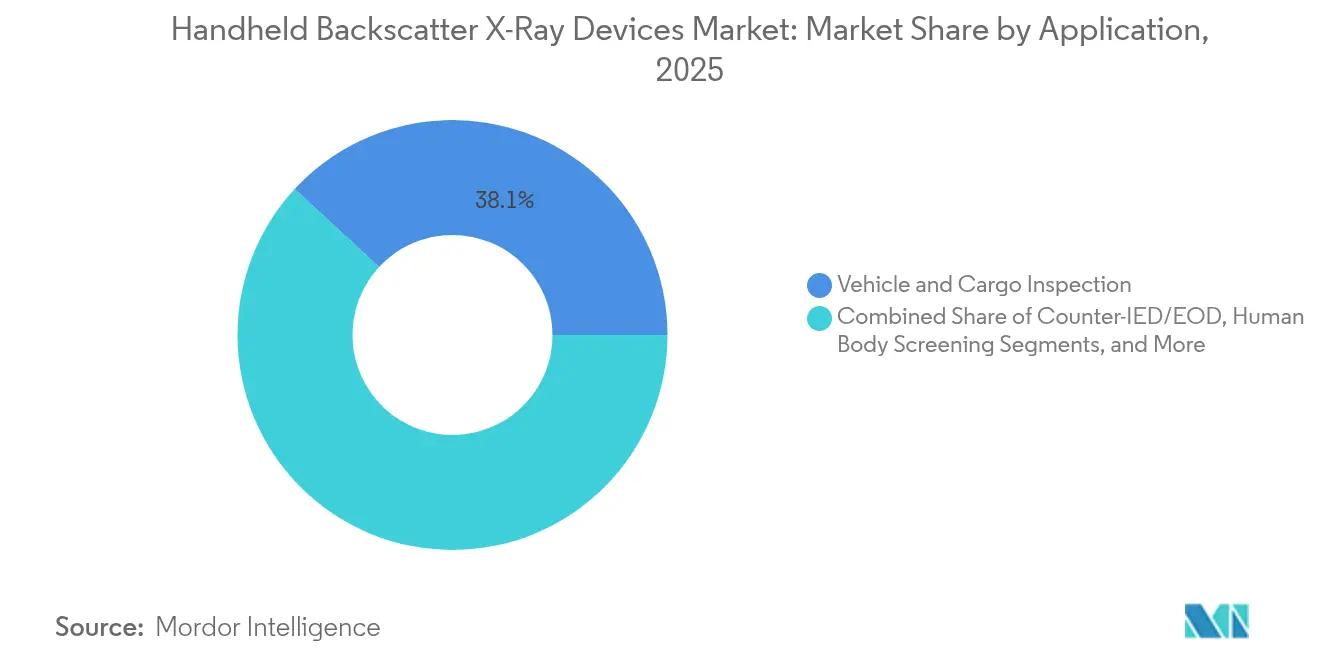
- By application, vehicle and cargo inspection accounted for 38.12% of the handheld backscatter X-ray devices market size in 2025, and counter-IED/EOD leads growth at a 6.62% CAGR.
- By end-user, customs agencies commanded a 40.78% share of the handheld backscatter X-ray devices market size in 2025, while critical-infrastructure users advanced at a 6.78% CAGR to 2031.
- By geography, North America led with 39.25% revenue share in 2025, whereas Asia-Pacific is projected to post the fastest 7.28% CAGR through 2031.
Note: Market size and forecast figures in this report are generated using Mordor Intelligence’s proprietary estimation framework, updated with the latest available data and insights as of 2026.
Market Trends and Insights
Drivers Impact Analysis of Handheld Backscatter X-Ray Devices Market*
| Driver | (~) % Impact on CAGR Forecast | Geographic Relevance | Impact Timeline |
|---|---|---|---|
| Growing cross-border smuggling threats | +1.2% | Global, concentrated at North American and EU borders | Medium term (2-4 years) |
| Rapid customs adoption of non-intrusive inspection tech | +1.0% | Asia-Pacific core, spill-over to MEA and Latin America | Short term (≤2 years) |
| Compact high-energy tube innovations | +0.8% | Global, early adoption in North America and Europe | Long term (≥4 years) |
| AI-driven threat-recognition integration | +0.7% | North America and EU, expanding to Asia-Pacific | Medium term (2-4 years) |
| Demand for drone-compatible lightweight modules | +0.5% | North America, EU, select Asia-Pacific markets | Long term (≥4 years) |
| Radiation-safe shielding for public-event use | +0.3% | Global, concentrated in developed markets | Medium term (2-4 years) |
| Source: Mordor Intelligence | |||
Growing Cross-Border Smuggling Threats
Customs officers are intercepting record narcotics hauls that were hidden in dense vehicle panels and cargo containers, reinforcing the handheld backscatter X-ray devices market focus on penetration power. Field teams need portable scanners capable of exposing small packages of drugs or weapons without dismantling shipments. Lightweight units now allow rapid checks at secondary inspection bays, keeping traffic flowing while boosting seizure rates. Canada’s border laboratory shows how mobile scanners identify trace explosives inside luggage and parcels. [1]CBP Laboratory, Government of Canada, cbsa-asfc.gc.ca Continuous cat-and-mouse tactics between smugglers and enforcement agencies sustain demand for performance upgrades that can reveal ever-smaller concealments.
Rapid Customs Adoption of Non-Intrusive Inspection Tech
Emerging economies accelerate deployment of integrated inspection lanes that link X-ray imaging to AI engines and e-manifest data, shrinking cargo release times and deterring illicit trade. Asia-Pacific customs modernization programs cite potential 11% trade-cost savings from full digitalization, encouraging budget allocations for smart handheld sensors. Governments prefer devices that integrate seamlessly with risk-scoring software and handheld biometric tools, creating procurement advantages for vendors offering open APIs. Pilot projects in Southeast Asia illustrate how handheld backscatter units verify container anomalies flagged by drive-through scanners, closing security gaps without adding docks. Commercial logistics hubs adopt similar workflows to bolster supply-chain credibility and attract shipping lines.
Compact High-Energy Tube Innovations
Advances in tube cooling, battery density, and shielded housings let ≥120 keV generators fit into pistol-grip formats, broadening use cases from static checkpoints to remote field patrols. Operators gain 6-hour endurance without external power, enabling off-grid inspections at rough terrain border stretches. The latest handheld backscatter X-ray devices market entrants can pierce up to 7 mm of steel while keeping weight under 5 kg. These capabilities unlock vehicle under-carriage scans, aircraft wheel-well checks, and disaster-zone assessments previously reserved for larger systems. Incremental tube efficiency also cuts heat output, easing regulatory compliance on surface temperatures.
AI-Driven Threat-Recognition Integration
Machine-learning software now distinguishes prohibited items across cluttered images, dropping false alarms and boosting operator confidence. Real-time inference at the edge means handheld backscatter X-ray devices market users receive on-screen threat alerts within seconds. Common API frameworks let agencies upgrade older scanners with AI modules instead of replacing hardware, protecting capital budgets. Research labs report near-zero performance loss when models trained on fixed scanners migrate to handheld image streams. Future integration with augmented-reality visors may allow technicians to overlay scan results onto physical objects, shortening decision loops in counter-IED missions.
Restraints Impact Analysis of Handheld Backscatter X-Ray Devices Market*
| Restraint | (~) % Impact on CAGR Forecast | Geographic Relevance | Impact Timeline |
|---|---|---|---|
| High acquisition and lifecycle costs | −1.5% | Global, particularly affecting emerging markets | Short term (≤2 years) |
| Operator/bystander radiation-exposure concerns | −0.8% | Global, stricter in EU and other developed markets | Medium term (2-4 years) |
| Millimetre-wave alternative cannibalisation | −0.6% | North America and EU, expanding globally | Long term (≥4 years) |
| Export-control restrictions on sales | −0.4% | Global, concentrated impact on strategic regions | Medium term (2-4 years) |
| Source: Mordor Intelligence | |||
High Acquisition and Lifecycle Costs
Price tags ranging from USD 40,000 to USD 100,000 per unit strain budgets for rural police forces and customs posts in low-income regions. Annual maintenance contracts, consumables, and recertification audits further elevate the total cost of ownership. Refurbished systems can be 30% cheaper, but limited supply and shorter warranties reduce adoption confidence. Leasing models are emerging, yet government procurement rules in many jurisdictions still favor outright purchase. Without multilateral funding mechanisms, smaller agencies postpone upgrades, slowing the handheld backscatter X-ray devices market penetration.
Operator/Bystander Radiation-Exposure Concerns
Strict dose limits require shielding accessories and structured procedures that add weight, complexity, and training hours. [2]FDA, fda.gov EU guidance mandates comprehensive dose mapping before public-venue deployment, raising compliance costs. Misconceptions about radiation persist among staff and passengers, prompting some airports to favor non-ionizing millimeter-wave portals instead. Studies show handheld doses can stay below the 1 mSv annual limit when protocols are followed, yet perception issues continue to temper the handheld backscatter X-ray devices market growth.
*Our forecasts treat driver/restraint impacts as directional, not additive. The impact forecasts reflect baseline growth, mix effects, and variable interactions.
Handheld Backscatter X-Ray Devices Market Segment Analysis
By Generator Energy Level:
Penetration Depth Shapes AdoptionThe 90-120 keV category accounted for 52.62% of 2025 revenue as it balances deep imaging with manageable radiation footprints, securing the largest slice of the handheld backscatter X-ray devices market. Continuous refinements keep this sweet spot attractive for customs posts and aviation security lanes. Demand for ≥120 keV units rises rapidly at 7.05% CAGR because thicker steel panels in trucks and shipping containers require extra penetration. The handheld backscatter X-ray devices market size for high-energy systems is projected to widen as cooling advances offset earlier portability constraints. Vendors add smart dose-management software so operators can lower energy when scanning personal items, expanding use beyond cargo checks.
Manufacturers are packaging 140 keV tubes in devices weighing under 5 kg, enabling field commanders to inspect improvised explosive devices without robot support. Multi-energy pulse modes help analysts distinguish organics from metallic threats, a feature valuable to narcotics task forces. With millimeter-wave competitors emphasizing safety, makers of high-energy backscatter units highlight ISO-certified shielding that keeps leakage below 0.5 µSv per scan. Component price drops in lithium-iron-phosphate batteries also enhance cost-of-ownership economics, reinforcing the category’s mid-term growth outlook.



By Sales Channel:
Procurement Frameworks Influence ReachGovernment tenders dominated 67.35% of shipments in 2025, reflecting the sovereign-security roots of the handheld backscatter X-ray devices market. Ministries favor long-term suppliers able to bundle training, spares, and compliance services. Multi-year framework contracts smooth budget cycles and create high switching costs. Even so, integrator and distributor channels are scaling faster with an 7.6% CAGR, serving courier depots, mining sites, and event venues that prefer flexible service plans.
System integrators combine handheld backscatter units with CCTV, perimeter sensors, and analytics dashboards to deliver turnkey situational awareness platforms. Mobile-security firms lease scanners for temporary use at sports tournaments, raising rental demand. E-commerce growth spurs parcel-hub operators to add handheld checkpoints for random sampling, a niche best served through local distributors who can provide 24-hour support. The handheld backscatter X-ray devices market size for non-government channels is therefore widening, albeit from a smaller base.
By Application:
Vehicle Inspection Underpins VolumeVehicle and cargo inspection contributed 38.12% of 2025 revenue, cementing its role as the backbone of the handheld backscatter X-ray devices market. Operators rely on the technology to verify false compartments in trucks, railcars, and maritime containers without unloading cargo. Automated image-stitching now lets inspectors create composite visuals of entire chassis, accelerating clearance decisions. Counter-IED/EOD missions grow the fastest at 6.62% CAGR because militaries seek agile tools to diagnose suspicious packages on patrol.
Law-enforcement bomb squads value the ability to view wiring layouts in situ, cutting render-safe times. Parcel-and-baggage screening remains steady as airports refresh equipment to meet new cyber-resilience rules. Forensics labs deploy handheld backscatter units for rapid walk-throughs of crime scenes to locate shell casings lodged in walls. These diverse use cases reinforce the handheld backscatter X-ray devices market’s resilience to cyclical budget swings in any single sector.
By End-user:
Customs Agencies Retain PrimacyCustoms and Border Protection bodies controlled 40.78% of 2025 spending, underscoring their status as anchor customers for the handheld backscatter X-ray devices market. Programs that tie scanner data to trade-manifest analytics enhance risk assessments and help agencies meet trade-facilitation KPIs. Critical infrastructure managers—from nuclear plants to data centers—record the highest 6.78% CAGR as they tighten perimeter security against sabotage threats.
Law-enforcement teams deploy handheld scanners for warrant executions and roadside interdictions, favoring models with quick-swap battery packs. Defense forces integrate ruggedized variants into expeditionary toolkit suites that include drone-mounted sensors. Emergency-response units use scanners to locate survivors under collapsed structures, a humanitarian application that broadens public perception of the handheld backscatter X-ray devices market beyond law-enforcement imagery.
Geography Analysis
North America Handheld Backscatter X-Ray Devices Market
North America generated 39.25% of sales in 2025 due to well-funded DHS and CBP programs that upgrade legacy fleets every five to seven years. Strong supplier ecosystems and streamlined procurement frameworks support quick refresh cycles. North America retains the largest slice of the handheld backscatter X-ray devices market, and ongoing federal grants ensure that checkpoint operators cycle out aging scanners before performance dips below detection benchmarks. State-level fusion centers also tap Homeland Security allocations to equip mobile strike teams with portable units that plug data into shared intelligence portals. Suppliers operating in the United States benefit from Buy-American provisions that reduce foreign competition but raise compliance paperwork.
APAC and South America Handheld Backscatter X-Ray Devices Market
The handheld backscatter X-ray devices market size in Asia-Pacific is, however, expanding more rapidly at a 7.28% CAGR as governments pair trade-corridor expansions with smarter border controls. Asia-Pacific combines high trade growth with porous borders, triggering sustained equipment orders that elevate the region’s handheld backscatter X-ray devices market share each year. Customs modernization projects in India, Indonesia, and Vietnam include handheld scanners bundled with cloud-based image repositories that permit remote adjudication by senior analysts. Public–private partnerships finance Chile-Argentina mountain-pass security upgrades and pilot programs at freight railway depots in Thailand.
EMEA and LATAM Handheld Backscatter X-Ray Devices Market
EU adoption fluctuates due to evolving radiation and cybersecurity rules, yet sustained funding under the Connecting Europe Facility keeps airport upgrades on track. Europe enforces stringent radiation limits and has introduced a Cyber Resilience Act that forces vendors to show lifecycle vulnerability-management plans before devices enter service. While these rules slow the rollout of new models, they also steer purchases toward premium systems with hardened firmware, nudging average selling prices upward. African and Middle Eastern governments deploy handheld units at newly constructed maritime ports where infrastructure protection budgets are rising faster than passenger-screening outlays. The combined effect of divergent regulations, donor funding, and localized threats shapes a geographically fragmented but overall expanding handheld backscatter X-ray devices market. Middle East hubs invest in multilayered security suites to protect high-value energy assets. Latin America shows sporadic adoption tied to multilateral development-bank financing. Across all regions, high-energy portable units often reach frontline agencies first, illustrating global convergence in threat-detection expectations.

Regulatory Landscape
Handheld backscatter X-ray devices operate under ionizing-radiation product and use controls that set requirements for equipment performance, user safety programs, and reporting obligations. In the United States, X-ray-emitting products marketed for security and inspection must align with FDA radiation-emitting product requirements, including applicable sections of 21 CFR 1020.30-1020.33 and incident reporting under 21 CFR 1002.20. FDA guidance on X-ray equipment designed for hand-held use also provides a common compliance reference for safety features, labeling, and operating controls.
Internationally, procurement specifications often cite consensus radiation-safety standards and national radiation protection regimes. IEC 62463:2024 (published 2024) updates radiation protection requirements for X-ray security screening systems, which feeds into validation expectations for leakage, interlocks, and safe-use procedures. At the operator level, frameworks such as IAEA safety guidance for controlled-area practices (for open-beam use cases) and national registration and inspection requirements (including radiation protection programs that mandate device registration and user procedures) shape deployment models, training, and where handheld systems can be used in public-facing environments.
Value Chain Analysis
The value chain starts with specialized component suppliers for miniature X-ray tubes and generators, high-voltage power electronics, collimation and shielding materials, detectors and sensors, ruggedized housings, and battery systems. Device OEMs then integrate hardware with embedded firmware, dose-management controls, and on-device image processing. Software content is increasingly central, with real-time reconstruction, edge enhancement, and optional AI-assisted threat recognition used to differentiate products and support ongoing updates. Compliance documentation and test data (radiation leakage, interlocks, labeling) remain key commercialization inputs.
On the downstream side, sales skew toward direct government procurement and framework contracts, with in-country distributors and system integrators bundling handheld imagers into broader non-intrusive inspection stacks (fixed or mobile scanners, analytics dashboards, and evidence-management workflows). Aftermarket services, such as preventive maintenance, calibration, recertification audits, spare parts, and operator training, form a major lifecycle layer because agencies prioritize uptime, traceable service records, and adherence to evolving cybersecurity and radiation-safety requirements. Supply-side constraints tend to concentrate in regulated subassemblies (tubes and generators, shielding), export-control classification workflows, and the availability of qualified service networks for fielded fleets.
Competitive Landscape
Competitive intensity is moderate because regulatory barriers and customer switching costs limit rapid market entry. OSI Systems leads recent contract awards, adding USD 76 million in aviation security orders and expanding its backlog to USD 1.8 billion. [4]OSI Systems, investors.osi-systems.com Its strategy bundles hardware, analytics, and post-deployment services that lock in multiyear revenue. Viken Detection secures venture funding that strengthens R&D targeting vehicle forensic applications, signaling a niche expansion approach.
Technology patents covering backscatter signal calibration and edge enhancement underpin many competitive advantages. Vendors race to integrate AI modules that can be retrofitted across product generations, hoping to future-proof installed bases. Component supply risks, such as China’s rare-earth export controls, push manufacturers to diversify tube suppliers and invest in recycling protocols, raising the importance of resilient supply chains as a competitive differentiator.
Millimeter-wave and terahertz imaging firms intensify cross-technology rivalry by touting zero-ionizing radiation and faster throughput. Backscatter specialists respond with radiation-dose transparency dashboards and modular shielding kits that address operator concerns. Market incumbents leverage their regulatory dossiers and in-country support teams to maintain leadership while experimenting with drone-mountable backscatter payloads aimed at perimeter patrol missions.
Handheld Backscatter X-Ray Devices Industry Leaders
Rapiscan Systems Inc. (OSI Systems Inc.)
Viken Detection Corp.
Nuctech Company Limited
Tek84 Engineering Group LLC
Videray Technologies Inc.
- *Disclaimer: Major Players sorted in no particular order
Handheld Backscatter X-Ray Devices Market Companies Covered in this Report
- Rapiscan Systems Inc. (OSI Systems Inc.)
- Viken Detection Corp.
- Nuctech Company Limited
- Tek84 Engineering Group LLC
- Videray Technologies Inc.
- 3DX-Ray Ltd.
- Scanna MSC Ltd.
- American Science & Engineering Inc.
- Astrophysics Inc.
- Smiths Detection Group Ltd.
- Adani Systems Inc.
- LAURUS Systems Inc.
- Greyscan Detection Pty Ltd.
- Analyticon Instruments GmbH
- Pexray Oy
- Cad-Ray Imaging Inc.
- Photodontics Ltd.
- Dexcowin Co. Ltd.
- Varex Imaging Corp.
- KA Imaging Inc.
- Logos Imaging LLC
- Vidisco Ltd.
- Shanghai Eastimage Equipment Co. Ltd.
- Zhejiang Tianjie Industrial Corp.
- Shenzhen Safeway System Tech Co. Ltd.
Read Analysis of Handheld Backscatter X-Ray Devices Companies

Market Opportunities and Future Outlook
A key whitespace is compliance-forward upgrade work that reduces deployment friction in public-facing or time-sensitive operations. Buyers already focused on operator and bystander exposure concerns are prioritizing practical safety enablers, including integrated dose controls, clearer audiovisual indicators, and accessory kits that help enforce exclusion zones and procedures consistent with common safety frameworks (for example, FDA guidance for hand-held X-ray equipment and widely referenced ANSI/HPS practices for open systems and personnel screening). This supports competition around validated safety workflows and documentation packages, not only penetration performance.
Procurement-led expansion opportunities also come through active tendering channels and modernization programs that need portable, non-intrusive inspection tools at secondary checkpoints and distributed sites. Ongoing institutional demand shows up in public procurement activity, for example through UNGM tendering mechanisms and CanadaBuys opportunities, alongside continued product introductions targeting customs and field inspection workflows, such as MatriXcope releasing the MTC-HBX8200 handheld backscatter inspection system (October 2025). The installed-base service economy also continues to expand around multiyear support expectations, favoring suppliers that can deliver sustainment, compliance recertification, and software updates across mixed fleets.
Recent Industry Developments in Handheld Backscatter X-Ray Devices Market
- June 2026: OSI Systems received a USD 50 million services order to maintain an installed base of Rapiscan inspection systems. The award reinforces the importance of lifecycle support, field service coverage, and spares availability as agencies standardize around long-running fleets. A larger service footprint also supports faster refresh and retrofit programs that keep legacy imaging assets operational while new capabilities are introduced.
- June 2025: OSI Systems received a USD 10 million order from an international customer for Eagle M60 ZBx cargo and vehicle inspection systems using Z Backscatter technology. The win signals continued sovereign spending on non-intrusive inspection for border and cargo security and supports vendor leverage in bundling imaging, training, and sustainment. It also highlights how backscatter remains a core modality in high-throughput inspection environments alongside complementary detection tools.
- November 2024: The European Union adopted Regulation 2024/2847, adding cybersecurity lifecycle duties that affect connected handheld X-ray device manufacturers and their supply chains. The regulation increases the weight of secure firmware, vulnerability management, and updateability in procurement decisions, particularly for government buyers. Vendors with mature cybersecurity documentation and maintenance processes gain an advantage when devices are evaluated for field deployment and long-term support.


Handheld Backscatter X-Ray Devices Market Report Scope and Research Methodology
Market Definition and Coverage
This market covers revenues generated from handheld backscatter X-ray devices used to inspect objects for concealed threats in field settings, including the device hardware and standard supporting components sold with the unit.
Scope exclusions: We exclude fixed or portal X-ray systems, non-X-ray screening tools (such as millimeter-wave), and broader security screening services that are billed separately from device sales.
Segments Covered in This Report
- By Generator Energy Level
- ≤ 90 keV Systems
- 90 – 120 keV Systems
- ≥ 120 keV Systems
- By Sales Channel
- Direct Government Procurement
- Distributors and System Integrators
- By Application
- Vehicle and Cargo Inspection
- Parcel and Baggage Screening
- Human Body Screening
- Counter-IED/EOD
- Forensics and Customs Labs
- Other Applications
- By End-user
- Customs and Border Protection
- Law Enforcement
- Critical Infrastructure
- Military and Defense
- Other End-users
- By Geography
- North America
- United States
- Canada
- Mexico
- South America
- Brazil
- Argentina
- Chile
- Rest of South America
- Europe
- Germany
- United Kingdom
- France
- Italy
- Spain
- Russia
- Rest of Europe
- Asia-Pacific
- China
- India
- Japan
- South Korea
- Singapore
- Malaysia
- Australia
- Rest of Asia-Pacific
- Middle East and Africa
- Middle East
- United Arab Emirates
- Saudi Arabia
- Turkey
- Rest of Middle East
- Africa
- South Africa
- Nigeria
- Rest of Africa
- Middle East
- North America
Data Sources, Market Sizing, and Validation
Desk Research
Desk research was used to set the outer boundaries of the market and to align the model with publicly visible demand signals for security screening equipment. We reviewed official procurement notices and tender portals, import and export statistics for relevant inspection equipment categories, and standards or safety guidance that influence device adoption. References were also taken from public sources such as the US Department of Homeland Security publications, US Customs and Border Protection updates, International Atomic Energy Agency materials on radiation safety, National Institute of Standards and Technology guidance, and UN Comtrade trade statistics.
We also checked company filings and investor presentations where available, along with reputable press coverage of border security upgrades and critical infrastructure screening programs. Where a clearer view of shipment timing and deal values was needed, we used an approved paid database for global contracts and tenders, and another approved paid source for company financials and news context. The desk research sources listed here are illustrative, and other public sources were used for data collection, cross-checking, and clarification during the study.
Primary Interviews and Surveys
Primary work focused on validating what gets bought, how often replacement cycles occur, and how handheld backscatter units are typically bundled and priced across government and commercial channels. We spoke with a mix of manufacturers and channel partners, and we included end-user input from customs, law enforcement, and critical infrastructure security teams across major regions so assumptions could be stress-tested.
To close gaps left by public data, we used interviews to confirm practical ranges for average selling prices, typical deployment volumes per site or team, and how generator energy levels translate into purchasing decisions in the field.
Distribution of primary research fieldwork respondents
| Company type | Respondent position | Region |
|---|---|---|
| Top tier: 38% | CXOs: 12% | APAC: 42% |
| Mid tier: 45% | Functional/Unit leaders: 41% | EMEA: 34% |
| Smaller Players: 17% | Managers: 47% | Americas: 24% |
Market-Sizing & Forecasting
Sizing starts from a top-down demand pool build that links handheld inspection needs to active programs in border protection, law enforcement, and critical infrastructure screening, and then converts that demand into units and value. In practice, the model is shaped by a few grounded inputs, which include procurement cycle timing, device replacement intervals, average selling price ranges by energy level class, the share of buys done through direct government procurement versus integrators, and the mix of applications (vehicle and cargo inspection versus parcel and baggage screening).
After the first build is completed, selective bottom-up checks are applied to keep the totals realistic, including roll-ups from a sample of supplier revenues, channel checks on shipment cadence, and sampled ASP-to-volume math in regions with clearer purchasing visibility. Where bottom-up inputs are incomplete, we use conservative gap handling by expanding only from verified nodes (for example, confirmed contract volumes and repeat order patterns) rather than extrapolating across every end-user type.
For forecasting, we use scenario analysis supported by expert consensus on budget direction and adoption barriers, which is then translated into annual growth paths by region. The forward view is also checked against near-term indicators such as planned border modernization programs, critical infrastructure security upgrades, and observed pricing movement tied to component supply conditions.
Data Validation & Update Cycle
Validation is done through repeated variance checks between the model output and independent signals that can be observed, such as procurement awards, shipment timing noted in public releases, and the implied replacement demand from installed base assumptions. When an outlier appears, the drivers are re-reviewed, and follow-up questions are sent back to selected interviewees to confirm whether the change is real or caused by a scope or timing mismatch.
Before sign-off, the model goes through multi-step analyst reviews so calculation logic, currency conversion timing, and assumption sources are consistent across regions. Reports are refreshed annually, and interim updates are triggered when material events occur, including large contract wins, policy shifts affecting inspection practices, or supply constraints that change pricing. Right before delivery, an analyst performs a final pass so clients receive the latest updated view.
Mordor Intelligence's Handheld Backscatter X Ray Devices Market Estimate Compared With Other Published Estimates
Published market sizes for handheld backscatter X-ray devices can differ, and the differences usually come from how each publisher defines the product boundary, which revenue line items are counted, and which year is used as the starting point.
The table shows a wide spread mainly because some estimates blend handheld backscatter units with larger security scanner categories, and others apply aggressive growth paths without checking procurement timing and ASP realism across regions.
Benchmark comparison
| Source | Market Size | Gaps in Research Methodology |
|---|---|---|
| Mordor Intelligence | USD 175.26 M (2026) | |
| Industry Data Publisher A | USD 64.96 M (2025) | Uses an earlier base year and appears to apply a narrower demand pool, which can undercount higher-energy handheld units and broader field inspection deployments tied to border and infrastructure programs. |
| Market Analytics Site B | USD 150.00 M (2024) | Anchors the model on an older starting point and relies on broader assumption-led growth, which can overstate value when pricing progression and procurement cadence are not separately validated by application and channel. |
Mordor Intelligence's model limits total market value to handheld backscatter X-ray device revenues mapped to inspection use cases, with pricing and volume checks tied back to procurement cycles and channel validation so the number stays traceable to clear variables. Across the table, year selection and category boundaries explain most of the difference.


Key Questions Answered in the Report
What is the current size of the handheld backscatter X-ray devices market?
The market stands at USD 175.26 million in 2026 and is projected to reach USD 224.12 million by 2031.
Which region is growing the fastest in this market?
Asia-Pacific is set to post a 7.28% CAGR through 2031 as customs modernization and trade growth drive equipment purchases.
What generator energy range dominates shipments?
Systems in the 90-120 keV range hold 52.62% of 2025 revenue because they balance penetration and safety.
Who are the primary buyers of handheld backscatter X-ray devices?
Customs and border protection agencies account for 40.78% of spending due to constant pressure to interdict contraband.
How are AI solutions affecting the market?
AI-driven threat recognition cuts false alarms and enables real-time analysis, encouraging agencies to upgrade rather than replace devices.
What factors could restrain future growth?
High acquisition costs and ongoing concerns over operator radiation exposure present the most significant barriers to wider deployment.
Page last updated on:





