
Green Technology Market Size and Share
Market Overview
| Study Period | 2020 - 2031 |
|---|---|
| Market Size (2026) | USD 36.24 Billion |
| Market Size (2031) | USD 102.26 Billion |
| Growth Rate (2026 - 2031) | 23.05 % |
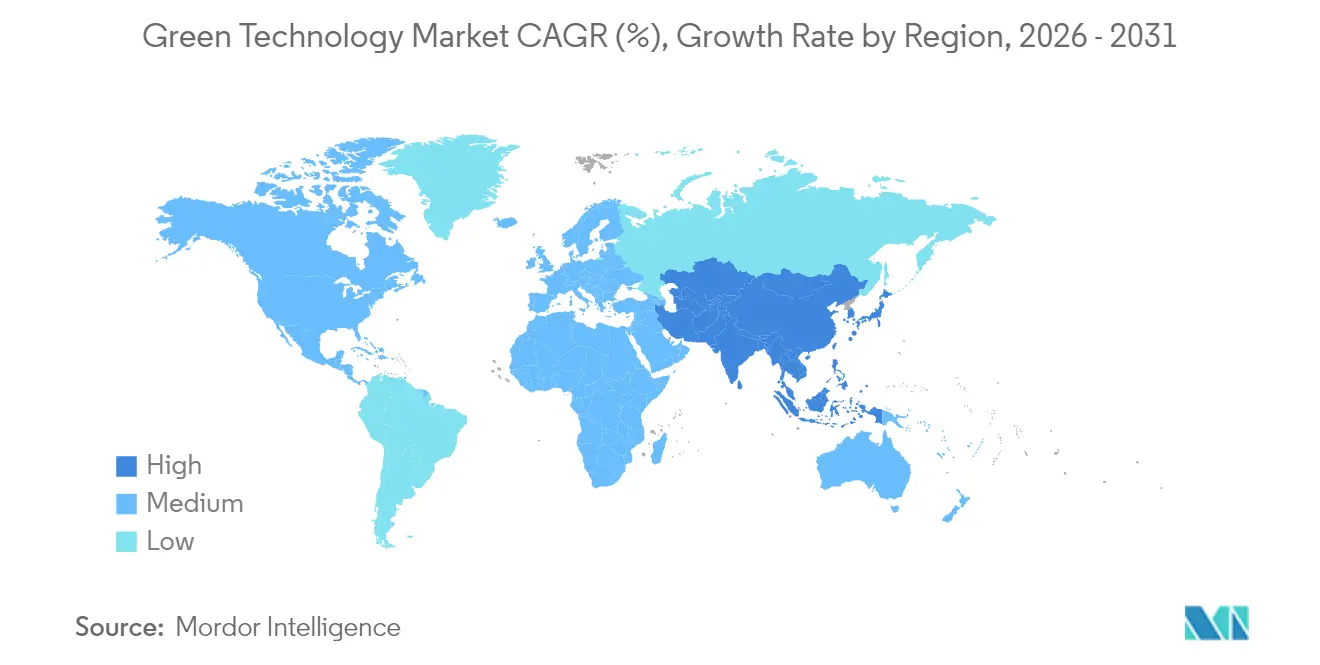
| Fastest Growing Market | Asia Pacific |
| Largest Market | North America |
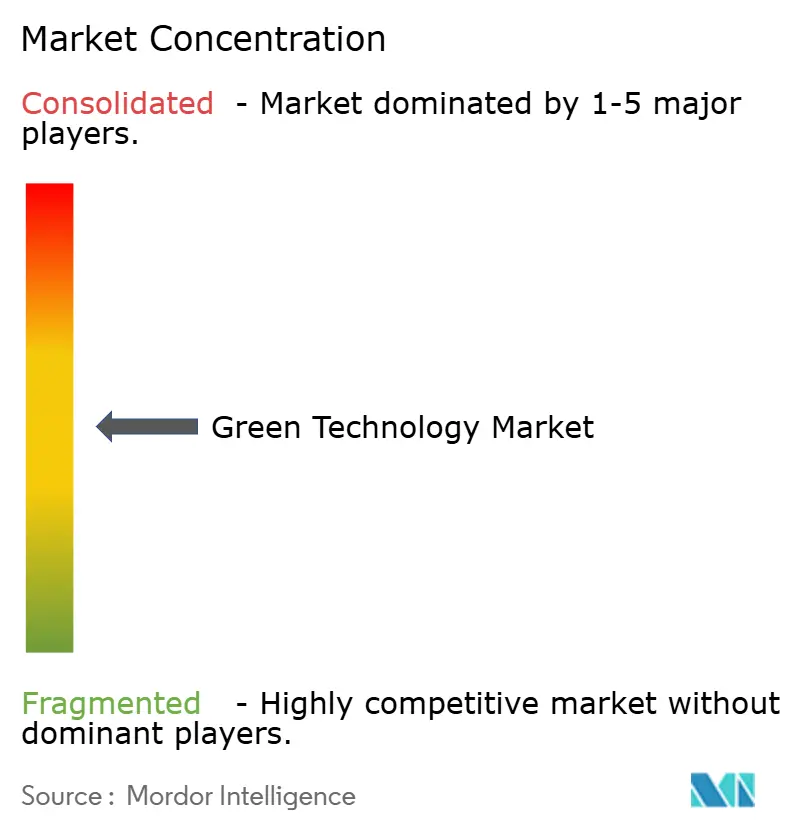
| Market Concentration | Medium |
Major Players *Disclaimer: Major Players sorted in no particular order Image © Mordor Intelligence. Reuse requires attribution under CC BY 4.0. | |
Green Technology Market Analysis by Mordor Intelligence
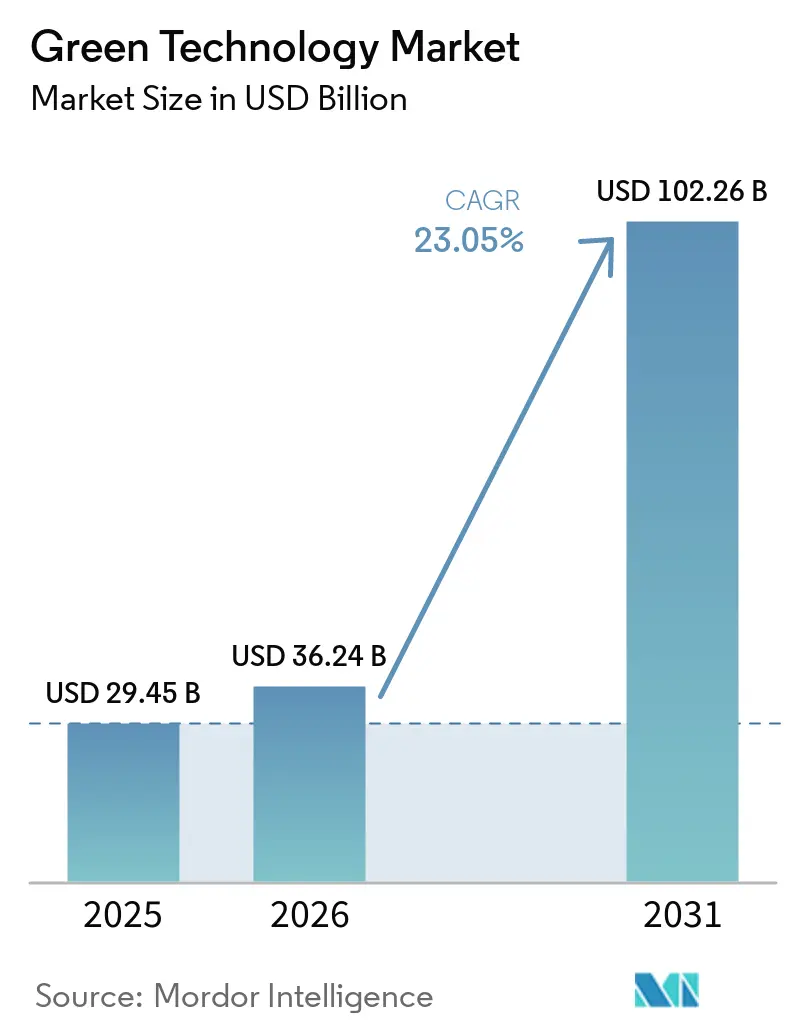
Green technology market size in 2026 is estimated at USD 36.24 billion, growing from 2025 value of USD 29.45 billion with 2031 projections showing USD 102.26 billion, growing at 23.05% CAGR over 2026-2031. Momentum stems from mandatory decarbonization rules, rapid sensor price declines, and the steady integration of AI-driven carbon accounting in enterprise software portfolios. Enterprises now embed real-time environmental data into procurement and production decisions, while investors channel capital toward low-carbon data-center designs that serve compute-heavy Gen-AI workloads. At the same time, supply-chain transparency initiatives spur demand for integrated monitoring platforms that cover everything from raw-material sourcing to last-mile logistics. As a result, the green technology market is moving from pilot projects to organization-wide deployments that align sustainability metrics with revenue goals.
Key Report Takeaways
- By component, Solutions led with 77.35% of green technology market share in 2025; Services are expanding at a 24.6% CAGR through 2031.
- By technology, IoT held 32.55% of the green technology market in 2025, while Blockchain is advancing at a 25.4% CAGR to 2031.
- By application, Green Building accounted for 35.70% of the green technology market size in 2025; Crop Monitoring is forecast to grow at a 24.1% CAGR to 2031.
- By end-user, Energy and Utilities commanded 35.15% of the green technology market in 2025, whereas Agriculture shows the sharpest climb at a 23.3% CAGR through 2031.
- By geography, North America captured 23.45% of the green technology market in 2025; Asia-Pacific is on course for a 23.8% CAGR through 2031.
Note: Market size and forecast figures in this report are generated using Mordor Intelligence’s proprietary estimation framework, updated with the latest available data and insights as of 2026.
Market Trends and Insights
Drivers Impact Analysis of Green Technology Market*
| Driver | (~)% Impact on CAGR Forecast | Geographic Relevance | Impact Timeline |
|---|---|---|---|
| Rising environmental awareness and corporate net-zero mandates | +6.20% | Global, with leadership in North America and EU | Medium term (2-4 years) |
| Stringent decarbonization policies and carbon pricing | +5.80% | EU core, expanding to Asia-Pacific and North America | Long term (≥ 4 years) |
| Rapid cost decline of IoT sensors and cloud platforms | +4.10% | Global, with manufacturing concentration in Asia-Pacific | Short term (≤ 2 years) |
| AI-driven carbon-accounting platforms embedded in ERP stacks | +3.70% | North America and EU enterprise markets | Medium term (2-4 years) |
| Surge in green data-centre investments for Gen-AI workloads | +2.90% | North America, expanding to Asia-Pacific | Short term (≤ 2 years) |
| Blockchain-based voluntary carbon "insetting" marketplaces | +1.50% | Global, with early adoption in developed markets | Long term (≥ 4 years) |
| Source: Mordor Intelligence | |||
Rising Environmental Awareness and Corporate Net-Zero Mandates
Mandatory sustainability reporting now links executive compensation to emissions targets, prompting companies to embed sensor networks across factories, offices, and logistics nodes. Over 300 listed firms in China must file sustainability disclosures by 2026, reinforcing demand for continuous monitoring tools. Schneider Electric reported record 2024 profits after targeting 800 million tonnes of customer emissions savings by 2025, illustrating how environmental performance is reshaping competitive positioning. Predictable subscription revenues emerge as enterprises move from annual audits to always-on dashboards, and procurement teams increasingly score suppliers on real-time carbon metrics rather than static certificates.
Stringent Decarbonization Policies and Carbon Pricing
The European Commission’s Ecodesign for Sustainable Products Regulation extends environmental requirements to nearly all physical goods by 2025, turning optional upgrades into legal obligations.[1]The EU’s Carbon Border Adjustment Mechanism forces carbon-intensive exporters to document embedded emissions, encouraging Asia-Pacific manufacturers to accelerate digital monitoring rollouts. Bangladesh, Indonesia, and Vietnam now retrofit textile lines with sensor arrays so finished goods can clear European customs. As a result, multinational supply chains standardize on shared data models, deepening the addressable base for green technology market platforms.
Rapid Cost Decline of IoT Sensors and Cloud Platforms
Sensors priced in cents rather than dollars unlock building-wide and field-wide deployments. The PHOENIX program cut domestic hot-water energy use by 39% in Irish trials and slashed Greek residential peak demand by 86%, showing how scale drives savings. Small and midsize enterprises join the green technology market once monthly cloud fees replace up-front server purchases. Scalable analytics turn volume data into optimization scripts, giving firms the confidence to automate HVAC set-points, irrigation schedules, and fleet routing without in-house data-science teams.
AI-Driven Carbon Accounting Platforms Embedded in ERP Stacks
Microsoft and Siemens integrate AI modules that calculate scope-1, -2, and -3 footprints from live production data, collapsing formerly siloed compliance workflows into finance and operations dashboards.[2] Plant managers can reroute orders or shift energy-intensive tasks to off-peak renewable hours after receiving automatic alerts. Scenario engines preview the carbon impact of supplier switches or facility expansions, making sustainability a core planning variable rather than a quarterly footnote. As adoption spreads, the green technology market benefits from ERP-license-based rollouts that scale across global subsidiaries with minimal extra coding.
Restraints Impact Analysis of Green Technology Market*
| Restraint | (~)% Impact on CAGR Forecast | Geographic Relevance | Impact Timeline |
|---|---|---|---|
| High upfront integration and lifecycle costs | -4.30% | Global, with acute impact in emerging markets | Short term (≤ 2 years) |
| Shortage of green-tech talent in emerging regions | -2.80% | APAC emerging markets, Latin America, Africa | Medium term (2-4 years) |
| Scrutiny of digital-infrastructure Scope-2 emissions | -2.10% | Global, with regulatory focus in EU and North America | Medium term (2-4 years) |
| Critical-mineral supply-chain bottlenecks | -1.90% | Global, with acute impact on manufacturing hubs | Long term (≥ 4 years) |
| Source: Mordor Intelligence | |||
High Upfront Integration and Lifecycle Costs
Total cost of ownership still deters smaller firms even as hardware prices fall. Integration fees can triple list prices once legacy industrial systems and staff retraining enter the equation. Many manufacturers struggle to monetize carbon visibility quickly enough to satisfy short-term budget cycles, so adoption skews toward large enterprises with ring-fenced sustainability capital. Consultants and managed-service providers fill capability gaps, yet their labor premiums widen the affordability gulf, slowing the green technology market in lower-margin sectors.
Critical-Mineral Supply-Chain Bottlenecks
Electric-vehicle and renewable-energy booms strain supplies of lithium, cobalt, and rare earths, materials that also underpin sensor boards and battery backups. China controls large portions of refining capacity, exposing downstream buyers to geopolitical risk. The International Energy Agency warns demand could quadruple by 2040, while current U.S. lithium output meets only 2-3% of projected needs.[3] Recycling and substitution research and development accelerates, yet commercialization lags, so component shortages may cap near-term production volumes in the green technology market.
*Our forecasts treat driver/restraint impacts as directional, not additive. The impact forecasts reflect baseline growth, mix effects, and variable interactions.
Green Technology Market Segment Analysis
By Component:
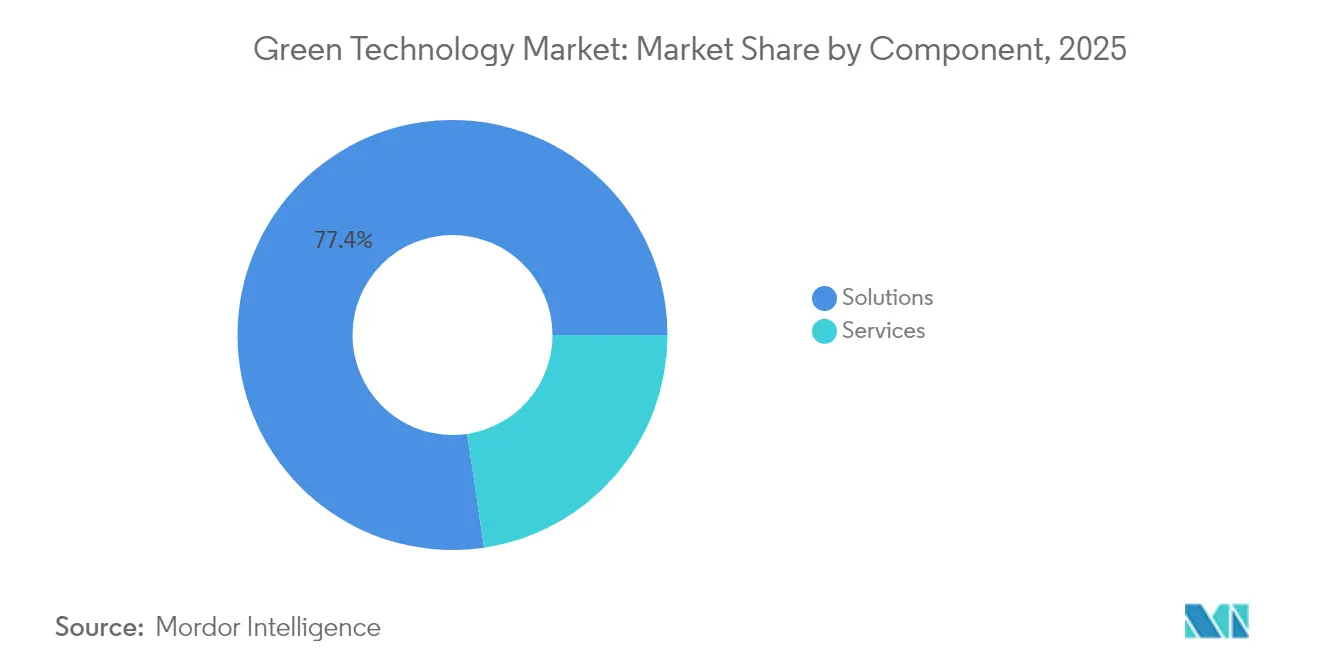
Solutions Drive Market FoundationSolutions accounted for 77.35% of green technology market share in 2025 because enterprises prefer unified suites that consolidate energy, waste, and emissions dashboards. Vendors package IoT ingestion, analytics, and compliance reporting in single licenses, reducing procurement friction and integration risk. The services segment, growing at a 24.6% CAGR, handles configuration, data cleansing, and staff enablement. Many deployments reveal that realized energy savings often exceed 20%, but only after consultants fine-tune sensor thresholds and predictive algorithms. Services teams also update rule libraries as regulations evolve, safeguarding audit readiness.
Professional-service revenue rises further once firms progress from descriptive to prescriptive analytics. For example, smart-building retrofits that link occupancy sensors to HVAC dampers deliver 20–30% energy savings but require continuous model retraining. Carbon-accounting advisory units translate raw readings into scope-3 disclosures accepted by multiple jurisdictions, sparing clients from duplicated reporting cycles. Together, solutions and services form a flywheel: platform rollouts generate data that exposes new optimization opportunities, which in turn demand additional service engagements, reinforcing the expansion of the green technology market.

By Technology:
IoT Leadership with Blockchain AccelerationIoT maintained 32.55% of the green technology market in 2025, reflecting the sheer volume of connected meters deployed across power grids, farms, and factories. Sensor data underpins performance baselines, enabling AI modules to target anomalies. Blockchain, rising at a 25.4% CAGR, supports trusted carbon-credit provenance and supply-chain insetting schemes where brands offset emissions inside their own ecosystems. Artificial-intelligence workloads refine wind-turbine maintenance schedules, a focus highlighted when Aerones secured USD 62 million to expand robotic inspection services.
Digital-twin engines now mirror entire campuses, letting managers test retrofits virtually before touching assets. Cloud hyperscalers supply elastic compute that crunches high-frequency readings, while edge nodes tackle latency-sensitive tasks such as voltage balancing. Trusted ledgers close the loop by recording verified reductions, allowing automated offset purchases when targets slip. This interplay among sensing, modeling, optimization, and traceability secures IoT’s leadership yet leaves room for blockchain’s rapid rise, fueling technology diversity inside the green technology market.
By Application:
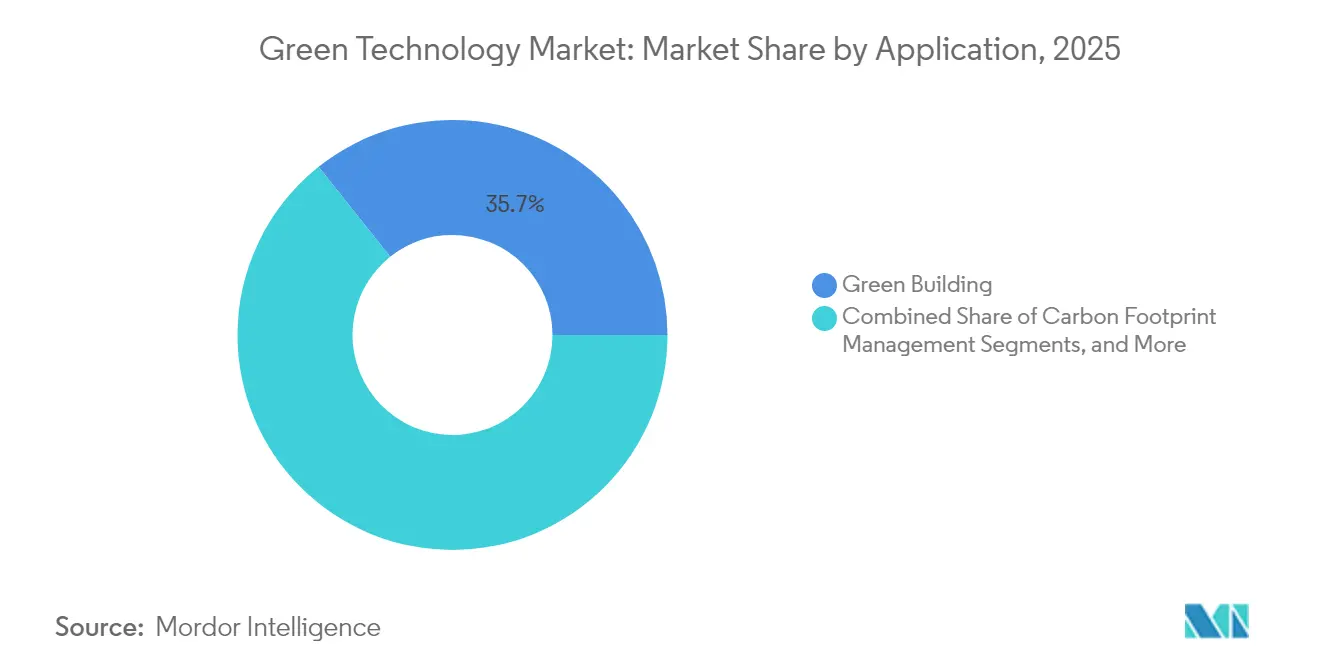
Green Building Dominance with Agricultural InnovationGreen Building applications represented 35.70% of the green technology market size in 2025, driven by smart lighting, adaptive HVAC, and occupancy-based ventilation that cut operational expenses alongside emissions. Commercial landlords weaponize verified efficiency metrics to attract tenants under ESG mandates. Crop Monitoring, growing at a 24.1% CAGR, harnesses soil probes, drone imaging, and localized weather feeds to steer irrigation and nutrient delivery. Yield gains and input savings justify sensor rollouts even for smallholder farms once service bundles shift costs from capex to opex.
Carbon-footprint management systems, though smaller, gain steady traction as global disclosure frameworks converge. Air and water-quality networks guard urban health, while predictive pollution alerts steer city traffic policies. Weather-monitoring feeds plug into agricultural dashboards, informing pest-control timing. These interoperable applications converge on unified analytics layers, letting organizations toggle among building energy, field moisture, and factory emissions inside one pane, reinforcing cross-vertical synergies that enlarge the green technology market.
By End-User Industry:
Energy Sector Leadership with Agricultural TransformationEnergy and Utilities controlled 35.15% of the green technology market in 2025 because regulators require granular emissions logs from generation to distribution. Grid operators deploy sub-second monitoring that balances variable renewable inputs with demand patterns. Agriculture, expanding at a 23.3% CAGR, adopts satellite imagery and autonomous machinery to lift yield per hectare while trimming chemical and water usage. Manufacturing plants insert environment-as-a-service modules into Industry 4.0 stacks, synchronizing quality, throughput, and carbon KPIs.
Transport fleets implement AI route optimizers that integrate charging-station availability for electric trucks. Construction firms specify low-carbon materials early in design phases, reducing retrofit costs. Data-center operators push immersion cooling and renewable power purchase agreements to offset AI workload surges. Municipal agencies fold building, waste, and mobility dashboards into smart-city control rooms. Each sector contributes domain-specific requirements yet shares common data pipelines, sustaining the horizontal expansion pathway for the green technology market.
Geography Analysis
North America Green Technology Market
North America led the green technology market with a 23.45% share in 2025 on the back of federal incentives and deep venture-capital pools. The Inflation Reduction Act funnels billions toward clean-energy infrastructure, while corporate buyers lock in multi-year sustainability budgets. United States firms bundle carbon analytics into enterprise contracts, leveraging mature software ecosystems. Canada scales similar platforms to track cross-border automotive and aerospace supply chains, and Mexico integrates emissions monitoring into maquiladora compliance workflows, reflecting region-wide policy alignment.
APAC Green Technology Market
Asia-Pacific recorded the fastest projected growth at a 23.8% CAGR, powered by industrial expansion paired with tighter environmental mandates. China’s stock-exchange rules, which require sustainability reports from 2026, catalyze factory sensor retrofits. India doubles down on domestic clean-tech IP to offset mineral import risks, and Japan accelerates smart-factory rollouts to maintain export competitiveness. South Korea allotted about USD 101 million to its Strategic Smart City Program, embedding IoT nodes in transport and water grids.
Regulatory Landscape
Sustainability and climate rules are shifting from voluntary disclosures toward operational requirements that demand auditable data, driving adoption of IoT, analytics, and carbon-accounting software in enterprise environments. In the European Union, policy anchors such as the Corporate Sustainability Reporting Directive (CSRD) and the Carbon Border Adjustment Mechanism (CBAM) are pushing manufacturers and exporters to document embedded emissions, while product-centric requirements expand under the European Commission's Ecodesign for Sustainable Products Regulation timeline referenced in the report context (with requirements extending to nearly all physical goods by 2025). In parallel, China is tightening disclosure expectations, including stock-exchange related sustainability reporting requirements starting in 2026 for listed firms, reinforcing the need for continuous monitoring and reporting systems.
Regulatory divergence is also visible across other major markets, creating multi-jurisdiction reporting and assurance complexity that favors platforms able to map Scope 1, 2, and 3 data to different rulebooks. In the United States, climate-related disclosure requirements have been finalized at the federal level (SEC rule in 2024), alongside state-level mandates such as California SB 253 for Scope 1, 2, and 3 emissions reporting for large companies, raising the bar for supply-chain traceability. This mix of disclosure, product, and border-adjustment mechanisms elevates demand for standardized data models, automated audit trails, and supplier-grade emissions telemetry across global value chains.
Competitive Landscape
The green technology market remains moderately fragmented. Technology giants such as Microsoft, IBM, and Oracle embed environmental modules into existing ERP, CRM, and cloud offerings, giving them stickiness among Fortune 500 accounts. Microsoft’s partnership with Global Infrastructure Partners adds AI-ready, renewables-powered data centers to its stack, illustrating how incumbents invest in physical infrastructure that aligns software performance with sustainability promises. IBM deepens Red Hat integrations so containerized workloads can surface carbon telemetry without extra agents, trimming deployment overhead.
Specialist innovators carve out niches where domain expertise trumps scale. CropX uses soil-moisture analytics to help farmers optimize irrigation, while Trace Genomics maps microbial data to fertilizer recipes. Aerones deploys robotics and AI to inspect wind-turbine blades, reducing downtime and improving annual energy production. Blockchain startups verify carbon-credit integrity, easing corporate fears of greenwashing. These focused players partner rather than compete head-to-head with full-suite vendors, stitching end-to-end ecosystems that address client pain points.
Green Technology Industry Leaders
-
General Electric
-
IBM Corporation
-
Microsoft Corporation
-
Siemens AG
-
Schneider Electric SE
- *Disclaimer: Major Players sorted in no particular order
Green Technology Market Companies Covered in this Report
- General Electric
- IBM Corporation
- Microsoft Corporation
- Siemens AG
- Schneider Electric SE
- Wolters Kluwer N.V.
- Oracle Corporation
- CropX Inc.
- Engie Impact
- Sensus (Xylem)
- Trace Genomics
- Accuvio (Diligent)
- Tesla Inc.
- Vestas Wind Systems
- ABB Ltd.
- Cority Software
- Schneider Electric
- Enel S.p.A.
- Siemens Gamesa
- KBR Inc.
Market Opportunities and Future Outlook
Compliance-grade measurement, reporting, and verification (MRV) remains a core whitespace as regulations and buyer mandates move from periodic reporting to continuous, asset-level emissions evidence. Companies that can operationalize Scope 3 data capture across suppliers, logistics, and manufacturing lines benefit from near-term adoption triggers tied to CBAM documentation and expanding sustainability disclosures in major manufacturing hubs (including China from 2026 for listed firms per the report context). This creates room for integrated offerings that connect shop-floor IoT signals, ERP-embedded carbon accounting, and supplier collaboration workflows, especially where buyers require data traceability rather than static certificates.
Adjacent opportunities are forming where green technology platforms directly reduce the unit economics of decarbonization projects, not only reporting them. In April 2026, Schneider Electric and Microsoft deployed an AI-based control approach on a 20 kW solid oxide electrolyzer system, with reported potential to reduce the levelized cost of hydrogen by up to 10%, illustrating demand for software-defined optimization in hard-to-abate processes. Grid modernization and low-GWP equipment replacement also support investment cases for monitoring and analytics stacks: GE Vernova disclosed 26 GW of new power generation capacity deployed in 2025 and has continued to commercialize lower-emissions grid and generation technologies, while project pipelines such as Net Zero Teesside Power (UK) and direct air capture pilots (Niskayuna, New York, with planned deployment at Deep Sky Alpha in Alberta) highlight additional deployment surfaces for sensors, digital twins, and operational analytics.
Recent Industry Developments in Green Technology Market
- July 2026: GE Vernova booked contracts for SF6-free grid hubs in Stromnetz Berlin to support SF6-free substations. The action expands decarbonized grid assets and enables scalable, low-GWP insulation rollout at utility scale. It aligns with shifting utility procurement toward lower environmental impact infrastructure.
- July 2026: Siemens Energy awarded North Sea Connector 2 offshore grid system contract with long-term service agreement (50Hertz). The award strengthens cross-border HV transmission capabilities and long-term maintenance ecosystem. It demonstrates progress in offshore grid integration and sustained service support for critical transmission assets.
- June 2026: Schneider Electric entered definitive agreement to acquire Cognite Holding B.V. for $3.1 billion in an all-cash transaction. The deal enhances industrial AI data stack and analytics for large-scale green deployments. It enables deeper data driven optimization across industrial assets supporting decarbonization programs.
Green Technology Market Report Scope and Research Methodology
Market Definition and Coverage
For this study, the market covers revenues generated from green technology solutions and related services that help measure, manage, or reduce environmental impact across organizations, including digital tools used for energy, emissions, and resource efficiency decisions.
Scope exclusions: The sizing excludes conventional IT spending that is not tied to measurable sustainability outcomes, and it also excludes pure hardware-only energy assets unless they are sold as part of a defined green technology offering.
Segments Covered in This Report
- By Component
- Solutions
- Services
- By Technology
- Internet of Things (IoT)
- Artificial Intelligence and Analytics
- Digital Twin
- Cloud Computing
- Blockchain
- Other Emerging Technologies
- By Application
- Green Building
- Carbon Footprint Management
- Air and Water Pollution Monitoring
- Weather Monitoring and Forecasting
- Crop Monitoring
- Others
- By End-user Industry
- Energy and Utilities
- Manufacturing
- Transportation and Logistics
- Agriculture
- Construction and Real-estate
- IT and Telecom
- Government and Public Sector
- Other Industries
- By Geography
- North America
- United States
- Canada
- Mexico
- South America
- Brazil
- Argentina
- Rest of South America
- Europe
- Germany
- United Kingdom
- France
- Italy
- Spain
- Rest of Europe
- Asia-Pacific
- China
- India
- Japan
- South Korea
- Australia and New Zealand
- Rest of Asia-Pacific
- Middle East and Africa
- Middle East
- Saudi Arabia
- United Arab Emirates
- Turkey
- Rest of Middle East
- Africa
- Nigeria
- South Africa
- Egypt
- Rest of Africa
- Middle East
- North America
Data Sources, Market Sizing, and Validation
Desk Research
Desk work starts with building a clean fact base on regulation, energy transition activity, and reported corporate sustainability priorities, because these shape where green technology budgets show up. We referenced public sources such as International Energy Agency publications, U.S. EPA program data, UNFCCC documentation, Eurostat datasets, and World Bank indicators to anchor macro direction and comparable time series.
To avoid overcounting, we also reviewed company annual reports, sustainability reports, and investor presentations to understand how firms describe software, services, and environmental management revenue lines. Where available, paid subscriptions for company financials and intelligence, news and financials, and patent databases were used to check business mix, product positioning, and the cadence of new solution launches. The sources mentioned here are illustrative only, and many other public documents and datasets were also used for collection, cross-checking, and clarification.
Primary Interviews and Surveys
Primary work focused on validating what is actually purchased and deployed, and how budgets are split between solutions and services across major end user industries. We spoke with a mix of solution providers, service specialists, and large adopters across APAC, EMEA, and the Americas so assumptions on adoption timing, pricing behavior, and typical deployment scope could be corrected before finalizing the model.
Distribution of primary research fieldwork respondents
| Company type | Respondent position | Region |
|---|---|---|
| Top tier: 29% | CXOs: 12% | APAC: 49% |
| Mid tier: 56% | Functional/Unit leaders: 35% | EMEA: 30% |
| Smaller Players: 15% | Managers: 53% | Americas: 21% |
Market-Sizing & Forecasting
Sizing was built using top-down demand pool reconstruction, where sustainability compliance and reporting needs, energy management activity, and enterprise digitization signals are translated into addressable spending for green technology offerings. Inputs used in the model include the pace of net-zero and disclosure policy adoption, enterprise ESG reporting intensity, typical software and service attachment rates for deployment programs, average contract value ranges by end user industry, and renewal and expansion behavior for multi-year platforms.
After the top-down total was formed, it was corroborated through selective bottom-up checks using a sampled ASP times volume approach for common solution categories, along with channel feedback on service-to-software ratios and typical implementation timelines. When a bottom-up view had gaps due to limited disclosure, we applied conservative penetration bands and then re-tested them with interview feedback before locking the totals.
Forecasts were created using scenario analysis supported by a light multivariate regression layer, where the key drivers were policy push, energy cost pressure, and enterprise reporting requirements, which were then adjusted using expert expectations on pricing and adoption speed. The final forecast path was kept consistent with observed deployment cycles so growth is not forced into a single straight line.
Data Validation & Update Cycle
Results were validated through triangulation across independent signals, including the implied spend per adopting organization, the split between solutions and services, and the timing of rollouts by large end users. Outliers were flagged when growth or pricing implied by the model moved away from what interviews and public filings suggest, and those cases were reworked until the assumptions could be explained in plain steps.
Before sign-off, the model is reviewed in multiple passes to confirm that additions across regions and use cases reconcile to the total, and that currency conversion and year alignment are applied consistently. The report is refreshed annually, with interim updates when major policy shifts or demand shocks occur, and a final pre-delivery check is completed so the numbers reflect the latest available information.
Mordor Intelligence's Green Technology Market Size Compared With Other Published Estimates
Published numbers for green technology can look far apart because the term itself is used differently across studies, and because some estimates mix software, services, and physical clean energy equipment into one total. Differences also show up when base years are not aligned, when currency conversion is taken from different months, and when forecast paths assume either aggressive or conservative adoption curves.
The benchmark table shows a narrower 2026 total than estimates that group broad clean tech manufacturing and deployment value into the same bucket, and in Mordor Intelligence's model the scope is restricted to green technology solutions and services revenues rather than the full value of clean energy hardware markets or the traded value of technologies.
Benchmark comparison
| Source | Market Size | Gaps in Research Methodology |
|---|---|---|
| Mordor Intelligence | USD 36.24 B (2026) | |
| Global Energy Agency A | USD 700.00 B (2023) | Uses the market value of selected mass-manufactured clean energy technologies (such as solar PV, wind, EVs, batteries, electrolysers, and heat pumps), which is a technology hardware deployment and manufacturing view rather than enterprise green technology solutions and services revenue. |
| Industry Briefing B | USD 28.60 B (2024) | Uses a different base year and often blends consulting-heavy sustainability services with broader environmental initiatives, which can shift the mix of what is counted and change the implied pricing and adoption trajectory versus a solutions and services-only definition. |
Seen together, the spread mainly comes from scope boundaries and year alignment, not from a simple disagreement on growth direction. By keeping the counted revenue streams tied to clear solution and service spend drivers, and then pressure-testing adoption and pricing through interviews, the estimate stays traceable to repeatable inputs that a buyer can sanity-check.
Key Questions Answered in the Report
What is the current size of the green technology market?
The green technology market size is USD 36.24 billion in 2026 and is forecast to reach USD 102.26 billion by 2031.
Which component segment leads the green technology market?
Solutions dominate with 77.35% of green technology market share in 2025, reflecting buyer preference for unified platforms.
Which technology is growing fastest within the green technology industry?
Blockchain is the fastest-growing technology segment with a 25.4% CAGR, driven by demand for transparent carbon-credit verification.
What region is expanding most rapidly?
Asia-Pacific shows the quickest expansion at a 23.8% CAGR through 2031 due to industrial growth paired with stricter regulations.