
Green and Bio-based Solvents Market Size and Share
Market Overview
| Study Period | 2021 - 2031 |
|---|---|
| Market Size (2026) | USD 6.32 Billion |
| Market Size (2031) | USD 9.39 Billion |
| Growth Rate (2026 - 2031) | 8.23 % |
| Fastest Growing Market | Asia Pacific |
| Largest Market | Asia Pacific |
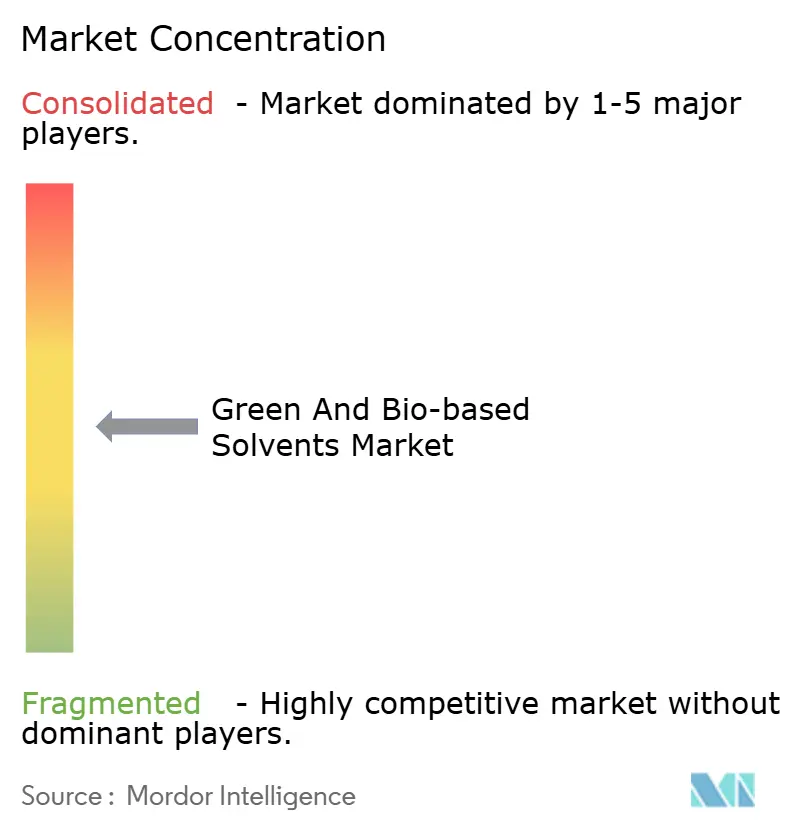
| Market Concentration | Medium |
Major Players *Disclaimer: Major Players sorted in no particular order Image © Mordor Intelligence. Reuse requires attribution under CC BY 4.0. | |
Green and Bio-based Solvents Market Analysis by Mordor Intelligence
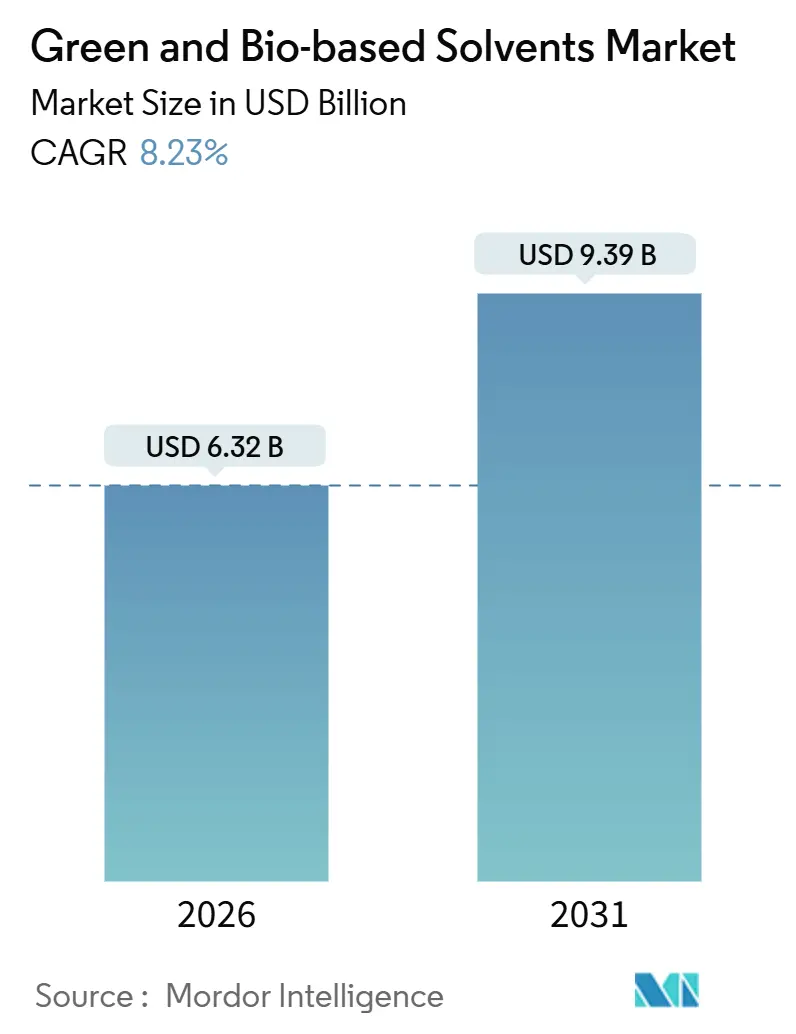
The Green and Bio-based Solvents Market size is estimated at USD 6.32 billion in 2026, and is expected to reach USD 9.39 billion by 2031, at a CAGR of 8.23% during the forecast period (2026-2031). Corporate decarbonization targets, stricter VOC thresholds, and tax incentives are shifting purchasing budgets toward renewable alternatives, while emerging bio-refinery capacity is beginning to temper historic price premiums. Tier-1 coatings, adhesives, and pharmaceutical companies are embedding solvent carbon-intensity metrics into supplier scorecards, creating pull-through demand that is relatively insulated from short-term crude-oil swings. At the same time, technology licensing for cellulosic ethanol and branched bio-alcohols is expanding feedstock optionality, a trend that is expected to further narrow cost gaps by the end of the forecast window. Cost headwinds remain, yet policy-driven adoption in North America and Europe, coupled with self-imposed ESG mandates among Asian multinationals, underpins a resilient growth path for the green and bio-based solvents market.
Key Report Takeaways
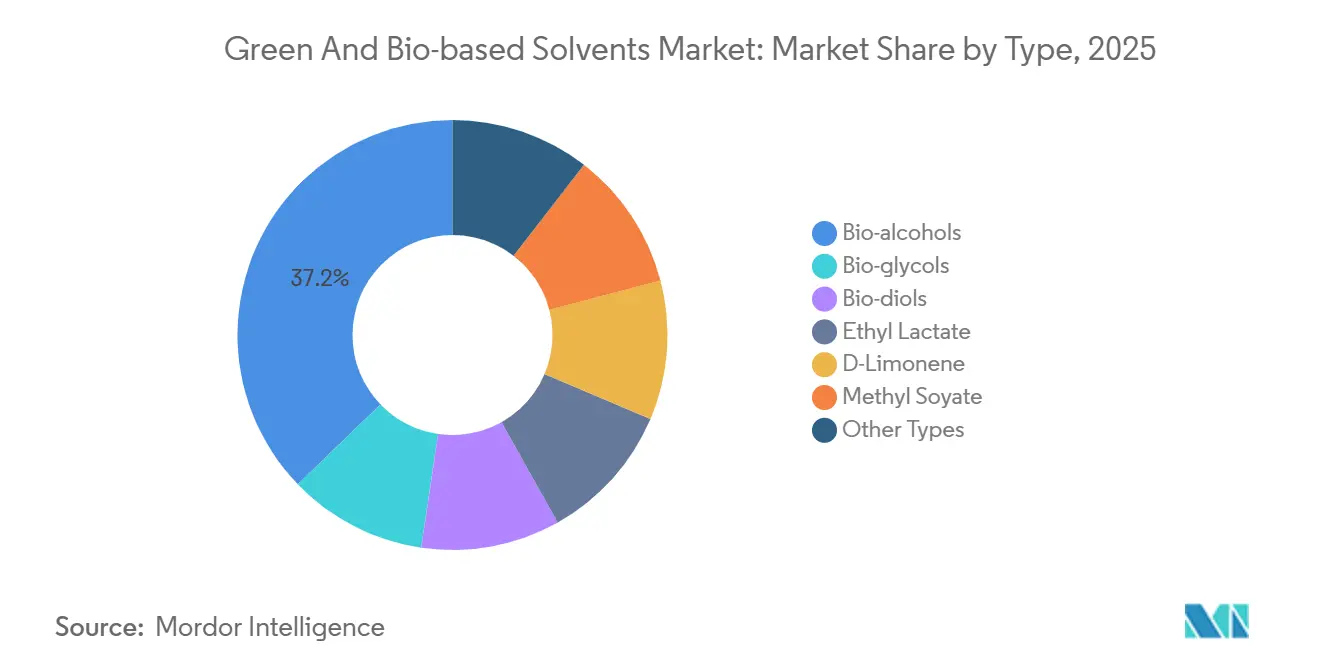
- By product type, bio-alcohols held 37.22% of the green and bio-based solvents market share in 2025, while ethyl lactate is projected to grow at a 9.61% CAGR to 2031.
- By application, paints and coatings accounted for 27.87% of the green and bio-based solvents market size in 2025; pharmaceutical uses are expanding the fastest at a 10.38% CAGR through 2031.
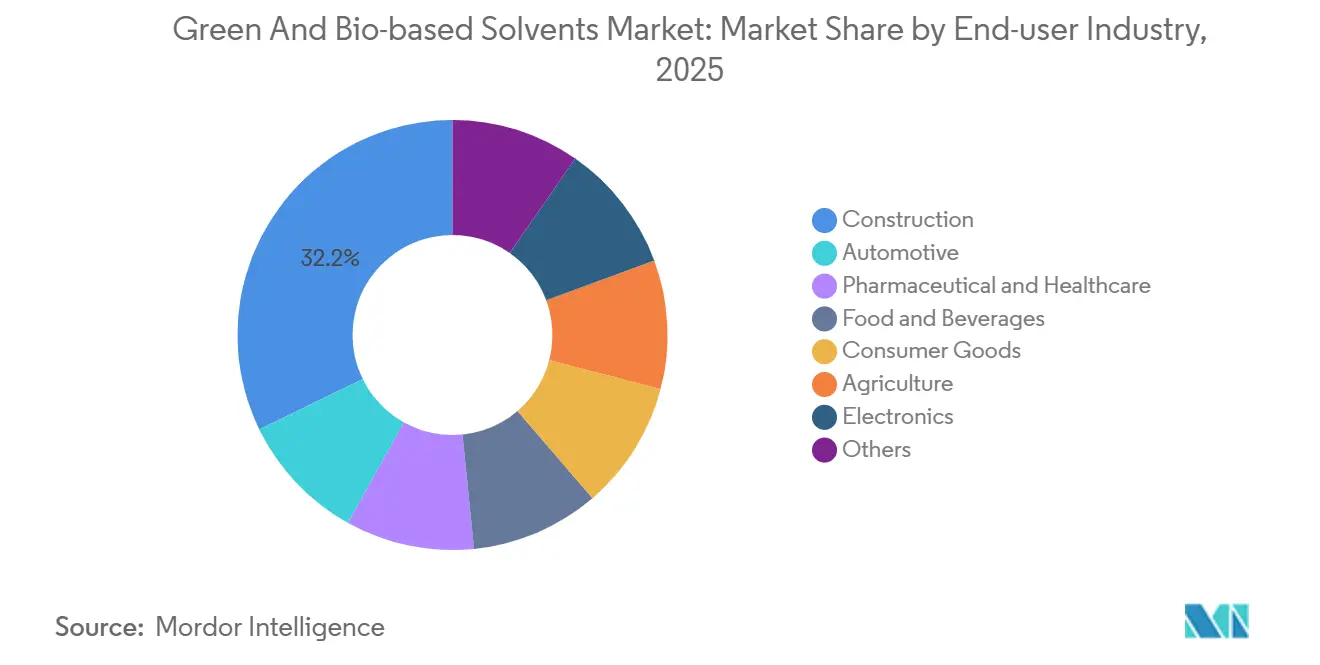
- By end user, the construction segment captured 32.24% revenue in 2025, whereas pharmaceutical and healthcare are forecast to post an 11.03% CAGR to 2031.
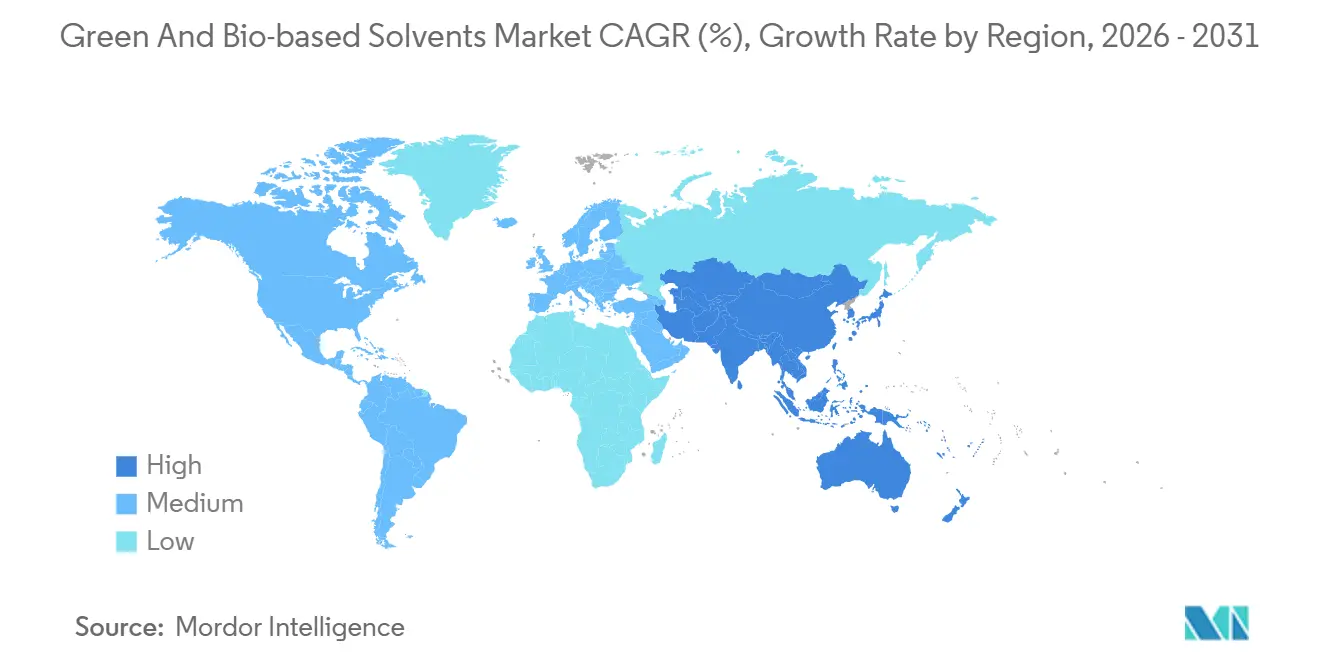
- By region, Asia Pacific dominated with 45.67% of 2025 revenue and is set to rise at an 8.92% CAGR to 2031.
Note: Market size and forecast figures in this report are generated using Mordor Intelligence’s proprietary estimation framework, updated with the latest available data and insights as of January 2026.
Market Trends and Insights
Drivers Impact Analysis of Green and Bio-based Solvents Market*
| Driver | (~) % Impact on CAGR Forecast | Geographic Relevance | Impact Timeline |
|---|---|---|---|
| Stringent VOC-emission regulations | +2.1% | Global, with peak enforcement in North America & EU | Medium term (2-4 years) |
| Volatility in crude-oil prices fueling bio-alternatives | +1.8% | Global, pronounced in import-dependent APAC economies | Short term (≤ 2 years) |
| Corporate ESG pledges and green-procurement mandates | +1.5% | North America & EU core, spill-over to APAC multinational supply chains | Long term (≥ 4 years) |
| Government incentives and tax credits for bio-chemicals | +1.3% | United States (IRA 45Z), EU (Innovation Fund, CBE JU), Brazil (RenovaBio) | Medium term (2-4 years) |
| Renewable feedstock build-out in emerging bio-refineries | +1.0% | APAC (China, India, Thailand), South America (Brazil, Argentina) | Long term (≥ 4 years) |
| Source: Mordor Intelligence | |||
Stringent VOC-Emission Regulations
Regulators are tightening atmospheric-emissions ceilings, making traditional glycol ethers increasingly non-compliant. The EU Directive 2004/42/EC capped VOC content in decorative paints at 30 g/L, prompting a shift toward bio-based propylene glycol in European coatings[1]European Commission, “Directive 2004/42/EC on the Limitation of Emissions of Volatile Organic Compounds,” eur-lex.europa.eu. California’s Rule 1113 imposes a 50 g/L VOC limit on architectural coatings sold in the Los Angeles basin, accelerating the uptake of bio-alcohol primers. China’s GB 18581-2020 restricts VOC emissions in architectural coatings to 80 g/L, catalyzing local demand for bio-ethanol and d-limonene. The US EPA formaldehyde rule for composite wood products, finalized in 2024, has indirectly boosted bio-solvent use in adhesives as formulators pivot away from formaldehyde-releasing resins. Third-party environmental audits under ISO 14001 now require documented solvent-emissions mitigation plans, embedding bio-solvent procurement into corporate compliance protocols.
Volatility in Crude-Oil Prices Fueling Bio-Alternatives
High oil-price variability supports multiyear bio-solvent contracts that hedge against petro-feedstock swings. Brent averaged USD 82/bbl in 2025, yet the CBOE Crude-Oil Volatility Index remained near 35%, signaling procurement risk for petro-solvents. The World Bank projects Brent to oscillate between USD 75 and USD 90/bbl through 2027, sustaining uncertainty that favors agricultural feedstock-linked pricing[2]World Bank, “Commodity Markets Outlook April 2025,” worldbank.org. D6 ethanol RINs traded at USD 0.70/gal in early 2025, providing a floor price for surplus fuel ethanol diverted into industrial-solvent channels. European naphtha averaged EUR 650/t in 2025, while bio-ethanol stood near EUR 750/t, a 15% premium that falls toward parity once CBAM levies on petrochemical imports arrive in 2026. Because bio-solvent feedstocks are indexed to agricultural cycles rather than geopolitical shocks, they offer a cost-stability proposition that resonates with procurement teams.
Corporate ESG Pledges and Green-Procurement Mandates
Global brands are weaving solvent carbon intensity into Scope 3 targets. Unilever disclosed that 38% of its cleaning-product formulations contained bio-based solvents in 2025, up from 22% in 2023. Procter & Gamble supplier scorecards now award premium ratings for ISCC-PLUS-verified solvents, influencing USD 60 billion in annual spend. The SBTi chemical-sector pathway recommends 30% renewable feedstock by 2030, making bio-solvent supply a prerequisite for 1.5°C alignment. Automotive OEMs such as Volkswagen require tier-1 suppliers to disclose solvent carbon intensity in coatings and adhesives, pressuring supply chains to source bio-glycols and oxygenated solvents. Such mandates position the green and bio-based solvents market as a credible lever for achieving corporate climate goals.
Government Incentives and Tax Credits for Bio-Chemicals
Fiscal tools are accelerating parity with fossil-based routes. The U.S. Inflation Reduction Act’s 45Z credit offers up to USD 1.75/gal for bio-chemicals that achieve at least a 50% lifecycle-emission reduction, directly shrinking the cost delta for bio-ethanol and bio-butanol. USDA’s BioPreferred purchasing program channels an estimated USD 150 million/year into federal procurement of bio-solvents. The EU Innovation Fund allocated EUR 3 billion for low-carbon chemical projects in 2024-2025, including Neste’s Rotterdam expansion to 1.4 million t/year of renewable feedstock processing. Brazil’s RenovaBio awarded CBios, averaging BRL 85/tCO₂-e in 2025, adding an 8-10% margin uplift for domestic bio-ethanol producers. These incentives improve project IRRs and spur forward-selling agreements that stabilize offtake for new capacity.
Restraints Impact Analysis of Green and Bio-based Solvents Market*
| Restraint | (~) % Impact on CAGR Forecast | Geographic Relevance | Impact Timeline |
|---|---|---|---|
| Higher production costs vs. petro-solvents | -1.4% | Global, most acute in price-sensitive APAC and MEA markets | Short term (≤ 2 years) |
| Feedstock supply volatility and agri-price swings | -0.9% | North America (corn, soy), South America (sugarcane), EU (rapeseed) | Medium term (2-4 years) |
| Land-use change certification bottlenecks | -0.6% | Southeast Asia (palm, sugarcane), Latin America (soy, sugarcane) | Long term (≥ 4 years) |
| Source: Mordor Intelligence | |||
Higher Production Costs vs. Petro-Solvents
Bio-solvents still command a 20-50% price premium over fossil equivalents on a liter basis. A 2024 Journal of Cleaner Production study placed bio-ethanol production at USD 0.65-0.85/L versus USD 0.45-0.55/L for petro-ethanol. Ethyl lactate remains 60-80% dearer than ethyl acetate in pharmaceutical formulations, confining uptake to high-value niches. The IEA estimates bio-chemical costs at 30-40% above fossil benchmarks absent carbon pricing. Downstream formulators report a 2-4 percentage-point gross-margin squeeze when shifting to fully bio-based systems, often leading to partial substitution strategies. Capital-intensive purification, such as multistage distillation to 99.5% purity, adds USD 0.10-0.15/L to processing costs, undercutting near-term parity goals.
Feedstock Supply Volatility and Agri-Price Swings
Agricultural raw-material markets remain susceptible to weather shocks. Corn futures averaged USD 4.50/bu in 2025, up 12% year on year after the Midwest drought clipped yields to the lowest level since 2020. Soybeans traded near USD 12.80/bu on tight 24% stocks-to-use ratios, inflating methyl-soyate economics. Brazilian sugarcane output dipped 3.5% in the 2024-2025 harvest, channeling scarce ethanol toward fuel blending rather than industrial sales. The World Bank expects agricultural prices to remain 18% above 2020 levels through 2027, sustaining cost pressure. Feedstock competition with food markets intensifies during supply shocks; in 2024, 36% of US corn output went to ethanol, limiting flexibility for solvent producers.
*Our forecasts treat driver/restraint impacts as directional, not additive. The impact forecasts reflect baseline growth, mix effects, and variable interactions.
Green and Bio-based Solvents Market Segment Analysis
By Type:
Bio-Alcohols Remain the Anchor, Ethyl Lactate AcceleratesBio-alcohols dominated green and bio-based solvents market size calculations, capturing 37.22% revenue in 2025 on the back of entrenched use in coatings, cleaners, and inks. Ethyl lactate, though smaller in baseline volume, is projected to post a 9.61% CAGR to 2031, buoyed by electronics cleaning and high-purity pharmaceutical synthesis, where residue-free evaporation commands premium pricing. Bio-glycols, principally renewable propylene glycol and ethylene glycol, are expanding alongside green and bio polyols in antifreeze and construction sealants, pushed by automotive OEM scorecards that reward verifiable bio-content. D-limonene, derived from citrus waste, is growing in household and industrial cleaners as citrus processors integrate downstream, while methyl soyate is establishing itself in agricultural adjuvants and low-toxicity printing inks.
Innovation pipelines extend beyond sugar- and corn-based routes; Gevo’s iso-butanol and DuPont’s propanediol platforms illustrate a pivot toward non-food biomass that could diversify supply and temper feedstock volatility. Company-owned fermentation strains engineered for higher conversion efficiencies are entering commercial scale-up, potentially setting new cost floors for the segment. Regulatory nods, such as the FDA’s GRAS status for ethyl lactate, are also unlocking food-contact and cosmetic use cases, broadening demand pools without materially cannibalizing incumbent solvent grades. Collectively, these factors reinforce the central role of type diversification in sustaining green and bio-based solvents market growth.



By Application:
Pharmaceuticals Outpace Traditional CoatingsPaints and coatings retained 27.87% of 2025 revenue yet face share dilution as pharmaceutical uses accelerate at a 10.38% CAGR through 2031. Drug-manufacturing adoption is driven by ICH Q3C solvent-residue limits, continuous-manufacturing platforms that prefer predictable evaporation, and CDMO sustainability audits that prioritize low-toxicity profiles. The green and bio-based solvents market size for industrial cleaning continues to expand as EPA Safer Choice and EU Ecolabel schemes push formulators toward d-limonene- and bio-ethanol-based systems. Printing inks, especially water-based flexographic grades for food packaging, are substituting petro-glycols with bio alternatives to comply with Swiss migration ordinances.
Adhesives and sealants increasingly deploy bio-propylene glycol to meet LEED v4.1 low-emission credits, while cosmetics producers are using bio-alcohols as multifunctional fragrance carriers in clean beauty lines. Agriculture remains a niche but strategically important outlet, with methyl soyate adjuvants improving herbicide penetration in both conventional and organic farms. Electronics cleaning, though small in absolute volume, shows double-digit growth in bio-lactate consumption as OEMs chase defect-rate reductions amid shrinking PCB feature sizes. These shifting demand centers collectively deepen the application moat of the green and bio-based solvents market.
By End-User Industry:
Healthcare Growth Surpasses Construction DominanceConstruction represented 32.24% of 2025 demand, powered by low-VOC architectural coatings and sealants that secure LEED and BREEAM credits. Still, pharmaceutical and healthcare demand is rising at an 11.03% CAGR, outpacing all other industries as CDMOs align solvent procurement with client-mandated net-zero audits. Automotive OEMs use bio-glycol-rich coatings to meet in-plant emission ceilings, while food and beverage processors deploy ethyl lactate and d-limonene for flavor extraction and GRAS-compliant cleaning.
Consumer-goods majors, spanning cleaning products to personal care, leverage high-bio-content solvents to meet retailer scorecards and reinforce brand sustainability narratives. Agriculture end-users employ methyl soyate as a biodegradable spray adjuvant, and electronics manufacturers value ethyl lactate’s ultra-low residue in critical cleaning steps. Niche domains such as textiles and leather finishing are piloting bio-solvent replacements in dyeing baths, signaling incremental but broad-based diversification in end-use patterns that sustains the green and bio-based solvents market’s demand resilience.
Geography Analysis
APAC Green and Bio-based Solvents Market
Asia Pacific accounted for 45.67% of 2025 revenue, making it the undisputed leader of the green and bio-based solvents market. China’s 14th Five-Year Plan mobilizes USD 10 billion in state funding for bio-refineries, and India’s pharma export boom relies on bio-solvents to meet EMA and FDA residue limits, underpinning an 8.92% regional CAGR through 2031. Japan’s GX program earmarks USD 150 billion for decarbonization, with subsidies for bio-based chemical production, while South Korea’s K-Chemicals 2030 roadmap incentivizes domestic capacity for bio-ethanol and bio-glycols.
North America Green and Bio-based Solvents Market
North America trails in volume yet captures higher value per ton as consumer goods and automotive brands pay premiums for certified bio-content. The US 45Z credit lowers the cost gap by up to 20%, and Canada’s Clean Fuel Regulations indirectly raise the floor for bio-ethanol prices. Mexico’s 3.5 million-vehicle assembly in 2024 is adopting bio-coatings to satisfy USMCA environmental provisions, extending market pull across the broader NAFTA bloc.
EMEA and South America Green and Bio-based Solvents Market
Europe sustains demand via policy, notably the EU Chemical Strategy for Sustainability, requiring hazardous-substance substitution by 2027. Germany’s TA Luft revisions tighten VOC limits, while the UK’s Industrial Decarbonisation Strategy positions bio-solvents as a transitional technology. South American momentum is anchored by Brazil’s RenovaBio CBios and Argentina’s soybean expansion, both improving regional feedstock economics. The Middle East and Africa remain emergent, though Saudi Arabia’s Vision 2030 envisages bio-refinery investments that could unlock future demand pockets.

Regulatory Landscape
Regulation for green and bio-based solvents is shaped by VOC-emissions controls, chemicals management rules, and bioeconomy incentives that affect both substitution decisions and qualification requirements. In the European Union, the European Commission officially abandoned the proposed major revision of REACH on 27 April 2026, while targeted restrictions and roadmaps continue to progress; the ECHA Risk Assessment Committee adopted its opinion on the broad PFAS restriction proposal on 3 March 2026, with a final Commission decision not anticipated before 2027. These moves sustain pressure on formulators to move away from persistent or high-concern chemistries, and they support demand for verified, lower-toxicity solvent options in coatings, cleaning, and industrial processes.
In the United States, the EPA finalized amendments to TSCA new chemicals procedural regulations in December 2024, effective 17 January 2025, including explicit exclusion of PFAS from Low Volume Exemptions and Low Release and Exposure Exemptions, which raises the compliance bar for new-chemicals pathways and reinforces a shift toward safer alternative profiles. Alongside restriction-driven compliance, EU institutions have been advancing industrial policy instruments such as the Clean Industrial Deal framing and an updated Bioeconomy Strategy (initiated in Q4 2025), while CBE JU work programming in 2026 continues to channel support toward scaling bio-based industrial solutions, improving the commercialization runway for bio-based chemical building blocks used in solvent production.
Value Chain Analysis
The value chain covers renewable feedstock sourcing (corn, sugarcane, cellulosic residues, and waste-derived streams), conversion and purification (fermentation, catalytic upgrading, and multi-stage distillation to high purities), and downstream formulation into paints and coatings, inks, cleaning products, adhesives, and pharmaceuticals. Industrial scale-up is concentrated in established bioprocessing clusters, and distribution commonly runs through specialty chemical channels and direct supply programs, as illustrated by Celtic Renewables partnering with Caldic (June 2024) to broaden route-to-market for bio-acetone and bio-butanol. Upstream technology and process partners (enzyme platforms, strain developers, and equipment suppliers) influence yields and cost, while certification and traceability programs (for example, mass balance or bio-based content verification used by buyers) act as gating requirements for premium grades.
Recent events highlight bottlenecks and risk points in the chain, particularly capex exposure to equipment availability and trade measures. Viridis Chemical halted operations at its nearly completed Peoria, Illinois, bio-based ethyl acetate facility in January 2026, citing budget overruns linked to tariffs on imported equipment and weaker market conditions, underscoring how distillation and purification hardware can become schedule- and cost-critical. At the same time, investments and partnerships in fermentation and biomanufacturing platforms, including BASF and Acies Bio scaling OneCarbonBio (November 2024) and NREL and Crysalis commissioning a pilot plant for 100% bio-based acetonitrile (June 2025), show the chain deepening into higher-purity solvent niches where end users in pharmaceuticals and advanced materials place a premium on specifications and reliable supply.
Competitive Landscape
The Green and Bio-Based Solvents market is moderately concentrated. Scale players pursue integrated corn-to-chemicals chains and joint ventures that unlock non-food biomass, as evidenced by BASF’s 25% stake in Synvina for FDCA technology and Dow’s partnership with New Energy Blue for cellulosic ethanol. Specialty niches such as d-limonene and methyl soyate remain fragmented, supplied by regional citrus processors and soybean crushers that collectively enjoy proximity-based cost advantages.
Green and Bio-based Solvents Industry Leaders
Dow
ADM
BASF
Solvay
Vertec BioSolvents Inc.
- *Disclaimer: Major Players sorted in no particular order
Green and Bio-based Solvents Market Companies Covered in this Report
- ADM
- BASF
- Bio Brands LLC
- Bioeutectics
- Braskem
- Cargill, Incorporated
- Corbion
- Covation Biomaterials
- Dow
- Elevance Renewable Sciences Inc.
- Florachem Corp.
- Florida Chemical Company
- Galactic
- Gevo
- GFBIOCHEMICALS
- LyondellBasell Industries Holdings B.V.
- Merck
- Peter Cremer Holding GmbH & Co. KG
- Sekab
- Solvay
- Vertec BioSolvents Inc.

Market Opportunities and Future Outlook
Opportunities concentrate where non-food or waste-based platform scale-up intersects with end uses that value purity, traceability, and VOC reduction. In pharmaceuticals and analytical applications, the April 2026 launch of Merck (MilliporeSigma) bio-based solvents for HPLC, marketed around measurable CO2e reduction versus fossil alternatives, indicates active customer pull for renewable drop-in grades that maintain performance. In packaging inks and coatings, Celanese and Siegwerk started a supply collaboration in June 2026 for bio-based ethyl acetate (with stated bio-content), reinforcing whitespace for bio-based oxygenated solvents that can be adopted without requalifying entire formulations.
Supply-side scaling also opens whitespace for regionalization and cost-down through integrated biorefineries, particularly in Asia and Europe where industrial policy and manufacturing ecosystems align to bio-based production. Covation Biomaterials reported mechanical completion (April 2026) of a first commercial plant in Qidong, China, with 50,000 tons per year capacity for bio-based THF and PTMEG, broadening the pool of bio-derived intermediates that can feed solvent and specialty applications. Hyosung TNC began supply of bio-based 1,4-butanediol from Vietnam (May 2026), and UPM commenced scaling up at its Leuna biorefinery in Germany (June 2026, with a stated 500,000 metric tons per year output slate including glycols and sugars), improving feedstock and intermediate availability for downstream solvent makers and supporting opportunities for long-term offtake structures with formulators seeking verified renewable content.
Recent Industry Developments in Green and Bio-based Solvents Market
- June 2026: Celanese initiated a supply collaboration with Siegwerk to provide bio-based ethyl acetate (with stated bio-content) for use in sustainable ink production. The initiative supports drop-in substitution in printing inks and packaging value chains, where VOC compliance and brand sustainability targets are increasingly built into material selection.
- April 2026: Shrieve Chemical Company announced the acquisition of Vertec BioSolvents, adding bio-based solvent manufacturing to its specialty chemicals portfolio. The transaction strengthens Shrieve's ability to serve agriculture, HI&I, coatings and inks, and consumer markets with renewable solvent options, and improves integration between manufacturing and distribution.
- June 2024: Celtic Renewables and Caldic formed a distribution partnership to commercialize bio-acetone and bio-butanol through Caldic's network. The agreement expands go-to-market reach for high-purity, low-carbon solvent grades and helps downstream customers access alternatives through established procurement channels.


Green and Bio-based Solvents Market Report Scope and Research Methodology
Market Definition and Coverage
This market is defined as the sales value of green and bio-based solvents that are mainly made from renewable feedstocks and are used as solvent ingredients across industrial and commercial uses.
Scope exclusions: the sizing excludes water, super-critical fluids, ionic liquids, and solvents that are fully petro-based.
Segments Covered in This Report
- By Type
- Bio-alcohols
- Bio-ethanol
- Bio-methanol
- Bio-propanol
- Bio-butanol
- Bio-glycols
- Bio-based Propylene Glycol
- Bio-based Ethylene Glycol
- Bio-diols
- Ethyl Lactate
- D-Limonene
- Methyl Soyate
- Other Types
- Bio-alcohols
- By Application
- Paints and Coatings
- Industrial and Domestic Cleaning
- Printing Inks
- Adhesives and Sealants
- Pharmaceuticals
- Cosmetics and Personal Care
- Agriculture
- Other Applications
- By End-User Industry
- Automotive
- Construction
- Pharmaceutical and Healthcare
- Food and Beverages
- Consumer Goods
- Agriculture
- Electronics
- Others
- By Geography
- Asia Pacific
- China
- India
- Japan
- South Korea
- Rest of Asia-Pacific
- North America
- United States
- Canada
- Mexico
- Europe
- Germany
- United Kingdom
- France
- Italy
- Rest of Europe
- South America
- Brazil
- Argentina
- Rest of South America
- Middle-East and Africa
- Saudi Arabia
- South Africa
- Rest of Middle-East and Africa
- Asia Pacific
Data Sources, Market Sizing, and Validation
Desk Research
Desk research was used to map the solvent value chain and set practical guardrails around demand and supply movement before modeling was finalized. We referenced public sources such as environmental agency publications on VOC-related rules, customs and trade statistics for relevant solvent categories, and safety and chemical registries that clarify product definitions and typical uses.
To keep the model grounded, we also reviewed sources such as industry and trade association updates, peer-reviewed green chemistry literature, company annual reports and investor presentations, and reputable press articles that discuss capacity adds, plant restarts, and bio-feedstock availability. Where needed, paid subscriptions that aggregate company financials and patent activity were used to cross-check revenue exposure and innovation intensity, and shipment-level trade databases were used selectively to validate directional import and export trends. The sources listed here are not exhaustive, and many other public references were also used for data collection, validation, and clarification during the research process.
Primary Interviews and Surveys
Primary interviews focused on quantifying how much solvent demand is shifting to bio-based options, and whether price premiums are sustained in actual contracts. We spoke with a mix of solvent producers, distributors, formulators, and large end users across key regions so gaps from desk inputs could be closed and assumptions adjusted before finalizing the market model.
Distribution of primary research fieldwork respondents
| Company type | Respondent position | Region |
|---|---|---|
| Top tier: 33% | CXOs: 13% | APAC: 48% |
| Mid tier: 46% | Functional/Unit leaders: 31% | EMEA: 31% |
| Smaller Players: 21% | Managers: 56% | Americas: 21% |
Market-Sizing & Forecasting
Sizing was built using a top-down and bottom-up logic, where overall solvents demand was reconstructed through end use consumption signals and then filtered by bio-based penetration to arrive at the addressable pool. To keep it anchored, we corroborated totals with selective bottom-up checks such as sampled supplier revenues by solvent family, distributor channel checks, and an ASP x volume approximation for a few high-visibility applications.
Key inputs that shaped the model included renewable feedstock availability and pricing direction (for example, bio-alcohol and ester pathways), regulatory pressure around VOCs in coatings and cleaning, adoption trends in paints and coatings and industrial cleaners, typical formulation loading levels where applicable, and observed price premiums versus conventional solvents. When data was thin for smaller geographies, we used proxy indicators such as downstream output growth and trade flows, and then adjusted the splits based on expert feedback.
Forecasts were prepared using scenario analysis, with demand growth linked to macro industrial output, and separate cases for adoption speed, price premium compression, and policy tightening. As we moved from assumptions to final numbers, the scenarios were narrowed using what interviewees shared about contract structures, qualification timelines, and the pace of reformulation in key end uses.
Data Validation & Update Cycle
Outputs were validated through triangulation across independent signals, such as trade movement, downstream production trends, and the direction of bio-feedstock availability, then checked for any sharp jumps that did not match market reality. Variance checks were run at the region and application level so outliers could be traced back to a single assumption and corrected.
Before sign-off, the work goes through multi-step analyst reviews, and follow-up calls are triggered when a material mismatch appears between modeled demand and what practitioners report. The report is refreshed annually, and interim updates are made when major events occur, such as a regulation shift or a notable capacity change. Right before delivery, a final pass is done so clients receive the latest updated view available at that time.
Mordor Intelligence's Green and Bio Based Solvents Market Size Compared With Other Published Estimates
Published numbers for this market can vary a lot, even when they refer to similar products, because they do not always apply the same inclusion rules, year timing, and pricing logic. Differences also show up when one estimate is built from broad chemical market splits, while another leans more on application-side adoption assumptions.
The main gap comes from whether adjacent low-toxicity solvent options are counted, where Mordor Intelligence excludes water, super-critical fluids, ionic liquids, and fully petro-based solvents, and then sizes only renewable-feedstock solvent sales tied to commercial use cases. Another driver is how price premiums are carried forward, since some methods assume a flat premium while others step it down as scale improves, which changes the total even if volumes match.
Benchmark comparison
| Source | Market Size | Gaps in Research Methodology |
|---|---|---|
| Mordor Intelligence | USD 6.32 B (2026) | |
| Global Consultancy A | USD 4.10 B (2024) | Uses an earlier base year and a narrower demand pool, and it can understate value if bio-based penetration is applied conservatively across coatings and cleaners without updating ASP premiums to current contract levels. |
| Industry Publisher B | USD 5.37 B (2025) | Appears to include broader green solvent groupings and may blend partially bio-based and conventional solvent revenues, which can shift totals upward or downward depending on how blends and drop-in products are treated. |
The table shows that timing and scope choices explain much of the spread, and pricing carry-forward methods add another layer of difference. By tying the total to clear exclusions, practical adoption inputs, and checkable price and demand signals, the final estimate stays repeatable and easier to reconcile when new market evidence emerges.


Key Questions Answered in the Report
What was the green and bio-based solvents market size in 2026?
It reached USD 6.32 billion in 2026 and is forecast to grow to USD 9.39 billion by 2031.
Which solvent type holds the largest share?
Bio-alcohols led with a 37.22% green and bio-based solvents market share in 2025.
Which application is expanding fastest?
Pharmaceutical uses are growing at a 10.38% CAGR between 2026 and 2031.
Why is Asia Pacific the leading region?
China’s bio-economy plan and India’s pharmaceutical export growth boosted Asia Pacific to a 45.67% revenue share in 2025 with an 8.92% CAGR outlook.
How do government incentives influence adoption?
US 45Z tax credits, EU Innovation Fund grants, and Brazil’s RenovaBio credits reduce production costs and accelerate capacity expansion for bio-solvents.
Page last updated on:


 Your data is secure and never sold or shared.


