
Cameroon Grains Market Analysis by Mordor Intelligence
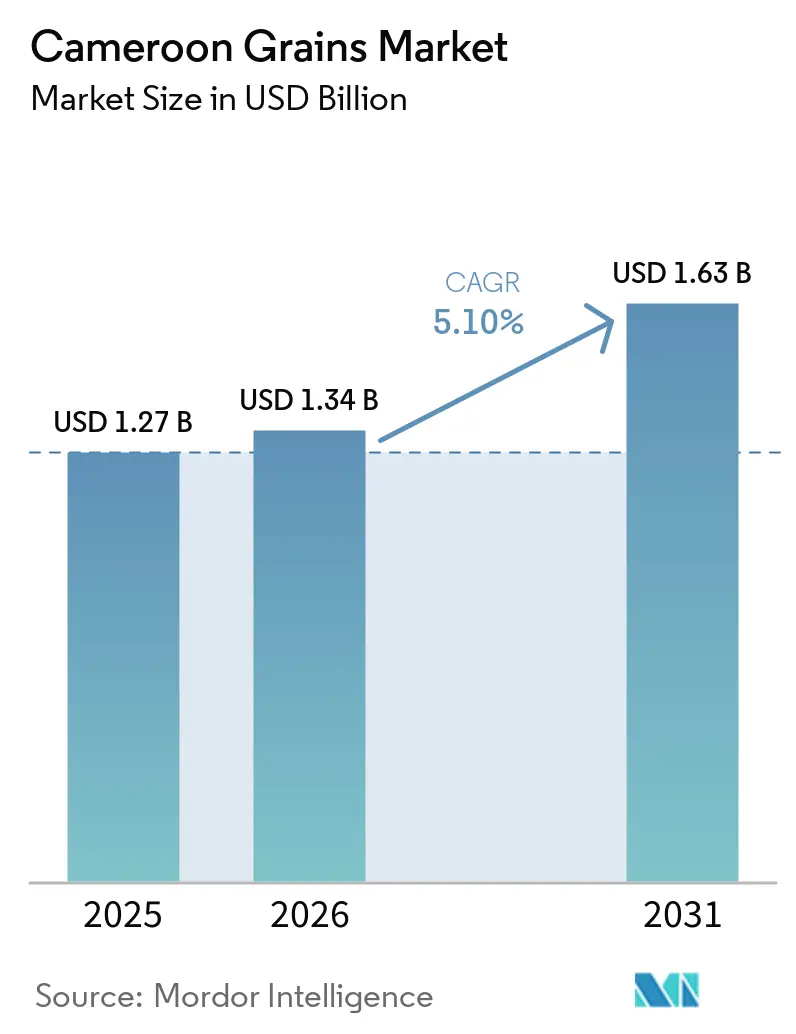
The Cameroon grains market is projected to grow from USD 1.27 billion in 2025 and USD 1.34 billion in 2026 to USD 1.63 billion by 2031, with a CAGR of 5.1% during the period from 2026 to 2031. The market is influenced by a structural supply-demand imbalance, as population growth surpasses domestic cereal production, maintaining a dependency on imports. To address this, the government is focusing on import substitution by investing in staple crop value chains to improve food security and reduce reliance on external sources. Additionally, consolidation in the milling sector and the development of modern processing infrastructure are enhancing efficiency and boosting industry competitiveness. The increasing use of digital and precision agriculture technologies is also contributing to productivity gains, positioning innovation as a significant factor in the market's long-term growth.
Key Report Takeaways
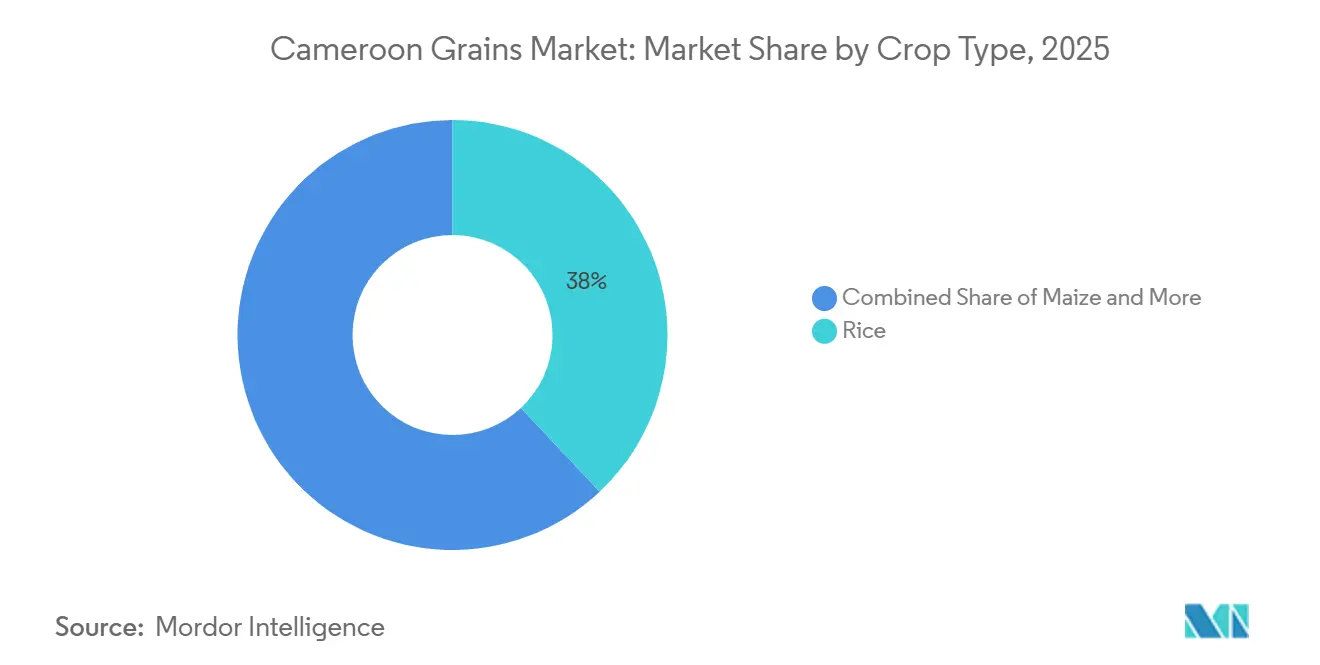
- By crop type, rice accounted for the largest 38.0% of the Cameroon grains market share in 2025, and the sorghum market size is projected to grow at the fastest 6.8% from 2026 to 2031.
Note: Market size and forecast figures in this report are generated using Mordor Intelligence’s proprietary estimation framework, updated with the latest available data and insights as of January 2026.
Cameroon Grains Market Trends and Insights
Drivers Impact Analysis*
| Driver | (~) % Impact on CAGR Forecast | Geographic Relevance | Impact Timeline |
|---|---|---|---|
| Growing population and rapid urbanization | +1.0% | Douala, Yaoundé, Garoua, and nationwide spillovers | Medium term (2-4 years) |
| Huge demand from livestock feed companies | +0.8% | Center, Littoral, and West | Short term (≤ 2 years) |
| Favorable government policies and input subsidies | +0.9% | Priority zones in Adamaoua, North, and Far North | Medium term (2-4 years) |
| Rising disposable income and diet shifts | +0.7% | Urban centers and emerging middle-class corridors | Long term (≥ 4 years) |
| Logistics upgrades in the Douala–Lagos corridor | +0.5% | Littoral, Southwest, and cross-border trade zones | Long term (≥ 4 years) |
| Solar-powered dry-season irrigation adoption | +0.4% | Far North, North, Adamaoua dry-season clusters | Long term (≥ 4 years) |
| Source: Mordor Intelligence | |||
Growing Population and Rapid Urbanization
The steadily increasing urban population in Cameroon, with an annual growth rate exceeding 3.1% in 2024, underscores the rapid urbanization in the country[1]Source: CEIC Data, “Cameroon: Urban Population Growth,” ceicdata.com. Cities such as Douala and Yaoundé are expanding, concentrating income, retail infrastructure, and demand for food services. This growth structurally boosts the consumption of processed and convenient cereal-based products, including rice and wheat derivatives. The urban concentration also enhances organized supply chains, supports large-scale milling and distribution networks, and sustains consistent growth in grain demand. These factors collectively reinforce the significance of "growing population and rapid urbanization" as a key driver in the Cameroon grains market.
Huge Demand from Livestock Feed Companies
According to the United States Department of Agriculture, Cameroon’s maize imports reached 90 thousand metric tons in 2024/25, representing a 100% increase compared to the previous year[2]Source: USDA Foreign Agricultural Service, “Production, Supply and Distribution (PSD) Database – Corn (Maize), Cameroon,” fas.usda.gov. This sharp rise reflects the growing demand from the livestock feed industry, particularly poultry and pig farming, which rely heavily on maize as a primary feed ingredient. The notable year-on-year growth suggests that feed millers are increasingly relying on imports to maintain production levels due to domestic supply limitations. This trend highlights the critical role of the feed sector in driving grain demand and its significance as a key growth factor in the Cameroon grains market.
Favorable Government Policies and Input Subsidies
Cameroon’s policy framework is fostering growth in the grains market, primarily through fiscal incentives designed to boost agricultural investment. Under the 2024 Finance Act, the government reduced state fees for agricultural enterprises by 92%, significantly decreasing operational costs and improving the business environment in the sector. This initiative is driving increased private sector involvement in areas such as crop production, storage, and processing. Additionally, government support through input distribution programs and agricultural development initiatives continues to enhance productivity and improve supply chain efficiency.
Rising Disposable Income and Diet Shifts
Cameroon’s increasing income levels are driving changes in dietary habits and boosting demand for grain-based products. According to the Federal Reserve Bank of St. Louis, GDP per capita rose to USD 1,830.01 in 2024, against last year, which is USD1,720.4 indicating improved consumer purchasing power[3]Source: World Bank, “GDP per capita – Cameroon,” fred.stlouisfed.org. This economic growth, particularly in urban areas, is fostering a shift toward more convenient and processed cereal-based foods, including bread, rice, and packaged maize products. With higher disposable incomes, consumers are increasingly favoring branded and higher-quality grain products, prompting product diversification and premiumization. These changes in consumption patterns are contributing to the growth of organized retail and food service channels, highlighting rising disposable incomes and evolving diets as significant drivers of demand in the Cameroon grains market.
Restraints Impact Analysis*
| Restraint | (~) % Impact on CAGR Forecast | Geographic Relevance | Impact Timeline |
|---|---|---|---|
| High dependence on grain imports | -0.6% | Littoral, Center, and major consumption corridors | Short term (≤ 2 years) |
| Increase in pest and disease outbreaks | -0.5% | North, Far North, and Northwest | Medium term (2-4 years) |
| Land-tenure insecurity limiting mechanization | -0.4% | Customary tenure zones nationwide | Long term (≥ 4 years) |
| Port congestion surcharges inflating input costs | -0.3% | Douala import clusters | Short term (≤ 2 years) |
| Source: Mordor Intelligence | |||
Increase in Pest and Disease Outbreaks
The rise in pest and disease outbreaks poses a significant challenge to Cameroon’s grains market, particularly due to the effects of fall armyworm on maize production. According to researchers from the University of Yaoundé I and the International Institute of Tropical Agriculture (IITA), fall armyworm infestations in Cameroon, as reported in 2026, can result in maize yield losses ranging from 15% to 73%, depending on agro-ecological zones and crop varieties. This underscores the severity and variability of pest pressure across major maize-producing regions. Such extensive crop damage reduces effective grain output and heightens production risks for farmers, particularly smallholders with limited access to timely pest control measures. As a result, recurring pest outbreaks constrain supply availability and disrupt value chain stability, making biological threats a critical restraint in Cameroon’s grains market.
Land-Tenure Insecurity Limiting Mechanization
Land tenure insecurity is a significant barrier to mechanization and large-scale agricultural investment in Cameroon. According to (Réseau de Lutte contre la Faim (RELUFA), land that is not formally registered is legally classified as part of the national domain, which weakens the legal standing of customary land rights unless they are formally titled. This structural issue creates uncertainty for both farmers and investors, deterring long-term investments in mechanization and commercial farming. Consequently, agricultural operations remain fragmented, under-mechanized, and difficult to scale. While recent reforms aim to acknowledge customary land rights through intermediate documentation, legal ambiguities persist. These challenges continue to hinder productivity improvements and serve as a major constraint in the Cameroon grains market.
*Our forecasts treat driver/restraint impacts as directional, not additive. The impact forecasts reflect baseline growth, mix effects, and variable interactions.
Segment Analysis
By Crop Type: Import Substitution Reshapes Production Priorities
Rice accounted for 38.0% of the Cameroon grains market share in 2025. This dominance is attributed to strong urban consumption patterns, where the rising middle class prefers convenient staple foods with consistent quality. Limited domestic production capacity significantly influences market dynamics, as high reliance on imports persists to meet consumption demands. Government-led initiatives aim to strengthen local rice value chains through measures such as irrigation, mechanization, and improved seed distribution. Collaborations with international stakeholders and the expansion of commercial farming projects are supporting efforts to reduce import dependency and improve long-term food security.
Sorghum market size is projected to grow at the fastest 6.8% from 2026 to 2031. This growth is driven by the crop's adaptability to drought-prone regions, particularly in northern Cameroon, where climate variability impacts crop reliability. Sorghum plays a vital role in traditional consumption and local brewing industries while gaining traction in animal feed and alternative flour applications. Research institutions are promoting improved seed varieties and climate-resilient farming practices to boost yields. The integration of irrigation technologies and sustainable farming methods is further enhancing sorghum’s position as a resilient and scalable crop within Cameroon’s grain market.



Geography Analysis
Douala and Yaoundé serve as key hubs for marketing, storage, and last-mile distribution networks, driven by robust urban consumption and the growth of retail channels. The Douala port manages the majority of grain imports, supported by infrastructure improvements such as the Boscam terminal, which offers dedicated storage capacity, enhances turnaround efficiency, and reduces logistics costs. The corridor's development is further supported by high population density, rapid urbanization, and the growth of grain market.
The Far North and North regions play a critical role in domestic grain production, particularly for sorghum, maize, and irrigated rice. In 2026, the Agricultural Research Institute for Development (IRAD) and the Yagoua Rice Expansion and Modernisation Company (SEMRY) undertook initiatives to rehabilitate 12,350 hectares of rice perimeters in Yagoua and Maga. These efforts aimed to strengthen irrigation systems and enhance rice productivity. Key outcomes of these initiatives include improved water management and more consistent cropping cycles in climate-sensitive areas. Such investments are stabilizing yields, supporting the domestic grain supply, and solidifying northern Cameroon as an essential production hub.
Cross-border trade with neighboring countries such as Chad, Gabon, and the Republic of Congo is growing, driven by regional integration frameworks. In 2026, Cameroon government implemented fiscal incentives under the Finance Law, providing up to 30% tax relief to support the agropastoral sector. These incentives include exemptions on specific equipment and inputs used in agricultural production. The measures aim to encourage investment and lower operational costs rather than eliminate all expenses. Furthermore, enhancements in port operations and customs procedures are anticipated to improve trade efficiency, reinforcing Cameroon’s position in regional grain distribution and processing.
Competitive Landscape
The competitive dynamics of the Cameroon grains market are increasingly influenced by the vertical integration strategies of major players. Key processors are extending their operations across various stages of the value chain, such as milling, feed production, and downstream food products, to secure raw material access and enhance profit margins. This approach allows companies to better manage supply chain risks, exercise greater control over input sourcing, and adapt more effectively to fluctuations in raw material availability. In 2025, Cadyst Group’s acquisition of Grands Moulins du Cameroun (SGMC) and Grands Moulins du Phare du Congo (SGMP), both subsidiaries of the Somdia Group, significantly boosted its processing capacity and solidified its position as a leading market player. This development has driven competitors to expand their operations and invest in capacity enhancements.
Mid-sized and niche operators in Cameroon’s grain market are increasingly focusing on value-added segments for key crops such as rice, maize, wheat, and sorghum. These companies are emphasizing the production of composite flours, fortified grain products, and feed formulations to cater to bakeries, food processors, and institutional buyers. By utilizing locally sourced raw materials and benefiting from government support programs, they are enhancing market access and product differentiation. Efforts to improve traceability and implement supply chain financing are stabilizing procurement processes and increasing transparency, thereby strengthening their role in production, processing, and distribution activities within the grain value chain.
Technology adoption is emerging as a significant differentiator in Cameroon’s grain market, particularly in production and post-harvest operations. Market participants are integrating digital advisory tools, improved seed varieties, and precision farming practices to boost yields and optimize input usage for crops like maize, rice, and sorghum. Collaboration between processors and farmers is ensuring a consistent supply of high-quality raw materials. Additionally, investments in storage infrastructure, logistics, and data-driven farm management are enhancing efficiency across the value chain, supporting competitiveness in production, trade, and pricing dynamics within the grain market.
Recent Industry Developments
- April 2026: The Agricultural Research Institute for Development (IRAD) and the Yagoua Rice Expansion and Modernisation Company (SEMRY) have signed a three-year agreement aimed at improving rice seed quality and rehabilitating 12,350 hectares of irrigated rice perimeters in Yagoua and Maga.
- January 2026: Alapala Holding upgraded a wheat flour mill in Douala, Cameroon, increasing its capacity to 300 metric tons per day with a fully automated milling system. This upgrade improved efficiency, extraction rates, and product quality.
- August 2025: Cadyst Group has completed the acquisition of Le Grand Moulin du Cameroun (SGMC) and Le Grand Moulin du Phare (SGMP), significantly expanding its agro-industrial operations and enhancing its integrated activities in grain processing.


Cameroon Grains Market Report Scope
Grains are small, hard, edible seeds obtained from cereal crops such as wheat, rice, maize, and sorghum. They serve as staple foods for human consumption and are essential components in livestock feed. Rich in carbohydrates, fiber, and essential nutrients, grains play a critical role in global food systems and the dietary energy supply. The Cameroon grain market report is segmented by crop type (rice, wheat, maize, and sorghum). The report includes production analysis (volume), consumption analysis (value and volume), import analysis (value and volume), export analysis (value and volume), wholesale price trend analysis and forecast, and seasonality analysis. The market forecasts are provided in terms of value (USD) and volume (metric tons).
By Crop Type
| Rice | Production Analysis | Production Volume | |
| Area Harvested and Yield | |||
| Consumption Analysis (Value and Volume) | |||
| Trade Analysis (Value and Volume) | Import Market Analysis | Import Value and Volume | |
| Key Supplying Markets | |||
| Export Market Analysis | Export Value and Volume | ||
| Key Destinations Markets | |||
| Wholesale Price Trend Analysis and Forecast | |||
| Seasonality Analysis | |||
| Wheat | Production Analysis | Production Volume | |
| Area Harvested and Yield | |||
| Consumption Analysis (Value and Volume) | |||
| Import Value and Volume | |||
| Key Supplying Markets | |||
| Export Value and Volume | |||
| Key Destinations Markets | |||
| Wholesale Price Trend Analysis and Forecast | |||
| Seasonality Analysis | |||
| Maize | Production Analysis | Production Volume | |
| Area Harvested and Yield | |||
| Consumption Analysis (Value and Volume) | |||
| Import Value and Volume | |||
| Key Supplying Markets | |||
| Export Value and Volume | |||
| Key Destinations Markets | |||
| Wholesale Price Trend Analysis and Forecast | |||
| Seasonality Analysis | |||
| Sorghum | Production Analysis | Production Volume | |
| Area Harvested and Yield | |||
| Consumption Analysis (Value and Volume) | |||
| Import Value and Volume | |||
| Key Supplying Markets | |||
| Export Value and Volume | |||
| Key Destinations Markets | |||
| Wholesale Price Trend Analysis and Forecast | |||
| Seasonality Analysis | |||
By Geography
| Production Analysis | Production Volume | |
| Area Harvested and Yield | ||
| Consumption Analysis (Value and Volume) | ||
| Import Value and Volume | ||
| Key Supplying Markets | ||
| Export Value and Volume | ||
| Key Destinations Markets | ||
| Wholesale Price Trend Analysis and Forecast | ||
| Seasonality Analysis |
| By Crop Type | Rice | Production Analysis | Production Volume | |
| Area Harvested and Yield | ||||
| Consumption Analysis (Value and Volume) | ||||
| Trade Analysis (Value and Volume) | Import Market Analysis | Import Value and Volume | ||
| Key Supplying Markets | ||||
| Export Market Analysis | Export Value and Volume | |||
| Key Destinations Markets | ||||
| Wholesale Price Trend Analysis and Forecast | ||||
| Seasonality Analysis | ||||
| Wheat | Production Analysis | Production Volume | ||
| Area Harvested and Yield | ||||
| Consumption Analysis (Value and Volume) | ||||
| Import Value and Volume | ||||
| Key Supplying Markets | ||||
| Export Value and Volume | ||||
| Key Destinations Markets | ||||
| Wholesale Price Trend Analysis and Forecast | ||||
| Seasonality Analysis | ||||
| Maize | Production Analysis | Production Volume | ||
| Area Harvested and Yield | ||||
| Consumption Analysis (Value and Volume) | ||||
| Import Value and Volume | ||||
| Key Supplying Markets | ||||
| Export Value and Volume | ||||
| Key Destinations Markets | ||||
| Wholesale Price Trend Analysis and Forecast | ||||
| Seasonality Analysis | ||||
| Sorghum | Production Analysis | Production Volume | ||
| Area Harvested and Yield | ||||
| Consumption Analysis (Value and Volume) | ||||
| Import Value and Volume | ||||
| Key Supplying Markets | ||||
| Export Value and Volume | ||||
| Key Destinations Markets | ||||
| Wholesale Price Trend Analysis and Forecast | ||||
| Seasonality Analysis | ||||
| By Geography | Production Analysis | Production Volume | ||
| Area Harvested and Yield | ||||
| Consumption Analysis (Value and Volume) | ||||
| Import Value and Volume | ||||
| Key Supplying Markets | ||||
| Export Value and Volume | ||||
| Key Destinations Markets | ||||
| Wholesale Price Trend Analysis and Forecast | ||||
| Seasonality Analysis | ||||


Key Questions Answered in the Report
What is the projected value of the Cameroon grains market by 2031?
The Cameroon grains market size is forecast to reach USD 1.63 billion by 2031, advancing at a 5.1% CAGR from 2026 to 2031.
What role do solar pumps play in closing the production gap?
Solar-powered irrigation in the Far North and North already lifts dry-season maize yields to 4-6 metric tons per hectare, demonstrating a viable path to boost national output and cut imports.
How much new grain storage did the Boscam terminal deliver in 2025?
The Boscam public-private terminal added 40,000 metric tons of silo capacity at Douala port.
What portion of Cameroonians now live in urban areas?
Urban residents account for about 59.2% of the population, concentrating demand in Douala and Yaoundé.
Page last updated on:






