
Supply Chain Big Data Analytics Market Size and Share
Market Overview
| Study Period | 2020 - 2031 |
|---|---|
| Market Size (2026) | USD 13.2 Billion |
| Market Size (2031) | USD 31.44 Billion |
| Growth Rate (2026 - 2031) | 18.95 % |
| Fastest Growing Market | Asia Pacific |
| Largest Market | North America |
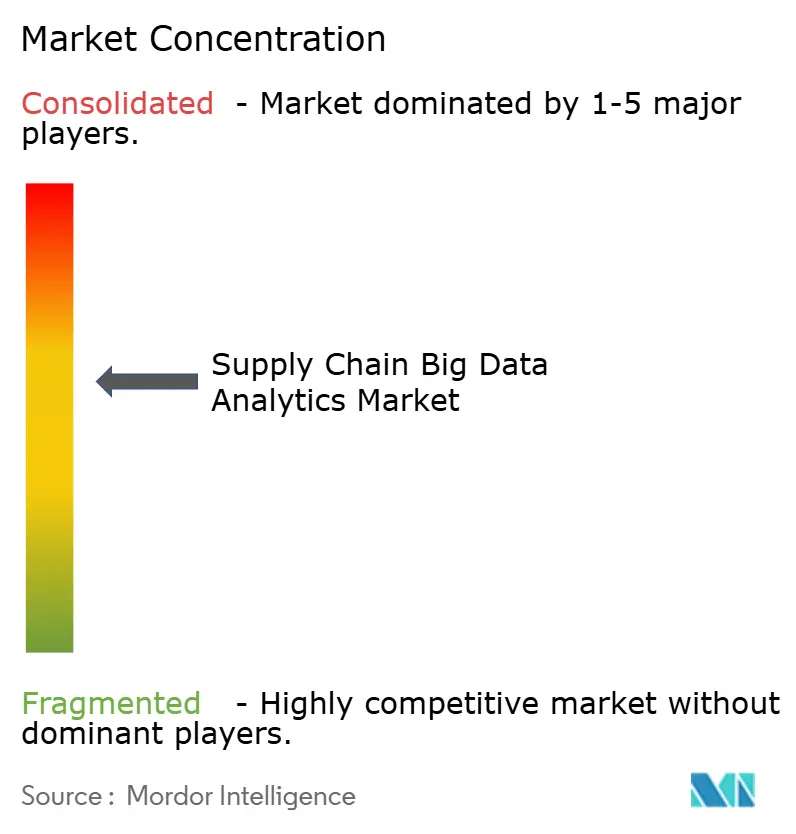
| Market Concentration | Medium |
Major Players *Disclaimer: Major Players sorted in no particular order Image © Mordor Intelligence. Reuse requires attribution under CC BY 4.0. | |
Supply Chain Big Data Analytics Market Analysis by Mordor Intelligence
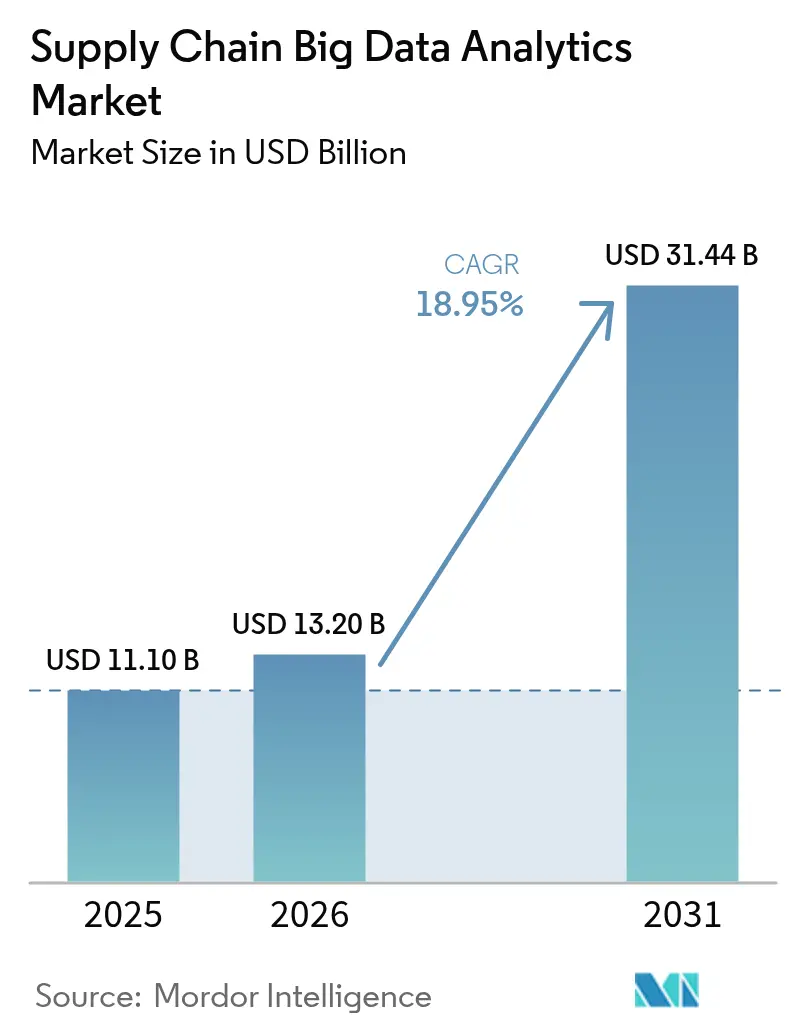
The Supply Chain Big Data Analytics market size is expected to grow from USD 11.10 billion in 2025 to USD 13.20 billion in 2026 and is forecast to reach USD 31.44 billion by 2031 at 18.95% CAGR over 2026-2031. This momentum reflects surging omni-channel retail complexity, fast-growing IoT telemetry volumes, and the rapid fall in cloud-data-warehouse costs, each pushing enterprises toward real-time, data-driven orchestration. Regulatory mandates such as the EU Deforestation Regulation and the FDA Food Safety Modernization Act Section 204 intensify demand for end-to-end visibility tools that can process multi-tier supplier data. North America presently leads adoption, while Asia Pacific shows the steepest growth curve, driven by manufacturing expansion and e-commerce acceleration. Investment activity remains strong, with large funding rounds for transparency, risk intelligence, and demand-forecasting platforms confirming investor confidence in AI-first analytics propositions.
Key Report Takeaways
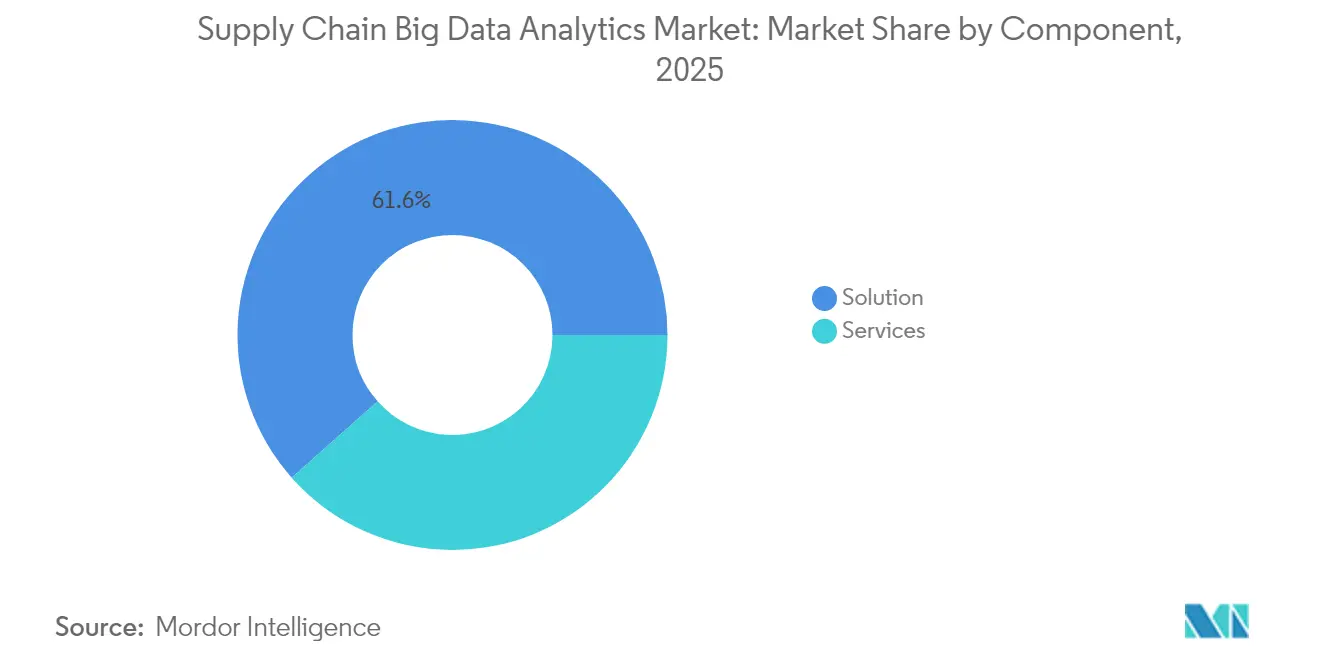
- By component, solution offerings held 61.55% of the supply chain big data analytics market share in 2025, while service-based offerings are projected to have a 19.32% CAGR through 2031.
- By end user, retail led with 33.10% revenue share in 2025; healthcare is advancing at a 20.60% CAGR through 2031.
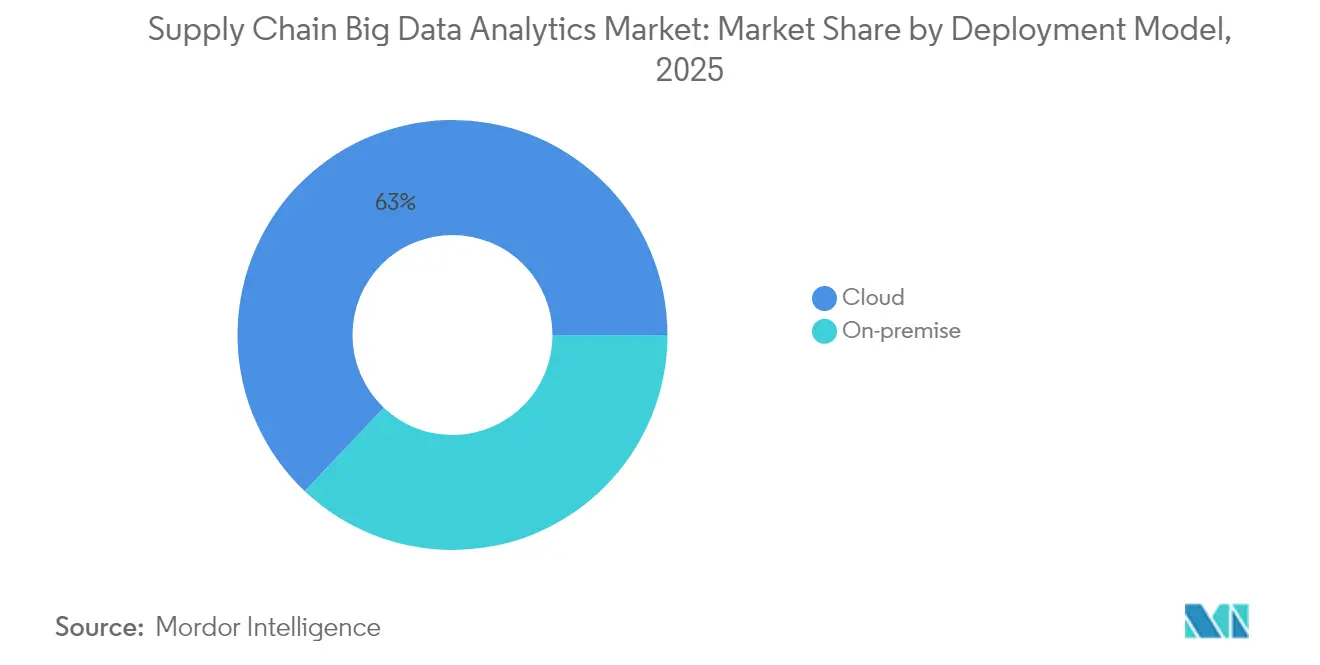
- By deployment model, cloud platforms accounted for 62.95% of the supply chain big data analytics market size in 2025 and are expanding at a 21.60% CAGR to 2031.
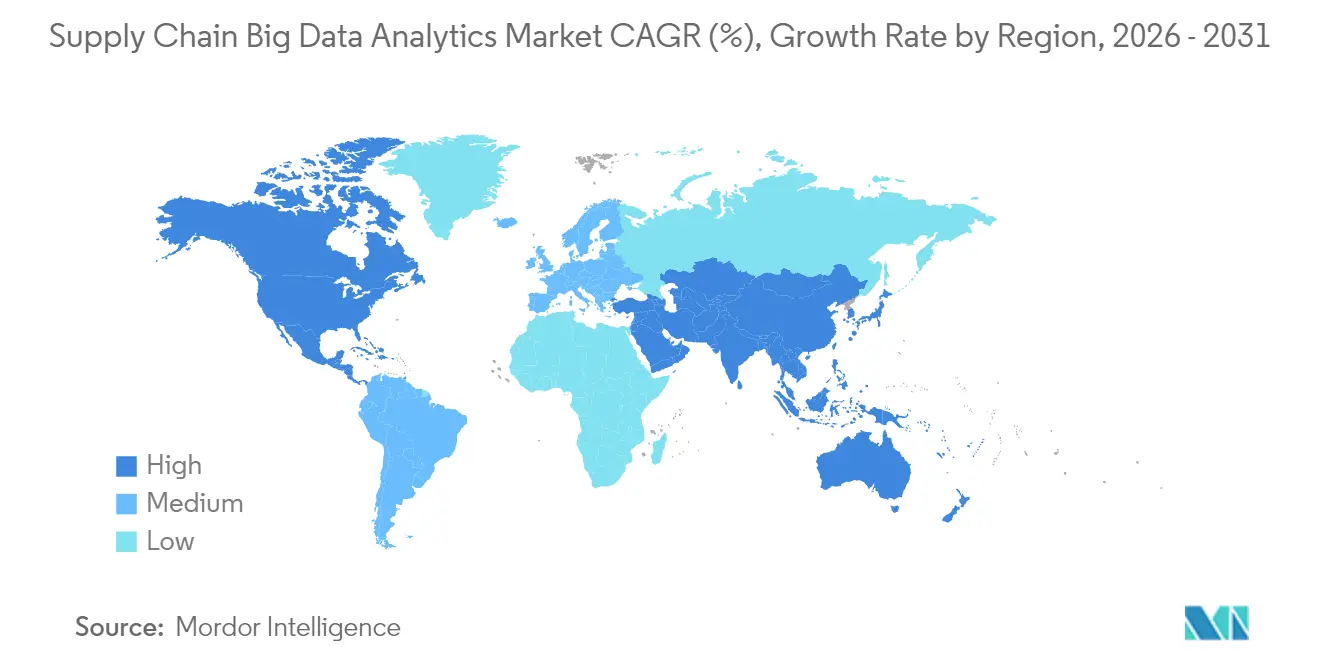
- By geography, North America commanded 42.40% share of the supply chain big data analytics market size in 2025, whereas the Asia Pacific is posting the highest regional CAGR at 21.15% to 2031.
Note: Market size and forecast figures in this report are generated using Mordor Intelligence’s proprietary estimation framework, updated with the latest available data and insights as of 2026.
Market Trends and Insights
Drivers Impact Analysis of Supply Chain Big Data Analytics Market*
| Driver | (~) % Impact on CAGR Forecast | Geographic Relevance | Impact Timeline |
|---|---|---|---|
| Surging omni-channel complexity | +3.2% | North America, Europe, spill-over global | Medium term (2-4 years) |
| Proliferation of IoT telemetry in logistics | +2.8% | Asia Pacific core, spill-over North America | Short term (≤2 years) |
| Falling cloud-data-warehouse costs | +2.1% | Global | Short term (≤2 years) |
| Regulatory push for supply-chain traceability | +1.9% | Europe, North America, expanding Asia Pacific | Long term (≥4 years) |
| Rise of digital twin control towers | +1.7% | North America, Europe, early adoption Asia Pacific | Medium term (2-4 years) |
| Carbon-credit-linked freight optimization | +1.5% | Europe leading, North America following | Long term (≥4 years) |
| Source: Mordor Intelligence | |||
Surging Omni-Channel Complexity
Retailers manage store, e-commerce, marketplace, and direct-to-consumer flows simultaneously, generating multi-petabyte data volumes that require real-time inventory algorithms. Walmart and Target each process more than 2.5 petabytes of supply data daily, prompting adoption of integrated planning platforms that synchronize demand signals and cut out-of-stock incidents by 30-40% [1]Editorial Board, “Digital Manufacturing in 2024: Industry 4.0 Paves Path for Business Resilience and Growth,” Manufacturing Today India, manufacturingtodayindia.com.
Proliferation of IoT Telemetry in Logistics
Logistics operators deployed more than 1.2 billion IoT devices in 2024, each sending 25-30 data points per minute. Advanced analytics predicts equipment failures, optimizes fuel through live routing, and assures cold-chain integrity, delivering 20-30% maintenance cost cuts and 95% compliance for temperature-sensitive freight.
Falling Cloud Data-Warehouse Costs
Between 2022-2024, unit costs fell 40-50% as Snowflake, Amazon Redshift, and Google BigQuery competed on price-performance. Mid-market firms now access elastic compute that trims total ownership costs by up to 70% versus on-premise stacks, while halving time-to-insight [2]Product Team, “Snowflake Performance Benchmarks,” Snowflake, snowflake.com . Organizations can now leverage modern cloud platforms for elastic scaling, enabling them to handle peak workloads during demand planning cycles and scale down during regular operations. This shift has led to a significant reduction in total ownership costs, with savings of 60-70% compared to traditional on-premise architectures.
Regulatory Push for Supply-Chain Traceability
The EU Deforestation Regulation and FDA FSMA Section 204 require digital chain-of-custody records, pushing firms toward blockchain-ready analytics that sustain 90%+ compliance and reduce audit prep time by one-quarter. Organizations must now adopt comprehensive visibility systems to monitor products from raw material sourcing to final delivery. This shift generates vast datasets, necessitating advanced analytics for regulatory compliance.
Restraints Impact Analysis of Supply Chain Big Data Analytics Market*
| Restraint | (~) % Impact on CAGR Forecast | Geographic Relevance | Impact Timeline |
|---|---|---|---|
| Integration and data-quality hurdles | -2.3% | Global, acute in legacy-heavy industries | Medium term (2-4 years) |
| Shortage of analytics talent | -1.8% | North America and Europe, emerging in APAC | Long term (≥ 4 years) |
| High TCO for real-time streaming stacks | -1.4% | Global, particularly SMEs in emerging markets | Short term (≤ 2 years) |
| Cyber-insurance exclusions for data-lake breaches | -1.1% | North America and Europe, expanding globally | Medium term (2-4 years) |
| Source: Mordor Intelligence | |||
Integration and Data-Quality Hurdles
Enterprises juggle 15-25 legacy systems with incompatible schemas, leading to six-to-twelve-month integration delays and forcing teams to spend up to 60% of analytics budgets on data cleansing before realizing value [3]John D. Schulz, “Three Steps Manufacturers Need to Take Before Investing in AI,” SupplyChainBrain, supplychainbrain.com. Data quality issues, such as duplicate records, missing values, inconsistent naming conventions, and outdated information, can diminish analytics accuracy by 20-30%. This undermines confidence in both predictive models and prescriptive recommendations.
Shortage of Analytics Talent
Organizations grapple with a global shortage of data scientists, machine learning engineers, and supply chain analytics specialists, hampering market growth. These roles demand a unique blend of advanced mathematics and in-depth knowledge of logistics, procurement, manufacturing, and distribution. This specialized expertise results in a limited talent pool, driving up salary expectations.
*Our forecasts treat driver/restraint impacts as directional, not additive. The impact forecasts reflect baseline growth, mix effects, and variable interactions.
Supply Chain Big Data Analytics Market Segment Analysis
By Component:
Solutions Build the Core of Analytics AdoptionSolutions captured 61.55% of the supply chain big data analytics market share in 2025 by bundling procurement planning, manufacturing analytics, and transportation optimization into unified suites. Manufacturing analytics modules gain traction as Industry 4.0 initiatives link shop-floor sensors to predictive models. Transportation tools are equally in demand as e-commerce growth multiplies last-mile deliveries.
The services segment grows at a 19.32% CAGR as enterprises call on system integrators for data migration, model calibration, and round-the-clock support. Hybrid cloud and generative-AI workloads amplify complexity, widening the gap between packaged software and client customization needs.



By End User Industry:
Retail Dominance Meets Healthcare AccelerationRetail accounted for 33.10% of the supply chain big data analytics market size in 2025 as omni-channel leaders embedded AI-driven forecasting that lifts prediction accuracy by up to 30%. Transportation and manufacturing follow, investing heavily in route and plant optimization.
Healthcare is the fastest-growing segment at a 20.60% CAGR. Cold-chain monitoring, pharmaceutical serialization, and strict regulatory audits push hospitals and drug makers toward sensor-rich visibility platforms that secure patient safety while reducing spoilage.
By Deployment Model:
Cloud Scaling Sets the PaceCloud deployments held 62.95% share of the supply chain big data analytics market size in 2025 and are expanding at 21.60% CAGR, driven by elastic scaling and consumption-based pricing that aligns spend with peaks in S and OP cycles. Global control towers now leverage embedded AI services for predictive ETAs and automated exception handling.
On-premise environments remain where data sovereignty or latency constraints matter. Hybrid and edge architectures bridge plant-floor processing with cloud-level scenario simulations, protecting sensitive data while enabling global optimization.
Geography Analysis
North America Supply Chain Big Data Analytics Market
North America led with 42.40% of the supply chain big data analytics market share in 2025, owing to early digital-twin pilots and a mature cloud landscape. US manufacturers extend analytics into nearshored Mexican plants to improve quality yields, while Canadian energy operators optimize pipeline maintenance through predictive models.
APAC Supply Chain Big Data Analytics Market
Asia Pacific is growing at a 21.15% CAGR. China funds smart-factory roll-outs and cross-border e-commerce corridors that demand high-speed analytics. India accelerates retail and pharma use cases, whereas Japan and South Korea refine automotive and electronics supply chains through AI-powered scheduling. Government incentives and cloud-native startups make adoption cost-effective.
Europe Supply Chain Big Data Analytics Market
Europe maintains steady uptake under stringent sustainability and data-privacy rules. German auto and machinery exporters rely on plant-level analytics to protect global competitiveness. UK retailers integrate AI demand-planning tools to navigate volatile consumer sentiment, while EU-wide traceability laws spur investment in blockchain-enabled visibility platforms.

Regulatory Landscape
Supply chain big data analytics deployments are being shaped by traceability requirements, AI governance expectations, and public-sector data-sharing initiatives. In the United States, updates published in the Federal Register during May 2024 around OMB data governance (Circular A-130 refresh) reinforce expectations for standardized data management and interoperability across federal acquisition and analytics environments, which affects how vendors structure metadata, access controls, and auditability in analytics stacks.
In China, the State Administration for Market Regulation issued GB/T 46881-2025 (Digital supply chain, General requirements for traceability system), implemented from December 31, 2025, formalizing traceability system requirements and increasing demand for data ingestion, master data management, and chain-of-custody analytics. In Europe, policy attention is extending beyond reporting into shared risk-monitoring platforms, including the European Commission proposal for a Business-to-Business Semiconductor Supply Chain Platform (COM(2026) proposal) and related Council-level work on advanced cargo data initiatives, both of which raise the need for standardized multi-party data exchange and governance in supply chain analytics programs.
Value Chain Analysis
The value chain for supply chain big data analytics begins with data generation across procurement, manufacturing, transportation, warehousing, and customer channels, then moves through connectivity (IoT and telematics), data integration and quality management, cloud data platforms, and analytics and AI layers that feed planning and execution workflows (S&OP, inventory optimization, logistics routing, and supplier risk). Enterprises typically coordinate implementations with system integrators and consulting partners for data migration, model calibration, and workflow redesign, reflecting the challenge of harmonizing 15 to 25 legacy systems and operational data sources.
More of the bottlenecks and dependencies are shifting upstream into compute and infrastructure availability for real-time analytics and AI workloads. Industry commentary and disclosures in 2026 also pointed to structural constraints around advanced semiconductor capacity and adjacent components (for example, printed circuit boards for optical transceivers), which can lengthen lead times and push technology and telecom buyers from just-in-time sourcing toward buffer-stock and multi-year agreements. These disruptions increase the operational value of control towers, predictive lead-time analytics, and supplier risk intelligence, while also raising the importance of governance, cybersecurity supply chain risk management practices, and resilient cloud architectures across delivery and operations stages.
Competitive Landscape
The supply chain big data analytics market features moderate concentration. Enterprise software giants SAP, IBM, Oracle, and Microsoft bundle analytics with existing ERP or cloud contracts, leveraging account control. Pure-play vendors Blue Yonder, Manhattan Associates, and Kinaxis focus on deep optimization for planning and fulfillment. All parties now embed generative AI copilots as baseline functionality.
Strategic alliances reshape competition. Kinaxis partnered with ExxonMobil to co-develop energy-sector planning tools, while OMP piloted generative AI with Fortune 500 firms to speed scenario modeling. Vendors increasingly quantify outcomes, inventory turns, service levels, and CO₂ cuts to differentiate beyond feature parity.
Venture-backed disruptors Altana, Impact Analytics, and Everstream Analytics target transparency, demand sensing, and risk intelligence niches, drawing sizeable funding that presses incumbents to accelerate merger and acquisitions or white-label integrations. Consolidation is expected among providers unable to meet escalating client expectations for autonomous decision support.
Supply Chain Big Data Analytics Industry Leaders
IBM Corporation
Oracle Corporation
SAP SE
Kinaxis Inc.
Microsoft Corporation
- *Disclaimer: Major Players sorted in no particular order
Supply Chain Big Data Analytics Market Companies Covered in this Report
- SAP SE
- IBM Corporation
- Oracle Corporation
- Microsoft Corporation
- Amazon Web Services, Inc.
- Google LLC (Looker)
- Salesforce Inc. (Tableau Software Inc.)
- SAS Institute Inc.
- MicroStrategy Inc.
- Kinaxis Inc.
- Genpact Ltd.
- Blue Yonder Inc.
- Manhattan Associates
- Infor Inc.
- Qlik Techology Inc.
- Alteryx Inc.
- Snowflake Inc.
- Sage Clarity Systems
- Capgemini SE
- Birst Inc.

Market Opportunities and Future Outlook
Government-led and critical-supply-chain programs are creating whitespace for analytics platforms that support multi-party data sharing, digital-twin monitoring, and policy-grade risk intelligence. The UK Government continued the Global Supply Chains Intelligence Programme (GSCIP) in April 2026 as an AI-enabled, big-data analytical platform for cross-departmental intelligence, while the EU advanced a proposed Business-to-BBusiness Semiconductor Supply Chain Platform to map structural interdependencies and risks. These initiatives favor vendors that can operationalize secure data exchange, lineage, and standardized entity resolution across suppliers and logistics partners, rather than point solutions focused only on internal optimization.
In enterprise deployments, the market is moving toward decision intelligence and agentic workflows embedded directly into supply chain applications and control towers. UPS deployed a real-time digital twin of its global logistics network in June 2026 with 10-minute update cycles, showing how streaming telemetry and analytics can support rapid network reconfiguration. Platform updates, including Oracle introducing new Fusion agentic applications for SCM and Kinaxis launching Maestro Agent Studio for no-code agent composition, reinforce demand for governed automation that links planning outputs to execution actions. A concrete opportunity remains in services and accelerators that shorten integration timelines, improve data quality, and harden security controls, since legacy fragmentation and data-cleansing burdens are still core blockers for scaling real-time analytics.
Recent Industry Developments in Supply Chain Big Data Analytics Market
- June 2026: Oracle launched four new Fusion Agentic Applications for Oracle Fusion Cloud SCM, including workspaces for inventory planning, supplier qualification, production readiness, and kanban administration. The release extends embedded, workflow-native automation across planning and execution tasks, lifting the bar for suite vendors bundling analytics and AI agents into core SCM processes.
- March 2025: Kinaxis launched Planning One for Infor CloudSuite to combine ERP data with AI-driven orchestration for discrete manufacturers. The integration focus is aimed at faster time-to-value for customers standardizing on Infor while extending advanced planning and analytics through the Kinaxis platform.
- May 2024: Manhattan Associates unveiled Manhattan Active Supply Chain Planning with embedded GenAI assistants. By adding generative AI into planning workflows, the vendor signaled a shift from dashboard-driven analytics toward guided decision support within cloud-native supply chain planning suites.


Supply Chain Big Data Analytics Market Report Scope and Research Methodology
Market Definition and Coverage
For this study, the market covers revenue earned from big data analytics software and related services that turn supply chain data into decisions across planning, sourcing, manufacturing, and logistics, including on-premise and cloud deployments.
Scope exclusions: Excluded from sizing are general IT infrastructure that is not primarily purchased for supply chain analytics (such as commodity servers, network gear, and generic data storage sold without an analytics use case).
Segments Covered in This Report
- By Component
- Solution
- Supply-Chain Procurement and Planning Tools
- Sales and Operations Planning
- Manufacturing Analytics
- Transportation and Logistics Analytics
- Inventory Planning and Optimization
- Service
- Professional Services
- Support and Maintenance
- Solution
- By End User Industry
- Retail
- Transportation and Logistics
- Manufacturing
- Healthcare
- Other end-user Industries (Consumer-Packaged Goods, Energy and Utilities, etc.)
- By Deployment Model
- On-premise
- Cloud
- By Geography
- North America
- United States
- Canada
- Mexico
- South America
- Brazil
- Argentina
- Rest of South America
- Europe
- United Kingdom
- Germany
- France
- Italy
- Rest of Europe
- Asia Pacific
- China
- Japan
- South Korea
- India
- Rest of Asia Pacific
- Middle East and Africa
- United Arab Emirates
- Saudi Arabia
- South Africa
- Rest of Middle East and Africa
- North America
Data Sources, Market Sizing, and Validation
Desk Research
Desk research was used to build the first version of the market map and to set realistic boundary conditions for demand and spend. We reviewed public sources such as the US Bureau of Economic Analysis for software and services indicators, the US Census Bureau for trade and logistics activity proxies, and Eurostat for transportation and digital economy series.
To keep assumptions grounded, supporting reads were taken from sources such as the World Bank, OECD, and UN Comtrade for macro and trade intensity signals that influence supply chain digitization. We also used company annual reports, earnings call transcripts, investor presentations, and reputable business press to understand how pricing is described, the pace of cloud migration, and where analytics sits inside supply chain budgets.
Where needed, a paid subscription focused on company financials and another subscription focused on patent databases were used to cross-check company exposure and product direction. These examples are not exhaustive, and many other public documents were reviewed to clarify gaps, validate inputs, and reduce ambiguity.
Primary Interviews and Surveys
Primary conversations were completed with a mix of analytics platform suppliers, system integrators, logistics-focused users, and supply chain leaders in end user industries such as retail, manufacturing, and transportation. We used these inputs to confirm adoption levels, typical contract structures (subscription vs services), and how buyers separate supply chain analytics from broader enterprise analytics programs.
Because the analysis is global, responses were balanced across APAC, EMEA, and the Americas, so growth assumptions reflect differences in cloud readiness, trade exposure, and compliance-driven traceability needs.
Distribution of primary research fieldwork respondents
| Company type | Respondent position | Region |
|---|---|---|
| Top tier: 32% | CXOs: 14% | APAC: 47% |
| Mid tier: 51% | Functional/Unit leaders: 29% | EMEA: 30% |
| Smaller Players: 17% | Managers: 57% | Americas: 23% |
Market-Sizing & Forecasting
Sizing starts with a top-down build where supply chain analytics spend is reconstructed from enterprise software and services outlays, then filtered by adoption rates for big data analytics use cases across planning, procurement, and logistics workflows. Those totals are checked using selective bottom-up approximations, such as sampling typical subscription price bands, expected user counts, and services attachment rates seen in interviews, followed by channel checks with integrators.
A few practical model inputs that move the number include cloud migration pace for analytics deployments, average contract duration and renewal behavior, services-to-software mix for implementation projects, the share of analytics tied to transportation and warehousing activity, and the rate at which traceability and compliance requirements drive new data integration work. When bottom-up evidence is thin in a country or end-user pocket, we interpolate using nearby markets with similar cloud maturity and trade intensity, and then re-test the outcome with expert feedback.
For forecasting, scenario analysis is used, because adoption and pricing can swing with macro cycles and IT budget priorities. In each scenario, growth is guided by expected changes in deployment mix, buyer willingness to expand seats and data volumes, and the timing of large transformation programs, and then reconciled back to the total addressable spend pool.
Data Validation & Update Cycle
Validation is done through a set of cross-checks that look for gaps between the model output and independent signals, such as cloud software growth patterns, logistics activity trends, and management commentary on analytics demand. Outliers are investigated, and if a driver looks overstated, assumptions are adjusted and then rechecked with fresh calls or follow-up questions.
Before sign-off, the file goes through multi-step analyst reviews where calculations, currency conversions, and year mapping are re-tested to avoid timing mismatches. The report is refreshed annually, and interim updates are made when major market-moving events occur, followed by a final pre-delivery pass so clients receive the latest view.
Mordor Intelligence's Global Supply Chain Big Data Analytics Market Market Sizing Compared With Other Published Estimates
Published market sizes for this space often vary, because each publisher draws the boundary in a slightly different way and then applies its own timing rules for currency conversion and pricing changes. Differences also come from how much services revenue is counted alongside software, and whether general big data platforms are treated as supply chain analytics even when the use case is not clear.
A refresh-led gap is common here, because subscription pricing and implementation work can shift with cloud adoption and multi-year contract renewals, which makes the base-year cut and exchange-rate timing more visible. When ASP progression is updated using recent renewal and expansion feedback, and when results are rechecked against external spend signals before release, the 2025 value in Mordor Intelligence tends to track closer to what buyers budgeted for supply chain analytics in that year.
Benchmark comparison
| Source | Market Size | Gaps in Research Methodology |
|---|---|---|
| Mordor Intelligence | USD 11.10 B (2025) | |
| Global Consultancy A | USD 11.04 B (2025) | This estimate aligns on the base year but its scope presentation leans more toward software-led definitions, which can understate services-heavy rollouts in early-stage adoption markets. |
| Industry Publisher B | USD 6.67 B (2025) | The lower figure appears to include a narrower demand pool, and it also introduces hardware as a component, which can shift what is counted as analytics revenue versus supporting infrastructure and reduce comparability. |
The table indicates that the biggest spread is usually not from arithmetic, it is driven by scope and timing choices that affect what is counted in 2025. By keeping software and services tied to clear supply chain use cases, and by revalidating price and currency assumptions close to publication, the final number remains traceable to inputs a buyer can understand and replicate.


Key Questions Answered in the Report
What is the current value of the supply chain big data analytics market?
The market stands at USD 13.2 billion in 2026 and is on track to reach USD 31.44 billion by 2031.
Which region is growing fastest for supply chain big data analytics?
Asia Pacific is expanding at a 21.15% CAGR due to manufacturing growth, e-commerce expansion, and supportive government policies.
Which deployment approach dominates new analytics projects?
Cloud platforms account for 62.95% of 2025 revenue and continue to outpace on-premise alternatives as enterprises favor elastic scaling and pay-as-you-go pricing.
Which industry vertical leads in adoption?
Retail held 33.10% of 2025 revenue by leveraging analytics to manage omni-channel complexity and improve inventory accuracy.
Why are services growing faster than software solutions?
The 19.32% CAGR in services reflects rising demand for system integration, data cleaning, and AI model tuning that enterprises often lack in-house expertise to perform.
What is a key restraint on market growth?
Integration and data-quality issues can delay projects by up to a year and absorb as much as 60% of analytics budgets, slowing broader adoption.
Page last updated on:


 Your data is secure and never sold or shared.


