
Mobile Identification Market Size and Share
Market Overview
| Study Period | 2020 - 2031 |
|---|---|
| Market Size (2026) | USD 6.55 Billion |
| Market Size (2031) | USD 20.79 Billion |
| Growth Rate (2026 - 2031) | 25.99 % |
| Fastest Growing Market | Asia-Pacific |
| Largest Market | North America |
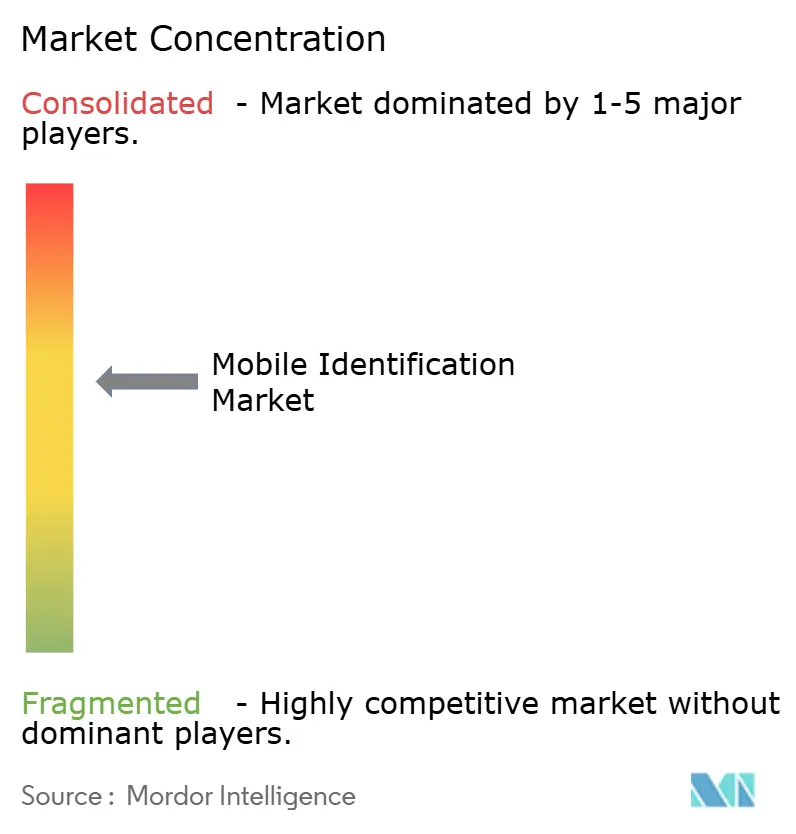
| Market Concentration | Medium |
Major Players *Disclaimer: Major Players sorted in no particular order Image © Mordor Intelligence. Reuse requires attribution under CC BY 4.0. | |
Mobile Identification Market Analysis by Mordor Intelligence
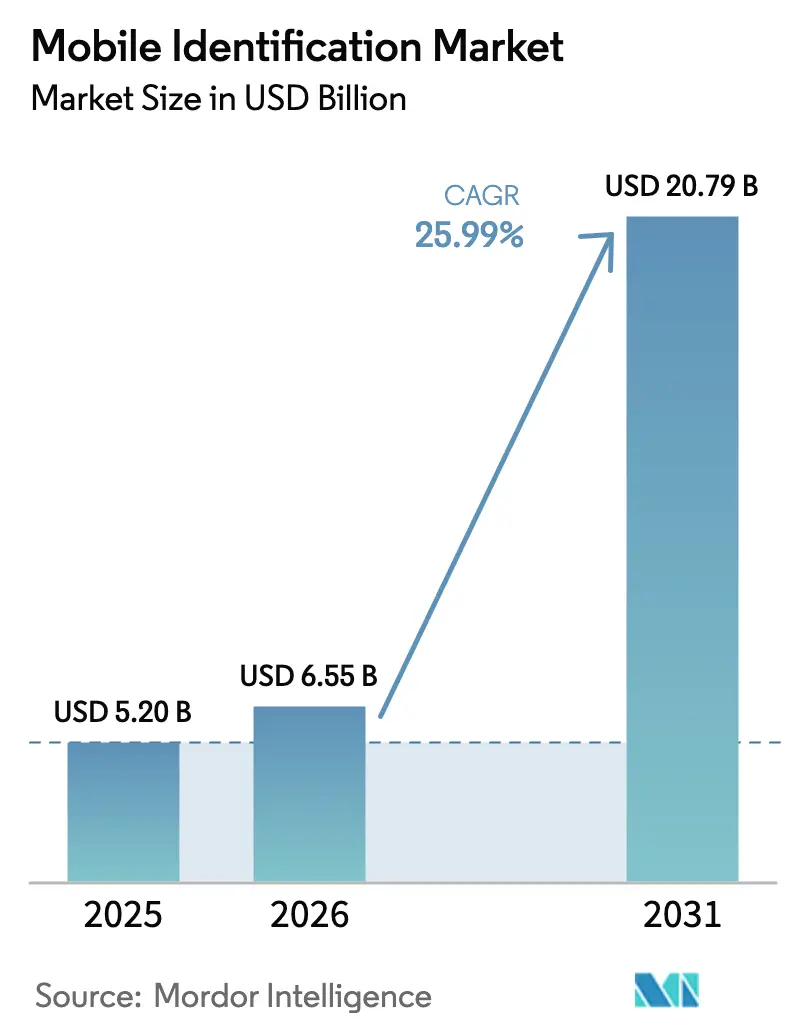
The Mobile Identification market size is expected to grow from USD 5.20 billion in 2025 to USD 6.55 billion in 2026 and is forecast to reach USD 20.79 billion by 2031 at 25.99% CAGR over 2026-2031.
Expansion is anchored in three structural forces: a steep rise in credential-based cyberattacks, tightening global authentication mandates, and the seamless integration of biometric hardware in mainstream smartphones. Financial services providers are shifting rapidly from passwords to multi-factor and passwordless journeys, while telecom operators, healthcare networks, and governments deploy national digital ID schemes that converge payments, welfare, and public service access. Competitive intensity remains high as established vendors pivot from hardware-centric offerings to software-defined, AI-enabled orchestration layers, and as venture-backed specialists carve out niches in deep-fake detection, behavioral biometrics, and mobile SDKs for app developers. Asia’s policy-driven leap in national ID roll-outs positions the region as the fastest-expanding opportunity pool, whereas Europe balances growth with stringent data-residency restrictions that complicate cross-border deployments.
Key Report Takeaways
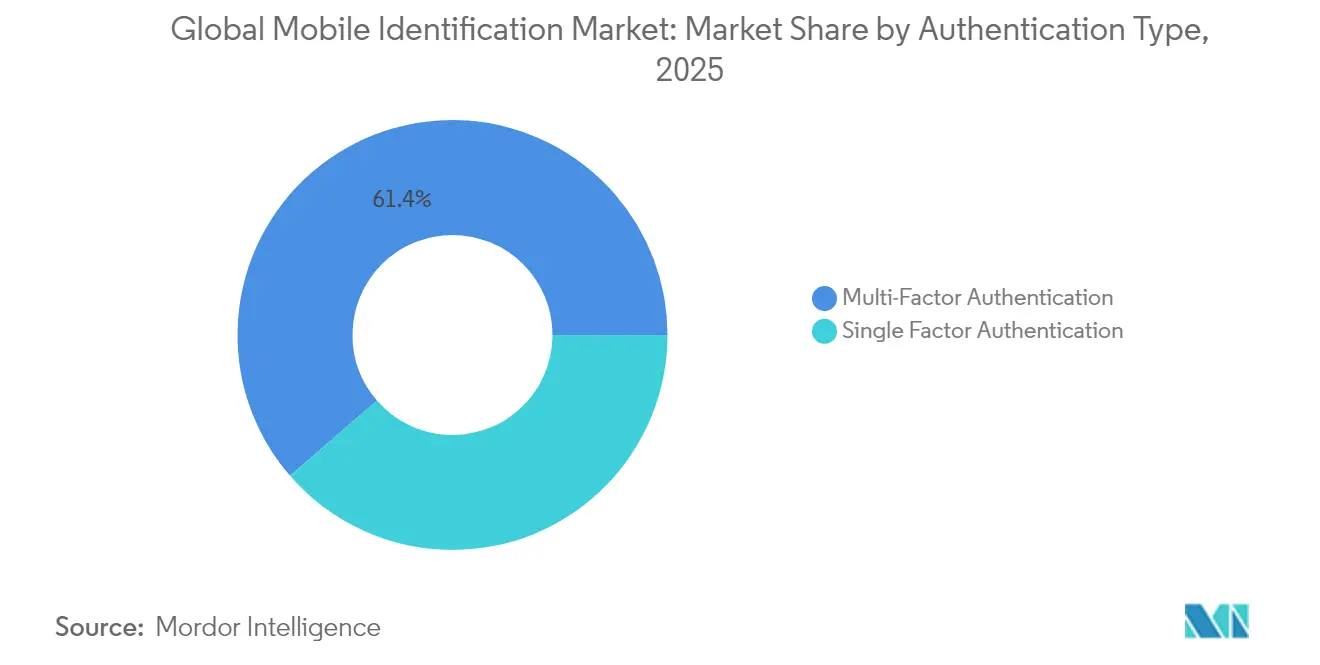
- By authentication type, multi-factor authentication commanded 61.37% of the mobile identification market share in 2025; four-factor-and-above configurations are forecast to expand at a 28.74% CAGR through 2031.
- By component, biometric technologies captured 67.92% revenue share in 2025, while the services segment is projected to advance at a 26.35% CAGR to 2031.
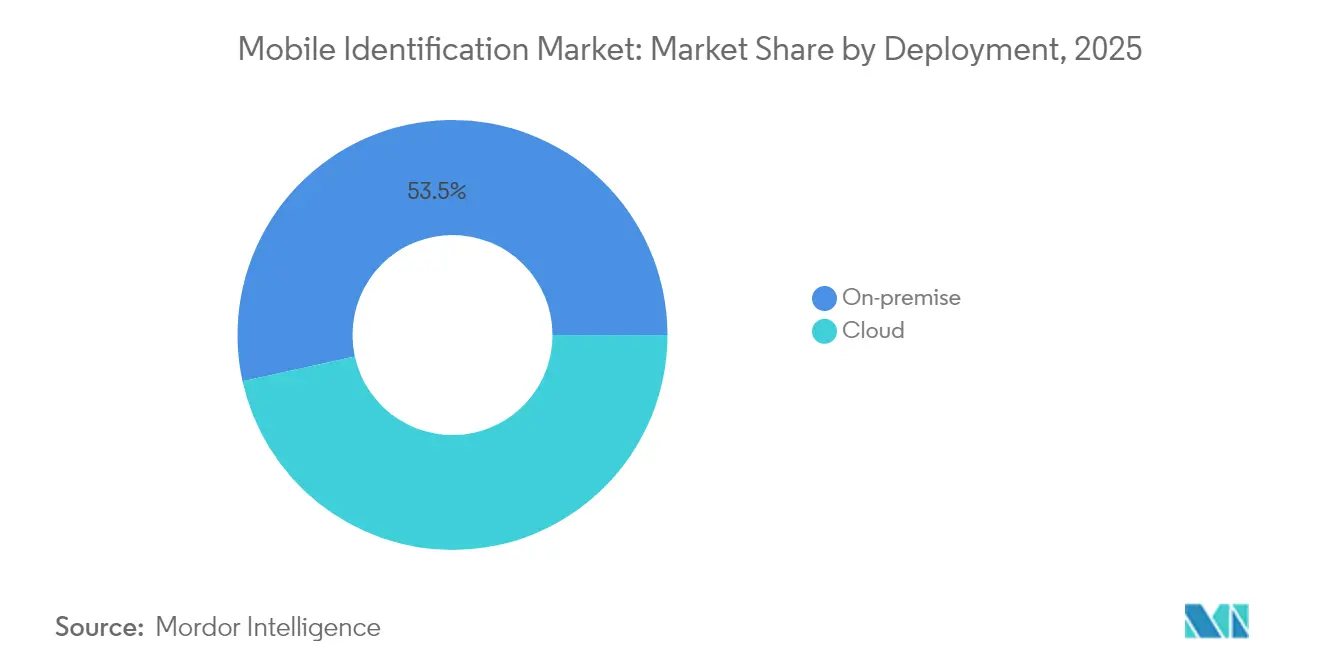
- By deployment, on-premise solutions accounted for 53.45% of the mobile identification market size in 2025; the cloud segment is poised to accelerate at a 26.12% CAGR.
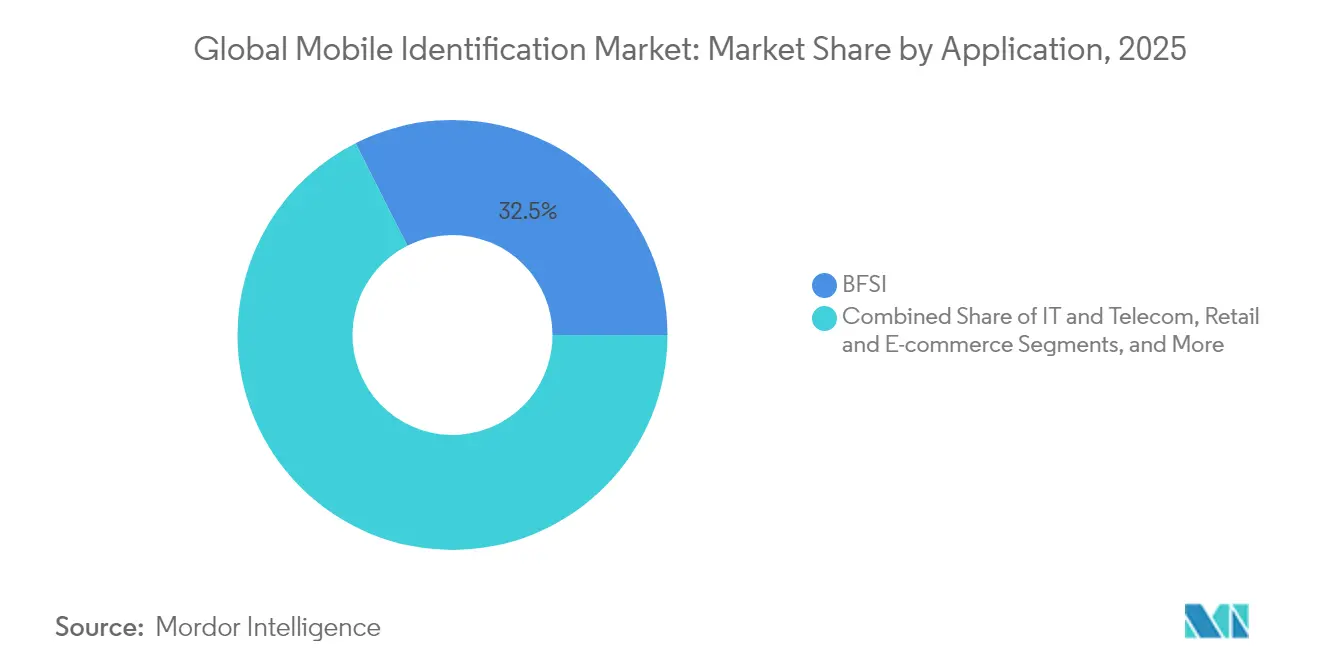
- By application, the BFSI sector led with 32.45% revenue share in 2025, whereas retail & e-commerce is on track for a 27.95% CAGR.
- By region, North America held 36.22% of revenue in 2025, while Asia is set to outpace all regions at a 28.05% CAGR.
Note: Market size and forecast figures in this report are generated using Mordor Intelligence’s proprietary estimation framework, updated with the latest available data and insights as of 2026.
Market Trends and Insights
Drivers Impact Analysis of Mobile Identification Market*
| Drivers | (~) % Impact on CAGR Forecast | Geographic Relevance | Impact Timeline |
|---|---|---|---|
| eKYC mandates across BFSI | +3.2% | North America, spillover to Europe | Medium term (2-4 years) |
| National digital ID projects | +4.5% | India, Singapore, China; global influence | Long term (≥ 4 years) |
| Remote workforce zero-trust roll-outs | +2.8% | Europe and United States | Short term (≤ 2 years) |
| Telco-bank SIM-based ID alliances | +1.9% | Africa and Middle East | Medium term (2-4 years) |
| Mid-tier smartphone biometric hardware | +3.7% | Asia-Pacific | Medium term (2-4 years) |
| FinTech and crypto real-time verification | +2.4% | Concentrated in North America and Europe | Short term (≤ 2 years) |
| Source: Mordor Intelligence | |||
eKYC Mandates Across BFSI
Financial-services regulators in the United States and Canada are tightening identity-proofing standards, prompting banks to embed real-time biometric checks into mobile apps. Rising fraud losses, estimated at USD 56 billion in 2021, are accelerating multi-factor authentication adoption across credit issuance, digital wallets, and P2P transfers. A parallel wave of streamlined KYC guidance allows self-declarations in markets such as India, cutting onboarding friction without diluting risk controls. Industry working groups now benchmark AI-scored document verification accuracy, and user expectations for frictionless login are driving passwordless pilots in high-risk workflows.
National Digital ID Projects
Asia’s large-scale identity schemes, most notably India’s 1.3 billion-record Aadhaar platform and Singapore’s Singpass ecosystem, embed mobile credentials into payments, healthcare, and public subsidies. These programs anchor a broader 43% CAGR in digital-payment volumes across emerging APAC economies, catalyzing private-sector wallet, lending, and insurance use cases. Early-stage roll-outs in Malaysia and Indonesia highlight implementation hurdles - low opt-in rates and integration gaps - but also reveal long-run capacity to uplift formal economic participation. Global vendors view these government tenders as entry points for cloud-based orchestration layers and country-specific trust frameworks.
Remote Workforce Zero-trust Roll-outs
Enterprises in Europe and the United States rebuilt access-control policies after the pandemic’s shift to hybrid work. Zero-trust architectures authenticate every device and session, leading CISOs to invest in FIDO-compliant, phishing-resistant tokens and facial-recognition SDKs. Treasury reports citing 1.6 million suspicious-activity cases in 2024 elevated board-level scrutiny of legacy password stores. As 80% of breaches trace back to credential misuse, passwordless sign-in journeys that merge behavioral-biometric signals and device attestation are moving from pilot to baseline control.
Telco-bank SIM-based ID Alliances
Mobile-network operators in Nigeria, Kenya, and the Gulf states partner with banks to deliver SIM-rooted Know-Your-Customer layers, leveraging high mobile-penetration rates to circumvent thin branch networks. Checkin.com’s rollout within Ooredoo exemplifies in-device biometric capture that complies with telecom regulations while satisfying bank AML checks. Application-to-person messaging APIs enrich these flows with operator-verified subscriber data, positioning telcos as de facto identity providers.
Restraints Impact Analysis of Mobile Identification Market*
| Restraints | (~) % Impact on CAGR Forecast | Geographic Relevance | Impact Timeline |
|---|---|---|---|
| EU data-residency barriers | −2.1% | European Union | Medium term (2-4 years) |
| High spoofing in low-light conditions | −1.8% | Africa, parts of Asia, South America | Short term (≤ 2 years) |
| Fragmented OS security standards | −2.5% | Global multinationals | Medium term (2-4 years) |
| Budget limits for MFA in SME retail | −1.5% | South America; parts of Asia and Eastern Europe | Short term (≤ 2 years) |
| Source: Mordor Intelligence | |||
Data-residency Regulations Create Cross-border Friction
The EU Digital Markets Act and Digital Services Act impose strict localisation and gatekeeper provisions that raise compliance costs for U.S.-headquartered cloud-ID platforms.[1]CCIA, “Key Threats to Digital Trade in the European Union,” Computer & Communications Industry Association, ccianet.org Simultaneously, new U.S. rules restrict the export of sensitive personal data to designated countries of concern.[2]Federal Register, “Preventing Access to U.S. Sensitive Personal Data by Countries of Concern,” U.S. Department of Commerce, federalregister.gov Providers operating pan-regional wallets must therefore replicate data stores, reroute API calls, and negotiate sub-processor arrangements, stretching deployment timelines and eroding cost advantages.
High Spoofing in Low-light Environments
Quarterly fraud-rejection rates in East Africa reached 27% in 2024, driven by presentation attacks and poor-quality identity documents.[3]Smile ID, “Fraud Trends in Africa: 6 Key Insights from the 2025 Report,” Smile Identity usesmileid.com Research demonstrates 80% success rates for novel optical-synthesis spoofing devices against leading commercial face-recognition stacks. Vendors respond by integrating dual-spectrum sensors, pulse-detection liveness, and multi-modal fusion with voice or finger-vein checks, yet cost constraints limit adoption in mass-market Android devices.
*Our forecasts treat driver/restraint impacts as directional, not additive. The impact forecasts reflect baseline growth, mix effects, and variable interactions.
Mobile Identification Market Segment Analysis
By Authentication Type:
Multi-Factor Solutions Consolidate LeadershipMulti-factor frameworks held 61.37% of the mobile identification market share in 2025 as financial services, healthcare, and government portals elevated assurance requirements for high-value transactions. The surge coincides with regulators urging stronger customer authentication and enterprises migrating toward risk-adaptive policies that layer device, biometric, and contextual signals. Four-factor and higher models are projected to grow at a 28.74% CAGR through 2031, driven by national schemes embedding digital signatures and hardware-rooted credentials. While OTP remains widespread, standards bodies champion FIDO-aligned, public-key cryptography to curb SIM-swap and phishing exploits, gradually displacing SMS codes in Western markets.
Adoption dynamics are nuanced: retail-banking apps embed selfie checks mainly during account opening, whereas crypto wallets perform real-time KYC refreshes at each fiat on-ramp. Behavioral-biometric overlays - gauging typing cadence or device grip - offer continuous authentication without undermining user experience. Enterprises balancing security with usability orchestrate these layers via identity APIs that normalise signals across vendors, reducing vendor-lock risk and accelerating policy updates in response to evolving threat taxa.



By Component:
Biometrics Anchor Innovation, Services OutpaceBiometric modules generated 67.92% of 2025 revenue, confirming facial and fingerprint modalities as the de facto gatekeepers for consumer apps. Sensor miniaturisation, improved matching algorithms, and on-device AI accelerators have shortened latency and elevated liveness-detection accuracy, consolidating user trust. As government mandates expand, backend orchestration services—document verification, risk scoring, and behavioural analytics - are forecast to outpace hardware at a 26.35% CAGR.
Service-layer differentiation rests on federated-learning models that avoid centralising raw biometrics while still improving fraud-detection heuristics. In addition, vendors monetise add-ons such as continuous credential-health checks, breach-notification feeds, and UI-level SDKs for rapid mobile-app integration, positioning services as high-margin, recurring-revenue streams.
By Deployment Model:
Cloud Pivot Gains MomentumOn-premise deployments still accounted for 53.45% of the mobile identification market size in 2025, reflecting data-sovereignty clauses in sectors like defense and critical infrastructure. Yet cloud migration is gathering pace, propelled by elastic capacity, faster update cycles, and subscription economics favourable to mid-market enterprises. Managed-service identity clouds facilitate geographic redundancy, advanced analytics, and shared compliance tooling that would be cost-prohibitive for self-hosted environments.
Hybrid architectures bridge the trust gap: sensitive biometric templates reside on enterprise-controlled hardware-security modules, while edge devices process liveness and scoring algorithms. This split-trust model satisfies regulators demanding local data control without forgoing global resilience and AI-powered fraud signals pooled across tenants.
By Application:
BFSI Retains Primacy; Retail-Ecommerce AcceleratesBanking, Financial Services and Insurance (BFSI) accounted for 32.45% of 2025 revenue, underpinned by high-risk transaction flows and strict AML obligations. Mobile-first banking propositions popular in the United States now embed passkeys, selfie-liveness loops, and behavioural analytics as non-negotiable safeguards. Meanwhile, retail and e-commerce operators intersect account-to-account payments, Buy-Now-Pay-Later, and loyalty wallets, propelling the segment toward a 27.95% CAGR.
Merchants calibrate friction: low-value carts clear with device-based risk scoring, whereas high-ticket or cross-border purchases trigger step-up biometric proofing. As deep-fake chargebacks rise, marketplaces roll out seller-verification programs using video-KYC. Convergence of loyalty IDs, payment tokens, and age verification within a single mobile credential streamlines checkout, bolstering both security posture and cart-conversion metrics.
Geography Analysis
North America Mobile Identification Market
North America maintained a 36.22% revenue share in 2025, supported by robust fintech ecosystems, the world’s highest mobile-banking penetration, and pervasive zero-trust architectures in Fortune 500 enterprises. Regulatory clarity around consent, open-banking APIs, and digital-government service expansion sustains demand across public and private verticals.
APAC Mobile Identification Market
Asia-Pacific represents the fastest-growing theatre, with a 28.05% CAGR projected through 2031. India’s Aadhaar-linked UPI rails, Singapore’s Singpass integrations, and China’s provincial ID pilots generate network effects that entice private digital-lending, ride-sharing, and insure-tech players onto shared credential backbones. Mid-tier handset proliferation makes advanced biometrics ubiquitous, narrowing the urban-rural security divide and broadening inclusion.
Europe Mobile Identification Market
Europe’s growth is tempered by localisation mandates; nevertheless, the forthcoming EU digital identity wallet regulation obliges all member states to issue interoperable credentials by 2026, creating a multi-billion-dollar procurement wave. Vendors must certify against eIDAS 2.0 assurance levels and integrate selective-attribute disclosure to meet privacy-by-design prescriptions.
MEA Mobile Identification Market
Africa and the Middle East advance through telco-bank partnerships that align SIM registration with real-time KYC. Pan-regional operator consortia leverage GSMA Open Gateway APIs to counter A2P fraud, while Gulf Cooperation Council states pilot mobile-driver-licence schemes that couple residency permits with banking access. Skeletal fixed-line infrastructure in vast rural zones pushes reliance on mobile edge networks, amplifying the importance of lightweight SDKs optimised for intermittent connectivity.


Regulatory Landscape
Mobile identification adoption is being pulled into tighter assurance and interoperability regimes as governments formalize wallet-based identity. In the European Union, Regulation (EU) 2024/1183 establishing the European Digital Identity Framework entered into force in May 2024, and the Commission followed with Implementing Regulation (EU) 2026/798 (April 2026) that specifies remote onboarding procedures for EUDI Wallet use cases. This converts eIDAS 2.0 requirements into operational controls for identity proofing, liveness, and issuer/relying-party processes.
In the United States, NIST finalized SP 800-63-4 (July 2025), updating Digital Identity Guidelines for architectures such as verifiable credentials and wallet-mediated subscriber control. This shapes how regulated sectors structure identity proofing and authentication risk tiers. Standards alignment is also tightening: ISO/IEC TS 23220-4:2026 adds protocols and security services for mobile electronic identification, reinforcing procurement checklists for government and BFSI buyers that need audit-ready remote onboarding, wallet interoperability, and stronger device-bound security.
Value Chain Analysis
The value chain starts with trust anchors and enabling components, including smartphone OEM security features (secure elements/TEE), SIM/eSIM and operator identity data, and biometric capture on-device. Standards and ecosystem bodies (notably FIDO Alliance, NIST, and ISO/IEC) translate these primitives into implementable specifications that flow downstream into credential formats, wallet frameworks, and phishing-resistant authentication methods. Identity platform vendors and specialists then deliver core engines such as biometric matching, document verification, liveness, risk scoring, and orchestration through SDKs and APIs, which relying parties across BFSI, government, telecom, healthcare, and retail integrate into onboarding and transaction journeys.
Commercialization centers on enterprise IAM/CIAM platforms, government tender channels, and telco-led identity rails. Systems integrators and managed security providers handle deployment, compliance mapping, and operations for regulated buyers. Industry coordination is also building around wallet and passkey ecosystems, reflected in FIDO Alliance governance expansion in 2026 with board-level participation from firms such as SK Telecom and OpenAI, which supports faster specification cycles and relying-party enablement. Friction remains at the implementation layer, where cross-border data residency constraints, device/OS fragmentation, and spoofing-resilience requirements push buyers toward multi-vendor architectures that combine on-device checks with cloud orchestration and continuous monitoring.
Competitive Landscape
Market concentration is moderate; the five largest suppliers collectively capture about 40% of revenue. Thales and IDEMIA preserve incumbency in government tenders by coupling secure-element manufacturing with cloud orchestration, reinforcing defensible moats in passport, license, and border-control deployments. IDEMIA’s 2025 alliance with a regional telecom operator signals strategic intent to fuse SIM and biometric credentials, shortening customer onboarding cycles and driving network-effect lock-in.
Okta and ForgeRock ride the cloud-native wave, differentiating through developer-friendly APIs, low-code policy engines, and marketplace ecosystems. Okta’s February 2025 acquisition of an AI security specialist enhances its deep-fake detection stack, positioning the firm as a reference vendor for continuous-authentication pipelines.
Emerging niche players exploit gaps: BioCatch scales behavioural biometrics in high-volume fraud scenarios; Jumio specialises in AI-validated document verification; and Checkin.com embeds facial recognition within telco-grade back-ends. Incumbents increasingly form technology alliances—IBM’s quantum-resistant cryptography layer integrates with third-party mobile SDKs, reflecting a coopetition mindset as threat surfaces evolve. Pricing models tilt toward per-verification-event consumption, compressing margins yet broadening addressable market reach among SMEs.
Mobile Identification Industry Leaders
OneLogin (One Identity LLC. )
Thales Group
SecureAuth Corporation.
IBM Corporation
Micro Focus
- *Disclaimer: Major Players sorted in no particular order
Mobile Identification Market Companies Covered in this Report
- IDEMIA
- Thales Group
- Okta, Inc.
- OneLogin (One Identity LLC)
- IBM Corporation
- Micro Focus
- SecureAuth Corp.
- Trend Micro
- F-Secure
- Sophos Ltd.
- Telesign
- Regula
- Ping Identity
- Cisco Systems
- RSA Security
- NEC Corporation
- HID Global
- Duo Security (Cisco)
- ForgeRock
- Entrust Datacard
- Nok Nok Labs
- 42Gears Mobility Systems

Market Opportunities and Future Outlook
Government-backed wallet frameworks and mobile credentials are creating procurement and integration whitespace for vendors that can meet higher assurance, privacy-by-design, and cross-ecosystem interoperability requirements. The EU EUDI Wallet program anchors this shift, with implementing rules for remote onboarding (Commission Implementing Regulation (EU) 2026/798, April 2026) and a December 2026 requirement for Member States to provide at least one compliant wallet. This expands near-term demand for wallet-ready identity proofing, issuer tooling, and relying-party integration stacks that support selective disclosure and auditable onboarding.
A second opportunity lane is the replacement of SMS OTP with network-native, phishing-resistant methods, driven by operator API platforms and enterprise passkey defaults. In July 2026, Aduna (with AT&T, T-Mobile, and Verizon) launched network-based number verification positioned as an alternative to SMS codes, which increases addressable demand for mobile ID orchestration that can fuse operator signals with device attestation and biometrics. On the workforce and enterprise side, Microsoft announced passkeys as the default method for Microsoft Entra ID starting September 1, 2026, which increases the demand for migration services, device policy alignment, and step-up identity proofing for high-risk actions. Legislative moves also widen the TAM for high-trust mobile credentials in emerging markets, including Nigeria designating NIMC as the Root Certification Authority for national PKI and Digital Public Infrastructure (June 2026), creating integration work across banking, telcos, and government portals where mobile identity can serve as the front-end credential.
Recent Industry Developments in Mobile Identification Market
- June 2026: One Identity announced plans to operate as an independent company and named Cork, Ireland as its new global headquarters. The announcement supports a standalone operating model and can accelerate product and partner decisions around identity governance and authentication, including mobile-first deployments that must align with European data and assurance requirements.
- May 2026: SecureAuth launched its Agentic Authority Platform, positioning it as a real-time control layer to authorize actions attempted by AI agents. This adds a new category of policy enforcement for non-human identities, expanding mobile identification use cases where device, user, and agent signals need to be evaluated together under zero-trust rules.
- June 2025: Thales partnered with the Alaska Department of Motor Vehicles to implement a mobile driver license program using Thales digital identification technology. The program advances government-grade mobile credentials and expands the pipeline for wallet integration, issuer systems, and relying-party acceptance across public services and regulated private-sector verifiers.


Mobile Identification Market Report Scope and Research Methodology
Market Definition and Coverage
For this report, the global mobile identification market is defined as software and service revenue that helps a person prove or verify identity through a mobile device, including identity proofing, credentialing, and authentication used to access apps, services, or transactions.
Scope exclusions: We exclude pure hardware-only sales (such as tokens), desktop-only identity modules, and physical access cards that are not delivered as a mobile identification workflow.
Segments Covered in This Report
- By Authentication
- Single-Factor Authentication
- Multi-Factor Authentication
- By Component
- Biometric
- Non-Biometric
- Services
- By Deployment
- Cloud
- On-Premise
- By Application
- Banking, Financial Services and Insurance (BFSI)
- IT and Telecom
- Retail and E-commerce
- Healthcare and Life Sciences
- Government and Defense
- Travel and Hospitality
- By Geography
- North America
- United States
- Canada
- Mexico
- South America
- Brazil
- Argentina
- Chile
- Colombia
- Europe
- United Kingdom
- Germany
- France
- Italy
- Spain
- Middle East and Africa
- Middle East
- Saudi Arabia
- United Arab Emirates
- Turkey
- Qatar
- Africa
- South Africa
- Nigeria
- Kenya
- Egypt
- Middle East
- Asia-Pacific
- China
- Japan
- India
- South Korea
- Rest of Asia-Pacific
- North America
Data Sources, Market Sizing, and Validation
Desk Research
Desk research starts with setting clear boundaries for what counts as mobile identification revenue and what sits next to it in the wider identity and authentication space. We used public sources such as ITU indicators on mobile connectivity, World Bank population and digital adoption series, OECD digital economy publications, and NIST digital identity guidance to keep terms and use cases consistent.
We also reviewed cybersecurity and digital identity material from bodies such as ENISA, along with regulator updates and public procurement portals where digital ID programs and e-KYC rules influence adoption. Company annual reports, investor presentations, and reputable press coverage were used to understand product positioning, target customers, and geographic exposure. To complete the commercial view, our analysts also referenced paid subscriptions for company financials and intelligence, patent databases, and a news and financials service to cross-check timing of launches, acquisitions, and major contract awards. The sources mentioned above are illustrative and not exhaustive, and many other references were used for data collection, validation, and clarification.
Primary Interviews and Surveys
Primary work focused on validating pricing behavior and deployment patterns across regions, because mobile identification revenue can shift quickly when cloud adoption accelerates or when regulators update e-KYC requirements. We spoke with solution providers, system integrators, mobile security specialists, and buyer-side teams in BFSI, government, telecom, and digital commerce to confirm assumptions, fill gaps from desk findings, and tighten the final totals across APAC, EMEA, and the Americas.
Distribution of primary research fieldwork respondents
| Company type | Respondent position | Region |
|---|---|---|
| Top tier: 28% | CXOs: 19% | APAC: 47% |
| Mid tier: 52% | Functional/Unit leaders: 24% | EMEA: 29% |
| Smaller Players: 20% | Managers: 57% | Americas: 24% |
Market-Sizing & Forecasting
Our sizing starts from a top-down view where digital identity and authentication spending pools are reconstructed using adoption indicators and then filtered down to mobile-first identification use cases. The cut-down is guided by variables such as smartphone and mobile broadband penetration, regulated e-KYC and digital ID program activity, the mix of cloud versus on-premise deployments, the share of multi-factor authentication use, and typical pricing structures (subscription per user, per verification, or enterprise license).
To keep totals realistic, results are corroborated using selective bottom-up checks, including sampled vendor revenue disclosures, channel discussions on average selling price (ASP) progression, and volume proxies such as active verified users or verification transactions in high-adoption verticals. Where revenue disclosure is limited, we estimate ranges using comparable deployment sizes and then convert to paid seats or paid verifications using conservative assumptions before finalizing segment totals.
For forecasting, we primarily use scenario analysis supported by regression-style sensitivity checks, because demand is shaped by measurable drivers and also by policy and fraud trends that can shift quickly. Growth paths were adjusted using primary feedback on renewal cycles, expected ASP changes, and the pace of rollout for digital identity programs and mobile onboarding journeys, which makes the forward view practical to explain and repeat.
Data Validation & Update Cycle
Validation is done in layers, starting with arithmetic checks and moving to logic checks that compare outputs against independent signals such as cloud security spending momentum, identity program rollouts, and buyer adoption patterns by vertical. If a region or component shows an unusual jump, the model inputs are rechecked, and follow-up calls are triggered to confirm whether it reflects real pricing, contract timing, or an inclusion mismatch.
Before sign-off, the full workbook goes through analyst peer review where assumptions, currency treatment, and segment splits are challenged and corrected when needed. Reports are refreshed annually, with interim updates when material events occur such as major regulation changes, large-scale fraud events that shift budgets, or notable consolidation among suppliers. Right before delivery, we run a final pass so clients receive an updated view aligned with the latest available market signals.
Mordor Intelligence's Global Mobile Identification Market Size Measured Against Other Published Estimates
Published market sizes for mobile identification often differ because the line between mobile-first identity workflows and adjacent authentication or biometrics revenue is not drawn the same way by every publisher. Differences also show up when current-year values are refreshed at different times, since contract cycles, cloud packaging, and pricing can shift recognized revenue within a short window.
A common gap driver is how currency timing, ASP uplift assumptions, and late-year contract recognition are treated in the current year, and those checks are tightened in Mordor Intelligence so the figure stays aligned with what buyers actually pay for mobile identification services.
Benchmark comparison
| Source | Market Size | Gaps in Research Methodology |
|---|---|---|
| Mordor Intelligence | USD 6.55 B (2026) | |
| Global Consultancy A | USD 5.90 B (2026) | This estimate often holds ASPs flatter across renewals and uses earlier currency conversion timing, which can understate revenue when cloud deployments expand quickly. |
| Industry Association B | USD 7.30 B (2026) | This figure commonly includes broader mobile security and authentication spend that is not strictly tied to identity proofing or mobile credential issuance. |
The spread across sources is mainly explained by how narrowly mobile identification is scoped and how current-year pricing and currency are refreshed. By keeping inclusions tied to mobile identity proofing and credential-based workflows, and by rechecking ASP and contract timing with market contacts, we produce a market value that stays traceable to clear inputs and repeatable steps.


Key Questions Answered in the Report
What is driving the rapid growth of the mobile identification market?
Growth stems from rising cyber-attack volumes, stricter eKYC and zero-trust mandates, and the spread of biometric sensors into mass-market smartphones, jointly pushing the market toward a 25.99% CAGR through 2031.
Which authentication approach commands the largest share today?
Multi-factor authentication leads with 61.37% of 2025 revenue, reflecting widespread regulatory endorsement and proven resilience against credential-stuffing attacks.
Why is Asia the fastest-growing region?
National digital ID programs such as Aadhaar and Singpass, paired with surging smartphone adoption, propel Asia toward a forecast 28.05% CAGR through 2031.
Which region has the biggest share in Global Mobile Identification Market?
In 2025, the North America accounts for the largest market share in Global Mobile Identification Market.
What deployment model is gaining momentum among enterprises?
While on-premise still dominates, cloud-based identity orchestration is accelerating at a 26.12% CAGR thanks to scalability, continuous updates, and lower upfront costs.
How are telcos influencing mobile identification adoption?
Telco-bank partnerships leverage SIM registration data and A2P messaging APIs to deliver streamlined KYC in markets with limited branch infrastructure, notably across Africa and the Middle East.
What are the main obstacles to wider implementation?
Key barriers include EU data-residency rules, high spoofing rates in low-light environments, fragmented mobile-OS security standards, and budget constraints among SME retailers in emerging markets.
Page last updated on:


 Your data is secure and never sold or shared.


