
Market Overview
| Study Period | 2020 - 2031 |
|---|---|
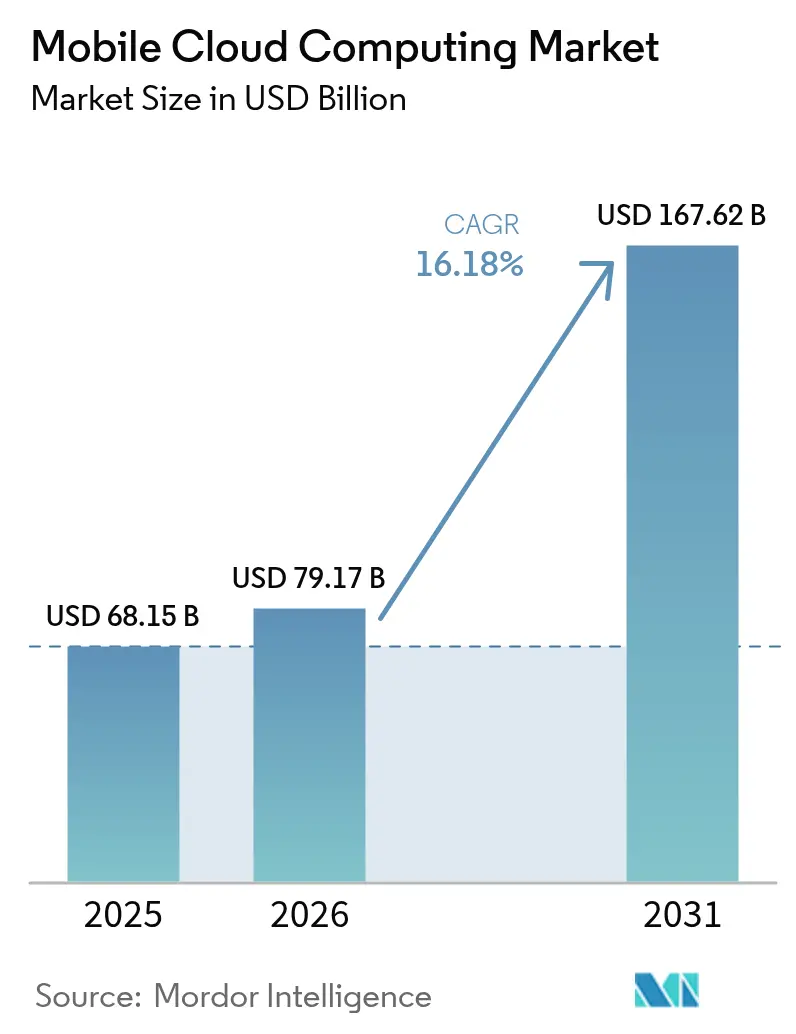
| Market Size (2026) | USD 79.17 Billion |
| Market Size (2031) | USD 167.62 Billion |
| Growth Rate (2026 - 2031) | 16.18 % |
| Fastest Growing Market | Asia Pacific |
| Largest Market | North America |
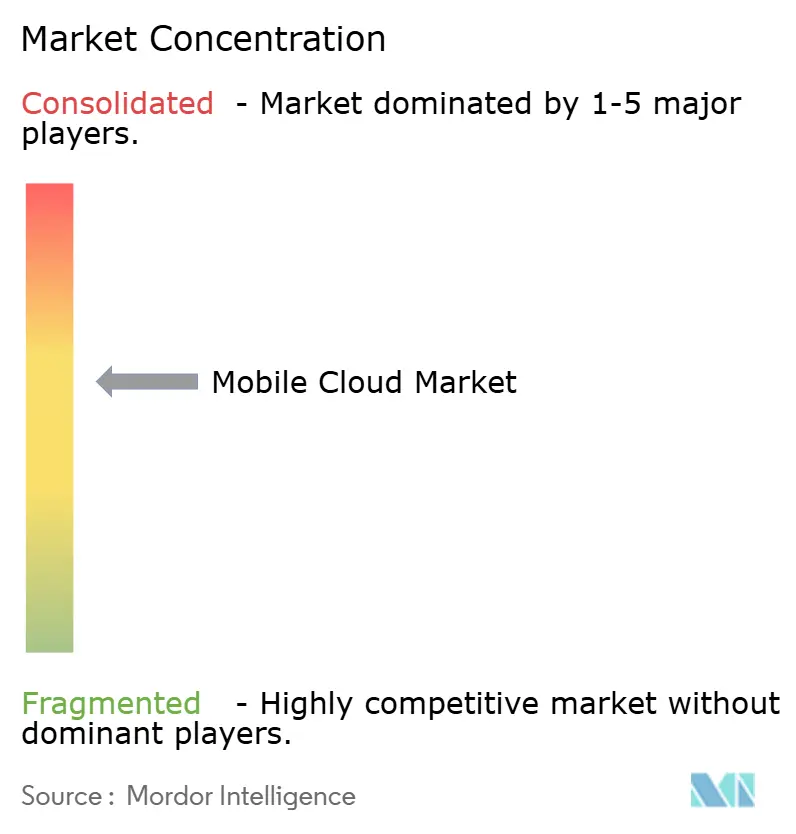
| Market Concentration | Medium |
Major Players *Disclaimer: Major Players sorted in no particular order Image © Mordor Intelligence. Reuse requires attribution under CC BY 4.0. | |
Mobile Cloud Computing Market Analysis by Mordor Intelligence
The mobile cloud computing market size was valued at USD 68.15 billion in 2025 and estimated to grow from USD 79.17 billion in 2026 to reach USD 167.62 billion by 2031, at a CAGR of 16.18% during the forecast period (2026-2031). Falling 5G latency, ubiquitous low-code platforms, and developer demand for scalable back-ends pull new workloads into the cloud, while edge AI orchestration sends only heavy inference and model-training tasks to hyperscale clusters, keeping response time near on-device speeds. Public cloud still dominates volumes, yet regulated industries are pivoting toward hybrid topologies that pair sovereign data centers with elastic hyperscaler zones, preserving compliance without sacrificing agility. Competitive intensity remains elevated as providers differentiate on gaming-grade latency, egress-fee transparency, and vertical bundles for healthcare, banking, and industrial IoT. Near-term demand spikes center on multiplayer cloud gaming, tele-diagnostic imaging, and real-time language translation, each signaling how user experience becomes hardware-agnostic once compute lifts into the cloud continuum.
Key Report Takeaways
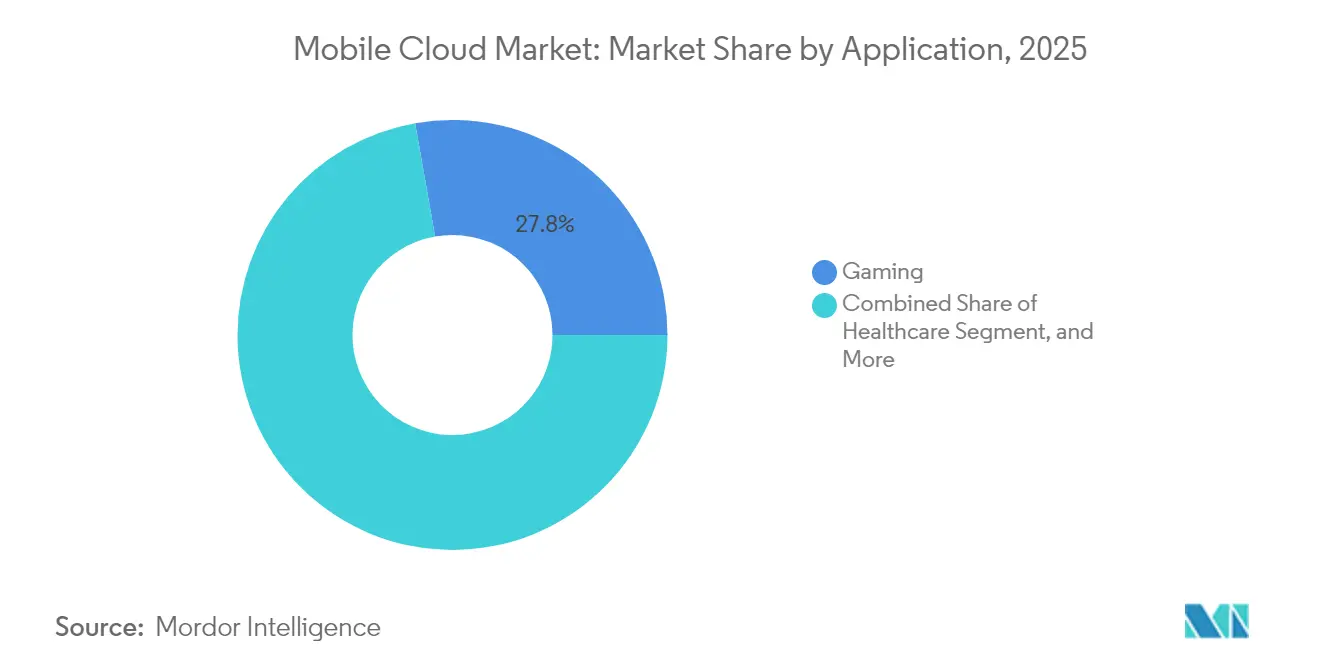
- By application, gaming led with 27.78% revenue share in 2025, while healthcare is projected to grow at a 17.12% CAGR through 2031.
- By user, the enterprise segment held 70.55% of the mobile cloud computing market share in 2025, and the consumer segment is expanding at an 17.95% CAGR to 2031.
- By service model, Software-as-a-Service accounted for 63.60% share of the mobile cloud computing market size in 2025, whereas Platform-as-a-Service is rising at a 16.44% CAGR between 2026 and 2031.
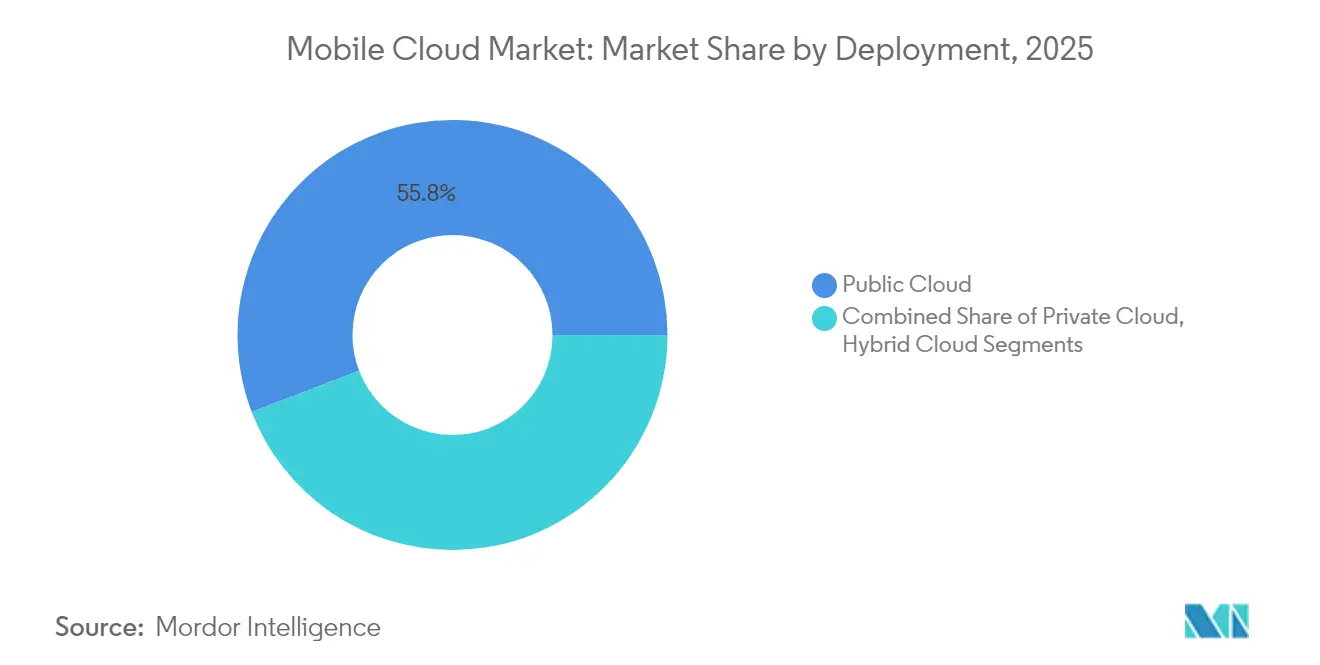
- By deployment, public cloud remained dominant with 55.82% share in 2025, yet hybrid cloud is advancing at a 17.38% CAGR to 2031.
- By mobile operating system, Android devices captured 71.10% revenue share in 2025, and iOS users generated higher average spend per subscriber.
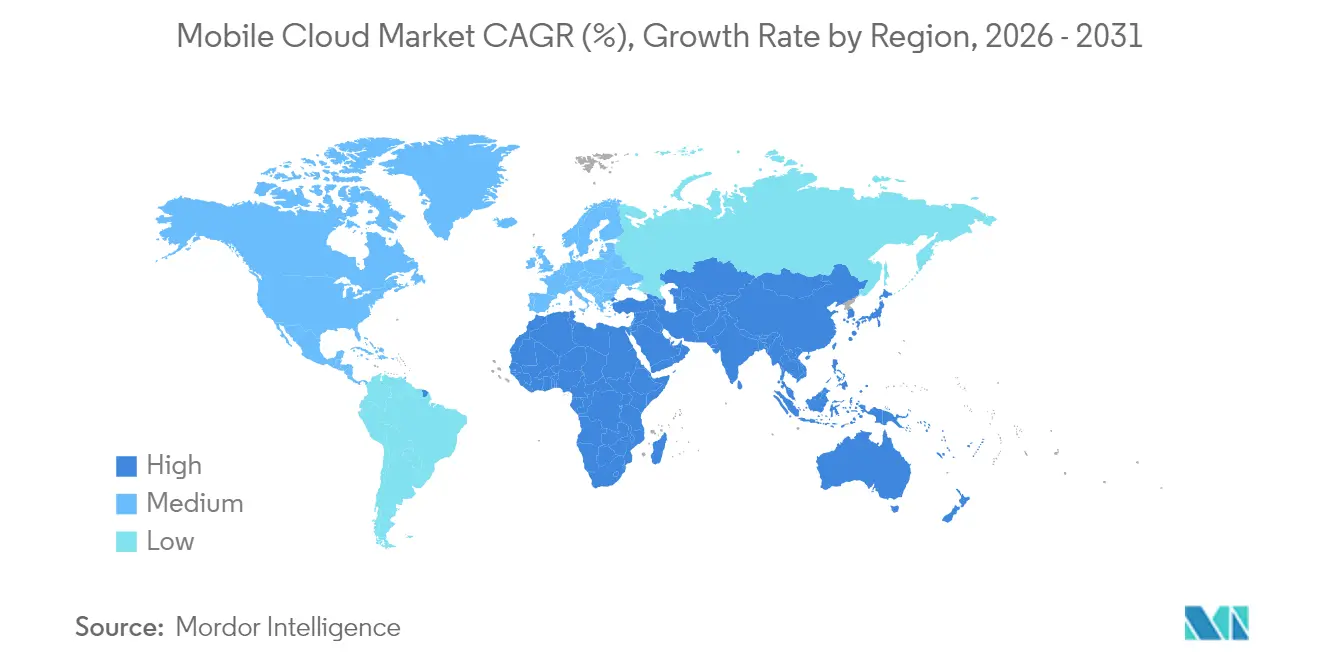
- By geography, North America generated 36.25%% of 2025 revenue, yet Asia-Pacific is poised to grow at a 16.65%% CAGR over the forecast window.
Note: Market size and forecast figures in this report are generated using Mordor Intelligence’s proprietary estimation framework, updated with the latest available data and insights as of 2026.
Market Trends and Insights
Drivers Impact Analysis of Mobile Cloud Computing Market*
| Driver | (~) % Impact on CAGR Forecast | Geographic Relevance | Impact Timeline |
|---|---|---|---|
| Development in IT Infrastructure in Emerging Countries | +2.8% | Asia Pacific, Middle East, Africa, South America | Medium term (2-4 years) |
| Advancing Internet Connectivity | +3.1% | Global, stronger in Asia Pacific and Africa | Short term (≤ 2 years) |
| Growing Adoption of Edge AI for Mobile Applications | +2.5% | North America, Europe, Asia Pacific core markets | Medium term (2-4 years) |
| Rising Usage of Cloud Gaming Platforms | +1.9% | North America, Europe, Asia Pacific urban centers | Short term (≤ 2 years) |
| Expansion of 5G Stand-Alone Networks | +3.4% | Global, led by North America, Europe, China, South Korea | Medium term (2-4 years) |
| Proliferation of Low-Code Mobile Backend Services | +1.7% | Global, early traction in North America and Europe | Long term (≥ 4 years) |
| Source: Mordor Intelligence | |||
Development in IT Infrastructure in Emerging Countries
Massive fiber backbones and sovereign data-center mandates in India, Indonesia, Brazil, and Nigeria are shrinking latency and widening coverage, making cloud-backed apps viable in tier-2 and tier-3 cities. India’s Digital India program allocated USD 1.2 billion in 2024 to build state-owned cloud zones that local start-ups can tap without foreign dependency.[1]Government of India, “Digital India Initiative,” digitalindia.gov.in Indonesia’s requirement that public mobile apps reside in domestic zones has already triggered new hyperscale facilities in Jakarta and Surabaya. Similar upgrades in Brazil lifted 4G availability to 94% of municipalities in 2024, catalyzing rural agribusiness adoption. As edge nodes propagate, application publishers migrate functions closer to users, sustaining double-digit expansion in the mobile cloud computing market.
Advancing Internet Connectivity
Global mobile data traffic reached 131 exabytes per month in 2024, a 25% jump year-on-year, underpinned by high-definition video streaming and always-synced productivity apps.[2]Ericsson, “Ericsson Mobility Report,” ericsson.com Submarine systems such as 2Africa lowered wholesale bandwidth prices 30%, letting carriers in Senegal, Kenya, and Tanzania bundle unlimited data with cloud storage, flipping intermittent users into daily uploaders. LEO satellite constellations from Starlink and OneWeb filled connectivity gaps in Alaska and the Amazon basin, widening the accessible base for cloud-powered mobile services. The reinforcing cycle of cheaper gigabytes and higher usage accelerates service uptake, boosting the mobile cloud computing market.
Growing Adoption of Edge AI for Mobile Applications
Frameworks like TensorFlow Lite allow phones to run light inference while pushing heavier model-training tasks to the cloud, balancing latency and battery life. A 2024 developer survey showed 41% of respondents shipping edge AI features, up from 28% in 2023. Qualcomm’s Snapdragon 8 Gen 3 delivers 45 TOPS on-device, trimming cloud API calls for virtual assistants by 60%. Apple’s privacy-first design processes health metrics locally and syncs anonymized results, overcoming compliance hurdles. This hybrid model cements cloud platforms as the training hub while positioning handsets for instant inference, a dynamic lifting long-run demand in the mobile cloud computing market.
Rising Usage of Cloud Gaming Platforms
Subscriber counts hit 75 million in 2024 as services such as Xbox Cloud Gaming, GeForce Now, and PlayStation Plus streamed AAA titles to handsets without console hardware.[3]Microsoft, “Xbox Cloud Gaming,” microsoft.comMobile now accounts for 40% of Xbox Cloud Gaming sessions, proof that portability expands engagement. Telecoms in South Korea placed edge nodes within 50 kilometers of gamers, slicing latency to 15 milliseconds and monetizing premium routing plans. Such performance hinges on hyperscaler footprints, reinforcing scale advantages and steering more traffic and revenue into the mobile cloud computing market.
Restraints Impact Analysis of Mobile Cloud Computing Market*
| Restraint | (~) % Impact on CAGR Forecast | Geographic Relevance | Impact Timeline |
|---|---|---|---|
| Concerns Associated with Data Security | -1.8% | Global, heightened in Europe and North America | Short term (≤ 2 years) |
| Limited Battery Life of Mobile Devices | -1.3% | Global, higher friction for power users | Medium term (2-4 years) |
| Escalating Cloud-Service Egress Fees | -1.1% | Global, multi-cloud setups | Short term (≤ 2 years) |
| Data-Residency and Digital-Sovereignty Regulations | -1.5% | Europe, China, India, Middle East | Long term (≥ 4 years) |
| Source: Mordor Intelligence | |||
Concerns Associated with Data Security
Multi-tenant architectures elevate exposure to interception during transit and unauthorized access at rest. A 2024 study of 1,200 enterprises found 62% delayed migrations over key-management uncertainty and audit gaps, notably in healthcare and banking sectors. European regulators tightened scrutiny around mobile banking apps caching transaction data in foreign clouds, pushing several banks back to private zones. End-to-end encryption layers add 10-15 milliseconds of latency, impairing real-time experience and tempering uptake.
Limited Battery Life of Mobile Devices
Always-on sync drains smartphone batteries 30% faster than periodic uploads, according to an IEEE power study. Augmented-reality streams consume 2.5 watts, emptying a 4,000 mAh cell in under 3 hours. Although new 5G modems reduce idle draw by 40%, active data transfer remains energy-heavy, forcing users in price-sensitive markets to carry backup packs and blunting enthusiasm for high-frequency cloud interactions.
*Our forecasts treat driver/restraint impacts as directional, not additive. The impact forecasts reflect baseline growth, mix effects, and variable interactions.
Mobile Cloud Computing Market Segment Analysis
By Application:
Healthcare Mobilizes Cloud DiagnosticsThe healthcare slice of the mobile cloud computing market size is on track to expand at a 17.12% CAGR through 2031 as telemedicine, remote patient monitoring, and cloud-sourced diagnostics scale. The U.S. FDA cleared 87 mobile medical apps for cloud data processing in 2024, up from 52 in 2023. Philips rolled out a mobile ultrasound that streams images to radiologists, shortening rural diagnostic cycles from 48 hours to 4 hours. Gaming still holds 27.78% revenue share, but growth is maturing in saturated markets. Finance, entertainment, and education apps ride steady demand, yet healthcare’s regulatory green lights and reimbursement models position it as the catalytic vertical shaping the next wave of the mobile cloud computing market.
Cloud gaming’s share leadership signals entrenched demand for low-latency rendering, micro-transactions, and social play features. Yet first-person shooters require sub-30 millisecond round-trip time, compelling providers to deploy edge compute within 50 kilometers of users, capital-intensive for all but the largest hyperscalers. In contrast, healthcare gains from longer tolerance for latency seconds rather than milliseconds allowing workloads to reside deeper in the cloud and easing rollout across emerging markets with limited edge presence. By 2031, the healthcare segment’s expanding user base and regulatory clarity will narrow the share gap with gaming and solidify multi-vertical resilience in the mobile cloud computing market.



By User:
Enterprises Dominate Volume While Consumers AccelerateEnterprises contributed 70.55% of 2025 revenue as mobile workforces demanded continuous access to customer records, collaboration suites, and field service apps. Salesforce, Microsoft 365, and SAP mobile clients anchor this spend. A survey of 800 IT leaders in 2024 showed 73% view mobile-cloud integration as top-three purchase criteria for new software deployments JMIR.ORG. Meanwhile, consumers are expanding at an 17.95% CAGR as subscription cloud storage, streaming, and gaming services gain traction. Dropbox reported 35% year-on-year growth in mobile uploads in 2024, and Apple recorded more than 1 billion paid iCloud accounts the same year.
The consumer trajectory forces providers to optimize for intermittent connectivity, lighter UI flows, and lower entry-level price points, shifting design priorities previously centered on enterprise compliance and service-level agreements. Enterprises will continue to wield budget influence, but the swelling consumer base adds volume scale and brand visibility, widening the funnel for the mobile cloud computing market.
By Service Model:
PaaS Narrows the GapSoftware-as-a-Service retained 63.60% share of the mobile cloud computing market size in 2025 because turnkey apps deliver instant productivity without customization. However, Platform-as-a-Service is projected to climb at a 16.44% CAGR as low-code tools lower technical barriers. Google’s Firebase logged 5 million active projects in 2024, with 60% originating from small businesses lacking formal development teams. AWS Amplify’s generative AI assistant automatically builds authentication flows and APIs from natural-language prompts, cutting development cycles by 70% . Infrastructure-as-a-Service remains for specialists needing granular resource control, yet abstractions are winning mindshare, closing the gap and intensifying competition within the mobile cloud computing market.
PaaS growth reflects a shift from hardware-oriented differentiation to developer experience. Hyperscalers package analytics, messaging, and AI inference as drag-and-drop services, letting startups focus on front-end differentiation while the provider captures recurring margins. As PaaS convenience pushes deeper into corporate IT backlogs, the mobile cloud computing industry will normalize on these higher-level constructs, relegating raw compute to niche needs.
By Deployment:
Hybrid Cloud Finds Its MomentHybrid implementations are expanding at 17.38% CAGR to 2031 as financial services, healthcare, and government workloads straddle sovereign on-premises zones and elastic public regions. Public deployments still hold 55.82% revenue share because startups and digital natives value global scale. JPMorgan Chase’s 2024 mobile banking architecture processes transactions on-premises for compliance then exports fraud analytics to AWS, trimming infrastructure spend 22%. Europe’s Digital Operational Resilience Act effective 2025 compels institutions to validate that critical mobile services function under multi-cloud scenario, accelerating hybrid adoption.
Hybrid demands mature IT operations identity federation, network peering, data-synchronization orchestration creating services revenue for integrators such as IBM and Accenture. Over the forecast window, regulated entities seeking agility without regulatory exposure will keep hybrid the fastest-growing slice of the mobile cloud computing market.
By Mobile Operating System:
Android Scales, iOS MonetizesAndroid owned 71.10% share in 2025, supported by availability across all price tiers and Google’s cloud API integration, logging 2.1 billion daily calls to Drive, Photos, and Firebase. Yet iOS monetizes more aggressively Apple users buy iCloud storage at 2.3× the rate of Android users. Developers prioritize iOS for premium subscriptions because unified hardware and payment rails shorten time-to-market by 30%.
HarmonyOS, at 700 million units shipped, builds its own mobile cloud ecosystem inside China, anchored by Huawei Cloud. Providers must therefore sustain parity across Android’s scale engine and iOS’s spend engine, threading offerings to each platform’s economics to capture full value from the mobile cloud computing market.
Geography Analysis
North America Mobile Cloud Computing Market
North America generated 36.25% of 2025 revenue, benefiting from dense availability zones and 280 million 5G standalone subscribers, which deliver sub-20 millisecond latency for mobile workloads. Amazon Web Services, Microsoft Azure, and Google Cloud operate more than 40 zones in the region, powering autonomous vehicle telemetry, industrial IoT, and high-frequency finance apps. Canada mandated sovereign cloud for public mobile services in 2024, prompting Telus and Bell investments but leaving most commercial traffic on U.S. hyperscalers.
APAC Mobile Cloud Computing Market
Asia Pacific is projected to lead growth at a 16.65% CAGR to 2031. China surpassed 3.5 million 5G base stations in 2024, covering 95% of urban zones, allowing Alibaba Cloud and Tencent Cloud to place edge nodes within 10 milliseconds of 800 million mobile users. India’s Unified Payments Interface processed 12 billion mobile transactions monthly in 2024 over cloud payment gateways, illustrating mobile-first scale. Japan’s carrier network slicing guarantees enterprise latency, while South Korea doubled hyperscale capacity to feed live streaming and gaming hunger.
EMEA and South America Mobile Cloud Computing Market
Europe, the Middle East and Africa, and South America present mixed scenarios. Europe’s Gaia-X hardens data sovereignty, requiring local cloud processing for public mobile apps. Dubai’s Smart City uses mobile cloud for civic services, inspiring neighboring Gulf states. Africa benefits from new subsea capacity and bundled data-plus-cloud offerings, yet power instability compels on-premises backups. South America contends with macro volatility, though new Tencent Cloud regions in São Paulo and Lagos cut latency for fintech and gaming. The imbalance of regulatory stringency, infrastructure maturity, and consumer purchasing power sets a mosaic growth profile for the mobile cloud computing market.

Regulatory Landscape
Mobile cloud computing deployments are increasingly shaped by data sovereignty, security assurance, and edge interoperability standards across major regions. In Europe, the EU has advanced cloud policy work around trusted and sovereign cloud services, and in 2026 the European Commission proposed a Union-level cloud sovereignty framework with multiple assurance levels for trusted cloud services, reinforcing procurement and compliance expectations for public-sector and regulated mobile workloads.
Outside Europe, national cloud policies are codifying cloud-first approaches and residency requirements that directly affect where mobile back ends, analytics, and identity services can run. Nigeria launched its National Cloud Policy 2025 in October 2025, which formalizes cloud-first for public institutions and clarifies shared responsibility expectations, while South Africa released a National Data and Cloud Policy in 2024 to support public-sector cloud adoption and local infrastructure rollout. On the technical side, ETSI MEC (including MEC federation specifications updated in 2024) and ITU-T recommendations such as Y.3223 (approved August 2025) and Y.3169 (released in 2026) add architecture guidance for multi-access edge computing and resource-efficient, containerized edge environments, influencing how providers design hybrid and edge mobile-cloud topologies.
Competitive Landscape
The mobile cloud computing market is moderately concentrated. The top five Amazon Web Services, Microsoft Azure, Google Cloud, Alibaba Cloud, and Tencent Cloud command roughly 65% of infrastructure revenue in 2024, leaving 35% to regional providers and vertical specialists. AWS operates 450 edge locations, Microsoft 60 zones, and Google invests heavily in subsea cables to thin inter-regional latency, while Alibaba and Tencent scale Asia Pacific edge density. Oracle’s 2024 zero-egress policy attacked incumbents’ lock-in economics, winning mindshare among multi-cloud architects.
Emerging disruptors include Cloudflare, leveraging content delivery roots to offer serverless edge compute, and Fastly, targeting real-time mobile workloads with sub-10-millisecond guarantees. DigitalOcean courts independent developers via price simplicity, while IBM’s 2024 patent filing on federated workload routing hints at an interoperability future. Telcos such as Verizon and Deutsche Telekom are bundling connectivity with edge compute to monetize latency advantages, adding competitive vectors.
Strategic motions center on vertical integration. Hyperscalers buy mobile back-end platforms to lock developer pipelines, partner with carriers to plant micro-zones in metro areas, and roll out AI inference chips to lower in-cluster operating cost. With scale effects preserved, the market rewards depth edge nodes, sovereignty zones, AI services more than headline core compute. Providers that solve cross-border compliance and edge orchestration will capture outsized share as workloads proliferate across the mobile cloud computing market.
Mobile Cloud Computing Industry Leaders
IBM Corporation
Amazon Web Services Inc.
Google LLC
Oracle Corporation
Microsoft Corporation
- *Disclaimer: Major Players sorted in no particular order
Mobile Cloud Computing Market Companies Covered in this Report
- International Business Machines Corporation
- Amazon Web Services Inc.
- Google LLC
- Oracle Corporation
- Microsoft Corporation
- SAP SE
- Akamai Technologies, Inc.
- Salesforce, Inc.
- Cloudways Ltd.
- Kony, Inc.
- Alibaba Cloud (Alibaba Group Holding Limited)
- Tencent Cloud Computing Beijing Co., Ltd.
- Huawei Technologies Co., Ltd.
- VMware, Inc.
- Rackspace Technology, Inc.
- Fujitsu Limited
- Citrix Systems, Inc.
- Red Hat, Inc.
- Box, Inc.
- Dropbox, Inc.

Market Opportunities and Future Outlook
Opportunities concentrate around regulated hybrid mobile-cloud stacks, operator-led edge cloud, and developer platforms that reduce build time while meeting sovereignty controls. Hybrid remains a practical whitespace for mobile workloads that must keep sensitive records or payments on sovereign or on-premises zones while using hyperscalers for elastic analytics and AI, a pattern reinforced by compliance programs and oversight in banking and healthcare and by operational resilience requirements (for example, DORA effective in 2025). On the standards and architecture side, ongoing 3GPP Release 18 work items for edge computing and ETSI MEC federation specifications provide a clearer path for roaming edge access and multi-operator edge service continuity, opening room for platforms that can orchestrate policies, identity, and workload placement across carrier edge and public cloud.
Carrier and ecosystem investments in AI-ready infrastructure also widen the runway for mobile cloud use cases that depend on low latency and high-throughput inference at the edge or regional hubs. SK Telecoms July 2026 announcement outlining a multi-gigawatt AI data center buildout plan underscores how telecom groups are positioning themselves as AI infrastructure providers, creating supply-side capacity and commercial models for GPU-backed mobile services (such as cloud gaming, real-time translation, and video understanding). In parallel, developer adoption of low-code and mobile back-end platforms (for example, large-scale usage of Firebase projects and generative features in managed back-end tooling) supports an opportunity for PaaS and serverless offerings that package security controls, observability, and cost governance, including egress-aware architectures for multi-cloud mobile applications.
Recent Industry Developments in Mobile Cloud Computing Market
- June 2026: IBM and Google Cloud announced a strategic partnership to scale enterprise AI and modernize core systems, including the launch of a new Google Cloud Practice within IBM. The collaboration combines Google Cloud capabilities with IBM Consulting Advantage and targets faster delivery of AI-assisted modernization programs that depend on cloud and hybrid foundations. This increases competitive pressure on hyperscalers and integrators to package end-to-end mobile-cloud modernization, security, and AI enablement.
- March 2026: NTT DOCOMO launched commercial 5G Core network services on a hybrid environment using AWS alongside the operators on-premises NFV infrastructure. The deployment highlights how telecom operators are using public cloud and on-premises combinations to run carrier-grade functions while keeping control over sensitive network workloads. It also expands the addressable base for mobile cloud services that benefit from cloud-native network programmability and edge-adjacent compute.
- November 2024: Alibaba Cloud and China Mobile launched 5G standalone slices for cloud gaming across 50 cities, reporting 12-millisecond latency and rapid early user uptake. The rollout demonstrated how network slicing paired with distributed cloud can meet stringent latency requirements for interactive mobile applications at scale. It strengthened the role of carrier-hyperscaler collaboration as a go-to-market path for premium, performance-sensitive mobile cloud services.


Mobile Cloud Computing Market Report Scope and Research Methodology
Market Definition and Coverage
For this study, the mobile cloud market is defined as the revenue generated from cloud delivered services and platforms that enable mobile apps and mobile devices to store, process, sync, and deliver content through public, private, or hybrid cloud environments.
Scope exclusions: We exclude on-device only processing that does not use cloud resources, and we also exclude general telecom connectivity charges that are not billed as cloud services.
Segments Covered in This Report
- By Application
- Gaming
- Finance and Business
- Entertainment
- Education
- Healthcare
- Travel
- Other Applications
- By User
- Enterprise
- Consumer
- By Service Model
- Software-as-a-Service (SaaS)
- Platform-as-a-Service (PaaS)
- Infrastructure-as-a-Service (IaaS)
- By Deployment
- Public Cloud
- Private Cloud
- Hybrid Cloud
- By Mobile Operating System
- Android
- iOS
- Others
- Geography
- North America
- United States
- Canada
- Mexico
- Europe
- United Kingdom
- Germany
- France
- Italy
- Rest of Europe
- Asia-Pacific
- China
- Japan
- India
- South Korea
- Rest of Asia
- Middle East
- Israel
- Saudi Arabia
- United Arab Emirates
- Turkey
- Rest of Middle East
- Africa
- South Africa
- Egypt
- Rest of Africa
- South America
- Brazil
- Argentina
- Rest of South America
- North America
Data Sources, Market Sizing, and Validation
Desk Research
Desk research was used to set the outer boundaries of the market and to build the first set of assumptions for regional demand and service mix. We relied on non paywalled sources such as ITU connectivity indicators, OECD digital economy tables, World Bank macro series, and regulator releases like FCC and European Commission digital reports to understand data usage patterns, 4G and 5G rollout coverage, and cloud adoption direction. For technical context, we also reviewed peer reviewed papers and standards body publications (such as IEEE and IETF) that describe mobile edge computing constraints, latency considerations, and how workloads are typically placed between edge and cloud.
To convert these signals into a sizing model, public company filings, investor presentations, and credible press coverage were used to map product positioning and estimate revenue exposure to mobile cloud use cases, including mobile backend services and cloud gaming. Select paid subscriptions for company financials and intelligence, news and financials, and patent databases were used only to speed up cross checks and fill missing disclosure gaps. These desk sources are illustrative, and many other public materials were also referenced during data collection, validation, and clarification.
Primary Interviews and Surveys
Primary work was used to pressure test the desk assumptions and close gaps around pricing, workload migration pace, and the split between public and hybrid deployments. We spoke with a mix of cloud ecosystem participants, telecom and edge delivery stakeholders, and enterprise and consumer facing buyers across APAC, EMEA, and the Americas, so regional adoption differences were captured. After interviews, inputs were reconciled back into the model to adjust uncertain variables, including mobile cloud gaming traffic growth and mobile backend usage intensity, to ranges that better reflect what respondents described as real purchasing behavior.
Distribution of primary research fieldwork respondents
| Company type | Respondent position | Region |
|---|---|---|
| Top tier: 33% | CXOs: 15% | APAC: 47% |
| Mid tier: 49% | Functional/Unit leaders: 30% | EMEA: 29% |
| Smaller Players: 18% | Managers: 55% | Americas: 24% |
Market-Sizing & Forecasting
Sizing starts from a top-down demand pool build where smartphone and mobile broadband usage, 4G and 5G rollout, and cloud workload suitability are translated into expected cloud consumption tied to mobile apps. The model is then corroborated with selective bottom-up approximations, where sampled price points and volumes for mobile cloud use cases are rolled up and compared against the top line total, and gaps are adjusted using explicit rules.
Key inputs include mobile data traffic growth, edge and cloud region expansion signals, public versus hybrid adoption rates, app category mix (such as gaming, education, finance, and healthcare), and typical price progression for storage, compute, and mobile backend services. Because not every region discloses comparable detail, missing splits are handled through proxy variables like smartphone penetration and enterprise cloud maturity, followed by expert checks. For forecasting, we use scenario analysis based on 5G coverage expansion, latency sensitive workload adoption, and enterprise mobility budgets. We then smooth the trajectory using short ARIMA style checks so the curve does not shift unrealistically year to year.
Data Validation & Update Cycle
Outputs are validated through multiple checks so the final numbers remain consistent with real world signals. We compare the model results against independent indicators, including regional cloud adoption commentary, telecom edge investment direction, and the implied spend per active mobile user, and then review any outliers before sign off.
If variance is large or a key assumption looks unstable, experts are re contacted and the driver is rebuilt rather than patched. Reports are refreshed annually, and interim updates are made when there are material shifts, such as policy changes, major pricing moves, or step changes in 5G and edge deployment. Before delivery, a final analyst pass is completed so clients receive the latest updated view.
Mordor Intelligence's Global Mobile Cloud Market Market Size Compared With Other Published Estimates
Published market sizes for mobile cloud can differ quite a bit, even when the topic name looks the same. The main reasons are usually scope boundaries (what gets counted as mobile cloud versus general cloud), the year chosen as the starting point, and how pricing and adoption curves are treated.
Key gap drivers show up in practice when one estimate blends adjacent cloud categories, such as broad cloud storage or security tooling, without checking whether usage is driven by mobile workloads, or when aggressive growth assumptions are used for 5G and edge enablement without enough reality checks. By tracking demand signals in the model, including mobile workload intensity and public versus hybrid adoption splits, Mordor Intelligence keeps the 2026 total tied to a defined mobile cloud usage pool, and then refreshes pricing and exchange rate timing so cross region aggregation stays consistent.
Benchmark comparison
| Source | Market Size | Gaps in Research Methodology |
|---|---|---|
| Mordor Intelligence | USD 79.17 B (2026) | |
| Global Consultancy A | USD 84.99 B (2025) | Uses a different base year and a broader service basket that explicitly includes add-on categories like cloud storage, analytics, and security, which can pull in spend not uniquely linked to mobile cloud workloads. |
| Industry Research Group B | USD 58.59 B (2024) | Anchors sizing on an earlier base year and applies a lower growth profile, which can understate the step up expected from 5G coverage expansion and latency sensitive use cases such as cloud gaming and real time content delivery. |
The spread in the table mainly comes from base year choice and what gets included in the revenue pool. When scope stays specific to mobile driven cloud usage and the assumptions are checked against practical adoption signals, the market size is easier to replicate and explain on a client call.


Key Questions Answered in the Report
What is the current value of the mobile cloud computing market?
The mobile cloud computing market size is USD 79.17 billion in 2026.
How fast is the market expected to grow through 2031?
It is projected to advance at a 16.18% CAGR, reaching USD 167.62 billion by 2031.
Which application segment is growing the fastest?
Healthcare mobile cloud applications are forecast to expand at a 17.12% CAGR due to telemedicine and remote diagnostics.
Why are enterprises adopting hybrid cloud for mobile workloads?
Hybrid topologies let regulated sectors keep sensitive data on-premises while scaling analytics and AI in public clouds, balancing compliance and agility.
Which region will post the highest growth?
Asia Pacific is expected to grow at a 16.65% CAGR on the back of dense 5G rollouts and government digital-first programs.
Who are the leading providers in this space?
Amazon Web Services, Microsoft Azure, Google Cloud, Alibaba Cloud, and Tencent Cloud collectively control around 65% of infrastructure revenue.
Page last updated on:


 Your data is secure and never sold or shared.


