
Lab Automation Software Market Size and Share
Market Overview
| Study Period | 2023 - 2031 |
|---|---|
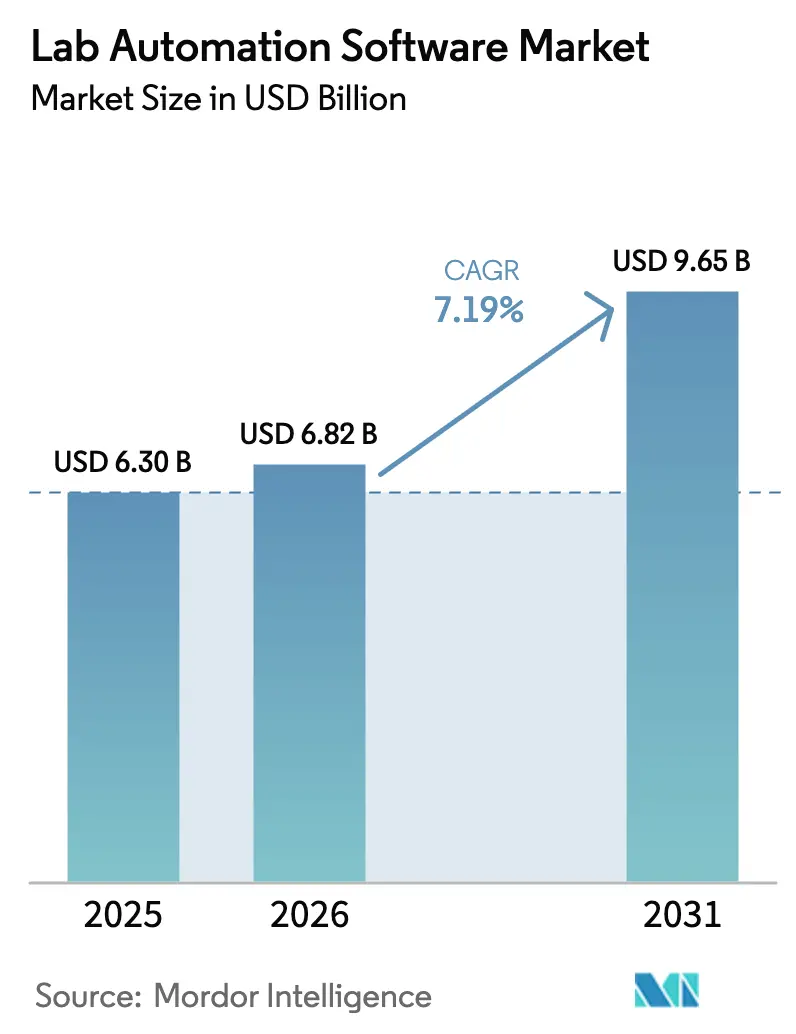
| Market Size (2026) | USD 6.82 Billion |
| Market Size (2031) | USD 9.65 Billion |
| Growth Rate (2026 - 2031) | 7.19 % |
| Fastest Growing Market | Asia Pacific |
| Largest Market | North America |
| Market Concentration | Medium |
Major Players *Disclaimer: Major Players sorted in no particular order Image © Mordor Intelligence. Reuse requires attribution under CC BY 4.0. | |
Lab Automation Software Market Analysis by Mordor Intelligence
The Lab Automation Software Market size is projected to be USD 6.30 billion in 2025, USD 6.82 billion in 2026, and reach USD 9.65 billion by 2031, growing at a CAGR of 7.19% from 2026 to 2031. Advancing artificial-intelligence scheduling, cloud-native Laboratory Information Management Systems (LIMS), and stricter electronic-record mandates are shortening research timelines and lowering compliance risk across pharmaceutical, biotechnology, and diagnostic laboratories. Incumbents are embedding generative AI into execution systems to automate sample routing and calibration, while 21 CFR Part 11 rules continue to accelerate the phase-out of paper documentation.[1]U.S. Food and Drug Administration, “21 CFR Part 11 Draft Guidance,” fda.gov Cloud deployments already exceed half of installed LIMS instances, and subscription pricing is convincing contract research organizations (CROs) to modernize multi-site data workflows. Market opportunity also widens as Asia-Pacific CROs attract Western sponsors seeking lower trial costs, and multi-omics integrations demand software capable of orchestrating petabyte-scale datasets.
Key Report Takeaways
- By software, Laboratory Information Management Systems held 43.00% revenue in 2025 and are forecast to grow at a 13.40% CAGR through 2031.
- By deployment, cloud-based models represented 51.20% of revenue in 2025 and are projected to expand at a 15.20% CAGR through 2031.
- By end user, CROs are expected to record the fastest 11.80% CAGR to 2031, whereas pharmaceutical and biotechnology companies retained 37.50% share in 2025.
- By application, drug discovery led with 41.80% revenue in 2025, while genomics is poised for the highest 14.90% CAGR through 2031.
- By region, North America commanded 34.00% of 2025 revenue, and Asia-Pacific is anticipated to post a 12.60% CAGR over the forecast period.
Note: Market size and forecast figures in this report are generated using Mordor Intelligence’s proprietary estimation framework, updated with the latest available data and insights as of January 2026.
Global Lab Automation Software Market Trends and Insights
Drivers Impact Analysis*
| Driver | (~) % Impact on CAGR Forecast | Geographic Relevance | Impact Timeline |
|---|---|---|---|
| Accelerated AI-Driven Workflow Optimization | +2.1% | Global, early adoption in North America and Europe | Medium term (2-4 years) |
| Rising Adoption of Cloud-Native LIMS Platforms | +1.8% | Global, led by North America and the Asia-Pacific | Short term (≤ 2 years) |
| Pharma Outsourcing Surge in Emerging Markets | +1.3% | Asia-Pacific core, spillover to the Middle East and Africa | Long term (≥ 4 years) |
| Convergence of Multi-omics and Automation | +1.0% | North America and Europe, expanding to the Asia-Pacific | Medium term (2-4 years) |
| Regulatory Push for Data Integrity (21 CFR Part 11) | +0.6% | North America and Europe | Short term (≤ 2 years) |
| ESG-Linked Funding for Green Laboratories | +0.3% | Europe and North America | Long term (≥ 4 years) |
| Source: Mordor Intelligence | |||
Accelerated AI-Driven Workflow Optimization
Generative AI now schedules instrument runs, predicts reagent depletion, and flags anomalous peaks before human review, cutting repetitive tasks and improving first-pass yield. Thermo Fisher Scientific integrated large language models across its Unity Lab Services platform in January 2026, allowing researchers to issue natural-language queries and receive protocol recommendations in seconds. Early adopters report protocol-development cycles shrinking by 60% during 2025 beta programs. Ginkgo Bioworks scaled autonomous foundries that iterate strain designs without manual intervention, showing the model’s viability beyond pharmaceuticals. Mid-term benefit peaks once labs validate AI-generated methods under ISO 17025 and CLIA, though definitive regulatory guidance remains forthcoming.
Rising Adoption of Cloud-Native LIMS Platforms
Separating compute from storage lets labs scale resources during heavy sequencing runs and idle them during lulls. A December 2025 TetraScience survey found 68% of biopharma quality-control labs planning at least one cloud migration by end-2026, citing disaster recovery and remote access as top drivers. Kubernetes-orchestrated microservices, introduced in LabVantage LIMS v8.7, enable automated failovers with sub-second queries across multi-terabyte datasets. CROs with global footprints see immediate ROI, as ICON plc reduced cross-site data reconciliation by 40% after deploying cloud-based sample tracking. Sovereign data laws in China and Russia still compel hybrid topologies, creating nuanced architecture decisions.
Pharma Outsourcing Surge in Emerging Markets
Multinational sponsors are shifting preclinical toxicology and early-phase trials to Asia-Pacific to gain budget flexibility and accelerate patient recruitment. WuXi AppTec’s laboratory-services revenue grew 22% year-over-year in 2025 on this trend. India attracted USD 1.8 billion in foreign direct investment during 2025 for GMP-compliant automation laboratories, catalyzed by tax incentives for pharma infrastructure. Charles River Laboratories opened an additional 15,000 square-foot automated facility in Shanghai in August 2025, integrating real-time sponsor portals to shorten decision cycles. Long-term growth stems from large graduate-scientist pools and expanding ICH alignment, lowering validation friction for Western sponsors.
Convergence of Multi-omics and Automation
Genome, proteome, metabolome, and transcriptome data volumes have outgrown manual data-management approaches. Illumina’s NovaSeq X Plus, upgraded in January 2026, outputs up to 16 terabases per run, necessitating automated compression and annotation pipelines. Element Biosciences’ AVITI sequencer links directly to Benchling’s R&D cloud, delivering real-time variant calls and trimming bioinformatics backlog. Oxford Nanopore’s PromethION 2 Solo adds edge base-calling modules, trimming cloud-egress fees, and accelerating infectious-disease surveillance. Labs that automate multi-omics data flows can cut turnaround from weeks to days, a decisive gain for precision-oncology programs.
Restraints Impact Analysis*
| Restraint | (~) % Impact on CAGR Forecast | Geographic Relevance | Impact Timeline |
|---|---|---|---|
| Shortage of Domain-Savvy Automation Engineers | -0.8% | Global, acute in North America and Europe | Short term (≤ 2 years) |
| Data-Security Concerns in Public Cloud Deployments | -0.6% | Global, heightened in Europe and North America | Medium term (2-4 years) |
| High Validation Costs for Regulated Labs | -0.4% | North America and Europe | Medium term (2-4 years) |
| Legacy System Incompatibility with Modern APIs | -0.3% | Global, concentrated in established markets | Long term (≥ 4 years) |
| Source: Mordor Intelligence | |||
Shortage of Domain-Savvy Automation Engineers
BioSpace reported 73% of U.S. biopharma firms unable to fill automation-engineer roles within 120 days during 2025, extending project timelines.[2]BioSpace, “Automation Engineer Talent Report 2025,” biospace.com Skills must span assay protocols, API design, and regulatory statutes such as GAMP 5, creating rare hybrid profiles. Tecan Group launched an internal academy to cross-train technicians in Python scripting and robotic-arm programming. Universities offer limited laboratory-informatics coursework, forcing companies to fund six-to-twelve-month upskilling, slowing near-term software rollouts.
Data-Security Concerns in Public Cloud Deployments
A February 2025 ransomware attack encrypted a European diagnostics network’s patient results and demanded USD 2 million, spotlighting public-cloud vulnerabilities. The HHS updated HIPAA guidance in August 2025, classifying cloud providers as business associates that must sign audit agreements.[3]U.S. Department of Health and Human Services, “HIPAA Cloud Guidance 2025,” hhs.gov Export-control rules such as ITAR and Wassenaar further limit cross-border data storage. Labs increasingly request SOC 2 Type II attestations and penetration tests, extending procurement cycles by up to six months.
*Our forecasts treat driver/restraint impacts as directional, not additive. The impact forecasts reflect baseline growth, mix effects, and variable interactions.
Segment Analysis
By Software: Integrated Ecosystems Redefine Value
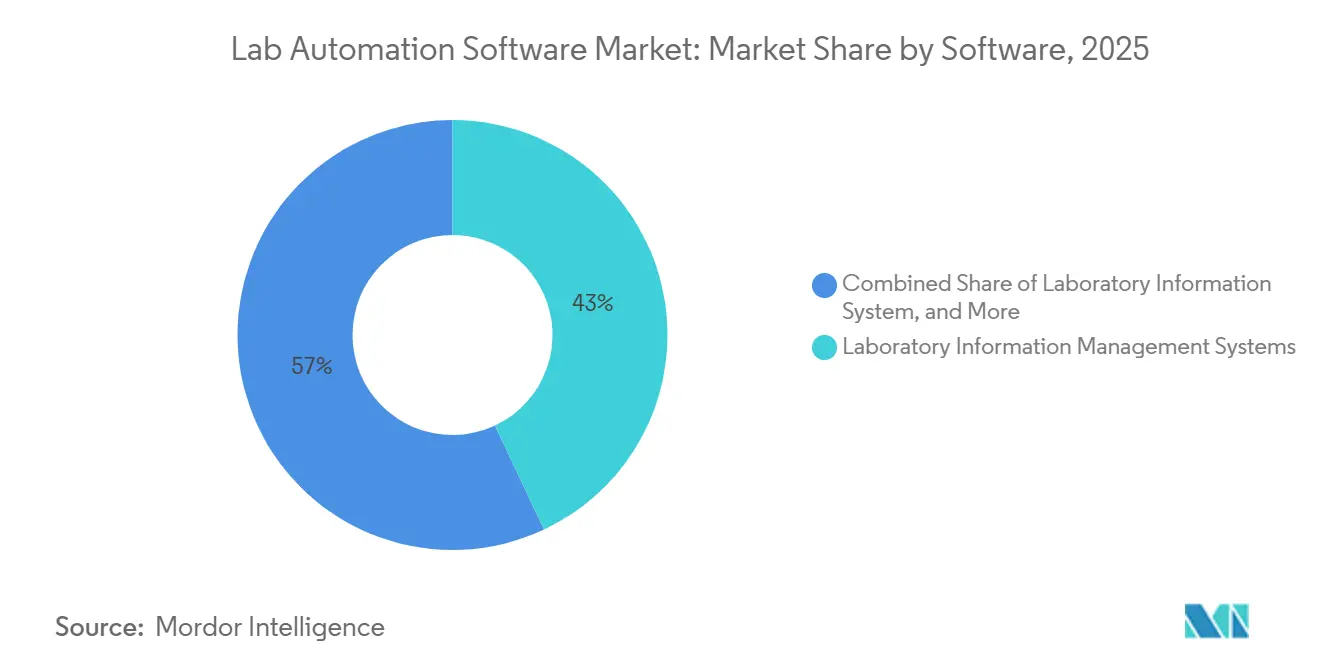
Laboratory Information Management Systems accounted for 43.00% of 2025 revenue, anchoring the lab automation software market with validated batch-release workflows in regulated pharma quality-control environments. Cloud-native variants are forecast to expand at a 13.40% CAGR, propelled by CRO demand for elastic capacity and pay-per-sample economics. Electronic lab notebooks and scientific data management systems are converging into unified subscription bundles, as Thermo Fisher’s AI-enriched Unity platform bundles LIMS, ELN, and middleware for one fee. Chromatography data systems remain entrenched, but Waters embedded core CDS functions directly into Arc HPLC firmware to lower standalone license costs. Integrated platforms from ABB and Mettler Toledo link benchtop robotics to enterprise analytics, signaling a shift toward holistic orchestration. These developments create a competitive gradient where established vendors rely on regulatory pedigrees while API-first entrants court cost-sensitive labs. The lab automation software market size for integrated platforms is expected to expand steadily, given their double-digit CAGR and growing preference among multi-omics programs.
Legacy LIS environments in diagnostics are gradually merging with LIMS as molecular pathology blurs research and clinical domains; Roche’s cobas pro automates sample flow from accessioning to report, exemplifying this overlap. Benchling’s ELN advanced version-control features attracted cross-functional discovery teams, especially where fine-grained audit trails are vital. Dotmatics’ machine-learning classifiers auto-tag unstructured datasets, improving knowledge capture in large pharmas. ISO 17025 and CLIA validation continues to favor incumbents with long audit histories, yet pre-validated connectors from startups are eroding traditional switching costs.



By Deployment Model: Cloud Adoption Reshapes Budgets
Cloud deployments held 51.20% revenue in 2025 and are projected to climb at a 15.20% CAGR, marking the fastest shift inside the lab automation software market. Subscription models convert hardware outlays to operational expense, and lab teams rely on built-in redundancy instead of on-premise server rooms. Kubernetes-ready releases such as LabVantage v8.7 illustrate container portability across AWS, Azure, or private data centers. Hybrid topologies, which replicate metadata to the cloud while retaining raw instrument files locally, appeal to jurisdictions enforcing strict data-residency rules. However, data-egress fees emerge as hidden costs; Oxford Nanopore mitigates these by performing edge base calling. The lab automation software market share for on-premise deployments remains sticky in defense and agrochemical labs bound by export-control mandates, yet overall momentum favors cloud incremental migrations.
Rapid cloud validation is another catalyst. Providers now supply pre-qualified instances with 21 CFR Part 11 controls, cutting validation from months to weeks. Nevertheless, the 2025 ransomware breach in Europe forced many labs to require SOC 2 Type II reports and third-party penetration audits before contract signature, elongating sales cycles. Over the forecast period, workload portability and unit-based pricing will tilt even cautious enterprises toward cloud-heavy hybrids.
By End User: CROs Accelerate Adoption Curve
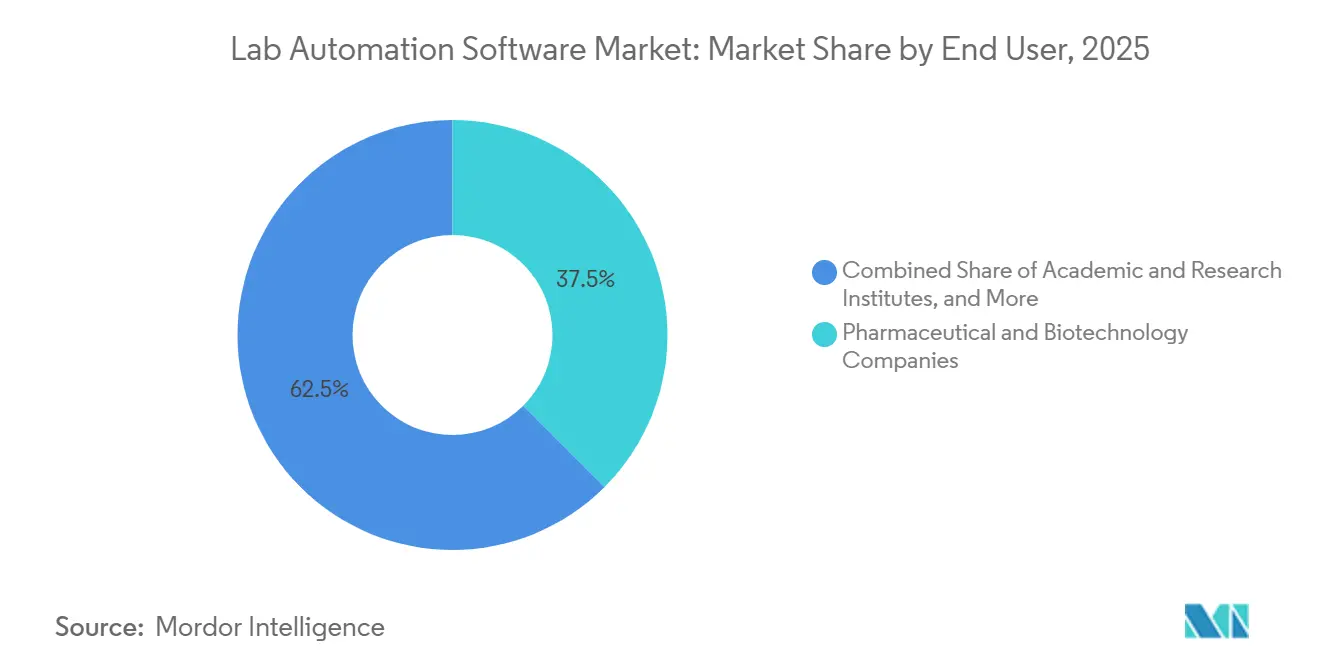
CROs represent the fastest-growing cohort, projected to grow at a 11.80% CAGR through 2031 as big pharma sponsors externalize more discovery and clinical tasks. ICON plc shaved 40% off cross-site reconciliation times with cloud sample tracking, securing more competitive bids. WuXi AppTec’s 22% revenue jump in 2025 underscores the pull of Asia-Pacific capacity. Pharmaceutical and biotechnology companies still account for 37.50% of revenue in 2025, leveraging enterprise LIMS to meet cGMP lot-release obligations. The lab automation software market size for academic institutes grows modestly, constrained by grant cycles, but open-source frameworks like LabKey help bridge budget gaps.
Clinical diagnostics labs automate high-throughput PCR and molecular assays, with BD’s Kiestra middleware linking microbiology data to hospital systems in real time. Smaller food-safety and environmental labs value localized support and ISO 17025 compliance, creating white space for regional vendors. Validation resource scarcity keeps many mid-tier CROs in mixed environments, creating integration consulting opportunities for system integrators.
By Field of Application: Genomics Leads Growth Curve
Drug discovery still dominates revenue at 41.80% in 2025, powered by ultra-high-throughput screens and machine-learning optimization of compound libraries. Yet genomics workflows are forecast to grow at a 14.90% CAGR, the fastest across use cases, as precision oncology and national population genetics initiatives scale. Illumina’s NovaSeq X Plus upgrade positions labs for large-cohort sequencing, while Element Biosciences and Oxford Nanopore address latency and cost barriers for real-time analysis. Proteomics gains momentum from Danaher’s USD 5.7 billion Abcam acquisition, pairing antibody discovery with liquid-handling robotics to deliver integrated protein analytics.
Clinical diagnostics emerges as the third-largest application, automating EGFR and KRAS mutation testing via Roche’s cobas pro system to hasten treatment decisions. Metabolomics and lipidomics remain niche but are increasingly embedded into multi-omics panels aimed at elucidating drug mechanisms. Bio-Rad’s QX ONE droplet digital PCR automates vector copy-number assays crucial for cell and gene therapy manufacturers. ISO 20387 biobank compliance and CLIA requirements continue to favor vendors offering validated instrument connectors.
Geography Analysis
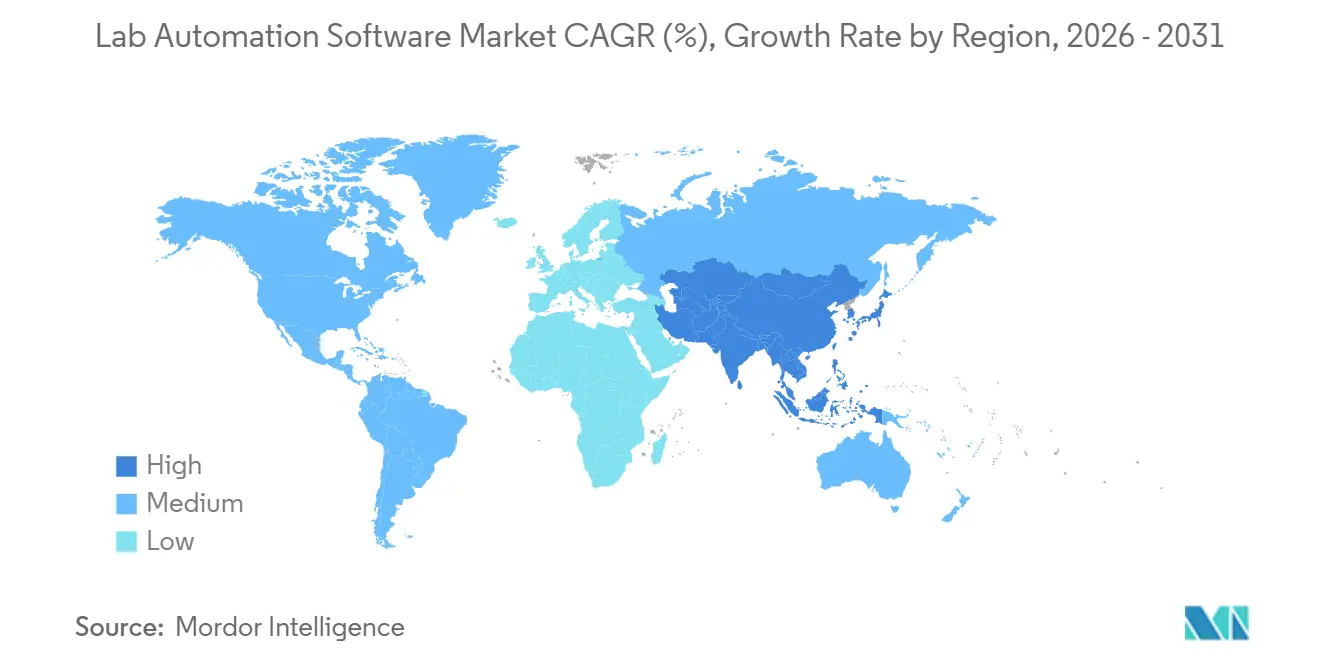
North America held 34.00% of market revenue in 2025, supported by dense biopharma clusters in Boston, San Francisco, and Raleigh. The FDA’s 2025 21 CFR Part 11 update clarified cloud-signature expectations, prompting many legacy LIMS migrations to AWS and Azure. Canada’s National Research Council awarded CAD 50 million (USD 37 million) in grants to help small laboratories automate cleantech and ag-genomics workflows, expanding addressable demand.[4]National Research Council Canada, “Laboratory Automation Grants 2025,” nrc.canada.ca Mexico’s contract-manufacturing hubs have adopted cloud-based LIMS to meet FDA export audit requirements, though rural connectivity gaps still necessitate hybrid installations.
Asia-Pacific is forecast to post a 12.60% CAGR during 2026-2031, the fastest worldwide. China’s National Medical Products Administration certified domestic LIMS vendors with Mandarin interfaces, easing validation for local labs. India’s USD 1.8 billion in FDI inflows into biopharma automation in 2025 reflects policy incentives and a large STEM talent pool. South Korea earmarked KRW 120 billion (USD 90 million) to digitize public health labs, while Japan is pushing clinical automation to manage an aging population. Australia’s draft software-as-medical-device guidance in 2025 opens regulatory pathways for cloud LIMS in diagnostics.
Europe’s outlook is tied to the EU Clinical Trials Regulation, which mandates electronic source-data capture; Germany’s Annex 11 update in 2024 further clarified cloud validation standards, unlocking migrations among Bavarian manufacturers. The United Kingdom now runs a divergent post-Brexit regime, forcing dual-compliant systems among pan-European labs. France allocated EUR 40 million (USD 45 million) to academic automation grants, and Spain’s Catalonia region issued tax credits for AI-enabled bioprocessing. In the Middle East, Saudi Vision 2030 earmarked SAR 2 billion (USD 533 million) for genomics labs that must support Arabic-language LIMS reporting. Africa remains early stage; South Africa’s National Health Laboratory Service piloted cloud chromatography data systems to centralize HIV testing across provinces.

Regulatory Landscape
Compliance requirements for lab automation software continue to be anchored by electronic records and signatures controls under 21 CFR Part 11 for regulated US workflows, alongside accreditation requirements that drive validation discipline in testing and calibration labs. ISO/IEC 17025 (Clause 6.4.7) specifically requires software used to collect, process, record, or store laboratory data to be validated for its intended use, reinforcing demand for auditable change control, versioning, and traceable data handling across LIMS, CDS, ELN, and integration middleware.
In February 2026, the US FDA issued final guidance on Computer Software Assurance (CSA) for Production and Quality Management System Software, aligning risk-based assurance expectations with the Quality Management System Regulation (QMSR) and ISO 13485:2016. The CSA shift places emphasis on intended use and patient or product risk, and it explicitly covers automation tooling such as cloud computing and AI/ML-based analytics when used within production or quality systems. That framing pushes vendors and regulated end users to update validation approaches, evidence artifacts, and monitoring controls for adaptive software functions.
Value Chain Analysis
The value chain runs from instrument and robotics OEMs and automation and orchestration software providers to lab informatics platforms (LIMS/ELN/SDMS/CDS), plus integration specialists that connect heterogeneous devices, data models, and enterprise quality systems. Upstream inputs include lab hardware platforms, such as modular robotics, and standardized assay or consumable workflows that must be compatible with automation. Midstream value is created through scheduling, workflow execution, instrument control and connectivity, and data integrity layers. Downstream delivery is typically supported by direct enterprise sales to pharma, diagnostics, and CRO networks, as well as partner channels that bundle software with instruments and validation services.
Interoperability and data movement remain the critical bottleneck, which keeps the focus on vendor-agnostic connectors and standards bodies such as the SiLA Consortium and ASTM (AnIML) to reduce integration friction. Partnerships also show how the chain is tightening between robotics and software: in February 2026, HighRes and Opentrons announced an AI agent-to-agent workflow partnership for orchestration on Opentrons platforms, and in April 2026, LabWare and Phizzle partnered to automate instrument data transfer in pharmaceutical cleanroom labs. Together, these moves point to edge-to-LIMS connectivity that preserves compliant audit trails while reducing manual transcription.
Competitive Landscape
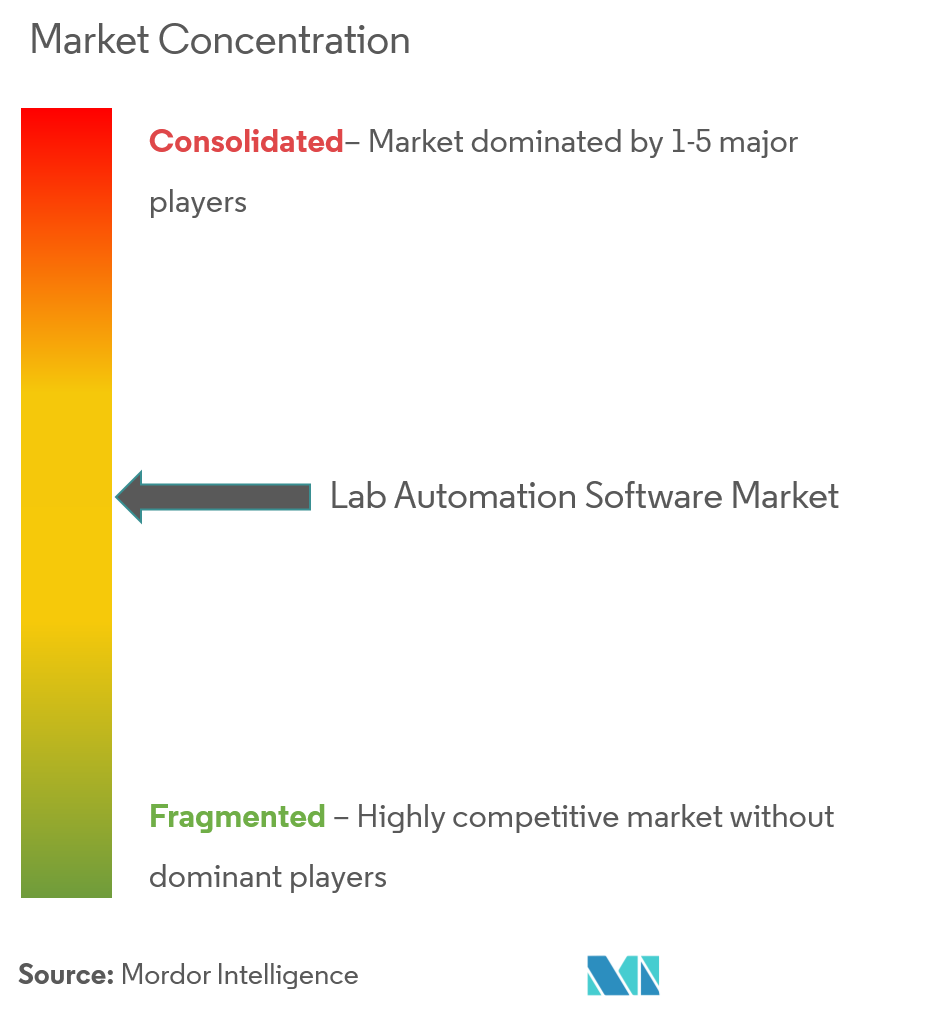
The lab automation software market exhibits moderate concentration: the top five vendors account for roughly 40-45% of global revenue, with no single firm exceeding a 15% share. Instrument makers are vertically integrating into software to capture recurring revenue, as seen in Danaher’s USD 5.7 billion Abcam buyout that merges proteomics data with automated liquid handlers. Thermo Fisher’s January 2026 NVIDIA partnership illustrates a pivot toward algorithmic differentiation over pure hardware. Vendors like Agilent, Siemens Healthineers, and Roche embed informatics in multi-modal instruments, locking customers into proprietary ecosystems.
API-first disruptors Benchling and Dotmatics gain traction in mid-tier CROs and academic labs that view enterprise suites as over-engineered. Open-source foundations such as OpenBIS underlie managed-service offerings that undercut incumbents on price but still monetize through premium support. Regulatory compliance remains a formidable moat; packages with documented change-control records and 21 CFR Part 11 validation scripts shorten audit prep. Yet cloud providers’ pre-qualified environments are diluting this advantage by trimming validation to six weeks.
Patent filings underscore AI’s strategic priority. Thermo Fisher secured 12 U.S. patents in 2024-2025 covering machine-learning models that predict maintenance schedules, improving uptime. Standards groups like the Allotrope Foundation promote vendor-neutral formats to facilitate data portability, potentially commoditizing instrument middleware. Competitive intensity is likely to rise as ESG-linked lab funding in Europe rewards vendors offering energy-efficient orchestration features.
Lab Automation Software Industry Leaders
Thermo Fisher Scientific
Danaher Corporation
Hudson Robotics
Becton Dickinson
Synchron Lab Automation
- *Disclaimer: Major Players sorted in no particular order

Market Opportunities and Future Outlook
A primary opportunity is the shift from systems-of-record into agentic orchestration layers that coordinate instruments, people, and data, while embedding compliance controls such as audit trails, e-signature readiness, and GxP evidence capture into automated workflows. Commercial product activity in 2026 supports this direction. LabVantage Solutions launched LabVantage CORTEX in March 2026 to integrate AI, analytics, and automation with LIMS-based orchestration, and Thermo Fisher Scientific integrated generative-AI capabilities into Unity Lab Services in January 2026, signaling buyer interest in natural-language interaction, automated routing, and exception management rather than manual queue building.
A second whitespace area is modular, vendor-neutral automation that decouples software from specific instruments to reduce lock-in and speed multi-site rollouts for CROs and hybrid global labs that face data residency and security constraints. Collaboration activity points to this direction, including ABB Robotics and Roche Diagnostics announcing a global collaboration in July 2026 to develop robotic solutions for clinical laboratory pathology slide handling and intralogistics, and Opentrons working with NVIDIA platforms in February 2026 to enable physical AI-driven lab robotics. These initiatives reinforce demand for standardized device connectivity, edge data capture, and cross-platform workflow engines that can operate across cloud and hybrid deployments while maintaining validation artifacts aligned to regulated quality environments.
Recent Industry Developments
- May 2026: Thermo Fisher Scientific introduced the Gibco CTS DynaXS Single Use Bioreactor to advance automated, scalable cell therapy manufacturing. The launch extends automation beyond informatics into tightly controlled upstream production workflows, increasing the importance of software that can orchestrate runs, capture batch records, and maintain traceable process data across equipment and quality systems.
- January 2026: Danaher-backed Molecular Devices partnered with Automata to integrate imaging and detection systems with Automata's LINQ platform for automated, AI-ready research workflows, alongside Danaher Ventures' participation in Automata's Series C round. The integration strengthens end-to-end workflow automation by linking instrument data generation with robotic execution and scheduling, tightening the ecosystem around interoperable automation layers.
- March 2025: Thermo Fisher Scientific launched the Vulcan Automated Lab system for semiconductor analysis, combining robotics and AI-enhanced instrumentation for higher-throughput metrology workflows. This expansion into specialized, high-precision automated labs widens demand for orchestration and data-management software that can manage complex instrument fleets and enforce repeatable protocols.


Research Methodology Framework and Report Scope
Market Definition and Coverage
This market covers software used to plan, run, record, and manage laboratory workflows, including sample tracking, instrument data capture, compliance documentation, and reporting, across research and testing labs worldwide.
Scope exclusions: This scope does not count lab automation hardware, standalone instruments, consumables, or installation-only revenue when no software license or subscription is sold.
Segmentation Overview
- By Software
- Laboratory Information Management System (LIMS)
- Laboratory Information System (LIS)
- Chromatography Data System (CDS)
- Electronic Lab Notebook (ELN)
- Scientific Data Management System (SDMS)
- Integrated Automation Platforms
- By Deployment Model
- On-Premise
- Cloud-Based
- Hybrid
- By End User
- Pharmaceutical and Biotechnology Companies
- Contract Research Organizations
- Clinical Diagnostics Laboratories
- Academic and Research Institutes
- Other End Users
- By Field of Application
- Drug Discovery
- Genomics
- Proteomics
- Clinical Diagnostics
- Other Field of Applications
- By Geography
- North America
- United States
- Canada
- Mexico
- South America
- Brazil
- Argentina
- Rest of South America
- Europe
- Germany
- United Kingdom
- France
- Italy
- Spain
- Rest of Europe
- Asia-Pacific
- China
- Japan
- India
- South Korea
- Rest of Asia-Pacific
- Middle East
- Saudi Arabia
- United Arab Emirates
- Rest of Middle East
- Africa
- South Africa
- Rest of Africa
- North America
Data Sources, Market Sizing, and Validation
Desk Research
Desk research was used to set the market boundaries, build the initial demand pool, and align consistent time series for the forecast. We referenced public sources such as the US FDA guidance library for regulated lab documentation cues, the US National Institutes of Health and other grant databases for research activity signals, OECD and World Bank indicators for R&D spend direction, and USITC trade statistics to sanity check instrumentation cycles that often pull software demand along with them.
To translate those signals into a software market view, we also reviewed company filings and investor presentations for recurring revenue mix, cloud transition commentary, and lab informatics product updates, then cross-checked adoption themes using association websites and reputable press in pharma, diagnostics, and academic labs. In some cases, paid subscriptions for company financials and patent databases were used to confirm product positioning and the pace of new workflows being digitized. These examples are not exhaustive, and we consulted many other public and paid sources to collect, validate, and clarify data points.
Primary Interviews and Surveys
Primary interviews and surveys were run with a mix of software providers, system integrators, lab operations leaders, and procurement and IT stakeholders who influence platform selection. Coverage was kept global, and the discussions were used to test adoption rates, typical contract structures (license vs subscription), upgrade cycles, and pricing direction. This then helped us tighten assumptions where public data was limited.
Distribution of primary research fieldwork respondents
| Company type | Respondent position | Region |
|---|---|---|
| Top tier: 34% | CXOs: 16% | APAC: 37% |
| Mid tier: 44% | Functional/Unit leaders: 39% | EMEA: 36% |
| Smaller Players: 22% | Managers: 45% | Americas: 27% |
Market-Sizing & Forecasting
The sizing starts with a top-down build where the global demand pool is reconstructed from lab activity and digitization signals, and then it is narrowed to software spend that directly supports automated workflows. We anchor this using indicators such as R&D spending trends, volume of regulated testing and documentation needs, the share of labs shifting to cloud deployment, instrument connectivity and data volume growth, and the rate of workflow standardization in pharma, CROs, and clinical diagnostics.
Once the total is formed, it is corroborated using selective bottom-up checks such as sampled average selling prices by software category and typical customer counts by lab type, along with channel checks on renewal behavior and multi-year contract terms. Where coverage gaps appear, for example smaller labs that buy through bundles or regional partners, assumptions are adjusted using interview feedback and then re-checked against public signals so the totals stay grounded.
For forecasting, we primarily use scenario analysis, since adoption and pricing can shift with cloud migration and regulatory emphasis. The scenarios are shaped around variables that respondents consistently track, including cloud conversion pace, compliance workload, funding levels for research programs, and the balance between new deployments and renewals.
Data Validation & Update Cycle
Validation is done through stepwise cross-checks, where model outputs are compared against independent demand signals and common sense ranges for software spend per lab type. If a region or end-user trend shows an unusual jump, it is flagged, reviewed by another analyst, and then traced back to the driver assumptions before sign-off.
Reports are refreshed annually, and interim updates are made when material events shift pricing, deployment patterns, or adoption speed. Before delivery, a final review pass is completed so clients receive the most current view reflected in the model inputs and checks.
Mordor Intelligence's Global Lab Automation Software Market Market Size Measured Against Other Published Estimates
Published market sizes for lab automation software often differ because the included revenue streams, time windows, and pricing logic are not the same from one study to another. Differences also show up when some sources blend adjacent lab informatics tools or attach services revenue without clearly separating what is software versus implementation.
The benchmark table shows a spread around 2025 values, and in Mordor Intelligence's model the count is limited to lab automation software revenue (including core informatics platforms and integrated suites) while excluding lab automation hardware and consumables, which can inflate totals when mixed into one number.
Benchmark comparison
| Source | Market Size | Gaps in Research Methodology |
|---|---|---|
| Mordor Intelligence | USD 6.30 B (2025) | |
| Industry Data Publisher A | USD 5.80 B (2025) | Uses a narrower software taxonomy that emphasizes only a few platform types, and it applies faster cloud share expansion with limited disclosure on how renewals and upgrades are treated. |
| Research Portal B | USD 5.80 B (2025) | Likely blends software with add-on services in parts of the estimate, and the forecast path relies on higher long-term growth assumptions without clear checks against lab activity and regulated testing demand. |
Taken together, the gap is mostly explained by what gets counted as software revenue, and by how pricing and renewal cycles are carried forward over time. Our approach stays traceable to practical inputs like lab activity, deployment shift, and contract behavior, which makes the total easier to reproduce and to update when conditions change.


Key Questions Answered in the Report
What is the forecast growth rate for the lab automation software market to 2031?
The market is projected to grow at a 7.19% CAGR, rising from USD 6.82 billion in 2026 to USD 9.65 billion by 2031.
Which region is expected to expand the fastest through 2031?
Asia-Pacific is expected to expand the fastest through 2031.
Why are CROs adopting automation software more quickly than pharmaceutical sponsors?
CROs pursue automation to shorten study timelines, win more outsourcing contracts, and harmonize data across multi-site labs, resulting in an estimated 11.80% CAGR for this user group.
How is AI affecting purchasing decisions for laboratory software?
Generative AI features that automate scheduling, protocol design, and anomaly detection are becoming key differentiators, leading many buyers to choose platforms with embedded machine-learning capabilities.
What major security concern influences cloud-based LIMS adoption?
High-profile ransomware attacks and evolving HIPAA obligations push laboratories to demand SOC 2 reports, hybrid architectures, and third-party penetration tests before moving sensitive data to public clouds.
Page last updated on:





