
Human Enhancement Market Size and Share
Market Overview
| Study Period | 2020 - 2031 |
|---|---|
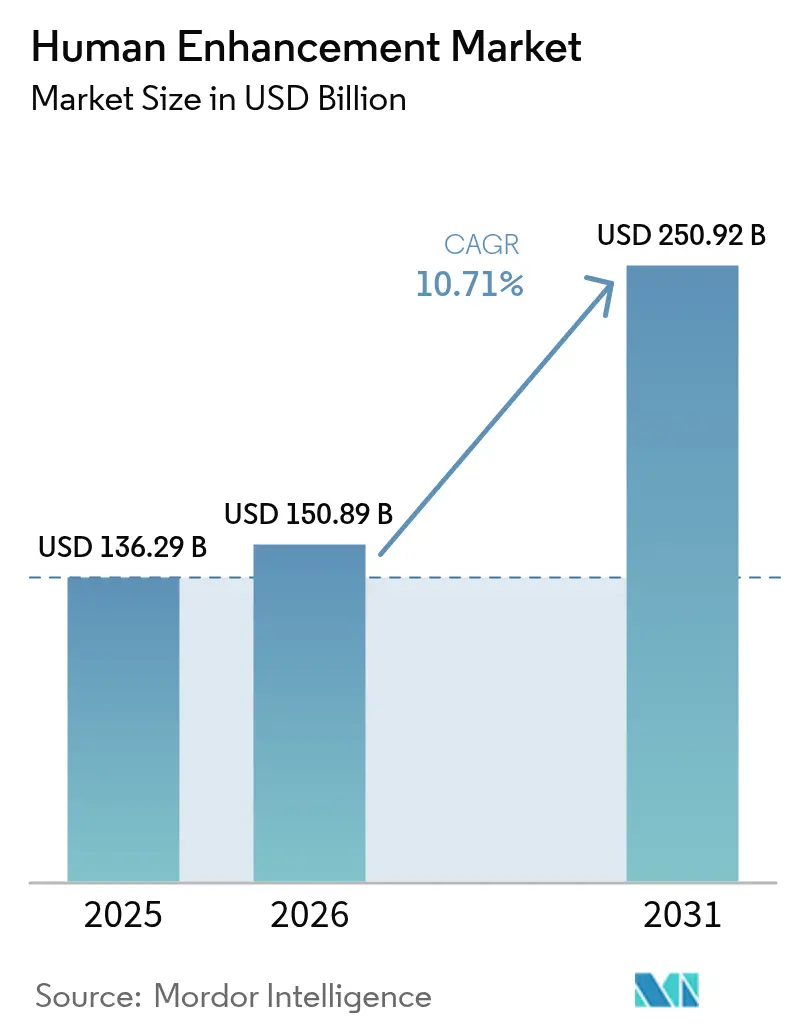
| Market Size (2026) | USD 150.89 Billion |
| Market Size (2031) | USD 250.92 Billion |
| Growth Rate (2026 - 2031) | 10.71 % |
| Fastest Growing Market | Asia Pacific |
| Largest Market | North America |
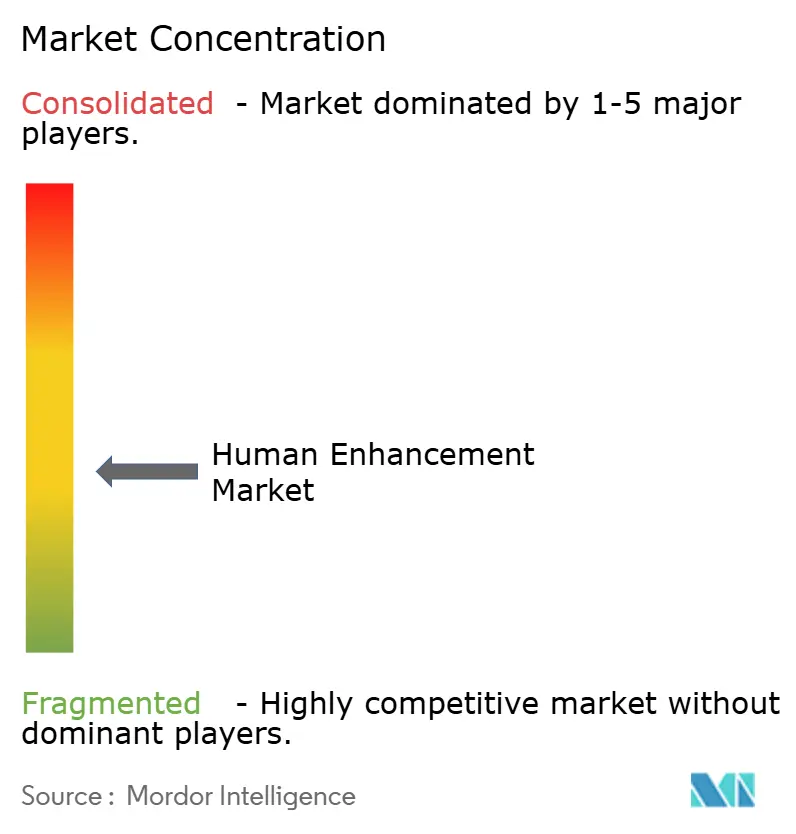
| Market Concentration | Medium |
Major Players *Disclaimer: Major Players sorted in no particular order Image © Mordor Intelligence. Reuse requires attribution under CC BY 4.0. | |
Human Enhancement Market Analysis by Mordor Intelligence
The human enhancement market size was valued at USD 136.29 billion in 2025 and estimated to grow from USD 150.89 billion in 2026 to reach USD 250.92 billion by 2031, at a CAGR of 10.71% during the forecast period (2026-2031). A decisive pivot from reactive treatment to proactive augmentation is unfolding as edge-AI chips run health algorithms locally, exoskeletons move from trial to procurement, and wearable batteries last long enough for continuous monitoring. U.S. Food and Drug Administration clearances for sleep-apnea detection on Apple Watch and for Abbott’s FreeStyle Libre 3 Plus illustrate how miniaturized sensors and efficient firmware are collapsing the gap between wellness gadgets and regulated medical devices. Chronic diseases now drive 74% of global mortality, while the cohort aged 60 and above is forecast to exceed 1.4 billion by 2030, putting mobility and metabolic tracking devices into mainstream retail channels. Defense ministries view powered exoskeletons as force multipliers and are issuing multi-year contracts that reduce manufacturer risk. At the same time, data-privacy mandates such as the EU General Data Protection Regulation compel on-device processing to keep biometric streams local.
Key Report Takeaways
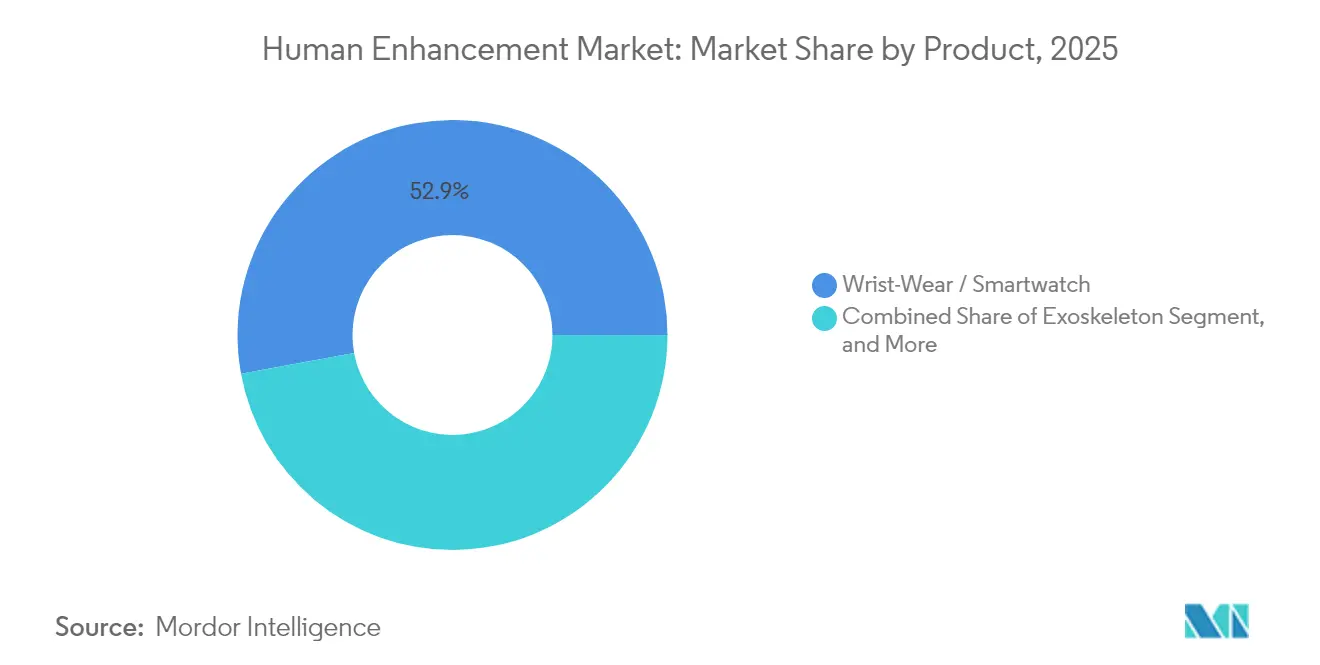
- By product type, wrist-wear and smartwatches led with 52.88% revenue share in 2025, while exoskeletons are projected to expand at an 11.39% CAGR through 2031.
- By application, healthcare and rehabilitation accounted for 41.96% of 2025 revenue, whereas military and defense applications are poised for the fastest 12.43% CAGR to 2031.
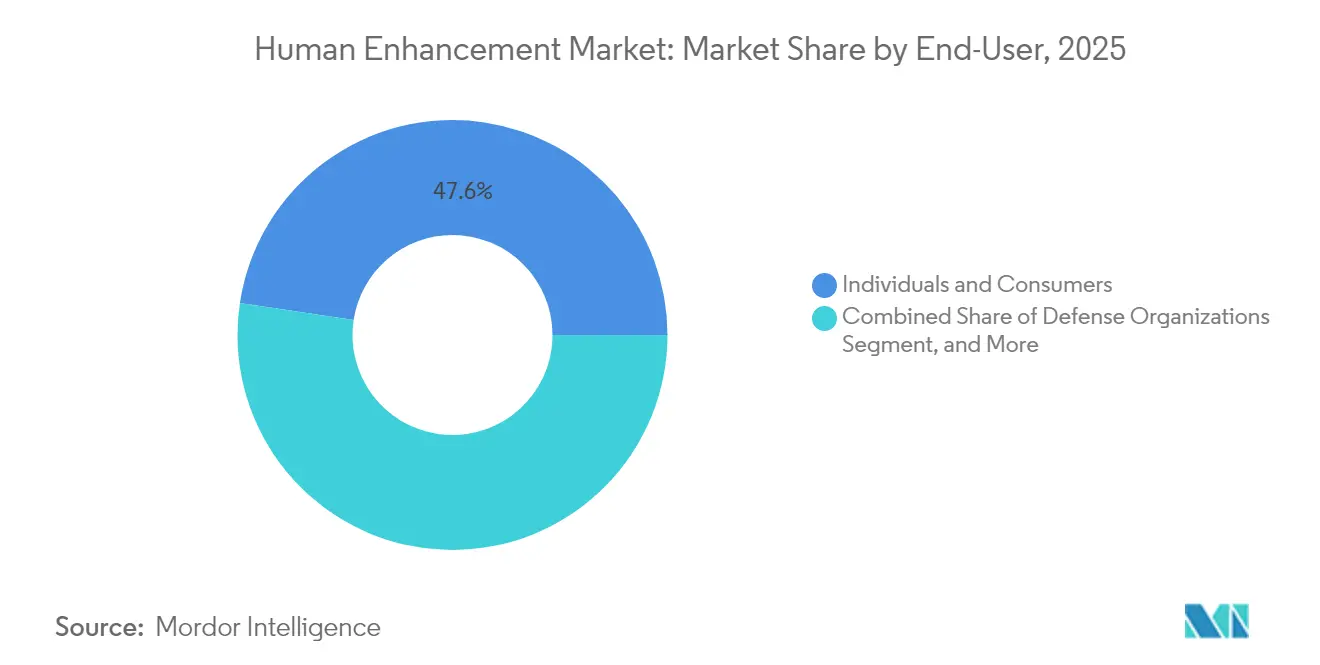
- By end-user, individuals and consumers commanded 47.62% of spending in 2025, yet defense organizations will grow at an 11.63% CAGR during the forecast window.
- By technology, wearable electronics held 54.45% of 2025 revenue, and brain-computer interfaces are projected to post a 11.98% CAGR through 2031.
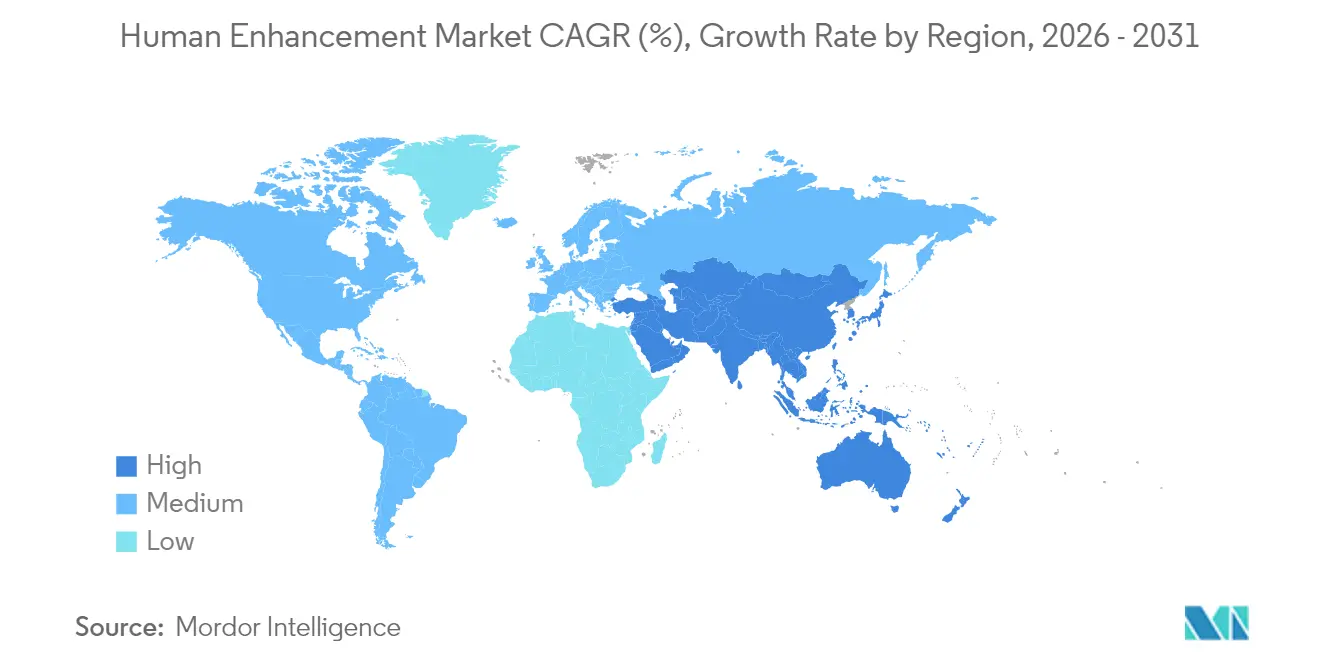
- By geography, North America captured 48.36% of 2025 revenue, but Asia-Pacific is set to record the highest 12.64% CAGR to 2031.
Note: Market size and forecast figures in this report are generated using Mordor Intelligence’s proprietary estimation framework, updated with the latest available data and insights as of 2026.
Market Trends and Insights
Drivers Impact Analysis of Human Enhancement Market*
| Driver | (~) % Impact on CAGR Forecast | Geographic Relevance | Impact Timeline |
|---|---|---|---|
| Advancements in Wearable Sensor Miniaturization and Battery Life | +1.80% | Global, with early commercial deployment in North America and Asia-Pacific | Medium term (2-4 years) |
| Rising Prevalence of Chronic Diseases Boosting Demand for Assistive Devices | +2.10% | Global, particularly acute in North America, Europe, and aging Asia-Pacific markets | Long term (≥ 4 years) |
| Increasing Consumer Health and Fitness Awareness | +1.50% | Global, strongest in North America, Western Europe, and urban Asia-Pacific | Short term (≤ 2 years) |
| Growing Aging Population Requiring Mobility and Cognitive Support | +1.90% | Global, most pronounced in Japan, South Korea, Germany, and Italy | Long term (≥ 4 years) |
| Integration of On-Device Edge AI Enabling Real-Time Personalized Assistance | +2.00% | Global, led by North America and China for AI chip production | Medium term (2-4 years) |
| Government Defense Programs Funding Soldier Augmentation Pilots | +1.20% | North America, Europe, and select Middle East nations | Medium term (2-4 years) |
| Source: Mordor Intelligence | |||


Advancements in Wearable Sensor Miniaturization and Battery Life
Sub-5-gram sensor stacks now combine accelerometers, microcontrollers, and solid-state batteries, allowing multi-day operation without recharging. MIT researchers embedded a 32-bit microcontroller and rechargeable cell into a single elastic fiber, proving garments can perform distributed inference at 95% accuracy. Apple’s sleep-apnea approval rides on the same trend, with edge algorithms parsing wrist motion locally to eliminate cloud latency.[1]U.S. Food and Drug Administration, “FDA Authorizations and Clearances,” fda.gov Higher energy densities, plus body-heat or kinetic energy harvesting prototypes, promise runtimes that make daily charging obsolete. As hardware friction dissolves, the human enhancement market integrates sensors into textiles, shoes, and helmets, extending addressable use cases. Component suppliers that co-optimize power and signal integrity now capture design-win premiums across consumer and clinical buyers.
Rising Prevalence of Chronic Diseases Boosting Demand for Assistive Devices
Noncommunicable ailments kill 41 million people each year, spurring payers and employers to subsidize continuous monitors that avert costly hospitalizations.[2]World Health Organization, “Noncommunicable Diseases,” who.int Abbott’s FreeStyle Libre 3 Plus delivers 14-day glucose streams and smartphone alerts, shifting diabetes care toward predictive intervention. Smartwatches with photoplethysmography and electrocardiogram sensors detect atrial fibrillation, nudging users to seek evaluation before stroke occurs. Regulatory sandboxes, such as the FDA Digital Health Center of Excellence, shorten review cycles for hybrid wellness-medical products, favouring firms with robust compliance teams. Economic modelling by health insurers shows remote monitoring lowers readmission penalties, fuelling enterprise bulk purchases that swell unit volumes in the human enhancement market.
Growing Aging Population Requiring Mobility and Cognitive Support
The world will host 1.4 billion people aged 60 plus by 2030, and nations with super-aged demographics already subsidize rehab robotics to offset caregiver shortages. Cyberdyne’s small-size HAL won Japanese clearance in 2025, opening pediatric and smaller-stature indications.[3]CYBERDYNE Inc., “Medical HAL Approval,” cyberdyne.jp Exoskeleton-aided gait therapy reduces fall risk and hospital stays, outcomes that resonate with cost-conscious health ministries. Hearing aids with AI noise-cancellation tackle age-related hearing loss, a condition projected to affect 900 million people by 2050. Brain-computer interfaces such as Synchron’s Stentrode give paralyzed patients cursor control, signalling future value for neurodegenerative care. As longevity rises, policy incentives, reimbursement codes, and caregiver relief accelerate device penetration across the human enhancement market.
Integration of On-Device Edge AI Enabling Real-Time Personalized Assistance
Edge inference slashes latency to milliseconds and keeps biometric data local, a compliance win under stringent privacy laws. SensorLM neuromorphic chips consume one-tenth the power of standard microcontrollers, enabling always-on anomaly detection without battery drain. Apple shifted atrial-fibrillation analysis onto the watch processor, freeing users from constant phone pairing. Defense programs layer augmented-reality overlays on soldier visors, where sub-100 ms response times are mission critical.[4]U.S. Department of Defense, “Defense Research Programs,” defense.gov Commercial players replicate the architecture for fall detection, glucose-trend warnings, and fatigue alerts, expanding the human enhancement market into environments with patchy connectivity.
Restraints Impact Analysis of Human Enhancement Market*
| Restraint | (~) % Impact on CAGR Forecast | Geographic Relevance | Impact Timeline |
|---|---|---|---|
| High Upfront Costs of Advanced Enhancement Devices | -1.30% | Global, most acute in price-sensitive emerging markets | Short term (≤ 2 years) |
| Data Privacy and Security Concerns Around Biometric and Neural Data | -1.10% | Global, particularly stringent in EU under GDPR and forthcoming AI Act | Medium term (2-4 years) |
| Regulatory Uncertainty for Hybrid Wellness-Medical Devices | -0.90% | Global, with divergent pathways in FDA (US), EMA (EU), and PMDA (Japan) | Medium term (2-4 years) |
| Supply Chain Constraints for High-Performance Flexible Electronics Materials | -0.80% | Global, concentrated in graphene and rare-earth supply chains dominated by China | Long term (≥ 4 years) |
| Source: Mordor Intelligence | |||
High Upfront Costs of Advanced Enhancement Devices
Powered exoskeletons list between USD 40,000 and USD 100,000, restricting adoption to defense buyers and reimbursed rehab centers. Robotics-as-a-Service spreads cost over monthly fees but raises lifetime expenses and embeds vendor lock-in. Fitness wearables face opposite pressures: Xiaomi retails trackers below USD 50, eroding margins for mid-tier brands. Medicare funds continuous glucose monitors but not wellness devices, creating reimbursement gaps that slow uptake. In emerging markets, out-of-pocket healthcare spending caps demand, meaning premium devices must either drop price or prove multi-year payback.
Data Privacy and Security Concerns Around Biometric and Neural Data
Biometric data reveal intimate health and behavioural insights, so breaches erode trust and invite fines that smaller vendors cannot absorb. GDPR treats health data as a special category, mandating explicit consent and strict storage controls. Neural interfaces amplify worries by capturing brain signals that could infer intent, prompting neuro-rights legislation debates. On-device processing mitigates exposure but ups the silicon bill of materials. Companies that architect privacy by design gain competitive advantage, yet the compliance overhead tempers the overall CAGR for the human enhancement market.
*Our forecasts treat driver/restraint impacts as directional, not additive. The impact forecasts reflect baseline growth, mix effects, and variable interactions.
Human Enhancement Market Segment Analysis
By Product Type:
Smartwatches Dominate, Exoskeletons SurgeSmartwatches anchored 52.88% of 2025 revenue, reinforcing their role as the core gateway to the human enhancement market share. Exoskeleton revenue, although lower in absolute terms, is on an 11.39% growth trajectory that could materially shift the product mix by 2031. Head-mounted displays cater to surgical visualization and industrial maintenance but battle user comfort and battery limits. Smart clothing prototypes show promise through conductive fibers that power sensors without bulky packs, yet mass production remains elusive. Ear-worn devices combine hearing assistance and real-time translation, appealing to aging and cross-border workforces. Body-worn cameras, funded by law-enforcement grants, illustrate that enhancement extends beyond health to accountability. Neural interface devices are pre-commercial but have secured breakthrough FDA pathways, signalling future inclusion in the broader product portfolio.
The product landscape reflects a continuum from consumer price points under USD 50 for basic trackers to six-figure therapeutic robots. As premium smartwatches fold in FDA-cleared features, they blur lines with medical-grade equipment and pull diagnostic revenues into the consumer channel. Exoskeletons shift from experimental prototypes to pallet-lifting workhorses on factory floors, where injury reduction delivers tangible return on investment. Smart clothing could leapfrog wrist devices once durability and washability challenges drop. Ear-worn form factors ride an audio-first trend, integrating voice assistants and potential cognitive augmentation. In aggregate, these dynamics anchor the human enhancement market as a multiproduct arena in which overlap rather than substitution drives growth.


By Application:
Healthcare Leads, Defense AcceleratesHealthcare and rehabilitation applications commanded 41.96% of 2025 spending, underlining their foundational influence on the human enhancement market size for clinical use. Military and defense are the fastest climbers, set to expand at 12.43% CAGR as governments validate exosuits for soldier load carriage and tactical awareness. Industrial safety deployments scale in warehousing and construction, where exoskeleton leasing models compress payback periods to under 12 months. Consumer fitness devices mature into holistic wellness platforms that integrate sleep, stress, and recovery scores, but saturation in developed economies pushes brands toward emerging-market expansion. Cognitive enhancement applications remain nascent yet attract venture funding as neural-gaming pilots showcase thought-controlled interfaces.
The application breakout shows convergence between medical and non-medical domains. Hospitals deploy continuous glucose monitors for at-home management to free bed capacity, while defense labs spin off tech later adopted by sports-memory coaches. Industrial buyers weigh assistive robotics against workers’ compensation and retention costs, creating data-driven procurement criteria. As consumer devices integrate approved diagnostics, the line between fitness and medical narrows, potentially unlocking reimbursement. Defense projects generate ruggedization standards that industrial exoskeleton manufacturers reuse, accelerating commercial reliability.
By End-User:
Consumers Prevail, Defense Organizations ClimbIndividuals accounted for 47.62% of 2025 purchases, confirming the retail pull that keeps human enhancement market demand diversified. Defense organizations, though smaller in value, register an 11.63% CAGR, reflecting formal procurement cycles and confidentiality clauses that ensure volume commitments. Healthcare providers adopt powered exoskeletons and glucose monitors under reimbursement codes, yet budget scrutiny slows experimental trials. Industrial enterprises rely on injury-reduction metrics to justify exosuit rentals, often bundling vendor training into service contracts. Academia and research institutions function as crucibles, generating evidence that converts early adopters into mainstream buyers.
Consumer segments bifurcate premium ecosystems by Apple and Samsung lock users in with proprietary services, while value brands like Xiaomi push affordable pools of basic functionality. Defense entities demand domestic supply chains and cybersecurity certifications, effectively narrowing the vendor field. Hospitals prioritize scalable, interoperable data platforms to ease electronic medical record integration. Industrial firms compare productivity gains against subscription costs, sometimes negotiating usage-based pricing. The resulting mosaic keeps the human enhancement market resilient to shocks in any single buyer group.
By Technology:
Wearables Lead, Brain-Computer Interfaces GainWearable electronics represented 54.45% of 2025 revenue, anchoring the human enhancement market as the most mature technology stack. Brain-computer interfaces, though early stage, hold a 11.98% growth outlook thanks to breakthrough device designations and encouraging clinical pilots. Exoskeleton robotics straddle hardware and software, merging actuators with biomechanical sensing for precise torque delivery. Gene editing and cell therapies aim at curative interventions but face ethical scrutiny when framed as enhancement. Implantable stimulators and cochlear devices deliver sensory restoration yet require surgical implantation, limiting uptake to patients with clear clinical indications.
Supply-chain dynamics favour vertically integrated wearables suppliers that control displays, batteries, and health silicon, letting them iterate features at smartphone cadences. Brain-computer interface firms solve electrode longevity and wireless power to transition from lab to living room. Exoskeleton designers hunt for lightweight composite materials and high-density batteries that reconcile torque with user comfort. Gene-editing ventures prioritize therapy but maintain intellectual property and tooling applicable to future augmentation. Implantable device makers explore less invasive insertion techniques to broaden candidacy, potentially adding elective enhancement procedures to their roadmaps.
Geography Analysis
North America, APAC and EMEA Human Enhancement Market
North America held 48.36% of 2025 human enhancement market share due to early FDA approvals, high healthcare spend, and robust defense R and D pipelines. Asia-Pacific is forecast to post a 12.64% CAGR to 2031 as China leverages manufacturing economies of scale and Japan subsidizes mobility aids for its super-aged society. Europe benefits from universal healthcare reimbursements, yet GDPR compliance and multilingual labelling prolong launches and increase costs. The Middle East funds exoskeleton pilots within smart-city and border-security projects, while Africa adopts mobile health integrations that piggyback on high smartphone penetration.
North America and APAC Human Enhancement Market
The United States leads brain-computer interface research under DARPA grants, creating a spillover talent pool for private startups. Canada’s reimbursement for continuous glucose monitoring broadens addressable diabetic populations. China delivers over 60% of global smartwatch shipments through contract manufacturers in Shenzhen and Guangdong. Japan’s January 2025 clearance of Cyberdyne’s small-size HAL cements its rehabilitation robotics leadership. India’s Ayushman Bharat Digital Mission lays groundwork for integrating wearable feeds into national health records, yet rural bandwidth gaps slow real-time uploads.
EMEA Human Enhancement Market
Europe’s Medical Device Regulation demands post-market surveillance, raising compliance costs but improving patient safety. Germany and Italy, facing high dependency ratios, subsidize homecare exoskeleton rentals. Saudi Arabia and the United Arab Emirates funnel Vision 2030 budgets into telehealth and exoskeleton supply chains. South Africa pilots smart-clothing kits for mining safety, adding an industrial dimension to adoption. These varied regional priorities diversify revenue streams, reducing concentration risk and sustaining global growth in the human enhancement market.

Regulatory Landscape
Regulation in human enhancement is split across medical-device safety, AI governance, and biometric privacy, with requirements diverging by jurisdiction and device intent. In the European Union, the EU AI Act (Regulation (EU) 2024/1689) establishes a risk-based framework for AI systems, with application from August 2, 2026 and earlier phased provisions beginning in 2025. This raises compliance expectations for AI-enabled wearables and neurotechnology workflows alongside GDPR obligations for special-category health data. In the United States, the FDA continues to regulate many enhancement-adjacent products through medical-device pathways, and its 2024 guidance on Predetermined Change Control Plans (PCCP) provides a structured route to update AI-enabled device software within defined limits without repeated new submissions.
Neurotechnology-specific governance is also tightening beyond traditional medical-device rules, especially around neural data rights and security. California SB-44 (2025-2026 session) proposes privacy requirements for neural data collected via brain-computer interface systems, including deletion requirements after intended use, while US Senate bill S.2925 (MIND Act) directs FTC work on neural data governance. Standards activity functions as an additional soft-regulatory anchor, with IEEE Brain advancing P7700 toward socio-technical guidance for ethical neurotechnology design, shaping expectations for suppliers even before formal publication.
Value Chain Analysis
The human enhancement value chain starts with enabling components, including miniaturized sensors, edge-AI semiconductors, displays and waveguides for head-worn systems, high-capacity batteries, and lightweight structural materials. It then moves through OEM design, clinical validation and regulatory work (for medical-grade functions), and finally into channel execution across consumer retail, enterprise deployments, and institutional procurement. Consumer wearables lean on high-volume electronics manufacturing ecosystems, while exoskeletons and neurotechnology place more weight on specialized mechatronics integration, safety engineering, and evidence generation, which extends development cycles and raises documentation and post-market support requirements.
Downstream, distribution splits into (i) direct-to-consumer ecosystems for smartwatches and wellness wearables, (ii) B2B sales with integration and workflow software for industrial safety and logistics deployments, and (iii) hospital, rehabilitation, and defense procurement with training, service, and multi-year support. Regulatory and market access capabilities increasingly sit inside the chain as differentiating functions, supported by evolving AI governance (EU AI Act) and medical-device oversight (FDA). Regional policy and approval pathways can also accelerate commercialization in some markets, as reflected in China, where an invasive BCI device received approval from the National Medical Products Administration in March 2026 for commercial use.
Competitive Landscape
Competition remains fragmented as consumer-electronics giants extend health stacks, while specialized robotics and neural firms cultivate regulatory moats. Apple and Samsung design custom silicon, integrate operating systems, and monetize health subscriptions to deepen ecosystem lock-in. Garmin and Oura target endurance athletes and sleep optimizers, respectively, yet tolerance for premium pricing narrows as incumbents clone features. Ekso Bionics, ReWalk Robotics, and Cyberdyne differentiate through peer-reviewed clinical trials and multijurisdictional approvals, a barrier that consumer brands cannot quickly replicate.
Neuralink, Synchron, and Precision Neuroscience race to prove safe, reliable brain implants that deliver functional gains for paralysis. The first to secure pivotal trial success and scalable manufacturing could command disproportionate human enhancement market influence. Industrial exoskeleton suppliers such as German Bionic partner with KULR Technology Group to localize U.S. assembly, cutting lead times and qualifying for federal procurement. Zimmer Biomet’s July 2025 acquisition of Monogram Technologies evidences consolidation, knitting autonomous robotic surgery into legacy orthopedic portfolios. Meanwhile, privacy legislation and supply-chain shocks around graphene and rare earths favour vertically integrated manufacturers that can buffer materials volatility.
White-space opportunities persist in smart clothing, where academic breakthroughs await commercial scaling. Gene-editing firms such as CRISPR Therapeutics own patents that could pivot from therapy to elective enhancement if ethics boards loosen. Body-worn camera vendors leverage Department of Justice grants, anchoring a non-medical revenue stream rooted in transparency mandates. As defense prototypes mature, dual-use technology flows into consumer and industrial lines, blurring sector boundaries and fuelling competitive churn that keeps prices in check and innovation cycles short.
Human Enhancement Industry Leaders
Vuzix Corporation
Ekso Bionics Holdings Inc.
Google LLC
B-Temia Inc.
Samsung Electronics Co. Ltd
- *Disclaimer: Major Players sorted in no particular order
Human Enhancement Market Companies Covered in this Report
- Apple Inc.
- Samsung Electronics Co. Ltd.
- Google LLC
- Garmin Ltd.
- Huawei Technologies Co. Ltd.
- Xiaomi Corporation
- Abbott Laboratories
- Cochlear Limited
- Ekso Bionics Holdings Inc.
- ReWalk Robotics Ltd.
- Cyberdyne Inc.
- Magic Leap Inc.
- Vuzix Corporation
- Neuralink Corporation
- Intellia Therapeutics Inc.
- CRISPR Therapeutics AG
- B-Temia Inc.
- Second Sight Medical Products Inc.
- RTX Corporation
- BrainGate Company

Market Opportunities and Future Outlook
A near-term opportunity centers on AI-enabled head-worn and eye-worn systems that blend assistive functions with enterprise workflows and consumer utility. The May 2026 Google and Samsung intelligent eyewear announcements, including Gemini AI integration and fashion partners (Gentle Monster and Warby Parker), highlight active platform investment aimed at all-day wearability and broader adoption beyond niche AR deployments. For enterprise buyers, programs that bundle hardware with workflow software shorten pilots and improve ROI clarity for warehouse and field operations, which widens whitespace for head-mounted displays in logistics, inspection, and safety use cases.
In invasive and bidirectional brain-computer interfaces, the market opportunity is increasingly tied to tangible clinical performance evidence and country-level commercialization pathways. A Nature Medicine report in June 2026 documented 3,800 hours of independent intracortical BCI use over 19 months, with high word accuracy using a transformer-based decoder, strengthening the case for long-duration, at-home usability as a product requirement rather than a lab milestone. China also moved BCI closer to commercial reality through approvals for invasive devices, which encourages suppliers to scale manufacturing, software decoding stacks, and clinical support networks. This creates whitespace for component and platform providers that can deliver medical-grade reliability while aligning with emerging neural-data governance requirements.
Recent Industry Developments in Human Enhancement Market
- May 2026: Google and Samsung unveiled intelligent eyewear with Gemini AI integration, developed with partners including Gentle Monster and Warby Parker. The development extends major mobile ecosystems into always-on, head-worn augmentation, increasing competitive pressure on standalone smart-glasses suppliers and drawing faster attention from developers around Android-based XR and ambient assistance.
- December 2025: Ekso Bionics entered an agreement to become the exclusive U.S. distributor of MediTouch's BalanceTutor rehabilitation system. The distribution-led expansion broadens Ekso Bionics' rehabilitation footprint beyond exoskeletons, strengthening its position with therapy providers seeking integrated mobility and balance solutions.
- October 2024: Oura acquired Sparta Science, adding force-plate and movement analytics capabilities to its health and wellness ecosystem for enterprise clients. The acquisition supports more objective musculoskeletal and performance assessment use cases, helping wearables vendors expand deeper into corporate wellness and occupational health programs.


Human Enhancement Market Report Scope and Research Methodology
Market Definition and Coverage
For this study, the human enhancement market is defined as revenue earned from technologies and solutions that improve or extend human physical or cognitive capabilities through devices, implants, wearables, and related enabling technologies sold for consumer, industrial, healthcare, or defense uses.
Scope exclusions: Non-enhancement medical care that only restores normal function, along with purely cosmetic services without a technology product component, is excluded where it cannot be tracked consistently in market value.
Segments Covered in This Report
- By Product Type
- Smartwatch
- Head-Mounted Display
- Smart Clothing
- Ear-Worn Devices
- Fitness Tracker
- Body-Worn Camera
- Exoskeleton
- Neural Interface Device
- Medical Enhancement Device
- By Application
- Healthcare and Rehabilitation
- Industrial and Workplace Safety
- Consumer Fitness and Wellness
- Military and Defense
- Cognitive Enhancement and Neuro-Gaming
- By End-User
- Individuals and Consumers
- Healthcare Providers
- Industrial Enterprises
- Defense Organizations
- Research and Academia
- By Technology
- Wearable Electronics
- Exoskeleton Robotics
- Brain-Computer Interfaces
- Gene Editing and Cell Therapy
- Implantable Devices
- By Geography
- North America
- United States
- Canada
- Mexico
- South America
- Brazil
- Argentina
- Rest of South America
- Europe
- Germany
- France
- United Kingdom
- Italy
- Spain
- Russia
- Asia Pacific
- China
- Japan
- India
- South Korea
- Australia
- Middle East
- Turkey
- Saudi Arabia
- United Arab Emirates
- Africa
- South Africa
- Nigeria
- Egypt
- North America
Data Sources, Market Sizing, and Validation
Desk Research
Desk research was used to build the first market structure and to keep the assumptions anchored to publicly visible signals. We reviewed product and regulatory cues, such as device clearances and safety guidance published by agencies like the US FDA, along with standards and technical references from bodies such as ISO and IEC.
To shape regional demand patterns, we relied on public health and demographic series from sources such as the World Bank, OECD, and WHO, and we also checked trade and production indicators using UN Comtrade style statistics where relevant for device-heavy categories. Company filings, investor decks, patent databases (via a paid subscription), and trusted press coverage were then used to understand launch timing, pricing direction, and where adoption is accelerating. This list is illustrative only, and many additional public sources were reviewed to collect data points, cross-check assumptions, and clarify open questions.
Primary Interviews and Surveys
Primary interviews and surveys were carried out with a mix of device and component suppliers, solution integrators, healthcare and industrial users, and domain experts who track adoption and regulation. The conversations were used to test what is actually being paid for, how usage differs by application, and which technologies are moving from pilots to scaled deployments across APAC, EMEA, and the Americas.
Distribution of primary research fieldwork respondents
| Company type | Respondent position | Region |
|---|---|---|
| Top tier: 28% | CXOs: 14% | APAC: 43% |
| Mid tier: 54% | Functional/Unit leaders: 41% | EMEA: 36% |
| Smaller Players: 18% | Managers: 45% | Americas: 21% |
Market-Sizing & Forecasting
Sizing starts with a top-down build where known demand pools and adoption rates are used to reconstruct spend by major use settings, and then values are allocated across regions using deployment intensity and affordability signals. To keep the model realistic, the totals are corroborated with selective bottom-up approximations, such as sampled ASP times shipment volumes for key device categories, plus channel checks on typical price bands and replacement cycles.
Inputs that were used (as examples) include installed base growth for wearables and assistive devices, regulatory and clearance cadence for higher-risk products, average selling price progression by category, replacement and upgrade cycles for body-worn hardware, and the share of spending going to industrial safety and rehabilitation programs. Where interview feedback pointed to missing capture in public data, gaps were handled through conservative penetration ranges tied back to the closest observable proxy, and then adjusted only when multiple respondent groups aligned on the same direction.
For forecasting, scenario analysis was used so the outlook can reflect different speeds of adoption and pricing, especially where reimbursement, workplace safety policies, and privacy requirements can change the pace. The forward assumptions are anchored in respondent consensus on which technologies will scale first, followed by a reasonableness check against macro indicators like income growth, healthcare spending, and industrial automation intensity.
Data Validation & Update Cycle
Model outputs are validated through triangulation across demand signals, pricing logic, and adoption checkpoints, and unusual jumps are reviewed before they are accepted. When variances show up, the chain of assumptions is rechecked from scope mapping through the final conversion into USD, and respondents may be re-contacted if a key input has shifted.
Before sign-off, multi-step internal reviews are completed so calculations, unit handling, and region splits remain consistent with the stated market boundary. Reports are refreshed annually, and interim updates are made when material events occur, such as new regulations, major technology approvals, or sharp price movements. Just before delivery, a final sweep is done to ensure the latest public indicators are reflected in the numbers.
Mordor Intelligence's Global Human Enhancement Market Market Size Compared Against Other Published Estimates
Published market sizes for human enhancement can vary a lot, even when the topic name looks the same on the cover. Differences usually come from what is counted as enhancement versus treatment, how much non-device spend is included, and how pricing and adoption are projected across regions.
By tracking device-level adoption signals and refreshing scope gates each update cycle, Mordor Intelligence keeps the count focused on enhancement-related technologies sold into identifiable use cases, rather than bundling broad cosmetic services or loosely defined wellness spending. Differences also come from how fast ASPs are assumed to change for wearables and interfaces, whether forecasts reflect a base case or an aggressive scale-up, and how currency timing is handled in multi-region totals.
Benchmark comparison
| Source | Market Size | Gaps in Research Methodology |
|---|---|---|
| Mordor Intelligence | USD 150.89 B (2026) | |
| Industry Publisher A | USD 139.40 B (2025) | Uses a broader definition that explicitly includes drugs, hormones, dietary supplements, and cosmetic procedures, which can pull in spend that is not consistently tracked as technology-market revenue in value terms. |
| Market Tracker B | USD 78.50 B (2025) | Frames the scope mainly as human enhancement technology buckets and may exclude large device and application areas captured in wider enhancement coverage, which can compress the reported total for the same general theme. |
The spread in the table is mainly explained by where each publisher draws the line on what is counted, and how directly those items can be tied to measurable technology sales. With a clearly defined boundary, repeatable demand indicators, and practical checks on price and adoption, the estimate stays easier to audit and more stable for planning from one update to the next.


Key Questions Answered in the Report
What is the current value of the human enhancement market?
The market is valued at USD 150.89 billion in 2026.
How fast is the human enhancement market expected to grow?
It is forecast to expand at a 10.71% CAGR, reaching USD 250.92 billion by 2031.
Which product category holds the largest share?
Smartwatches account for 52.88% of 2025 product revenue.
Which region will grow the fastest through 2031?
Asia-Pacific is projected to register a 12.64% CAGR, outpacing all other regions.
What technology shows the highest growth rate?
Brain-computer interfaces are expected to grow at a 11.98% CAGR through 2031.
Which application segment is expanding most rapidly?
Military and defense enhancement is forecast to grow at a 12.43% CAGR to 2031.
Page last updated on:


 Your data is secure and never sold or shared.


