
Chocolate Based Spreads Market Size and Share
Market Overview
| Study Period | 2021 - 2031 |
|---|---|
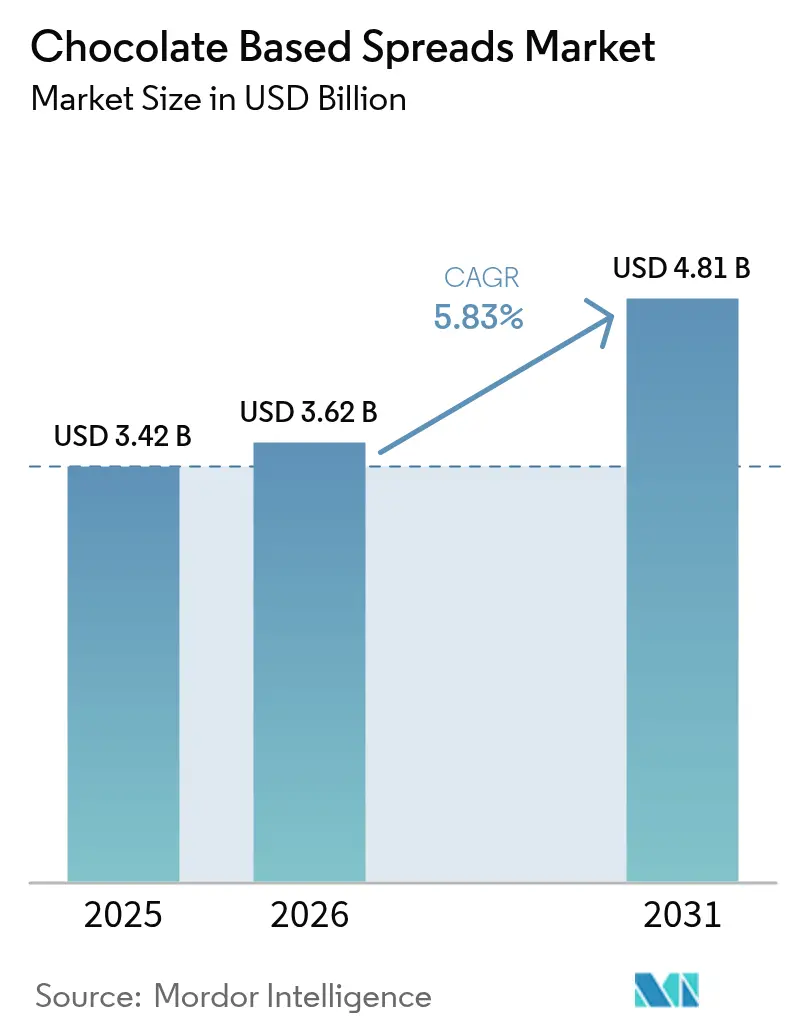
| Market Size (2026) | USD 3.62 Billion |
| Market Size (2031) | USD 4.81 Billion |
| Growth Rate (2026 - 2031) | 5.83 % |
| Fastest Growing Market | Asia Pacific |
| Largest Market | Europe |
| Market Concentration | High |
Major Players
*Disclaimer: Major Players sorted in no particular order Image © Mordor Intelligence. Reuse requires attribution under CC BY 4.0. |
|
Chocolate Based Spreads Market Analysis by Mordor Intelligence
The global chocolate-based spreads market size was valued at USD 3.42 billion in 2025 and estimated to grow from USD 3.62 billion in 2026 to reach USD 4.81 billion by 2031, at a CAGR of 5.83% during the forecast period (2026-2031). Market expansion is attributed to evolving consumer preferences toward convenient and indulgent food products, increased disposable income levels, and heightened demand for premium and health-oriented offerings. The acceleration of urbanization and time-constrained lifestyles has generated substantial demand for efficient breakfast solutions and snacks, with chocolate spreads providing both convenience and versatility. Market development is further augmented by product innovations incorporating clean-label, organic, vegan, and reduced-sugar formulations, addressing the increasing health consciousness among consumers. The proliferation of online retail platforms and modern distribution networks has enhanced product accessibility, thereby contributing to market expansion.
Key Report Takeaways
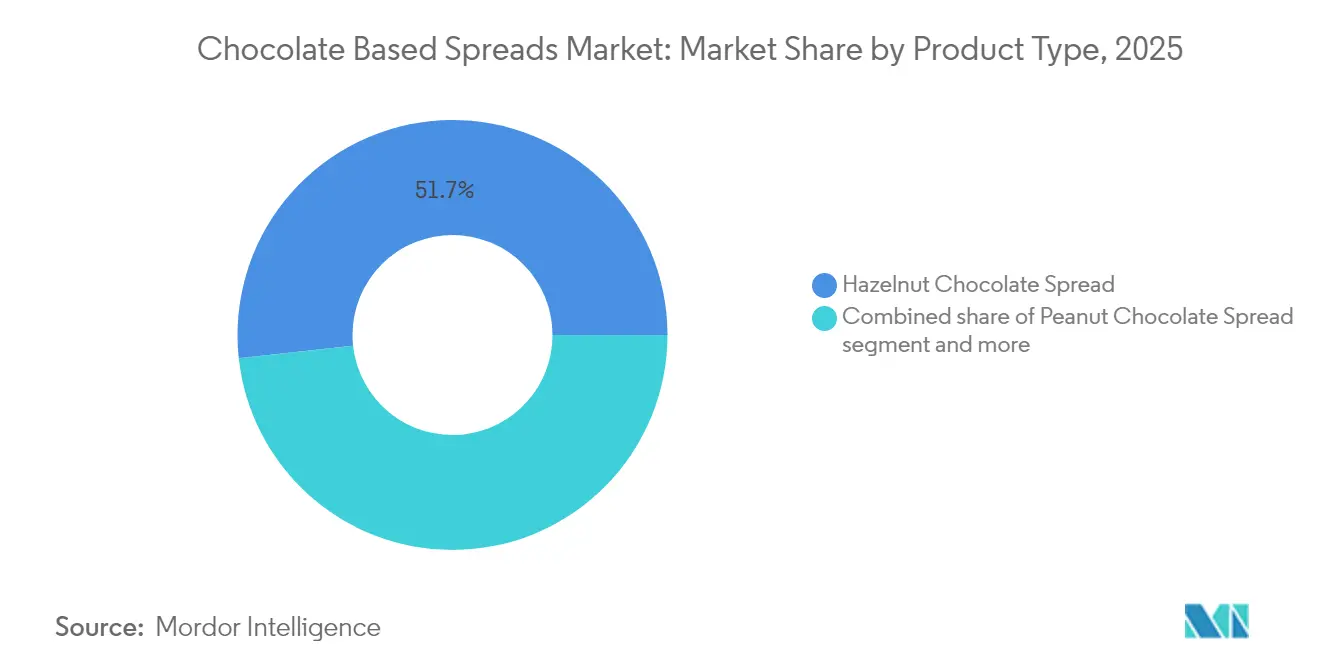
- By product type, hazelnut spreads led with 51.72% of the chocolate spread market share in 2025; Chocolate Spread (Milk, White, and Dark) variants are projected to expand at a 6.64% CAGR through 2031.
- By packaging type, PET and glass jars commanded 67.65% share of the chocolate spread market size in 2025, while squeeze bottles are advancing at a 7.39% CAGR through 2031.
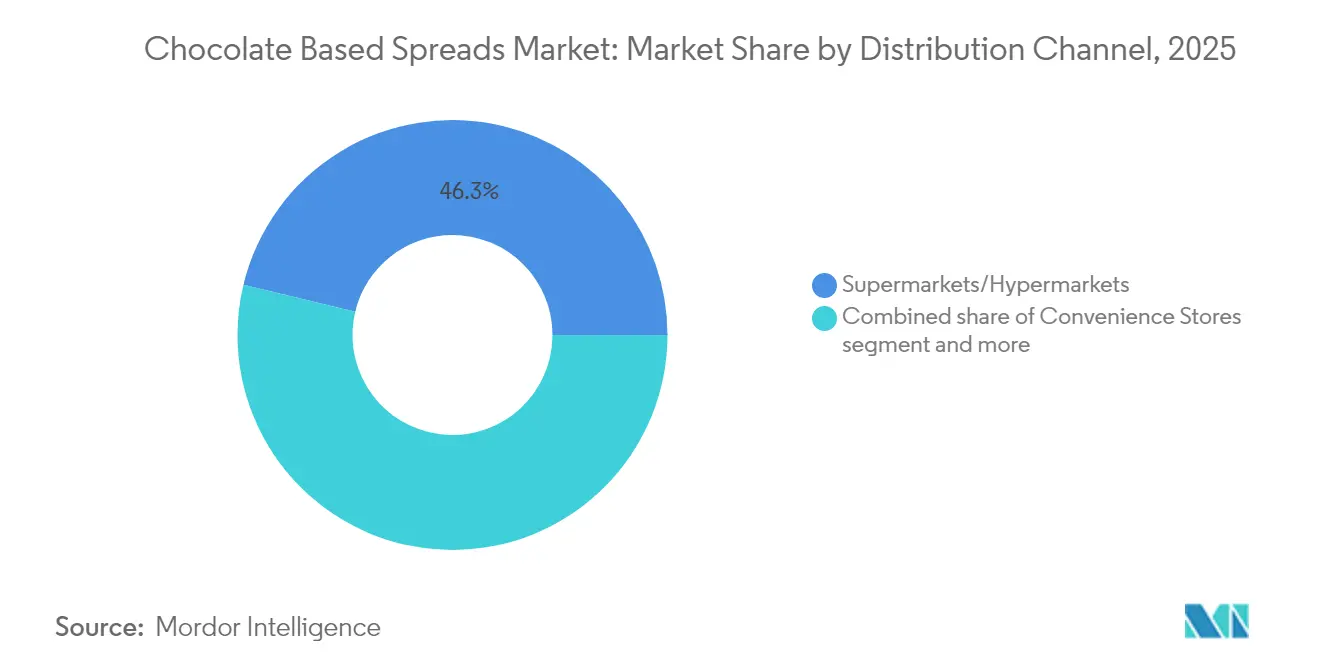
- By distribution channel, supermarkets and hypermarkets accounted for 46.25% of the chocolate spread market size in 2025; online retail stores are climbing at an 8.25% CAGR through 2031.
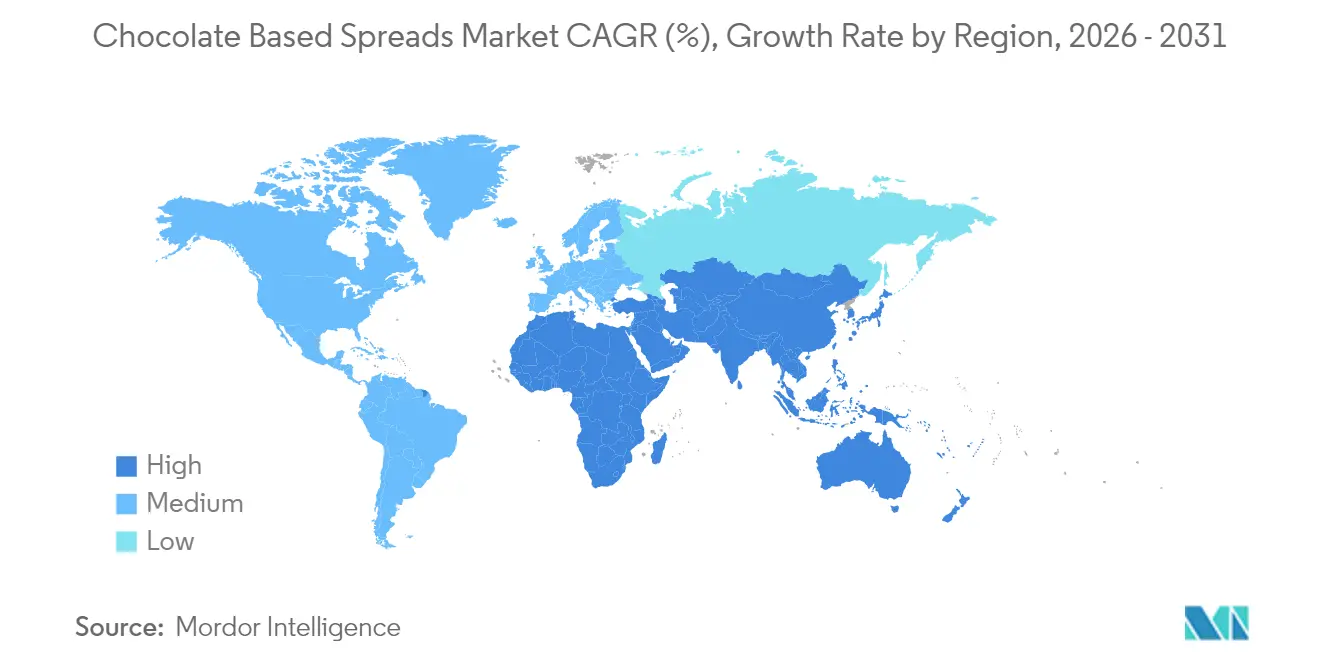
- By geography, Europe held a 43.85% share of the chocolate spread market size in 2025, while Asia-Pacific is advancing at a 6.98% CAGR to 2031.
Note: Market size and forecast figures in this report are generated using Mordor Intelligence’s proprietary estimation framework, updated with the latest available data and insights as of 2026.
Market Trends and Insights
Drivers Impact Analysis of Chocolate Based Spreads Market*
| Driver | (~) % Impact on CAGR Forecast | Geographic Relevance | Impact Timeline |
|---|---|---|---|
| Rising demand for convenient breakfast options | +1.2% | Global, with the strongest impact in North America and Asia-Pacific | Medium term (2-4 years) |
| Health-oriented product innovations | +0.9% | Europe and North America core, expanding to Asia-Pacific | Long term (≥ 4 years) |
| Increasing awareness of sustainability and clean-label products | +0.7% | Europe and North America, selective Asia-Pacific markets | Long term (≥ 4 years) |
| Rise in indulgence and premiumization trends | +1.1% | Global, with premium segments in developed markets | Medium term (2-4 years) |
| Influence of social media and food trends | +0.8% | Global, particularly strong in Asia-Pacific and North America | Short term (≤ 2 years) |
| Regional taste preferences and product localization | +0.6% | Asia-Pacific core, spill-over to Latin America, and Middle East, and Africa | Medium term (2-4 years) |
| Source: Mordor Intelligence | |||
Rising demand for convenient breakfast options
The global chocolate-based spreads market is driven by increasing demand for convenient breakfast options. With modern lifestyles becoming more fast-paced, consumers seek quick and easy-to-prepare foods without compromising taste or nutrition. Chocolate-based spreads align with this trend by offering a versatile solution for busy mornings. These spreads are commonly used on bread, pancakes, waffles, and as ingredients in smoothies and desserts, providing consumers with a quick and satisfying breakfast option. The convenience factor is particularly significant in regions with large working populations, such as the United Kingdom, where the Office for National Statistics recorded more than 34.2 million employed individuals in June 2025 [1]Source: Office for National Statistics, "Summary of labour market statistics", ons.gov.uk. This significant workforce demographic necessitates efficient breakfast solutions compatible with their professional schedules, consequently stimulating the demand for chocolate-based spreads.
Health-oriented product innovations
Health-oriented product innovations are a significant driving factor for the global chocolate-based spreads market as consumers increasingly seek products that combine indulgence with nutritional and clean-label benefits. Consumer awareness of health and wellness has increased the demand for spreads made with natural, organic, and non-GMO ingredients, without artificial flavors, additives, and palm oil. Manufacturers are developing products with reduced sugar content, added protein and vitamins, and options for specific dietary requirements, including vegan and gluten-free variants. These products appeal to health-conscious consumers who prioritize taste while maintaining a healthier lifestyle. For instance, in March 2023, Bonne Maman introduced a Hazelnut Chocolate Spread made with non-GMO ingredients, without artificial flavors and palm oil, demonstrating the industry's shift toward natural product formulations that align with consumer preferences for transparency, quality, and sustainability.
Increasing awareness of sustainability and clean-label products
The global chocolate-based spreads market is driven by increasing consumer awareness of sustainability and demand for clean-label products. Consumers prioritize products that are sustainably sourced, environmentally friendly, and transparently labeled, considering the environmental and social impact of their food choices. This consumer behavior has led manufacturers to implement ethical sourcing practices. The clean-label movement focuses on natural, minimally processed ingredients, attracting environmentally aware consumers. These preferences influence brand loyalty and drive companies to develop innovative products, contributing to market growth. According to the International Food Information Council (IFIC), 31% of consumers indicate that environmental sustainability significantly influences their food and beverage purchase decisions [2]Source: International Food Information Council (IFIC), "2024 IFIC Food & Health Survey", ific.org. This data demonstrates consumers' emphasis on sustainability, making it essential for chocolate-based spread manufacturers to develop eco-friendly, clean-label products that align with consumer expectations and sustainable development goals.
Rise in indulgence and premiumization trends
Consumer demand for premium and indulgent products continues to be a primary growth driver in the global chocolate-based spreads market. The increase in disposable income levels, coupled with accelerated urbanization and shifting consumer preferences, has generated substantial demand for high-quality chocolate spreads that deliver superior taste profiles and health benefits. Premium chocolate spread manufacturers have incorporated sophisticated ingredients, obtained organic certifications, and developed enhanced nutritional formulations, including omega fatty acid supplementation and sugar content reduction. In May 2023, Golden Penny Foods introduced a premium chocolate spread formulated with cocoa and fortified with omega-3 and omega-6 essential fatty acids, which demonstrate anti-inflammatory properties. This product development illustrates the industry's strategic approach to combining indulgence with nutritional benefits to address consumer requirements for premium, functional chocolate spreads.
Restraints Impact Analysis of Chocolate Based Spreads Market*
| Restraint | (~) % Impact on CAGR Forecast | Geographic Relevance | Impact Timeline |
|---|---|---|---|
| High and fluctuating raw material costs | -1.8% | Global, with severe impact on West Africa sourcing | Short term (≤ 2 years) |
| Stringent food safety and labeling regulations | -0.6% | Europe and North America, expanding globally | Medium term (2-4 years) |
| Intense competition and price wars | -0.9% | Global, particularly in mature markets | Medium term (2-4 years) |
| Supply chain and logistics challenges | -1.1% | Global, with critical nodes in West Africa and Europe | Short term (≤ 2 years) |
| Source: Mordor Intelligence | |||
High and fluctuating raw material costs
The global chocolate-based spreads market faces significant constraints due to high and fluctuating raw material costs. The primary ingredients, cocoa, sugar, and nuts, experience price volatility influenced by climate change, geopolitical tensions, supply chain disruptions, and varying agricultural yields. These price fluctuations increase production costs and create operational uncertainty for manufacturers, who must balance consumer pricing with profit margins. The premium and health-oriented segments face additional pressure from the higher costs of sustainable and organic raw materials. This cost instability affects market growth by limiting innovation investments, slowing capacity expansion, and particularly impacting smaller and mid-sized manufacturers who have reduced capacity to absorb price increases. According to the International Cocoa Organization (ICCO), cocoa prices reached approximately USD 9,876 per metric ton in April 2024, demonstrating the substantial price volatility that challenges cost management and pricing stability in the chocolate-based spreads market.
Stringent food safety and labeling regulations
Food safety and labeling regulations impose substantial constraints on the global chocolate-based spreads market. Regulatory authorities across jurisdictions implement comprehensive standards governing ingredient transparency, allergen declarations, nutritional content documentation, and permissible additive usage. Manufacturing entities must allocate significant capital towards product evaluation protocols, certification procedures, and quality assurance mechanisms to maintain compliance, thereby elevating operational expenditures. The heterogeneous regulatory framework across geographical regions presents operational complexities for international corporations in terms of product formulation, packaging specifications, and distribution protocols. Non-compliance can result in financial penalties, mandatory product withdrawals, and deterioration of brand equity. These regulatory prerequisites particularly impact smaller enterprises and prospective market entrants, potentially inhibiting product innovation and market expansion despite robust consumer demand.
*Our forecasts treat driver/restraint impacts as directional, not additive. The impact forecasts reflect baseline growth, mix effects, and variable interactions.
Chocolate Based Spreads Market Segment Analysis
By Product Type:
Hazelnut Dominance Faces Flavor InnovationThe hazelnut chocolate spreads segment maintains a dominant market position with a 51.72% share in 2025, attributed to increasing consumer preferences for premium confectionery products that deliver both nutritional value and superior taste characteristics. The segment's growth is supported by the widespread adoption of hazelnut chocolate spreads as versatile food accompaniments across multiple consumption occasions, including breakfast, snack periods, and dessert applications. In April 2023, Apis India's strategic introduction of its Hazelnut Chocolate Spread, positioned as a nutritionally optimized product featuring energy-enhancement properties, reduced cholesterol content, and elevated protein levels, illustrates the industry's response to evolving consumer requirements for functional indulgence products.
The chocolate spreads segment, comprising milk, white, and dark varieties, demonstrates the highest growth trajectory in the global chocolate spread market, with an anticipated CAGR of 6.64% through 2031. This expansion is attributed to the increasing consumer migration toward premium food products and heightened demand for gourmet chocolate varieties. Milk chocolate spreads maintain their market dominance due to their refined texture and established taste preferences. White and dark chocolate spreads are experiencing increased market penetration, driven by their documented health advantages and distinctive flavor characteristics.



By Packaging Type:
Convenience Drives InnovationPET and glass jars maintain a dominant market position with 67.65% share in 2025. Glass packaging demonstrates market leadership primarily through its established correlation with premium quality and product authenticity. The traditional glass jar format maintains significant market presence due to its association with heritage value and premium market positioning. Major international manufacturers, including Nutella and Biscoff, implement glass jar packaging for their chocolate spread products to maintain premium market positioning. Glass jars deliver substantial practical advantages, notably their reusability for storage applications, which resonates with environmentally conscious consumers. The combination of premium product presentation and reusability capabilities generates sustained consumer loyalty, particularly within established markets.
The squeeze bottle segment demonstrates significant market expansion in the chocolate-based spreads category, registering a CAGR of 7.39%. This growth trajectory corresponds directly to increasing consumer requirements for convenience and portability, specifically within urban consumer demographics. Squeeze bottle packaging demonstrates functional advantages through efficient dispensing mechanisms and enhanced mobility, establishing market relevance in convenience-oriented consumption patterns. The packaging configuration provides substantial surface area allocation for product information and operational instructions, thereby optimizing retail presence and consumer engagement metrics.
By Distribution Channel:
Digital Transformation AcceleratesSupermarkets and hypermarkets dominate the global chocolate-based spreads market distribution channels, accounting for 46.25% of the market in 2025. These retail formats serve as primary purchasing destinations due to their extensive reach and convenience. They offer a comprehensive selection of local and international chocolate spread brands at competitive prices. The ability to physically examine products before purchase particularly appeals to consumers buying food items like spreads. Regular promotional campaigns and discounts in these stores drive consistent sales through both planned and impulse purchases.
The online retail segment for chocolate-based spreads is growing at a CAGR of 8.25% in 2025. This growth aligns with increased global internet usage, as the International Telecommunication Union (ITU) reports that 5.5 billion people, representing 68% of the global population, were online in 2024, an increase from 65% in the previous year . The expanding internet access has improved consumer reach to e-commerce platforms, where chocolate spreads are purchased due to convenience, product variety, and competitive pricing. Online platforms enable consumers to compare brands, flavors, and packaging options, while offering discounts and product recommendations.
Geography Analysis
Europe Chocolate Based Spreads Market
Europe holds 43.85% market share in 2025, driven by traditional consumption patterns and established brand loyalty. The region's mature market generates consistent revenue despite limitations from market saturation and demographic trends. Germany, the United Kingdom, Italy, and France represent key markets with consumers preferring premium and artisanal products. Eastern European countries, particularly Poland, show growth potential through expanding middle-class populations and western-influenced consumption patterns.
APAC Chocolate Based Spreads Market
Asia-Pacific registers the highest growth rate at 6.98% CAGR through 2031, supported by urbanization, middle-class expansion, and changing breakfast habits favoring convenient nutrition options. China and India present significant market opportunities with developing consumption patterns, while Japan and Australia demonstrate mature markets with premium product preferences. Southeast Asian consumers show strong interest in premium offerings, particularly gourmet dark chocolate, creating opportunities for high-value products.
North America Chocolate Based Spreads Market
North America represents a mature market shaped by health-conscious consumers and demand for convenient breakfast options. The United States and Canada feature well-developed distribution networks and retail environments that facilitate premium product launches and brand expansions. Mexico shows emerging market characteristics with an expanding middle class and increasing adoption of international food trends through cultural and media exposure.

Regulatory Landscape
Chocolate-based spreads operate under food safety and labeling rules that vary by region. In the United States, the FDA requires facility registration for food manufacturers and compliance programs that include allergen labeling obligations, notably milk and tree nuts, plus foreign supplier verification for imported ingredients and finished goods.
In the European Union, the EU Deforestation Regulation (Regulation (EU) 2023/1115) introduces due diligence obligations for cocoa sourcing. Its general application starts on 30 December 2025, with a later 30 June 2026 effective date for micro and small undertakings, which increases the need for traceable, documented cocoa sourcing. Across international trade, Codex Alimentarius standards continue to shape safety and quality expectations.
Value Chain Analysis
The value chain begins with sourcing cocoa and nuts, where sustainability and traceability requirements influence supplier relationships. Programs such as the Cocoa & Forests Initiative (CFI) frame supplier engagement around deforestation-free cocoa, and compliance data increasingly includes geolocation information and legality checks to support access to regulated destinations.
Midstream processing is equipment-intensive, covering roasting, refining, conching, mixing, and filling into jars and squeeze bottles. Brands typically split production between in-house manufacturing and co-manufacturing to compress concept-to-shelf timelines and support localized flavors or healthier formulations (reduced sugar, palm-oil-free, vegan). In downstream channels, large players use supermarkets and hypermarkets for volume and visibility, while online retail increases assortment and supports more targeted launches. As a result, packaging integrity, shelf-life performance, and distribution network execution become recurring competitiveness factors.
Competitive Landscape
The global chocolate-based spreads market shows moderate concentration, with major companies maintaining substantial market share through established brand recognition and extensive distribution networks. Companies such as Ferrero International SpA, The Hershey Company, Mondelēz International, Inc., and Nestlé S.A. control significant portions of the market. These companies maintain their positions through global presence and effective marketing strategies that build consumer loyalty. Their competitive advantage stems from economies of scale and diverse product portfolios ranging from traditional hazelnut spreads to new formulations that address evolving consumer preferences.
Companies in the market are implementing technological solutions to optimize supply chains and develop alternative ingredients to address raw material cost fluctuations and sustainability requirements. Investment priorities include organic cocoa sourcing, palm oil reduction initiatives, and sustainable packaging development.
Market opportunities exist in developing health-conscious formulations, sustainable packaging solutions, and region-specific flavor variations that target distinct consumer groups and geographic markets. These developments enable product differentiation and market expansion by addressing specific consumer needs, creating growth potential within the competitive and consolidated market structure.
Chocolate Based Spreads Industry Leaders
-
Ferrero International SpA
-
The Hershey Company
-
Nestlé S.A.
-
Mondelēz International, Inc.
-
Mars, Incorporated
- *Disclaimer: Major Players sorted in no particular order

Chocolate Based Spreads Market Companies Covered in this Report
- Ferrero International SpA
- The Hershey Company
- Nestle S.A.
- Mondel?z International, Inc.
- Mars, Incorporated
- Gruppo Nutkao
- Dr. Oetker (Schwartau)
- Barefoot & Chocolate
- Nutiva Inc.
- Rigoni di Asiago
- Barry Callebaut AG
- Lotus Bakeries
- Lindt & Sprungli
- Kraft Heinz Co.
- Swasthum Wellness Pvt Ltd
- Venchi S.p.A.
- Hero Group
- Brinkers Food
- Wilhelm Reuss
- Ligao Foods

Market Opportunities and Future Outlook
Product and supply-chain localization supports faster replenishment and tighter execution near end markets. This is reflected in Ferrero North America opening a USD 75 million Nutella Peanut production line at Franklin Park, Illinois, aimed at supporting broader retail rollouts.
Regulation-driven traceability and sustainability programs also increase demand for documentation at scale under the EU Deforestation Regulation timeline (general application 30 December 2025; 30 June 2026 for micro and small undertakings). Innovation continues to add where formulation constraints matter, with Barry Callebaut integrating AI-enabled recipe development capabilities with NotCo to support reformulation for clean-label, reduced-sugar, and palm-oil-free demand while maintaining sensory performance.
Recent Industry Developments in Chocolate Based Spreads Market
- June 2026: Ferrero Group announced a 60 million euro industrial expansion program in France, covering production and logistics upgrades and additions such as a new 3 kg Nutella packaging line for professional channels and investment tied to Nutella Cookies capacity. The program strengthens Ferrero's European manufacturing footprint and broadens how the Nutella brand is served across retail and out-of-home formats.
- April 2026: Ferrero North America opened a USD 75 million Nutella Peanut production line at its Franklin Park, Illinois facility. The opening establishes U.S.-based manufacturing for a Nutella variant, improving supply responsiveness and creating a platform for additional localized product development.
- September 2024: Ferrero introduced a plant-based Nutella product in European supermarkets. The launch extends the brand into dairy-free positioning and supports portfolio diversification aligned with vegan and flexitarian consumer demand within mature retail markets.


Chocolate Based Spreads Market Report Scope and Research Methodology
Market Definition and Coverage
This market covers sales of chocolate-based spreads that are made to stay spreadable at room temperature and are consumed as a topping or filling, commonly with bread and other grain-based foods. The estimates are captured in current USD across major regions for the stated years.
Scope exclusions: We exclude solid chocolate bars and blocks, chocolate syrups and sauces that are mainly poured, and industrial chocolate ingredients that are not sold as a ready-to-eat spreadable paste.
Segments Covered in This Report
-
By Product type
- Hazelnut Chocolate Spread
- Peanut Chocolate Spread
- Chocolate Spread (Milk, White, and Dark)
- Others
-
By Packaging Type
- PET/Glass Jars
- Squeeze Bottles
- Pouches
- Others
-
By Distribution Channel
- Supermarkets/Hypermarkets
- Convenience Stores
- Online Retail Stores
- Other Distribution Channel
-
By Geography
-
North America
- United States
- Canada
- Mexico
- Rest of North America
-
Europe
- Germany
- United Kingdom
- Italy
- France
- Spain
- Netherlands
- Poland
- Belgium
- Sweden
- Rest of Europe
-
Asia-Pacific
- China
- India
- Japan
- Australia
- Indonesia
- South Korea
- Thailand
- Singapore
- Rest of Asia-Pacific
-
South America
- Brazil
- Argentina
- Colombia
- Chile
- Peru
- Rest of South America
-
Middle East and Africa
- South Africa
- Saudi Arabia
- United Arab Emirates
- Nigeria
- Egypt
- Morocco
- Turkey
- Rest of Middle East and Africa
-
North America
Data Sources, Market Sizing, and Validation
Desk Research
Desk research was used to set the demand context and to anchor model inputs that do not change sharply from one year to the next. We referred to public sources such as FAOSTAT, UN Comtrade, World Bank indicators, national statistics offices, and selected trade association releases that touch on spreads and confectionery consumption.
To keep the sizing grounded, company annual reports and investor presentations were reviewed for category commentary, pricing behavior, and region-level revenue cues, followed by reputed press coverage to track promotions and new launches. We also used paid subscriptions for company financials and intelligence, plus a patent database to sense formulation and packaging directions that can influence product mix. These desk research examples are illustrative only, and many other sources were also used during data collection, validation, and research clarification.
Primary Interviews and Surveys
Primary work was done through structured expert interviews and surveys with manufacturers, distributors, retailers, and selected foodservice participants across major regions, so assumptions from desk research could be tested and corrected. These discussions helped us validate what is counted as a chocolate-based spread in real trade, how pack sizes and channel margins affect pricing, and how online versus store-based sales are trending.
Distribution of primary research fieldwork respondents
| Company type | Respondent position | Region |
|---|---|---|
| Top tier: 32% | CXOs: 17% | APAC: 41% |
| Mid tier: 50% | Functional/Unit leaders: 39% | EMEA: 34% |
| Smaller Players: 18% | Managers: 44% | Americas: 25% |
Market-Sizing & Forecasting
The core model starts with a top-down build where bread and similar carrier-food consumption, category penetration, and per-capita usage assumptions are combined to reconstruct the addressable demand by region, which is then priced using region-wise average selling price ranges. After the first pass, totals were checked through selective bottom-up approximations, such as sampling shelf prices by pack type and channel, and then multiplying by implied volumes to confirm the direction and scale.
Inputs that materially shape the model include distribution channel mix (supermarkets versus convenience and online), typical pack sizes and price ladders, premiumization rates in key markets, and raw material pressure (notably cocoa and sugar) that influences shelf pricing and promotions. Forecasts were developed using scenario analysis, where the base case and two sensitivity cases were aligned to what interviewees expect on pricing progression, consumption frequency, and channel shifts over the forecast window. Where direct signals were limited for smaller countries, proxy assumptions were used based on similar income levels and retail structure, and then adjusted using primary feedback so the totals stayed realistic.
Data Validation & Update Cycle
Outputs were validated through repeated checks, including comparing implied per-capita consumption against diet patterns and assessing whether price movement matches observed commodity and retail signals. When a region or channel result looked inconsistent, the underlying inputs were re-reviewed, and follow-up calls were done to confirm whether the gap was real or caused by a definition mismatch.
The report is refreshed annually, and interim updates are made when material events occur, such as major pricing resets, regulation changes affecting ingredients, or sizable capacity and distribution changes. Before delivery, a final analyst pass is completed so clients receive the latest updated view.
Mordor Intelligence's Global Chocolate Based Spreads Market Market Size Compared Against Other Published Estimates
Published market values for chocolate-based spreads can vary even when the category name sounds the same, because the counted products, base years, and pricing build-ups are often different. Some sources also mix adjacent sweet toppings into the same bucket, which can shift the demand pool before any forecasting assumptions are applied.
Other differences come from how foodservice is treated, whether growth is modeled with a flat price uplift or a pack and channel mix shift, and how currency conversion timing is handled for multi-region totals. Update cadence matters too, since cocoa-linked pricing cycles can change the current-year value faster than consumption changes.
Benchmark comparison
| Source | Market Size | Gaps in Research Methodology |
|---|---|---|
| Mordor Intelligence | USD 3.62 B (2026) | |
| Market Analytics Firm A | USD 2.82 B (2024) | Uses a 2024 valuation year and a lower assumed price and mix uplift through the forecast window, which can reduce the later-year value when retail pricing has stepped up in multiple regions. |
| Industry Publisher B | USD 2.40 B (2024) | Defines the category as chocolate spread revenue with a 2024 base year, and may treat some spread-like toppings and flavor variants differently, which changes what gets included in the total. |
The table shows a clear year alignment issue, since two figures are anchored in 2024 while the baseline here is stated for 2026, and in Mordor Intelligence's model only spreadable, non-solidifying chocolate-flavored paste products are counted, excluding syrups and solid chocolates. With those inclusions kept consistent, the remaining variation mostly comes from price progression, channel mix, and how quickly assumptions are refreshed when shelf prices move.


Key Questions Answered in the Report
What is the projected value of the chocolate spread market in 2031?
The chocolate spread market is projected to reach USD 4.81 billion by 2031.
Which region is growing fastest for chocolate spreads?
Asia-Pacific is expanding at a 6.98% CAGR through 2031, making it the fastest-growing region.
Why are squeeze-bottle formats gaining popularity?
Squeeze bottles support on-the-go consumption and mess-free application, leading the packaging segment at a 7.39% CAGR.
How are cocoa price spikes affecting manufacturers?
Record-high cocoa costs compress margins and prompt strategies such as partial cocoa substitution, hedging, and supply-chain diversification.
Page last updated on:


 Your data is secure and never sold or shared.


