
Chipless RFID Market Size and Share
Market Overview
| Study Period | 2021 - 2031 |
|---|---|
| Market Size (2026) | USD 2.16 Billion |
| Market Size (2031) | USD 6.49 Billion |
| Growth Rate (2026 - 2031) | 24.68 % |
| Fastest Growing Market | Middle East and Africa |
| Largest Market | Asia Pacific |
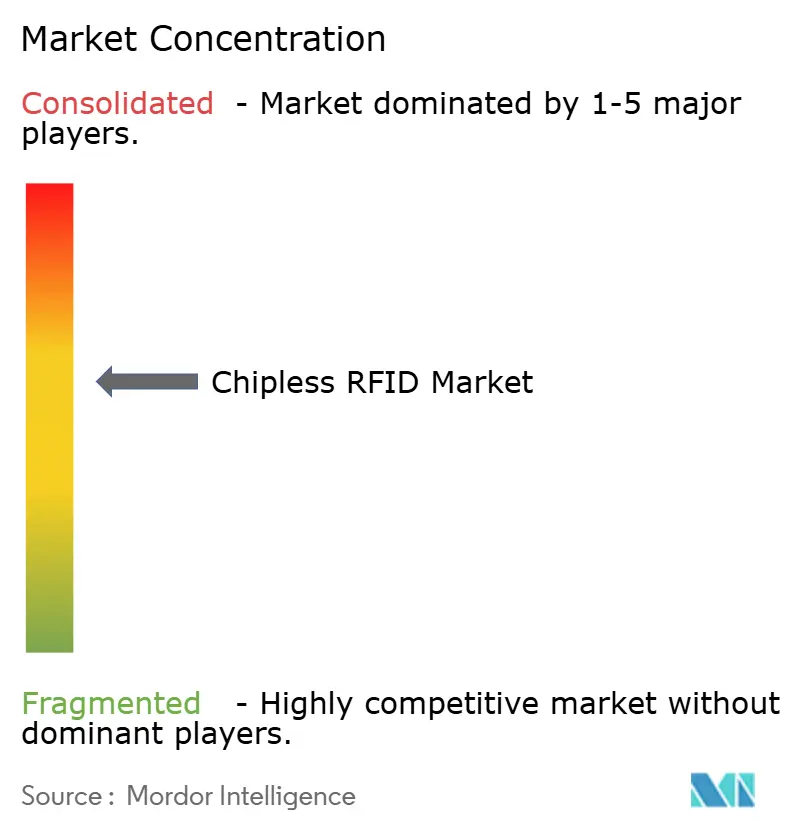
| Market Concentration | Medium |
Major Players
*Disclaimer: Major Players sorted in no particular order Image © Mordor Intelligence. Reuse requires attribution under CC BY 4.0. |
|
Chipless RFID Market Analysis by Mordor Intelligence
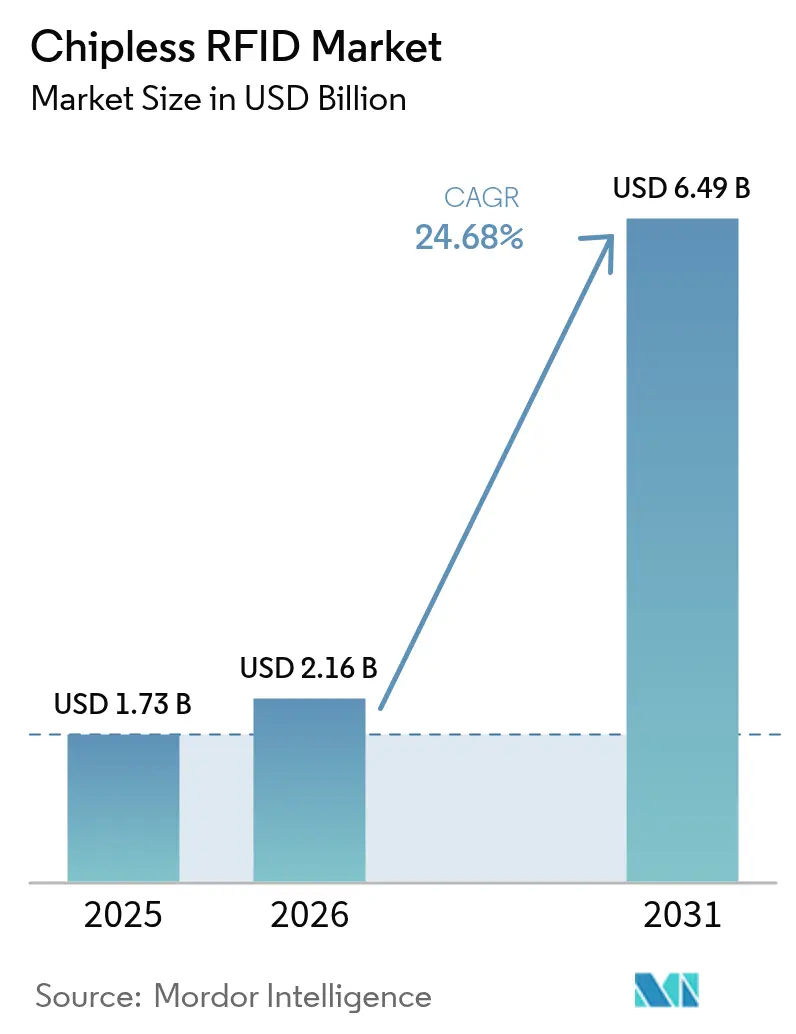
The chipless RFID market size was valued at USD 1.73 billion in 2025 and estimated to grow from USD 2.16 billion in 2026 to reach USD 6.49 billion by 2031, at a CAGR of 24.68% during the forecast period (2026-2031). Demand acceleration stems from fast-moving consumer-goods packaging in Asia, stricter authentication regulations in Europe and the Middle East, and advances in printable conductive inks that have cut per-tag manufacturing costs below USD 0.05. Leadership in low-cost authentication solutions, longer read-range antenna designs, and passive temperature-sensing features is reshaping competitive priorities. Suppliers are expanding vertically into inks, substrates, and middleware in order to safeguard margins and offer one-stop solutions. Convergence with blockchain and cold-chain monitoring platforms is opening additional revenue streams in regulated industries.
Key Report Takeaways
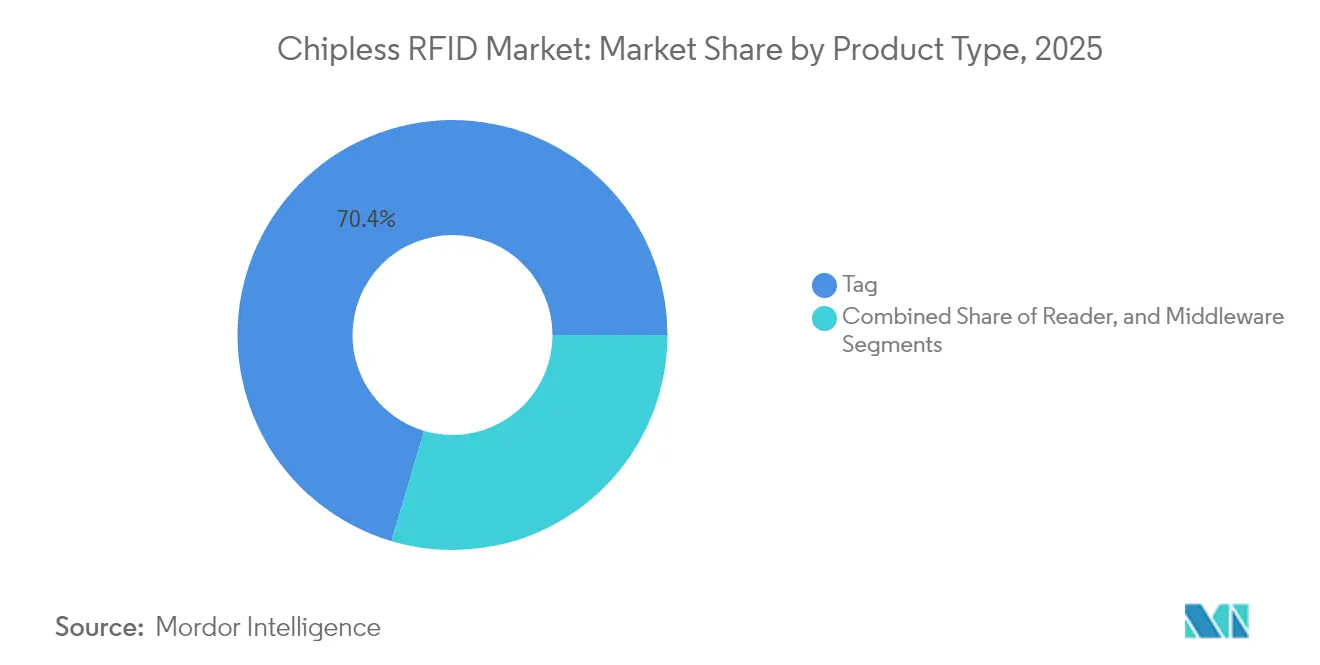
- By product type, tags held 70.42% of the chipless RFID market share in 2025, while middleware is projected to expand at a 26.05% CAGR to 2031.
- By printing technology, screen printing led with 37.35% revenue share in 2025; ink-jet printing is forecast to advance at a 27.15% CAGR through 2031.
- By operating frequency, HF commanded 51.25% share of the chipless RFID market size in 2025, whereas UHF is expected to grow at 26.6% CAGR during 2026-2031.
- By material, silver-nano inks accounted for 61.10% of the chipless RFID market size in 2025; graphene-based inks record the highest projected CAGR at 27.4% to 2031.
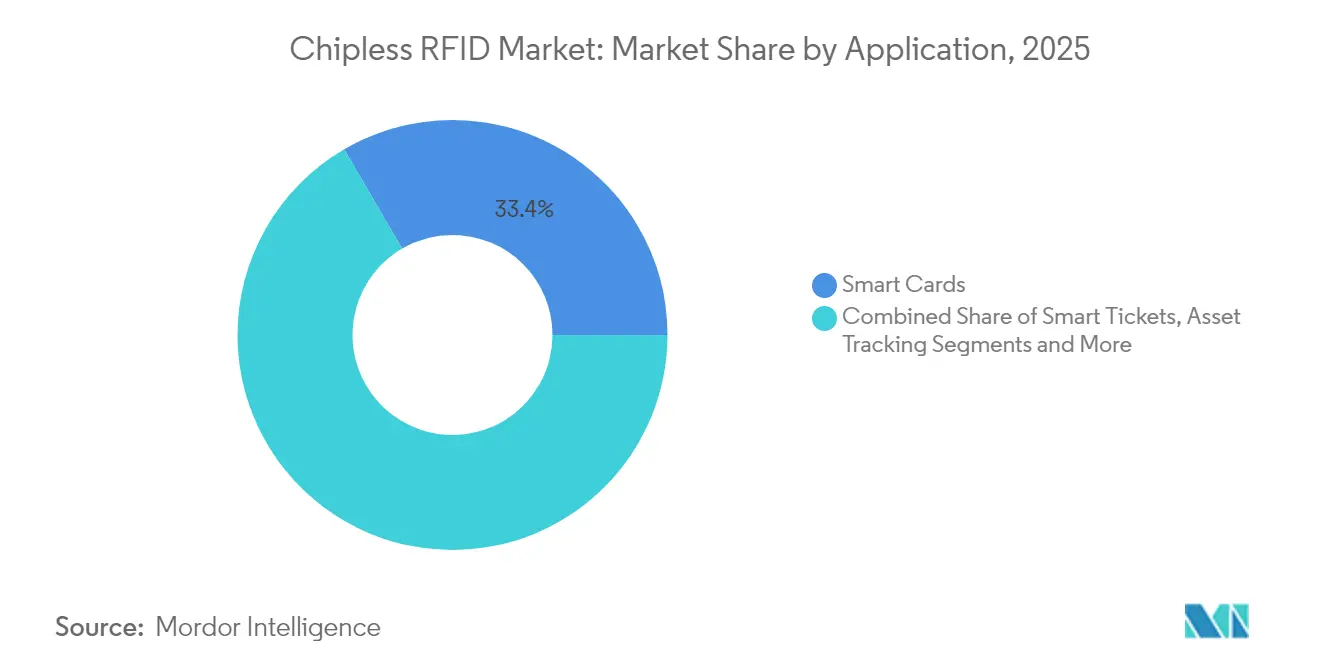
- By application, smart cards captured 33.40% of the chipless RFID market size in 2025, and brand & document authentication is accelerating at a 27.55% CAGR to 2031.
- By end-user industry, retail held 28.55% revenue share in 2025; healthcare & pharmaceuticals is forecast to expand at a 29.0% CAGR through 2031.
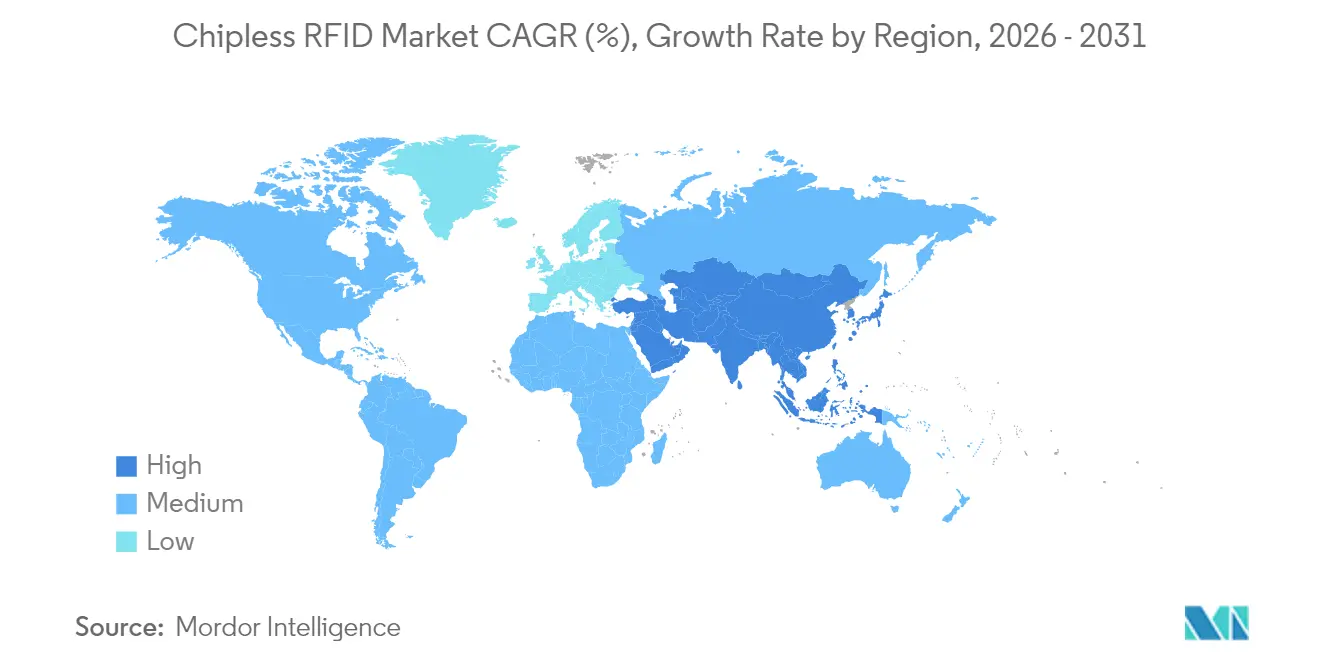
- By geography, Asia Pacific owned 39.30% of the chipless RFID market size in 2025, while the Middle East & Africa is poised for the highest regional CAGR at 26.9% to 2031.
Note: Market size and forecast figures in this report are generated using Mordor Intelligence’s proprietary estimation framework, updated with the latest available data and insights as of 2026.
Market Trends and Insights
Drivers Impact Analysis of Chipless RFID Market*
| Driver | (~) % Impact on CAGR Forecast | Geographic Relevance | Impact Timeline |
|---|---|---|---|
| Lower-cost Mass-production of IC-less Tags in Asian FMCG Packaging | +6.2% | Asia Pacific core, spill-over to global FMCG | Medium term (2-4 years) |
| Government Excise/Tax-stamp Mandates (EU Counter-feiting) | +4.8% | Europe & Middle East, expanding to emerging markets | Long term (≥ 4 years) |
| Printable Conductive-Ink Advances in North American Label Converting | +5.1% | North America & EU, technology transfer to APAC | Short term (≤ 2 years) |
| Passive Sensor Adoption for Cold-chain Healthcare Logistics | +3.9% | Global, with concentration in developed markets | Medium term (2-4 years) |
| Banknote & Secure-Document Authentication Demand (Middle East) | +2.7% | Middle East & Africa, selective adoption globally | Long term (≥ 4 years) |
| Source: Mordor Intelligence | |||
Lower-cost Mass Production of IC-less Tags in Asian FMCG Packaging
Manufacturers in China and Southeast Asia have combined flexible substrates with silver-nano paste to reach sub-5-cent tags, positioning the chipless RFID market for high-volume adoption in consumer-goods multipacks. Contract printers are running multi-lane flexographic lines at speeds above 120 m/min, allowing over 2 billion units per plant annually. Fast payback on retrofits and geographic proximity to packaging converters accelerate uptake. Suppliers are piloting recyclable cellulose substrates to align with brand sustainability targets. As costs fall, single-use tags are extending into disposable electronics and unit-dose pharmaceutical packs.
Government Excise / Tax-stamp Mandates
EU loss estimates of EUR 16 billion (USD 17.3 billion) in counterfeited goods prompted Directive 2024/1640, which endorses tamper-evident identifiers with unique RF signatures.[1]European Union Intellectual Property Office, “Economic Impact of Counterfeiting in the Clothing, Cosmetics, and Toy Sectors in the EU,” euipo.europa.eu Ministries of finance in Italy, Spain, and Saudi Arabia now specify chipless formats for alcohol and tobacco stamps so printers can embed security in a single press pass. Long-run contracts incentivise end-to-end traceability platforms and open replacement cycles for high-resolution readers. Similar legislation is under review in ASEAN, suggesting a second wave of demand by 2028.
Printable Conductive-Ink Advances in North American Label Converting
Silver nanoparticle and graphene hybrid inks have reached sheet resistances below 10 mΩ/□ at 80 °C sintering, enabling narrow-line antennas printed on standard BOPP labels without separate ovens. [2]Tamara Tomašegović et al., “Fine-Tuning Flexographic Ink’s Surface Properties,” doi.orgUS converters integrate digital front ends that switch from CMYK to conductive layers within the same job queue, lowering downtime. Partnerships with ink makers secure exclusive formulations, creating entry barriers. The approach reduces capex for new players yet raises intellectual property complexity that favours incumbents with patent portfolios.
Passive Sensor Adoption for Cold-chain Healthcare Logistics
Copper-doped ionic-liquid sensors link temperature excursions directly to a tag’s phase response, producing an immutable history for biologics during transit. Global distributors integrate GS1 EPCIS event structures, allowing regulators to audit chain-of-custody in near real time. [3]GS1 US, "Standards & Sensors for Visibility in the Pharmaceutical Cold Chain," documents.gs1us.org Hospitals receive automated alerts through existing RFID gateways, avoiding active data loggers and batteries. The cost profile fits vaccine campaigns and cell-therapy shipments, while blockchain pilots aim to secure data integrity.
Restraints Impact Analysis of Chipless RFID Market*
| Restraint | (~) % Impact on CAGR Forecast | Geographic Relevance | Impact Timeline |
|---|---|---|---|
| Limited Read Range vs. Chipped UHF Systems | -3.4% | Global, particularly in logistics applications | Short term (≤ 2 years) |
| Absence of Harmonised ISO/IEC Encoding Standards | -2.1% | Global, with regional variation in adoption | Long term (≥ 4 years) |
| Retrofit Cost of Reader Infrastructure | -1.8% | Developed markets with existing RFID infrastructure | Medium term (2-4 years) |
| Moisture & Abrasion Vulnerability of Printed Antennas | -1.2% | Global, with higher impact in harsh environments | Short term (≤ 2 years) |
| Source: Mordor Intelligence | |||
Limited Read Range versus Chipped UHF Systems
Chipless tags typically peak at 3 m in free air, compared with over 10 m for chipped UHF tags, forcing warehouses to increase reader density, which can double infrastructure budgets. Multi-layer metamaterial antennas now in prototype add 40% range, yet metallic racks and liquid contents still attenuate signals. Integrators respond with zone-based portals and hybrid deployments, reserving chipless tags for package-level items while pallets continue to carry chipped inlays.
Absence of Harmonised ISO / IEC Encoding Standards
Proprietary encoding schemes fragment middleware development and complicate cross-border shipments. Retailers running multi-supplier imports must map five or more tag signatures into a single ERP instance. Industry groups work on a unifying data model, but spectrum coordination challenges in the 860-960 MHz range delay ratification. Until a standard is formalised, large buyers hedge by dual-sourcing or favour vendors with open-source firmware.
*Our forecasts treat driver/restraint impacts as directional, not additive. The impact forecasts reflect baseline growth, mix effects, and variable interactions.
Chipless RFID Market Segment Analysis
By Product Type:
Tags Remain Core While Middleware Gains GroundTag sales generated 70.42% of 2025 revenue, underscoring their indispensability across every deployment scenario in the chipless RFID market. Asian contract printers leverage scale to drive unit costs down, while European security printers focus on high-value authenticators. Middleware revenues, although smaller today, are set to climb faster at a 26.05% CAGR because enterprises require cloud connectors, data cleansing, and analytics to turn raw RF echoes into actionable dashboards.
Accelerated middleware growth alters bargaining power; software vendors now influence hardware design road maps and push for open APIs. As a result, tag manufacturers invest in data-services teams to defend share. The trend positions middleware as a gatekeeper for future functionality such as predictive maintenance and AI-based signature matching.



By Printing Technology:
Ink-jet Precision Challenges Screen DominanceScreen printing held a 37.35% share in 2025 thanks to long-run productivity and mature supply chains, especially within food and beverage packaging. The chipless RFID market now sees ink-jet processes expanding at 27.15% CAGR because droplet-on-demand heads create fine-line antennas suitable for high-density signature encoding.
Ink-jet adoption also supports on-site customisation. Brand owners can print limited-edition authenticity marks days before product launch, cutting obsolescence risk. Screen lines keep their advantage in very high-volume SKUs where tooling amortisation offsets changeover costs. Hybrid lines that start with screen for ground planes and finish with ink-jet for micro-antennas are gaining traction, reflecting a transition phase rather than outright displacement.
By Operating Frequency:
UHF Momentum Builds Behind HF Install BaseHF frequencies dominated with 51.25% of 2025 revenue because payment, ticketing, and secure access ecosystems already employ 13.56 MHz readers. UHF, however, is forecast to rise at 26.6% CAGR as antenna breakthroughs mitigate near-metal detuning and extend read windows beyond 5 m, crucial for warehouse portals.
Dual-frequency tags are emerging; they carry HF for consumer NFC interactions and UHF for logistics checkpoints, helping brand owners justify a single label across the product life cycle. LF maintains niche roles in livestock tracking and liquid-filled container identification where penetration depth outweighs data-rate needs.
By Material:
Silver-Nano Leads Yet Graphene AdvancesSilver-nano inks supplied 61.10% of antenna coatings in 2025 owing to unmatched conductivity and compatible curing profiles. The chipless RFID market is witnessing rapid progress in graphene and carbon nanotube alternatives that target cost and sustainability concerns. Graphene prints drop silver loading by up to 80%, lowering exposure to price volatility while reducing environmental impact.
Copper formulations cater to disposable tags in ultra-high-volume retail units where brief shelf life overshadows oxidation risks. Material selection is now part of corporate ESG scorecards, compelling suppliers to document lifecycle carbon footprints and recycling pathways.
By Application:
Smart Cards Hold Lead While Authentication SurgesSmart cards contributed 33.40% of 2025 revenue, benefiting from ongoing EMV migration and mass transit upgrades. Authentication applications, however, will outpace all others at a 27.55% CAGR as governments and brands confront counterfeiting losses. MIT-developed terahertz-encoded tags promise forensic-grade security levels suitable for luxury goods and pharmaceuticals.
Diversification into asset tracking and smart tickets widens the total addressable demand. Bundled offerings that include cloud dashboards and mobile readers lower entry barriers for small and mid-sized enterprises that lack internal RFID expertise.
By End-user Industry:
Retail Leads, Healthcare AcceleratesRetail and e-commerce retained a 28.55% share in 2025. Grocery chains in North America demonstrated inventory-shrink reduction after deploying paper-based chipless labels at the item level. Healthcare & pharmaceuticals, poised for a 29.0% CAGR, benefit from mandatory cold-chain tracking rules and rising biologic therapy volumes.
Logistics operators integrate disposable chipless tags for last-mile parcels, complementing reusable chipped tags on pallets. Government agencies test chipless identifiers for national ID programs, while BFSI firms evaluate document security use cases.
Geography Analysis
APAC Chipless RFID Market
Asia Pacific led the chipless RFID market with 39.30% revenue in 2025. China’s converters run integrated screen and flexographic lines, serving domestic and export FMCG brands, while Japanese rail operators extend RFID-enabled fare systems to rural routes. Australia’s postal service is trialling chipless tags on cross-border parcels to cut declaration fraud. Regional governments co-fund research into biodegradable substrates, aligning with zero-plastic directives.
North America Chipless RFID Market
North America follows with strong intellectual-property portfolios and an early-adopter customer base in healthcare and aerospace. Universities collaborate with start-ups to commercialise graphene inks, and federal grants support secure supply chains for biologics and critical spare parts. Supermarket chains deploy chipless tags to reduce perishables wastage and tie item-level data into ESG reporting.
EMEA Chipless RFID Market
Europe ranks third yet posts steady gains driven by anti-counterfeiting mandates. Tax-stamp programs in Italy and Poland stipulate chipless RF security layers. Nordic packaging firms integrate paper inlays to meet circular-economy targets, and German machine builders ship modular ink-jet heads to Asian OEMs. The Middle East & Africa region, while smaller today, is the fastest growing; GCC central banks standardise banknote RF authentication and South African customs rolls out chipless seals on high-value exports.

Regulatory Landscape
The regulatory environment shaping chipless RFID deployments is tightening around traceability, product authentication, and data integrity, with requirements increasingly influenced by standards bodies and supranational programs. In the European Union, the Ecodesign for Sustainable Products Regulation (ESPR, EU) 2024/1781 and the Digital Product Passport (DPP) framework elevate the role of machine-readable data carriers, including RFID, in cross-border product compliance; in April 2026, CEN/CENELEC JTC 24 voted to adopt six harmonized standards to support DPP implementation. In parallel, government revenue-protection and anti-counterfeiting programs in Europe and parts of the Middle East continue to specify tamper-evident identifiers (including RF-based security features) for excise and tax-stamp use cases, aligning with the report’s authentication-driven demand focus.
Security and assurance requirements also influence adoption in regulated environments. ISO/IEC continued updating RFID security services through the ISO/IEC 29167 series, with ISO/IEC 29167-22:2026 (SPECK) and ISO/IEC 29167-13:2026 (Grain-128A) published in March 2026 to specify cryptographic suites for RFID air-interface security services, reinforcing procurement emphasis on authenticated, integrity-protected data flows. In the United States, federal guidance such as NIST SP 800-98 and DHS 4300A Sensitive Systems policy requirements places RFID systems under formal security authorization, including Authorizing Official approval of the technology and implementation, which affects reader and middleware hardening and the selection of cryptographic controls when RFID is used in sensitive applications.
Value Chain Analysis
The chipless RFID value chain starts with conductive materials and substrates and then moves through tag design and encoding, high-volume printing and converting, and system integration across readers, antennas, and middleware. Upstream inputs include silver-nano, copper-based, and graphene or carbon inks and printable substrates such as paper, BOPP films, and specialty foils. Downstream converting leverages established label and packaging operations using screen, flexographic, gravure, and ink-jet processes to embed resonant structures at packaging-line speeds. Midstream value capture is increasingly tied to IP (signature design, antenna structures, and material formulations) and process capability (curing and sintering profiles, and registration accuracy), while downstream monetization is shifting toward middleware that normalizes RF signatures into enterprise events and connects to track-and-trace platforms.
Bottlenecks and margin pressure points are concentrated in interoperability and infrastructure. The absence of harmonized encoding standards for chipless RFID fragments middleware development and complicates cross-border deployments. Reader retrofits and performance constraints around metal and liquid attenuation also add cost in logistics-heavy environments. To address this, suppliers and integrators increasingly use hybrid architectures, applying chipless technology at item or pack level while using conventional RFID at pallet or asset level, and pursuing vertical integration into inks, substrates, and software to protect profitability and control performance. Partnering around adjacent battery-free identification and sensing inlays, including inlay makers aligning with ambient IoT sensor platforms, further reinforces converters and software partners as gatekeepers for scalable deployments.
Competitive Landscape
The chipless RFID market shows moderate fragmentation. The top five players control about 45% of global revenue through integrated portfolios that span inks, substrates, antenna IP, and middleware. Avery Dennison leverages materials expertise to secure multi-year agreements with grocery and apparel leaders, while Impinj invests in reader chipsets that interpret both chipped and chipless signatures, anchoring an ecosystem lock-in effect.
Emerging entrants concentrate on graphene and metal-compatible antenna architectures, often licensing patents from university labs. These challengers form joint ventures with regional converters to gain scale without heavy capex. M&A activity targets software and analytics specialists, evident in the Seagull-Mojix merger that created an end-to-end visibility stack.
Strategic road maps emphasise sustainability credentials, with players marketing plastic-free inlays and low-energy curing processes. Intellectual-property assertions rise, especially around ink chemistries and dual-frequency structures. Large buyers mitigate vendor risk by insisting on escrowed manufacturing files and performance warranties.
Chipless RFID Industry Leaders
-
Alien Technology Corporation
-
Zebra Technologies Corporation
-
Avery Dennison Corporation
-
SATO Holdings
-
Smartrac Technology
- *Disclaimer: Major Players sorted in no particular order
Chipless RFID Market Companies Covered in this Report
- Alien Technology
- Avery Dennison
- Zebra Technologies
- SATO Holdings
- Smartrac Technology
- NXP Semiconductors
- Thinfilm Electronics ASA
- PragmatIC Semiconductor
- Impinj Inc.
- Stora Enso
- Spectra Systems Corp.
- Linxens
- TagSense
- Tageos SA
- Variuscard GmbH
- IDTRONIC GmbH
- SML Group
- Toppan Printing Co.

Market Opportunities and Future Outlook
Near-term opportunities center on lowering deployment friction, particularly reader cost and interoperability, while moving chipless RFID beyond pilot programs in packaging and authentication into repeatable, multi-site rollouts. A concrete signal arrived in February 2026, when Idyllic Technology introduced a smaller 24x24 mm chipless RF Barcode tag for item-level applications, including fresh produce and cosmetics, and also communicated reader cost reductions targeted at parity with conventional RFID readers. This combination broadens the workable set of packaging formats, including smaller labels, curved containers, and use cases with limited real estate, and supports adoption where optical codes are constrained by line-of-sight requirements.
Opportunity is also building around compliance-driven traceability and security-focused applications, where product identity needs to remain durable, tamper-evident, and machine-readable across supply chains. The EU’s ESPR-driven DPP push, including the April 2026 CEN/CENELEC JTC 24 vote to adopt harmonized standards for DPP, creates a clearer path for integrating RFID-enabled identifiers as part of standardized product data exchange. Another area of traction is sensing-enabled chipless tags for cold-chain and regulated logistics, where passive temperature-excursion features can be integrated into existing RFID gateways and normalized through standards-aligned event models, including GS1 EPCIS structures referenced in industry adoption. Progress depends on alignment across tag physics (read range, selectivity, and resilience on metal and liquids), security services (ISO/IEC 29167 updates), and middleware abstraction layers that reduce signature fragmentation across suppliers.
Recent Industry Developments in Chipless RFID Market
- April 2026: Alien Technology raised USD 7.1 million in funding to accelerate R&D and expand its RFID market reach. The infusion supports product and engineering execution as low-cost tags, readers, and software move into more integrated solutions, which can reshape competitive positioning across identification and traceability deployments.
- February 2026: Idyllic Technology launched a 24x24 mm chipless RF Barcode tag aimed at item-level tagging, including categories such as fresh produce and cosmetics. The company also announced reductions in RF Barcode reader hardware costs, targeting parity with conventional RFID readers, which directly lowers barriers to broader deployments that have been constrained by specialized reader economics.
- October 2024: Seagull merged with Mojix to form a broader end-to-end traceability software stack that complements low-cost identifiers used in supply chain visibility programs. The merger consolidates middleware and analytics capabilities and strengthens the role of software platforms as integration hubs for heterogeneous tag and reader environments.


Chipless RFID Market Report Scope and Research Methodology
Market Definition and Coverage
This market is defined as revenues generated from chipless RFID solutions that store and communicate identity or sensing information without a silicon chip, including the tags, reader hardware, and supporting middleware used to read and interpret the signal.
Scope exclusions: We do not count conventional chipped RFID tags or NFC products where a silicon IC is the core identifier.
Segments Covered in This Report
-
By Product Type
- Tag
- Reader
- Middleware
-
By Operating Frequency
- LF (125-134 kHz)
- HF (13.56 MHz)
- UHF (860-960 MHz)
-
By Material
- Silver-nano Ink
- Copper-based Ink
- Graphene/Carbon Ink
-
By Application
- Smart Cards
- Smart Tickets
- Brand and Document Authentication
- Asset Tracking
-
By End-user Industry
- Retail and E-commerce
- Healthcare and Pharmaceuticals
- Logistics and Transportation
- Banking, Financial Services and Insurance (BFSI)
- Government and Public Sector
-
By Geography
-
North America
- United States
- Canada
- Mexico
-
South America
- Brazil
- Argentina
- Rest of South America
-
Europe
- United Kingdom
- Germany
- France
- Italy
- Spain
- Russia
- Rest of Europe
-
Asia Pacific
- China
- Japan
- South Korea
- India
- Australia
- Rest of Asia Pacific
-
Middle East and Africa
- GCC
- South Africa
- Rest of Middle East and Africa
-
North America
Data Sources, Market Sizing, and Validation
Desk Research
Desk work starts by building a practical fact base on RFID adoption and the enabling ecosystem for printed electronics. We typically refer to public sources such as ITU radio spectrum material, ISO/IEC identification standards, U.S. FCC equipment authorization references, and European Commission documents on product traceability and labeling. To keep the demand picture grounded, we also use sources like UN Comtrade trade statistics, national customs releases, and packaging and logistics association publications that track item-level marking and shipment flows.
Company filings, investor presentations, and credible press coverage are then used to map product readiness, pricing direction, and target applications like authentication, smart tickets, and asset tracking. Where it helps, paid subscriptions for company financials and intelligence, patent databases, and shipment-level import and export records are used to cross-check capacity signals and technology momentum without forcing the model to match them. These examples are illustrative only, and many other public and paid sources were reviewed for data collection, validation, and clarification.
Primary Interviews and Surveys
Primary work is used to test what we built from public data and to fill gaps on real adoption timing, price erosion, and where chipless options are actually being specified. We spoke with a mix of tag and materials ecosystem participants, reader and solution providers, and end users across retail and logistics, healthcare, industrial tracking, and authentication use cases, with coverage across APAC, EMEA, and the Americas.
Distribution of primary research fieldwork respondents
| Company type | Respondent position | Region |
|---|---|---|
| Top tier: 31% | CXOs: 14% | APAC: 39% |
| Mid tier: 51% | Functional/Unit leaders: 42% | EMEA: 37% |
| Smaller Players: 18% | Managers: 44% | Americas: 24% |
Market-Sizing & Forecasting
Our sizing logic starts from a top-down demand pool view where RFID use cases are reconstructed by application intensity and the feasible substitution of chipless tags, then translated into revenue using typical price bands for tags, readers, and middleware. The totals are checked using selective bottom-up approximations, such as sampled average selling price ranges multiplied by implied tag volumes in priority applications, plus channel checks on reader attach rates. This combination helps correct for unrealistic penetration jumps.
Key inputs in the model include (as illustrative examples) the pace of item-level traceability mandates and labeling programs, printed electronics material readiness, reader infrastructure reuse from existing RFID deployments, tag cost targets versus barcodes and conventional RFID, and the share of authentication and anti-counterfeiting programs that require low-cost identifiers. Because adoption can be uneven by region and end use, scenario analysis is used for forecasting, and the scenario weights are refined based on what industry experts consider achievable deployment curves. When bottom-up checkpoints are missing for smaller use cases, we use conservative penetration caps and only relax them after follow-up validation.
Data Validation & Update Cycle
Validation is handled through triangulation across the model, independent market signals, and the primary feedback loop. Outliers are reviewed by checking unit economics, penetration ceilings, and regional adoption timing, and then the assumptions are revisited until the variance becomes explainable. Before sign-off, a second analyst review is applied so that arithmetic, currency conversion timing, and growth drivers remain consistent across chapters.
Reports are refreshed annually, and interim updates are triggered when material events occur, such as regulatory shifts in labeling, major product launches, or sudden changes in printed materials availability and pricing. Right before delivery, we do a fresh pass of key inputs so clients receive the most current view that can still be traced back to clear variables.
Mordor Intelligence's Global Chipless Rfid Market Market Size Compared Against Other Published Estimates
Published market values for chipless RFID can look far apart because the market boundary is not always consistent, and because adoption timing assumptions can move a young market up or down quickly. Differences usually come from what is included in the revenue pool, the base year chosen, and how fast tag pricing is assumed to fall as volumes rise.
The table shows a noticeable spread, and in Mordor Intelligence's model the market is counted as chipless RFID revenues across tags, reader hardware, and middleware, and it excludes conventional chipped RFID and NFC even when they sit in the same procurement budgets. Other published figures can also shift upward when item-level tagging penetration in retail and logistics is pushed faster than what end users and solution providers describe during validation discussions.
Benchmark comparison
| Source | Market Size | Gaps in Research Methodology |
|---|---|---|
| Mordor Intelligence | USD 2.16 B (2026) | |
| Industry Marketplace A | USD 2.49 B (2024) | Uses a different base year and may mix adjacent RFID spending into the same revenue pool, which lifts the starting value even before forecasting assumptions are applied. |
| Market Publisher B | USD 2.80 B (2024) | Public details emphasize broad applications and a long horizon, but limited visibility is provided on how tag ASP decline and reader reuse are checked, which can move near-term totals upward. |
Taken together, the comparison suggests that scope inclusions and early-year adoption expectations explain most of the gap, not simple arithmetic differences. By keeping the inputs tied to clear deployment signals and rechecking outliers during the review cycle, the final number remains easier to trace and repeat.


Key Questions Answered in the Report
How fast is the chipless RFID market growing?
The chipless RFID market is projected to grow from USD 2.16 billion in 2026 to USD 6.49 billion by 2031 at a 24.68% CAGR.
Which region currently leads the chipless RFID market?
Asia Pacific leads with 39.30% revenue share in 2025 due to manufacturing scale and packaging demand.
What segment shows the quickest growth?
Brand & document authentication applications are expanding at 27.55% CAGR, driven by anti-counterfeiting regulations.
Why is middleware important in chipless RFID deployments?
Middleware translates raw RF signatures into actionable data, enabling analytics and system interoperability, and is forecast to grow at a 26.05% CAGR.
What is the primary technological restraint today?
Limited read range compared with chipped UHF systems reduces effectiveness in large warehouses, though antenna innovations are improving performance.
How are sustainability goals influencing material choices?
Brand owners increasingly favor graphene or paper-based inlays to cut precious metal usage and align with ESG commitments.
Page last updated on:


 Your data is secure and never sold or shared.


