
Chicory Market Size and Share
Chicory Market Analysis by Mordor Intelligence
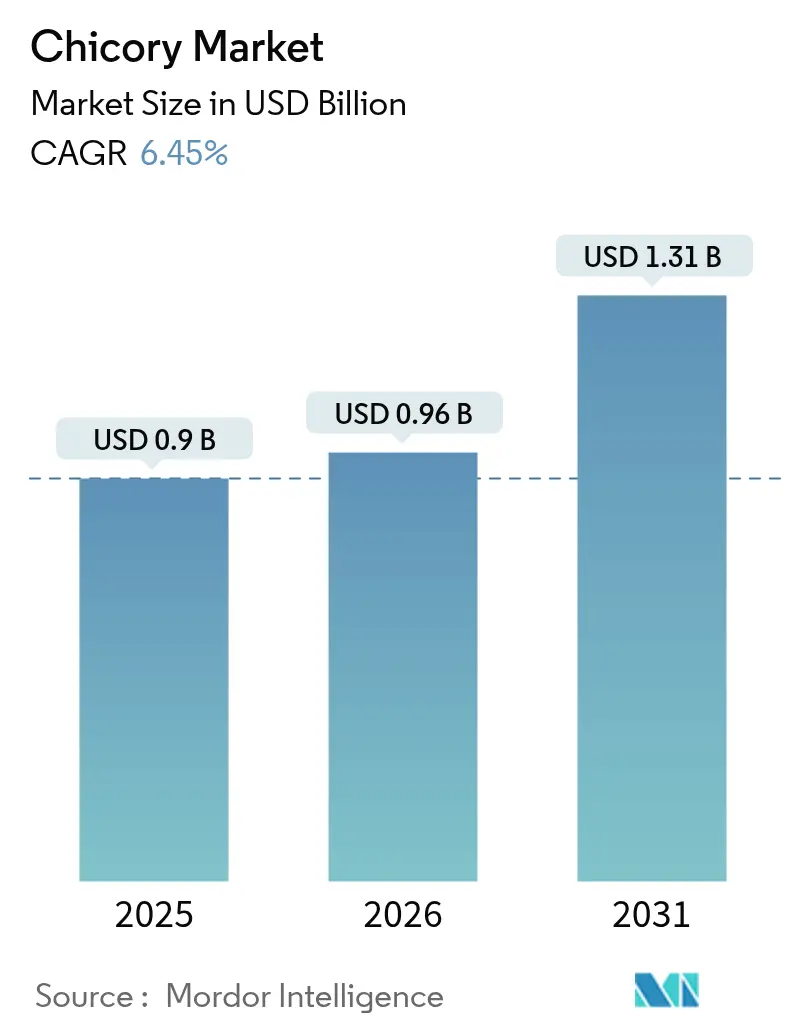
The chicory market was valued at USD 0.9 billion in 2025 and estimated to grow from USD 0.96 billion in 2026 to reach USD 1.31 billion by 2031, at a CAGR of 6.45% during the forecast period (2026-2031). Growth is driven by rising industrial demand for inulin extraction, increasing consumer preference for caffeine-free beverages, and the steady expansion of natural sweetener applications across food and pharmaceutical formulations. Europe continues to hold the largest production base due to its long-standing cultivation expertise in France, Belgium, and the Netherlands, while the Asia-Pacific region delivers the fastest growth as processors in China and India scale up their capacity to meet the demand for functional ingredients. Upstream, the Common Agricultural Policy’s eco-schemes are steering 25% of direct payments toward sustainable farming practices, a shift that promotes chicory within diversified rotations and strengthens the crop’s environmental credentials. Downstream, price volatility in coffee is currently at multi-year highs, encouraging beverage companies to increase chicory blend ratios to protect margins, thereby deepening demand visibility for farmers and traders alike. Investment momentum remains healthy as processors integrate ultrasonic, microwave, and enzyme-assisted extraction technologies to enhance inulin yields and support premium positioning in nutraceutical and infant nutrition channels.
Key Report Takeaways
- By geography, Europe led the chicory market share with 43.40% in 2025, while the Asia-Pacific region is projected to advance at an 8.55% CAGR through 2031.
Note: Market size and forecast figures in this report are generated using Mordor Intelligence’s proprietary estimation framework, updated with the latest available data and insights as of January 2026.
Global Chicory Market Trends and Insights
Drivers Impact Analysis
| Driver | (~) % Impact on CAGR Forecast | Geographic Relevance | Impact Timeline |
|---|---|---|---|
| Increasing demand for caffeine-free beverage ingredients | +1.2% | Global, with the strongest impact in Asia-Pacific and North America | Medium term (2-4 years) |
| Coffee price volatility is pushing blend adoption | +1.5% | Global, especially Europe and South America | Short term (≤ 2 years) |
| Europe Union subsidies for root chicory cultivation | +0.8% | Europe, with spillover to North America | Long term (≥ 4 years) |
| Expansion of global inulin extraction capacities | +1.3% | Global, concentrated in Europe and the Asia-Pacific | Medium term (2-4 years) |
| Regenerative farming boosts chicory yields | +0.7% | Global, early adoption in Europe and North America | Long term (≥ 4 years) |
| Novel uses as a natural sweetener and colorant | +0.9% | Global, led by North America and Europe | Medium term (2-4 years) |
| Source: Mordor Intelligence | |||
Increasing Demand for Chicory-Based Ingredients
Consumers seeking a coffee-like flavor without caffeine are increasingly opting for chicory-based drinks, driving up ingredient purchases among beverage manufacturers that cater to wellness-oriented shoppers. The United States Department of Agriculture (USDA) Food statistics flagged a 12% uptick in per-capita chicory fiber intake in the United States over the past two years, underscoring mainstream adoption [1]Source : United States Department of Agriculture, “Food Availability (Per Capita) Data System,” USDA.GOV . Scientific reviews confirm that chicory coffee delivers antioxidant activity comparable to conventional coffee, while also providing bioactive compounds such as sesquiterpene lactones. Asian markets demonstrate a strong alignment between chicory’s documented hepatoprotective properties and traditional medicine, supporting its adoption in Japan, Korea, and China.
Coffee Price Volatility Pushing Blend Adoption
Coffee futures remain highly sensitive to climate disruption in Brazil and Colombia, intensifying cost pressure on roasters. European blenders, notably in France and Belgium, increasingly replace up to 30% of coffee content with chicory to stabilize input costs during price spikes. Because chicory prices demonstrate lower seasonal variance, processors gain a natural hedge, which limits retail price passes and preserves consumer loyalty. The International Coffee Organization's composite prices fluctuated between 160 and 215 United States cents per pound during 2024, forcing roasters to seek cost cushions [2]Source: International Coffee Organization, “Historical Coffee Prices,” ICO.ORG. Chicory offers a stable alternative because its farm-gate prices track domestic root crop indices rather than global futures, lowering exposure to commodity speculation.
Regenerative Farming Boosting Chicory Yields
Chicory’s deep taproot aids soil loosening and carbon sequestration, allowing regenerative farmers to secure supplementary revenues from emerging carbon markets. Studies in Europe and North America have confirmed that rotational systems incorporating chicory enhance microbial diversity and water infiltration, resulting in yield increases of up to 9% compared to conventional tillage. Chicory’s taproot penetrates over 1.5 meters, a trait that enhances water infiltration and reduces surface runoff, attributes documented by the United States Department of Agriculture (USDA), Natural Resources Conservation Service in 2024 field audits [3]Source: USDA NRCS, “Soil Health Technical Note,” NRCS.USDA.GOV. In Australia, the Department of Agriculture tested no-till chicory rotations in Victoria, noting a 9% increase in organic matter over three seasons and measurable gains in earthworm counts, which serve as a proxy for soil vitality.
Novel Uses as Natural Sweetener and Colorant
Research funded by the European Food Safety Authority validated chicory-derived anthocyanins as stable natural colorants for acidic beverages, extending shelf life under ultraviolet exposure by 30% relative to beet pigments [4]Source: European Food Safety Authority, “Scientific Report on Natural Colorants,” EFSA.EUROPA.EU. France’s Agency for Ecological Transition issued a 2024 memorandum encouraging beverage companies to replace caramel colors with chicory concentrates to lower 4-MEI safety concerns, a measure that spurred two multinational cola brands to trial chicory color bases in limited runs. The expanding functional toolkit elevates chicory beyond its historic role as a coffee substitute, stretching demand across confectionery, sports nutrition, and clean-label cola categories.
Restraints Impact Analysis
| Restraint | (~) % Impact on CAGR Forecast | Geographic Relevance | Impact Timeline |
|---|---|---|---|
| High labor costs due to low mechanization | -1.1% | Europe and North America | Short term (≤ 2 years) |
| Flavor variability limiting industrial standardization | -0.8% | All processing regions | Medium term (2-4 years) |
| Susceptibility to nematode and fungal diseases | -0.9% | Humid Asia-Pacific and Europe | Medium term (2-4 years) |
| Export-import policy uncertainties | -0.7% | Major trading hubs | Short term (≤ 2 years) |
| Source: Mordor Intelligence | |||
High Labor Costs Due to Low Mechanization
Manual harvesting can account for up to 60% of farm-gate chicory costs in northern Europe, where wage inflation outpaces grower prices. While Asian producers enjoy lower labor costs, tightening the rural labor supply is narrowing that advantage. Eurostat’s 2024 Farm Accountancy Data Network shows that hired labor outlays for chicory reached USD 3,694 per hectare in Belgium, triple the figure for sugar beet. Mechanical harvesters adapted from carrot or beet rigs struggle with chicory’s brittle taproot, often causing breakage that downgrades inulin yield.
Flavor Variability Limiting Industrial Standardization
Inulin and sugar profiles fluctuate by terroir and harvest date, complicating large-scale sourcing for multinational processors that require uniform taste and functional properties. The sweetness and bitterness of chicory hinge on ratios of inulin, sucrose, and sesquiterpene lactones, which fluctuate with soil pH and harvest timing. The European Committee for Standardization reported that sample-to-sample variation in 2024 raw-root panels reached 22 % for key flavor markers, a hurdle for processors aiming at uniform product lines. The United States National Institute of Standards and Technology’s Food Safety Lab noted that variance in volatile profiles complicates harmonized flavor calibration across multi-sourcing strategies.
Geography Analysis
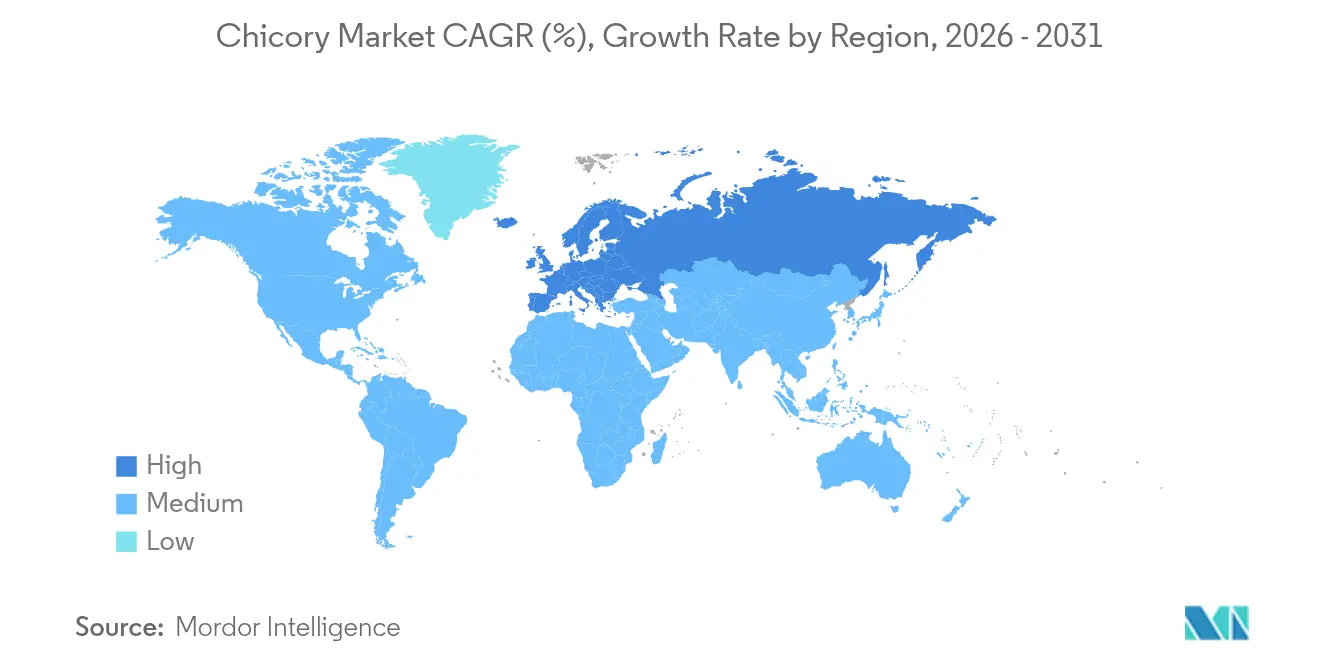
Europe accounted for 43.40% share of the chicory market in 2025, driven by high consumption of traditional coffee substitutes and increasing demand for inulin among dairy and bakery processors. The region benefits from USD 417.96 billion in Common Agricultural Policy (CAP) funding, which supports eco-schemes that include chicory as a diversification crop. This funding helps stabilize prices for growers while promoting soil health. Additionally, research and development in biorefineries, such as converting chicory waste into high-value chemicals, is creating new revenue opportunities and strengthening the position of processors within the region. Field robotics pilots in countries like the Netherlands and Germany are further reducing labor dependency and ensuring better taproot preservation during harvest.
The Asia-Pacific region is projected to experience the fastest production growth, with a compound annual growth rate (CAGR) of 8.55% through 2031. Rising regional chicory consumption is attributed to functional-food manufacturers increasingly incorporating inulin into beverages, snacks, and dietary supplements. India’s export volume is projected to grow, supported by production-linked incentives that fund new extraction lines. Meanwhile, China, a significant importer in 2024, is forecast to see import volumes increase by 10.7% as domestic processing demand surpasses agricultural capacity. Australia is also contributing to the region’s growth by utilizing advanced agronomy and arid-zone irrigation techniques to produce premium roots for pharmaceutical-grade inulin.
North America is experiencing steady growth, with the United States expanding its production of organic and specialty-grade roots for premium coffee substitutes. In South America, countries like Brazil and Argentina are diversifying their crop portfolios to mitigate coffee price volatility, resulting in a positive growth outlook for the region. The Middle East and Africa are recording higher growth trajectories, albeit from smaller market bases. This growth is driven by food security initiatives and an increasing awareness of chicory’s digestive health benefits.
Recent Industry Developments
- February 2025: The European Commission released its agri-food vision for 2040, highlighting digitalization and sustainability themes relevant to chicory supply chains.
- May 2024: PJ's Coffee announced the return of its popular Southern Wedding Cake flavor and the introduction of a chicory-infused beverage. Customers enjoy the Southern Wedding Cake Iced Latte, which combines espresso, almond, and vanilla syrups, or the Southern Wedding Cake Velvet Ice, made with cold brew and whipped cream. The Southern Charm Chicory Cold Brew also features chicory and black sugar cold foam, celebrating the brand's New Orleans heritage and flavors.
- March 2023: Cargill unveiled its Oliggo-FiberTM brand, showcasing Oliggo-FiberTM chicory root fiber products at the Shanghai National Exhibition and Convention Center in China. Oliggo-FiberTM chicory root fiber, a prebiotic, boasts a high dietary fiber content.
Global Chicory Market Report Scope
Chicory, a herbaceous plant belonging to the dandelion family, boasts numerous health benefits. While primarily cultivated for its leaves and roots, chicory also serves as a substitute for various products and has demonstrated efficacy in addressing several health issues. Chicory Market Report is Segmented by Geography (North America, Europe, Asia-Pacific, and More). The Report Includes Production Analysis (Volume), Consumption Analysis (Value and Volume), Export Analysis (Value and Volume), Import Analysis (Value and Volume), and Price Trend Analysis. The Market Forecasts are Provided in Terms of Value (USD) and Volume (Metric Tons).
| North America | United States |
| Canada | |
| Mexico | |
| South America | Brazil |
| Argentina | |
| Chile | |
| Europe | Spain |
| Netherlands | |
| Russia | |
| Germany | |
| Italy | |
| Asia-Pacific | China |
| India | |
| Vietnam | |
| Indonesia | |
| Middle East | Turkey |
| Iram | |
| Saudi Arabia | |
| Israel | |
| United Arab Emirates | |
| Africa | Nigeria |
| Egypt | |
| Kenya | |
| South Africa |
| Geography (Production Analysis (Volume), Consumption Analysis (Volume and Value), Import Analysis (Volume and Value), Export Analysis (Volume and Value), and Price Trend Analysis) | North America | United States |
| Canada | ||
| Mexico | ||
| South America | Brazil | |
| Argentina | ||
| Chile | ||
| Europe | Spain | |
| Netherlands | ||
| Russia | ||
| Germany | ||
| Italy | ||
| Asia-Pacific | China | |
| India | ||
| Vietnam | ||
| Indonesia | ||
| Middle East | Turkey | |
| Iram | ||
| Saudi Arabia | ||
| Israel | ||
| United Arab Emirates | ||
| Africa | Nigeria | |
| Egypt | ||
| Kenya | ||
| South Africa | ||
Key Questions Answered in the Report
What is the projection size of chicory market in 2026?
The chicory market size is forecast to reach USD 1.31 billion by 2031, expanding from USD 0.96 billion in 2026 to a 6.45% CAGR.
Which region currently leads the chicory production?
Europe leads production with 43.40% of volume, supported by established farming systems in France, Belgium, and the Netherlands.
Which policy help European Farmer grow more chicory?
Eco-schemes under the Common Agricultural Policy provide direct payments for crop diversification, and several member states run national vouchers and carbon-farming programs that specifically list chicory rotations.
Which mechanization still limited in chicory harvesting?
Current digging equipment often damages the brittle taproot, so growers rely on manual labor, which pushes up costs, especially in high-wage regions like Western Europe and parts of the United States.


