
Biotechnology Reagents Market Size and Share
Market Overview
| Study Period | 2020 - 2031 |
|---|---|
| Market Size (2026) | USD 50.96 Billion |
| Market Size (2031) | USD 69.98 Billion |
| Growth Rate (2026 - 2031) | 6.55 % |
| Fastest Growing Market | Asia Pacific |
| Largest Market | North America |
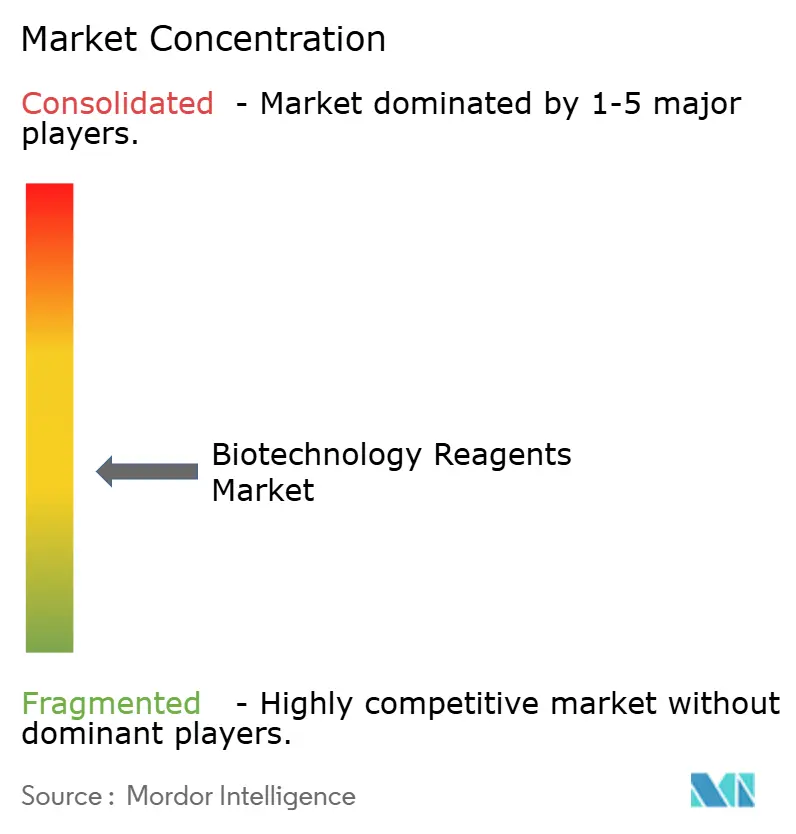
| Market Concentration | Medium |
Major Players *Disclaimer: Major Players sorted in no particular order Image © Mordor Intelligence. Reuse requires attribution under CC BY 4.0. | |
Biotechnology Reagents Market Analysis by Mordor Intelligence
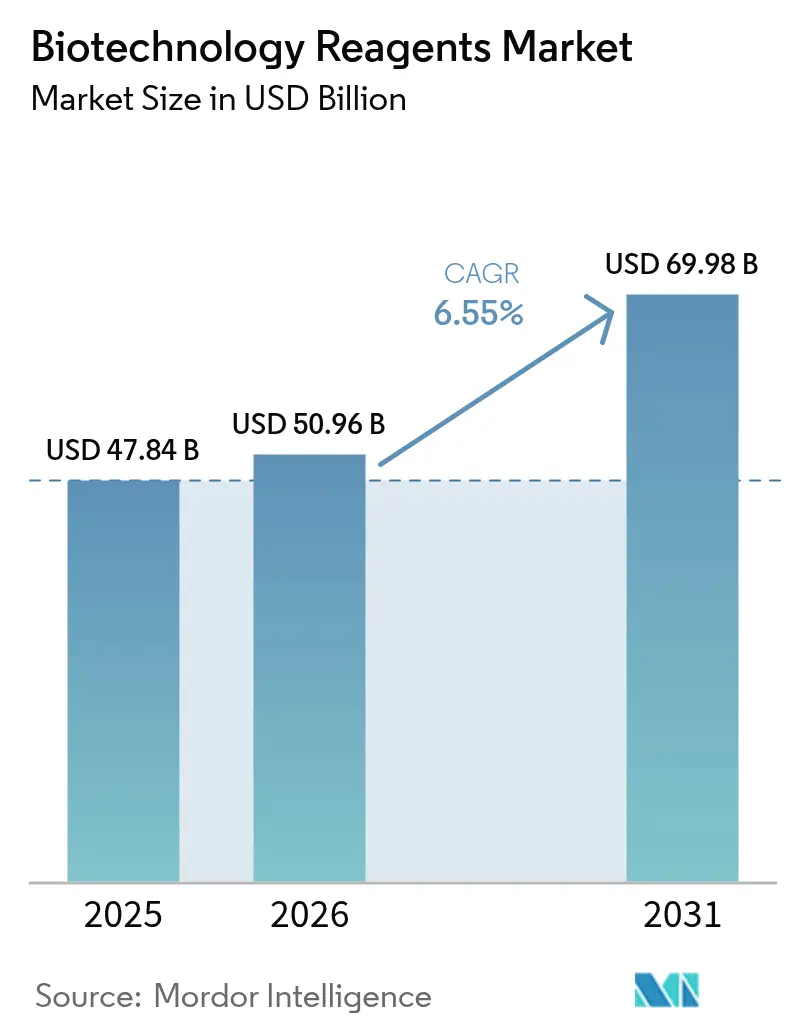
Biotechnology Reagents Market size in 2026 is estimated at USD 50.96 billion, growing from 2025 value of USD 47.84 billion with 2031 projections showing USD 69.98 billion, growing at 6.55% CAGR over 2026-2031.
Intensifying investment in AI-enabled drug discovery, growing biomanufacturing capacity, and rapid adoption of single-cell analytics enlarge the addressable demand for high-performance reagents. Multinational mergers that integrate consumables with data-analysis platforms accelerate end-to-end solution uptake, while government incentives in Asia support local production of GMP-grade inputs. Ongoing digitalisation of laboratories further boosts demand for pre-optimised, automation-ready reagent kits, particularly in oncology and regenerative-medicine pipelines. Meanwhile, stricter global quality standards lengthen product-validation cycles, pressuring smaller suppliers to partner with established players.
Key Report Takeaways
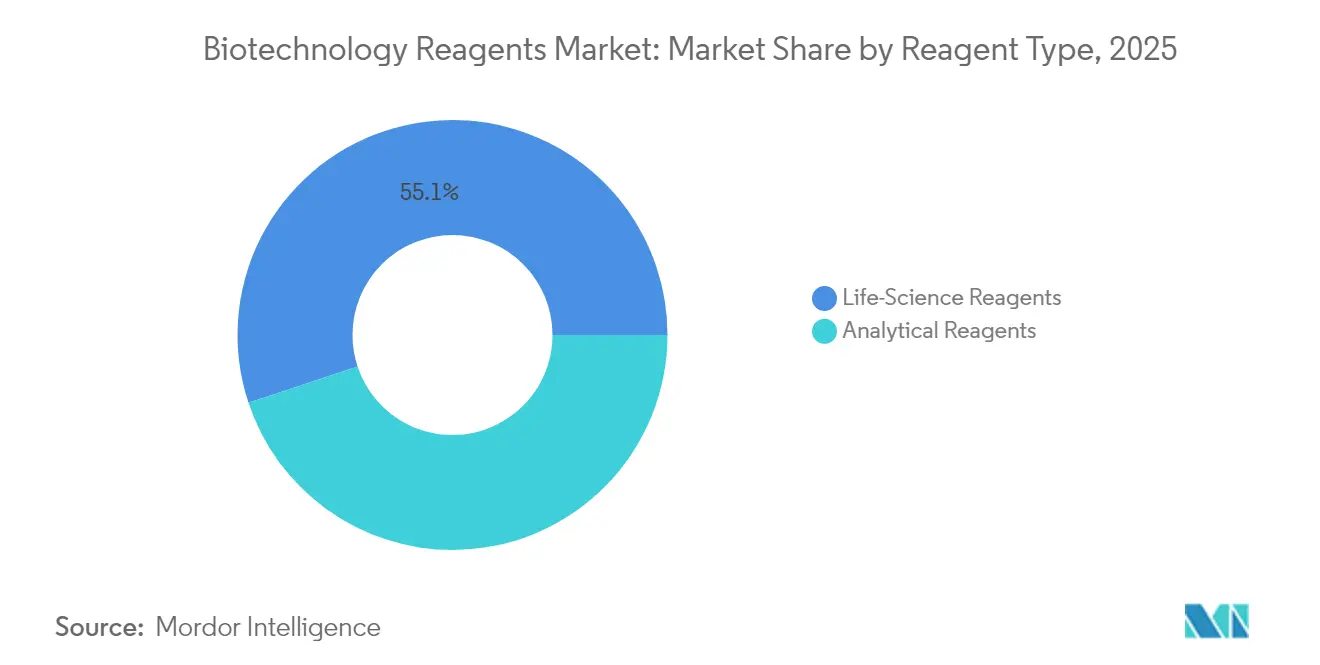
- By reagent type, life-science reagents led with 55.10% revenue share in 2025, whereas analytical reagents are projected to grow at a 8.85% CAGR through 2031.
- By application, DNA & RNA analysis accounted for 29.65% of the biotechnology reagents market share in 2025, while single-cell gene expression is expanding at an 10.95% CAGR to 2031.
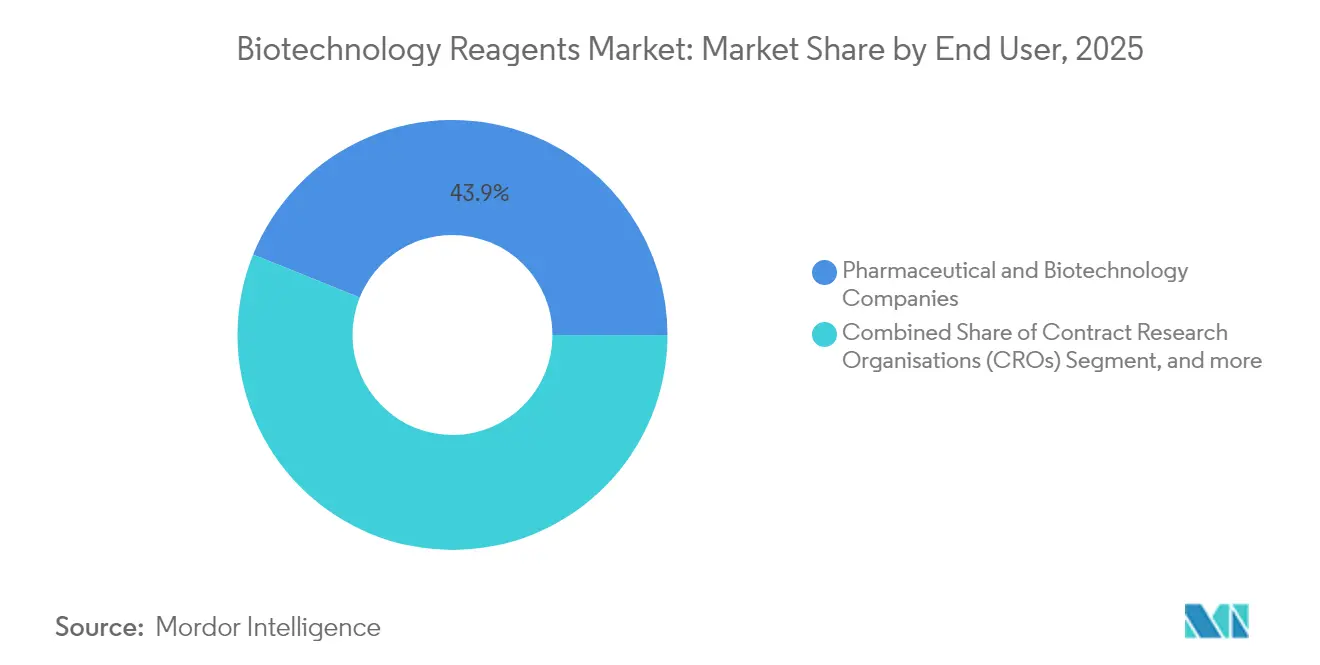
- By end user, pharmaceutical & biotechnology companies represented 43.90% of the biotechnology reagents market size in 2025; contract research organizations posted the fastest-growing demand at 9.55% CAGR.
- By geography, North America commanded 38.80% revenue share in 2025, whereas Asia-Pacific is set to grow at a 9.15% CAGR between 2026-2031.
Note: Market size and forecast figures in this report are generated using Mordor Intelligence’s proprietary estimation framework, updated with the latest available data and insights as of 2026.
Market Trends and Insights
Drivers Impact Analysis of Biotechnology Reagents Market*
| Driver | (~) % Impact on CAGR Forecast | Geographic Relevance | Impact Timeline |
|---|---|---|---|
| High R&D spending by biotech firms & startup pipeline | +1.8% | North America & Europe; spill-over to APAC | Medium term (2-4 years) |
| Expanding stem-cell & regenerative-medicine studies | +1.2% | North America & APAC | Long term (≥ 4 years) |
| Oncology-centric omics projects | +1.5% | Global, with APAC acceleration | Medium term (2-4 years) |
| AI-assisted reagent optimisation | +1.1% | North America & Europe; emerging in APAC | Medium term (2-4 years) |
| Rising point-of-care molecular diagnostics | +0.9% | APAC core; expanding to MEA & Latin America | Short term (≤ 2 years) |
| Government biomanufacturing localisation incentives | +0.8% | APAC | Long term (≥ 4 years) |
| Source: Mordor Intelligence | |||
High R&D Spending by Biotech Firms & Swelling Startup Pipeline
Venture funding in precision fermentation and synthetic biology startups surged, channeling USD 2 billion into new platforms that rely on premium-grade reagents for cell—and gene-therapy workflows.[1] Each biologic candidate requires bespoke analytical consumables, driving recurring demand in the global bioprocess technology market. Fragmented demand lets specialist suppliers command premium pricing, while platform-based discovery models push labs to standardise reagent systems compatible with multiple targets. Consequently, procurement strategies increasingly favour vendors that offer modular, AI-ready kits with validated performance data.
Expanding Stem-Cell & Regenerative-Medicine Studies
Adult stem-cell protocols dominate, prompting innovation in isolation and expansion reagents that preserve phenotype. APAC governments co-fund large-scale GMP facilities, such as Aurora Biosynthetics’ AUD200 million (USD 129.4 million) plant, boosting regional demand for compliant consumables. As personalised regenerative procedures proliferate, suppliers must deliver flexible formulations capable of small-batch, patient-specific processing.
Oncology-Centric Omics Projects Demanding High-Throughput Reagents
Long-read sequencing for liquid biopsies requires novel chemistries optimised for GC-rich cell-free DNA, while single-cell RNA-seq platforms like 10x Genomics’ Chromium drive uptake of speciality barcoding kits. AI-enhanced molecular optimisation registers success rates above 80%, intensifying throughput needs for high-purity screening reagents. Clinical deployment of point-of-care oncology assays further stimulates demand for lyophilised, room-temperature stable reagents compatible with decentralised settings.
AI-Assisted Reagent Optimisation Shortening Development Cycles
Deep-learning engines such as DrugGen achieve 99.9% validity in molecule generation, enabling predictive design of reagent compositions that dramatically cut iteration time. Pharmaceutical manufacturers are integrating automated synthesis robots that rely on standardised reagent libraries; vendors providing digitally-traceable, lot-consistent kits gain preferred-supplier status. Real-time monitoring of reactions through embedded sensors places additional emphasis on data-rich, machine-readable packaging.
Restraints Impact Analysis of Biotechnology Reagents Market*
| Restraint | (~) % Impact on CAGR Forecast | Geographic Relevance | Impact Timeline |
|---|---|---|---|
| Stringent multi-jurisdictional quality & safety certifications | −1.3% | Global; complexity peaks in EU & APAC | Medium term (2-4 years) |
| Volatile bioprocess raw-material supply chain post-COVID | −0.8% | Global; acute in APAC manufacturing hubs | Short term (≤ 2 years) |
| Rising average selling price of premium-grade reagents | −0.7% | Global; highest impact in emerging markets | Short term (≤ 2 years) |
| Sustainability pressures on hazardous components | −0.5% | EU & North America; spreading to APAC | Long term (≥ 4 years) |
| Source: Mordor Intelligence | |||
Stringent Multi-Jurisdictional Quality & Safety Certifications
FDA and EMA divergence on reference-standard validation forces suppliers to duplicate studies, adding 6-12 months to product launches and raising development costs by up to 30%.[2] Achieving ISO 13485 certification for each production site strains smaller firms, while Quality-by-Design documentation now covers entire life-cycles, pushing demand toward larger, vertically integrated players able to absorb compliance costs.
Volatile Bioprocess Raw-Material Supply Chain Post-COVID
Chromatography resin and critical media shortages persist as drought-affected shipping lanes and geopolitical tensions disrupt logistics.[3] Manufacturers hedge risk through dual-sourcing strategies and higher safety stocks, yet this ties up working capital and compresses margins. Localisation moves in Asia require parallel investments in cold-chain and warehousing infrastructure to stabilise reagent supply.
*Our forecasts treat driver/restraint impacts as directional, not additive. The impact forecasts reflect baseline growth, mix effects, and variable interactions.
Biotechnology Reagents Market Segment Analysis
By Reagent Type:
Life-Science Leadership and Analytical UpsideLife-Science Reagents captured 55.10% of biotechnology reagents market share in 2025. Strong utilisation in PCR-based diagnostics and next-generation sequencing keeps the segment ahead, while continuing investment in COVID-era molecular infrastructure supports baseline demand. Analytical Reagents, though smaller, are set to surpass overall biotechnology reagents market growth with a 8.85% CAGR, benefitting from regulatory emphasis on deep characterisation and the proliferation of mass-spectrometry-driven proteomics. Emerging hybrid kits that integrate sample prep with assay reagents promise workflow simplification valued by high-throughput labs.
Second-generation chromatography buffers and single-use filtration reagents enable continuous bioprocessing, while electrophoresis consumables optimise resolution for cell-free systems. Suppliers increasingly bundle software licences with reagents to capture recurring analytics revenue, signalling convergence between wet-lab and digital offerings.

By Application:
Single-Cell Analytics Gain MomentumDNA & RNA Analysis remained the largest application, holding 29.65% of biotechnology reagents market size in 2025 through entrenched usage in genomic surveillance and virus-variant monitoring. Yet Single-Cell Gene Expression is advancing at 10.95% CAGR, spurred by oncology and immunology research that leverages granularity unattainable with bulk assays. Vendors capable of lowering per-cell costs without compromising data quality stand to unlock new cohorts of users in academic and translational labs.
Downstream, protein-purification reagents benefit as biotherapeutic pipelines swell, particularly monoclonal antibodies and mRNA-based vaccines. Demand for multiplexed assay kits that permit simultaneous proteomic and transcriptomic readouts further blurs application boundaries, calling for reagents engineered for cross-modality compatibility.
By End User:
CROs Drive Outsourced DemandPharmaceutical and Biotechnology Companies maintained a 43.90% stake in 2025 consumption, but Contract Research Organizations are projected to outpace with 9.55% CAGR as developers outsource specialised analytics and early-stage screening. CRO consolidation produces mega-sites able to negotiate reagent bulk discounts, pushing suppliers to craft volume-tiered pricing and just-in-time delivery services.
Academic institutes remain foundational customers, especially where government funding funds basic research and shared-resource facilities. Diagnostic laboratories expand molecular-testing menus, adopting lyophilised PCR kits that reduce cold-chain dependence in emerging markets, a trend that diversifies end-user procurement cycles.
Geography Analysis
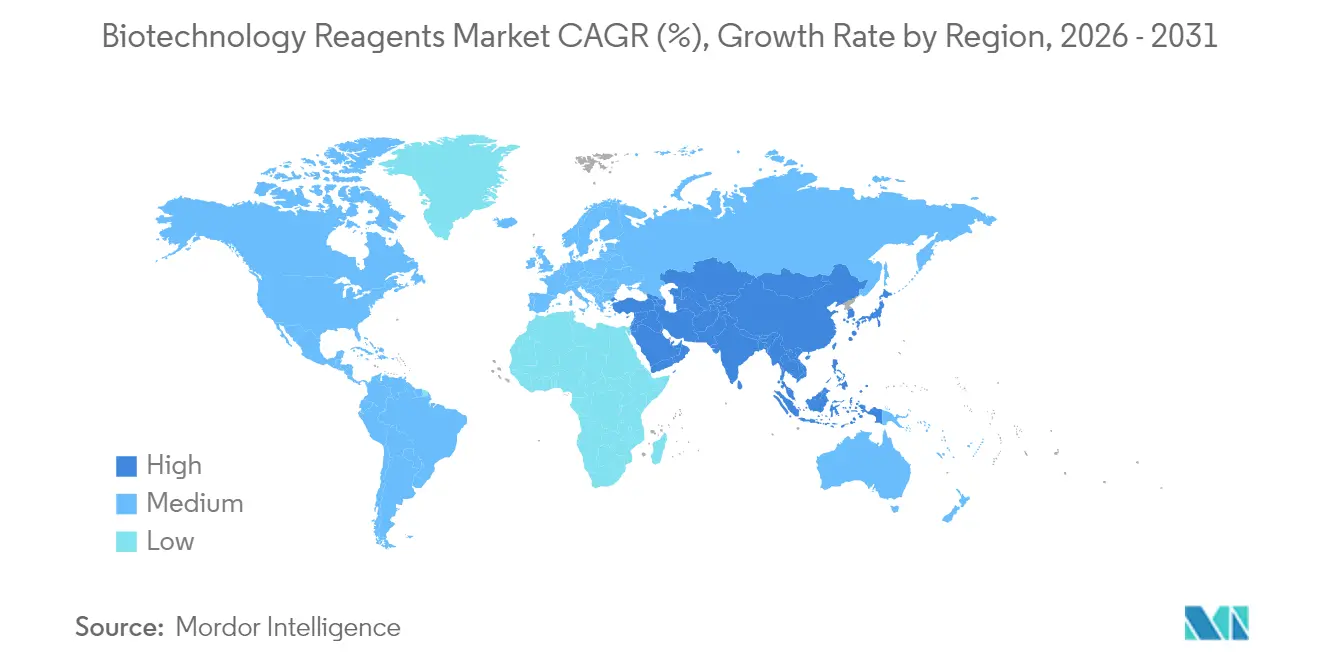
North America and Europe Biotechnology Reagents Market
North America anchored 38.80% of 2025 revenues on the back of entrenched biopharmaceutical clusters, deep venture capital pools, and a supportive regulatory climate. Federal programmes promoting advanced biomanufacturing generate steady requisitions for GMP-validated reagents. In Europe, continued adherence to sustainability mandates propels interest in green-chemistry formulations and recyclable packaging, prompting suppliers to revamp product life-cycle assessments.
APAC Biotechnology Reagents Market
Asia-Pacific tops global expansion, expected to post 9.15% CAGR through 2031. China’s Circular No. 53 has trimmed review timelines and expanded data-protection windows, catalysing local innovation and inbound partnerships. Japan’s goal of tripling its biotech economy by 2030 underwrites domestic demand for clinical-grade reagents, while Southeast Asia’s CDMO rise creates fresh outlets for single-use consumables. Local suppliers leverage government subsidies to close capability gaps, although adherence to international QC standards remains a hurdle.
MEA and South America Biotechnology Reagents Market
Markets in the Middle East, Africa, and South America record mid-single-digit growth. Technology-transfer agreements sponsored by multilateral health agencies facilitate local reagent fill-finish operations, reducing import reliance. However, limited cold-chain infrastructure and fluctuating currency valuations temper the adoption of premium products, incentivising suppliers to offer modular, cost-tiered reagent lines tailored to regional purchasing power.
Value Chain Analysis
The biotechnology reagents value chain begins with upstream inputs such as specialty chemicals, enzymes, ligands, resins, and biological raw materials, then moves to formulation and fill-finish into liquid, lyophilized, or kit-based products. Production typically runs on GMP and research-grade lines, while quality systems and lot-traceability documentation shape batch release and extend validation cycles for regulated-use reagents.
Go-to-market relies on a mix of direct sales (common for high-value, technical-support-heavy kits), channel distributors, and third-party logistics with cold-chain and hazardous-material handling. Persistent constraints include availability of high-purity GMP-grade inputs, single-source dependencies for proprietary enzymes or ligands, long lead times for custom chromatography resins (raised as 12 to 18 months in industry supply chain discussions), and throughput limits tied to stringent quality validation. In response, localization and regional hub strategies are taking shape, including Bio-Techne’s announcement of a summer 2026 Customer Service Center in Dusseldorf to support EMEA access and engagement for its reagent and instrument portfolio.
Competitive Landscape
The biotechnology reagents market continues to consolidate as strategics chase vertical integration. Danaher fused Cytiva with Pall into a USD 7.5 billion bioprocess powerhouse, coupling upstream media with downstream analytics to offer seamless workflows. Its USD 5.5 billion Abcam buy extends reach into antibody and proteomics reagents, reinforcing multiproduct lock-in across discovery and manufacturing. Thermo Fisher’s purchase of Solventum’s Purification & Filtration unit for USD 4.1 billion exemplifies similar portfolio-broadening moves, supported by an active USD 40-50 billion M&A pipeline.
Meanwhile, technology-centric challengers harness AI to formulate reagents with accelerated iteration cycles, as evidenced by DrugGen’s near-perfect molecular-validity output. Startups introducing lyophilised RT-LAMP kits aim to disrupt traditional PCR segments by removing cold-chain constraints, appealing to decentralised testing environments. Regulatory sandboxes like the FDA Platform Designation fast-track give nimble entrants a clear route to market, forcing incumbents to escalate R&D spend and partnership activity.
Suppliers also diversify revenue through data-service models, bundling cloud-based analytics and reagent subscription plans that lock users into ecosystems. Firms able to guarantee uninterrupted supply and regulatory-compliant quality documentation differentiate themselves as customers seek risk-mitigation in the wake of pandemic-era shortages.
Biotechnology Reagents Industry Leaders
-
Bio-Rad Laboratories
-
Becton Dickinson & Company
-
Danaher Corporation (Beckman Coulter Inc)
-
Agilent Technologies
-
Thermo Fisher Scientific Inc.
- *Disclaimer: Major Players sorted in no particular order
Biotechnology Reagents Market Companies Covered in this Report
- Abbott Laboratories
- Agilent Technologies
- Danaher (Cytiva & Beckman Coulter)
- Beckton Dickinson
- Bio-Rad Laboratories
- bioMérieux
- Siemens Healthineers
- Merck KGaA (MilliporeSigma)
- Thermo Fisher Scientific
- Waters Corporation
- Eurofins
- Takara Bio
- QIAGEN
- Illumina
- PerkinElmer (Revvity)
- Promega
- Roche
- Lonza Group
- Bio-Techne (R&D Systems)
- New England Biolabs
Market Opportunities and Future Outlook
Opportunities are concentrated where customers pay for high-purity, traceable, automation-ready reagents linked to regulated workflows and advanced modalities (cell and gene therapies, multiomics, and high-throughput screening). European investments create specific whitespace for suppliers that can qualify GMP-grade reagents with robust documentation while tightening supply chains: Sartorius opened a competence center in Freiburg with an investment of over EUR 140 million to expand capacity for quality-critical materials used in cell and gene therapies, and Miltenyi Biotec advanced its Cologne facility expansion with a modernization milestone for clinical reagents manufacturing targeted for end-2026.
Another opportunity is building integrated discovery-to-GMP capabilities that reduce handoffs across vendors, strengthening QC and shortening iteration cycles for therapeutic protein and biologics programs. Icosagen completed a EUR 45 million expansion in Tartu, Estonia in June 2026 to bring therapeutic protein discovery, development, and GMP manufacturing under one roof, reinforcing demand for standardized, lot-consistent reagents that can transfer from R&D into GMP settings without reformulation. As procurement shifts toward resilient supply and regional availability, regional distribution and service footprints (including customer service and demonstration labs) and access programs in under-served regions expand the addressable user base beyond traditional North American and European core accounts.
Recent Industry Developments in Biotechnology Reagents Market
- July 2026: Thermo Fisher Scientific received the first FBI approval for Rapid DNA crime scene profiles to be eligible for national CODIS searches. The decision accelerates deployment of standardized rapid DNA workflows, increasing demand for validated consumables and tightly controlled reagent performance in decentralized testing environments.
- February 2025: Thermo Fisher Scientific agreed to acquire Solventum’s Purification and Filtration business for USD 4.1 billion, expanding its bioproduction portfolio. The deal strengthens Thermo Fisher’s position in downstream workflows that consume purification and filtration-related reagents and supports bundled offerings across bioprocess development.
- October 2024: Bio-Rad Laboratories launched the Vericheck ddPCR Empty-Full Capsid Kit to improve AAV vector quality control in gene therapy development. The launch adds specialized QC reagents aligned to advanced therapy manufacturing needs, reinforcing demand for high-sensitivity analytical kits used during process development and release testing.
Biotechnology Reagents Market Report Scope and Research Methodology
Market Definition and Coverage
For this study, the biotechnology reagents market covers chemical and biologic preparations that get consumed during biotech lab and bioprocess workflows, including liquid, lyophilized, and kit-based formats used to run molecular and cell-based procedures.
Scope exclusions: We exclude stand-alone instruments, single-use bioreactor plastics, and routine clinical chemistry reagents.
Segments Covered in This Report
- By Reagent Type
- Life-Science Reagents
- PCR
- Cell Culture
- Hematology
- In-vitro Diagnostics
- Other Technologies
- Analytical Reagents
- Chromatography
- Mass Spectrometry
- Electrophoresis
- Flow Cytometry
- Other Analytical Reagents
- Life-Science Reagents
- By Application
- Protein Synthesis & Purification
- Gene Expression
- DNA & RNA Analysis
- Drug Testing
- Other Applications
- By End User
- Pharmaceutical & Biotechnology Companies
- Contract Research Organisations (CROs)
- Academic & Research Institutes
- Clinical & Diagnostic Laboratories
- By Geography
- North America
- United States
- Canada
- Mexico
- Europe
- Germany
- United Kingdom
- France
- Italy
- Spain
- Rest of Europe
- Asia-Pacific
- China
- Japan
- India
- Australia
- South Korea
- Rest of Asia-Pacific
- Middle East & Africa
- GCC
- South Africa
- Rest of Middle East & Africa
- South America
- Brazil
- Argentina
- Rest of South America
- North America
Data Sources, Market Sizing, and Validation
Desk Research
Desk work starts with mapping the demand environment and confirming what qualifies as a reagent in this market before we quantify any value. We use public sources such as the US FDA for test and assay context, the US NIH and NSF for life-science funding signals, the OECD for R&D intensity and country comparisons, and the World Bank for macro indicators that affect lab spending.
To keep the model practical, we also review company filings, investor presentations, association websites, and reputable press releases to understand product positioning and how pricing direction evolves. When needed, a paid subscription for company financials and news intelligence is used to normalize business line disclosures, and a patent database is checked to see where assay and chemistry innovation is heading. These sources are not exhaustive, and we also relied on other public references for data collection, cross-checking, and clarification.
Primary Interviews and Surveys
Primary work is used to sanity-check the reagent boundary and translate lab activity into realistic spending patterns. We spoke with stakeholders across reagent supply, distribution, biopharma and biotech labs, contract research settings, and diagnostic lab environments. We then validated the assumptions across APAC, EMEA, and the Americas so regional adoption differences did not get averaged out too early.
Distribution of primary research fieldwork respondents
| Company type | Respondent position | Region |
|---|---|---|
| Top tier: 36% | CXOs: 15% | APAC: 40% |
| Mid tier: 46% | Functional/Unit leaders: 32% | EMEA: 33% |
| Smaller Players: 18% | Managers: 53% | Americas: 27% |
Market-Sizing & Forecasting
Sizing is built first through a top-down approach where R&D and testing activity is translated into a reagent demand pool by geography, then valued using typical consumption per workflow. Once the demand pool is formed, we corroborate it using selective bottom-up approximations such as supplier revenue splits, channel checks, and sampled ASP times volume calculations for commonly purchased reagent categories.
A few inputs are tracked as model drivers in this market, including biopharma and academic R&D spending direction, the pace of PCR and sequencing related workflows, cell culture and transfection usage intensity, and the mix shift between liquid and kit-based formats that changes average pricing. We also monitor regulatory and diagnostics activity as a practical signal for assay volumes, then track how procurement behavior shifts purchases between direct sales and distribution. For forecasting, we use scenario analysis around R&D budgets and workflow adoption rates, and we tighten the ranges based on what interviewees expect for pricing and volume progression.
Data Validation & Update Cycle
We validate outputs by comparing model totals against independent signals like R&D spend movement, lab workflow adoption trends, and cross-checked supplier exposure to reagent-heavy portfolios. If a country or application line shows a jump that cannot be explained by the tracked drivers, we reopen the assumptions and re-contact experts to confirm whether it is a one-off event or a real step-up.
Before sign-off, the model goes through multi-step analyst review where unit logic, pricing assumptions, and currency handling are checked for internal consistency. Reports are refreshed annually, with interim updates when major regulatory, funding, or supply changes are observed. Right before delivery, we run a final pass so clients receive the most current view available at that time.
Mordor Intelligence's Global Biotechnology Reagents Market Market Size Measured Against Other Published Estimates
Published market sizes for biotechnology reagents often differ because the counted basket is not the same, and pricing and volume assumptions get updated at different times. Even when the label sounds similar, inclusion of kits, adjacent consumables, or broader life-science supplies can move the number significantly.
By tracking workflow-level reagent consumption and refreshing currency and pricing timing, Mordor Intelligence keeps the estimate tied to consumable reagents used in molecular, cellular, and analytical procedures, rather than folding in instruments or broader lab supply pools. Differences also come from whether a study uses a single base year snapshot, how it assumes sequencing and PCR volumes, and whether it validates the demand pool with interviews across regions before locking the totals.
Benchmark comparison
| Source | Market Size | Gaps in Research Methodology |
|---|---|---|
| Mordor Intelligence | USD 50.96 B (2026) | |
| Global Consultancy A | USD 109.68 B (2024) | Uses a broader scope that bundles wide reagent families and related lab workflow inputs under biotechnology reagents, and it anchors the model to a 2024 base year which can overstate the comparable basket versus a consumables-only boundary. |
| Industry Publisher B | USD 46.61 B (2024) | Blends reagents with kits and applies a different growth window, which changes the year-to-year comparability, and the lower value can also reflect tighter category coverage with less adjustment for higher-throughput molecular workflow adoption. |
The spread in the table is mainly explained by what gets counted as a reagent, plus the choice of base year and pricing progression. When scope is kept specific to consumable reagents and the demand pool is checked against real workflow activity, the final number is easier to trace and repeat across regions.
Key Questions Answered in the Report
What is the current size of the biotechnology reagents market?
It was valued at USD 50.96 billion in 2026 and is projected to hit USD 69.98 billion by 2031.
Which reagent type dominates market revenue?
Life-Science Reagents held 55.10% of revenue in 2025, benefiting from widespread use in PCR and sequencing.
Why are Contract Research Organizations growing faster than in-house pharma labs?
Drug developers increasingly outsource specialised analytics, giving CROs a forecast 9.55% CAGR through 2031.
Which geography offers the fastest expansion opportunity?
Asia-Pacific leads with a 9.15% CAGR, aided by policy incentives and expanding CDMO capacity.
How is AI influencing reagent development?
AI platforms predict optimal reagent formulations, shortening design cycles and raising demand for automation-ready kits.
What are the key hurdles for new reagent suppliers?
Obtaining multi-region quality certifications and securing resilient supply chains add cost and delay market entry.