
Glass Tiles Market Size and Share
Market Overview
| Study Period | 2020 - 2031 |
|---|---|
| Market Size (2026) | USD 76.16 Billion |
| Market Size (2031) | USD 100.26 Billion |
| Growth Rate (2026 - 2031) | 5.66 % |
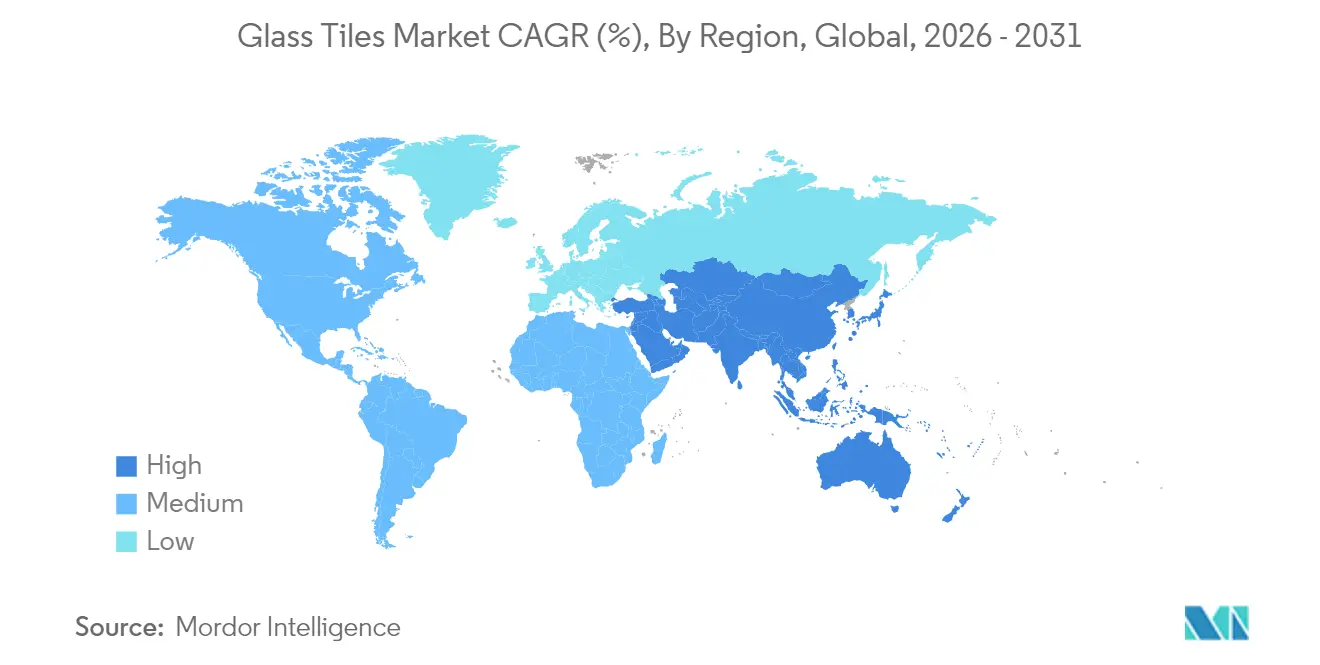
| Fastest Growing Market | Asia Pacific |
| Largest Market | Asia Pacific |
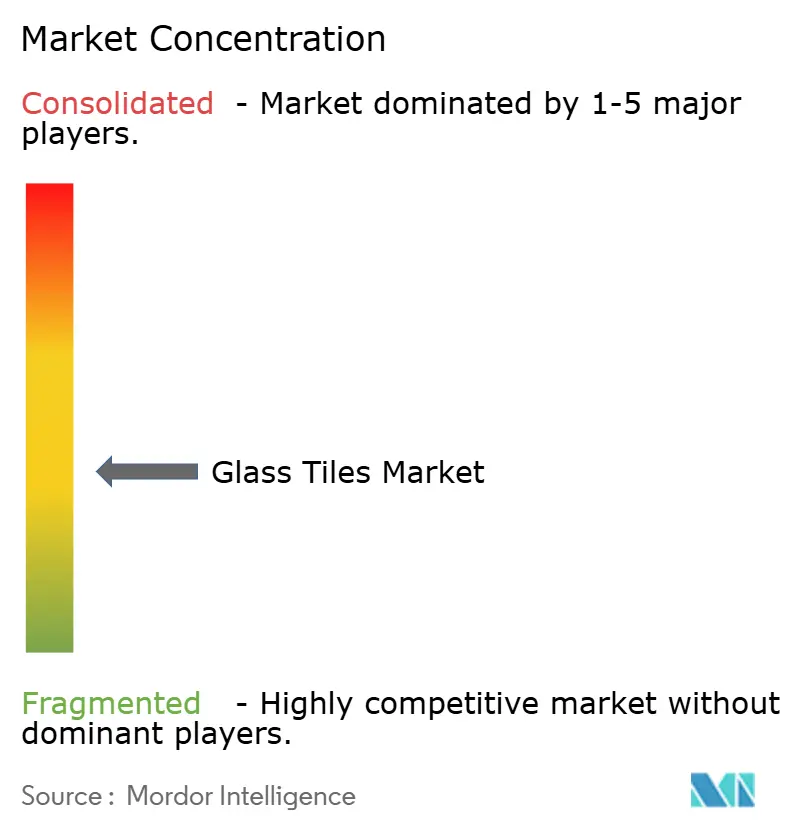
| Market Concentration | Medium |
Major Players *Disclaimer: Major Players sorted in no particular order Image © Mordor Intelligence. Reuse requires attribution under CC BY 4.0. | |
Glass Tiles Market Analysis by Mordor Intelligence
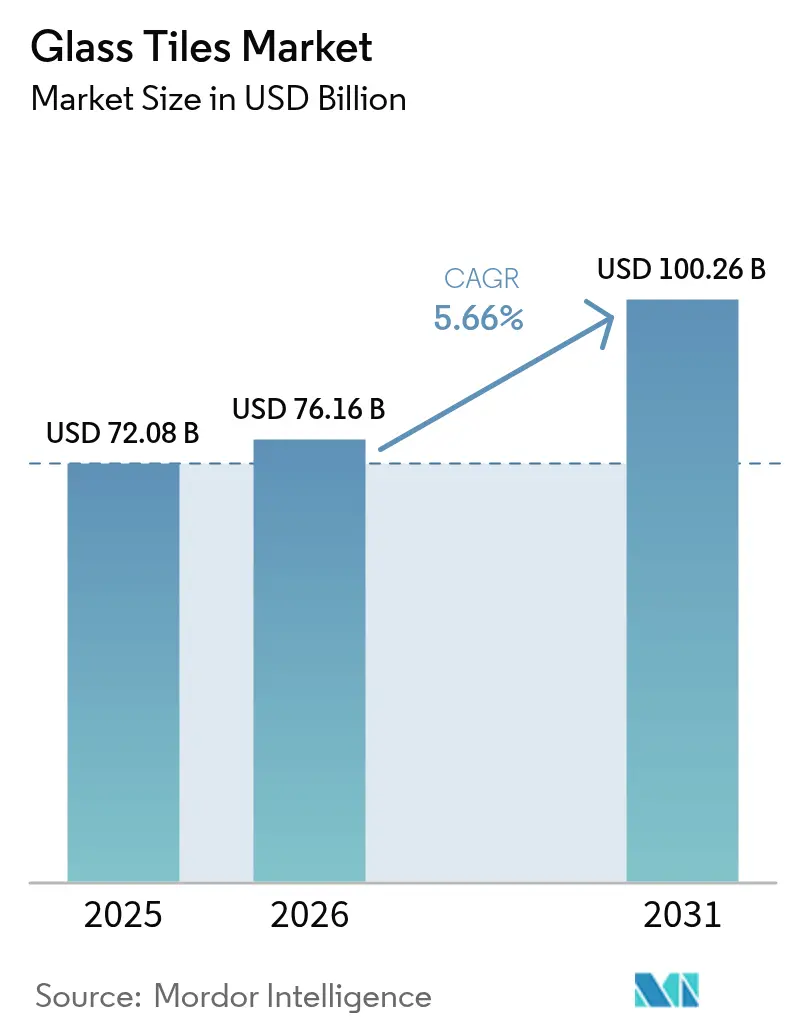
The glass tiles market size was valued at USD 72.08 billion in 2025 and estimated to grow from USD 76.16 billion in 2026 to reach USD 100.26 billion by 2031, at a CAGR of 5.66% during the forecast period (2026-2031). Rising urbanization, premium renovation spending, and stricter green-building codes favor lightweight, low-carbon cladding materials, positioning the glass tiles market as a preferred solution in residential, commercial, and infrastructure projects. Sintered technology gains momentum because it trims firing temperatures and cuts energy use, while design trends toward matte finishes widen aesthetic options for architects. Asia-Pacific leads both production and consumption thanks to large-scale infrastructure programs, integrated supply chains, and growing disposable incomes.
Key Report Takeaways
- By product type, smooth/glossy finishes accounted for 55.49% share of the glass tiles market size in 2025; matte finishes are projected to expand at 6.88% CAGR between 2026-2031.
- By manufacturing process, fused tiles led with 37.58% of the glass tiles market share in 2025, while sintered tiles are forecast to grow at a 6.97% CAGR through 2031.
- By application, wall cladding commanded 40.12% share of the glass tiles market size in 2025, while outdoor and landscape installations are set to rise at 6.55% CAGR through 2031.
- By end-user industry, the residential segment held 50.43% revenue share in 2025, whereas infrastructure applications are advancing at a 6.74% CAGR to 2031.
- By geography, Asia-Pacific dominated with 51.84% of the glass tiles market share in 2025 and is growing at a 6.61% CAGR to 2031.
Note: Market size and forecast figures in this report are generated using Mordor Intelligence’s proprietary estimation framework, updated with the latest available data and insights as of 2026.
Market Trends and Insights
Drivers Impact Analysis of Glass Tiles Market*
| Driver | (~) % Impact on CAGR Forecast | Geographic Relevance | Impact Timeline |
|---|---|---|---|
| Rising demand in residential construction | +1.8% | Global, with concentration in Asia-Pacific and North America | Medium term (2-4 years) |
| Eco-friendly manufacturing processes | +1.2% | Europe and North America leading, expanding to Asia-Pacific | Long term (≥ 4 years) |
| Growing usage in luxury and high-end architectural projects | +1.0% | North America, Europe, and select Asia-Pacific markets | Medium term (2-4 years) |
| Increasing demand for lightweight glass tiles for high-rise retrofits | +0.8% | Global urban centers, particularly Asia-Pacific and North America | Short term (≤ 2 years) |
| Growing popularity in renovation and DIY market | +0.7% | North America and Europe, with emerging growth in Asia-Pacific | Medium term (2-4 years) |
| Source: Mordor Intelligence | |||
Rising Demand in Residential Construction
Renovation activity fuels premium material uptake as homeowners target kitchens and bathrooms where durability and aesthetics justify higher budgets. Canada’s building construction investment reached CAD 22.2 billion in March 2025, and year-over-year growth of 5.4% underscores resilient housing demand [1]. The residential share of 51.04% reflects this preference for higher-value finishes over commodity ceramic alternatives. Glass tiles’ stain resistance and color permanence add long-term value in moisture-prone rooms, aligning with buyer expectations for low lifecycle costs. Consequently, the glass tiles market benefits from steady replacement cycles in mature housing stock and upscale condominium projects in Asia-Pacific and North America.
Eco-Friendly Manufacturing Processes
Regulators and building-rating schemes favor low-carbon materials, prompting manufacturers to increase cullet content and switch to renewable power. AGC Glass Europe recycled 700,000 tonnes of cullet in 2024 and targets a 50% cullet ratio by 2030, cutting 490,000 tonnes of CO₂ emissions. NSG Group plans to reach 50% renewable electricity in 2024 and achieve carbon neutrality by 2050, supported by new green-hydrogen furnaces in the United Kingdom[2]. These initiatives create brand differentiation and meet specification criteria in Europe and North America, where architects select products that contribute to LEED and BREEAM credits. Sintered processes that lower kiln temperatures amplify these environmental gains, steering procurement toward suppliers with verifiable decarbonization roadmaps.
Growing Usage in Luxury and High-End Architectural Projects
Designers specify glass tiles for their depth, translucence, and light-reflecting qualities that ceramic rivals cannot replicate. Guardian Glass developed ClimaGuard and SunGuard coatings to enhance solar control without sacrificing clarity, demonstrating how performance upgrades support contemporary facades. Luxury resorts in Southeast Asia adopt matte-etched glass mosaics for spa interiors to convey bespoke aesthetics, while premium office towers in North America incorporate back-lit glass walls for visual impact. Rising disposable incomes in China and India boost upscale residential demand, further bolstering the glass tiles market. The synergy of aesthetics and energy performance secures a premium price point, protecting margins against cheaper substitutes.
Increasing Demand for Lightweight Glass Tiles for High-Rise Retrofits
Urban densification drives retrofits of aging high-rise stock, where structural load limits dictate material choice. Research on foamed glass aggregates containing 90% recycled waste shows potential to lighten structural concrete while maintaining strength. Lightweight glass tiles reduce dead load on curtain walls and simplify seismic anchoring in earthquake-prone regions. Municipal incentive programs that subsidize energy-efficient facade upgrades in Tokyo, New York, and Shanghai further enhance adoption. Short installation cycles appeal to property owners seeking minimal tenant disruption, accelerating specification of sintered thin-panel formats. Consequently, the glass tiles market secures share in retrofit budgets previously dominated by aluminum composite and stone slabs.
Restraints Impact Analysis of Glass Tiles Market*
| Restraint | (~) % Impact on CAGR Forecast | Geographic Relevance | Impact Timeline |
|---|---|---|---|
| Raw-material & energy cost volatility | -1.5% | Global, with acute impact in energy-intensive manufacturing regions | Short term (≤ 2 years) |
| Cheaper ceramic & porcelain substitutes | -0.9% | Price-sensitive markets globally, particularly emerging economies | Medium term (2-4 years) |
| Micro-cracking risk in seismic zones | -0.6% | Seismic-prone regions including California, Japan, Chile, and Turkey | Long term (≥ 4 years) |
| Source: Mordor Intelligence | |||
Raw-Material & Energy Cost Volatility
Glass production is energy-intensive, making manufacturers vulnerable to fuel spikes and electricity shortages. Engineering News-Record reported a 3% increase in its Materials Cost Index by end-2024, with glass prices expected to climb 6-11% in 2025 due to tariffs and energy levies. Steel price inflation of 11.2% compounded furnace maintenance costs, squeezing margins. Spot natural-gas rates in Europe surged during 2024, temporarily forcing capacity curtailments and elongating lead times. Such volatility prompts developers to switch to ceramic tiles when budgets tighten, especially in emerging markets lacking green-building incentives. Hedging strategies and on-site renewable power become critical for glass tile producers to stabilize operating expenses.
Cheaper Ceramic & Porcelain Substitutes
Ceramic producers leverage scale and low-cost clay inputs to challenge the glass tiles market in mass segments. The United States consumed 264.5 million m² of ceramic tiles in 2023, with average factory prices of USD 19.06 per m², far below glass equivalents. Distributor consolidation, illustrated by Louisville Tile’s acquisition of American Olean Midwest, enhances purchasing power and marketing reach. Wider retail networks improve ceramic availability and shorten delivery times. In price-sensitive housing projects across Latin America and Southeast Asia, contractors often downgrade from glass to ceramic backsplashes to protect profit margins, limiting glass penetration outside premium tiers.
*Our forecasts treat driver/restraint impacts as directional, not additive. The impact forecasts reflect baseline growth, mix effects, and variable interactions.
Glass Tiles Market Segment Analysis
By Product Type:
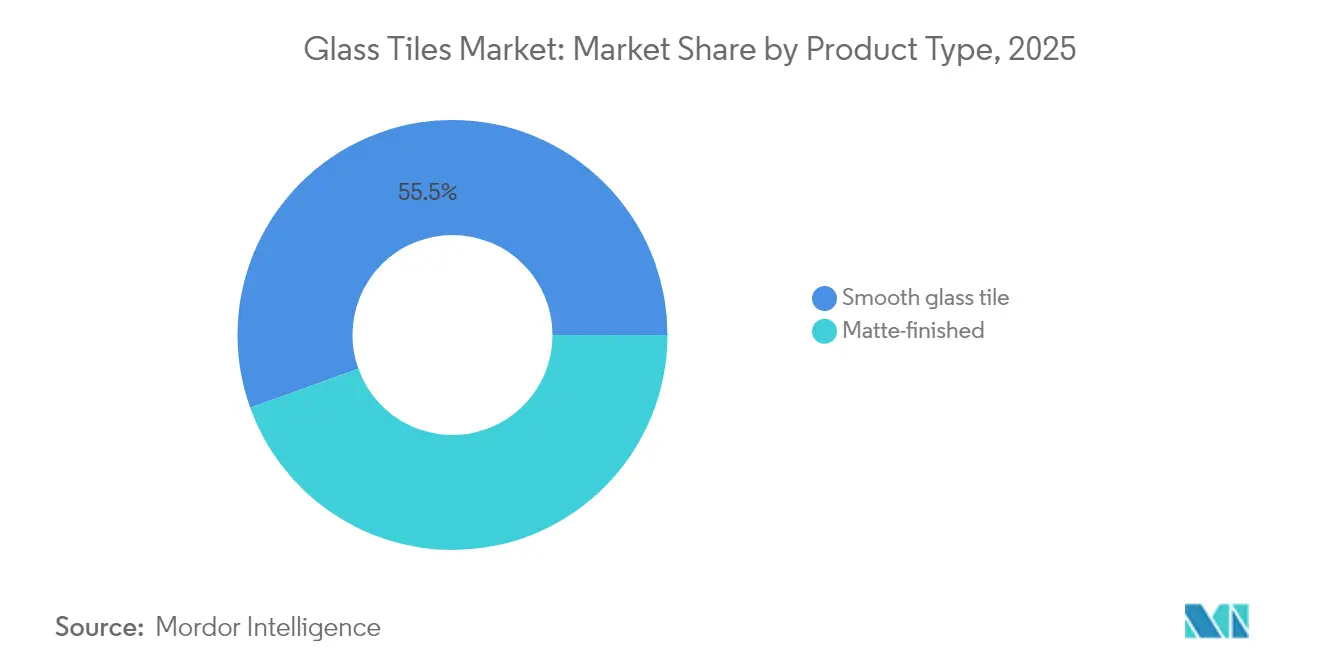
Matte Finishes Gain Premium PositioningSmooth/glossy products held 55.49% share in 2025, yet matte finishes expand fastest at 6.88% CAGR. Designers appreciate low-glare surfaces that provide subtle depth and modern aesthetics. Anti-fingerprint treatments now preserve matte purity in high-traffic hotel lobbies, widening use cases beyond bathrooms. Advances in nano-etching allow manufacturers to retain the easy-clean surface of glossy glass while delivering a satin appearance. Matte variants often command price premiums of 10-15%, encouraging producers to allocate incremental capacity to these SKUs. Hybrid digital-print systems apply metallic accents onto matte backgrounds, satisfying luxury commercial interiors. The glass tiles market size for matte finishes is projected to exceed USD 44.62 billion by 2031, underpinned by upscale condominium demand in Asia-Pacific.
Smooth tiles remain essential in clinical settings, foodservice areas, and swimming pools because their impervious glaze simplifies sanitation. Public health codes in the United States mandate non-porous wall surfaces behind commercial kitchen prep lines, securing baseline demand for glossy glass. Producers bundle anti-microbial silver ions into clear glazes, differentiating from ceramic rivals. Although matte popularity rises, balanced production portfolios help mitigate style swings. Integrated facilities dedicate sequential furnace zones to alternate between gloss and matte runs without stopping the line, maintaining throughput. Overall, product-type diversification anchors the glass tiles market against fashion-cycle volatility while giving distributors a broader palette.

By Manufacturing Process:
Sintered Technology Drives InnovationSintered products register the highest 6.97% CAGR through 2031 while fused tiles retain 37.58% share in 2025. The glass tiles market rewards sintering because the process fires at lower temperatures, cutting gas consumption and CO₂ emissions. Manufacturers embed recycled cullet into sintered blends without compromising strength, aligning with LEED scoring. Fused formats still dominate large-run production due to mature kiln infrastructure, but rising carbon taxes elevate operating costs. Cast and smalti tiles serve artisanal mosaics and heritage restorations where hand-crafted textures justify premium pricing. Research at the Saitama Institute of Technology shows low-temperature recycling routes that could transfer to glass tile furnaces and further reduce energy bills. As architects demand environmental product declarations, sintered suppliers gain preferred-vendor status in publicly funded projects. The glass tiles industry thus pivots capital expenditure toward continuous sinter lines equipped with waste-heat recovery, reinforcing the shift away from traditional fusion.
Lower thermal budgets extend kiln life, freeing maintenance outlays for surface-coating R&D. Automated pressing and calendaring equipment boosts dimensional accuracy, easing site installation and trimming labor spend for contractors. The glass tiles market sees sintered planks entering ventilated facade systems where lighter weight and tight tolerances are critical. Producers co-fire iridescent glazes in a single pass, reducing cycle time compared with separate fusing stages. Lifecycle analyses demonstrate up to 25% embodied-carbon savings relative to fused equivalents, supporting procurement under green-public-procurement rules in Europe. Consequently, sintered technology is forecast to narrow the glass tiles market share gap with fused formats before 2030.
By Application:
Outdoor Installations Drive Premium GrowthWall cladding dominated at 40.12% share in 2025, yet outdoor and landscape installations rise fastest at 6.55% CAGR. UV-stable glazes and frost-resistant bodies now permit glass mosaics in exterior pools, plazas, and terrace planters. Luxury resorts commission iridescent lagoon pools that leverage sunlight refraction for dramatic visuals. Glass pavers with anti-slip texture replace stone on rooftop walkways where weight limits favor thin profiles. Landscape architects specify recycled-glass aggregates in permeable pathways, tying hardscape design to circular-economy goals. As a result, the glass tiles market harvests premium margins in boutique outdoor projects.
Interior flooring, backsplash, and countertop applications remain stable niches. Slip-rated glass floor tiles line spa shower areas where hygiene and aesthetics converge. Commercial kitchens adopt heat-resistant glass countertops that withstand thermal shock better than engineered stone. Backsplashes in quick-service restaurants favor glossy glass for ease of wipe-down during service peaks. Despite these steady volumes, growth concentrates on exterior segments that exploit glass’s resilience to weather cycles and algae staining. Manufacturers supplying pre-mounted mesh sheets streamline installation, reducing field labor and reinforcing the cost case versus porcelain alternatives.
By End-User Industry:
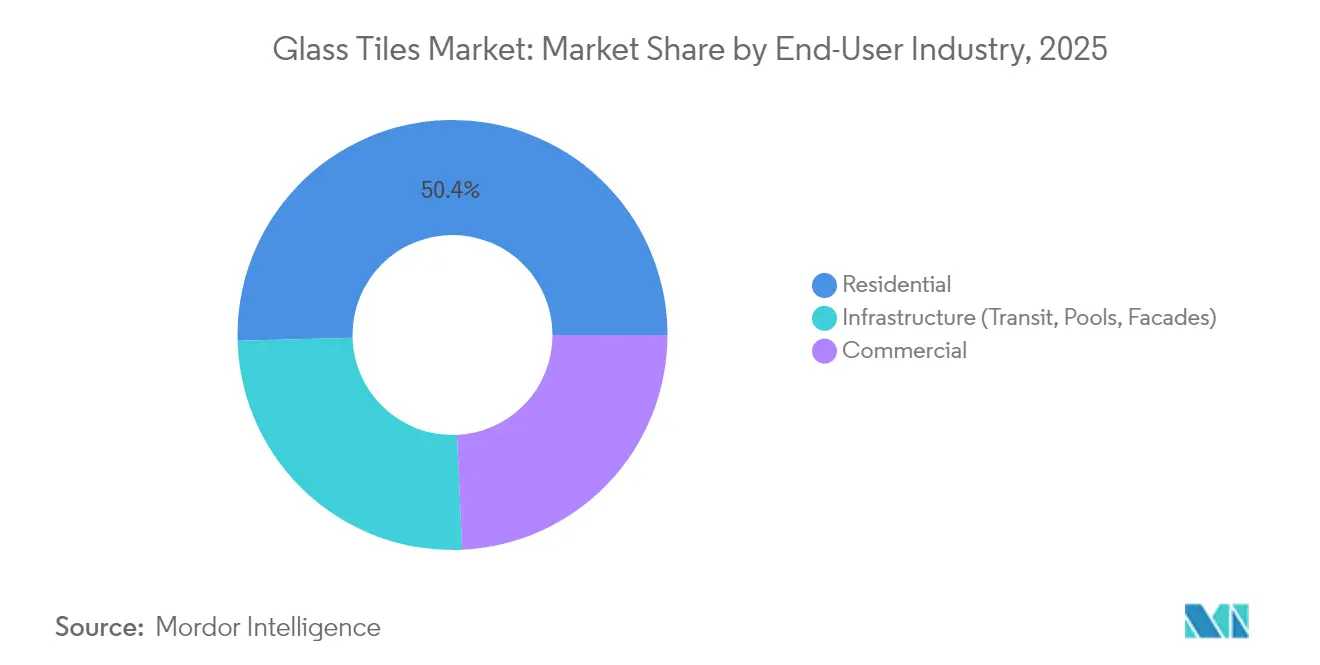
Infrastructure Modernization Accelerates GrowthThe residential category accounted for 50.43% of revenue in 2025 because households prioritize premium kitchen backsplashes and bathroom mosaics. However, infrastructure projects such as metro stations, airports, and civic centers offer the fastest 6.74% CAGR. Governments in China and India budget record sums for transit corridors that specify vandal-resistant, low-maintenance finishes, fueling bulk orders of textured glass panels. Glass tiles meet stringent fire-safety and smoke-toxicity requirements, securing approval in mass-transit design codes. Commercial refurbishments also gain traction as landlords upgrade lobbies with luminous glass feature walls to attract tenants.
Infrastructure growth benefits suppliers with seismic-certified anchoring systems. ASCE guidelines for non-structural glazing in seismic Zone 4 demand flexible, high-displacement mounting hardware. Manufacturers offering pre-tested assemblies reduce engineering costs for design firms. The glass tiles market size serving public works is expected to surpass USD 25.35 billion by 2031, providing a defensive revenue stream amid cyclical housing swings. Residential demand still underpins volume, but infrastructure and commercial verticals diversify risk, ensuring balanced industry expansion.
Geography Analysis
APAC Glass Tiles Market
Asia-Pacific held 51.84% share of the glass tiles market in 2025 and continues to grow at a 6.61% CAGR through 2031. China’s metro-station construction pipeline, India’s Smart Cities Mission, and Japan’s hotel boom ahead of global events sustain robust regional purchasing. Integrated supply chains in Guangdong and Shandong provinces let producers source float glass, colorants, and packaging locally, cutting logistics costs and enabling aggressive export pricing. Governments promote recycled-content mandates, giving sintered producers a domestic advantage and bolstering regional leadership. Rapid urban household formation also supports steady residential renovation demand, making Asia-Pacific the strategic priority for multinational tile brands.
North America Glass Tiles Market
North America represents a mature yet resilient market. United States renovation outlays stay strong as aging housing stock needs updates, while Canada’s CAD 22.2 billion construction investment in March 2025 signals healthy activity. High rise retrofits in New York, Chicago, and Toronto prefer lightweight glass panels to minimize structural reinforcement costs. Mexico’s commercial real-estate growth underpins demand for back-painted glass murals in shopping centers. Stringent energy-codes catalyze adoption of low-emissivity coated glass cladding, offering a functional edge over ceramic alternatives. Consequently, the glass tiles market maintains premium positioning despite economic headwinds.
Europe Glass Tiles Market
Europe commands significant share, anchored by strict decarbonization policies that align with cullet-rich, low-carbon glass. AGC’s target of 50% cullet usage by 2030, together with hybrid-furnace pilots cutting emissions 75%, meets EU taxonomy requirements. Public authorities in Germany and France tender transit-hub refurbishments demanding environmental product declarations, accelerating procurement from certified suppliers. United Kingdom and Italy focus on heritage building upgrades, where glass mosaics complement restoration aesthetics without compromising authenticity. Although growth lags Asia-Pacific, stable public-sector spending and regulatory certainty underpin Europe’s contribution to global revenue.
South America and MEA Glass Tiles Market
South America and Middle East and Africa offer early-stage potential. Brazil’s hotel and resort construction along coastal corridors spurs niche demand for iridescent pool mosaics. Saudi Arabia’s giga-projects specify large-format back-lit glass walls in retail districts, yet supply-chain gaps and price sensitivity limit widespread adoption. Distributors invest in regional warehouses to shorten lead times, positioning the glass tiles market for faster uptake as economic conditions stabilize.
Value Chain Analysis
The glass tiles value chain begins with upstream minerals and recycled inputs, including silica sand, soda ash, limestone, and high-cullet streams from post-consumer and pre-consumer glass. Batch preparation (crushing, storage, weighing, and mixing) leads into energy-intensive melting and forming steps, followed by shaping and finishing through pressing or rolling, firing (including lower-temperature sintering lines), surface treatments, and quality inspection. Producers increasingly use higher cullet ratios and waste-glass integration as fluxing routes to reduce firing temperature and energy intensity, reflecting the market shift toward sintered formats and sustainability-driven specifications.
On the downstream side, sales typically run through specialized wholesale distributors, retail showrooms, and direct-to-consumer digital channels, while jobsite fulfillment depends on regional warehousing and LTL shipping for mixed-SKU orders. Digital production control and logistics tools (such as batch tracking and RFID-capable weighing or scale systems) support traceability, yield management, and on-time delivery, which can influence contractor choice where lead times and breakage risk affect project schedules. Key constraints continue to center on furnace uptime, energy price volatility, and import logistics in regions without integrated supply chains, which keeps the value of regional manufacturing and distributor networks tied to service levels for renovation and commercial projects.
Competitive Landscape
The glass tiles market is moderately fragmented, with major conglomerates leveraging integrated manufacturing and omnichannel distribution to dominate, creating barriers for smaller producers. European players such as Saint-Gobain and Arizona Tile focus on R&D for sustainability, securing institutional projects emphasizing carbon disclosure. Strategic acquisitions enhance distribution and competitiveness against low-cost imports. Technological advancements, including AI-driven designs and renewable energy integration, drive innovation, shifting competition from volume to value-based differentiation.
Glass Tiles Industry Leaders
-
Arizona Tile
-
Daltile
-
Emser Tile
-
Saint-Gobain
-
Iris Ceramica Group
- *Disclaimer: Major Players sorted in no particular order
Glass Tiles Market Companies Covered in this Report
- American Olean
- Arizona Tile
- Artaic, LLC
- Bellavita Tile
- Crossville Inc.
- Daltile
- Emser Tile
- Fireclay Tile
- Hirsch Glass Corp.
- Iris Ceramica Group
- Lunada Bay Tile
- Maniscalco
- Marazzi Group S.r.l.
- Mulia Inc.
- Oceanside Glass & Tile
- Roca Tile USA
- Saint-Gobain
- Sonoma Tilemakers
- Susan Jablon
Market Opportunities and Future Outlook
Decarbonized manufacturing and verified environmental documentation create room for suppliers that can convert recycled glass into premium tile and mosaic offerings while meeting green-building procurement requirements. In May 2026, ONIX published an updated Environmental Product Declaration for its glass mosaic products, citing 100% recycled pre-consumer glass and solar-powered electric production lines, an example of how EPD-backed portfolios can support specification pull in commercial and public projects where embodied-carbon disclosure is increasingly tied to material selection.
Process digitization and alternative forming methods also open specific opportunities around energy efficiency and product differentiation. In June 2026, Glass Futures implemented an AI-driven digital twin of its multi-fuel pilot furnace in St Helens, UK, to test low-carbon glass manufacturing approaches, including hydrogen and biofuels, which supports faster iteration of furnace settings that affect cost and emissions for glass-based building materials. Separately, ORNL and Vitriform3D reported using binder jet 3D printing to turn discarded glass bottles into architectural cladding and decorative tile-type components, indicating a route toward higher-value geometries and more localized production from waste streams. Equipment upgrades that reduce cycle times and energy use, including Glaston highlighting its TC Series flat tempering system with Chinook convection technology at China Glass 2026, reinforce investment priorities across throughput, yield, and operating-cost control throughout the glass tile value chain.
Recent Industry Developments in Glass Tiles Market
- June 2026: Glass Futures implemented an AI-driven digital twin of its multi-fuel pilot furnace at its St Helens, UK center to accelerate testing of low-carbon glass production routes, including hydrogen and biofuels. The capability improves process optimization and repeatability for glass manufacturers working to lower energy use and emissions. It also expands scalable manufacturing know-how supporting recycled-content and lower-carbon glass-based building materials, including tile formats.
- August 2025: Saint-Gobain began construction of a 7th float glass line at Oragadam, Chennai, designed for 1,000 tonnes per day of capacity to serve the construction market. Expanding local glassmaking capacity improves downstream availability of architectural glass inputs used across cladding and interior finish applications. The investment also strengthens Asia-Pacific supply chain integration, a factor behind the region's leading production and consumption footprint in glass-based building materials.
- March 2024: Fireclay Tile reintroduced its Glass Tile product line, producing it at its Glass Factory in Spokane, Washington. The reintroduction increased the availability of domestically manufactured glass tile options for North American renovation and custom design channels. It also pointed to growing momentum behind sustainability-forward positioning and controlled manufacturing for premium interior finishes.
Glass Tiles Market Report Scope and Research Methodology
Market Definition and Coverage
For this study, the glass tiles market covers sales of glass-based tiles used as a surface finish in construction and renovation, mainly on walls, floors, backsplashes, pools, and decorative facades. We size the market in value terms based on the price level where tiles are typically sold into projects.
Scope exclusions: We do not count flat architectural glazing, fiberglass panels, or ceramic or composite tiles that only use a glass coating.
Segments Covered in This Report
- By Product Type
- Matte-finished
- Smooth glass tile
- By Manufacturing Process
- Smalti Tiles
- Fused Tiles
- Sintered Tiles
- Cast Tiles
- Other Manufacturing Processes (Slumped / Etched Tiles)
- By Application
- Wall Cladding
- Flooring
- Backsplashes and Countertops
- Outdoor and Landscape
- By End-User Industry
- Residential
- Commercial
- Infrastructure (Transit, Pools, Facades)
- By Geography
- Asia-Pacific
- China
- India
- Japan
- South Korea
- Rest of Asia-Pacific
- North America
- United States
- Canada
- Mexico
- Europe
- Germany
- United Kingdom
- Italy
- France
- Rest of Europe
- South America
- Brazil
- Argentina
- Rest of South America
- Middle East and Africa
- Saudi Arabia
- South Africa
- Rest of Middle East and Africa
- Asia-Pacific
Data Sources, Market Sizing, and Validation
Desk Research
Desk work starts by mapping the demand pool and the supply chain so market numbers can be built from construction activity indicators. We use public sources such as national statistics offices and construction ministries, customs and trade statistics portals, the World Bank, UN Comtrade, and industry standards bodies to understand construction output, renovation cycles, and materials trade flows.
To translate those signals into a workable model, we also review company filings and investor presentations, association websites, and reputed business press for product mix cues and price movement direction. Where useful, we add paid subscriptions for company financials and intelligence, plus shipment-level import and export databases and patent databases to cross-check manufacturing processes and innovation activity. These desk sources are not exhaustive, and multiple additional references were used to collect data, validate it, and clarify open questions.
Primary Interviews and Surveys
Primary calls and surveys were used to pressure-test the desk assumptions on how glass tiles are specified, priced, and purchased across new build and remodeling. We spoke with a mix of manufacturers, distributors, contractors, and large project buyers across major regions so the model reflects differences in project mix, channel margins, and local price bands. When gaps showed up, the assumptions were revised and then rechecked with respondents before finalizing the totals.
Distribution of primary research fieldwork respondents
| Company type | Respondent position | Region |
|---|---|---|
| Top tier: 26% | CXOs: 20% | APAC: 37% |
| Mid tier: 54% | Functional/Unit leaders: 32% | EMEA: 36% |
| Smaller Players: 20% | Managers: 48% | Americas: 27% |
Market-Sizing & Forecasting
Sizing is built using a top-down approach where construction output, renovation intensity, and finishes adoption are used to reconstruct the addressable spend for glass tile applications. Once the demand pool is formed, we apply market-specific splits and price logic so only the relevant glass tile value is captured.
Key inputs used in the model include indicators such as residential and non-residential construction spending, housing starts and building permits, renovation and repair activity, import and export flows for glass tile and related HS codes, and observed price ranges by finish and format (supported by channel feedback). Pool and wet-area installation trends are also checked because they can move volume even when general construction slows. To keep totals realistic, selective bottom-up checks are run using supplier and distributor revenue cues, sampled average selling price times estimated volume for common applications, and channel margin stacking to bridge factory value to project-level value.
For forecasting, scenario analysis is used with regional construction outlooks and price progression assumptions that respondents confirm as reasonable for the next few years. If a country has limited direct reporting, we use proxy indicators like construction growth, trade dependence, and typical finish mix, then adjust after interview feedback so outliers do not distort the global roll-up.
Data Validation & Update Cycle
Outputs are validated through triangulation across independent signals, then reviewed for variance by region, application intensity, and implied pricing before sign-off. If the model suggests a sudden jump or dip, we re-check the drivers, including permits, trade flows, and channel price movement, and we re-contact sources when a mismatch stays unresolved.
The report is refreshed annually, and interim updates are made when material events occur, such as sharp construction slowdowns, tariff changes, or unusual raw material price moves that affect tile pricing. Before delivery, an analyst performs a fresh pass of the key assumptions and the latest public releases so clients receive an updated view that follows the same repeatable steps.
Mordor Intelligence's Glass Tiles Market Sizing Compared With Other Published Estimates
Published market sizes for glass tiles often differ because the boundary of what is counted changes between studies, and because price points are treated differently across channels. Variations also show up when one source sizes by production value and another sizes by installed or retail-equivalent value, while both are presented as the same market.
Import and export trade flows for glass tile categories, together with construction spending and project-specification feedback from installers, are used as checks that keep Mordor Intelligence's estimate tied to true glass-tile usage in buildings and renovation rather than adjacent tile categories. Spread in other figures usually comes from mixing glass tiles with broader tile markets, using narrower channel coverage, or applying an average price that does not align to local finish mix and margin structure.
Benchmark comparison
| Source | Market Size | Gaps in Research Methodology |
|---|---|---|
| Mordor Intelligence | USD 76.16 B (2026) | |
| Industry Publisher A | USD 4.50 B (2025) | Uses a much narrower value basis that appears closer to manufacturer-level revenue and a tighter definition of what gets counted as glass tiles in the total, which reduces the stated market size. |
| Industry Publisher B | USD 2.51 B (2025) | Leans on a restricted product and pricing scope with conservative average selling price assumptions and limited channel margin capture, which tends to understate installed and retail-equivalent value. |
The comparison shows that the biggest driver is the value point used in sizing, followed by how strictly glass-only tiles are separated from look-alike or coated products. By tying the model to clear demand indicators and a consistent price-and-margin logic, the final number stays traceable and easier to replicate across regions and years.
Key Questions Answered in the Report
What is the current Glass Tiles Market size?
The glass tiles market size is valued at USD 76.16 billion in 2026 and is forecast to reach USD 100.26 billion by 2031.
Which region contributes the most revenue to the glass tiles market?
Asia-Pacific leads with 51.84% share in 2025 and is also the fastest-growing region at a 6.61% CAGR through 2031.
Why are sintered glass tiles gaining popularity?
Sintered tiles fire at lower temperatures, lower energy costs, and deliver superior mechanical properties, driving a 6.97% CAGR that outpaces other manufacturing methods.
What applications are expanding fastest within the glass tiles market?
Outdoor and landscape installations are advancing at a 6.55% CAGR as UV-stable, frost-resistant glass tiles gain favor in pools, facades, and premium exterior features.