
Market Overview
| Study Period | 2020 - 2031 |
|---|---|
| Forecast Data Period | 2026 - 2031 |
| Base Year Market Size (2025) | USD 7.85 Billion |
| Market Size (2026) | USD 8.19 Billion |
| Market Size (2031) | USD 10.12 Billion |
| Growth Rate (2026 - 2031) | 4.33 % |
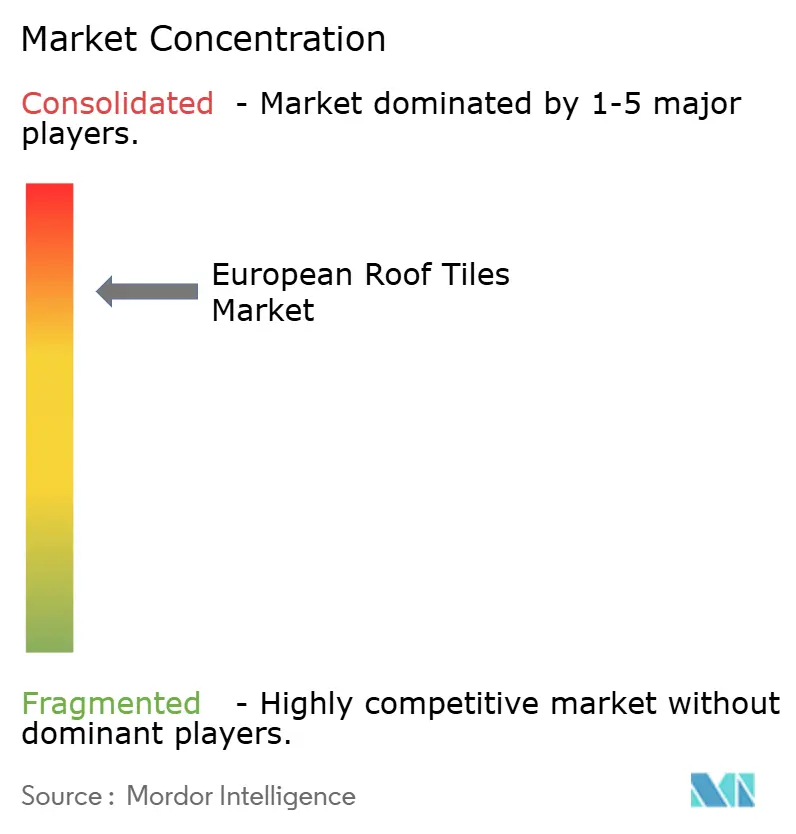
| Market Concentration | High |
Major Players *Disclaimer: Major Players sorted in no particular order Image © Mordor Intelligence. Reuse requires attribution under CC BY 4.0. | |
European Roof Tiles Market Analysis by Mordor Intelligence
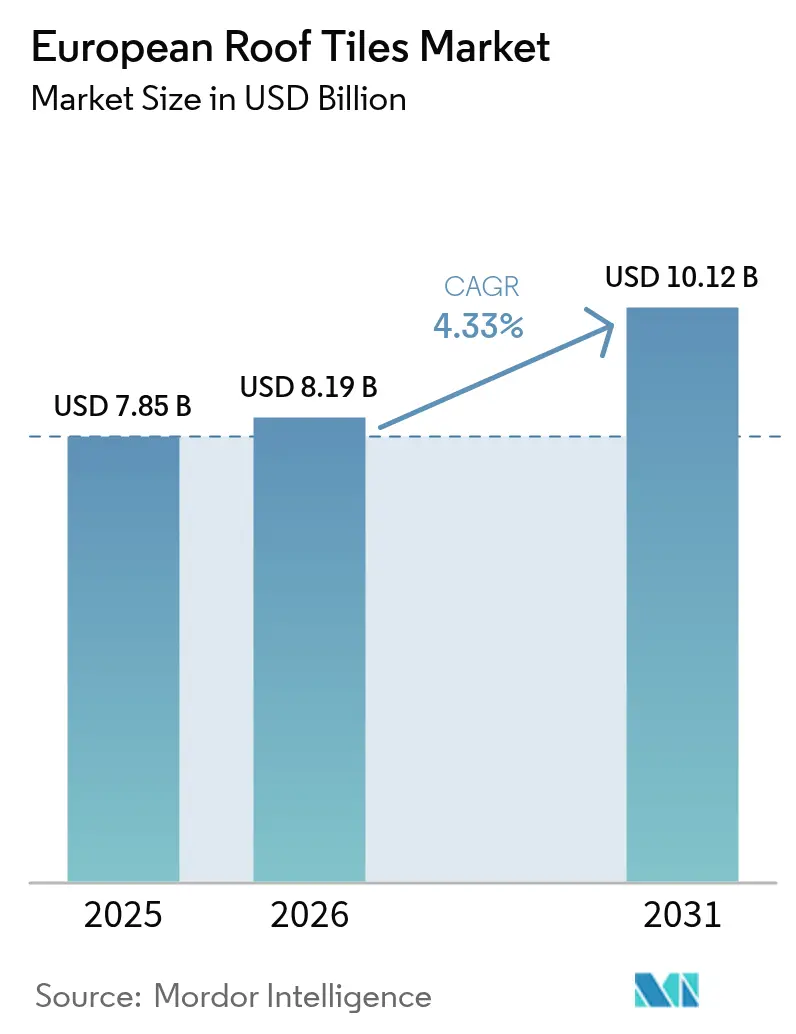
European Roof Tiles market size in 2026 is estimated at USD 8.19 billion, growing from 2025 value of USD 7.85 billion with 2031 projections showing USD 10.12 billion, growing at 4.33% CAGR over 2026-2031. Robust regulatory pressure to decarbonize buildings, an aging housing stock that requires systematic renovation, and rising weather-related risks underpin the steady expansion of the European roof tiles market. Demand is buoyed by the cost efficiency of concrete tiles, the longevity of clay tiles, and the accelerating shift toward building-integrated photovoltaic (BIPV) formats that align with mandatory rooftop solar rules. Competitive activity centers on product convergence, where established producers acquire solar-tile specialists to align with EU green-building mandates. At the same time, raw material cost volatility and skilled labor bottlenecks remain immediate headwinds that manufacturers must navigate to protect margins in the European roof tiles market.
Key Report Takeaways
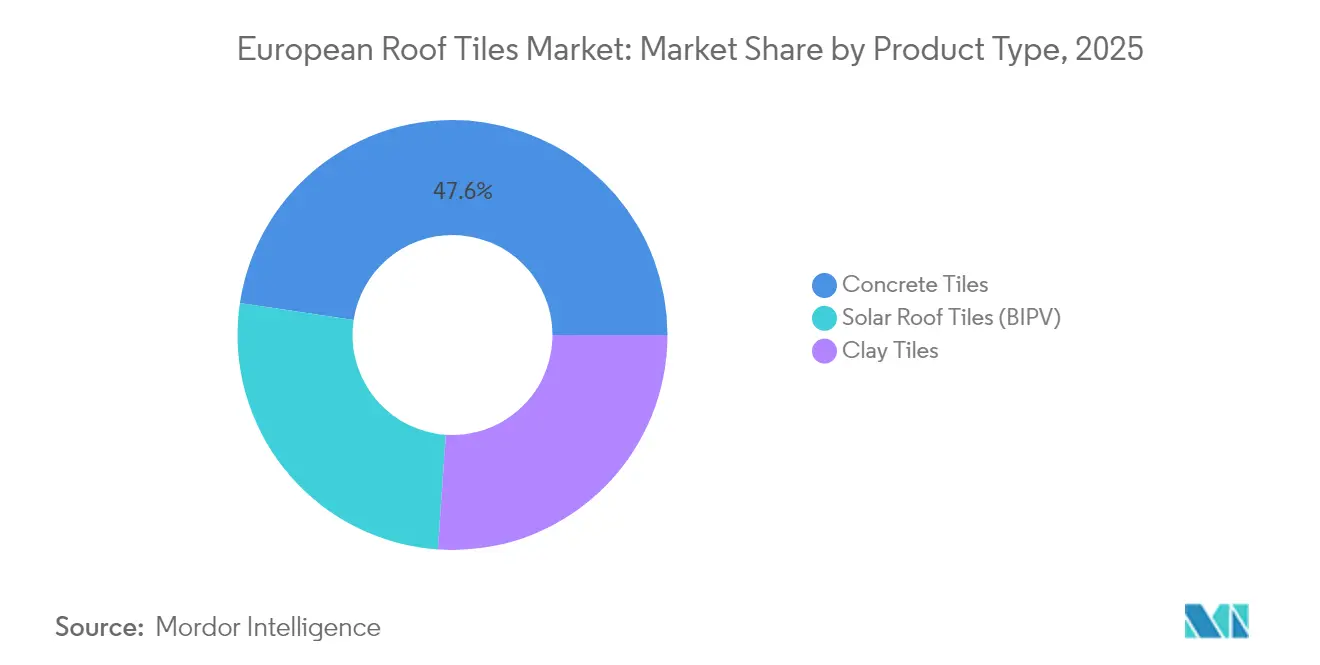
- By product type, concrete tiles led with 47.62% of the European roof tiles market share in 2025, while solar roof tiles recorded the fastest 6.85% CAGR through 2031.
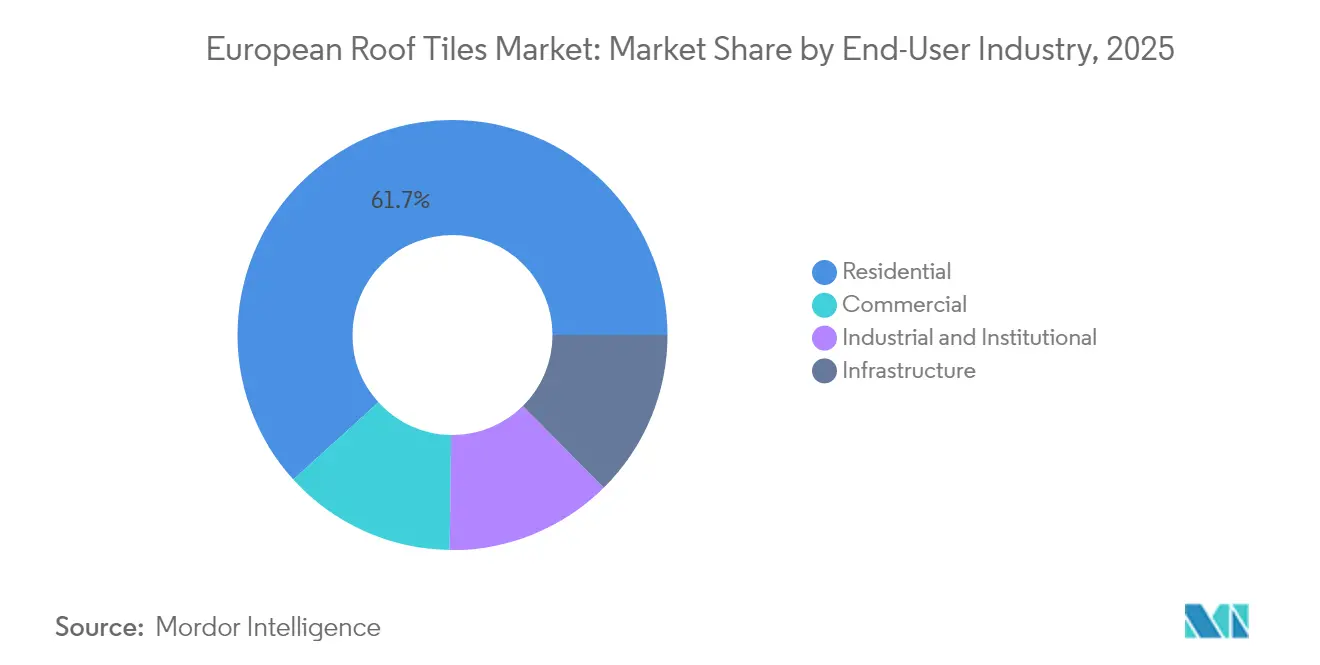
- By end-user industry, residential applications accounted for 61.73% of the European roof tiles market size in 2025; the commercial segment is advancing at a 5.45% CAGR to 2031.
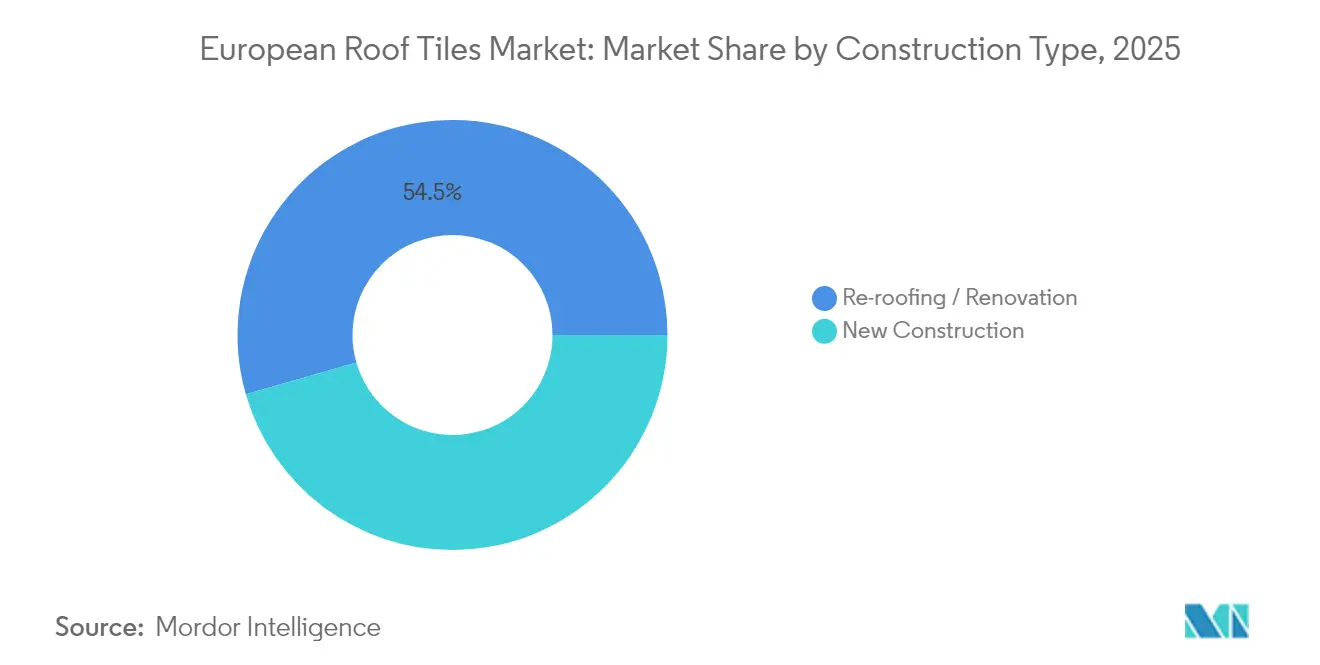
- By construction type, re-roofing and renovation captured 54.45% share of the European roof tiles market size in 2025, whereas new construction is projected to grow at a 5.02% CAGR through 2031.
- By geography, Germany held the largest 18.55% revenue share in 2025, and Turkey is set to expand at a 5.26% CAGR between 2026-2031.
Note: Market size and forecast figures in this report are generated using Mordor Intelligence’s proprietary estimation framework, updated with the latest available data and insights as of 2026.
European Roof Tiles Market Trends and Insights
Drivers Impact Analysis*
| Driver | (~) % Impact on CAGR Forecast | Geographic Relevance | Impact Timeline |
|---|---|---|---|
| EU green-building mandates accelerate adoption | +1.20% | EU-wide; strongest in Germany, France, Netherlands | Medium term (2-4 years) |
| Renovation wave across aging housing stock | +1.80% | EU-wide; concentrated in Western Europe | Long term (≥4 years) |
| Durability and life-cycle benefits of clay/concrete | +0.90% | Northern and Central Europe | Long term (≥4 years) |
| Climate-driven re-roofing after extreme weather | +0.70% | Southern Europe; coastal regions | Short term (≤2 years) |
| Mandatory rooftop-PV rules lift solar tiles | +1.10% | Germany, Netherlands, France; expanding EU-wide | Medium term (2-4 years) |
| Source: Mordor Intelligence | |||


EU Green-Building Mandates Accelerate Tile Adoption
The recast Energy Performance of Buildings Directive compels buildings consuming more than 290 kWh/m² annually to undergo energy renovations by 2030. Consequently, procurement specifications now emphasize roof systems that offer high insulation values and integrate solar generation capacity. Concrete and clay tiles that meet emerging U-value thresholds are becoming default choices in public tenders as local governments align with the Renovation Wave strategy. Early-mover manufacturers roll out tiles pre-certified for BIPV compatibility, positioning themselves ahead of phased compliance deadlines. Late adopters risk exclusion from project shortlists once national transpositions of the directive are fully in force.
Renovation Wave Across Aging European Housing Stock
Three out of every four European dwellings were built before 1990 and fall short of present-day efficiency norms. Brussels targets 35 million renovations by 2030, and roofs top retrofit priority lists because they deliver immediate heat-loss reductions. Concrete tiles remain the default choice for budget-sensitive owners because familiar installation practices limit labor hours and project disruption. Manufacturers leverage predictable replacement cycles to synchronize capacity additions with regional renovation funding programs. Distributors expand just-in-time inventory services, ensuring installers can meet tight subsidy-linked project timelines.
Durability and Life-Cycle Sustainability Advantages of Clay/Concrete Tiles
A 50- to 100-year service life positions clay and concrete products as lower total-cost solutions when labor inflation is factored into replacement scenarios. Independent lifecycle assessments show that the embodied carbon payback of clay tiles occurs within five years, thanks to their superior thermal mass, while concrete tiles require 40% fewer replacements than asphalt shingles over a typical building's life. As climate risk intensifies, insurers are revising premiums in favor of tested products with proven wind-uplift and hail-impact ratings. Producers therefore market durability metrics as both a financial and environmental value proposition.
Integrated Solar Roof Tiles Boosted by Rooftop-PV Rules
Germany’s federal states require solar on new homes as of 2025, while France mandates on-site generation for select commercial roofs. Aesthetic constraints in heritage districts favor BIPV tiles that mimic traditional profiles yet reach 25% cell efficiency. Market entrants partner with conventional roof-tile distributors to capitalize on existing installer relationships, thereby shortening sales cycles. The shift from niche to mainstream has halved system payback periods in high-insolation regions, which drives scale economies and further price reductions.
Restraints Impact Analysis*
| Restraint | (~) % Impact on CAGR Forecast | Geographic Relevance | Impact Timeline |
|---|---|---|---|
| Premium pricing vs. asphalt and sheet metal | -0.80% | EU-wide; strongest in Eastern Europe | Short term (≤2 years) |
| Skilled-labor shortages in tile installation | -0.60% | EU-wide; acute in Germany and Netherlands | Medium term (2-4 years) |
| Volatile energy and raw-material costs | -0.90% | Manufacturing-intensive regions across the EU | Short term (≤2 years) |
| Source: Mordor Intelligence | |||
Premium Pricing Versus Asphalt and Sheet-Metal Roofs
Clay and concrete solutions remain 40-60% pricier than asphalt alternatives, limiting penetration in price-sensitive Eastern European markets. Inflationary spikes in gas and cement during 2024-2025 widened this gap, forcing manufacturers to choose between absorbing costs or raising prices at the risk of volume losses. Nevertheless, where labor costs exceed material costs, owners increasingly value tiles’ extended lifespans, shifting the affordability discussion from upfront expense to lifecycle economics.
Skilled-Labor Shortages in Specialist Tile Installation
Nearly two-thirds of roofing contractors surveyed in 2025 reported project delays due to a lack of trained installers. Tile placement, flashing, and BIPV integration demand precise skill sets that apprenticeship programs are not replenishing fast enough. Wage escalation erodes contractor margins and prompts some to steer clients toward lower-skill alternatives such as bituminous sheets. Manufacturers counter by introducing interlocking designs and augmented-reality training modules, yet a demographic cliff of retiring artisans keeps the constraint acute.
*Our forecasts treat driver/restraint impacts as directional, not additive. The impact forecasts reflect baseline growth, mix effects, and variable interactions.
Segment Analysis
By Product Type: Solar Integration Drives Premium Segment Growth
Solar tiles expanded at a 6.85% CAGR, outpacing all other formats as rooftop-PV obligations proliferated. Concrete maintained a 47.62% share of the European roof tile market in 2025, reflecting its cost advantages and logistical reach into renovation-heavy zones. Clay tiles have captured the heritage restoration market due to their authentic aesthetics and 100-year durability claims. Manufacturers merge traditional lines with BIPV variants to capture adjacency sales, while curved solar formats erase earlier aesthetic objections.
The European roof tiles market increasingly maps to a three-tier value hierarchy: solar tiles at premium price points but limited volume, concrete as a mainstream workhorse, and clay for design-driven or conservation contexts. Plant modernization focuses on digital kiln control to cut gas usage, aligning with corporate net-zero roadmaps. Cross-border acquisitions accelerate, creating platforms that balance commodity concrete capacity with patent-protected solar portfolios, further consolidating the European roof tiles industry.


By End-User Industry: Commercial Acceleration Outpaces Residential Stability
Residential projects accounted for 61.73% of the European roof tiles market share in 2025 as owner-occupied dwellings continued to prioritize curb appeal and durability. Commercial roofs, however, are advancing at a 5.45% CAGR because corporate ESG targets are elevating interest in BIPV solutions that offset energy bills. Industrial and public buildings adopt performance-based procurement, rewarding suppliers who can quantify the total cost of ownership rather than just the headline bid price.
Project financing structures evolve, with roof-lease models bundling installation, maintenance, and energy off-take into a single contract that de-risks capital budgeting for facility managers. Manufacturers respond by building in-house energy services teams or partnering with power purchase agreement aggregators, a shift that blurs the historical lines between construction materials and distributed generation sectors.
By Construction Type: Renovation Dominance Reflects Market Maturity
Re-roofing captured 54.45% of 2025 demand, underscoring the mature profile of European buildings. Predictable replacement cycles ensure stable order intake, even when new housing starts fluctuate, allowing producers to optimize batch runs and raw material purchasing. New construction, forecasted at a 5.02% CAGR, benefits from policy-linked subsidies that require energy-positive envelopes from the outset.
Renovation clients often favor concrete due to familiarity and rapid availability, whereas new-build architects experiment with integrated solar formats that satisfy carbon budgets without compromising design intent. Software-based configurators now allow contractors to assess structural load, wind zone, and electrical output in a single interface, shortening the sales process and increasing specification accuracy.
Geography Analysis
Germany held 18.55% of the European roof tiles market in 2025, supported by stringent energy codes and a dense installer ecosystem that seamlessly handles both traditional and solar formats. Federal state mandates introduced in 2025 require on-site renewables for most residential new builds, effectively guaranteeing baseline demand for BIPV tiles. Automation in German factories raises throughput while maintaining dimensional accuracy, enabling exports that meet diverse European standards.
Turkey is forecast to grow at a 5.26% CAGR through 2031, propelled by rapid urbanization and post-earthquake reconstruction that prioritizes seismic safety and energy efficiency. Local clay deposits reduce input costs, allowing Turkish producers to price competitively within the customs union. Proximity to EU markets offers export optionality, and the government’s housing push sustains domestic volume.
Italy, Spain, and France form a mature yet policy-sensitive triad. Italy’s renovation subsidies spurred a spike in 2025 reroofing permits, but year-to-year volatility persists as fiscal incentives shift. Spain’s tourism-linked construction revival centers on sustainable hotel refurbishments, favoring tiles with Mediterranean aesthetic continuity. France’s 2024 decree mandating solar on large commercial roofs fast-tracks BIPV adoption while strict heritage rules still safeguard clay specifications in protected zones.
Northern Europe exhibits slower but steady adoption, driven by high labor costs that tilt lifecycle economics toward long-lasting tiles. Eastern Europe remains price-constrained, though EU cohesion funds earmarked for energy efficiency could unlock latent demand if subsidy design addresses upfront affordability gaps. Collectively, geographic variations necessitate flexible go-to-market models, from direct sales in Germany to distributor-led approaches in fragmented Mediterranean regions.
Value Chain Analysis
The value chain begins with mineral and energy inputs, including clay extracted from local quarries, sand and aggregates, water, pigments, and cement for concrete tiles, along with packaging materials and palletized logistics. Manufacturing is commonly localized near clay resources to reduce transport costs and emissions. Core process steps include raw material preparation, extrusion or molding, drying, and kiln firing for clay, while concrete production relies on batching, molding, curing, and surface finishing. Energy (gas and electricity) and process control in kilns and curing are major cost and decarbonization levers.
Secondary raw materials and additives (for example, residues used to adjust porosity or improve firing behavior) are increasingly used to manage carbon footprint and performance. Downstream, producers sell through direct specification channels (architects, public tenders, and large contractors) and distributor-led networks that support small installers and renovation work. Installation is a key value-add stage where skilled labor availability and training influence throughput, particularly for detailed tile placement, flashing, and BIPV integration. Industry bodies such as Tiles & Bricks Europe (TBE) support technical exchange and guidance on roof integrity and PV integration, while manufacturers differentiate via system warranties, technical documentation (including EPDs), and just-in-time delivery programs designed to help installers meet subsidy-linked renovation timelines.
Competitive Landscape
The European roof tiles market exhibits consolidated concentration, with Wienerberger, Terreal, and BMI holding a significant share, while dozens of regional specialists cater to localized tastes. Consolidation momentum intensified in 2024-2025 as incumbents acquired solar-tile startups to pre-empt competition from photovoltaic module manufacturers. Private-equity-backed roll-ups target fragmented installer networks, bundling services under unified brands to capture downstream margin.
Technology adoption is a key differentiator. Producers utilize AI-driven kiln optimization to reduce gas usage by up to 8%, thereby meeting their Scope 1 emission goals. Digital specification tools integrate BIM libraries, allowing architects to drag and drop tile styles with embedded performance data. Customer portals now offer order-tracking and remote warranty claims, a service dimension that smaller rivals struggle to replicate.
Strategic thematics revolve around sustainability credentials. EPD-certified products and cradle-to-cradle claims resonate with institutional buyers, while voluntary third-party hail-resistance labels unlock insurance-backed discounts. Companies also pilot recycled-content concrete tiles to mitigate emissions related to cement production. As regulatory bars rise, the cost of compliance escalates, effectively widening the moat for incumbents with ISO-accredited labs and certified quality systems.
European Roof Tiles Industry Leaders
BMI Group
IKO Industries Ltd
Marley
EGGER
Wienerberger AG
- *Disclaimer: Major Players sorted in no particular order

Market Opportunities and Future Outlook
Lower-embodied-carbon roof coverings with verifiable product declarations are emerging white-space areas as buyers and public procurement increasingly seek EPD-backed comparisons. Recent product and materials moves point to commercially actionable routes. Marley launched a concrete roof tile (Edgemere 2.0), positioned around carbon-capture cement from Heidelberg Materials Brevik (Norway), and concrete-tile formulations validated at factory scale using graphene-enhanced cement (FP McCann with First Graphene) show how cement intensity can be reduced without changing existing equipment. Tile makers and raw material suppliers can use these examples to co-develop low-carbon binders, increase recycled or secondary input content, and expand EPD coverage to protect specification access.
BIPV continues to function as a premium growth pocket where performance improvements and form-factor compatibility can broaden addressable roofs beyond niche aesthetics. In April 2026, TNO disclosed progress on perovskite solar roof tiles using flexible solar foils applied to curved composite tiles, tying next-generation PV materials to traditional roof geometries. This supports partnership opportunities across tile manufacturers, PV-material innovators, and installer networks to standardize mounting, wiring, and weatherproofing details, and to package roof plus generation offerings for commercial buildings navigating on-site generation rules and tighter building-energy requirements.
Recent Industry Developments
- June 2026: Marley launched the Edgemere 2.0 concrete roof tile, positioned as the first UK concrete tile to use carbon-capture cement technology, leveraging Heidelberg Materials evoZero cement from the Brevik (Norway) CCS-enabled plant. The move links roof-tile specification to embodied-carbon benchmarks and pressures competitors to respond with EPD-backed, lower-carbon formulations that fit existing installation practices.
- July 2025: BMI Group upgraded inspection capability at its Crawley Technical Center by integrating LK Metrology laser scanning (7-axis FREEDOM Arm Classic Scan) to improve dimensional verification for roofing systems. Higher measurement precision supports tighter quality control and faster product validation cycles, which is increasingly relevant as tiles and roofing components incorporate PV and higher-performance envelope requirements.
- March 2024: Wienerberger completed the acquisition of Terreal (France, Italy, Spain, and the USA) and Creaton (Germany), expanding its roof-tiles footprint and portfolio depth across key European markets. The transaction strengthened scale advantages in manufacturing, distribution, and specification coverage, reinforcing consolidation dynamics in European roof tiles.


Research Methodology Framework and Report Scope
Market Definition and Coverage
This market captures the value of roofing tiles sold in Europe for roof covering and weather protection, covering both new builds and re-roofing activity. Values are counted at the manufacturer to first-sale level in USD.
Scope exclusions: We exclude non-tile roof coverings that are primarily membranes or liquid-applied systems, and we also exclude labor-only installation revenues.
Segmentation Overview
- By Product Type
- Clay Tiles
- Concrete Tiles
- Solar Roof Tiles (BIPV)
- By End-user Industry
- Residential
- Commercial
- Infrastructure
- Industrial and Institutional
- By Construction Type
- New Construction
- Re-roofing / Renovation
- By Geography
- Germany
- United Kingdom
- France
- Italy
- Spain
- Russia
- Nordics
- Turkey
- Rest of Europe
Data Sources, Market Sizing, and Validation
Desk Research
Desk work started by mapping how roofing activity translates into tile demand, then keeping the mapping consistent across countries. We leaned on public construction output and permit indicators, together with housing stock renovation signals, to identify where re-roofing typically dominates versus new construction.
For Europe and major countries, we referenced sources such as Eurostat building production series, national statistical offices, UN Comtrade trade flows for ceramic and concrete building products, and construction and building materials associations that publish outlook notes. We also checked company annual reports, investor decks, and reputable business press to understand pricing actions, plant changes, and product-mix shifts. Where available, a paid subscription covering company financials and a shipment-level trade database were used to cross-check revenue direction and import dependence. These sources are illustrative, and we also used other public and paid references to collect, validate, and clarify data points.
Primary Interviews and Surveys
Primary work was used to challenge what the desk indicators implied, especially around replacement cycles, premiumization (including solar-integrated tiles), and the speed at which price changes were passed through. We spoke with a mix of manufacturers, distributors, roofing contractors, and specifiers across Europe so assumptions could be aligned to purchasing behavior, and we adjusted where local practices differed by country.
Distribution of primary research fieldwork respondents
| Company type | Respondent position |
|---|---|
| Top tier: 34% | CXOs: 14% |
| Mid tier: 50% | Functional/Unit leaders: 27% |
| Smaller Players: 16% | Managers: 59% |
Market-Sizing & Forecasting
Sizing was built mainly from a top-down demand pool. Country-level roofing activity and renovation intensity were translated into tile consumption, then priced using country and product-mix aware average selling prices. We corroborated the results with selective bottom-up checks, including sampled supplier revenue splits by geography, distributor channel checks on volumes, and ASP times volume math for the main tile materials. These checks helped correct overstatement risks in smaller markets.
Key drivers that moved the totals included residential versus non-residential roofing share, re-roofing frequency linked to housing stock age and weather exposure, clay versus concrete mix by country, import share for tile products, and observed price progression tied to energy and raw material cost swings. For forecasting, scenario analysis was used around construction cycles and renovation incentives, then weighted using expert views collected in interviews. When a bottom-up signal was incomplete, for example limited disclosure on smaller producers, gaps were handled by applying conservative capacity and utilization proxies and validating them against trade and channel feedback.
Data Validation & Update Cycle
Each sizing step is checked against at least one independent signal, so the model does not depend on a single data series. Large variances are flagged, the driver is traced back to the underlying assumption, and then corrected only after another source or interview confirmation supports the change.
Before sign-off, outputs are reviewed across countries for logical consistency in per-roof demand, pricing, and trade dependence, followed by a second analyst review focused on outliers. The reports are refreshed annually, with interim updates when material events occur, such as sharp energy-price shifts, policy changes affecting renovations, or major capacity moves. Right before delivery, we run a final pass to ensure clients receive the latest updated view.
Mordor Intelligence's Europe Roofing Tiles Market Estimate Compared With Other Published Estimates
Published numbers for Europe roofing tiles can look far apart because the scope line is not always drawn the same way, and because replacement demand is measured differently across countries. Differences also come from how solar roof tiles are treated, which year currency conversion uses, and whether prices are kept flat or allowed to move with energy and raw material costs.
The main gap comes from whether adjacent roofing products are folded into the total, because in Mordor Intelligence's model, only roofing tiles (including solar roof tiles where they are sold as roof tiles) are counted, and non-tile roofing categories are kept out even if they sit in the same contractor budget.
Benchmark comparison
| Source | Market Size | Gaps in Research Methodology |
|---|---|---|
| Mordor Intelligence | USD 7.85 B (2025) | |
| Trade Journal A | USD 5.24 B (2025) | Uses a narrower product lens and appears to anchor demand more to reported sales by a limited set of countries, which can undercount renovation-heavy markets and smaller import flows. |
| Industry Bulletin B | USD 10.41 B (2022) | Uses an older base year and likely applies a broader roofing scope and different price escalation assumptions, which can inflate the total when inflationary years are not normalized. |
The spread in the table is mainly explained by product inclusion choices, base-year timing, and how quickly pricing is allowed to adjust in the model. By tying demand to roofing activity and re-roofing intensity, and then checking it against trade and channel signals, the estimate stays traceable to practical variables that can be reviewed and repeated.


Key Questions Answered in the Report
What is the current value of the European roof tiles market?
The market is valued at USD 8.19 billion in 2026 and is forecast to reach USD 10.12 billion by 2031.
Which product segment leads in market share?
Concrete tiles hold the highest share at 47.62% in 2025.
Which geography shows the fastest growth?
Turkey is projected to grow at a 5.26% CAGR through 2031.
Why are BIPV tiles gaining traction?
Mandatory rooftop-solar rules, improved aesthetics, and 25%+ cell efficiency are driving adoption.
What is the main restraint facing tile installers?
A skilled-labor shortage limits installation capacity across the region.
Page last updated on:





