
Glass Fiber Reinforced Concrete (GFRC) Market Size and Share
Market Overview
| Study Period | 2020 - 2031 |
|---|---|
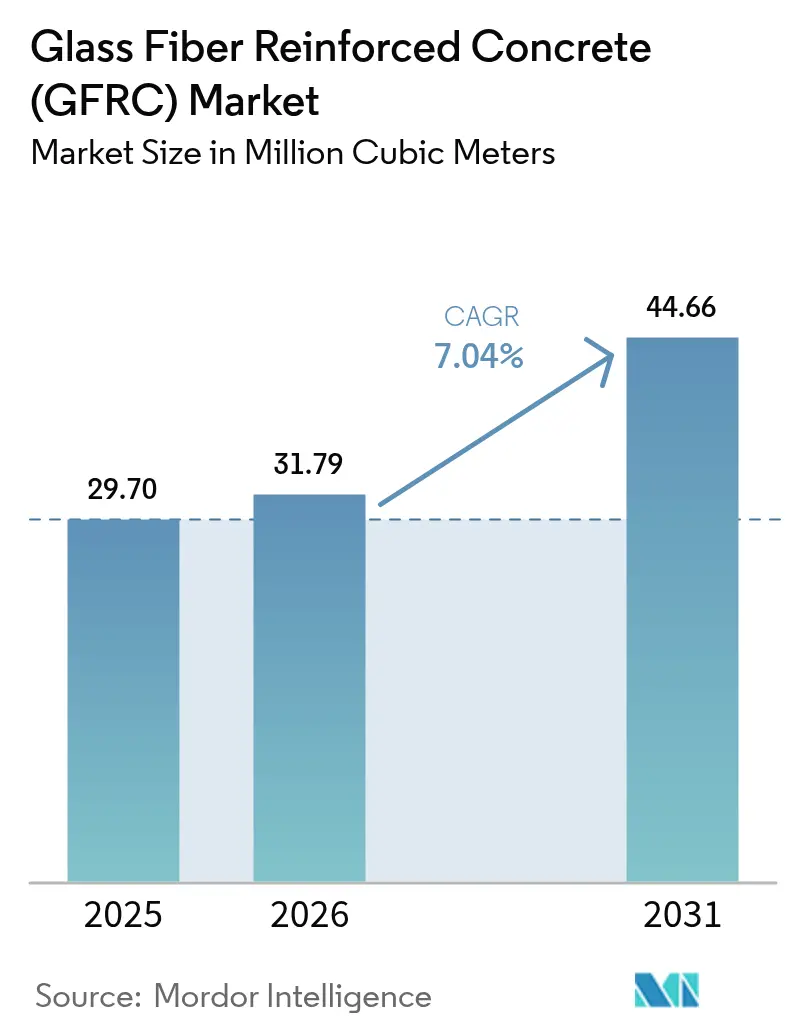
| Market Volume (2026) | 31.79 Million cubic meters |
| Market Volume (2031) | 44.66 Million cubic meters |
| Growth Rate (2026 - 2031) | 7.04 % |
| Fastest Growing Market | Asia Pacific |
| Largest Market | Asia Pacific |
| Market Concentration | Low |
Major Players *Disclaimer: Major Players sorted in no particular order Image © Mordor Intelligence. Reuse requires attribution under CC BY 4.0. | |
Glass Fiber Reinforced Concrete (GFRC) Market Analysis by Mordor Intelligence
Glass Fiber Reinforced Concrete Market size in 2026 is estimated at 31.79 million cubic meters, growing from 2025 value of 29.70 million cubic meters with 2031 projections showing 44.66 million cubic meters, growing at 7.04% CAGR over 2026-2031. This expansion is fueled by the material’s higher strength-to-weight ratio, growing green-building mandates, and rapid adoption of digital manufacturing. Infrastructure owners are retrofitting assets with slender GFRC panels to reduce seismic loads, while architects exploit CNC-machined molds to deliver intricate façades at lower cost. Expanded supply of alkali-resistant (AR) fibers stabilizes raw-material pricing, making long-run production planning easier for both regional and global suppliers. However, the pace of growth still hinges on faster code development, as engineers remain cautious where ductility rules favor steel reinforcement.
Key Report Takeaways
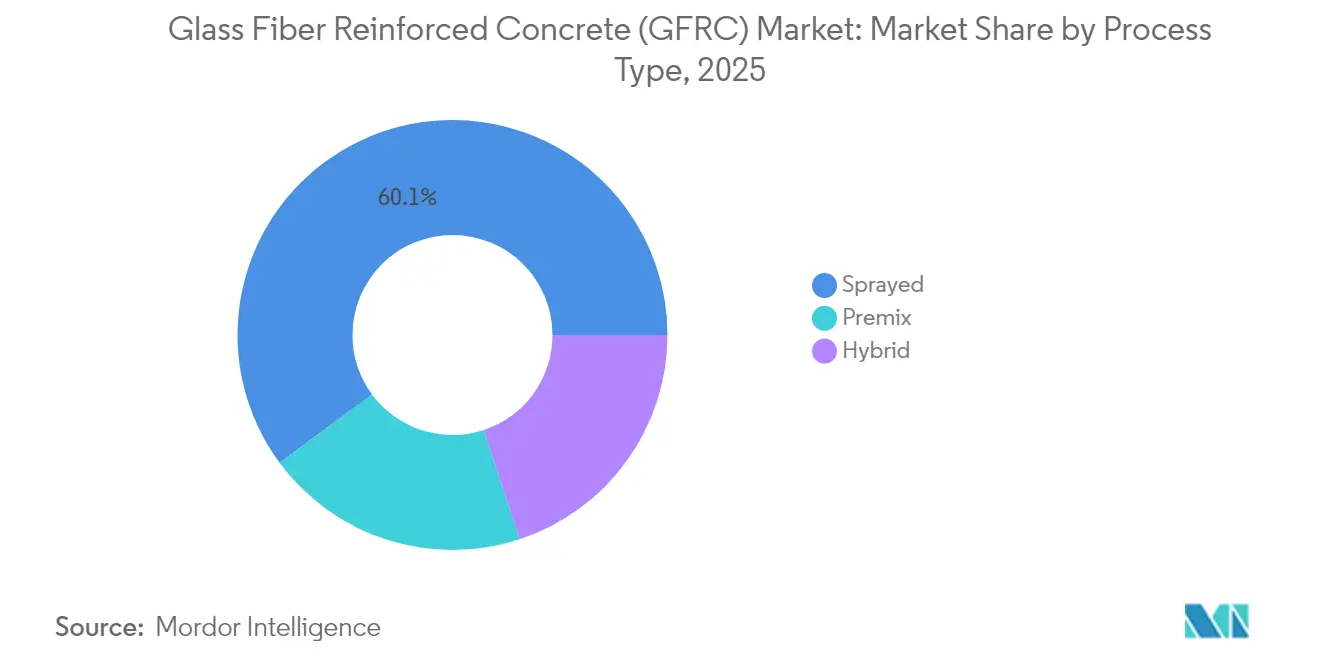
- By process type, the sprayed method captured 60.12% of the glass fiber reinforced concrete market share in 2025 and is growing at a 7.21% CAGR through 2031.
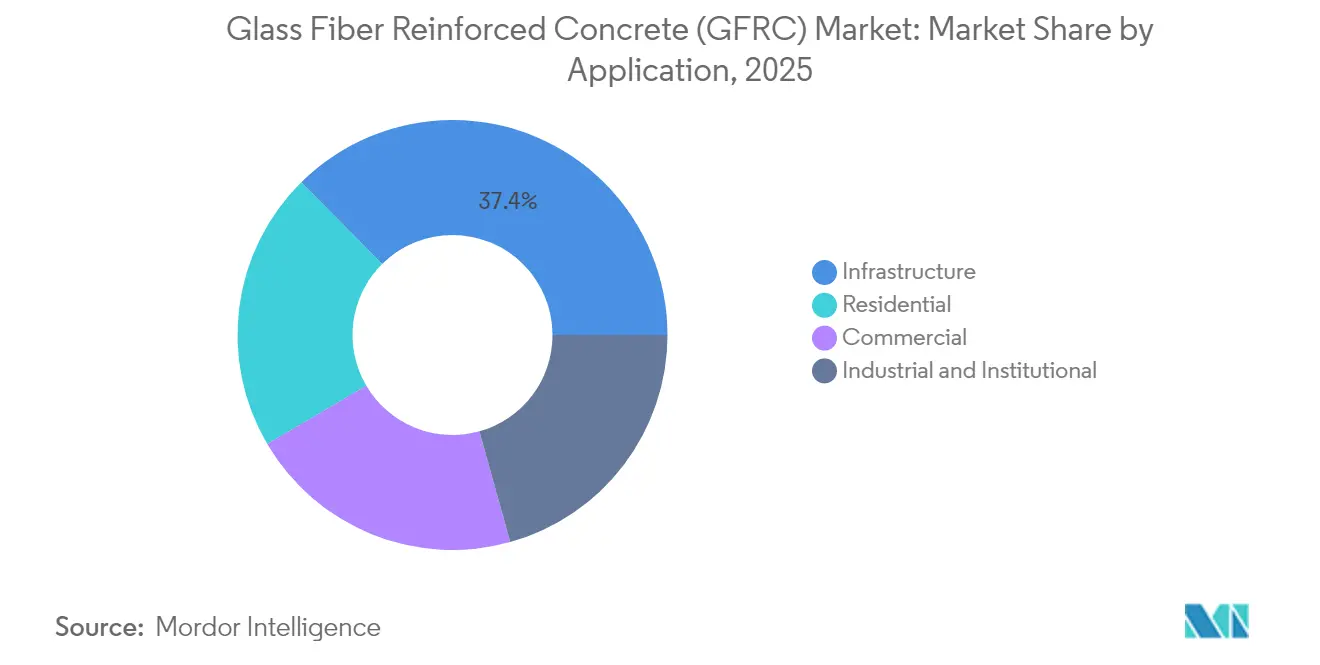
- By application, infrastructure accounted for 37.42% of the glass fiber reinforced concrete market size in 2025, while residential is advancing at a 7.63% CAGR through 2031.
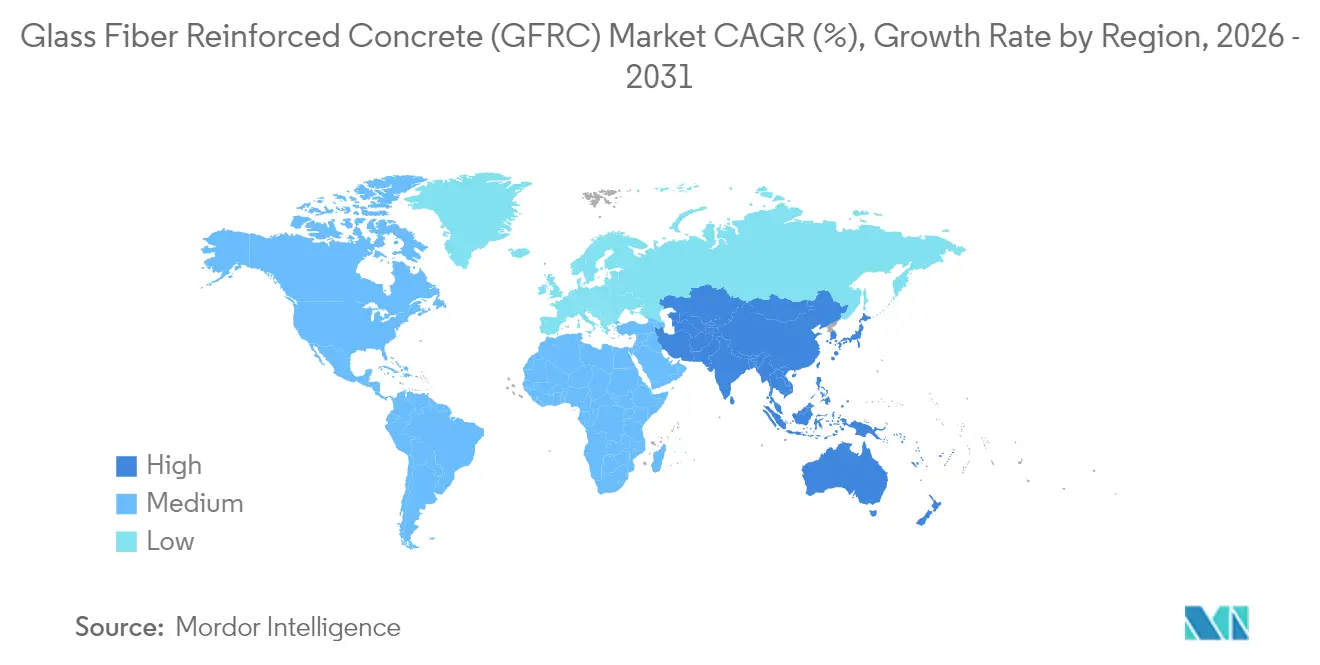
- By geography, Asia-Pacific held 53.58% revenue share of the glass fiber reinforced concrete market in 2025; the region is set to expand at a 7.29% CAGR through 2031.
Note: Market size and forecast figures in this report are generated using Mordor Intelligence’s proprietary estimation framework, updated with the latest available data and insights as of 2026.
Market Trends and Insights
Drivers Impact Analysis of Glass Fiber Reinforced Concrete (GFRC) Market*
| Drivers | (~) % Impact on CAGR Forecast | Geographic Relevance | Impact Timeline |
|---|---|---|---|
| Increased emphasis on green buildings (LEED ratings) | +1.8% | Global, led by North America and EU | Medium term (2-4 years) |
| Superior strength-to-weight ratio reduces structural and logistics cost | +2.1% | Global, especially APAC mega-projects | Long term (≥ 4 years) |
| Precast adoption to cut on-site labor and cycle time | +1.5% | APAC core, rising in North America | Short term (≤ 2 years) |
| Growing availability of alkali-resistant glass fiber supply | +0.9% | Global | Medium term (2-4 years) |
| Digital manufacturing enables complex façades | +0.8% | North America and EU first movers | Long term (≥ 4 years) |
| Source: Mordor Intelligence | |||
Increased Emphasis on Green Buildings (LEED Ratings)
GFRC reduces cement clinker volume and supports thinner cross-sections, both of which lower embodied carbon. The resulting credits help commercial buildings meet LEED v4 material and resource benchmarks. Developers also gain operational savings because lighter panels permit smaller foundations and less steel framing[1]. Pilot studies show up to 65% CO₂ savings in floor slabs that combine GFRC skins with recycled aggregates, a result now cited in voluntary disclosure statements across Europe. Structure owners increasingly demand environmental product declarations, and GFRC makers have begun publishing cradle-to-gate data that compares favorably with masonry and precast concrete. These disclosures accelerate specification rates in both public and private tenders.
Superior Strength-to-Weight Ratio Reduces Structural and Logistics Cost
GFRC panels weigh roughly 20% less than comparable reinforced-concrete elements while delivering 25-35% higher ultimate tensile capacity[2]. Infrastructure teams deploying tunnel liners in China’s Dalian Bay shaved 15 days off crane work after switching to thin GFRC segments. Lower dead load also improves seismic resilience by cutting base shear forces, a concern in Japan and California. Transportation cost drops become notable on long-haul routes where weight-based freight tariffs dominate. These economic gains strengthen the business case despite fiber and polymer premiums relative to ordinary concrete.
Precast Adoption to Cut On-Site Labor and Cycle Time
Chronic craft-labor shortages intensify pressure on contractors to prefabricate structural elements. Controlled factory conditions cut rework and shorten pour-to-install cycles by 20-30%. GFRC offers crisp finishes without external cladding, eliminating multiple job-site trades. Automation readiness adds further value: palletizing robots can place sprayed panels directly onto curing racks, while bar-coding systems track mix designs in real time. The result is predictable throughput that aligns with just-in-time site logistics, giving developers confidence to lock in accelerated delivery milestones.
Growing Availability of Alkali-Resistant Glass Fiber Supply
Regional AR-fiber plants in China and India now serve 80% of Asia-Pacific demand, slashing import lead times and buffering price shocks. Advanced sizings improve bond durability under high-pH pore solutions, extending fatigue life projections beyond 50 years. The tighter supply chain allows mid-tier manufacturers to secure multi-year contracts at indexed rates, a hedge against volatility during construction booms. As fiber suppliers scale, minimum-order volumes drop, bringing smaller mold shops into the market and broadening geographic reach.
Restraints Impact Analysis of Glass Fiber Reinforced Concrete (GFRC) Market*
| Restraints | (~) % Impact on CAGR Forecast | Geographic Relevance | Impact Timeline |
|---|---|---|---|
| Lack of ductility vs. steel-reinforced concrete | -1.2% | Global, seismic zones | Long term (≥ 4 years) |
| Limited design codes and certification standards | -0.8% | North America and EU | Medium term (2-4 years) |
| High initial cost of proprietary premix/polymer systems | -0.6% | Price-sensitive economies | Short term (≤ 2 years) |
| Source: Mordor Intelligence | |||
Lack of Ductility vs. Steel-Reinforced Concrete
Fiber bridging narrows but does not close the gap between GFRC and steel in post-yield behavior, a property enshrined in seismic-resistance provisions worldwide. Engineers remain uneasy specifying GFRC for plastic hinge regions, particularly in high-rise cores that carry life-safety loads. Hybrid reinforcement trials mixing GFRC panels with internal steel cages show promise, yet add back both weight and corrosion risk, dulling two core advantages. Structural adoption will lag until national codes formally recognize design equations for displacement-based checks.
Limited Design Codes and Certification Standards
The building-code vacuum forces project teams into costly mock-up testing or special-inspection regimes that stretch schedules. While the PCI and GRCA publish best-practice manuals, municipal authorities seldom grant blanket approvals, so every load-bearing use still goes through alternate-means submittals. Divergent acceptance criteria among the International Building Code, Eurocode, and local Asian standards further complicate multinational rollouts. Harmonized test methods under ISO or ASTM banners would streamline compliance, but committee processes move slower than product innovation, stranding new mixtures in regulatory limbo.
*Our forecasts treat driver/restraint impacts as directional, not additive. The impact forecasts reflect baseline growth, mix effects, and variable interactions.
Glass Fiber Reinforced Concrete (GFRC) Market Segment Analysis
By Process Type:
Versatility of the Sprayed MethodThe sprayed route led the glass fiber reinforced concrete market with 60.12% volume in 2025 and is on track for a 7.21% CAGR through 2031. Real-time deposition control and higher fiber alignment deliver reliable tensile capacity, letting producers mold ultra-thin panels that match 1.6 kN/m² wind-load targets. Automated spray guns cut labor hours by 30%, pushing per-panel cost down even on low-volume runs. Hybrid plants overlay premix backing onto sprayed face coats, marrying cosmetic quality with structural heft in one pass. Field adoption rises fastest in stadium roofs and transit hubs that require graceful curves and rapid erection.
Growing penetration of six-axis robots expands the sprayed method beyond premium façade work. Continuous-measurement nozzles now adjust slurry flow for ambient humidity, reducing rebound to under 5% and costing less than manual cleanup. The process remains sensitive to curing-room climate, but sensor-driven HVAC mitigates shrinkage cracking in temperate and tropical zones. Premix-only lines still rule when compressive-strength targets top 100 MPa, yet their slower cycle time limits appeal for mass-produced cladding.

By Application:
Infrastructure Momentum and Residential UpswingInfrastructure owned 37.42% of 2025 shipments, translating to the largest slice of the glass fiber reinforced concrete market size and reflecting public-works demand across tunnels, bridges, and wastewater tanks. Weight savings trim crane capacity and allow prefabricated arch segments that speed nightly bridge-deck replacements. Meanwhile, residential demand climbs at 7.63% CAGR as modular developers in Japan and Australia select GFRC skin-plus-core panels to solve labor gaps and deliver net-zero energy walls.
Commercial towers prefer GFRC curtain walls over aluminum where local codes impose strict fire-spread limits. Institutional campuses—especially hospitals—specify GFRC for interior cladding in MRI suites due to its non-magnetic character. Industrial wastewater operators choose the material for secondary containment basins because chloride resistance exceeds that of epoxy-coated conventional concrete. Each niche adoption feeds a flywheel: higher production volume lowers average cost, prompting architects to expand specification breadth.
Geography Analysis
APAC Glass Fiber Reinforced Concrete (GFRC) Market
Asia-Pacific generated 53.58% of global volume in 2025 and carries the highest growth outlook at 7.29% CAGR to 2031. China’s Belt and Road megaprojects demand GFRC, and localized AR-fiber production shortens supply chains. India’s Smart Cities Mission budgets USD 165 billion for transit-oriented hubs, many in corrosive coastal zones perfectly suited to GFRC façades. Japan and South Korea refine seismic-grade mix designs, targeting 1.2 GPa flexural capacity while keeping density below 2,200 kg/m³. Government-backed lab programs certify these formulations, slashing approval hurdles.
North America Glass Fiber Reinforced Concrete (GFRC) Market
North America ranks second in volume and leads in green-building adoption. LEED-linked mandates across California and New York add specification pull, while U.S. federal infrastructure funds channel USD 24 billion toward bridge replacement projects that can benefit from weight-saving GFRC decks. Canada’s cold-climate trials confirm freeze-thaw durability, a prerequisite for Highway 11 viaduct retrofits. Mexico explores GFRC crash-barrier applications on its expanding toll-road network, where lighter panels simplify overnight lane closures.
Europe Glass Fiber Reinforced Concrete (GFRC) Market
Europe focuses on retrofit markets, using GFRC to relieve overstressed masonry foundations in historic districts. Germany pilots large-format rainscreen panels integrated with vacuum insulation, meeting near-zero energy targets under the updated EPBD. The United Kingdom reshapes the office refurb sector after whole-life carbon criteria entered planning guidance in 2025. France courts heritage-preservation specialists by coloring GFRC with iron oxide pigments that mimic sandstone while resisting acid rain. Italy deploys slender vault shells inside basilica restorations, exploiting the material’s high impact resilience.
Regulatory Landscape
GFRC compliance is anchored to product and installation standards, alongside building-code acceptance pathways that vary by geography. In the United States, ANSI/PCI 128-24 is used for the design, manufacture, and installation of GFRC panels, while ASTM C1666/C1666M-08(2023) sets minimum requirements for alkali-resistant glass fibers used in hydraulic cement environments, tightening durability expectations for in-service performance.
In Europe, CEN EN 1170:2024 updates standardized test methods for GRC products (including bending strength metrics such as LOP and MOR, water absorption, and density), shaping type testing and factory production control alignment. At the sub-national level, California Division of the State Architect guidance (IR 19-2 under the 2025 California Building Code) shows how authorities having jurisdiction operationalize acceptance for GFRC panel systems, increasing emphasis on documented QA/QC and traceable test data for project approvals.
Value Chain Analysis
The GFRC value chain starts with upstream raw materials and formulations, mainly Portland cement, silica sand, water, polymer modifiers (often acrylic-based), and specialty alkali-resistant (AR) glass fibers. AR fibers are a key constraint point because they are specification-driven (durability in high-alkaline cement matrices) and directly affect long-term performance and compliance, making fiber qualification and consistent sizing and bond behavior central to procurement decisions.
Midstream conversion takes place in precast and façade shops through spray-up, premix, and hybrid routes (sprayed face coat with a premix backer). Value is added via mold-making (including CNC-machined molds and formwork), controlled curing, finishing, and embedded connection hardware. Downstream channels include façade contractors, precast installers, and general contractors serving infrastructure owners and commercial and residential developers, with adoption often gated by certification and documented production controls (for example, PCI Plant Certification for GFRC and GRCA manufacturer schemes) that qualify suppliers for larger tenders and code-driven submittals.
Competitive Landscape
Global supply is fragmented, yet regional oligopolies form around fiber, binder, and panel capacity. Innovation strategy now tilts toward Industry 4.0. European suppliers deploy digital twins to predict panel distortion during cure, while U.S. startups fit machine-vision cameras that scan fiber distribution. Asia-Pacific giants couple proprietary AR-fiber plants with captive panel shops, allowing cost-plus pricing that undercuts independent molders. Yet capital intensity—robotic arms, curing kilns, real-time analytics—raises financial barriers for new entrants. Consolidation is expected as middle-tier firms lacking scale share transfer to investors eager for environmental-tech exposure. Over the horizon, recycled carbon fiber fillers loom as a disruptive option, promising higher strength-to-weight ratios at modest carbon impact.
Glass Fiber Reinforced Concrete (GFRC) Industry Leaders
-
Formglas Products Ltd
-
Ultratech Cement Ltd
-
Clark Pacific
-
Fibrex Construction Group
-
Betofiber
- *Disclaimer: Major Players sorted in no particular order

Glass Fiber Reinforced Concrete (GFRC) Market Companies Covered in this Report
- Aparna RMC.
- ASAHI BUILDING-WALL CO.,LTD.
- BarChip Pty Ltd.
- Betofiber
- Buddy Rhodes Concrete Products
- Chiltern GRC Ltd
- Clark Pacific
- Dalian Shantai New Industrial Co. Ltd
- Fibrex Construction Group
- FIBROBETON
- Fishstone Studio Inc.
- Formglas Products Ltd
- Frey-Fil Corporation
- GB Architectural Cladding Products Ltd
- GRCUK
- Ibstock Plc.
- Lindner SE
- Loveld
- Low & Bonar
- Pennine Stone Ltd
- Polycon Group a.s
- Shanghai Zhuoou Building Decoration Engineering Co. Ltd
- SureCrete Design Products
- Telling Ltd
- Ultratech Cement Ltd
- Yeung's Fiberglass Company
Read Analysis of Glass Fiber Reinforced Concrete (GFRC) Companies
Market Opportunities and Future Outlook
Low-carbon GFRC/GRC formulations and verified environmental documentation support a white-space pathway in projects shaped by embodied-carbon criteria and green-building scoring. Research published in April 2026 (White Rose Research) described a low-carbon GRC mix using calcium sulpho-aluminate cement with recycled concrete fine aggregate, citing 74% lower CO2 emissions and 48% lower embodied energy versus ordinary Portland cement controls, which aligns with the market shift toward thinner sections and EPD-led specification in public and private tenders.
Manufacturing and performance innovations are also expanding application whitespace where variability and post-crack behavior have constrained adoption. A June 2026 study (Journal of Materials in Civil Engineering) validated a low-pressure casting method for premix GFRC, improving fiber distribution and reporting large gains in flexural strength (95%) and post-cracking ductility (60%), supporting more repeatable production beyond premium spray-up façades. On the demand side, product-line expansion in prefabricated GFRC by Homebridge Precast, LLC (June 2026, landscaping-oriented modular lines) indicates continued commercialization of factory-made GFRC into standardized SKUs, complementing the broader precast trend that reduces on-site labor and shortens installation cycles.
Recent Industry Developments in Glass Fiber Reinforced Concrete (GFRC) Market
- April 2026: UltraTech Cement Ltd announced a capital expenditure plan of Rs 16,000 crore to expand manufacturing capacity to 240 million tonnes per annum by FY 2027-28, after surpassing 200 mtpa. Larger and more secure cementitious supply can improve input availability for GFRC fabricators tied to cement and binder systems, particularly in Asia-Pacific where the region leads global GFRC volume.
- April 2025: PORAVER gmbh announced it would provide expanded glass to improve GFRC properties, with the intent of lowering component weight when incorporated into mixes. Lighter GFRC elements strengthen the value proposition in cladding and retrofit use cases where dead-load reduction and handling efficiency drive design decisions.
- February 2025: Ibstock plc exited its GFRC division and ceased production following sustained financial underperformance, including a GBP 3 million trading loss in 2024. The withdrawal reduced local supply options for some buyers and highlighted margin and execution risks in GFRC operations, especially where subcontractor performance and project-based volatility are high.
Glass Fiber Reinforced Concrete (GFRC) Market Report Scope and Research Methodology
Market Definition and Coverage
For this study, the market covers glass fiber reinforced concrete (GFRC) used in building and civil works, counted when GFRC mixes or GFRC finished elements are supplied for construction and retrofit projects.
Scope exclusions: We exclude conventional reinforced concrete without glass fibers, and we also exclude standalone glass fiber roving and chemical admixtures sold without GFRC conversion.
Segments Covered in This Report
- By Process Type
- Sprayed
- Premix
- Hybrid
- By Application
- Commercial
- Residential
- Infrastructure
- Industrial and Institutional
- By Geography
- Asia-Pacific
- China
- India
- Japan
- South Korea
- Rest of Asia-Pacific
- North America
- United States
- Canada
- Mexico
- Europe
- Germany
- United Kingdom
- Italy
- France
- Rest of Europe
- South America
- Brazil
- Argentina
- Rest of South America
- Middle-East and Africa
- Saudi Arabia
- South Africa
- Rest of Middle-East and Africa
- Asia-Pacific
Data Sources, Market Sizing, and Validation
Desk Research
Desk work started with public construction indicators so we could map where GFRC demand is realistically coming from. We reviewed sources such as US Census construction spending releases, Eurostat construction output, World Bank macro and urbanization series, and UN Comtrade trade flows for glass fibers and related materials as direction checks.
To connect demand with real usage, we also used building code guidance and fire performance references (where publicly available), peer-reviewed cement and concrete journals for mix design and durability context, and association or standards body publications related to concrete, precast, and composites. These were complemented with company filings, investor presentations, press releases, and a paid subscription for company financials, patents, and shipment-level import-export checks where they were useful for sanity tests. This list is illustrative only, since many other sources were also read for data collection, validation, and clarification.
Primary Interviews and Surveys
Primary work focused on the value chain elements that can explain actual GFRC consumption, including precast fabricators, facade and cladding contractors, architects and specification teams, distributors, and raw material suppliers. We used these discussions to confirm how often GFRC is chosen over precast concrete, GRC alternatives, and polymer-based panels, and to tighten assumptions on project mix, scrap rates, and pricing.
Coverage was balanced across major construction regions so local building practices, labor availability for sprayed versus premix methods, and infrastructure pipeline timing could be reflected consistently in the model.
Distribution of primary research fieldwork respondents
| Company type | Respondent position | Region |
|---|---|---|
| Top tier: 38% | CXOs: 14% | APAC: 44% |
| Mid tier: 44% | Functional/Unit leaders: 41% | EMEA: 31% |
| Smaller Players: 18% | Managers: 45% | Americas: 25% |
Market-Sizing & Forecasting
Sizing was built using a top-down approach that reconstructs GFRC demand from the construction activity pool, and then applies realistic adoption and usage intensity for applications where GFRC is technically preferred (such as facade panels, decorative elements, and certain infrastructure components). Once the demand pool was set, we converted it into market value using typical project level GFRC content and prevailing price bands shared during interviews.
To keep the numbers grounded, we used selective bottom-up approximations as cross-checks, including supplier and fabricator revenue cues, sampled price per square foot (or per cubic meter) ranges, and channel checks on regional throughput. Inputs that mattered most included new commercial floor space additions, infrastructure capex direction, facade renovation cycles, process split between sprayed and premix, and the spread between material-only versus installed pricing. For forecasting, scenario analysis was run around construction starts and renovation momentum, and then the central path was chosen when it matched expert expectations on pipeline conversion and price movement. Where company disclosures were incomplete, gaps were handled by using regionally consistent utilization and mix assumptions, followed by interview-based corrections.
Data Validation & Update Cycle
Outputs were triangulated against independent signals such as construction output indices, trade movements of glass fibers, and the direction of precast and facade activity in major regions. When a country estimate looked unusually high or low, the assumptions were rechecked in steps, starting with demand pool sizing, then adoption rates, and finally pricing and unit conversions.
Before sign-off, the model goes through peer review where sensitivities are tested and large variances are documented with a clear reason. Reports are refreshed annually, and interim updates are made when material events occur, such as major code changes, sharp raw material price swings, or construction cycle breaks. Right before delivery, a final pass is completed so clients receive the latest updated view.
Mordor Intelligence's Glass Fiber Reinforced Concrete Gfrc Market Size Compared Against Other Published Estimates
It is normal to see different market sizes for GFRC because publishers do not always count the same thing, and they also anchor their math to different years and pricing logic. Differences show up quickly when one estimate is built from construction activity and usage intensity, while another is driven more by broad materials revenue pools.
In GFRC, the largest gaps typically come from whether the value is counted at material supply level or at installed project level, and whether precast concrete products that are not GFRC are quietly blended into the total. Another common driver is that some pages report only value in USD, while others use volume first and then apply a generic price, which can move the outcome a lot when regional labor and specification needs change.
Benchmark comparison
| Source | Market Size | Gaps in Research Methodology |
|---|---|---|
| Mordor Intelligence | USD 2.95 B (2026) | |
| Industry Research Publisher A | USD 3.20 B (2024) | Uses an earlier base year and appears to stay closer to a broad value view, where pricing and installation scope are not clearly separated, which can lift totals in high labor markets. |
| Global Research Group B | USD 3.49 B (2025) | Runs a USD-first model with a different base year and may count installed construction value more widely across civil applications, which can raise the number versus material supply only views. |
The spread in the table is mainly explained by year alignment and what is being priced, followed by how tightly GFRC is separated from adjacent precast and facade materials. By anchoring demand to construction activity and then applying application level usage and pricing checks, the estimate stays traceable to practical inputs, a modeling choice used by Mordor Intelligence.
Key Questions Answered in the Report
How large will the glass fiber reinforced concrete market be by 2031?
Volume is forecast to reach 44.66 million cubic meters by 2031, reflecting a 7.04% CAGR from 31.79 million cubic meters in 2026.
Which region leads the current demand for GFRC?
Asia-Pacific commands 53.58% of global volume thanks to large infrastructure programs and local fiber production advantages.
What application segment shows the fastest growth?
Residential construction is expanding at a 7.63% CAGR as developers adopt precast GFRC panels to reduce labor and accelerate schedules.
Why are architects choosing GFRC over aluminum curtain walls?
GFRC offers lighter weight, superior fire resistance, and the ability to deliver complex shapes at lower embodied carbon.
What limits structural adoption of GFRC today?
Engineers remain cautious due to limited ductility relative to steel reinforcement and the lack of comprehensive design codes.