
Market Overview
| Study Period | 2020 - 2031 |
|---|---|
| Forecast Data Period | 2026 - 2031 |
| Base Year Market Size (2025) | USD 3.09 Billion |
| Market Size (2026) | USD 3.3 Billion |
| Market Size (2031) | USD 4.6 Billion |
| Growth Rate (2026 - 2031) | 6.86 % |
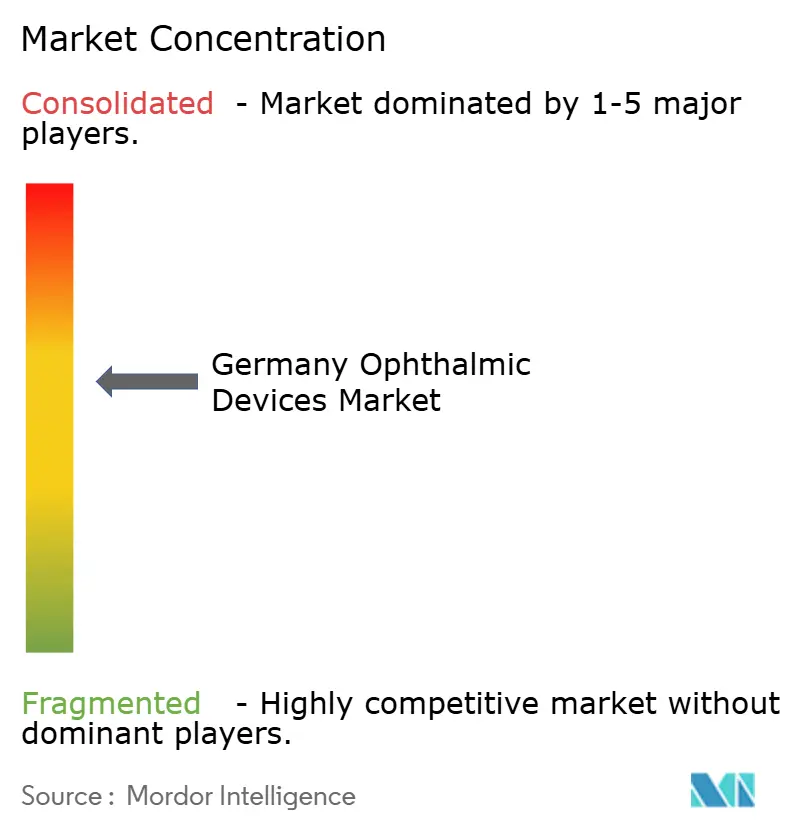
| Market Concentration | Medium |
Major Players *Disclaimer: Major Players sorted in no particular order Image © Mordor Intelligence. Reuse requires attribution under CC BY 4.0. | |
Germany Ophthalmic Devices Market Analysis by Mordor Intelligence
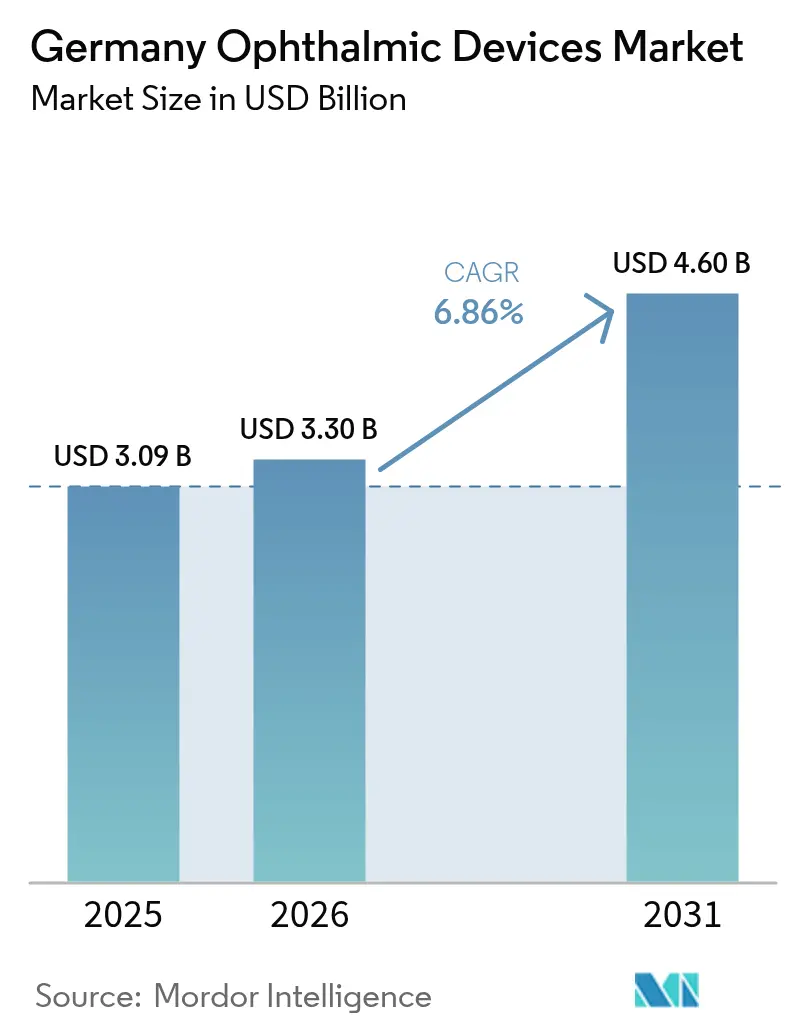
The Germany ophthalmology devices market size is expected to grow from USD 3.09 billion in 2025 to USD 3.3 billion in 2026 and is forecast to reach USD 4.6 billion by 2031 at 6.86% CAGR over 2026-2031. A rapidly ageing population, high digital literacy among clinicians, and the migration of cataract and refractive surgery to ambulatory settings collectively underpin sustained demand across diagnostic, vision-care, and surgical product lines. Device makers are pouring capital into data-enabled platforms that compress diagnostic pathways and into minimally invasive tools that trim operating-room time, insulating order volumes even during macro-economic slow-downs. Payer alignment around DRG incentives and clearer reimbursement for technology add-ons is shortening payback horizons, which attracts small innovators seeking niche opportunities. Although the Germany ophthalmology devices market remains fragmented, suppliers that can bundle consumables, capital equipment, and software are positioned to capture superior margins.
Key Report Takeaways
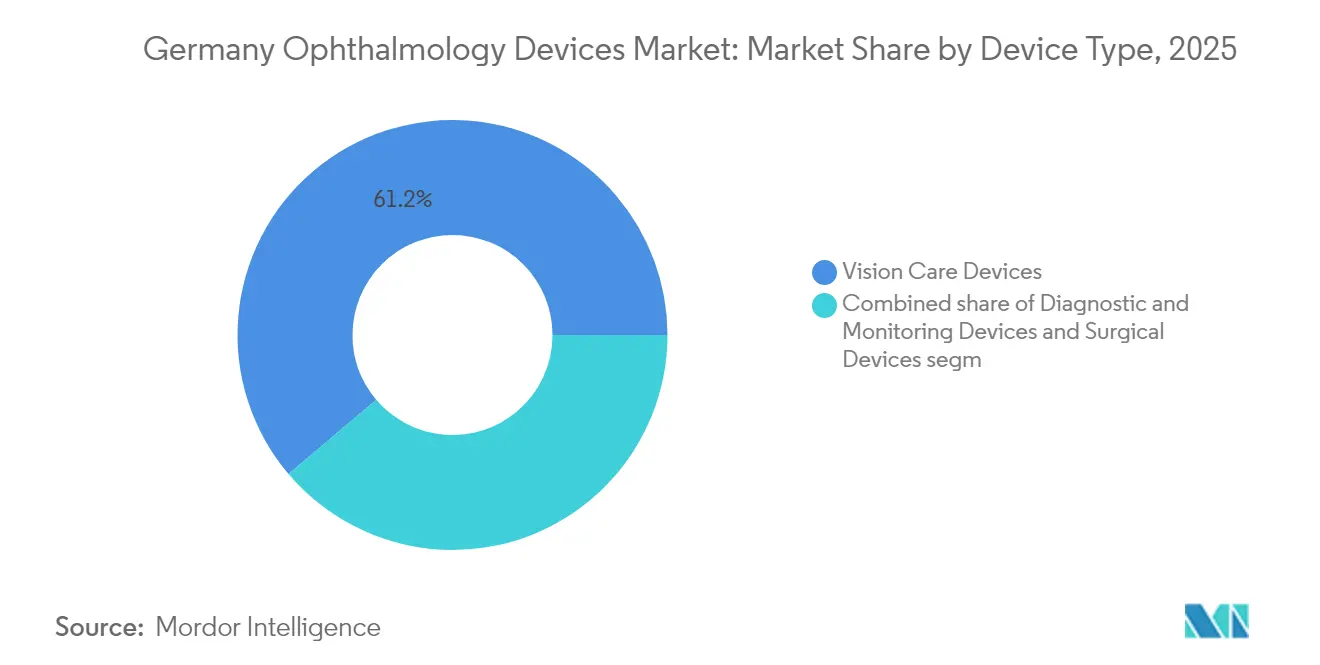
- By device type, vision-care products led with 61.20% Germany ophthalmology devices market share in 2025, while diagnostic platforms registered the highest projected CAGR at 8.2% through 2031.
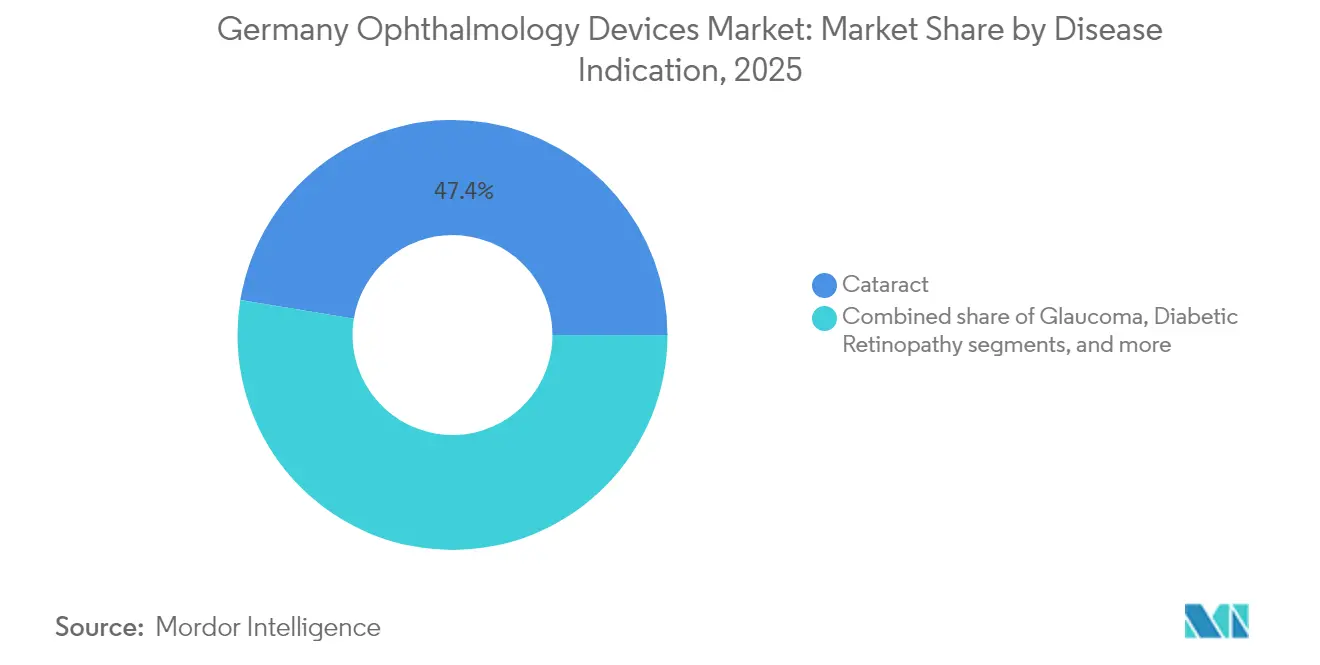
- By disease indication, cataract solutions accounted for 47.40% share of the Germany ophthalmology devices market size in 2025, whereas retinal-disorder devices are forecast to advance at a 8.85% CAGR between 2026-2031.
- By end-user, hospitals held 44.30% of Germany ophthalmology devices market share in 2025, yet ambulatory surgery centres are on track for an 7.95% CAGR to 2031.
Note: Market size and forecast figures in this report are generated using Mordor Intelligence’s proprietary estimation framework, updated with the latest available data and insights as of 2026.
Germany Ophthalmic Devices Market Trends and Insights
Drivers Impact Analysis*
| Drivers Impact Analysis | (~) % Impact on CAGR Forecast | Geographic Relevance | Impact Timeline |
|---|---|---|---|
| Rising myopia and hyperopia prevalence | +1.9% | Nationwide | Long term (≥ 4 years) |
| DRG expansion for premium IOLs | +1.4% | Nationwide | Medium term (2-4 years) |
| AI-enabled diagnostic accuracy | +1.3% | Urban centres | Short term (≤ 2 years) |
| Shift to ambulatory ophthalmic surgery | +1.1% | Nationwide | Medium term (2-4 years) |
| Germany’s photonics manufacturing cluster accelerating innovation | +0.9% | Berlin-Brandenburg | Medium term (2-4 years) |
| Post-COVID backlog of cataract procedures | +1.2% | Nationwide | Short term (≤ 2 years) |
| Source: Mordor Intelligence | |||
Demographic Shift – Rising Myopia and Hyperopia Patterns
Studies tracking refractive errors show prevalence rates rising sharply from primary-school age to young adulthood, while hyperopia accelerates in older cohorts. Retailers respond with gender-specific frames and ortho-k lenses that increase repeat purchases without aggressive price hikes. Screen-time proliferation and reduced outdoor activity amplify demand for spectacles, contact lenses, and emerging myopia-control solutions. Vision-care vendors that pair product launches with mobile apps monitoring wear-time see stronger brand loyalty, validating a data-driven upsell strategy. The Germany ophthalmology devices market consequently enjoys a broad, resilient consumer base.
Statutory Health Insurance Reimbursement for Premium IOLs
The October 2024 DRG update added three ophthalmology codes that broaden coverage for advanced IOLs. While monofocal models remain fully reimbursed, multifocal and toric lenses still entail co-payments, tempering immediate uptake. Hospitals therefore pilot adjustable IOLs that can be fine-tuned post-operatively, demonstrating cost-effective visual outcomes. Early adopters report lower re-operation rates, a metric expected to influence future tariff negotiations. Manufacturers using real-world evidence to prove these benefits reinforce the Germany ophthalmology devices market narrative that premium technology aligns with payer value frameworks.
Rapid Uptake of AI-Enabled Diagnostic Platforms
Peer-reviewed data confirm that AI algorithms now achieve perfect sensitivity in diabetic-retinopathy screening and near-perfect accuracy in detecting age-related macular degeneration and glaucoma[1]Skevas C. et al., “Implementing and evaluating a fully functional AI-enabled model for chronic eye disease screening in a real clinical environment,” BMC Ophthalmology, biomedcentral.com. Clinics integrating cloud-based image-analysis suites report shorter patient throughput times, freeing capacity for high-margin vitrectomy and cataract cases. Direct integration with electronic health records simplifies reimbursement audits, nudging insurers toward favourable coverage decisions. The digital maturity of German eye-care therefore fuels recurring software revenues within the Germany ophthalmology devices market.
Expansion of Ambulatory Ophthalmic Surgery Centers
Policy makers are moving cataract and refractive surgery from inpatient wards to accredited ambulatory surgery centres (ASCs), mirroring an EU-wide trend[2]Organisation for Economic Co-operation and Development, “Health at a Glance: Europe 2024,” oecd.org. Surgeons cite reduced anaesthesia needs and smaller incision sizes as enablers of same-day discharge, while private-equity investors scale national ASC networks that co-locate optical retail stores. Competitive pressure prompts hospitals to install compact phaco consoles and single-use packs, lifting order books for suppliers that tailor equipment to lean workflows. This shift helps the Germany ophthalmology devices market capture procedure growth without straining hospital budgets.
Restraints Impact Analysis*
| Restraints Impact Analysis | (~) % Impact on CAGR Forecast | Geographic Relevance | Impact Timeline |
|---|---|---|---|
| Public-fund price ceilings on refractive devices | −1.0% | Nationwide | Medium term (2-4 years) |
| Rural shortage of ophthalmologists | −0.8% | Eastern & Southern Länder | Long term (≥ 4 years) |
| High out-of-pocket cost for premium contact lenses | −0.7% | Nationwide | Short term (≤ 2 years) |
| MDR 2017/745 certification delays for SMEs | −0.9% | Nationwide | Medium term (2-4 years) |
| Source: Mordor Intelligence | |||
Price Pressure from Public Sickness Funds on Refractive Devices
Statutory sickness funds apply tight reference pricing to premium spectacles and accommodative IOLs, compressing manufacturer margins. The looming EU Health Technology Assessment regulation, mandating joint clinical evaluations for high-risk devices from 2025, could elongate market-entry timelines for small firms. Companies equipped with robust real-world evidence may convert the regulatory hurdle into a competitive moat. Nonetheless, persistent cost caps weigh on ASPs, limiting the pricing latitude of the Germany ophthalmology devices market.
Shortage of Ophthalmologists in Rural Bundesländer
OECD data show Germany sharing Europe’s broader healthcare workforce deficit, with rural districts hardest hit. Mobile programmes such as the Eye Van deliver outreach services, yet patchy broadband connectivity hampers tele-ophthalmology deployment. Device makers are therefore re-engineering diagnostic units into ruggedised, portable formats to suit mobile clinics. Until workforce imbalances recede, this gap constrains procedure volumes in underserved areas, capping growth for portions of the Germany ophthalmology devices market.
*Our forecasts treat driver/restraint impacts as directional, not additive. The impact forecasts reflect baseline growth, mix effects, and variable interactions.
Segment Analysis
By Device Type: Diagnostic Growth Outpaces, Vision-Care Dominates
Vision-care products accounted for the largest slice of Germany ophthalmology devices market size in 2025, reflecting entrenched purchasing habits and the steady introduction of higher-margin continuous-wear lenses. Retail chains integrating on-site refraction services increase store traffic and boost ancillary accessory sales, further protecting the segment’s 61.20% share. Suppliers deploying myopia-management lenses accompanied by mobile-app compliance trackers raise replacement frequency and reinforce brand stickiness. The coexistence of high-volume spectacles and premium contact-lens materials underscores a dual-track opportunity: volume stability alongside ASP expansion.
Diagnostic and monitoring equipment, though smaller in absolute terms, is forecast to post a high single-digit CAGR from 2026-2031, making it the fastest-growing category. Hospital administrators cite preventive-care guidelines and chronic-disease surveillance targets as drivers for OCT and fundus-camera purchases. A leading lens maker’s acquisition of a Heidelberg-based imaging specialist illustrates how vertical integration pairs screening hardware with personalised lens solutions, enabling seamless data flow from scan to prescription. By closing this loop, vendors sharpen competitive moats and lift wallet share within the Germany ophthalmology devices market.



By Disease Indication: Cataract Still Leads, Retina Surges
Cataract solutions retained the largest Germany ophthalmology devices market share at 47.40% in 2025, mirroring cataract’s status as Europe’s most common surgical intervention. Adjustable IOLs designed to fine-tune refractive outcomes reduce spectacle dependency and elevate patient-reported satisfaction, aligning with payer mandates for measurable benefits. Public tenders increasingly request lens-coating innovations that lower posterior capsule opacification rates, rewarding suppliers able to document long-term efficacy.
Devices addressing diabetic retinopathy and broader retinal disorders are set to deliver the fastest indication-level CAGR at 8.85%, buoyed by Germany’s rising diabetes prevalence. AI-guided imaging catches micro-vascular changes earlier than slit-lamp exams, enabling treatment well before irreversible damage. Pharmaceutical-device combination products, such as sustained-release implants, necessitate handheld scanners to verify placement during follow-ups, thereby selling diagnostics alongside therapeutics. Integration of longitudinal data with reimbursement-linked outcome tracking positions suppliers to capitalise on bundled payments in the Germany ophthalmology devices market.
By End-User: Hospitals Anchor Volume, ASCs Accelerate
Hospitals controlled 44.30% of Germany ophthalmology devices market share in 2025, leveraging large operating budgets to adopt 3D heads-up microscopes and digitally networked phaco consoles. Administrators emphasise cybersecurity-certified platforms that simplify audit trails under Germany’s evolving hospital-financing rules. Service contracts bundling predictive maintenance and on-site staff training provide incremental value, strengthening vendor-hospital relationships.
Ambulatory surgery centres are projected to clock an 7.95% CAGR through 2031, outstripping other facility types. Private-equity investments accelerate ASC roll-outs, and ophthalmology’s predictable cash flows appeal to diversified healthcare portfolios. Laser-vision networks benefit from region-wide marketing campaigns promising transparent pricing and convenient scheduling, enticing younger cohorts who prefer outpatient care. Suppliers offering consumables-leasing models lower upfront costs, rapidly expanding installed bases within the Germany ophthalmology devices market.
Geography Analysis
Southern Bundesländer such as Baden-Württemberg and Bavaria capture a disproportionate share of cataract and refractive surgeries, reflecting higher household incomes and dense provider networks. These regions also host the Berlin-Brandenburg photonics cluster, where over 400 enterprises collaborate with university labs, accelerating prototype-to-trial timelines for corneal lasers and high-resolution imaging systems. Proximity between optics engineers and clinicians allows suppliers to iterate devices quickly, a competitive edge that reverberates across national procurement channels.
Germany’s northern states, including Lower Saxony and Schleswig-Holstein, increasingly channel diabetic-retinopathy screening into mobile outreach programmes run by public insurers. Portable OCT and fundus-camera units designed for rugged conditions witness stronger order volumes in these regions, compensating partially for lower surgical throughput. Insurers stationed here favour AI-enabled triage platforms that reduce unnecessary specialist visits, nudging adoption curves upward within the Germany ophthalmology devices market.
Eastern federal states face pronounced ophthalmologist shortages, as clinician density lags national averages. Tele-ophthalmology pilots show promise yet remain limited by inconsistent broadband, prompting reliance on mobile vans equipped with satellite connectivity. Device manufacturers that tailor compact, battery-operated diagnostic systems gain early-mover advantage. Although procedure counts per capita remain subdued, latent demand suggests a long-term expansion runway once digital infrastructure catches up, offering geographic diversification for participants in the Germany ophthalmology devices market.
Regulatory Landscape
Germany follows the EU Medical Devices Regulation (MDR, EU 2017/745) framework. The Federal Institute for Drugs and Medical Devices (BfArM) provides national guidance on classification questions and market-access processes, while day-to-day market surveillance is handled by the Laender authorities (Landesbehoerden). In practice, many ophthalmic devices enter the market via CE marking supported by conformity assessment and, where applicable, Notified Body involvement, rather than pre-market authorization by a German authority.
A key 2026 operational shift for manufacturers is the move away from the national DMIDS process for device registration. BfArM notes that, as of 28 May 2026, registration of new devices in DMIDS is terminated and registration in EUDAMED becomes mandatory, with legacy devices to be registered in EUDAMED by 28 November 2026. For drug-device combination products, the regulatory path depends on principal mode of action; when a medicinal product drives the primary action, the medicinal product framework applies while the device component must meet MDR General Safety and Performance Requirements. Article 117 can also require a Notified Body Opinion for the device part in integral combinations.
Competitive Landscape
Competitive Landscape
Consolidation reshapes the Germany ophthalmology devices industry as multinationals acquire niche imaging and surgical firms to offer end-to-end eye-care pathways. EssilorLuxottica’s 80% stake in Heidelberg Engineering folds diagnostics into its retail empire, capturing recurring revenue streams from screening through spectacle sales. Market observers expect this blueprint to spur similar moves, compelling rivals to forge partnerships or risk ceding integrated-care territory.
Private-equity entry into ASC networks injects operational rigor, emphasising lean workflows and cost discipline. Equipment vendors differentiate by demonstrating measurable efficiency gains, such as reduced phaco-tip energy consumption and auto-calibrated sterile fields. Those who validate claims in real-world settings negotiate multi-year supply deals across growing ASC footprints, stabilising unit demand even as public-tender cycles elongate.
Innovation remains a pillar: ZEISS devotes a notable share of revenue to R&D and expanded its Dresden hub to co-locate optics, software, and data-science teams. Collaboration with pharmaceutical majors links imaging outputs directly to therapeutic decision support, creating platform value that pure-play device firms struggle to replicate. Concurrently, life-science conglomerates dip into device territory—Boehringer Ingelheim’s data partnership with ZEISS exemplifies convergence—as they seek to couple drugs with monitoring hardware. Companies that cultivate data-rich ecosystems thus occupy strategically defensible space in the Germany ophthalmology devices market.
Germany Ophthalmic Devices Industry Leaders
Alcon Inc.
Carl Zeiss Meditec AG
Johnson & Johnson Vision Care
Bausch + Lomb Corp.
Ziemer Ophthalmic Systems AG
- *Disclaimer: Major Players sorted in no particular order

Market Opportunities and Future Outlook
White space is emerging around workflow-linked diagnostics and screening deployments that help providers manage throughput constraints, particularly where ophthalmologist shortages and outpatient migration are most visible. Clinics and networks scaling AI-enabled imaging and connected diagnostic pathways have room for suppliers offering integrated hardware plus cloud-enabled analysis and interoperability with existing clinical systems, consistent with the shorter diagnostic pathways described across German eye-care settings.
On the surgical side, the continued shift of cataract and refractive procedures into ambulatory settings supports demand for compact, efficiency-oriented platforms and procedure kits that fit lean operating models. The October 2024 DRG update that broadened coverage through new ophthalmology codes for advanced IOLs also provides a payer anchor for premium lens adoption strategies. For combination and adjacent drug-device pathways, such as sustained-release implants that require follow-up verification and monitoring, MDR classification discipline and Article 117 Notified Body Opinion requirements increase the value of vendors that pair device performance evidence with compliant regulatory coordination, reducing friction from MDR implementation and 2026 database transition milestones for both providers and manufacturers.
Recent Industry Developments
- June 2026: Carl Zeiss Meditec announced successful early clinical implantations of the ZEISS AT LUCIA toric 721P intraocular lens in Europe, including Germany, under an early-access clinical trial framework. The update signals continued product-cycle activity in premium IOLs and adds momentum for toric offerings aligned with refractive-outcome expectations in cataract pathways.
- April 2025: Nordic Pharma secured CE Mark for Lacrifill canalicular gel for dry-eye therapy, with a German commercial release planned later in the year. The approval expands non-surgical options in the dry-eye treatment pathway and can shift demand away from traditional punctal plug placement for certain patient segments.
- April 2024: Carl Zeiss Meditec finalized the acquisition of Dutch Ophthalmic Research Center (DORC), strengthening its vitreoretinal surgery portfolio and related workflow tools. The combination deepens surgical breadth for hospitals and specialty centers and supports bundled equipment and digital workflow selling across retina-focused care lines.


Research Methodology Framework and Report Scope
Market Definition and Coverage
For this report, the market covers the annual sales value of new ophthalmic devices sold and used in Germany for eye diagnosis, monitoring, surgery, and vision correction across clinical and retail settings.
Scope exclusions: Refurbished or used equipment, standalone software modules sold without hardware, pharmaceuticals, and routine post-sales consumables are excluded from this sizing.
Segmentation Overview
- By Device Type
- Diagnostic & Monitoring Devices
- OCT Scanners
- Fundus & Retinal Cameras
- Autorefractors & Keratometers
- Corneal Topography Systems
- Ultrasound Imaging Systems
- Perimeters & Tonometers
- Other Diagnostic & Monitoring Devices
- Surgical Devices
- Cataract Surgical Devices
- Vitreoretinal Surgical Devices
- Refreactive Surgical Devices
- Glaucoma Surgical Devices
- Other Surgical Devices
- Vision Care Devices
- Spectacles Frames & Lenses
- Contact Lenses
- Diagnostic & Monitoring Devices
- By Disease Indication
- Cataract
- Glaucoma
- Diabetic Retinopathy
- Other Disease Indications
- By End-user
- Hospitals
- Specialty Ophthalmic Clinics
- Ambulatory Surgery Centers (ASCs)
- Other End-users
Data Sources, Market Sizing, and Validation
Desk Research
Desk research was used to build the basic data spine for Germany, and then to decide which demand and supply signals can be trusted for market modeling. We mainly pulled public healthcare statistics and demographics, such as from the Federal Statistical Office of Germany (Destatis) and the OECD, to understand aging trends and care utilization that connect to eye testing and surgery demand.
To anchor device relevance, we reviewed medical device and safety information from sources such as the German Federal Institute for Drugs and Medical Devices (BfArM), along with peer-reviewed ophthalmology journals for procedure and adoption context. Trade and production direction was checked using Eurostat and UN Comtrade series for relevant instrument and optical product categories, and we also scanned company annual reports, investor decks, and reputable press for price and product-mix signals. Where needed, a paid subscription covering company financials, news, and patent filings was referenced to confirm corporate exposure and innovation intensity. These desk sources are illustrative only, and many other public and paid references were also used for cross-checking and clarification.
Primary Interviews and Surveys
Primary work focused on validating what is really being purchased in Germany and how pricing moves through the channel. We spoke with a mix of manufacturers, distributors, optical retail decision-makers, and clinical stakeholders, then used follow-up surveys to test assumptions on volumes, replacement cycles, and how device bundles are typically quoted.
Because this is a single-country market, interviews concentrated on Germany-wide demand centers and procurement behavior, with extra attention on cataract and refractive care pathways where device use is high.
Distribution of primary research fieldwork respondents
| Company type | Respondent position |
|---|---|
| Top tier: 34% | CXOs: 13% |
| Mid tier: 50% | Functional/Unit leaders: 35% |
| Smaller Players: 16% | Managers: 52% |
Market-Sizing & Forecasting
The core model was built using a top-down approach where procedure and vision-testing demand is reconstructed into an addressable device spend for Germany, and then translated into revenue using typical device mix and pricing ranges. We then corroborated totals with selective bottom-up approximations, such as sampled average selling price multiplied by estimated unit placements for key categories, plus channel checks on optical retail sell-in versus clinical procurement, which are then used to adjust outliers.
A few practical inputs were used repeatedly because they are measurable and explain most of the movement in this market. These include cataract surgery and refractive procedure volumes, the treated patient pool for glaucoma and diabetic retinopathy monitoring, replacement cycles for diagnostic platforms, penetration of contact lenses and spectacle lens upgrades, and average price progression for capital equipment versus consumables-linked device categories. When a data point was missing for a sub-category, the gap was handled through proxy ratios derived from comparable Germany care settings and validated through interviews, before being rolled back into the total.
For forecasting, scenario analysis was used so the outlook stays tied to real-world drivers that respondents can sanity-check, such as procedure growth, reimbursement and care setting shifts, and expected pricing behavior. When the demand indicators moved together and explained historical change, a simple multivariate regression was used as a secondary check on the scenario path.
Data Validation & Update Cycle
Outputs were validated in layers so a single assumption could not move the whole market. We checked direction and magnitude against independent signals like trade movement for relevant product groups, reported company exposure to ophthalmic lines, and the implied device spend per procedure, and then anomalies were reviewed in an internal analyst pass.
When large variances showed up, re-contact was triggered with interviewees to confirm whether it was a scope boundary, a one-time procurement spike, or a pricing assumption that needed to be reset. The report is refreshed annually, and material events are incorporated through interim checks, followed by a final pre-delivery review so clients receive the latest updated view.
Mordor Intelligence's Germany Ophthalmic Devices Market Sizing Compared With Other Published Estimates
It is normal to see different market sizes for Germany ophthalmic devices because studies do not always count the same product boundaries or selling channels. Some publications focus mainly on hospital-installed equipment, while others blend in broader eye care spending, which changes the number quickly.
Key gap drivers here tend to be whether vision-care products like spectacle lenses and contact lenses are included, how refurbished equipment and service-related revenue are treated, and what year is used for currency conversion and inflation. By tracking procedure-linked demand signals and refreshing the included product boundary, Mordor Intelligence keeps the estimate tied to new device sales in Germany rather than mixing in broader ophthalmology services or reused equipment.
Benchmark comparison
| Source | Market Size | Gaps in Research Methodology |
|---|---|---|
| Mordor Intelligence | USD 3.09 B (2025) | |
| Regional Consultancy A | USD 1.90 B (2024) | This estimate appears to emphasize clinical equipment and core surgical and diagnostic devices, with limited or no inclusion of retail vision-care products, which reduces the total versus a wider device basket. |
| Industry Association B | USD 4.97 B (2024) | This number reflects a broader ophthalmology market that can include examinations, services, and drug-related spend, so it is not directly comparable to a device-only sales model. |
The spread in the table mainly comes from scope choices, not from arithmetic differences. When the boundary is kept consistent around new device sales and checked against procedure and channel signals, the resulting market size stays easier to reproduce and to use for planning.


Key Questions Answered in the Report
What is the current value of the Germany ophthalmology devices market?
The market stands at USD 3.3 billion in 2026 and is forecast to reach USD 4.6 billion by 2031, growing at a 6.86% CAGR.
Which device category leads in unit sales?
Vision-care products, notably spectacles and contact lenses, command 61.20% of market share due to entrenched purchasing habits.
Why are AI-enabled diagnostics gaining traction in Germany?
Peer-reviewed studies show perfect sensitivity for diabetic-retinopathy screening, and clinics adopting these tools shorten patient throughput times, boosting profitability.
How is ambulatory surgery influencing device demand?
The migration of cataract and refractive procedures to ASCs drives demand for compact phaco consoles and single-use packs tailored to lean workflows.
What are the main restraints on market growth?
Price ceilings imposed by public sickness funds on premium refractive devices and a shortage of ophthalmologists in rural regions both exert downward pressure on growth.
Page last updated on:


 Your data is secure and never sold or shared.


