
Market Overview
| Study Period | 2022 - 2031 |
|---|---|
| Forecast Data Period | 2026 - 2031 |
| Historical Data Period | 2022 - 2024 |
| Growth Rate | 10.32 % |
Major Players *Disclaimer: Major Players sorted in no particular order Image © Mordor Intelligence. Reuse requires attribution under CC BY 4.0. | |
Germany Fuel Cell Market Analysis by Mordor Intelligence
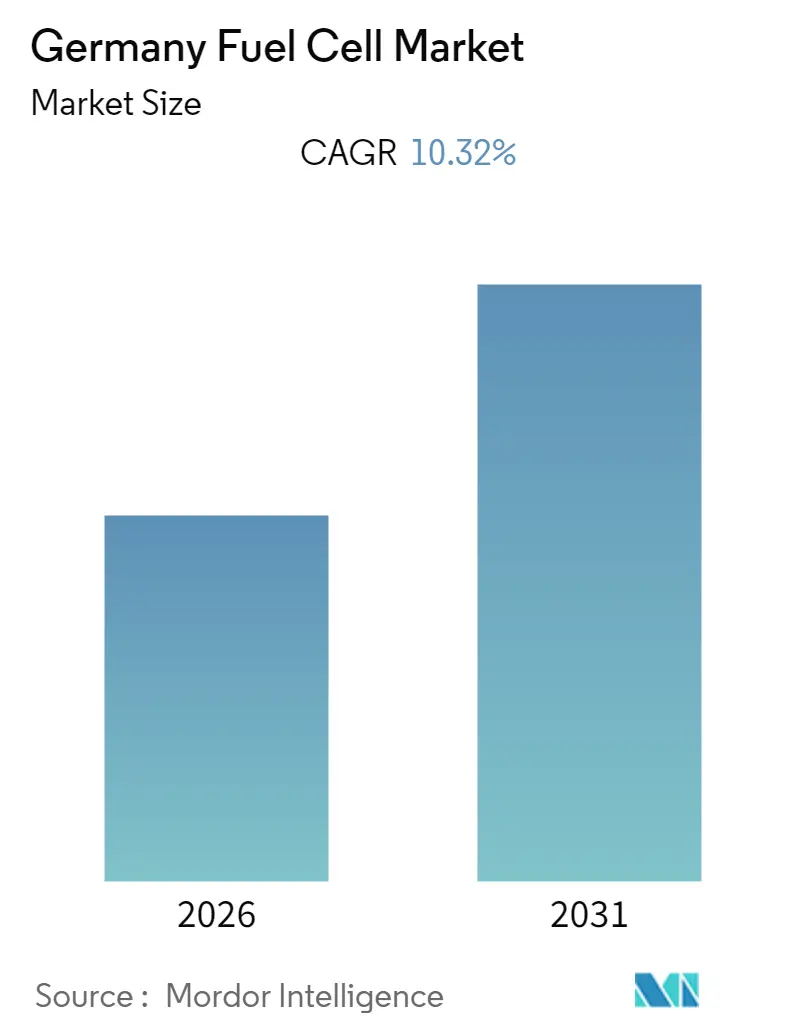
The Germany Fuel Cell Market size is expected to register a CAGR of 10.32% during the forecast period.
The market was moderately impacted by the Covid-19 pandemic, however, the market has rebounded, and is expected to grow steadily during the forecast period.
- Factors, such as advantages of fuel cell over its alternatives such as the lithium-ion battery and high energy density are expected to drive the market studied.
- However, on the flip side, the availability of proven and cost-effective alternate energy storage systems in the market and lack of hydrogen supply infrastructure are expected to restrain the market during the forecast period.
- Pure battery vehicles cannot cover all the route, load, and refueling requirements, therefore fuel cells are being considered as a practical solution for trucks to maintain a place. Thus, this is expected to provide a great opportunity for the fuel cell market in the near future.
Note: Market size and forecast figures in this report are generated using Mordor Intelligence’s proprietary estimation framework, updated with the latest available data and insights as of 2026.
Germany Fuel Cell Market Trends and Insights
Polymer Electrolyte Membrane Fuel Cell (PEM) to Dominate the Market
- PEM fuel cell used for electrical power generation continues to dominate the stationary application, while household heat and power it is in the nascent stage.
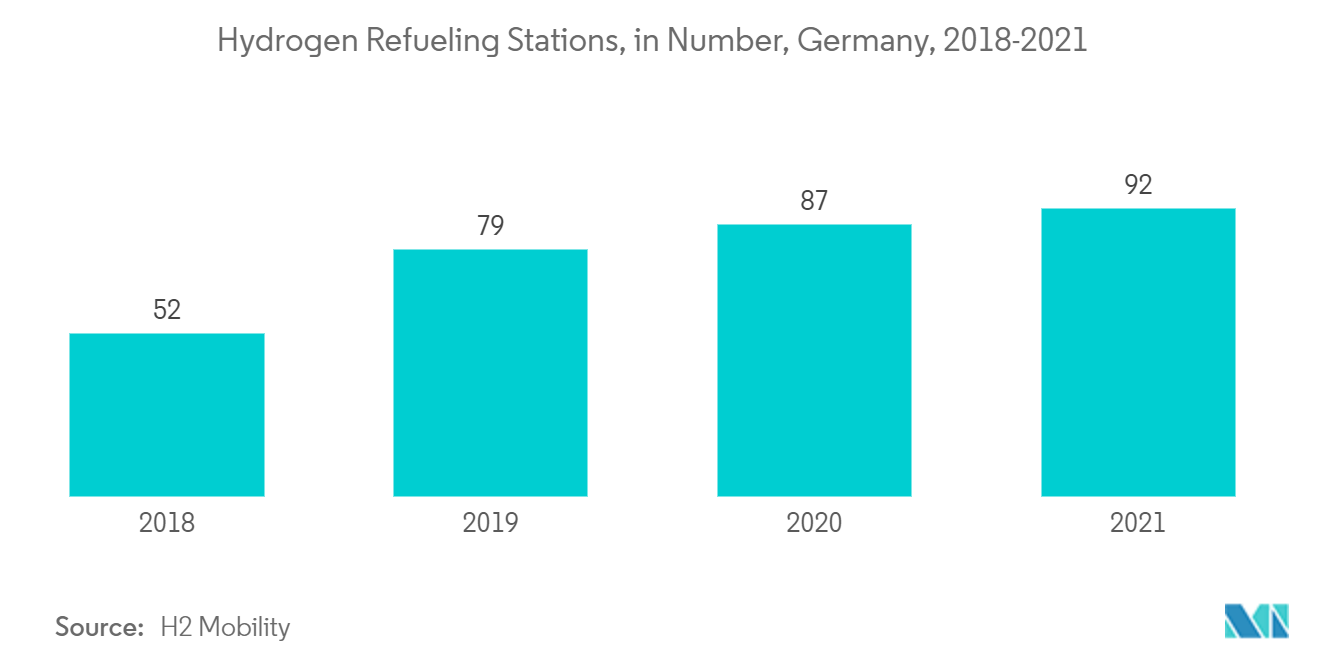
- According to H2 Mobility, as of March 2021, there were 92 hydrogen filling stations in Germany, up by nearly 77% from 52 in 2018. This is indicative of the steady rise in the demand for hydrogen in the transport sector, driving the demand for hydrogen refueling stations and hence the demand for PEM fuel cells, the most commonly used techniques used in the transport sector.
- The marine sector is also expected to witness the adoption of PEM fuel in the coming years for supplying power to hotel operations of cruise ships during docking and for the provision of primary propulsion power when ships are at sea, mainly due to IMO's emission regulations on the marine sector.
- The commercialization of PEM fuel cells has been limited due to the high cost and low stability of electrodes. Generally, platinum on carbon support (Pt/C) is the most widely used catalyst for both anode and cathode in PEM fuel cells.
- However, as research has progressed, commercialsiation has increased. In December 2022, German automotive and industrial supplier Schaeffler has signed a letter of intent (LOI) with French hydrogen producer Lhyfe that includes a technology partnership, green hydrogen, and a 15 MW industrial electrolysis plant in Herzogenaurach, Germany. Under this partnership, Schaeffler will provide polymer electrolyte membrane (PEM) electrolyzers to Lhyfe. Such developments indicate that the PEM cell segment is expected to dominate the market during the forecast period.
Increasing Government Support to Drive the Market
- The fuel cell technology has been under development in Germany for many years, both for the distributed generation of power and heat and as a source of power for vehicles in mobile applications. Since the pandemic has subsided, and the Russia-Ukraine conflict has forced Germany to accelerate its transition towards renewables, the German government has been trying to speed up research and development into renewable energy technologies such as green hydrogen and fuel cells.
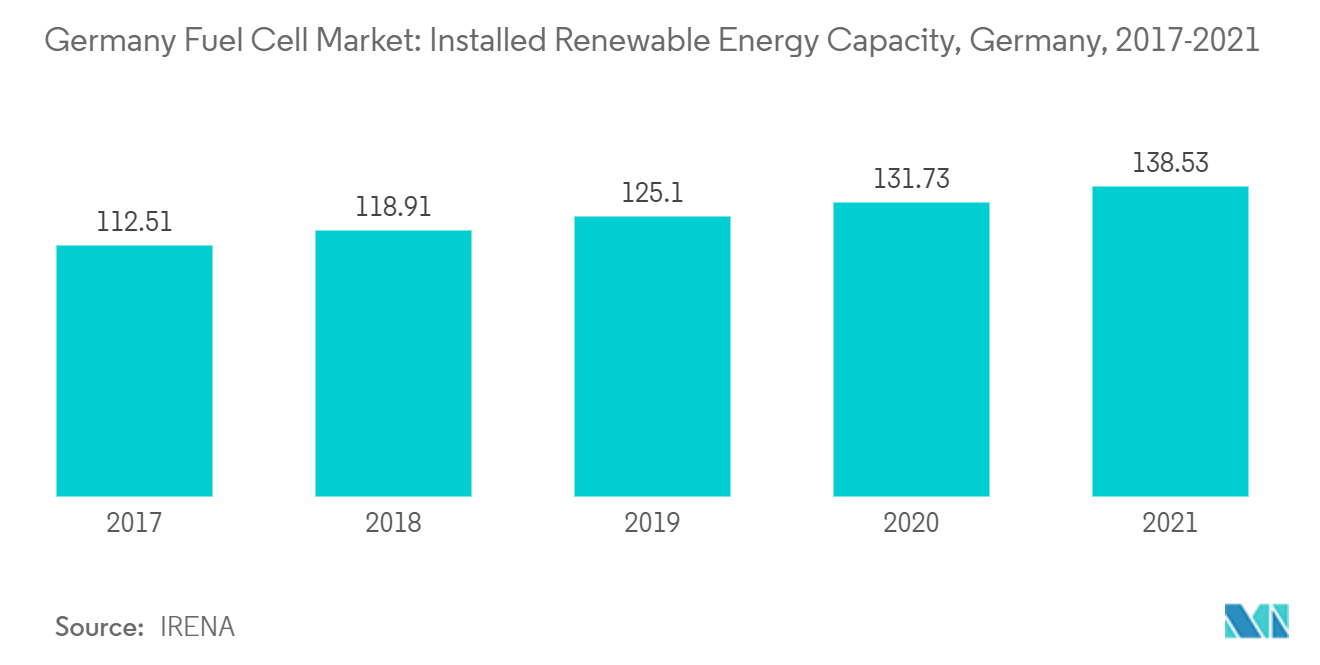
- Additonally, as Germany upgrades it's renewable energy capacity, more green energy will be available for running electrolysers, which can be used to produce green hydrogen. As of 2021, according to IRENA, Germany's renewable enrgy capacity stood at 138.15 GW, up by nearly 4.1% year-on-year, and up by nearly 21.5% since 2017. As German lawnmakers try to accelerate the adoption and expansion of renewable energy capacity, this rapid rise in renewable energy capacity is expected to continue, driving the market during the forecast period.
- In September 2021, the German government allocated nearly EUR 8 billion (USD 9.4 billion) of funding support for 62 hydrogen projects. Additonally, the government approved EUR 900 million (USD 1 billion) in funding for H2Global, an initiative to auction tenyear hydrogen supply contracts matched with equivalent hydrogen off-take contracts, with a public intermediary covering the difference between the costs of the two contracts
- The funding from the Federal Ministry for Economic Affairs and Energy for research and development in the field of fuel cell and hydrogen technologies is tied into the 'National Hydrogen and Fuel Cell Technology Innovation Programme' (NIP), which was launched in 2006. The programme is being continued as the government's NIP2 programme in the 2016-2025 period.
- In December 2022, the state government of Bavaria in Germany presented its public transport strategy for 2030, which supports hydrogen fuel cells for railways. Such developments demonstrate how
Regulatory Landscape
Germany's hydrogen and fuel cell deployment is being shaped by faster permitting and a more formalized network-regulation regime. The Hydrogen Acceleration Act (WasserstoffBG), enacted on March 29, 2026 and in force from April 2, 2026, is designed to simplify and speed up planning and approval processes for hydrogen generation, storage, import, and transport infrastructure, which directly affects how quickly hydrogen supply can support fuel cell adoption.
Network access and infrastructure approvals are central anchors for market buildout. The Bundesnetzagentur (BNetzA) acts as the key regulator for the hydrogen core network (Wasserstoff-Kernnetz), overseeing approvals and non-discriminatory access under the Energy Industry Act (EnWG). In parallel, national rules are being adapted to align with the European Gas and Hydrogen Market Package (Directive (EU) 2024/1788), which requires implementation by August 5, 2026, creating a near-term compliance and design milestone for hydrogen infrastructure and market participants. On the funding side, the National Innovation Programme on Hydrogen and Fuel Cell Technology (NIP Phase II), led by BMWK with BMDV involvement, continues as the primary R&D and market-activation vehicle through end-2026.
Value Chain Analysis
The German fuel cell value chain spans R&D, stack and system engineering, balance-of-plant manufacturing, project integration, and end-use deployment across transportation, stationary, and portable segments. Germany is strong in IP generation, testing, and system integration, supported by industrial players and applied research organizations. Critical upstream inputs and components still include imported elements such as fuel cell stacks in certain supply routes and carbon-fiber storage tanks.
Midstream and downstream activity is increasingly linked to the regulated buildout of hydrogen transport assets and industrial cluster connections. The hydrogen core network approved by Bundesnetzagentur on October 22, 2024 (9,668 km of pipelines, with around 60% conversions of existing natural gas pipelines, and around EUR 19.8 billion of planned investment) sets concrete corridors and nodes that shape where electrolyzers, import entry points, storage, and industrial offtakers connect. On the manufacturing side, domestic emphasis includes system integration and balance-of-plant components, alongside efforts to scale industrial stack production via partnerships and pilots (for example, initiatives referenced in industry guides and applied research programs). Demand-side channels include public transport operators, logistics fleets, and industrial sites procuring complete systems and service contracts.
Competitive Landscape
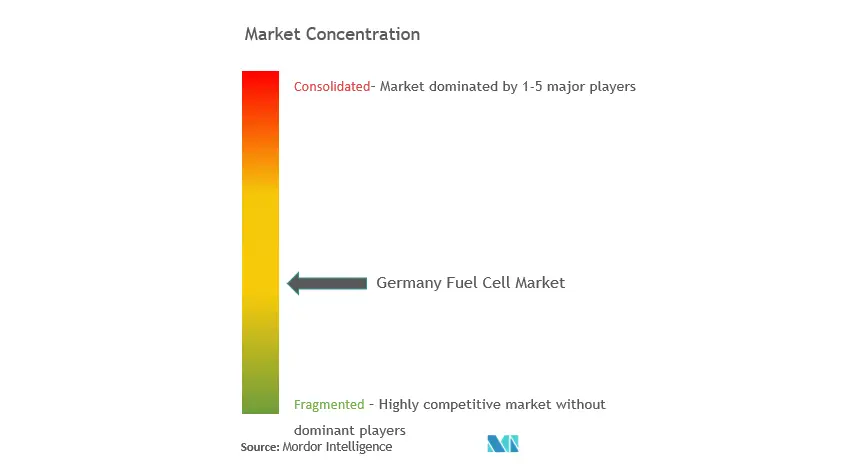
The Germany fuel cell market is moderately fragmented. Some of the key players, in no particular order, are SFC Energy AG, Proton Motor Fuel Cell GmbH, Ballard Power Systems Inc., FuelCell Energy Inc., and Plug Power Inc, among others.
Germany Fuel Cell Industry Leaders
-
SFC Energy AG
-
Proton Motor Fuel Cell GmbH
-
Ballard Power Systems Inc.
-
FuelCell Energy Inc.
-
Plug Power Inc.
- *Disclaimer: Major Players sorted in no particular order
Market Opportunities and Future Outlook
Heavy-duty transport and fleet deployments provide a visible near-term route to scale because infrastructure and vehicle programs are being coupled more tightly than in earlier phases. In July 2026, Germany's Federal Ministry of Transport reported 526 applications totaling EUR 455 million against a EUR 220 million funding call tied to 40 hydrogen refueling stations and 400 fuel cell trucks, indicating an active project pipeline and competition for co-funding. Alongside this, OEM activity provides a commercialization anchor: Daimler Truck announced in June 2026 the start of a 100-vehicle small series of Mercedes-Benz NextGenH2 liquid hydrogen trucks, with a first deployment planned with DACHSER in December 2026, supporting use cases where fast refueling and long range are valued.
Infrastructure linkage and industrial energy management create additional whitespace for stationary and hybrid solutions. The core network buildout and project-level connections reduce the distance between hydrogen production and consumption, as shown by EWE starting construction in July 2026 on a 24 km hydrogen pipeline (H2Coastlink 1) connecting a 320 MW Emden electrolyzer to the national hydrogen core network. At the site level, modular reversible systems are being commissioned for flexibility between electrolysis and power generation, such as HARTING Technology Group commissioning a reversible fuel cell plant in Espelkamp in June 2026 using Reverion technology (250 kW electrolysis and 100 kW fuel cell modes). This supports industrial resilience and energy optimization use cases that extend beyond pure mobility demand.
Recent Industry Developments
- June 2026: SFC Energy AG announced a contract exceeding EUR 42 million to supply fuel cell products and accessories for military and civilian applications in Ukraine under an enablement initiative financed by the German Federal Government. The order improves near-term demand visibility for portable and off-grid fuel cell systems and supports scale effects across manufacturing and service capabilities.
- May 2025: thyssenkrupp nucera and Fraunhofer IKTS opened a solid oxide electrolyzer cell (SOEC) pilot production plant for electrolysis stacks in Arnstadt, Thuringia. The pilot line advances domestic stack-related know-how and industrialization pathways that can improve the reliability of hydrogen supply for stationary and transport fuel cell applications.
- October 2024: Siemens Mobility and Niederbarnimer Eisenbahn (NEB) began operating Mireo Plus H hydrogen trains on the Heidekrautbahn (RB27) line with Ballard fuel cell engines. The entry into service provides a reference deployment for fuel cell rail operations in Germany and ties vehicle operation to local green hydrogen supply arrangements.
Research Methodology Framework and Report Scope
Market Definition and Coverage
For this report, the Germany fuel cell market is defined as the revenue generated from fuel cell systems sold and deployed in Germany across key end-use applications, tracked on a value basis in USD over the study period.
Scope exclusions: The sizing excludes hydrogen production, distribution, and storage infrastructure, along with broader electrolyzer and refueling station construction spend.
Segmentation Overview
- Application
- Portable
- Stationary
- Transportation
- Fuel Cell Technology
- Polymer Electrolyte Membrane Fuel Cell (PEMFC)
- Solid Oxide Fuel Cell (SOFC)
- Other Fuel Cell Technologies
Data Sources, Market Sizing, and Validation
Desk Research
Desk research was used to set the baseline context for demand signals and policy direction in Germany, and then to anchor the model inputs to public time series where possible. We typically rely on public sources such as the German Federal Statistical Office (Destatis), the Federal Motor Transport Authority (KBA) registrations, and national energy and climate publications for market direction and adoption indicators.
To avoid overbuilding assumptions, the secondary layer was also checked against sources such as Eurostat trade statistics, the IEA technology and energy datasets, and publications from German or European hydrogen and fuel cell associations. Company annual reports, investor presentations, and reputable press were used to confirm active projects, commissioning timelines, and product focus, and then a paid subscription for company financials and news intelligence was used selectively to cross-check revenue exposure and event timing. This list is not exhaustive, and many other public and paid sources were also referenced for data collection, validation, and clarification.
Primary Interviews and Surveys
Primary work was used to convert broad demand signals into realistic adoption and pricing assumptions, especially where public data is delayed or too aggregated. Interviews were held with manufacturers, integrators, project developers, and large end users in Germany to validate shipment momentum, typical project sizes, and the pace at which older pilots are moving into repeat deployments.
Distribution of primary research fieldwork respondents
| Company type | Respondent position |
|---|---|
| Top tier: 29% | CXOs: 12% |
| Mid tier: 57% | Functional/Unit leaders: 30% |
| Smaller Players: 14% | Managers: 58% |
Market-Sizing & Forecasting
The core sizing model starts from a top-down demand pool built around Germany-specific deployment activity by application, and then converts that into value using practical pricing and system configuration assumptions. Once the annual totals are obtained, we corroborate them using selective bottom-up approximations such as sampled supplier revenue exposure, channel checks on typical system pricing, and volume to ASP cross-checks where enough evidence is available.
Key inputs used in the model include fuel cell system shipments or deployments by application (transport, stationary, and portable), typical kW class and average system value by use case, project commissioning timelines, public support and permitting milestones that influence the installation pipeline, and observed import-export patterns for relevant equipment categories. When a variable was available only in partial form, gaps were handled by using conservative ranges that were then tightened through interview feedback and by checking against adjacent indicators like vehicle registrations and grid-connected project announcements.
For forecasting, scenario analysis was used so near-term bookings and policy-backed pipelines could be translated into a base case and bounded with cautious and upside cases. The final forecast path was then adjusted so it remains consistent with constraints that experts highlighted, including lead times, supply availability, and the realistic speed of customer conversion from pilots to scaled deployments.
Data Validation & Update Cycle
Model outputs were checked against independent signals such as deployment announcements, registration trends where relevant, and trade flows, and then variances were reviewed before final sign-off. If a segment showed an unusual jump that could not be explained by pricing or volume logic, the assumptions were revisited and targeted follow-ups were triggered with participants.
Each report is refreshed on an annual cycle, and interim updates are made when material events occur, such as policy changes or major project delays that impact the installation pipeline. Before delivery, a final review pass is completed so clients receive the most current view that can be supported by documented inputs and repeatable steps.
Mordor Intelligence's Germany Fuel Cell Market Market Sizing Compared With Other Published Estimates
Published market sizes for Germany fuel cells can look far apart, even when they discuss similar technologies, because they do not always measure the same revenue pool or use the same timing for project recognition. The gaps usually come from what is counted as market revenue, the year used as the base, and how pricing and adoption are projected forward.
Deployment pipeline checks and application-level adoption signals are the evidence that tie Mordor Intelligence's estimate to Germany-only system revenues, which reduces inflation from broader hydrogen value chain spending or multi-country rollups. Differences also show up when an estimate leans heavily on aggressive forward CAGR targets, applies a single price curve across applications, or counts future infrastructure build-out as part of fuel cell market value, which can shift the headline number sharply.
Benchmark comparison
| Source | Market Size | Gaps in Research Methodology |
|---|---|---|
| Mordor Intelligence | USD 0.00 B (2024) | |
| Global Consultancy A | USD 3.20 B (2024) | Uses a broader interpretation of the market that appears to fold in adjacent hydrogen and system value streams, and its growth path is set with a high forward CAGR that can overstate near-term realized deployments. |
| Industry Research Group B | USD 0.37 B (2022) | Uses an older base year and a shorter study window, and the revenue capture looks closer to currently realized deployments, which can sit below models that assume faster scaling or wider scope. |
The spread in the table mainly reflects scope boundaries and timing choices, not just math. By keeping the model tied to observable Germany deployment activity and application-specific pricing, the final number stays traceable to clear inputs, and the same steps can be repeated when new evidence arrives.
Key Questions Answered in the Report
What is the current Germany Fuel Cell Market size?
The Germany Fuel Cell Market is projected to register a CAGR of 10.32% during the forecast period (2026-2031)
Who are the key players in Germany Fuel Cell Market?
SFC Energy AG, Proton Motor Fuel Cell GmbH, Ballard Power Systems Inc., FuelCell Energy Inc. and Plug Power Inc. are the major companies operating in the Germany Fuel Cell Market.
What years does this Germany Fuel Cell Market cover?
The report covers the Germany Fuel Cell Market historical market size for years: 2021, 2022, 2023 and 2024. The report also forecasts the Germany Fuel Cell Market size for years: 2026, 2027, 2028, 2029, 2030 and 2031.