
Market Overview
| Study Period | 2020 - 2031 |
|---|---|
| Forecast Data Period | 2026 - 2031 |
| Base Year Market Size (2025) | USD 30.43 Billion |
| Market Size (2026) | USD 31.06 Billion |
| Market Size (2031) | USD 34.42 Billion |
| Growth Rate (2026 - 2031) | 2.07 % |
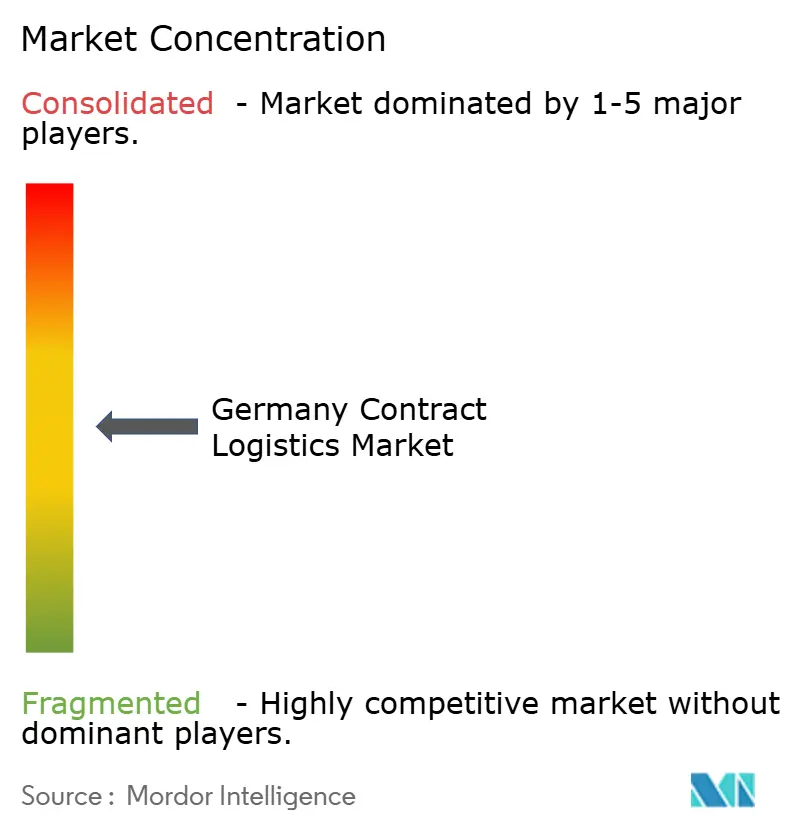
| Market Concentration | Medium |
Major Players *Disclaimer: Major Players sorted in no particular order Image © Mordor Intelligence. Reuse requires attribution under CC BY 4.0. | |
Germany Contract Logistics Market Analysis by Mordor Intelligence
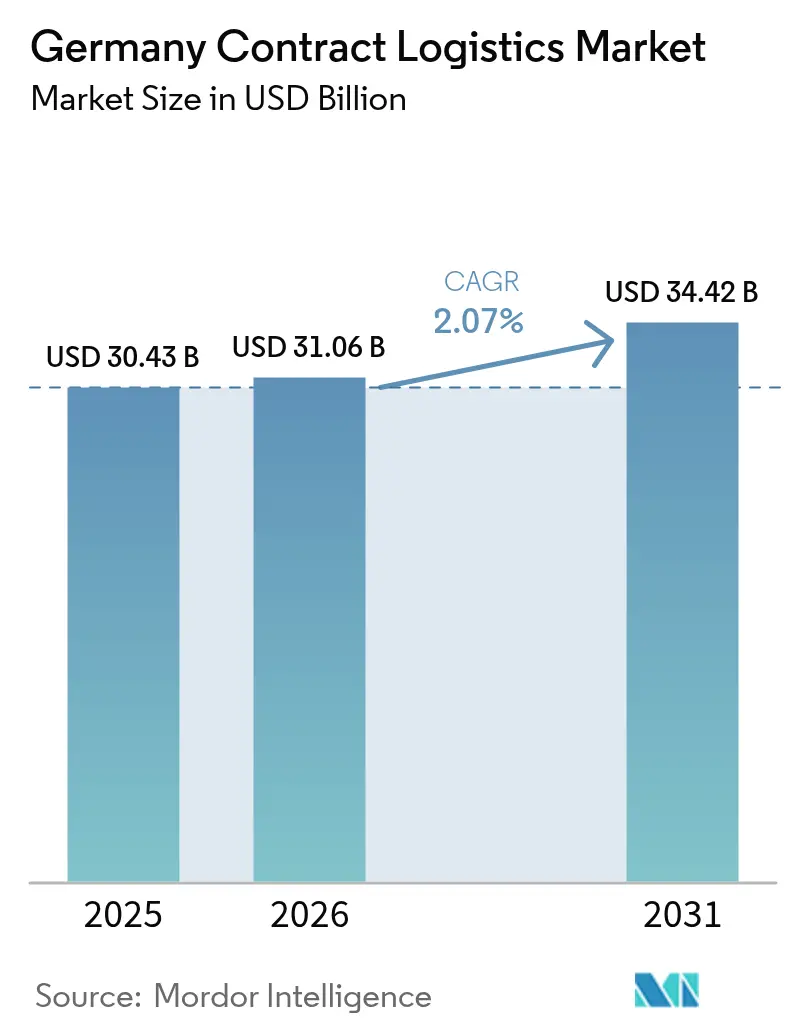
Germany Contract Logistics Market size in 2026 is estimated at USD 31.06 billion, growing from 2025 value of USD 30.43 billion with 2031 projections showing USD 34.42 billion, growing at 2.07% CAGR over 2026-2031. Growth is underpinned by expanding e-commerce fulfilment volumes, rising complexity in inbound electric-vehicle supply chains, and heightened demand for GDP-compliant cold-chain services. The new Supply Chain Due Diligence Act is prompting manufacturers and retailers to shift logistics activities to compliant third-party providers, while warehouse automation and AI are improving productivity enough to absorb higher wage costs. At the same time, fleet decarbonisation investments and stricter real-estate economics are reshaping operating models, favoring providers with scale, technology depth, and multimodal capabilities. Competitive dynamics are evolving after DSV agreed to acquire DB Schenker, a deal that will reshape bargaining power across the German contract logistics market.
Key Report Takeaways
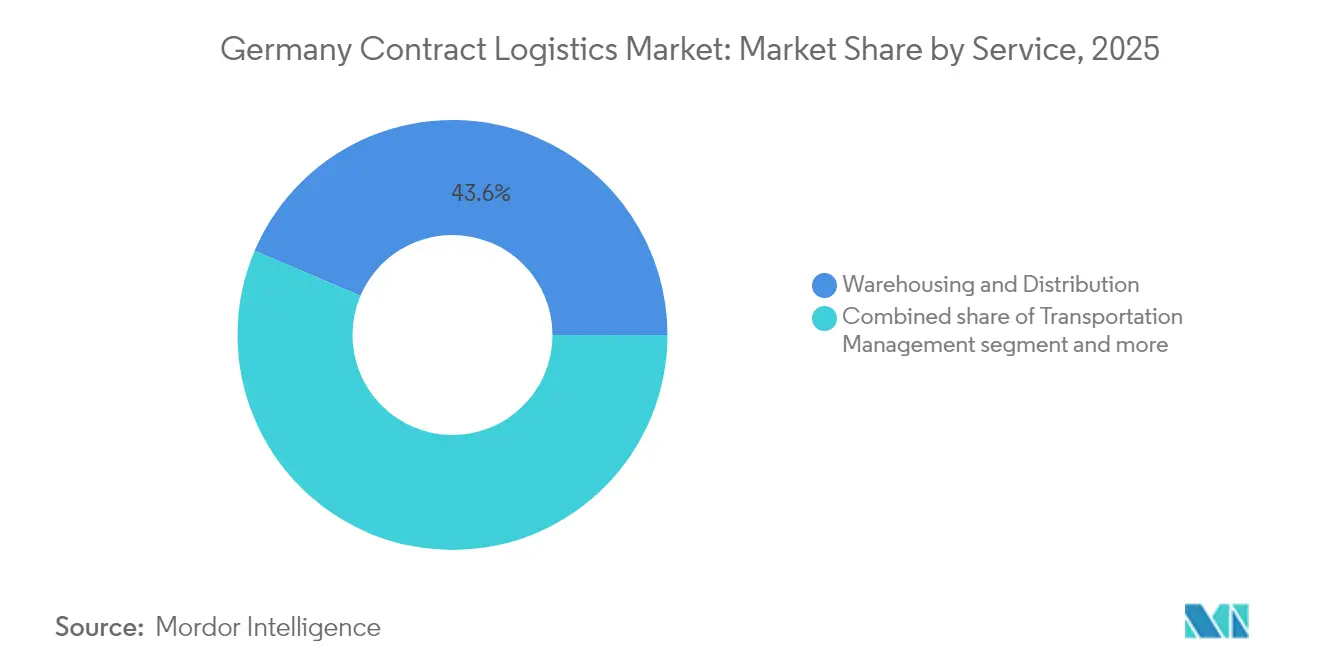
- By service, Warehousing and Distribution held 43.60% of Germany contract logistics market share in 2025. The Germany contract logistics market size for Value-Added Services is projected to compound at 3.92% CAGR between 2026-2031.
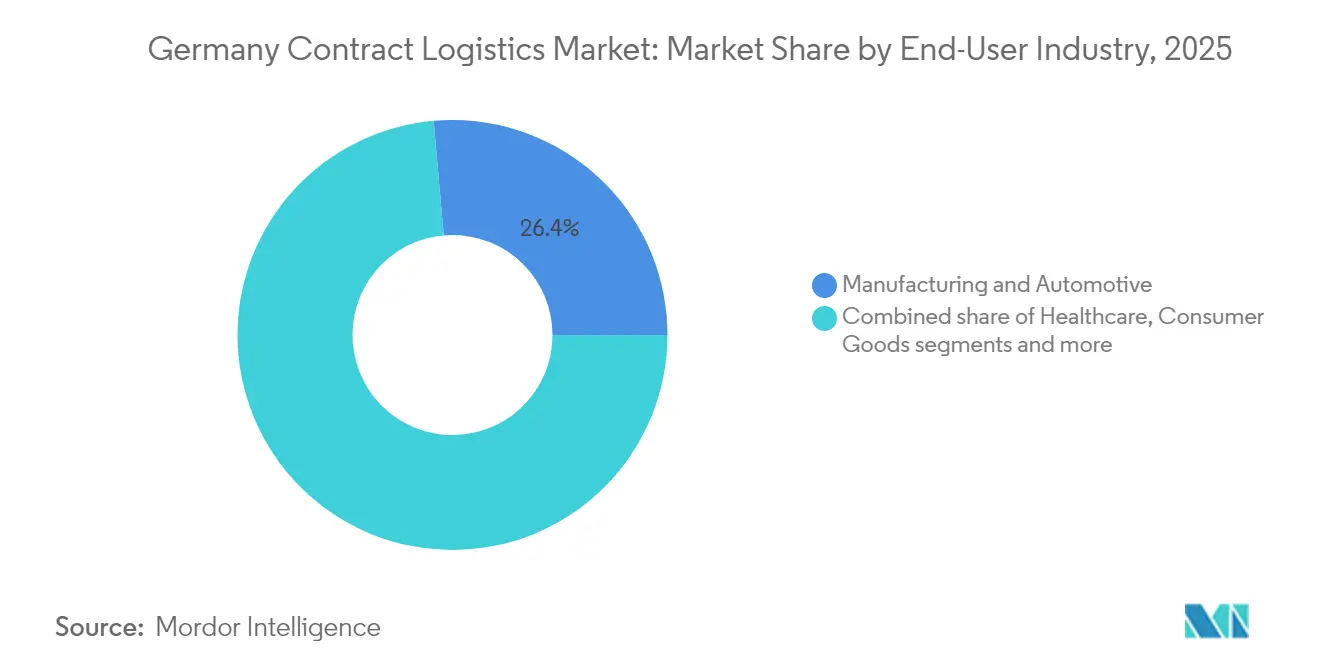
- By end-user industry, Manufacturing and Automotive accounted for 26.40% of the Germany contract logistics market size in 2025. The Germany contract logistics market for Healthcare and Pharmaceuticals is forecast to expand the fastest at 4.65% CAGR between 2026-2031.
- By contract duration, Long-Term (Greater than or equal to 1 Year) held 67.30% of Germany contract logistics market share in 2025, while Short-Term (Less Than 1 Year) post the highest expected CAGR at 3.25% over the forecast period.
- By geography, North Rhine-Westphalia commanded 23.20% of Germany contract logistics market share in 2025. The Germany contract logistics market for Eastern Germany is poised to grow at 3.60% CAGR between 2026-2031.
Note: Market size and forecast figures in this report are generated using Mordor Intelligence’s proprietary estimation framework, updated with the latest available data and insights as of 2026.
Germany Contract Logistics Market Trends and Insights
Drivers Impact Analysis*
| Driver | ( ~ ) % Impact on CAGR Forecast | Geographic Relevance | Impact Timeline |
|---|---|---|---|
| Accelerating B2C e-commerce penetration | +2.0% | Nationwide, strongest in large urban areas | Medium term (2-4 years) |
| OEM shift to electric-vehicle and battery production | +1.8% | Bavaria and Baden-Württemberg | Medium term (2-4 years) |
| Supply Chain Due Diligence Act compliance outsourcing | +1.5% | Nationwide | Short term (≤ 2 years) |
| Expansion of domestic pharma and biotech manufacturing | +2.8% | Hesse, Berlin-Brandenburg | Long term (≥ 4 years) |
| Rapid adoption of warehouse robotics and AI | +2.0% | Logistics hubs nationwide | Medium term (2-4 years) |
| Corporate decarbonization targets for transport | +1.0% | Nationwide, urban focus | Long term (≥ 4 years) |
| Source: Mordor Intelligence | |||
Accelerating e-commerce amplifies parcel volumes
B2C e-commerce now reaches 74% of German consumers and pushes fulfilment and last-mile traffic to record highs, raising the attractiveness of outsourcing to 3PLs that can scale automation and omnichannel capabilities. Parcel density, especially inside the Ruhr and Berlin metropolitan areas, enables route optimization that lowers per-unit delivery costs, incentivizing retailers to award multi-year fulfilment mandates within the Germany contract logistics market. Robots and goods-to-person systems shorten order-to-ship cycles, supporting same-day delivery commitments that have become a differentiator for fashion and consumer electronics sellers.
Electric-vehicle transition reshapes inbound flows
Germany remains Europe’s largest vehicle producer, yet platform electrification adds high-value battery modules and hazardous materials handling to inbound JIT and JIS logistics. Dedicated sequencing centers close to assembly plants in Bavaria and Baden-Württemberg are expanding, and providers able to guarantee ISO 45001 and ADR compliance are securing multi-plant contracts. This complexity lifts outsourcing intensity within the Germany contract logistics market as OEMs focus capital on cell production lines rather than warehouse footprints.
Supply Chain Due Diligence Act stimulates compliance-focused outsourcing
Since January 2024, the Act covers firms with at least 1,000 employees and imposes fines of up to 2% of global turnover for violations. Manufacturers have responded by handing over inbound visibility, supplier vetting, and audit-ready documentation to 3PLs with mature ESG platforms. Providers that combine regulatory expertise with blockchain traceability have tripled pipeline enquiries, translating into higher contract values and longer tenures across the Germany contract logistics market.
Domestic pharma expansion escalates cold-chain demand
Germany hosts Europe’s largest pharmaceutical output, and biologics, mRNA vaccines, and cell therapies increasingly require strict 2°C - 8°C or ultra-low-temperature handling down to -196°C. Logistics4Pharma has added dry shippers in Kelsterbach capable of maintaining cryogenic conditions, and UPS Healthcare commissioned a new multi-range cross-dock in Frankfurt. As a result, cold-chain volumes are outpacing the overall Germany contract logistics market by more than two times, supporting premium pricing.
Restraints Impact Analysis*
| Restraint | ( ~ ) % Impact on CAGR Forecast | Geographic Relevance | Impact Timeline |
|---|---|---|---|
| Shortage of truck drivers and warehouse labor | −1.2% | Nationwide, acute in rural areas | Medium term (2-4 years) |
| Rising prime logistics real-estate rents and land scarcity | −0.8% | Core urban regions | Long term (≥ 4 years) |
| Strict emission regulations elevate fleet costs | −0.7% | Urban corridors | Short term (≤ 2 years) |
| Inflation-linked input costs under muted industrial output | −0.9% | Nationwide | Short term (≤ 2 years) |
| Source: Mordor Intelligence | |||
Labor scarcity inflates operating costs
Vacancies for drivers and warehouse operatives reached about 500,000 in 2024, with the average driver age climbing to 47.2 years, prompting 3.42% statutory wage hikes. Providers in the Germany contract logistics market are investing in academies and flexible rosters, but labor adds volatility to cost bases and limits capacity during peak seasons.
Emission standards trigger fleet spending
Euro VII and CO₂-based tolls add EUR 46,500 (USD 53,737.35) annual charges to diesel heavy-duty vehicles versus less than EUR 2,000 (USD 2,311.28) for zero-emission options[1]. The capex gap still deters wholesale electrification for long-haul routes, causing selective deployment and higher depreciation schedules.
*Our forecasts treat driver/restraint impacts as directional, not additive. The impact forecasts reflect baseline growth, mix effects, and variable interactions.
Segment Analysis
By Service: Warehousing Holds Scale, Value-Added Services Accelerate
Warehousing and distribution generated 43.60% of Germany contract logistics market revenue in 2025 on the back of extensive cross-docking and regional fulfilment centers aligned along the Rhine-Ruhr axis. The segment benefits from dense road, rail, and inland waterway links that shorten lead times to West European consumer markets, yet cost pressures from land scarcity and labor mean automation adoption is climbing steeply. Autonomous mobile robots pick and place small parcels, while automated storage and retrieval systems enhance pallet density, raising throughput by 25% and supporting higher utilization of scarce floor space.
Value-added services ranging from kitting to packaging and end-of-line light assembly are forecast to expand at 3.92% CAGR, outpacing the overall Germany contract logistics market. Clients increasingly require configuration near market to cut inventory risk and accelerate product launches, particularly for consumer electronics and industrial machinery. These specialized tasks command margins of 200–300 basis points above basic warehousing, and providers leverage digital twins to model process flows before committing physical assets. As a result, pressure mounts on smaller operators to invest in skills and technology or partner with larger 3PLs.

By End-User Industry: Healthcare leads growth momentum
Manufacturing and automotive still represent the single largest slice of Germany contract logistics market size at 26.40% in 2025, supported by high-frequency material flows into Bavaria and Baden-Württemberg plants. However, the sector confronts subdued industrial output and an accelerating pivot toward electric vehicles, which shifts layout and inventory profiles. Providers are retrofitting sequencing centers for battery modules, adopting fire-suppression standards, and redesigning transport packaging to mitigate thermal runaway risk.
Healthcare and pharmaceuticals deliver the fastest trajectory at 4.65% CAGR thanks to biologics and cell-and-gene therapies that demand rigorous GDP and GMP handling. Cold-chain volumes grow nearly twice as fast as the overall Germany contract logistics market, and specialized 3PLs have differentiated themselves using real-time temperature visibility, qualified packaging, and end-to-end regulatory documentation. UPS Healthcare, DB Schenker, and Pfenning are enlarging temperature-controlled footprints, triggering further M&A as generalists seek premium vertical exposure. Germany contract logistics industry participants recognize that high-margin healthcare contracts offset the cost drag from standard services.
By Contract Duration: Flexibility Gains Preferential Demand
Long-term agreements of one year or more still cover 67.30% of Germany contract logistics market contracts, offering visibility that underpins asset-heavy investments such as dedicated automation and sustainability upgrades. Automotive and consumer-goods shippers favor multi-year terms to lock in capacity near assembly lines or population centers. Nonetheless, short-term contracts below one year are advancing at a 3.25% CAGR, mirroring heightened macro uncertainty and rapid technological change.
The shift is visible in e-commerce peak season playbooks, where merchants request six-month fulfilment deals that scale both workforce and robot fleets on demand. Providers respond with modular warehousing, variable cost structures, and performance-linked pricing to safeguard profitability while meeting flexibility expectations. Robotics as a Service allows capex avoidance, aligning amortization periods with shorter commitments. These dynamics strengthen competitive rivalry within the Germany contract logistics market as agile mid-tier specialists compete on responsiveness against global incumbents.
Geography Analysis
North Rhine-Westphalia remains the largest regional node, contributing 23.20% of Germany contract logistics market revenue in 2025 on the strength of the Port of Duisburg and dense highway arteries. The Duisburg Gateway Terminal adds 850,000 TEU of annual capacity, enhancing intermodal connectivity that lowers hinterland transport costs for containerized imports. Proximity to Benelux seaports and dense consumer populations underpins robust warehousing demand, with vacancy rates below 3% across the Rhine-Ruhr region, encouraging speculative multilevel developments equipped with renewable energy solutions.
Eastern Germany, encompassing Berlin, Brandenburg, Saxony, Saxony-Anhalt, and Thuringia, is the fastest growing area at 3.60% CAGR, buoyed by Tesla’s gigafactory in Grünheide and Intel’s EUR 30 billion (USD 34.67 billion) semiconductor commitment. Logistics parks near Leipzig/Halle Airport and rail-served sites along the A14 corridor attract electronics, life-sciences, and battery players seeking access to skilled labor and competitively priced land. The German government’s EUR 500 billion (USD 577.82 billion) infrastructure fund prioritizes Eastern corridors, promising motorway upgrades and digital rail enhancements that could further elevate the Germany contract logistics market size in the region.
Hamburg and Schleswig-Holstein benefit from Hamburg’s deep-sea gateway, which handled over 220 million tons of cargo in 2024. Q1 2025 logistics space take-up jumped 89% year on year to 125,000 sqm, reflecting renewed container throughput and rising offshore-wind component staging. Bavaria and Baden-Württemberg, historically automotive strongholds, are reconfiguring supply chains for electric powertrains, creating new inbound flows for battery cells and recyclable materials. The resulting need for hazardous-goods warehousing, just-in-sequence shuttling, and green transport corridors further diversifies service demand across the Germany contract logistics market.
Regulatory Landscape
Germany's contract logistics operations sit under a mix of national and EU rules for road haulage, labor and safety compliance, and transport documentation, with the Bundesamt fur Logistik und Mobilitat (BALM) acting as the key federal authority for enforcement and market oversight under the GueKG. A major 2026 compliance step is the Mobility Package I-related rollout of new smart tachograph requirements (FS GEN II V2), which BALM highlighted as taking effect from July 2026 for light commercial vehicles (2.5t to 3.5t) used in international transport or cabotage, tightening monitoring and documentation expectations for transport-heavy contract logistics providers.
On the policy side, the Federal Ministry for Digital and Transport (BMDV) continues to frame sector modernization through its freight transport and logistics strategy instruments, including programs that promote digital standards and interoperable data exchange (for example, electronic freight information, eFTI) alongside multimodal freight initiatives. In parallel, the Supply Chain Due Diligence Act coverage expansion from January 2024 (firms with at least 1,000 employees, with fines up to 2% of global turnover referenced in the report context) is reinforcing demand for audit-ready traceability, supplier screening workflows, and ESG data capture embedded into 3PL operating models.
Value Chain Analysis
The Germany contract logistics value chain spans solution design and contracting (tendering, network engineering, compliance planning), inbound transportation and forwarding, warehousing and distribution (including multi-user campuses and cross-docks), and value-added services such as kitting, packaging, sequencing, and reverse logistics. Execution draws on dense national infrastructure and multimodal gateways: seaports (Hamburg and others), inland hubs like Duisburg, and key air cargo nodes (Frankfurt, Leipzig/Halle, Cologne/Bonn). This mix lets providers combine road, rail, and air legs for time-critical and temperature-sensitive flows such as healthcare, automotive, and high-tech.
Upstream inputs to service delivery include labor and equipment (drivers, warehouse staff, MHE, automation), compliance tooling (tachograph, ADR, GDP documentation), and IT layers for inventory visibility and transport planning. Industry bodies (for example, DSLV and BGL) represent operator and shipper interests, while applied research organizations such as Fraunhofer IML support technology transfer into warehouse robotics, AI, and digital twins, reflecting the report's emphasis on automation to offset wage inflation and capacity constraints. Public policy workstreams also influence bottleneck management and productivity initiatives, including BMDV action planning and the Commission for Road Freight Transport established in January 2024 to identify relief measures for the road freight segment.
Competitive Landscape
The top tier is populated by DHL Supply Chain, DSV-DB Schenker (post-closing), Kühne + Nagel, and UPS Healthcare, which together control meaningful but not dominant shares, indicating moderate market concentration. DSV’s EUR 14.3 billion (USD 16.53 billion) purchase of DB Schenker adds 60,000 employees and propels pro forma revenue to EUR 39.3 billion (USD 45.42 billion), forging the second-largest global contract logistics provider. The integration strategy focuses on network synergies in Europe and North America, while German operations will absorb capability overlaps and rationalize redundant facilities, reshaping competitive pricing benchmarks across the Germany contract logistics market.
Technological differentiation eclipses pure scale. DHL has deployed more than 7,000 robots and expanded its robotics center of excellence in Troisdorf, enabling rapid cross-site rollout of AMR, vision-picking, and AI-driven labor planning. Hellmann Worldwide Logistics enlarged its global Contract Logistics division in 2025 through new hubs in Osnabrück and mobile automation pilots in Singapore, but the company also added pharmaceutical GDP certifications to bolster healthcare credentials. Mid-tier specialists like Logistics4Pharma focus on ultra-cold capabilities and compliance consulting, allowing them to command high-margin niches despite smaller footprints.
Sustainability commitments shape competitive postures. DB Schenker and DHL target 100% fossil-free line-haul transport in Germany by 2030, driving orders for battery-electric 19-t rigid trucks and piloting hydrogen fuel-cell tractors on hub-to-hub lanes. Providers harness intermodal shifts, especially Duisport-sited rail links, to cut emissions and mitigate Eurovignette CO₂ toll exposure. Customers increasingly evaluate 3PL bids on greenhouse-gas intensity, pushing smaller operators to partner with asset-light green-tech platforms or risk displacement in the Germany contract logistics market.
Germany Contract Logistics Industry Leaders
-
DHL Supply Chain & Global Forwarding
-
Dachser SE
-
Kuehne + Nagel
-
Rhenus Logistics
-
DSV Solutions
- *Disclaimer: Major Players sorted in no particular order
Market Opportunities and Future Outlook
White space is expanding in compliance-first, data-rich contract logistics offerings that help shippers meet due diligence and sustainability reporting needs while maintaining service performance. The operational impact of Mobility Package I implementations, including BALM-noted smart tachograph requirements from July 2026 for certain light commercial vehicles in international use, raises the value of 3PLs that can standardize transport documentation, workforce planning, and audit trails across multi-site networks. That strengthens the case for providers that combine transportation management with warehousing, visibility platforms, and supplier documentation services, particularly for manufacturers and retailers facing tighter governance requirements under the Supply Chain Due Diligence Act referenced in the report context.
Technology and multimodality programs also support addressable demand for integrated providers that can connect warehouse automation with interoperable data exchange across modes. BMDV initiatives such as the Strategic Dialogue on Multimodal Freight Transport and the Innovationsprogramm Logistik 2030 highlight government support for digital standards and platform-neutral approaches, aligning with the market shift toward AI-enabled planning, robotics, and standardized electronic freight information processes. In practice, the market is also seeing deeper omnichannel integration needs, evidenced by Nagel-Group and B+S GmbH Logistik und Dienstleistungen beginning work in June 2026 on a scalable omnichannel logistics platform for KoRo Handels GmbH, signaling demand for contract logistics setups that unify e-commerce, retail replenishment, and cross-border flows within a single operating model.
Recent Industry Developments
- March 2026: DHL Supply Chain began construction of a 26,600 sqm carbon-neutral logistics center in Rheinbach, with operations scheduled for August 2026. The project adds modern, sustainability-aligned warehousing capacity and strengthens DHL's ability to serve multi-customer contract logistics needs under tighter emissions and cost constraints.
- September 2025: Kuehne+Nagel opened a 10,000 sqm healthcare distribution center in Hamburg for Sysmex Europe SE and Sysmex Deutschland GmbH. The facility expands Germany's specialized healthcare logistics footprint, enabling temperature- and quality-sensitive distribution that adheres to evolving handling standards. It signals growing demand for compliant contract logistics in life sciences and strengthens integration with hospital networks and diagnostics suppliers.
- July 2024: Dachser completed the acquisition of Brummer Logistik GmbH (Germany) and Brummer Logistic Solutions GmbH & Co KG (Austria), integrating temperature-controlled food logistics capabilities into its network. The transaction broadened Dachsers controlled-temperature footprint and strengthened its position in food logistics segments where service quality, traceability, and network density influence contract awards.
Research Methodology Framework and Report Scope
Market Definition and Coverage
This market is defined as revenues earned in Germany from outsourced contract logistics deals where a specialist provider runs integrated warehousing and transportation, plus agreed value added activities, under longer term service contracts.
Scope exclusions: We exclude purely in-house logistics spend, one-off spot freight moves, postal mail, and stand-alone courier or express parcel services.
Segmentation Overview
- By Service
- Transportation Management
- Road
- Rail
- Air
- Sea
- Warehousing and Distribution
- Cold Chain/Temperature-Controlled
- Non-Cold Chain/Non-Temperature-Controlled
- Value-Added Services (Kitting, Packaging, Assembly, etc.)
- Transportation Management
- By End-User Industry
- Manufacturing and Automotive
- Consumer Goods and Retail (incl. E-commerce)
- High-Tech and Electronics
- Healthcare and Pharmaceuticals
- Oil, Gas and Chemicals
- Other End Users
- By Contract Duration
- Short-Term (Less Than 1 Year)
- Long-Term (Greater than or equal to 1 Year)
- By Geography
- North Rhine-Westphalia
- Hamburg and Schleswig-Holstein
- Lower Saxony and Bremen
- Hesse / Rhine-Main
- Bavaria
- Baden-Württemberg
- Rhineland-Palatinate and Saarland
- Eastern Germany (Berlin, Brandenburg, Saxony, Saxony-Anhalt, Thuringia)
Data Sources, Market Sizing, and Validation
Desk Research
Desk research was used to set the Germany demand context and to anchor the model in observable trade and activity signals. We referred to public sources such as Destatis and Deutsche Bundesbank releases for external trade, Eurostat transport series, and Germany customs trade statistics to understand import-export flows and the warehouse relevant throughput trends.
For logistics infrastructure and operating conditions, sources such as the Federal Ministry for Digital and Transport, and airport and port authority publications were reviewed where they help explain modal shifts and capacity constraints.
To convert those signals into a practical market model, we also used company annual reports, investor presentations, association publications, and reputed business press coverage to track service mix changes, customer vertical exposure, and pricing commentary. Where needed, paid subscriptions were used in a limited way for company financials and intelligence, news and financials, and shipment level import-export checks so assumptions could be cross-verified. The specific desk sources mentioned above are illustrative, and many other public references were also used for data collection, validation, and research clarification.
Primary Interviews and Surveys
Primary work focused on interviews and structured surveys with logistics service providers, large shippers that outsource, and supporting ecosystem participants such as facility operators and industry advisors. These discussions helped confirm what is typically included in contracted services versus handled as ad hoc activities. We also pressure tested utilization, pricing pass-through, and contract renewal patterns across Germany.
Distribution of primary research fieldwork respondents
| Company type | Respondent position |
|---|---|
| Top tier: 28% | CXOs: 13% |
| Mid tier: 56% | Functional/Unit leaders: 34% |
| Smaller Players: 16% | Managers: 53% |
Market-Sizing & Forecasting
Sizing starts with a top-down build where Germany freight activity and trade-linked flows are reconstructed, then filtered by outsourcing intensity and the share of freight that sits under longer term contract logistics agreements. Once the demand pool is shaped, we corroborate it with selective bottom-up approximations using supplier revenue disclosures, sampled contract rate cards, and volume times ASP checks for warehousing and transportation bundles, which then helps adjust totals where gaps show up.
Key inputs used in the model include Germany import-export value and tonnage direction, industrial production and automotive output trends, warehousing footprint and vacancy signals, labor and fuel cost movements that influence indexation, and e-commerce parcel volume as a proxy for distribution complexity that drives value added tasks. Forecasting is run using scenario analysis supported by expert views on how quickly contracts reprice, how automation affects unit costs, and how industrial demand shifts between domestic and cross-border lanes. When bottom-up references are incomplete, missing revenue is handled through calibrated coverage ratios that are reviewed with interview feedback before finalizing.
Data Validation & Update Cycle
Validation is done by triangulating the final totals against independent signals such as logistics employment trends, warehouse take-up indicators, and Germany freight performance series, so outliers can be explained rather than averaged away. Variance checks are run across years to confirm that step changes align with known events such as energy price shocks, industrial slowdowns, or major policy changes affecting transport.
Before sign-off, a second analyst reviews the model logic, key assumptions, and conversion steps. Any large deviations trigger re-contacts with selected primary respondents. The report is refreshed annually, and interim updates are made when material events can change pricing, capacity, or demand. Right before delivery, we do a final data pass so clients receive the most current view available.
Mordor Intelligence's Germany Contract Logistics Market Sizing Compared With Other Published Estimates
Published market values for Germany contract logistics can differ even when the same country is being discussed, because the service scope and the deal type definition are not always aligned. Differences also come from the year used as the anchor, the way currencies and inflation adjustments are treated, and how often the numbers are refreshed.
A practical gap driver here is whether spot freight and stand-alone courier or express parcel are mixed into the total, or whether only longer term integrated contracts are counted. Another driver is the pricing logic, where some estimates apply aggressive ASP growth across all services, even when parts of the market reprice through indexation clauses with lag. The spread can also reflect whether cross-border moves tied to Germany are captured as part of contracted revenue, which changes the addressable pool once the scope is fixed in the model used by Mordor Intelligence.
Benchmark comparison
| Source | Market Size | Gaps in Research Methodology |
|---|---|---|
| Mordor Intelligence | USD 31.06 B (2026) | |
| Global Consultancy A | USD 19.96 B (2024) | Uses a different base year and growth window, and its service bucket definitions can be broader, which can shift what is counted as contract logistics versus adjacent logistics services. |
| Industry Publisher B | USD 13.14 B (2024) | Likely applies a narrower capture of outsourced integrated contracts and can rely more on headline growth assumptions, with less explicit separation between contracted multi-year revenue and other outsourced logistics spend. |
Overall, the table shows that timing and scope choices explain most of the distance between estimates. When the addressable pool is tied to multi-year outsourced contracts, and checks are run against trade and industrial activity signals, the resulting number stays traceable to clear variables and repeatable steps, which reduces avoidable over-counting.
Key Questions Answered in the Report
What is the current size of the Germany contract logistics market?
The market is valued at USD 31.06 billion in 2026 and is forecast to climb to USD 34.42 billion by 2031.
Which region leads the Germany contract logistics market?
North Rhine-Westphalia is the largest region, holding 23.20% share in 2025 due to its dense infrastructure and proximity to European consumer hubs.
Which end-user industry is growing the fastest?
Healthcare and pharmaceuticals are expanding at a 4.65% CAGR, driven by strict cold-chain requirements and rising biologics production.
How is the Supply Chain Due Diligence Act affecting logistics outsourcing?
The Act mandates extensive human-rights and environmental checks, prompting firms to outsource logistics to 3PLs with robust compliance systems, thereby increasing contract volumes and values.
What role does automation play in the Germany contract logistics market?
Warehouse robotics and AI boost productivity and mitigate labor shortages, underpinning long-term outsourcing contracts and helping providers maintain margins amid wage inflation.