
Fusion Bonded Epoxy Coatings Market Size and Share
Market Overview
| Study Period | 2020 - 2031 |
|---|---|
| Market Size (2026) | USD 1.53 Billion |
| Market Size (2031) | USD 2.01 Billion |
| Growth Rate (2026 - 2031) | 5.60 % |
| Fastest Growing Market | Middle East and Africa |
| Largest Market | Asia Pacific |
| Market Concentration | Medium |
Major Players *Disclaimer: Major Players sorted in no particular order Image © Mordor Intelligence. Reuse requires attribution under CC BY 4.0. | |
Fusion Bonded Epoxy Coatings Market Analysis by Mordor Intelligence
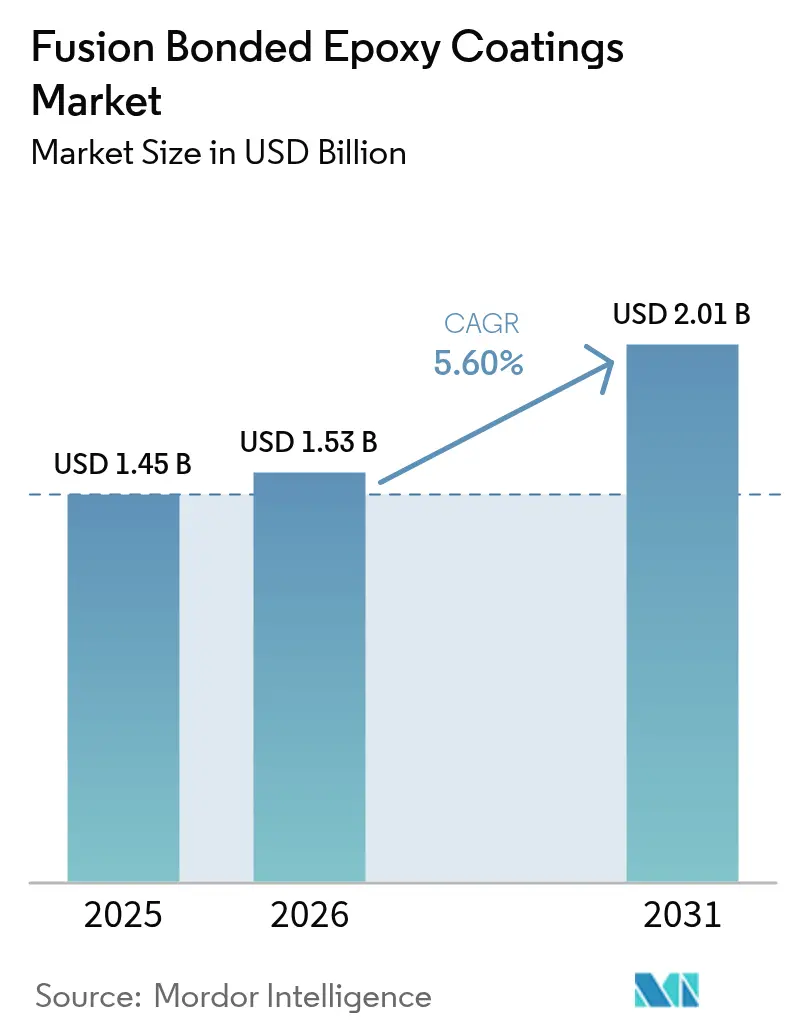
The Fusion Bonded Epoxy Coatings Market size is expected to grow from USD 1.45 billion in 2025 to USD 1.53 billion in 2026 and is forecast to reach USD 2.01 billion by 2031 at 5.60% CAGR over 2026-2031. Demand centers on pipeline corrosion protection, with large-scale oil, gas and water infrastructure projects in the Middle East, Asia and North America anchoring near-term volume. Saudi Aramco’s 4,000-kilometer Jafurah build-out, India’s 9,630-mile national gas grid and the United States’ lead service-line replacement initiative exemplify multi-year pipelines that lock in fusion-bonded epoxy powder offtake. Margins, however, are compressed by epoxy-resin price spikes and sustained competition from three-layer polyethylene (3-LPE) and polyurethane systems. Growth opportunities are shifting toward hydrogen-ready retrofits, potable-water mandates and sensor-embedded smart coatings that extend inspection intervals.
Key Report Takeaways
- By surface, external surface coatings led with 63.72% of the fusion-bonded epoxy coatings market share in 2025, while internal surface coatings are poised to advance at a 5.74% CAGR through 2031.
- By end-user industry, the oil and gas sector accounted for 57.05% of the fusion-bonded epoxy coatings market size in 2025; water and wastewater treatment is the fastest-growing end-user, expanding at a 5.98% CAGR to 2031.
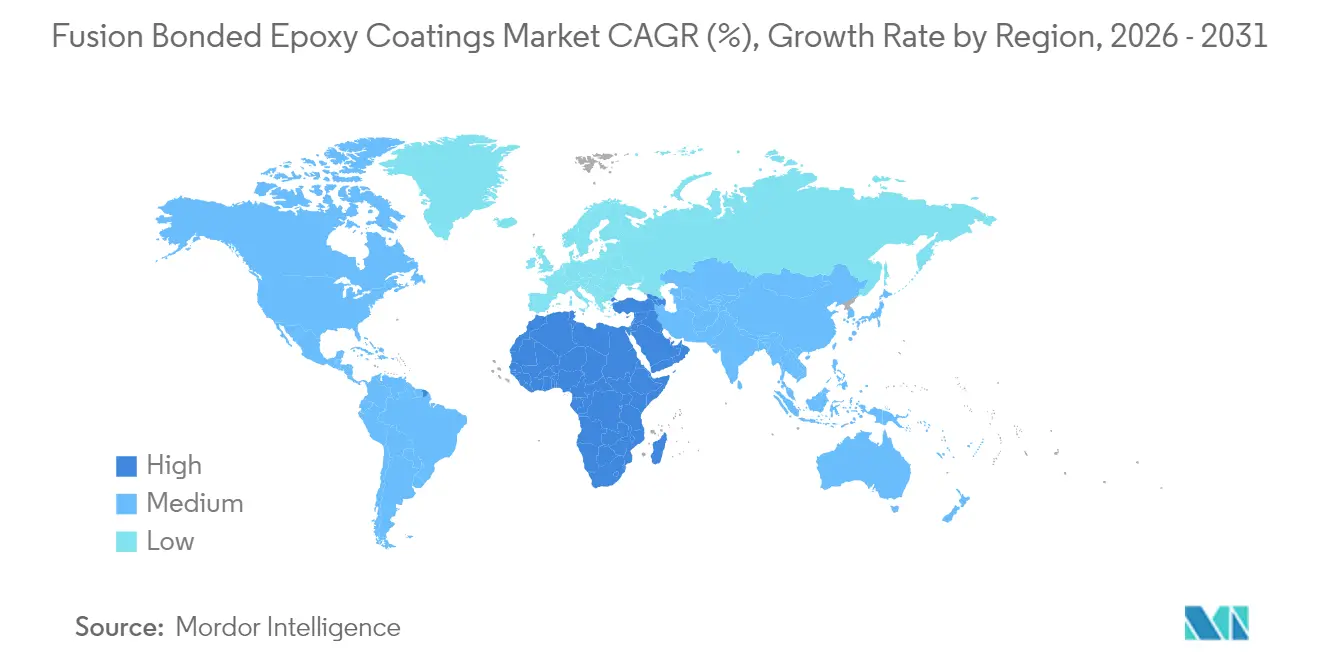
- By geography, Asia-Pacific captured 45.86% revenue in 2025 and remains the largest regional contributor; the Middle East and Africa are the fastest-growing regions, set to climb at a 6.03% CAGR through 2031.
Note: Market size and forecast figures in this report are generated using Mordor Intelligence’s proprietary estimation framework, updated with the latest available data and insights as of 2026.
Market Trends and Insights
Drivers Impact Analysis of Fusion Bonded Epoxy Coatings Market*
| Driver | (~) % Impact on CAGR Forecast | Geographic Relevance | Impact Timeline |
|---|---|---|---|
| Accelerating oil and gas pipeline expansions | +1.3% | Middle East, North America, Asia-Pacific | Medium term (2-4 years) |
| Rapid urban-water and wastewater projects | +1.5% | North America, Europe, India | Short term (≤ 2 years) |
| Infrastructure stimulus in India and Southeast Asia | +1.2% | India, ASEAN | Medium term (2-4 years) |
| Hydrogen-ready pipeline retrofits | +0.8% | Europe, Middle East, Japan, South Korea | Long term (≥ 4 years) |
| Smart FBE coatings with embedded sensors | +0.6% | North America, Europe, Middle East pilots | Long term (≥ 4 years) |
| Source: Mordor Intelligence | |||
Accelerating Oil and Gas Pipeline Expansions
Newbuild hydrocarbon corridors dominate large-diameter demand. Saudi Aramco committed USD 12.5 billion to Jafurah gas-field infrastructure in January 2024, requiring dual-layer coatings rated to 120°C for sour-gas service. In North America, 36-inch crude pipelines leaving the Permian Basin are specified to have 400-600 microns of external fusion-bonded epoxy to meet API RP 5L3. India’s Paradip–Hyderabad–Vijaypur–Bengaluru line stipulates fusion-bonded epoxy across 2,600 kilometers of monsoon-prone terrain. Film builds are thickening to 800 microns in high-consequence areas, effectively doubling resin consumption per meter. These projects underpin near-term revenue despite global drilling volatility.
Rapid Urban-Water and Wastewater Projects
Municipal replacement cycles are converging with health mandates. The U.S. Environmental Protection Agency’s USD 50 billion Bipartisan Infrastructure Law budget earmarks lead pipe replacement and wastewater upgrades, both requiring NSF/ANSI 61-certified internal fusion-bonded epoxy coatings[1]Environmental Protection Agency, “Bipartisan Infrastructure Law Investments,” EPA, epa.gov . Ofwat’s GBP 104 billion (USD 131 billion) United Kingdom water program covers 12,000 kilometers of trunk mains, with fusion-bonded epoxy chosen over cement mortar for high-velocity abrasion resistance. Utilities now apply oil-and-gas-grade specifications—AWWA C213 is converging with ISO 21809-1—justifying a 15–20% coating premium for a 1% reduction in leakage.
Infrastructure Stimulus in India and Southeast Asia
South Asia’s USD 1.4 trillion National Infrastructure Pipeline includes USD 67 billion for new gas lines such as the North Eastern Gas Grid. ASEAN’s Trans-ASEAN Gas Pipeline Phase 3 adds offshore and swamp crossings where cathodic protection is impractical. Pertamina’s 1,200-kilometer refined-product network chose fusion-bonded epoxy over polyethylene to combat tropical soil bacteria. Domestic Indian applicators compress lead times to 15 days, putting pressure on multinational margins.
Hydrogen-Ready Pipeline Retrofits
The transition to hydrogen as an energy carrier is driving the need to reassess pipeline coating systems due to risks like hydrogen embrittlement and permeation. The International Energy Agency's Global Hydrogen Review 2024 highlights that repurposing natural gas pipelines for hydrogen blends above 20% requires specialized internal coatings. Germany's 9,700-kilometer hydrogen core network, slated for completion by 2032, utilizes modified FBE formulations to minimize hydrogen uptake. The India-Middle East-Europe Economic Corridor, announced in 2024, includes hydrogen pipelines linking Saudi Arabia's NEOM green hydrogen hub to Europe, requiring coatings tested under ISO 15156 conditions. Japan is piloting hydrogen blending in city gas networks, with FBE coatings undergoing permeation testing at a pressure of 10 MPa. Hydrogen's smaller molecular size enables it to diffuse through polymer matrices, prompting early adopters to layer FBE with aluminum barrier films. This hybrid approach increases costs by 30-40% but extends inspection intervals from 5 to 15 years.
Restraints Impact Analysis of Fusion Bonded Epoxy Coatings Market*
| Restraint | (~) % Impact on CAGR Forecast | Geographic Relevance | Impact Timeline |
|---|---|---|---|
| Competition from 3-LPE and polyurethane coatings | -0.9% | North America, Europe, global subsea | Short term (≤ 2 years) |
| Volatile epoxy-resin input costs | -0.7% | Global, higher in Asia-Pacific | Medium term (2-4 years) |
| Capital-intensive powder-coating plants | -0.5% | India, Southeast Asia, Middle East | Long term (≥ 4 years) |
| Source: Mordor Intelligence | |||
Competition from 3-LPE and Polyurethane Coatings
Three-layer polyethylene systems outperform single-layer fusion-bonded epoxy in high-temperature offshore projects, delivering 40% lower cathodic disbondment in Gulf of Mexico trials[2]International Association of Oil & Gas Producers, “Coating Performance in Offshore Pipelines 2024,” IOGP, iogp.org. Polyurethane’s 300% elongation is suitable for pipelines in seismic zones. Price gaps narrowed to USD 8–12 per meter, prompting operators to absorb premiums to avoid mid-life recoating.
Volatile Epoxy-Resin Input Costs
Bisphenol-A-based resin prices rose 15–20% after China opened an anti-dumping probe against Korean and Taiwanese suppliers in August 2024. Fixed-price pipeline contracts squeezed applicator margins; Shawcor’s Composite Systems segment margin slipped to 12.3% in Q3 2024 despite revenue gains. Bio-based resins under development promise stability but require new ASTM D3963 benchmarks.
*Our forecasts treat driver/restraint impacts as directional, not additive. The impact forecasts reflect baseline growth, mix effects, and variable interactions.
Fusion Bonded Epoxy Coatings Market Segment Analysis
By Surface:
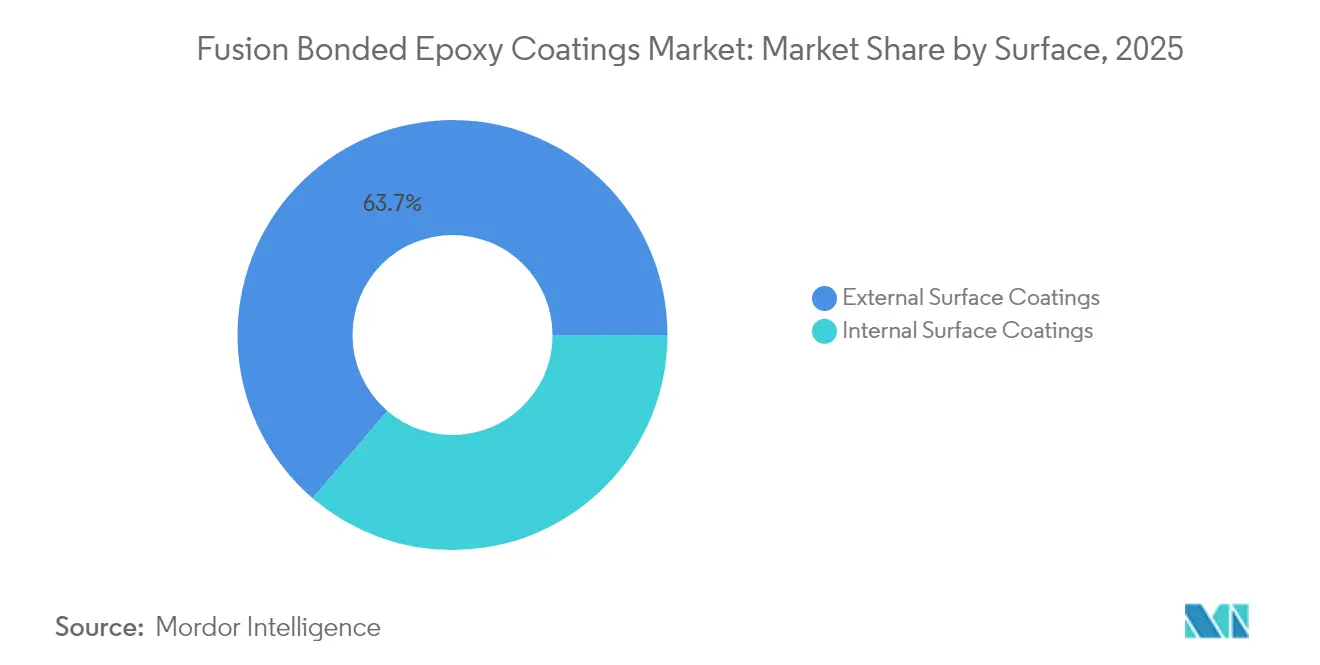
External Coatings Anchor Revenue, Internal Segment Gains TractionExternal surface coatings captured 63.72% of the fusion-bonded epoxy coatings market share in 2025, driven by pipeline designers specifying 600-micron films for buried and subsea lines. Saudi Aramco’s Master Gas System expansion alone demands 400,000 tons of powder between 2024 and 2028, reinforcing the segment’s scale. Internal coatings, although smaller, are growing at a 5.74% CAGR. Hydrogen blending above 20% and US lead-service replacements mandate NSF/ANSI 61-certified fusion-bonded epoxy that resists hydrogen permeation.
Premium pricing for internal systems averages 25% above that of external programs due to migration testing and potable-water certifications. Offshore wind monopiles now specify internal fusion-bonded epoxy to combat seawater condensation, contributing to AkzoNobel’s 7% coatings growth in Q3 2024. Dual-layer internal builds extend the life of transition pieces to 35 years, lowering total ownership costs.



By End-User Industry:
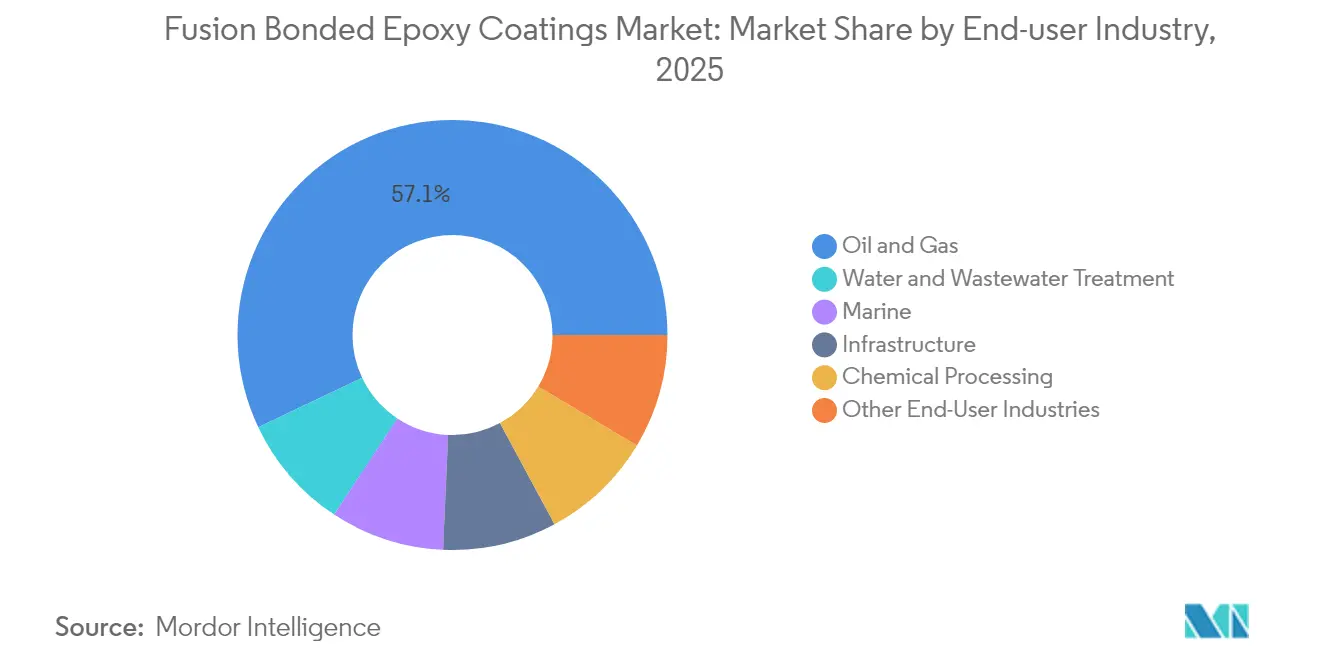
Oil and Gas Dominates, Water Treatment AcceleratesOil and gas accounted for 57.05% of the fusion-bonded epoxy coatings market size in 2025, as unconventional gas and export corridors required 120 °C dual-layer systems. The India–Middle East–Europe Economic Corridor and the Fujairah bypass pipeline are expected to expand demand through 2031. Water and wastewater outpace at a 5.98% CAGR, propelled by Ofwat’s GBP 104 billion trunk-main overhaul.
Marine and subsea applications face substitution by 3-LPE yet retain niches in deep-water acid-gas lifts. Chemical processing and district heating remain smaller, steady outlets where the chemical resistance of fusion-bonded epoxy offsets the higher up-front cost.
Geography Analysis
APAC Fusion Bonded Epoxy Coatings Market
Asia-Pacific accounted for 45.86% of revenue in 2025. India’s USD 67 billion gas grid and China’s pending West-East Phase 4 provide multi-year certainty. Domestic Indian applicators cut lead times to 15 days but still trail multinational quality benchmarks. Japan and South Korea focus on rehabilitation, leveraging the cathodic-protection compatibility of the fusion-bonded epoxy.
MEA Fusion Bonded Epoxy Coatings Market
The Middle East and Africa register the fastest expansion at a 6.03% CAGR. Jafurah’s sour-gas network, ADNOC’s Fujairah crude line, and the 300-kilometer Ras Mohaisen water pipeline collectively exceed USD 500 million in coating value. Hydrogen corridors linking NEOM to Europe will demand ISO 15156-tested formulations.
The Americas and Europe Fusion Bonded Epoxy Coatings Market
North America and Europe exhibit replacement dynamics. The US EPA’s USD 50 billion water program funnels internal fusion-bonded epoxy into lead-service replacements. Europe’s 9,700-kilometer hydrogen grid promises long-term demand once embrittlement protocols are finalized. South America remains lumpy; Petrobras' capital discipline and Argentina’s pipeline deficits delay large-scale awards.

Value Chain Analysis
The fusion bonded epoxy (FBE) coatings value chain starts with upstream feedstocks and epoxy resin systems (resins and curing agents), followed by powder coating formulation (blending with pigments, fillers, and performance additives). Application then runs through pipe surface preparation, electrostatic spraying, and heat-curing to project specifications. Downstream demand is dominated by pipeline owners and EPCs across oil and gas, water and wastewater, and industrial infrastructure, where qualification to project standards typically drives supplier selection more than conventional retail or distributor routes.
A key structural feature is how pipe mills and dedicated coating hubs bundle line pipe production with FBE application for large-diameter projects. This can compress procurement cycles and emphasizes integrated logistics and quality controls. Bottlenecks tend to concentrate around qualified application capacity, including trained inspectors and applicators, and around potential single-source exposure for specialized curing agents and high-performance additives. This constraint becomes more visible when epoxy-resin price volatility and fixed-price pipeline contracting tighten operating flexibility.
Competitive Landscape
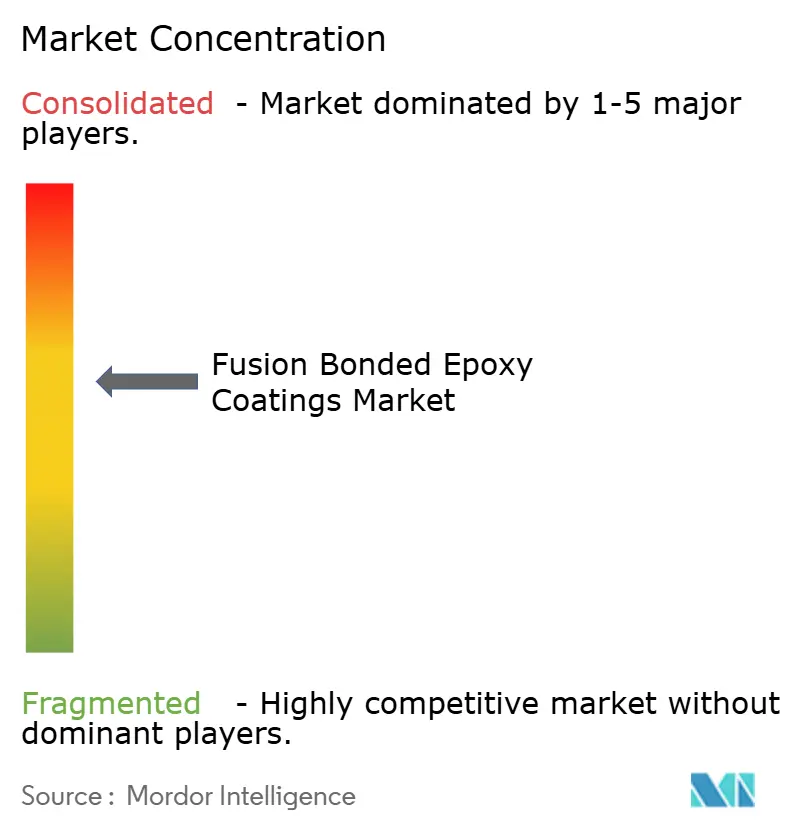
The Fusion Bonded Epoxy Coatings market is moderately consolidated. Shawcor’s CAD 224.5 million Composite Systems revenue in Q3 2024 underscores the value of integrated pipe-coating hubs adjacent to mills. AkzoNobel’s protective coatings franchise leverages offshore wind synergies for 30% price premiums. PPG cross-sells fusion-bonded epoxy into petrochemical revamps, though margins remain undisclosed. Sensor-enabled smart coatings, bio-based resins, and modular applicators are white-space arenas. University-validated surface-acoustic-wave sensors lack commercial rollout, while BASF’s 2024 backward integration into epoxy precursors signals cost hedging for large players. Indian fabricators erode price points but still face gaps in adhesion quality, thereby preserving their incumbent share in high-spec projects.
Fusion Bonded Epoxy Coatings Industry Leaders
3M
The Sherwin-Williams Company,
Akzo Nobel N.V.
Tenaris
PPG Industries, Inc.
- *Disclaimer: Major Players sorted in no particular order
Fusion Bonded Epoxy Coatings Market Companies Covered in this Report
- 3M
- Akzo Nobel N.V.
- Arkema Group
- Axalta Coating Systems, LLC
- BASF
- Jindal Group
- Jotun
- Maharashtra Seamless Limited
- PPG Industries, Inc.
- PSL Limited
- Shawcor (Bredero Shaw)
- SIGMA Corporation
- SolEpoxy Inc.
- Specialty Polymer Coatings Inc.
- Tecosy
- Teknos Group
- Tenaris
- The Sherwin-Williams Company
- Wasco Energy Group of Companies

Market Opportunities and Future Outlook
Standards and qualification updates are creating a clearer upgrade cycle for suppliers and applicators. ISO 21809-2:2026, released February 2026, updates requirements for external single-layer FBE coatings, including tighter qualification testing for porosity and cathodic disbondment resistance. That change supports opportunities in re-qualification services, higher-spec powder formulations, and line upgrades at coating plants that serve cross-border pipeline projects where ISO 21809 series requirements are used for procurement alignment.
End-market whitespace is also emerging where internal and specialty FBE systems address integrity needs beyond traditional buried oil and gas lines. The U.S. EPA-backed lead service-line replacement and wastewater upgrades emphasize NSF/ANSI 61-certified internal coatings, while hydrogen-ready pipeline retrofit programs highlighted by the IEA (notably for blends above 20%) increase demand for modified internal FBE formulations and hybrid barrier approaches in select corridors such as Germanys planned hydrogen core network and pilots in Japan. Separately, offshore wind monopiles and transition pieces that specify internal FBE for condensation and corrosion control broaden the addressable use cases for protective coatings suppliers already active in energy infrastructure.
Recent Industry Developments in Fusion Bonded Epoxy Coatings Market
- June 2026: PillarFour Capital Partners completed the acquisition of The Bayou Companies, a provider of fusion bonded epoxy and multi-layer anti-corrosion coating services for offshore and onshore pipelines. The transaction strengthens financial backing for coating-capacity and service expansion in a segment where integrated pipe-coating hubs are used to shorten delivery schedules. It also signals sustained private-capital interest in infrastructure-linked corrosion protection assets.
- March 2026: YTDR Group reported completion of production line upgrades and certifications aligned to ISO 21809-2:2026 for FBE powder coatings. The move positions the company to supply projects requiring updated qualification testing and documentation under the revised standard. It also raises the bar for competing applicators and suppliers that must keep certification current to remain on approved vendor lists.
- May 2025: AMPP launched a Fusion Bonded Epoxy (FBE) application and inspection course aimed at increasing the pool of qualified professionals. Expanded training supports higher throughput and more consistent quality outcomes at coating plants where inspection and process control drive acceptance. The initiative addresses a practical constraint for large pipeline and water programs that rely on certified application practices.


Fusion Bonded Epoxy Coatings Market Report Scope and Research Methodology
Market Definition and Coverage
This market covers the value of fusion-bonded epoxy (FBE) coating materials and related coating-system demand used to protect metal surfaces from corrosion and mechanical damage, mainly where long service life is expected in harsh environments.
Scope exclusions: It excludes non-FBE coating chemistries and any downstream fabrication or installation services unless they are bundled as part of the coating material value.
Segments Covered in This Report
- By Surface
- Internal Surface Coatings
- External Surface Coatings
- By End-User Industry
- Oil and Gas
- Marine
- Water and Wastewater Treatment
- Chemical Processing
- Infrastructure
- Other End-User Industries
- By Geography
- Asia-Pacific
- China
- India
- Japan
- South Korea
- ASEAN Countries
- Rest of Asia-Pacific
- North America
- United States
- Canada
- Mexico
- Europe
- Germany
- United Kingdom
- Italy
- France
- Spain
- Russia
- NORDIC Countries
- Rest of Europe
- South America
- Brazil
- Argentina
- Rest of South America
- Middle-East and Africa
- Saudi Arabia
- United Arab Emirates
- South Africa
- Rest of Middle-East and Africa
- Asia-Pacific
Data Sources, Market Sizing, and Validation
Desk Research
Desk research was used to build the starting structure for the model and to define the demand pool where FBE coatings are actually specified. We leaned on public pipeline and energy indicators, trade and customs series, and infrastructure spending signals, then matched them with coating consumption patterns described in technical literature.
Typical public sources included items such as the US Energy Information Administration for pipeline and energy indicators, the US Geological Survey for resin and mineral input context, UN Comtrade for trade flows in relevant chemicals and coating inputs, and standards and guidance from bodies such as ASTM and ISO that clarify qualification practices for coated pipes and fittings. We also reviewed company annual reports, investor presentations, and reputable press coverage, and selectively used paid subscriptions for company financials and intelligence, patent databases, and shipment-level import and export checks. These examples are not exhaustive, and additional sources were used for data collection, validation, and clarification during research.
Primary Interviews and Surveys
Primary work focused on validating how FBE demand is linked to pipeline builds, rehabilitation cycles, and specification shifts across oil and gas, water and wastewater, marine, chemical processing, and broader infrastructure uses. We spoke with coating formulators, applicators, raw material stakeholders, and procurement and project teams, then used these inputs to stress-test pricing, typical coating thickness ranges, and regional adoption differences across APAC, EMEA, and the Americas.
Distribution of primary research fieldwork respondents
| Company type | Respondent position | Region |
|---|---|---|
| Top tier: 28% | CXOs: 18% | APAC: 38% |
| Mid tier: 51% | Functional/Unit leaders: 39% | EMEA: 36% |
| Smaller Players: 21% | Managers: 43% | Americas: 26% |
Market-Sizing & Forecasting
Market sizing was built using a top-down approach where pipeline and infrastructure activity indicators are translated into an addressable coated-surface demand pool, then converted into FBE value using typical coating loads and pricing. To keep the totals grounded, we corroborated the outputs with selective bottom-up checks, such as sampled supplier revenue reviews, channel feedback on project awards, and volume times average selling price (ASP) calculations for a limited set of common applications.
Key inputs that shaped the model included oil and gas pipeline additions and replacement intensity, water transmission and wastewater network capex signals, regional preference for internal versus external surface coating systems, typical powder consumption per square meter based on thickness ranges, and observed resin and additive price direction that influences ASP progression. Where a direct volume proxy was weak for smaller end uses, the model filled gaps using adoption ratios shared in interviews, then re-checked implied consumption against trade and production signals.
For forecasting, we used scenario analysis supported by short-series smoothing on construction and pipeline indicators, then adjusted the outlook using expert views on project timing, tender pipelines, and qualification lead times. This kept the forecast explainable, and it also made sensitivity to price and volume drivers visible in the final numbers.
Data Validation & Update Cycle
Validation was done in several steps to challenge big swings before results were finalized. Model outputs were compared against independent signals such as pipeline investment direction, powder coating demand cues, and regional infrastructure activity, then variances were investigated with follow-up checks.
Before sign-off, the work was reviewed internally for assumption consistency, unit conversions, and year-to-year logic. Unusual spikes were traced back to either pricing steps, one-time project effects, or scope mismatches. The report is refreshed annually, and interim updates are triggered when major policy shifts, large project pipelines, or sharp raw material price moves create a material change. Right before delivery, a final analyst pass is completed so clients receive an updated view based on the latest available information.
Mordor Intelligence's Fusion Bonded Epoxy Coatings Market Sizing Compared With Other Published Estimates
It is common to see different published market sizes for FBE coatings, even when the topic appears to be the same. The spread usually comes from differences in what each provider counts inside the market, the starting year treated as the base, and how pricing and volume are converted into USD values.
In practice, the biggest drivers are scope and pricing math. Some estimates appear to bundle wider epoxy protective coating categories or include installation and field services, while others use an ASP path that is not re-checked against resin input trends. The table reflects this, where our estimate stays closer to a coated-surface demand pool tied to pipeline and infrastructure activity and is refreshed with re-contacts when assumptions move materially. That approach explains the lower total shown by Mordor Intelligence.
Benchmark comparison
| Source | Market Size | Gaps in Research Methodology |
|---|---|---|
| Mordor Intelligence | USD 1.53 B (2026) | |
| Global Consultancy A | USD 7.50 B (2026) | Appears to apply a broader product scope that can pull in adjacent epoxy protective coating categories beyond FBE, and the conversion to value may rely on higher blended ASP assumptions across end uses. |
| Industry Publisher B | USD 3.12 B (2024) | Uses an earlier base year and may include a wider set of coating-system revenues tied to projects, which can lift totals when installation-related charges and bundled services are not separated cleanly. |
Reading the three numbers together, the gap is mainly explained by what each source treats as in-scope and how it moves from activity indicators into a USD value. By keeping the steps traceable to pipeline and water network demand signals and by forcing price assumptions to align with input cost direction, the final total stays easier to reproduce and audit.


Key Questions Answered in the Report
How big is the fusion-bonded epoxy coatings market in 2026?
The fusion-bonded epoxy coatings market size is USD 1.53 billion in 2026.
What is the expected growth rate for fusion-bonded epoxy coatings through 2031?
The market is forecast to expand at a 5.60% CAGR to reach USD 2.01 billion by 2031 over 2026-2031.
Which region generates the most revenue for fusion-bonded epoxy coatings?
Asia-Pacific leads, accounting for 45.86% of 2025 revenue due to extensive gas-pipeline expansion.
Which application segment grows the fastest?
Internal pipeline coatings are set to grow at 5.74% annually through 2031, driven by hydrogen blends and potable-water mandates.
Why are resin costs a concern for fusion-bonded epoxy producers?
Epoxy resins form over half of coating costs, and recent anti-dumping actions in China raised prices 15–20%, squeezing applicator margins.
Page last updated on:


 Your data is secure and never sold or shared.


