
Fresh Cherries Market Size and Share
Fresh Cherries Market Analysis by Mordor Intelligence
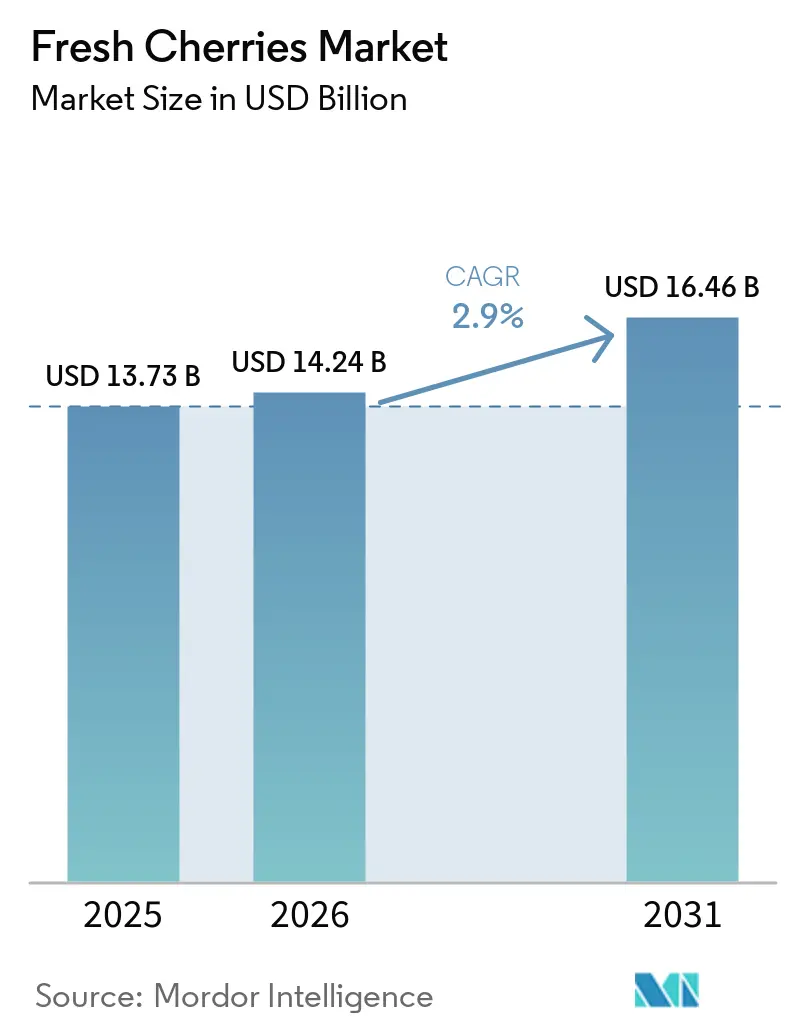
The Fresh Cherries Market size is expected to grow from USD 13.73 billion in 2025 to USD 14.24 billion in 2026 and is forecast to reach USD 16.46 billion by 2031 at 2.9% CAGR over 2026-2031. Rising demand for nutrient-dense fresh fruit snacks, an ever-widening export pipeline, and rapid improvements in post-harvest handling underpin this growth trajectory. High-density orchard systems, controlled-atmosphere logistics, and AI-enabled optical sorters are pushing both yield and quality frontiers, allowing growers to capture price premiums even in volatile seasons. Asia-Pacific remains the consumption fulcrum, while South America, led by Chile, delivers the fastest value growth. Across most producing regions, government incentives and research grants are accelerating cold-chain investments that safeguard fruit integrity during long transit windows.
Key Report Takeaways
- By geography, Asia-Pacific held a 28.5% of the fresh cherries market share in 2025, and South America is projected to record an 2.5% CAGR through 2031.
Note: Market size and forecast figures in this report are generated using Mordor Intelligence’s proprietary estimation framework, updated with the latest available data and insights as of 2026.
Market Trends and Insights
Drivers Impact Analysis of Fresh Cherries Market*
| Driver | (~) % Impact on CAGR Forecast | Geographic Relevance | Impact Timeline |
|---|---|---|---|
| Rising consumer preference for nutrient-rich fresh fruit snacks | +1.2% | Global, with strongest impact in North America and Asia-Pacific | Medium term (2-4 years) |
| Expanding export demand | +1.8% | Global, particularly Chile to China, the U.S. to Canada and Asia | Long term (≥ 4 years) |
| Government subsidies and R&D support for post-harvest infrastructure | +0.9% | North America, Europe, and emerging South American markets | Long term (≥ 4 years) |
| Proliferation of high-density orchard systems boosting yield | +1.4% | Global, with early adoption in the Pacific Northwest and Chile | Medium term (2-4 years) |
| Adoption of optical sorting and AI-grading reduces waste | +0.8% | Developed markets such as North America, Europe, Australia | Short term (≤ 2 years) |
| Premium varietal branding unlocking price premiums | +0.6% | North America, Europe, select Asian markets | Medium term (2-4 years) |
| Source: Mordor Intelligence | |||
Rising Consumer Preference for Nutrient-Rich Fresh Fruit Snacks
Retail shoppers are trading processed snacks for antioxidant-rich cherries, turning impulse displays into margin centers for retailers. The nutritional profile of cherries, rich in antioxidants and anti-inflammatory compounds, aligns with growing wellness trends, particularly among empty-nesters and health-conscious demographics. U.S. consumer polling shows quality and taste outrank price, yet volumes dip once retail labels[1]. Health-oriented marketing, such as the Northwest Cherry Growers’ campaign, garnered millions of media impressions during the 2024 Paris Olympics, reinforcing cherries’ superfood credentials. Empty-nesters and wellness-focused millennials drive this shift, and an uptick in organic supply from firms like Stemilt is widening assortment depth. The trend is global, but its pull is most pronounced in metropolitan North America and Asia-Pacific, where retailers leverage front-of-store bins for impulse conversion.
Expanding Export Demand
China’s appetite anchors the long-haul trade, with imports on track in 2025/26, an unprecedented tenth straight annual increase. Chile commands a major share in Southern Hemisphere shipments and in 2024 exports despite oversupply headwinds. Spain’s new phytosanitary protocol, signed in April 2025, grants it a foothold in China, partially diluting Chile’s dominance. Cold treatment and controlled-atmosphere containers are now non-negotiable capabilities for exporters serving 20-day ocean transit lanes into Asia. Tariff uncertainty lingers for U.S. growers, but resumed access in 2025 lifted Pacific Northwest planting confidence.
Government Subsidies and R&D Support for Post-Harvest Infrastructure
Public funding initiatives are accelerating agricultural modernization across North America. The U.S. Foreign Agricultural Service allocated new funding for horticultural export promotion in 2025. Mexico experienced significant growth in protected-agriculture acreage following increased government support budgets in the billions. Academic research demonstrates that targeted financial assistance reduces the cost premium associated with organic farming, increasing retailer adoption rates. The Washington State Fruit Commission established dedicated federal advocacy programs, highlighting the connection between policy initiatives and export market development. Studies confirm that government subsidies effectively promote organic farming adoption by reducing the social responsibility premiums that retailers must bear.
Proliferation of High-Density Orchard Systems Boosting Yield
High-density blocks often topping 500 trees per hectare lift outputs to 15 metric tons/hectare versus 9.5 metric tons/hectare in conventional layouts, despite capex almost doubling to USD 59,400 per hectare. Pacific Northwest growers trial dwarfing rootstocks like Gisela for pedestrian harvest and compatibility with over-row platforms[2]. Italy’s Super Slender Axe on Gisela 6 yields larger fruit and earlier production but demands trellis investments. Net Present Value comparisons still favor denser systems, delivering across protective-covered sites. Added benefits include uniform color and quicker ROI as trees bear commercially in year three.
Restraints Impact Analysis of Fresh Cherries Market*
| Restraint | (~) % Impact on CAGR Forecast | Geographic Relevance | Impact Timeline |
|---|---|---|---|
| Climate-induced crop losses | -1.6% | Global, with severe impacts in Turkey, Michigan, and Eastern Europe | Short term (≤ 2 years) |
| Price volatility from supply-demand imbalance | -1.1% | Global, particularly affecting export-dependent regions | Medium term (2-4 years) |
| Labor shortages during peak harvest window | -0.9% | North America, Europe, with emerging concerns in Australia | Short term (≤ 2 years) |
| Phytosanitary import barriers | -0.7% | Global trade corridors, particularly U.S.-Canada and EU-third country trade | Medium term (2-4 years) |
| Source: Mordor Intelligence | |||
Climate-Induced Crop Losses
Climate change impacts extend beyond immediate crop losses to affect post-harvest physiology, with research in Chile showing that increasing temperatures and heatwaves stress cherry trees during critical reserve accumulation and flower differentiation phases. Research out of Chile warns that warming trends disrupt winter chill fulfillment, imperiling late cultivars by 2050. Growers now pivot to resilient genetics, retractable roof systems, and protective netting, but the capital burden weighs on smaller orchards. Consequently, regional supply volatility amplifies price swings and complicates forward-contract planning for packers.
Price Volatility from Supply-Demand Imbalance
Market price instability affects cherry industry profitability, as oversupply conditions create financial pressure on growers across major producing regions. Northwest U.S. growers experienced margin compression in 2023 when California's extended harvest period delayed profitable sales beyond the July 4 peak season. Chile's record export volumes to China during the 2024/25 season led to declining FOB prices. Dole plc reported lower pricing for cherries and other southern hemisphere exports in Q1 2025, resulting in decreased segment performance despite higher volumes.
*Our forecasts treat driver/restraint impacts as directional, not additive. The impact forecasts reflect baseline growth, mix effects, and variable interactions.
Geography Analysis
APAC Fresh Cherries Market
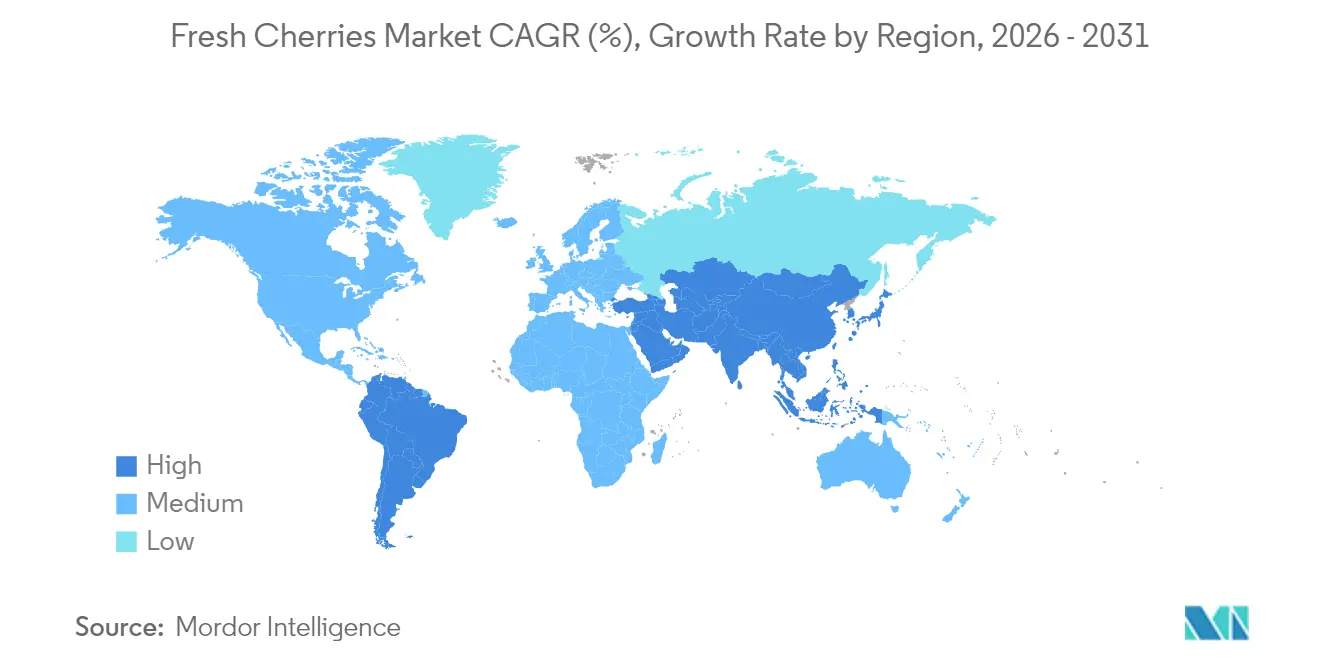
Asia-Pacific commanded 28.5% of the fresh cherries market share in 2025. China alone produced a good volume of cherries in the 2024/25 season and is on pace to import in 2025/26, a rare dual-role dynamic fueling intraregional trade. Government subsidies that reward mountain cultivation and cultivar re-grafting keep planted area climbing, while e-commerce platforms unlock lower-tier cities. Rising disposable incomes and health consciousness support sustained demand for both conventional and organic fruit.
South America Fresh Cherries Market
South America posts the fastest regional value acceleration, with an 2.5% CAGR projected through 2031 in the fresh cherries market. High-density plantings and robust cold-chain capacity uphold quality during the 20-plus-day voyage to China. Argentina and Brazil remain niche contributors but benefit from Chilean spillover expertise in tunnel covers and predictive irrigation. Currency weakness in both countries could enlarge their export pipeline once phytosanitary clearances mature.
North America and Europe Fresh Cherries Market
North America balances robust Pacific Northwest output with Midwest climate volatility. Exports are split among Canada, South Korea, and China. Europe experiences moderate growth tempered by production challenges and evolving trade relationships, with consumption rising despite declining domestic production in key countries. Labor shortages continue to affect harvest operations, though automation initiatives are progressing.
Recent Industry Developments in Fresh Cherries Market
- July 2025: British Columbia logged record cherry output after a seven-year recovery, extending harvest into early September and widening North American marketing windows.
- May 2025: Washington Fruit Growers installed a second high-capacity cherry packing line featuring advanced optical sorters and expanded clamshell formats to meet retailer specification shifts.
- September 2024: Jack Daniel’s launched the Jack & Coca-Cola Cherry Classic ready-to-drink canned cocktail. This offering harmoniously blends the robust notes of Tennessee whiskey with the fruity undertones of Coca-Cola Cherry.
Global Fresh Cherries Market Report Scope
Fresh cherries are small stone fruits that come in a variety of colors and flavors. There are two major categories - tart and sweet cherries, or Prunus cerasus L. and Prunus avium L., respectively.
The fresh cherries market is segmented by geography (North America, Europe, Asia-Pacific, South America, and the Middle East and Africa. The report offers production analysis (volume), consumption analysis (value and volume), import analysis (value and volume), export analysis (value and volume), and price trend analysis. The report offers market size and forecasts in terms of value (USD) and volume (metric tons) for all the above segments.
Segmentation Overview
| North America | United States |
| Canada | |
| Europe | Spain |
| Italy | |
| Germany | |
| United Kingdom | |
| Russia | |
| Asia-Pacific | China |
| India | |
| Japan | |
| Australia | |
| South America | Chile |
| Brazil | |
| Argentina | |
| Middle East | Turkey |
| United Arab Emirates | |
| Africa | South Africa |
| Egypt |
| By Geography (Production Analysis by Volume, Consumption Analysis by Volume and Value, Import Analysis by Volume and Value, Export Analysis by Volume and Value, and Price Trend Analysis) | North America | United States |
| Canada | ||
| Europe | Spain | |
| Italy | ||
| Germany | ||
| United Kingdom | ||
| Russia | ||
| Asia-Pacific | China | |
| India | ||
| Japan | ||
| Australia | ||
| South America | Chile | |
| Brazil | ||
| Argentina | ||
| Middle East | Turkey | |
| United Arab Emirates | ||
| Africa | South Africa | |
| Egypt | ||
Key Questions Answered in the Report
What is the current value of the fresh cherries market size in 2026?
The fresh cherries market size is valued at USD 14.24 billion in 2026.
How fast will the fresh cherries market grow through 2031?
It is forecast to post a 2.9% CAGR, reaching USD 16.46 billion by 2031.
Which region holds the largest share of fresh cherries consumption?
Asia-Pacific leads with 28.5% value share in 2025, driven mainly by China's import demand.
What technologies are most impactful for post-harvest quality?
Controlled-atmosphere storage, cold-treatment protocols, and AI-powered optical sorting preserve quality and reduce waste.
How are climate risks affecting fresh cherries producers?
Severe frosts and warming winters are driving 30-70% yield losses in some regions, prompting investments in protective infrastructure and resilient varieties.