
Market Overview
| Study Period | 2020 - 2031 |
|---|---|
| Forecast Data Period | 2026 - 2031 |
| Base Year Market Size (2025) | USD 7.33 Billion |
| Market Size (2026) | USD 7.72 Billion |
| Market Size (2031) | USD 10.02 Billion |
| Growth Rate (2026 - 2031) | 5.35 % |
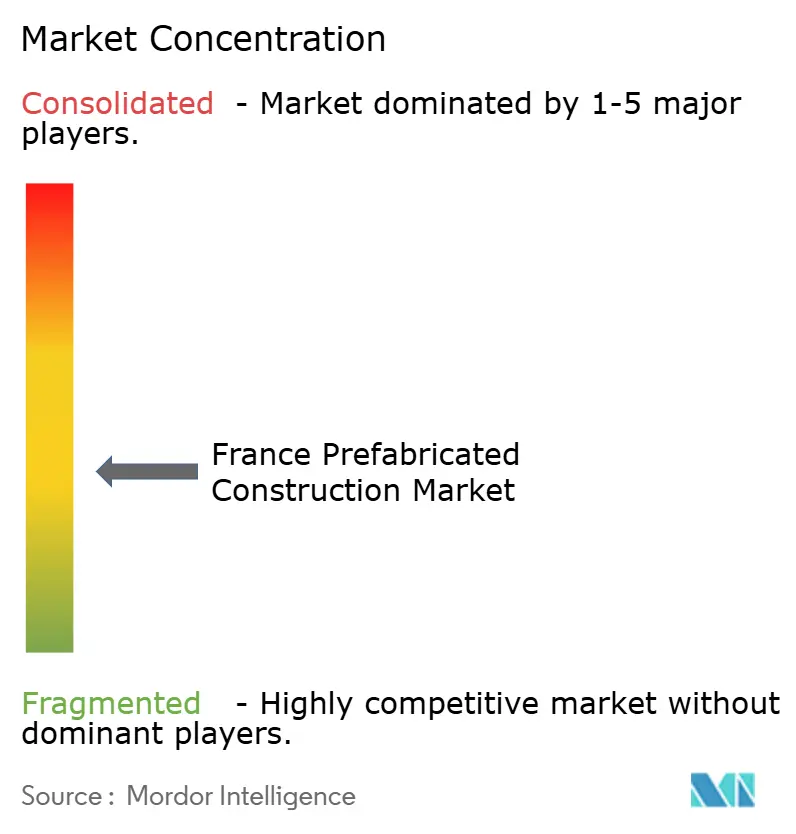
| Market Concentration | Medium |
Major Players *Disclaimer: Major Players sorted in no particular order Image © Mordor Intelligence. Reuse requires attribution under CC BY 4.0. | |
France Prefabricated Construction Market Analysis by Mordor Intelligence
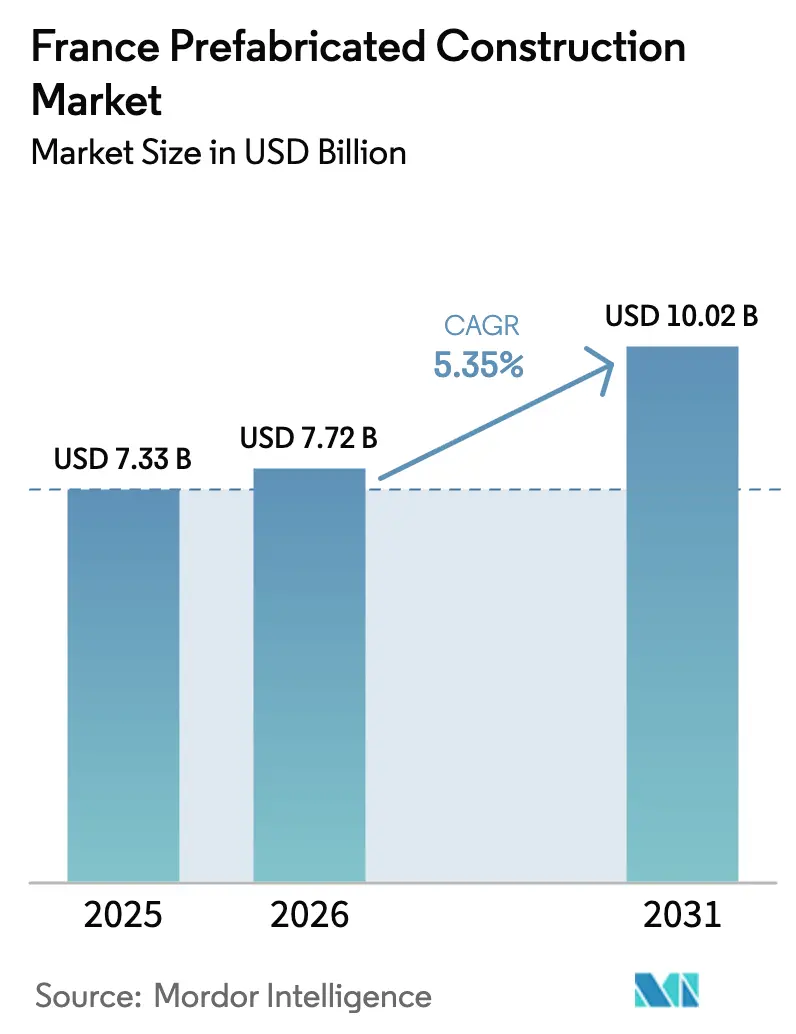
The France Prefabricated Construction Market size is projected to expand from USD 7.33 billion in 2025 and USD 7.72 billion in 2026 to USD 10.02 billion by 2031, registering a CAGR of 5.35% between 2026 to 2031.
Stringent RE2020 carbon limits, rising urban land prices, and persistent labor shortages prompt developers to favor factory-controlled assemblies that cut embodied emissions and shorten build programs. Public procurement for schools, clinics, and defense sites increasingly demands modular delivery to secure cost certainty and reduce neighborhood disruption. Private demand also gains momentum as data center and last-mile logistics operators place a premium on speed to revenue and on-site MEP integration. At the same time, timber-hybrid solutions attract investment because each cubic meter of cross-laminated timber (CLT) stores roughly 1 tonne of CO₂, a biogenic credit that helps projects comply with tightening caps without costly offsets.
Key Report Takeaways
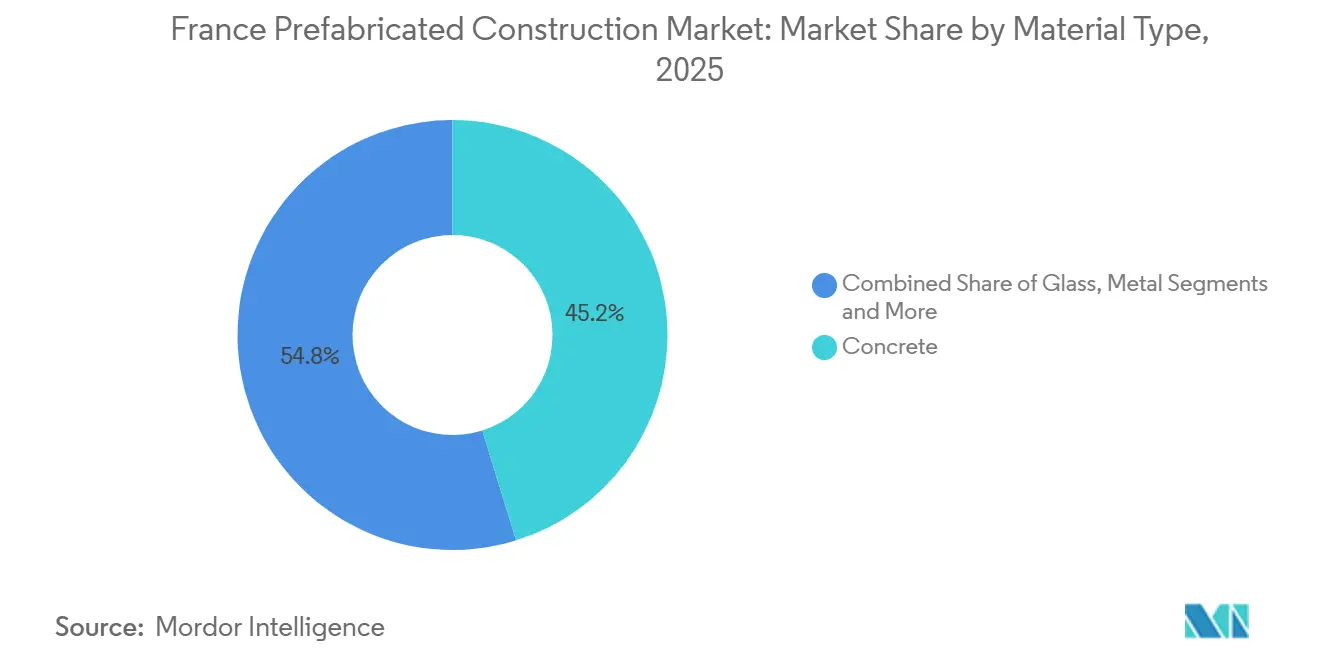
- By material type, concrete led with 45.2% of France prefabricated buildings market share in 2025, while timber is projected to post the fastest 6.12% CAGR through 2031.
- By application, the residential segment accounted for 59.4% of the France prefabricated buildings market size in 2025, whereas commercial projects are advancing at a 6.40% CAGR to 2031.
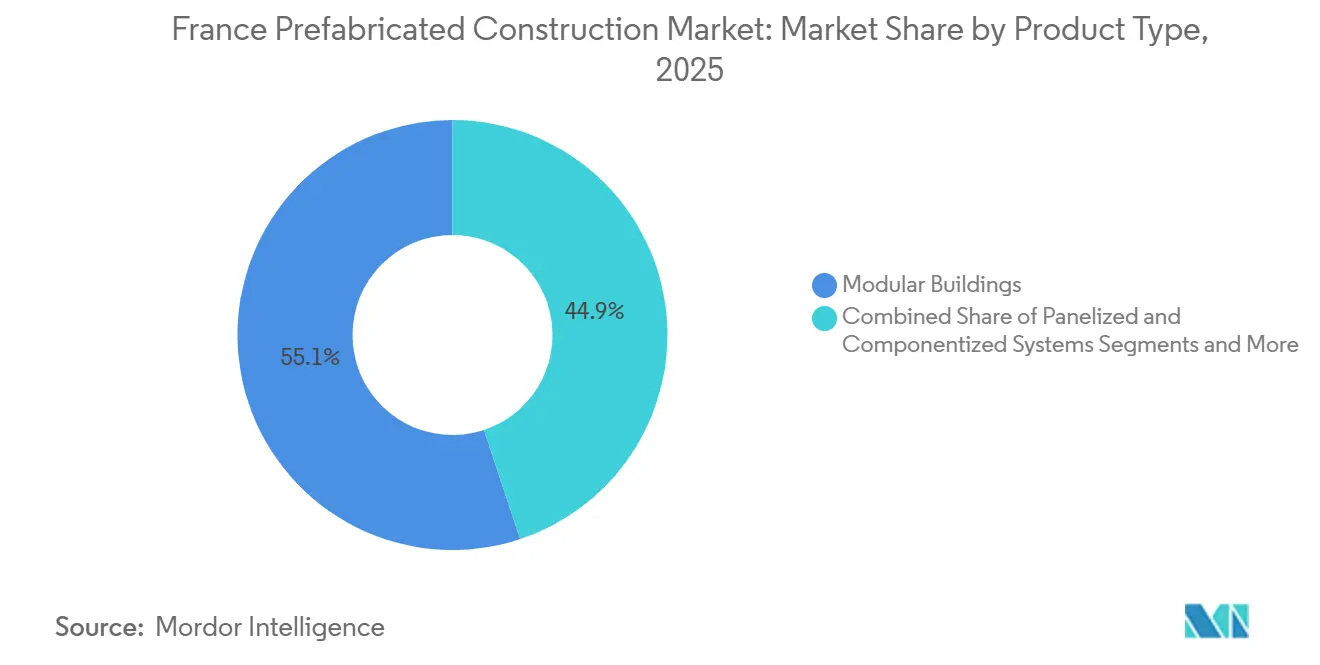
- By product type, modular buildings captured 55.1% of 2025 revenue, and panelized systems are forecast to expand at a 6.79% CAGR through 2031.
- By city, Paris contributed 39.7% of 2025 activity, yet Lyon records the strongest 7.08% city-level CAGR through 2031.
Note: Market size and forecast figures in this report are generated using Mordor Intelligence’s proprietary estimation framework, updated with the latest available data and insights as of January 2026.
France Prefabricated Construction Market Trends and Insights
Drivers Impact Analysis*
| Drivers | (~) % IMPACT ON CAGR FORECAST | Geographic Relevance | Impact Timeline |
|---|---|---|---|
| RE2020 energy and carbon standards | +1.8% | National with early adoption in Paris, Lyon, Grenoble | Medium term (2-4 years) |
| Public programs for schools, healthcare, defense | +1.2% | National, concentrated in Île-de-France, Auvergne-Rhône-Alpes, Provence-Alpes-Côte d’Azur | Short term (≤2 years) |
| Timber and hybrid prefab for decarbonization goals | +1.0% | National, leadership in Paris, Lyon, Bordeaux | Long term (≥4 years) |
| Urban infill and brownfield redevelopment | +0.9% | Paris, Lyon, Marseille, Lille | Medium term (2-4 years) |
| Industrial, logistics, and data center expansion | +0.8% | Île-de-France, Hauts-de-France, Auvergne-Rhône-Alpes | Short term (≤2 years) |
| Source: Mordor Intelligence | |||
RE2020 Energy and Carbon Standards
France’s RE2020 code adds lifecycle-carbon caps that tighten in 2025, 2028, and 2031, forcing developers to quantify embodied emissions from structure to end-of-life. Factory-built envelopes minimize waste, assure airtightness, and allow detailed tracing of material provenance, helping projects document compliance without costly redesigns[1]. Carbon accounting rules credit each cubic meter of structural timber with about 1 tonne of stored CO₂, a benefit that offsets emissions from foundations and MEP services[2]. These advantages translate into lower risk premiums for lenders and insurers, accelerating specification of modular and panelized solutions in new tenders. As the caps tighten, manufacturers that certify product footprints now are positioned to win repeat orders later.
Public-Sector Programs
French ministries responsible for education, health, and defense now embed offsite delivery in bid documents to shorten schedules and hold contractors to fixed price points[3]. A 12-classroom primary school in Bagneux opened in 2024 after only four months on site, demonstrating how volumetric units limit noise complaints in dense neighborhoods. Hospital extensions in Argenteuil and Rennes used modular patient rooms to maintain sterile zones while building new capacity, an approach that would have required phased closures with conventional methods. The military quietly deploys containerized barracks that relocate with troop rotations, proving the versatility of prefabrication for mission-critical assets. These examples build political confidence, ensuring that future public budgets continue to earmark funds for factory-made solutions.
Timber and Hybrid Prefab for Decarbonization
CLT and glued-laminated timber (GLT) lines expanded nationwide after landmark high-rise projects in Bordeaux and Grenoble validated fire and acoustic performance. Vertical integration deals, such as Eiffage’s 2024 purchase of B3 Ecodesign, secure local fiber supply and lock in price stability over multi-year frameworks. RE2020’s biogenic-carbon credit of up to 2 kg CO₂ per kilogram of dry wood enables mid-rise residential towers to achieve net-negative embodied carbon when coupled with low-carbon concrete podiums. National circular-economy guidelines now favor bolted rather than glued connections so panels can be recovered and redeployed, improving residual values at end-of-life. Timber’s dual climate and circular benefits are compelling private investors to include hybrid frames in sustainability-linked loan covenants.
Urban Infill and Brownfield Redevelopment
Tight urban plots face restrictions on working hours, crane pads, and truck routes, so contractors choose panelized facades and floor cassettes that lift into place in minutes and need fewer deliveries. The Bercy Village project in Paris kept weekend Metro service running by limiting heavy lifts to off-peak nighttime windows and finishing interiors with pre-fitted MEP risers. Lyon’s Part-Dieu masterplan inserts modular cores into towers beside active rail lines, minimizing track closures that would disrupt 140,000 passengers a day. Brownfield conversions enjoy a double benefit: lighter timber-hybrid frames reduce foundation loads on contaminated soils, and factory machining reduces worker exposure to onsite pollutants. These performance gains encourage planners to approve offsite methods as the default for infill projects.
Restraints Impact Analysis*
| Restraints | (~) % IMPACT ON CAGR FORECAST | Geographic Relevance | Impact Timeline |
|---|---|---|---|
| Complex permitting and heritage protections | -0.7% | National, acute in historic Paris, Bordeaux, Strasbourg | Medium term (2-4 years) |
| Transport and cranage limits in dense cities | -0.5% | Paris, Lyon, Marseille, Lille | Short term (≤2 years) |
| Cultural preference for masonry and cost perceptions | -0.4% | National, strongest in rural and peri-urban areas | Long term (≥4 years) |
| Source: Mordor Intelligence | |||
Complex Permitting and Heritage Protections
Municipal planners apply varied aesthetic rules under the Code de l’urbanisme, and heritage officials may veto modular facades within 500 meters of protected monuments. A 2024 survey by the French Building Federation found modular permits in historic districts average 14 months, five months longer than conventional builds. Custom tweaks required to satisfy local appearance guidelines erase some factory efficiencies and inflate design fees. National agencies are drafting pre-approved typologies, yet uptake remains slow because mayors fear backlash if projects seem “industrial.” Until zoning harmonizes, developers must budget extra time and contingency funds for landmark sites.
Transport and Cranage Limits
French road law caps standard module width at 2.55 meters, height at 4 meters, and vehicle weight at 44 tonnes; oversize loads need escorts that increase cost and limit delivery windows. Urban cores tighten the squeeze with night-only deliveries and narrow turning radii, so cranes must be booked in brief windows at daily rates of EUR 3,000-5,000 (USD 3,300-5,500) plus standby charges. To cope, manufacturers redesign units to fit transport envelopes rather than optimal layouts, which raises per-square-foot costs. Panelized kits reduce haulage headaches but shift more labor back to site, diluting some productivity gains.
*Our forecasts treat driver/restraint impacts as directional, not additive. The impact forecasts reflect baseline growth, mix effects, and variable interactions.
Segment Analysis
By Material Type: Concrete Holds Scale as Timber Accelerates
Concrete retained a 45.2% France prefabricated construction market share in 2025 thanks to its dominance in multi-story social housing and industrial sheds. Pre-cast stair cores and bathroom pods made with low-carbon cement allow developers to meet fire and acoustic codes while leveraging established supply chains. However, RE2020 charges higher embodied-carbon penalties on ordinary Portland cement, nudging contractors to adopt blends with granulated slag or calcined clay. Timber is the fastest climber, expanding at a 6.12% CAGR toward 2031 as CLT prices fall in line with rising domestic capacity, exemplified by Hexaom’s investment in POBI Industrie’s Vendée plant. Hybrid frames that marry timber floors to concrete podiums now anchor many 8-10 story towers, demonstrating how the France prefabricated construction market can balance structural resilience with decarbonization.
Growth momentum favors materials that meet both carbon and schedule targets. Timber cores cut building weight by up to 30%, enabling shallower foundations on weak soils and lowering spoil disposal costs in brownfield sites. Regional sawmills around Auvergne now machine CLT panels to 3.2-meter widths, maximizing truck payloads within French road limits. Meanwhile, steel holds a steady niche in wide-span logistics halls yet faces slower growth because virgin steel attracts hefty carbon coefficients. Composite sandwich panels and recycled-aggregate blocks are emerging as wildcard options for façades and interior partitions, but they still command a fraction of current demand. Overall, material substitution trends enrich supplier diversity and reinforce competitive dynamics within the France prefabricated construction market.

By Application: Residential Dominates while Commercial Gains Pace
Residential schemes contributed 59.4% of the France prefabricated construction market in 2025 as social-housing authorities raced to relieve a chronic shortage of affordable units. Modular typologies reduce tenant rehousing costs by shortening on-site programs, and RE2020 incentives make timber apartments attractive for public landlords pursuing BBCA certification. Yet buyer sentiment still leans toward masonry, so private developers proceed cautiously, focusing on peri-urban subdivisions where land savings offset the prefabrication premium. The Athletes’ Village, converted into 2,800 apartments after the 2024 Olympics, showcases how factory production scales in high-profile urban contexts and helps normalize offsite delivery to the broader market.
Commercial construction grows the fastest at a 6.40% CAGR through 2031, fueled by data-center and logistics investments that require precise MEP integration and flawless uptime. Prefabricated cooling modules, electrical rooms, and rooftop plant reduce commissioning risk and allow phased capacity additions in response to customer demand. Warehouses benefit from panelized steel frames that erect quickly during summer harvests when rural labor is scarce. Offices recover more slowly because hybrid work dampens demand; nonetheless, trophy towers in Paris and Lyon adopt curtain-wall cassettes and prefitted service risers to achieve HQE Excellent scores within compressed tenant fit-out windows. Healthcare, education, and defense remain smaller slices yet deliver marquee case studies that influence policy and procurement standards across the France prefabricated construction market.
By Product Type: Modular Leads, Panelized Surges
Modular buildings commanded 55.1% of 2025 revenue as volumetric classrooms, site offices, and worker dormitories formed an established rental fleet managed by Algeco, Portakabin, and Cougnaud. Permanent volumetric housing also gains share, though transport size limits and public-image concerns temper progress. The France prefabricated construction market size for panelized and componentized systems is smaller today, but recorded the strongest 6.79% CAGR outlook because the flat-pack format navigates narrow streets without escorts. Builders assemble wall panels and floor cassettes using conventional cranes, allowing architectural freedom and easier façade customization in heritage districts.
Manufacturers respond with advanced digital fabrication. VINCI’s robotics cuts and welds panels with millimeter precision in four weeks, giving contractors just-in-time delivery within dense city sites. Sub-segments such as precast lift shafts, staircases, and bathroom pods remain stable because they integrate seamlessly into both modular and traditional builds. Looking ahead, hybrid procurement that combines volumetric wet cores with panelized dry areas will likely dominate mixed-use towers, blending factory quality with on-site flexibility. This mix supports sustained value creation across the France prefabricated construction market.
Geography Analysis
Paris retained a commanding 39.7% share of the France prefabricated construction market in 2025 as contractors leveraged factory precision to meet non-negotiable Olympic handover deadlines without breaching tight noise ordinances. RE2020 enforcement also favors off-site in the capital because multi-award processes penalize high-carbon materials. Data-center operators situate new halls in Seine-Saint-Denis and Val-de-Marne, where land is cheaper, drawing large orders for prefitted MEP skids that shorten power-up cycles. Despite these strengths, narrow streets and heritage reviews still inflate craneage and design costs, nudging some developers toward panelized kits that can slip through standard transport envelopes.
Lyon is the fastest-growing metropolitan area at a projected 7.08% CAGR through 2031, thanks to the Part-Dieu redevelopment and a vibrant biopharma cluster that demands cleanroom modules. Municipal planners embrace prefabrication as a tool to limit rail-station disruption and to accelerate affordable-housing completions in Villeurbanne and Vénissieux. Logistics parks at Saint-Quentin-Fallavier adopt panelized steel frames to meet e-commerce growth, reinforcing a positive loop of industrial demand and supplier investment.
Marseille and the wider regions together account for the balance of market activity. Euroméditerranée’s waterfront masterplan integrates modular apartments that respect strict daytime noise caps while reducing truck trips through the port district. Elsewhere, prefabricated extensions to provincial hospitals in Rennes and Poitiers illustrate how offsite methods tackle service backlogs without suspending operations. Cultural skepticism and fragmented crane supply keep rural uptake modest, yet national targets to retrofit public buildings for energy efficiency will likely drive gradual diffusion of modular façades into smaller towns, ensuring steady though uneven expansion of the France prefabricated construction market.
Regulatory Landscape
Prefabricated buildings in France align with the same core building rules as conventional construction, with RE2020 acting as the primary compliance driver for energy performance, lifecycle-carbon accounting, and summer comfort. The RE2020 thresholds tighten on a defined schedule, including 2025, 2028, and 2031 steps, and consolidated RE2020 texts and guidance have been updated based on early implementation feedback, including changes introduced via the December 30, 2024 decree (Decree No. 2024-1258).
On the conformity and quality side, CSTB supports off-site and modular suppliers through technical assessments and certification pathways. The QB Modulaires certification (under the QB framework) formalizes process and product expectations for modular construction, while CE-marking and evaluation mechanisms (including equivalent-solution assessment pathways) help non-traditional assemblies enter the market when performance outcomes meet regulatory targets. Taken together, RE2020 documentation requirements and third-party certification have raised the importance of material provenance traceability and declared environmental performance as bid prerequisites, especially in public procurement and carbon-scored tenders.
Value Chain Analysis
The France prefabricated construction value chain typically starts with upstream inputs, including cementitious inputs and aggregates for precast, structural steel, and timber and engineered wood such as CLT/GLT, alongside insulation, facade systems, and MEP components. It then moves through design and engineering (architects, structural and MEP engineers, BIM and digital configuration), followed by off-site manufacturing, including 2D panel lines, 3D volumetric module plants, precast yards, and specialist pod producers, before reaching logistics, cranage, on-site assembly, commissioning, and after-sales service such as warranties, maintenance, and refurbishment of rental fleets.
General contractors and integrators, including Bouygues Construction, VINCI Construction, and Eiffage Construction, increasingly combine design-for-manufacture with factory capacity, either in-house or through long-term partnerships, to secure slots and reduce schedule risk in public programs (schools, healthcare, defense) and MEP-heavy commercial builds (logistics and data centers). Bottlenecks cluster around capital intensity and skills, and transport constraints that affect module dimensions and delivery windows in dense cities. Sector-level modernization efforts in the concrete ecosystem provide an anchor for industrial capability upgrades, including COP 2024-2027 signed on June 7, 2024 between the French State, FIB, and CERIB, which targets ecological transition and digital transformation for industrial sovereignty. Volatility in steel and wood input costs, along with tight crane availability, continues to shape total delivered cost and pushes some projects toward panelized or hybrid approaches that limit oversize transport needs while keeping critical elements such as bathroom pods, plant rooms, and risers industrialized.
Competitive Landscape
Competition is moderately fragmented: even the five largest suppliers capture only a modest share of industry revenue, leaving ample white space for regional specialists and niche offerings - particularly in healthcare and data-center product lines. Large contractors pivot faster toward vertical integration after RE2020 elevated embodied-carbon metrics in tender scoring. Eiffage grouped its concrete, timber, and panel operations into a single Off-Site division targeting USD 220 million equivalent revenue by 2027, while Bouygues opened the Scale One center to test digital twins that cut on-site rework by 15%.
Mergers and acquisitions accelerate as mid-tier housebuilders lock in factory slots. Hexaom bought timber specialist POBI Industrie in July 2025, combining a 12,000-square-meter line with its Trecobat brand to secure supply and protect margins against rising carbon tariffs. Investors also see value in rental fleets; Antin Infrastructure Partners acquired Portakabin for GBP 1 billion (USD 1.3 billion), funding a new French production line that targets healthcare and education orders. These moves increase capacity and raise the technological bar for smaller rivals.
Technology defines competitive gaps. VINCI robotizes panel cutting and welding, reducing lead times to four weeks and enabling just-in-time deliveries in constrained city sites. Cougnaud’s Citeden line incorporates digital patient-monitoring infrastructure, creating a turnkey solution that commands a premium in hospital tenders. Smaller fabricators remain viable by offering highly customized façades or localized after-sales service, but they risk margin compression as standards converge. Continued regulatory tightening and client demand for assured carbon footprints point to further consolidation within the France prefabricated construction market.
France Prefabricated Construction Industry Leaders
-
Bouygues Construction
-
VINCI Construction
-
Eiffage Construction
-
Cougnaud Construction
-
Bodard Construction Modulaire
- *Disclaimer: Major Players sorted in no particular order
Market Opportunities and Future Outlook
Public procurement is creating a concrete channel for modular and prefabricated offerings tied to circular-economy requirements. Since July 1, 2024, implementation linked to Article 58 of the AGEC law has required public buyers to prioritize products and solutions that incorporate minimum proportions of recycled content or reuse/re-use. This supports modular systems designed for disassembly, refurbishment, and redeployment, particularly in education, healthcare, and administrative buildings where framework purchasing is common.
Industrial upgrading and decarbonization programs are also shaping whitespace around low-carbon precast and bio-sourced hybrid systems. COP 2024-2027 (French State, FIB, CERIB) provides an industry roadmap focused on decarbonizing concrete products, advancing mixed construction systems using bio-sourced materials, and deploying digital resources across production. That direction favors suppliers able to provide declared environmental performance and repeatable manufacturing quality. Separately, France 2030 has backed hors-site industrialization through calls for projects that include automated prefabrication lines and modular capabilities, including named beneficiaries such as GA Smart Manufacturing and Bouygues Construction. This reinforces opportunities in factory automation, standardized all-trades modules, and documented carbon performance mapped to RE2020 reporting and tender scoring.
Recent Industry Developments
- April 2026: Eiffage Construction announced it had won an RTE contract to supply 450 modular buildings for electrical substations over five years, covering 1,125 prefabricated timber-frame modules. The award expands modular construction from buildings into critical energy infrastructure and underscores demand for high-spec integration in factory-built units at scale.
- July 2025: Hexaom closed its acquisition of timber specialist POBI Industrie, integrating a timber-frame production line with its Trecobat brand. The acquisition strengthened vertical integration for low-carbon housing delivery and improved access to factory capacity amid tightening RE2020 carbon constraints.
- April 2024: Eiffage Construction consolidated its prefabricated concrete and timber activities by forming a dedicated Off-Site division from its Industrialized Solutions unit. The reorganization formalized a specialized platform for 2D and 3D off-site delivery, supporting repeatable production and broader deployment across public and private programs.
Research Methodology Framework and Report Scope
Market Definition and Coverage
This market is measured as the revenue generated in France from prefabricated building solutions that are manufactured offsite and assembled onsite for permanent and semi-permanent building delivery across end users.
Scope exclusions: Traditional on-site construction services and building materials sold for fully stick-built projects are excluded from this market sizing.
Segmentation Overview
- By Material Type
- Concrete
- Glass
- Metal
- Timber
- Other Materials
- By Application
- Residential
- Commercial
- Others
- By Product Type
- Modular Buildings
- Panelized & Componentized Systems
- Other Prefab Types
- By City
- Paris
- Lyon
- Marseille
- Rest of France
Data Sources, Market Sizing, and Validation
Desk Research
Desk research was used to set the fact base for the model and keep the market logic consistent with what is observable in France. We referenced public construction output and permits, housing completions, and macro indicators from sources such as INSEE, the French Ministry for Ecological Transition and Territorial Cohesion, Eurostat, and the European Commission, which helped anchor the demand environment.
To sharpen the market context, we also reviewed technical and policy signals that influence prefabrication uptake, including RE2020-related materials shifts and modern methods of construction adoption, using sources such as ADEME publications, CSTB guidance notes, and peer reviewed building science journals. Company annual reports, investor presentations, and credible press coverage were used to understand portfolio mix and pricing direction. A paid subscription for company financials, patent databases, and shipment-level import-export views was used selectively to validate missing data points. These desk sources are illustrative only, and many other references were used for data collection, validation, and clarification during the study.
Primary Interviews and Surveys
Primary work focused on validating what portion of building demand is realistically served through prefabrication, and where pricing and lead times are moving across France. We spoke with contractors, module and panel manufacturers, distributors, architects, and project owners, then cross-checked claims on volumes, utilization, and typical contract values so the assumptions stayed aligned with real buying behavior across regions.
Distribution of primary research fieldwork respondents
| Company type | Respondent position |
|---|---|
| Top tier: 27% | CXOs: 19% |
| Mid tier: 52% | Functional/Unit leaders: 23% |
| Smaller Players: 21% | Managers: 58% |
Market-Sizing & Forecasting
Market sizing was built using a top-down and bottom-up logic that stays practical for France. On the top-down side, we reconstructed addressable building activity using construction output and permit and completion indicators, then applied prefabrication penetration factors by end use to arrive at a value pool that fits observed project pipelines.
Those totals were then corroborated using selective bottom-up checks, such as sampled price per square meter and typical unit values, along with supplier and channel feedback on volumes and capacity utilization. Key inputs used in the model included residential and non-residential building starts, renovation activity signals where relevant, materials mix shifts linked to low carbon requirements, lead time and labor availability trends, and average project size patterns across major urban areas. Where gaps appeared in bottom-up checks, we used conservative ranges and then tightened them through follow-up calls.
For forecasting, scenario analysis was used, since demand is shaped by both construction cycles and policy driven material choices. Growth paths were tested against expected housing activity, public and private investment visibility, and the pace at which offsite methods are being adopted. Assumptions were adjusted when multiple interviewees converged on similar forward views.
Data Validation & Update Cycle
We validated the model through step-by-step triangulation. Outputs were compared against independent signals like construction permits, housing completions, and visible project announcements, and then checked again for price and volume consistency. When an outlier appeared, we re-reviewed the underlying drivers, followed by re-contacting select respondents to confirm whether the change was structural or temporary.
Before sign-off, the work is reviewed in more than one analyst pass so the calculation logic, unit conversions, and assumptions remain consistent across the time series. Reports refresh annually, with interim updates triggered by material events such as policy changes, major shifts in construction activity, or abrupt pricing movements, and a final pre-delivery check is completed so clients receive the latest view.
Mordor Intelligence's France Prefabricated Buildings Market Size Compared Against Other Published Estimates
Published market values for prefabricated buildings in France can vary widely, even when the topic label looks similar, because different studies count different products and project types, and they also use different price logic and update timings.
Precast concrete products sold as building materials are often bundled into broader prefabricated construction totals, and that item sits outside Mordor Intelligence's scope in this report, which narrows the model to prefabricated building solutions delivered as buildings. Differences also come from whether refurbishment modules and temporary site units are counted as full market revenue, how EUR to USD conversion is timed, and whether penetration rates are validated with real project and capacity checks or kept as simple assumptions.
Benchmark comparison
| Source | Market Size | Gaps in Research Methodology |
|---|---|---|
| Mordor Intelligence | USD 7.33 B (2025) | |
| Trade Journal A | USD 15.18 B (2025) | Often aggregates prefabricated construction with precast concrete and related building materials, and may apply broad construction multipliers without separating building delivery revenue from materials-only sales. |
| Industry Association B | USD 1.33 B (2024) | Typically tracks modular construction activity only, which can undercount panelized and componentized systems and may emphasize rental or temporary units depending on member reporting. |
The spread in the table mainly comes from what is being counted as market revenue and how closely the estimate is tied to observable building activity. By keeping inclusion rules clear and cross-checking penetration and pricing with multiple field viewpoints, the final number stays traceable to simple drivers that can be re-tested as market conditions change.
Key Questions Answered in the Report
How large is the France prefabricated construction market in 2026?
The France prefabricated buildings market size stands at USD 7.72 billion in 2026 and is forecast to reach USD 10.02 billion by 2031.
What CAGR is expected for prefabricated construction in France to 2031?
Market revenue is projected to grow at a 5.35% CAGR over the 2026-2031 period.
Which material is gaining the most momentum in French offsite construction?
Timber-hybrid assemblies post the fastest 6.12% CAGR because RE2020 awards carbon credits for biogenic storage.
Why is Lyon growing faster than other French cities for prefab adoption?
The Part-Dieu redevelopment and a strong biotechnology and logistics base push Lyon to a 7.08% growth pace through 2031.
Who are the leading companies in this market today?
Bouygues Construction, VINCI Construction, Eiffage Construction, Cougnaud Construction, and Bodard Construction Modulaire are among the leading companies operating in this market.
What are the main barriers to wider prefab uptake in France?
Complex permitting in heritage districts, transport size limits in dense cities, and lingering consumer preference for traditional masonry slow broader adoption despite clear carbon and speed advantages.