
Market Overview
| Study Period | 2020 - 2031 |
|---|---|
| Forecast Data Period | 2026 - 2031 |
| Base Year Market Size (2025) | USD 88.77 Billion |
| Market Size (2026) | USD 97.69 Billion |
| Market Size (2031) | USD 142.83 Billion |
| Growth Rate (2026 - 2031) | 7.89 % |
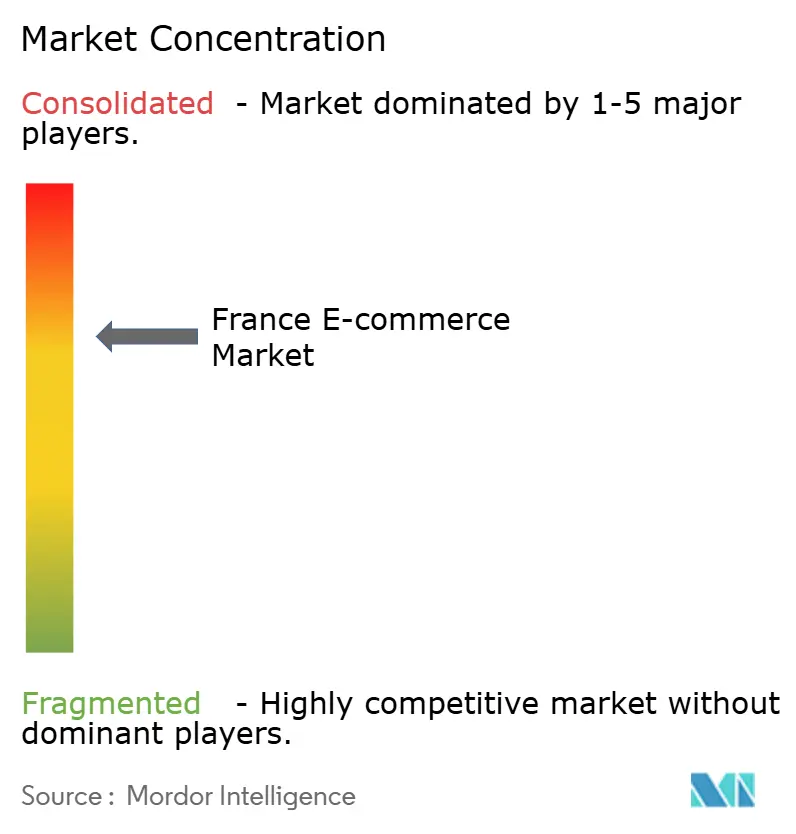
| Market Concentration | Medium |
Major Players *Disclaimer: Major Players sorted in no particular order Image © Mordor Intelligence. Reuse requires attribution under CC BY 4.0. | |
France E-commerce Market Analysis by Mordor Intelligence
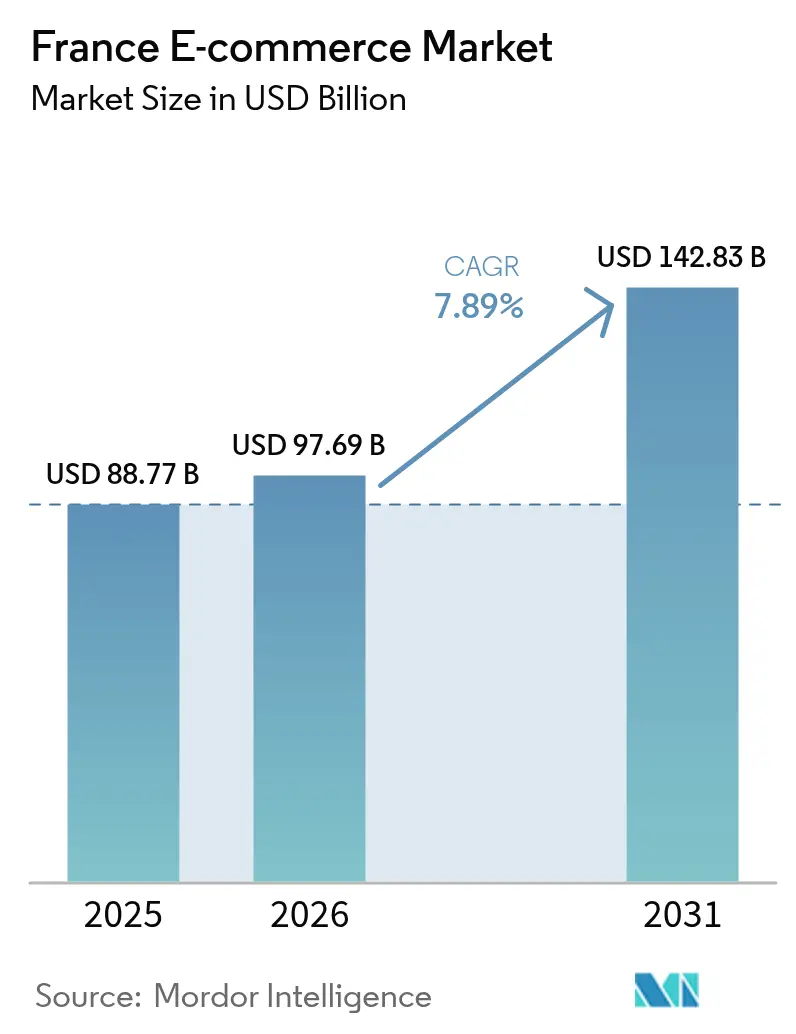
The France e-commerce market size is expected to increase from USD 88.77 billion in 2025 to USD 97.69 billion in 2026 and reach USD 142.83 billion by 2031, growing at a CAGR of 7.89% over 2026-2031. A nationwide fiber footprint that now covers 93.5% of premises, combined with 5G penetration of 29% of mobile connections, has erased the rural connectivity gap and enabled same-day fulfillment outside Paris and Lyon. Mobile already accounts for close to four out of every five consumer transactions, while buy now pay later is expanding faster than any other payment option as Gen Z and millennials favor short-term installment credit. Government subsidies under the France Num program are drawing thousands of regional artisans and specialty food producers online, which is broadening assortment depth and reinforcing consumer preference for locally sourced products. Finally, the cultural shift toward sustainable consumption is moving recommerce platforms into the mainstream, pressuring incumbent fashion retailers to launch their own resale channels.
Key Report Takeaways
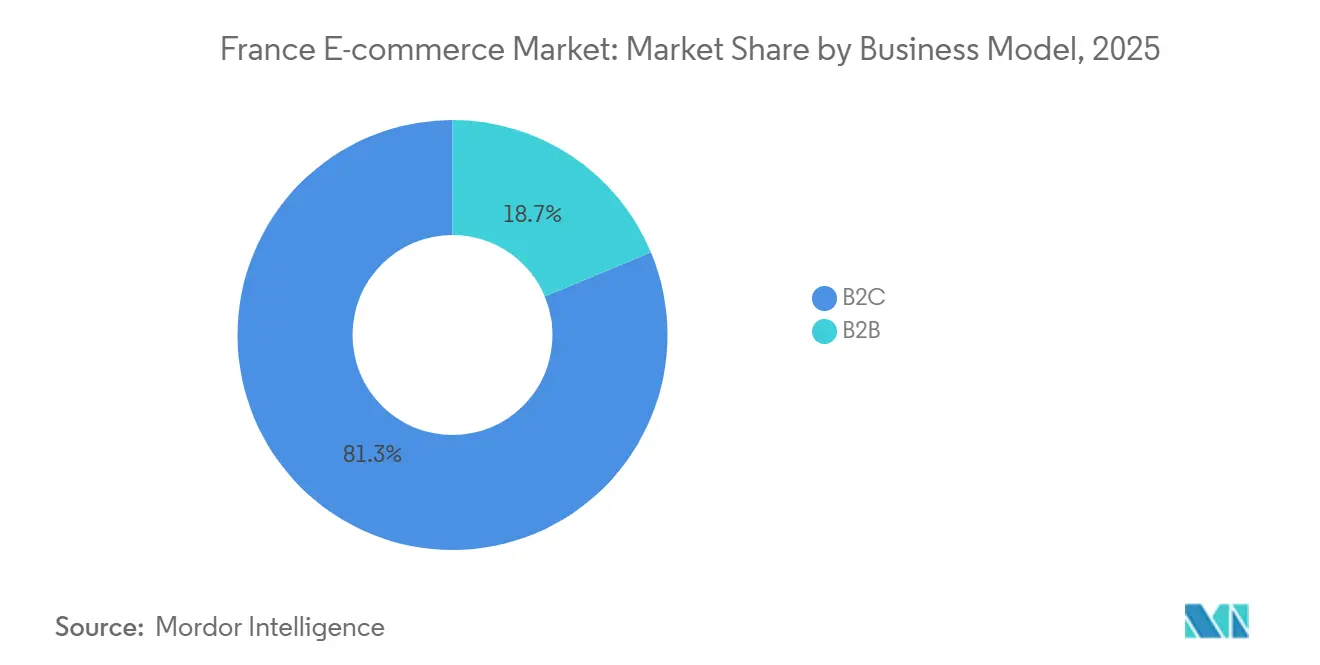
- By business model, business-to-consumer commerce led with 81.29% of the France e-commerce market share in 2025, while business-to-business is projected to expand at an 8.41% CAGR through 2031.
- By device, smartphones and other mobile hardware captured 78.67% of the 2025 transaction value of France e-commerce (Ecom) market, and are forecast to grow at an 8.24% CAGR to 2031.
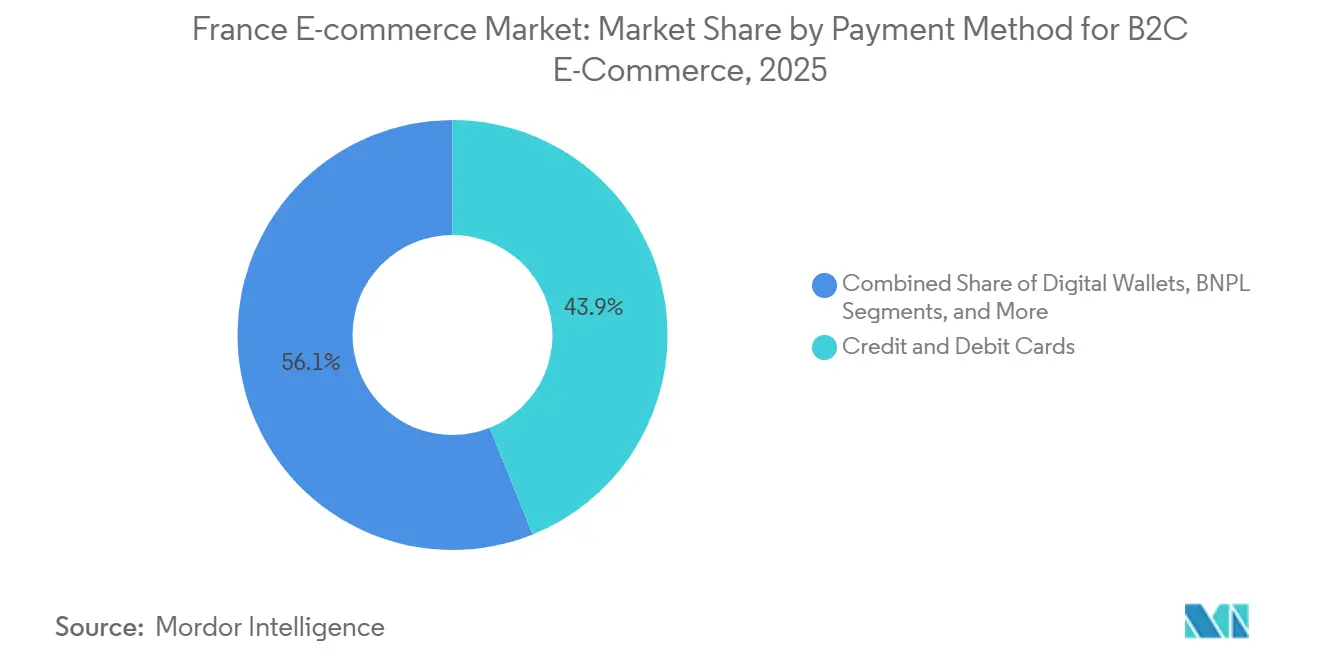
- By payment method, credit and debit cards held a 43.92% share of France Ecom market in 2025, whereas buy now pay later is advancing at a 9.27% CAGR over the same horizon.
- By product category, fashion and apparel accounted for 21.59% of 2025 spending, and food and beverages is positioned for the fastest rise at an 8.16% CAGR through 2031.
Note: Market size and forecast figures in this report are generated using Mordor Intelligence’s proprietary estimation framework, updated with the latest available data and insights as of 2026.
France E-commerce Market Trends and Insights
Drivers Impact Analysis*
| Driver | (~) % Impact on CAGR Forecast | Geographic Relevance | Impact Timeline |
|---|---|---|---|
| Ubiquitous High-Speed Fiber and 5G Coverage Accelerating Online Shopping in Rural France | +1.8% | National, strongest in Brittany, Occitanie, Nouvelle-Aquitaine | Medium term (2-4 years) |
| Government France Num Initiative Driving SME E-commerce Adoption | +1.5% | National, high SME density in Auvergne-Rhône-Alpes and Provence-Alpes-Côte d’Azur | Short term (≤ 2 years) |
| Shift Toward Sustainable Consumption Boosting Second-Hand Online Marketplaces | +1.2% | National, urban focus in Paris, Lyon, Bordeaux | Medium term (2-4 years) |
| Cultural Embrace of Click and Collect Enhancing Omnichannel Penetration | +0.9% | National, especially suburban and peri-urban zones | Short term (≤ 2 years) |
| Growing Popularity of Buy Now Pay Later Among Gen Z and Millennials | +0.7% | National, skewed to Île-de-France and Hauts-de-France | Short term (≤ 2 years) |
| Rise of the Made in France Label Fueling Domestic Platforms Traffic | +0.6% | National, premium positioning in Paris and regional capitals | Long term (≥ 4 years) |
| Source: Mordor Intelligence | |||
Ubiquitous High-Speed Fiber and 5G Coverage Accelerating Online Shopping in Rural France
France’s fixed and mobile networks now deliver urban-grade speeds to 93.5% of households, supporting real-time inventory checks, augmented reality visualization, and seamless checkout in Brittany, Occitanie, and other secondary regions.[1] Furniture and home décor merchants note double-digit mobile traffic growth from these areas, while municipal incentives for remote workers are enlarging the customer base for premium beauty, organic food, and artisanal craft. Retailers that once limited next-day delivery to the Île-de-France corridor now offer same-day delivery to rural communes, effectively extending the footprint of the French e-commerce market.
Government France Num Initiative Driving SME E-commerce Adoption
More than 13,000 small and medium enterprises secured funding and technical coaching under France Num between 2024 and 2025, enabling direct-to-consumer storefronts that bypass traditional distributors.[2] Training on marketplace integration, payment gateways, and digital marketing is lowering the entry barrier for niche producers of cheese, linens, and cosmetics. Large platforms have responded by onboarding these SMEs to enrich local assortments, enhancing differentiation from Amazon’s mass catalogue. The program therefore widens product diversity and deepens regional economic participation in the France e-commerce market.
Shift Toward Sustainable Consumption Boosting Second-Hand Online Marketplaces
Second-hand turnover climbed to EUR 946 million (USD 1.07 billion) in 2024 as 51% of French consumers purchased pre-owned goods online. Platforms such as Vinted count more than 10 million active buyers in France with a rising purchase frequency, signaling habitual recommerce behavior. Upcoming take-back mandates under the Anti-Waste for a Circular Economy law will push brands and department stores to funnel inventory into resale channels, tightening links between primary and secondary markets. Sustainable shopping, therefore, acts as a structural demand catalyst within the France e-commerce market.
Cultural Embrace of Click and Collect Enhancing Omnichannel Penetration
Parcel lockers have become the second-favorite delivery option after home drop-off, driven by dense urban living and work schedules. Retailers such as Carrefour operate thousands of drive-through and locker points, allowing consumers to choose convenient pick-up windows and verify high-value goods on site. Click and collect improves inventory efficiency by turning stores into micro-fulfillment hubs, reducing working capital while boosting same-day coverage across suburban belts. The model strengthens retailer economics and heightens customer control, a dual benefit that reinforces growth prospects for the France e-commerce market.
Restraints Impact Analysis*
| Restraint | (~) % Impact on CAGR Forecast | Geographic Relevance | Impact Timeline |
|---|---|---|---|
| Stringent GDPR/CNIL Compliance | -0.8% | Nationwide, heavier on cross-border sellers and SMEs | Medium term (2-4 years) |
| High Reverse-Logistics Costs in Fashion | -0.6% | National, apparel-centric | Short term (≤ 2 years) |
| Saturation of Urban Last-Mile Networks | -0.4% | Paris, Lyon, Marseille, Toulouse | Short term (≤ 2 years) |
| Intensifying Low-Cost Competition from China | -0.5% | National, fashion, electronics, home goods | Medium term (2-4 years) |
| Source: Mordor Intelligence | |||
Stringent GDPR/CNIL Compliance Increasing Operating Costs
Annual outlays for mid-sized merchants range from EUR 50,000 (USD 60,000) to EUR 200,000 (USD 240,000) to satisfy consent management, breach notification, and data-portability rules, a burden that weighs heavily on SMEs.[3] Limitations on behavioral tracking also reduce the effectiveness of personalization engines, inflating acquisition costs across the France e-commerce market. Cross-border sellers juggling multiple national interpretations of GDPR face still higher compliance complexity.
High Reverse-Logistics Costs Driven by Fashion Returns
Return rates of 30%-40% for online apparel absorb up to 20% of gross merchandise value in reverse logistics expenses, forcing Zara France and H&M to introduce restocking fees. The environmental footprint of these flows undermines sustainability messaging, while fast-fashion inventory cycles leave little time to resell returned items before markdowns. Investments in virtual fitting tools remain limited, keeping margin pressure high within the France e-commerce market.
*Our forecasts treat driver/restraint impacts as directional, not additive. The impact forecasts reflect baseline growth, mix effects, and variable interactions.
Segment Analysis
By Business Model: Enterprise Digitalization Outpaces Retail Growth
B2C transactions generated 81.29% of value in 2025, yet the B2B arm is forecast to compound at 8.41% annually through 2031, eclipsing consumer momentum. B2B buyers in manufacturing and wholesale are embracing cloud procurement suites that automate reordering and provide real-time stock visibility, thus enlarging the France e-commerce market size allocated to enterprise trade.
Vertical B2B marketplaces for construction supplies, industrial parts and food-service inputs aggregate fragmented vendors, standardize product data and offer trade finance. Meanwhile, B2C growth continues on the strength of mobile adoption and omnichannel extensions such as buy-online-pick-up-in-store. Social commerce campaigns on TikTok and Instagram are funneling incremental traffic that sustains consumer revenue streams within the France e-commerce market.
By Device Type for B2C E-Commerce: Mobile Takes Command of Shopping Journeys
Smartphones and tablets owned 78.67% of transaction share in 2025 and will extend dominance at an 8.24% CAGR, reflecting near-universal 4G-5G coverage and seamless wallet checkout. Gen Z and millennials complete more than half their purchases directly in branded apps, pushing retailers to release progressive web apps that operate under low-bandwidth conditions.
Desktop sessions persist for big-ticket items like appliances and furniture, where specification review benefits from larger screens, yet even those categories log rising mobile conversion rates. Responsive interfaces now deliver barcode scanning, voice search, and augmented reality previews across devices, enabling parity of functionality and reinforcing consumer loyalty to the broader France e-commerce market.
By Payment Method for B2C E-Commerce: Installment Credit Moves into the Mainstream
Cards still accounted for 43.92% of 2025 outlays, but buy now pay later is scaling at a 9.27% CAGR as Klarna, Alma, and PayPal embed interest-free installments at checkout. Klarna data show 40% overall consumer usage and 57% penetration among Gen Z, while average order values increase up to 30% when merchants display BNPL options.
Digital wallets such as Apple Pay and domestic Paylib also gain share by streamlining biometric authentication on mobile. Strong customer authentication rules under PSD2 have lifted trust levels, further enlarging qualified audiences for online payments across the France e-commerce market.

By Product Category for B2C E-Commerce: Grocery Surges as Fashion Matures
Fashion retained the top revenue slot at 21.59% in 2025, supported by high shopping frequency, yet margins tightened due to elevated return rates and discount pressure from Shein and Temu. Leading French retailers counter with curated collections, local design collaborations, and sustainable sourcing seals, strategies that resonate with urban professionals.
Food and beverages, aided by dark stores and micro-fulfillment, are projected to expand at an 8.16% CAGR to 2031, the fastest among categories. Carrefour and Auchan exploit store proximity to guarantee two-hour delivery windows, reinforcing subscription loyalty and driving per-basket value. Electronics, beauty and home improvement round out mid-tier positions, each displaying unique churn and profitability profiles that together sustain the France e-commerce market size momentum.
Geography Analysis
France ranks second in European online turnover, trailing only the United Kingdom, with sales climbing from EUR 175.3 billion (USD 208.72 billion) in 2024 to an estimated EUR 190 billion (USD 226.22 billion) in 2025. Île-de-France alone captures about 30% of the spend due to income concentration and logistics density. Auvergne-Rhône-Alpes and Provence-Alpes-Côte d’Azur follow, yet fiber expansion is shrinking historic divides and bringing Brittany, Nouvelle-Aquitaine, and Corsica into the e-commerce mainstream.
Cross-border flows remain fluid thanks to sub-two-day average transit into Belgium and the Netherlands, allowing mid-size merchants to scale regionally without building warehouses abroad. GDPR compliance raises cost hurdles, but it also undergirds high consumer trust levels that differentiate European sellers from less regulated global rivals, strengthening intrinsic demand within the France e-commerce market.
Pan-European giants such as Amazon and Zalando operate multi-node fulfillment architectures inside France, offering next-day delivery that sets the service benchmark. Domestic specialists answer by deepening vertical expertise and promoting Made in France provenance, a narrative that resonates with eco-conscious shoppers and cushions local platforms against low-cost import competition. Altogether, these dynamics generate robust yet regionally balanced growth trajectories.
Regulatory Landscape
France e-commerce operates under an EU-to-national compliance stack spanning consumer protection, content governance, and data privacy. Under the EU Digital Services Act (DSA), France designated Arcom as the national Digital Services Coordinator, with DGCCRF and CNIL also acting as competent authorities, which lifts expectations for marketplaces and online retailers on illegal-content handling, transparency, and user reporting pathways.
Consumer-facing obligations tightened in 2026 with the rollout of the "retraction in 1 click" requirement, effective June 19, 2026 (via a January 5, 2026 ordinance). This compels professional online sellers to provide an easily accessible withdrawal function directly in the interface. On tax and B2B process compliance, the Direction Generale des Finances Publiques (DGFiP) is steering the mandatory e-invoicing reform, including a requirement for businesses to be able to receive electronic invoices from September 1, 2026, which pushes merchants and enterprise sellers toward compliant e-invoicing and archiving workflows.
Value Chain Analysis
France e-commerce value creation starts with brand owners, manufacturers, and a long tail of SMEs moving assortment online (including via support programs such as France Num). From there, value flows through storefront and marketplace layers, payment providers (cards, wallets, and BNPL specialists), and order management and marketing stacks that increasingly prioritize mobile-first journeys. Demand capture is concentrated in large marketplaces and omnichannel retailers, while recommerce platforms (for example, apparel resale) add a secondary supply loop that extends product life and raises the need for authentication, grading, and reverse flows.
Fulfillment and returns are the main cost and service levers across the chain, covering cross-dock hubs, parcel networks, lockers, and click-and-collect points, alongside high-touch reverse logistics, particularly for fashion. Public policy is also shaping logistics modernization: the September 2025 introduction of the Enveloppe Logistique Obligatoire (ELO) for vehicles entering via RoRo ports or Eurotunnel (linked to ICS2) adds a structured data layer at the border, and in March 2026 the 5th Comite interministeriel de la logistique (CILOG) issued an orientation document on logistics digitalization to improve competitiveness. On private capacity and network depth, Amazon outlined a EUR 15 billion investment plan in France for 2026-2028 and, in June 2026, announced three new logistics sites in Pays de la Loire, Ile-de-France, and Nouvelle-Aquitaine, reinforcing how fulfillment scale supports delivery-time competition.
Competitive Landscape
The top five merchants, Amazon, Cdiscount, FNAC Darty, Carrefour, and eBay, collectively hold an estimated 45-50% revenue share, leaving room for vertical innovators and regional champions. Amazon leverages six national fulfillment centers and a large Prime subscriber base to achieve scale economies, but homegrown platforms retain category depth and brand loyalty in books, DIY, beauty, and grocery.
Price pressure from Temu and Shein is intense in fashion and home goods, though their low sustainability scores of 10-16% versus Decathlon’s 79% expose reputational vulnerabilities. Retailers, therefore, emphasize environmental credentials, transparency of origin, and predictable delivery to safeguard margins. Artificial intelligence underpins assortment curation, demand forecasting, and hyper-personalized journeys, with L’Oréal partnering with NVIDIA to deliver AI-powered virtual try-ons that lift conversion rates.
Omnichannel investments continue, as FNAC Darty fuses store inventory with online promises, and Carrefour scales its parcel locker networks. Emerging peer-to-peer models, such as Vinted in apparel and Leboncoin in classifieds, chip away at conventional retail's share by removing intermediation costs. The blended outcome is a moderately concentrated yet vigorously innovative France e-commerce market.
France E-commerce Industry Leaders
-
Zalando SE
-
H & M Hennes & Mauritz GBC AB
-
La Redoute SAS
-
ZARA France
-
Showroomprivé SA
- *Disclaimer: Major Players sorted in no particular order
Market Opportunities and Future Outlook
Compliance-driven product and process upgrades create near-term whitespace for enabling tools and service providers in France e-commerce. The June 2026 "retraction in 1 click" requirement forces merchants to redesign self-service customer journeys, contract management, and after-sales workflows directly within the website or app interface. The September 2026 e-invoicing reform under DGFiP also broadens demand for compliant invoicing connectivity, document management, and integration services across digitally active enterprises, which matters for SMEs coming online via France Num, where standardized onboarding to payments, invoicing, and customer service can reduce operational friction and improve marketplace readiness.
Channel diversification and new acquisition mechanics are also reshaping how merchants scale. In July 2026, Castorama launched its first store on Amazon France, showing how large, established French retailers are using marketplaces to extend online reach and flex fulfillment rather than treating them only as competitors. Traffic and acquisition performance is being reframed as well: Valiuz reported in July 2026 that generative AI-driven traffic to French e-commerce sites increased 20x between May 2025 and May 2026, with higher conversion than traditional channels in its dataset. That kind of measured lift supports investment in AI-ready catalogs, richer product data, and conversational shopping experiences alongside conventional search and paid media.
Recent Industry Developments
- July 2026: Castorama launched its first store on Amazon France, marking a notable shift by a major French DIY retailer toward marketplace-led reach expansion. The move broadens assortment exposure inside a high-traffic platform while testing a hybrid model that combines brand control with third-party demand capture, and it was paired with a partnership with Storfund focused on marketplace financial solutions.
- May 2026: Zalando partnered with Vestiaire Collective to integrate authenticated pre-owned luxury fashion into Zalando's platform. The tie-up strengthens recommerce depth and trust signals for higher-value categories, while giving Zalando a more differentiated second-hand proposition that aligns with growing sustainable shopping behavior in France.
- October 2024: Damart outlined plans to lift international e-tail revenue to 50% within a year by expanding on Zalando and upgrading cross-border delivery to four days. The initiative highlights how French apparel sellers are using pan-European marketplaces and logistics improvements to access demand beyond the domestic market while tightening service levels for cross-border buyers.
Research Methodology Framework and Report Scope
Market Definition and Coverage
For this study, the France e-commerce market covers the value of products and services that are ordered online in France, where a digital channel is used to place the order and complete the purchase journey.
Scope exclusions: Informal peer to peer transactions that are not captured in tracked online commerce reporting and purely offline orders (even if later paid online) are excluded.
Segmentation Overview
- By Business Model
- B2B
- B2C
- By Device Type for B2C E-commerce
- Smartphone and Mobile
- Desktop and Laptop
- Other Device Types
- By Payment Method for B2C E-commerce
- Credit and Debit Cards
- Digital Wallets
- Buy Now Pay Later
- Other Payment Methods
- By Product Category for B2C E-commerce
- Beauty and Personal Care
- Hair Care
- Skin Care
- Cosmetics and Beauty
- Other Beauty and Personal Care Product Categories
- Consumer Electronics
- Mobile
- PC and Laptops
- Audio Devices
- Gaming Devices
- Other Consumer Electronics Product Categories
- Fashion and Apparel
- Clothing
- Footwear
- Fashion Accessories
- Other Fashion and Apparel Product Categories
- Food and Beverages
- Packaged Food
- Bakery and Confectionery
- Meat, Poultry, and Seafood
- Other Food and Beverages Product Categories
- Furniture and Home
- Home Furniture
- Office Furniture
- Outdoor Furniture
- Other Furniture and Home Product Categories
- Other Product Categories
- Beauty and Personal Care
Data Sources, Market Sizing, and Validation
Desk Research
Desk research is used to anchor the model with publicly visible demand and enabling indicators, before assumptions are added. We pull context from sources such as INSEE releases on household consumption, Banque de France macro series, and Eurostat price and spending indicators that influence online basket values.
To tighten the market reality checks, we also use sources such as Fevad publications on online sales and transaction trends, customs and cross border trade context where relevant, and peer reviewed papers that discuss digital commerce adoption and payment behavior. Company filings, investor presentations, and reputed press help validate category mix shifts and promotional intensity. Select paid subscriptions for company financials and news, plus import or export shipment level datasets where applicable, are used only to fill gaps and check directional consistency. These are illustrative examples, and many other sources were also referred to for data collection, validation, and clarification.
Primary Interviews and Surveys
Primary interviews are used to test what desk research signals cannot confirm, especially category growth, price movement, and channel behavior across France. We speak with online retailers, marketplaces, logistics and delivery stakeholders, payment and fraud specialists, and category focused operators, then re-check assumptions across major demand pockets and cross border flows to avoid single source bias.
Distribution of primary research fieldwork respondents
| Company type | Respondent position |
|---|---|
| Top tier: 27% | CXOs: 14% |
| Mid tier: 53% | Functional/Unit leaders: 29% |
| Smaller Players: 20% | Managers: 57% |
Market-Sizing & Forecasting
Market size is constructed using a top-down approach where national online commerce totals are rebuilt from reported online sales and transaction signals, then filtered into a consistent definition for this market. To keep the model realistic, results are corroborated with selective bottom-up approximations such as sampled category sales run rates, order volumes multiplied by typical average order value, and channel checks on marketplace versus direct webstore contribution.
Key inputs that shape the numbers include online sales growth rates, transaction volumes, average basket value, the split between goods and services, the pace of mobile commerce adoption, and fulfillment cost pressure that can change pricing and conversion. When the build up creates gaps by category or business model, those gaps are bridged using conservative penetration assumptions validated in interviews, and then stress tested against public trend lines.
Forecasts are produced using scenario analysis supported by simple regression relationships between online sales, transaction growth, and consumer spending indicators, then adjusted for expected inflation and category mix changes. Because the market can swing during major promotional periods, we also check that implied quarterly seasonality does not create unrealistic annual jumps before finalizing the outlook.
Data Validation & Update Cycle
Validation is done through multiple checks to ensure the final totals fit real world signals, not just a single spreadsheet build. We compare the model output against independent indicators such as reported online turnover, transaction count trends, and the goods versus services mix, then investigate differences before sign-off.
Anomalies are flagged when implied basket values, growth rates, or category contributions move outside reasonable ranges, and the assumptions are reviewed again with fresh desk checks and follow up calls when needed. Reports are refreshed annually, with interim updates when material events shift demand, pricing, or regulation. Before delivery, a final review pass is completed so clients receive the latest updated view.
Mordor Intelligence's France Ecommerce Market Estimate Compared With Other Published Estimates
Published market sizes for France e-commerce do not always match because groups track different transaction types and they also use different year bases and currency timing. The spread usually comes from what is counted as e-commerce, how returns and cancellations are handled, and whether services and professional purchases are included.
A common gap driver is scope. Some sources lean on online turnover style reporting that may include shipping fees and may exclude cancellations and returns, while others focus more on retail goods GMV only. Differences also show up when one estimate is reported in euros for a specific year and another is converted to USD using a different average exchange rate, which can shift the headline number even if the underlying sales trend is similar. Refresh cadence matters too, since fast changing online promotions and category mix shifts can make older assumptions stale within a year.
Benchmark comparison
| Source | Market Size | Gaps in Research Methodology |
|---|---|---|
| Mordor Intelligence | USD 88.77 B (2025) | |
| Industry Association A | USD 191.30 B (2024) | Often reported as online turnover in euros with shipping fees included and cancellations or returns excluded, and the headline can shift materially when converted to USD using a different exchange rate timing. |
| Trade Journal B | USD 164.90 B (2024) | May emphasize total e-commerce GMV growth rates and broader digital commerce categories, with less clarity on how services versus goods and B2B versus B2C are treated year to year. |
The table shows that scope and currency timing explain most of the difference, especially when 2024 euro reported turnover is compared against a 2025 USD base year. When goods, services, and business purchases are kept consistent and assumptions are rechecked against transaction and basket signals, the estimate stays easier to reproduce, which is the approach applied here by Mordor Intelligence.
Key Questions Answered in the Report
What is the projected value of the France e-commerce market in 2031?
It is forecast to reach USD 142.83 billion by 2031, reflecting a 7.89% CAGR over 2026-2031.
How fast is business-to-business e-commerce expected to grow in France?
B2B transactions are projected to expand at 8.41% annually through 2031, outpacing consumer growth.
Which payment method is growing quickest among French online shoppers?
Buy now pay later leads with a 9.27% CAGR to 2031, driven by high adoption among Gen Z and millennials.
Why are second-hand platforms gaining popularity in France?
Rising sustainability concerns and supportive regulation have pushed recommerce sales past USD 1 billion, with over half the population buying pre-owned goods online.
Which product category is set to grow fastest through 2031?
Online food and beverage sales are forecast to rise at an 8.16% CAGR as grocers scale dark stores and micro-fulfillment centers.
How concentrated is competitive power in French e-commerce?
The top five merchants control roughly half of revenue, indicating moderate concentration with vibrant niche competition.